



Former jihadist testifies
Former jihadist Mubinoddin Shaikh says antisemitism is the connective tissue across extremist ideologies.
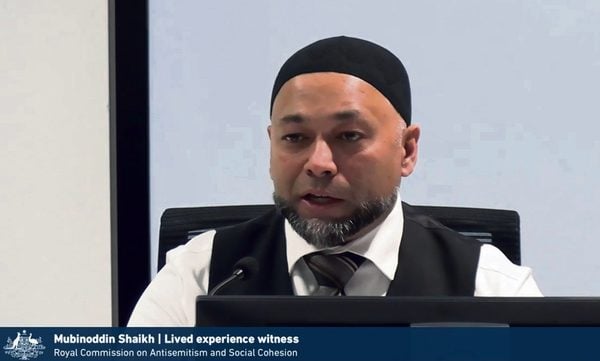
Seventy per cent of cases handled by a leading US counter-extremism organisation show some form of antisemitic influence, the Royal Commission on Antisemitism and Social Cohesion has heard, with a former jihadist turned interventionist describing antisemitism as the “connective tissue across extremist ideologies”.
Parents for Peace interventionist Mubinoddin Shaikh, who was radicalised as a teenager in Toronto and later spent years working undercover with Canadian intelligence infiltrating jihadist cells, told the commission the organisation had recently established a dedicated antisemitism and intervention recovery program in response to the volume of cases in which antisemitic beliefs featured.
Shaikh said antisemitism was front and centre in cases involving neo-Nazis, while in others it appeared alongside a broader set of hateful ideas. Parents for Peace, which recently received funding from the US Department of Homeland Security, operates a helpline and takes referrals from families, teachers, lawyers and the FBI across both the “pre-criminal” and “post-criminal” space.
Interventions are tailored to individual needs, drawing on motivational interviewing, psychoeducation and peer support. Shaikh works alongside a former neo-Nazi and trained social workers and psychologists, and said his own history as a “former” – the term used for individuals once part of violent extremist movements – was central to building trust with clients.
“I basically explained to him that I used to be that, and I know how they work and how they operate, and I’m here because I wish that I had somebody to talk to when I was your age,” he said, recounting a case in which a young man initially refused to engage.
comments