Fuhrer furore
CHANTAL ABITBOL AND DALIA SABLE
WHEN it comes to evoking the spirit of Nazi leader Adolf Hitler to ridicule a foe or highlight a cause, be forewarned -— judging by public sentiment these days, it is likely to backfire.
Unfortunately for Thomas Tudehope, an up-and-coming media strategist who worked as Opposition Leader Malcolm Turnbull’s chief online coordinator, it’s a lesson he had to learn the hard way.
This month, the 26-year-old was forced to resign after a string of emails appeared that link him to a spoof YouTube video portraying Liberal backbencher Alex Hawke as Hitler.
Earlier this year, US comedian Roseanne Barr also ignited a storm of controversy when she was photographed dressed as the Nazi leader and serving what she called “Jew cookies” in a send-up on the front cover of a Jewish magazine.
But it is not just Hitler spoofs that are sparking public outcry. Even a mere reference to the dictator can cause a furore.
The week after Tudehope bowed out due to pressure, Western Australian Liberal backbencher Peter Abetz also came under fire for citing Hitler when talking about stop-and-search laws in the state.
Certainly, the aim of invoking Hitler is to shock, but all too often the message seems to miss the mark. Should invoking Hitler and his crimes as a metaphor always be considered taboo and off limits?
Robert Goot, president of the Executive Council of Australian Jewry, thinks so.
“The Holocaust is generally recognised as the benchmark of the most extreme case of human evil, and Hitler as its architect. Whenever and however these matters are trivialised or where false analogies are made, others are deeply offended as they should be,” he told The AJN this week.
Such acts, he added, “seriously undermine and diminish” the lessons of the Holocaust.
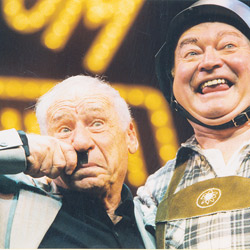
Dr George Foster, president of the Australian Association of Jewish Holocaust Survivors and Descendants, recognises that there have been a number of satirical films -— such as Mel Brooks’ The Producers and Charlie Chaplin’s The Great Dictator —- that have successfully mocked Hitler while making “valid points”. Holocaust humour, he said, will not be offensive “in all instances”.
But there is a fine line and, generally speaking, it must be tread with caution. With regards to the recent spoof YouTube video, he believes it is another example where the line was crossed.
“It’s actually not okay to refer to someone by the name of any dictator, particularly one who perpetrated mass murder. There are other means to describe people as wicked, psychopathic or evil without specific reference to particular dictators, especially the Nazis,” he said. “Such references are certainly off limits.”
Turnbull’s office maintains that Tudehope had no involvement in the production or dissemination of the video, and that his resignation was the result of his involvement in factional activities within the Liberal Party.
B’nai B’rith Anti-Defamation Commission executive director Deborah Stone said it was understandable Turnbull would be concerned about a video that compared a party faction to the downfall of Hitler.
Even so, she said the video was clearly meant to be humorous and should be seen as such.
“I don’t think we should regard it as having anything at all to say about Hitler or Nazis,” she said.
But when it comes to making comparisons to the Nazi regime in political discussions — such as in Abetz’s case — she believes it’s more complex.
“Abetz was making a serious but extreme point. I don’t think we need to get terribly upset about that, but I do think we need to be careful about the language we use. It’s important we distinguish clearly between oppressive fascist regimes like the Nazis, and the sort of conflict that occurs in Australian politics.”
Of course, there have been many evil leaders throughout history, but no other tyrants are subject to the same taboo. Linguistics graduate Nechama Zwier said that Hitler’s name has been removed from its original association — as his moniker — and instead has become a symbol of the atrocities he instigated.
“As far as dictators, Napoleon or Genghis Khan could rival Hitler, but as far as concentrated anti-Semitism, it’s likely that Hitler’s name is highly associated with anti-Semitism and may be synonymous with [it] in a symbolic way,” she explained.
“It’s really only other Jews, academics and compassionate people who would make that association so greatly that they would think to pass it on,” Zwier added.
Bernard Korbman, executive director of the Jewish Holocaust Centre, said he doesn’t believe Jews are overly sensitive when it comes to protesting the misuse of Hitler’s name and image.
“Jews have every right to cry foul,” he said. “The name Hitler for us in the Jewish community is not just any throwaway adjective. It’s a reopening of wounds, which in the best of times would take a few generations to heal. It’s important to remember that we still have living among us those who suffered their fate of being Jews during the Nazi era and are still suffering 65 years later.”
Looking ahead, B’nai B’rith’s Courage to Care chairman, Andrew Havas, said he doesn’t believe this view will change much in the years to come. “References or spoofs of Hitler must not become less of a taboo. Hitler was the greatest master of extermination in world history, and this must never be forgotten.”