NSW Jewish Board of Deputies CEO Michele Goldman told the Royal Commission on Tuesday afternoon about a number of incidents her organisation has been called in to deal with.
She described one incident involving a 13-year-old boy at a regional public high school who experienced “sustained and escalating antisemitic bullying” from fellow students who used phrases about Hitler and performed Nazi salutes.
“He felt incredibly unsafe, and his parents pulled him out of the school, and that is when they contacted us,” Goldman said.
She said the response of the school was inadequate, and after escalating the matter to the Department of Education, the boy was ultimately home-schooled while his parents worked out whether to move so he could attend a different public school.
In another incident at a Sydney primary school, a year five student was subjected to severe antisemitic bullying.
“He was physically pinned to the ground and punched numerous times. He was shown a photograph of Adolf Hitler, and was told that ‘He’s my idol. Watch your back if you snitch.’ And he was told that this other boy’s greatest regret was that World War Two had ended,” Goldman said.
The other boy was also 10 years old.
Despite the school committing to implementing teacher training, taking students on an excursion to the Sydney Jewish Museum, and utilising educational resources, when the student returned to school at the beginning of semester three, “the same bullying behaviours were repeated”.
“After a few days, the mother pulled him out of school, home-schooled him for a semester, whilst she then worked out another school that he could attend,” Goldman said.
“I think this example shows that when things aren’t addressed swiftly and effectively, these problems continue to perpetuate, and nothing is done to change the conditions.”
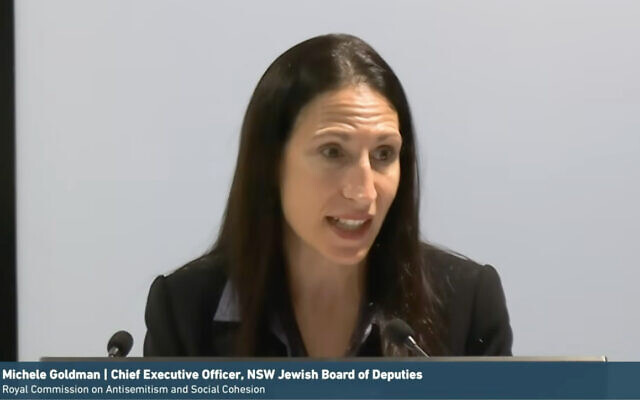
Michele Goldman at the Royal Commission. Photo: Screenshot/YouTube
Goldman also described an incident in early 2025 where a GP allegedly told a patient during a consultation, “you, your family and your Prime Minister are terrorists,” and accused her of being personally responsible for the deaths of others.
The consultation had begun with the GP requesting the children’s vaccination records, which showed their most recent vaccination had taken place in Israel. The patient’s husband was an Israeli national.
“The fact that this occurred in a health setting, which made the woman especially vulnerable because the GP had access to personal sensitive information, including her address where she lived, she left feeling very fearful and very vulnerable,” Goldman said.
Goldman said the JBD was the woman’s first point of call because “people feel extremely fearful. They don’t know where to reach out and to turn to because there’s growing distrust in a whole range of institutions that should be there to protect our standards and our civil liberties, but which have failed people.”
She said a definition of antisemitism would help institutions assess and address complaints.
She said education and training was also critical, as “sometimes it’s [antisemitism] employed inadvertently”.
“People may not appreciate, especially children in a school setting may not appreciate – they’re just trying to curry favour with their friends or making a joke, and they don’t appreciate the level of severity of what their words or their actions or the impacts that it can have on others.”
Asked about interfaith relations since October 7, 2023, Goldman said the JBD was in the process of developing an alumni program for its multicultural “We Are All Sydney” initiative and had reached out to about 100 participants.
“There were some people who were warm and embraced the opportunity to come together and really valued being part of the socially cohesive network,” she said. “There were other members who went silent and for which there was no response. And I understand from past employees that relationships that had existed for many, many years went cold.”
NSW Jewish Board of Deputies (JBD) CEO Michele Goldman has told the Royal Commission about being personally targeted after appearing at a NSW Parliamentary Inquiry into antisemitism.
Goldman appeared before the inquiry in May 2025.
“Someone had taken a video excerpt of my of my testimony at that hearing, and had circulated it on Twitter with some very vile antisemitic comments,” she said. “It was frightening and intimidating. I’d never personally been the brunt of an attack like that before.
“I reflected that this gave me a small inkling of what the many Jewish people who had been doxxed had felt like themselves, and it clearly was designed to intimidate, to instil fear and to silence, but I was adamant that I wasn’t going to let that happen.”
Leadership and staff at the JBD have been subject to heightened threats and security concerns, according to Goldman’s written statement.
“I think especially with the summer of terror, it really raised the level of fear amongst the community. So I certainly employed additional security precautions in my own home, and I was shaken that amongst the incidents was an attempted attack on the former home of one of our communal leaders,” she said, referring to the firebombing of Executive Council of Australian Jewry co-CEO Alex Ryvchin’s former home.
“Having to do so much more media myself during this time, I worried about becoming a known entity for our organisation as well,” Goldman continued. “We’ve had to significantly increase our security protocols. Threat assessments become part of anything we’re planning. We can only identify the venue of where we’re holding events in the day prior to the event actually occurring.
“So I think it’s become a huge part of our procedures, and it’s placed a significant emotional and psychological burden on our staff.”
In terms of the JBD’s work, she said it had gone from proactive initiatives to build inclusion and cohesion before October 7, 2023, to reacting to the latest incidents of antisemitism.
“I was no longer in charge of what my day was going to look like. You woke up and you were responding to whatever the urgent needs of the community were at the time,” Goldman said.
“Whether it was responding to incidents, whether it was handling media inquiries, whether it was dealing with police and political leaders, we just needed to respond to that.
“And since Bondi, we’ve now had to ramp up again to deal with the widespread trauma that the community is facing.”
The CEO of the NSW Jewish Board of Deputies (JBD) has told the Royal Commission how the 2024-25 “Summer of Terror” took antisemitism to another level.
Michele Goldman said that even before incidents began to ramp up in late 2024, the JBD had been contacted “by members across the community” in relation to incidents in schools, on university campuses, in workplaces, and online.
“We saw the intensity of antisemitism growing in all spaces,” she said. “The summer of terror took it to another level. We saw then where, you know, hateful speech and graffiti and symbols was now being elevated to acts of violence.
“There was no discerning pattern to the events playing out, so we didn’t know where the next attack would come from.”
Michele Goldman at the Royal Commission. Photo: Screenshot/YouTube
Goldman described the aftermath of October 7, 2023, as “something that was worse than any nightmares we could have previously conceived”.
“It felt like the ground was shifting beneath us, because Australia had always been such a tolerant, inclusive space for Jewish people to live our lives,” she said.
“So it was huge dissonance to have had for many decades this welcoming, inclusive country, to be a proud member of Australian society, and then all of a sudden, to be the brunt of hate and vitriol to such an extent that people were fearful, or we were fearful, for our own safety.”
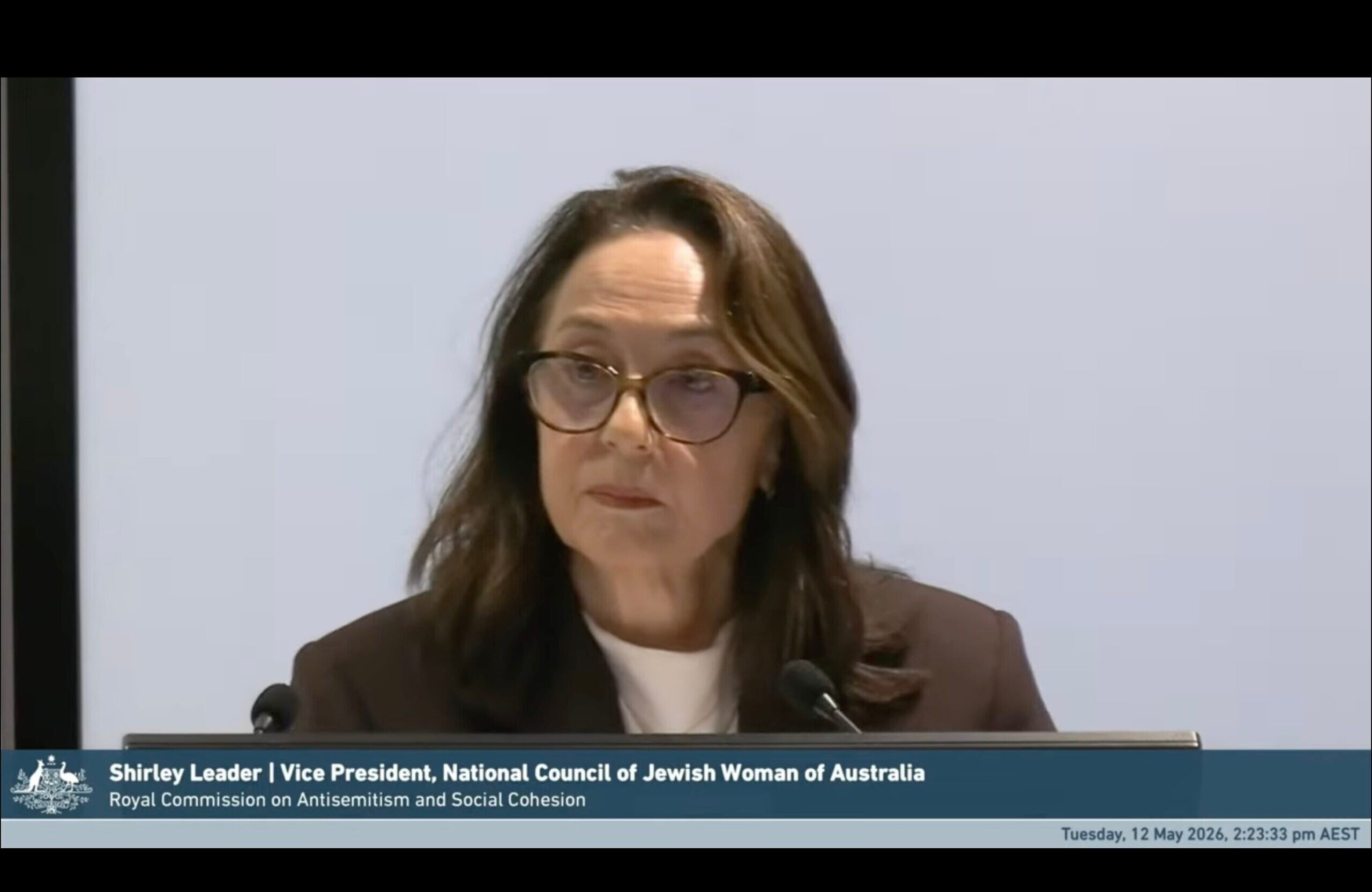
It was the simplest line of Shirley Leader’s testimony to the Royal Commission on Antisemitism and Social Cohesion, and the one that lingered.
Shirley Leader, Vice President of the Councillor Jewish Women, giving evidence at the Royal Commission, Photo: Screenshot
Speaking on behalf of the National Council of Jewish Women of Australia, the NCJWA Vice President and chair of its Resources Committee told the Commission that Jewish Australian women have been worn down by the attacks, and the hyper-vigilance now required just to navigate ordinary life.
“We also know that our detractors are actually counting on that exhaustion and are hoping that we will pack up our bags and leave,” Ms Leader said.
“But this is existential for us. This is about our ability to live our lives openly as Jewish women in Australia with the same rights as all other women, and so we will continue.”
Ms Leader’s evidence centred on a national survey the NCJWA conducted across two phases — the first running from July to August 2025, and the second opened on Christmas Eve, ten days after the Bondi attack of 14 December.
Administered via SurveyMonkey and circulated through the Council’s newsletter, social media and Jewish community WhatsApp groups, the combined survey drew 668 anonymous responses, with IP address checks used to confirm authenticity.
The findings were stark. Eighty-one per cent of respondents reported that they or an immediate family member had experienced antisemitism in the previous two years – Ms Leader described the timeframe as “a proxy for since the seventh of October 2023.”
More than half said they felt unsafe. Two in five were actively hiding their Jewish identity to protect themselves and their families.
One in five women reported actual physical violence or verbal abuse.
Ms Leader read selected open-ended responses into the record. They came from women across the country: third, fourth and fifth-generation Australians sitting alongside descendants of refugees from Germany, Poland, Iraq, Tunisia, Egypt, Yemen, Libya, Hungary and the former Soviet Union.
Fifty-eight per cent were survivors or descendants of survivors of the Holocaust or the ethnic cleansing of Jews from the Middle East and North Africa.
“My friend was punched in the face simply for discussing Judaism in public,” one woman reported.
Another described her child being “spat at, punched in the chest, held down, choked and shouted at” at high school.
A third told of a driver who “deliberately accelerated as my family was on the crosswalk, hurled antisemitic slurs at us and deliberately aimed his car at our granddaughter in a pram.”
A woman wrote of the synagogue “built by my grandfather, post-Holocaust” being burnt down.
Another, recovering in hospital from open-heart surgery, was emailed by a neighbour to be told that someone had daubed a swastika on her fence post.
A nurse at a Brisbane hospital, one respondent said, yelled that she “didn’t deserve care.”
Workplaces, daycares, universities, schools and homes were all named as sites of abuse.
Mezuzot were being removed from front doors.
One woman had her groceries delivered away from her home for fear delivery drivers would identify her as Jewish.
Ms Leader was clear that the antisemitism documented in the survey had specifically gendered dimensions in both its expression and its impact.
She pointed to the denial and ridicule of the sexual violence inflicted on Israeli women on October 7, and to where much of that denial was coming from.
“Jewish women have reported to us that they find this particularly harmful because another denial that they have seen has actually come from the women’s sector – so-called feminists in Australia, who have sought not only to keep silent about the sexual assault of Israeli women, but have sought to deny it and even to mock it.”
She read into the record a statement made by a self-described progressive woman, whom she did not name, describing the conflict-related sexual violence against Israeli women as “used by white power to discredit, demonise, diabolize and destroy black and brown men to deflect sympathy from those resisting oppression to the actual oppressors.”
The dissonance, Ms Leader told the Commission, “between the attacks on us and the dignified women that we know” was profound.
“There is no Jewish woman who sees herself as someone seeking to demonise, destroy, discredit anybody else.”
Asked what the survey would now drive, Ms Leader called for the cessation of government funding to “individuals, organisations, purveyors of hate,” and for stronger protections for Jewish women through the offices of the E-Safety Commissioner and state-based Women’s Safety Commissioners.
She also affirmed that Zionism was constitutive of the NCJWA’s identity, noting that for the women the Council represents Israel was “central to Jewish identity” – be it in ancestral, historical, spiritual or familial terms.
“We will continue to represent the women who have shared their lived experiences with us,” she told the Commission, “and to amplify their voices in the hope that someone will listen.”
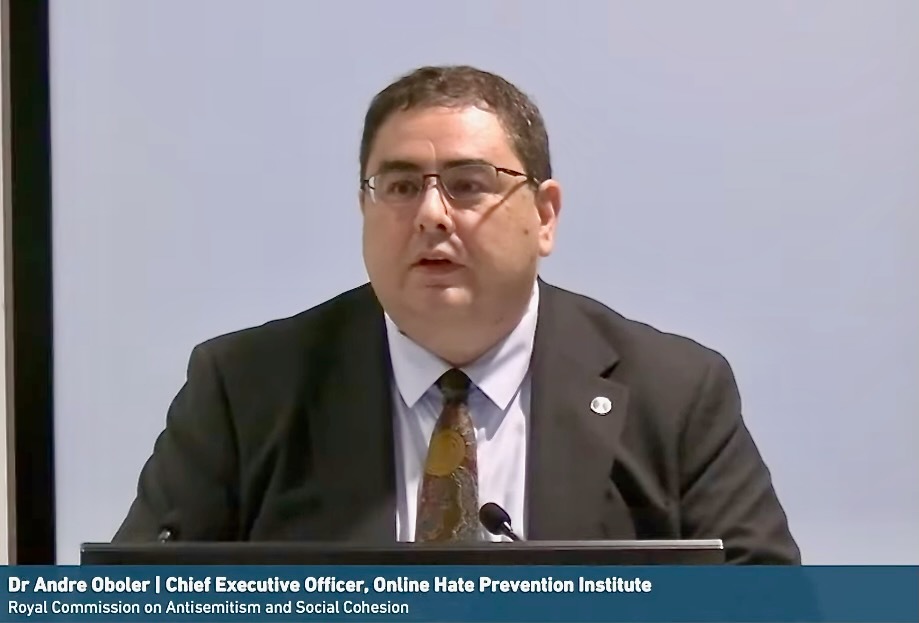
Dr Andre Oboler, CEO of the Online Hate Prevention Institute (OHPI), gave analytical evidence on Day 7 of the Royal Commission, that shed light on the spike in antisemitism – particularly in incidents of incitement – identified by the Institute’s extensive monitoring, research and analysis of data it has collected since late 2022, across 10 major social media platforms.
He emphasised how the research study was exclusively done by trained human analysts, rather than based on algorithms or automated responses.
Dr Oboler noted that from November 2023, the data showed approximately a fivefold increase in antisemitic content across all platforms, and “The pattern was consistent across every platform examined”.
The Institute’s research was grouped under four main types, each grounded in the International Holocaust Remembrance Alliance’s (IHRA) working definitions of antisemitism. The categories were: Holocaust-related content covering denial, distortion, and minimisation; Incitement, capturing content that glorifies or calls for violence against Jews; Traditional antisemitism; and ‘new antisemitism’ – which captures any content that refers to Israel, Israelis, or Zionists in ways that clearly cross into antisemitism.
Notably, he explained, the Institute’s data showed that the vast majority of ‘new antisemistism’ is, in substance, traditional antisemitism in coded language: for example, “Jews control the banks” rephrased as “Zionists control the banks.”
Dr Oboler expressed particular concern about the category of incitement, noting it had been rising again since September 2025, after an earlier post-October 7 peak, and that it represents “the most direct safety risk” to the Jewish community.
When directed to address the claim that antizionism is categorically distinct from antisemitism, Dr Oboler said “context counts”, and offered an example that calling for people to “be antizionist and go and kill the Jews” is plainly antisemitic.
What concerns him most is that the antizionist framing has been taken to its “nth degree” by some – using it as a licence for behaviour “with no limits”, on the premise that opposition to Zionism justifies any action.
He also revealed that the Institute’s ‘Public Squares’ project – another research study – examined every comment posted on 13 high-profile Australian government and social media posts, and found that 13.4 per cent of all comments were antisemitic, with some individual posts exceeding 40 per cent.
The dominant narrative found in that study was the conspiracy trope that Jews control the government.
Dr Oboler emphasised that the data reveals two things simultaneously: what members of the public are actually doing, and what the platforms are or are not doing in response.
Sharp drops in measured antisemitism on a given platform can indicate that a policy switch has been flipped and content is being removed, he said.
And conversely, rising figures may indicate platform inaction or permissiveness.
Dr Oboler will be called upon to give further evidence in another hearings block.
Markus quoted a 2025 Pew survey of “unfavourable” views towards Israel, taken in 24 countries, which shows that in the Anglosphere, among nations Australians often compare themselves with, Australia experienced the highest level of four countries, significantly higher levels of “unfavourable” views than in the US, Canada and the UK.
Australia’s figure of 74 per cent holding unfavourable views of Israel was significantly worse than the US at 53 per cent, Canada at 60 per cent, and the UK at 61 per cent.
But he said, “I think it has something to do with the question that they asked — favourable, unfavourable. Doesn’t have much nuance in it or substance in it, but the value of it is that they asked the same question in 24 countries.
“And the big finding there, I think, is that Australia is in the top group of countries with unfavourable views.
“So I think for me, the way I interpret that is the value is the ranking of the countries and where Australia is ranked, rather than the general question that they ask … I see it as a challenge, and I see that as something to be thought through.”
Markus said one explanation of Australia’s significantly worse ranking might be “understanding the landscape in Australia, it fits here”.
He attributed it to the way Australians perceive Israeli actions in the context of “the settler colonial narrative … but that’s just my interpretation, has a particular purchase in Australia … given the salience of Indigenous issues in this country … I don’t know, but that could be one possible explanation”.
Asked by Zelie Heger, SC, counsel assisting the Royal Commission on Antisemitism and Social Cohesion, if Indigenous concerns wouldn’t also affect thinking in the US and Canada, Markus responded that sensitivities about treatment of Indigenous peoples might have “less salience” in the US than in Australia.
Markus emphasised the “significance” of the Crossroads25 survey of Australian attitudes to Jews, which he designed, finding that 44 per cent of respondents were “not sure” about the facts of the October 7 Hamas attacks (with a further 5 per cent responding that the facts were “not true”).
The stark contrast with those responses and the “watershed” that these attacks represented in the Australian and worldwide Jewish communities is significant, he said.
“Now, if you were to ask various segments of the population, such as the Jewish community, is it true or not true, I would be surprised if it fell much below 90 per cent of people saying it’s true.
“But in the general population, you’ve got 44 per cent of people saying, ‘we’re not sure’ … and I think you’ve heard testimony that [this] is a fundamental watershed in the Jewish community’s life in this country and internationally.”
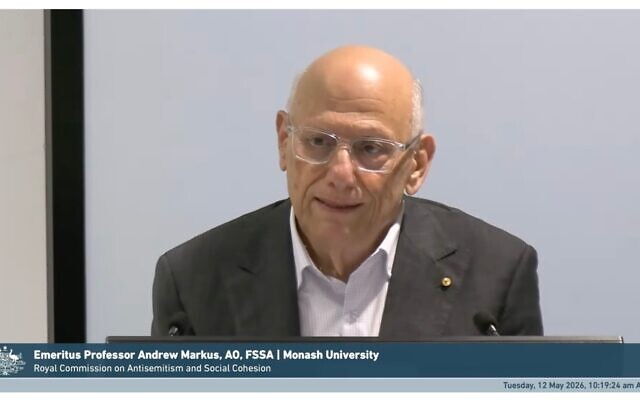
Emeritus Professor Andrew Markus provided testimony to the Royal Commission about large scale public opinion surveys he has conducted on attitudes to Jewish people.
He previously conducted the Scanlan Foundation mapping social cohesion series between 2007 and 2021, as well as two national surveys of attitudes within the Jewish community, the first known as Gen 08 and the second known as Gen 17. He also conducted surveys of Australian attitudes towards the Jewish community, the first being Crossroads 21 and the second being Crossroads 25 last year.
Professor Markus discussed the Scanlan survey which found 15% in 2025 indicated they are negative towards people of Jewish faith, and noted it was marginally lower than the proportion indicating a negative attitude towards other faith groups, with the exception of Hindus, which had 14% and Buddhists at 4%, and Muslims at 35%.
He noted that the proportion of respondents to this question expressing a negative attitude towards people of Jewish faith increased since 2023 from 9% to 15% correct, and that was reflected across other faith groups.
Professor Markus said that the Scanlan Foundation 2025 survey is consistent with the results of the Crossroads 25 survey, commissioned by the Jewish Independent, which was an attitudinal survey competed by 2270 respondents.
The Crossroads survey 2025 was aimed at understanding whether increased antisemitic incidents reflected a shift in public opinion towards Jewish Australians. It looked at two aspects – a judeophobic antisemitism sub scale which looks at classical antisemitism, as as well as an anti-Zionist antisemitism sub scale, which seeks to measure endorsement of antisemitic attitudes directed at Israel and its supporters.
Discussing the results Professor Markus said, “It’s about the pattern and how does society work? For example, how do young people answer those questions? How do people of a particular political persuasion answer that question? Are there patterns or not?”
The hearing noted some of the results of the Crossroads 25 survey: Regarding the statement “Jewish people are just as loyal to Australia as other Australian people” – 10% of those surveyed either disagreed or strongly disagreed with that statement; Regarding the statement “Jewish people can be trusted just as much as other Australian people in business”, 8% disagreed or strongly disagreed with that statement; Regarding the statement, “I’m just as open to having Jewish friends as I am to having friends from other sections of the Australian society” – 3% of those surveyed disagreed or strongly disagreed; Regarding the statement “Jewish people talk about the Holocaust just to further their political agenda” – 14% agreed or strongly agreed with that statement; Regarding the statement – “Australian Jewish people chase money more than other Australian people” – 18% agreed, or strongly agreed with that statement; Regarding the statement “Compared to other groups, Jewish people have too much power in the media” – 17% of those surveyed agreed, or strongly agreed.
Professor Markus noted the average across all those questions was 12% of those surveyed who agreed with negative statements about Jewish people, and said the “pattern” was similar to a survey conducted by the Special Envoy which was 17%.
“We keep coming back to this 15% you see, if you average the 12% and 17%, that’s what you’ve got. So that sort of starts to form, not any individual question, but the pattern across the survey starts to form an understanding that in general terms, that’s the proportion that we might be dealing with. But with some questions to do with Israel, you will get higher negativity,” he said.
Asked if you can conclude that 12 per cent is low, Professor Markus said, “No, because, again, you’re taking it in isolation. And what I’m interested in is the overall pattern in the population. One of the strongest findings for me, which you won’t find, probably in any other surveys that I know of, is that I report on the people who ‘don’t know’, ‘don’t care’, category…. But to me, that’s an opinion, and if it’s 45% of the Australian population, and that is accepted as probably valid, that could well be an important finding for the Commission going forward.”
Professor Andrew Markus giving evidence at the Royal Commission on 12 May 2026. Photo: Screenshot
On statements on the anti-zionist sub scale the survey found: Regarding the statement, “Being comfortable spending time with people who openly support Israel” – 6% disagreed or strongly disagreed; Regarding the statement, “Israel has a right to exist as a homeland for the Jewish people” – 6% disagreed or strongly disagreed; Regarding the statement, “Israel has a right to defend or is right to defend itself against those who want to destroy it” – 7% disagreed or strongly disagreed; Regarding the statement, “Israel can get away with anything because its supporters control the media” – 18% agreed, or strongly agreed; Regarding the statement, “Israel and its supporters are a bad influence on our democracy” – 20% agreed or strongly agreed; Regarding the statement, “Israel treats Palestinians like the Nazis treated the Jews” – 33% agreed or strongly agreed.
Professor Markus noted that among supporters of left wing causes, there was a higher proportion of agreement with negative statements about Jews or Israel. He said younger respondents also showed a pattern of negative attitudes. For example, on the question, “Israel is right to defend itself against those who want to destroy it” – 7% of the national sample disagreed, whereas 22% of those aged 18 to 24 disagreed.
A question included in the survey was “It’s been reported that Hamas killed around 1200 Israelis in the attacks on 7 October, 2023, from what you’ve seen or heard. Do you think these reports are, one broadly true” – and 48% agreed with that, that they’re broadly true, and 5% said it was broadly untrue, 3% preferred not to say and 44% said, ‘not sure’.
Professor Markus agreed that a substantially higher proportion of people saying it was untrue were in the group aged 18 to 24.
“For me, that’s a very important question and a very important finding,” he said.
Asked about findings of negative attitude amongst young people, Professor Markus said, “It’s not necessarily lack of education. It’s more a mindset, that you have reports from the United Nations on sexual violence that was committed. Now who would have most access to that sort of information? Would it be university students, more so than other sections of the community. And yet, if we run some of these correlations, we find they deny this and they agree with that. And so you have an issue there, and I don’t for a second think that if we educate people, you’re going to get around that, because some of them will say they’re not sure, because they basically don’t follow the news.”
The AJN is providing rolling coverage on the Royal Commission on Antisemitism and Social Cohesion. Read all the updates from Hearing block one, week one.



comments