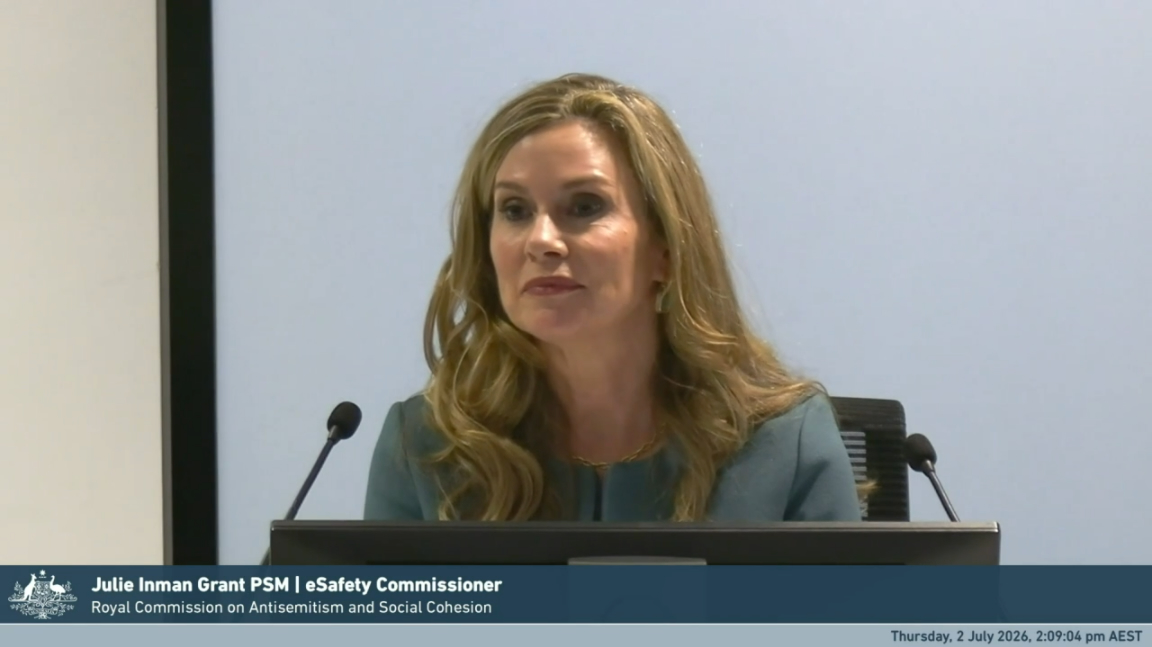
In the late afternoon session, Julie Inman Grant, continued giving evidence. She told the Royal Commission that that responsibility for tackling online antisemitism must shift decisively onto tech platforms, while warning that her agency remains under-resourced to police the problem alone.
She said that a promised “digital duty of care” from the Commonwealth could take 18 months to two years to legislate — too long, she said, for the Jewish community to wait.
As an interim fix, she has proposed making mandatory an existing voluntary EU online hate code, claiming that tech companies already have the sophisticated content-moderation systems needed to detect and remove such material, but choose not to deploy them fully in Australia.
She was scathing about recommender algorithms that she said “monetise the pain and suffering of other people” while “targeting us all with deadly precision”.
Turning to AI, she cited a presentation to the United Nations by Tech Against Terrorism, showing popular AI models being used to instruct people on mass-casualty attacks and to generate realistic deepfakes.
She then remarked, “We’ve got the most powerful technology in the world, owned by the richest, wealthiest technologists in the world, but we’ve never had looser guardrails, and that to me is a recipe for disaster.”
On resourcing, Ms Inman Grant revealed her office’s annual budget sits at $59.4 million, and her office received roughly 108,000 e-safety related complaints in the past 12 months.
She noted her agency has just 36 investigators, and said eSafety had “cut the cloth to fit” and “punched above our weight”.
Asked whether more funding was needed, she said plainly: “the answer is yes,” while acknowledging a tight federal budget.
She also pointed to a broader “evisceration” of trust and safety teams by companies including Meta and X, alongside a winding-back of anti-hate policies.
Pressed later on why platforms, rather than her office, should bear primary responsibility, she drew parallels with other regulated industries.
Just as car makers were compelled to install seatbelts and bars are held responsible for barring minors, she argued that platforms should be made to prevent harm before it occurs, rather than leaving victims and an under-funded regulator to clean up afterwards.
“This industry has created a very risky environment that permeates every element of our life,” she said, adding that as “a regulator in a middle power country that’s relatively small,” ensuring eSafety has adequate tools and resources to take on powerful global companies “is ever more important.”
“We’ve been given a fly swatter to kill a swarm of killer bees,” was how Australia’s eSafety Commissioner Julie Inman-Grant described the powers available to the Commissioner to fight online hate.
In testimony to the Royal Commission on Thursday afternoon, Inman-Grant also characterised the approaches the legislative limits as reducing some of the Commissioner’s activities to a game of “whack-a-mole”.
She said protective layers have been added “reactively” and that online hate speech needs to fall into one of four categories – illegal or restricted online content, cyber-bullying, cyber-abuse or non-consensual sharing of intimate material.
But she said closer ties to Jewish communal organisations combating online antisemitism, including the Online Hate Prevention Institute and the Dor Foundation, and overseas organisations such as the Institute for Strategic Dialogue and the Anti-Defamation League have proven to be valuable partners in the fight against online hate in Australia.
Inman-Grant highlighted the Antisemitism Education Taskforce, chaired by David Gonski, as a resource the eSafety Commissioner.
“We need to be talking to and working with those communities where we’re trying to reach, and was really great to speak to David Gonski this week about our work, and making sure we understood what the Anti-Semitism Education Taskforce was doing, and what kind of help we could provide in terms of any sort of curricula around online antisemitism and anti-hate. They’ve just put up a hub which has some of our materials already, but there’s clearly more work to do in that space.”
The eSafety Commissioner has partnered with Jewish schools and Jewish Care NSW, she said.
“We’ve done some presentations to NSW Jewish Care. We have some Jewish schools that are part of our National Online Safety Education Council network. I think there’s scope to do a lot more.
“One of the things I’ve spoken to the Special Envoy, [on Antisemitism] Jillian Segal about is tailoring our social media self-defence training, which is training that we give to people who are in the spotlight, who may be experiencing online abuse, in terms of understanding how to more effectively manage it, the different vectors, the weapons, understand where to get help and when and how,” said Inman-Grant.
Richard Lancaster SC, counsel assisting, asked Inman-Grant about a potential anomaly in the eSafety Commissioner’s powers, asking her to comment on whether “a good deal of antisemitic material that is observed on the internet or on social media platforms clearly does not fall within the definitions of class one [encouraging violence] and class two [harmful content for minors] material.
Inman-Grant responded that “neither online hate or online antisemitism is explicitly covered in those areas”.
“Class one content would encompass antisemitic online content only to the extent that there’s a promotion or an incitement or instruction to crime,” she said.
Asked by Lancaster if “mere abuse, if I could use that term” would fall into either class one or class two categorisations, she said it would not.
Inman-Grant said research has shown antisemitic hate content has spiked around milestone national and world events.
“We’ve definitely seen two very distinct spikes in reports of antisemitic content. The first was in the wake of the October 7 atrocity, the second was in February 2024 around the incident with the doxxing of 600 Jewish creatives.
“There’s still a lot of Australians that don’t know that we [the eSafety Commissioner] exist,” she noted, expressing caution about the volume of reports that come in.
“They’re not representative of the overall online hate and antisemitism that exists online, and we ourselves rely on academics and NGOs that do this important work,” she said.
Commissioner Viriginia Bell asked Inman-Grant whether antisemitic online content would fall within the category of cyber-abuse the eSafety Commissioner is empowered to act against.
Inman-Grant responded that antisemitic content that can be acted against under the current provisions “must prove serious intent to harm and not just mere emotional distress, so if it makes someone angry or scared or even devastated, that that isn’t captured by that”.
She said that since 2025 social media platforms have been automating moderation through AI and cutting back on trust and safety personnel.
“Meta has just announced that they’re not totally fully automating, there will be humans in the loop, but they are more of their content moderation will be done by artificial intelligence rather than trained content moderators.”
Inman-Grant likened the cumulative impact of sustained online antisemitic abuse on an individual to “death by a thousand cuts”.
Western Australia Police Deputy Commissioner Kylie Whiteley has told the Royal Commission that a memorandum of understanding with the eSafety Commissioner, negotiated since 2022, was never finalised, and that the force has had no significant direct engagement with the Commissioner on online hate and extremism.
Whiteley said the force’s engagement with the eSafety Commissioner occurred primarily through its state crime portfolio and related mainly to technology-based crimes such as child exploitation, cybercrime and intimate image abuse. Asked whether there had been any occasion on which the force had engaged with eSafety specifically in relation to online hate and extremism, she said there had not.
On the MOU, Whiteley said there had been a number of attempts by different parts of the force to finalise the agreement with the eSafety team, but responses often came some time later, and an internal restructure had seen the matter drop off the priority list. Time differences between Western Australia and the rest of the country, and the absence of a local eSafety presence, had not helped, she said, though she did not believe it had hampered the force from reaching out.
“We certainly see there’s a need to ensure there’s an MOU in place, and we’d be keen to enable that to occur,” she said, accepting there was now an important need to finalise it so information sharing could take place.
Western Australia Police Deputy Commissioner Kylie Whiteley.
Whiteley said she saw value in regular meetings with the eSafety Commissioner, which she believed would deliver “much better outcomes”, and in a local eSafety presence in the state. Such a presence, she said, would improve engagement, allow emerging risks to be raised, and help hold online platforms accountable. “We’ll know there’s something occurring, but another one occurs shortly after,” she said of the platforms.
She told the commission that online hate and abuse had been “fairly consistently increasing”, which was partly the catalyst for the force establishing its own hate crime team, on which it had taken proactive measures from April 2025. The force had seen a change since October 7, 2023, and had run operations since that period to monitor any local implications. Antisemitic abuse online was less common in the state, she said, though it did appear from time to time, prompting investigation and direct requests to have it removed.
Whiteley said the force had sufficient resources and training to investigate online abuse and extremism where it constituted an offence, pointing to its state security investigation group, which monitors online risks and triages matters that come to attention.
She also raised concern about public confusion over who bears responsibility for dealing with online abuse. Members of the public often believed they had reported something to police when they had in fact reported it to the eSafety Commissioner or Scam Watch, she said, and it was then difficult to track where those matters had ended up. Whiteley said the eSafety portal did not allow complaints to be tracked in real time, and called for a clearer communication strategy and defined referral points so the public and police could see clearer outcomes.
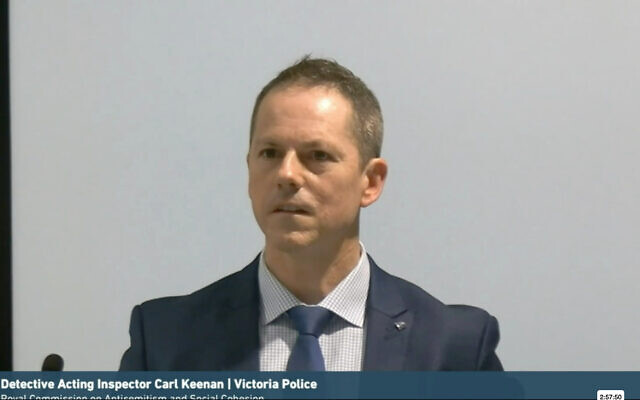
Victoria Police Cybercrime Squad head Detective Acting Inspector Carl Keenan told the Royal Commission on Thursday afternoon that a social media platform recently refused a police request to remove content.
Keenan said the incident occurred in June, when his squad asked the platform to take down the material and the request was denied. The squad then referred the matter to the eSafety Commissioner. “They were successful in removing the content,” he said, citing it as an example of the escalation process available to police.
Giving evidence on the relationship between Victoria Police and the eSafety Commissioner in addressing online hate and extremism, Keenan explained that his squad’s primary focus was “computer on computer” offences such as hacking, malware and ransomware, and that responsibility for investigating online abuse under Victorian anti-vilification laws sat elsewhere within the force. His squad might take on such matters where there was significant media attention, at the direction of the organisation’s leadership.
Victoria Police Cybercrime Squad head Detective Acting Inspector Carl Keenan.
The squad, which comprises about 70 personnel and examines approximately 10,000 devices a year across all its operations, includes a report cyber team that serves as the intake point for Victorians reporting cybercrime through the national platform — receiving around 25,000 reports annually.
Keenan said that team triaged reports first for any immediate threat to life or risk of harm, prompting a welfare check where necessary, and then to determine whether an offence had been committed, before referring matters to local police to investigate. Reports of online abuse, including harassment and image-based abuse, sometimes came through this channel. While the triage team did not itself decide which reports should go to the eSafety Commissioner — leaving that to investigators — every person who made a report was sent correspondence advising they could contact the eSafety Commissioner directly.
Asked whether that correspondence also told people they could report content to the platforms themselves, Keenan said he believed it did but would confirm, and accepted it would be beneficial to advise people of both avenues.
He said information sharing with the eSafety Commissioner occurred on an as-needed basis, governed by a memorandum of understanding in place since August 14, 2024, which he said was operating effectively as a two-way flow covering investigations and referrals. Content might be referred to the Commissioner where a member identified material inciting violence or involving child abuse. He accepted that severe online abuse — antisemitic or otherwise — that did not meet the threshold for criminal investigation but nonetheless raised concerns could still be passed on to eSafety.
Keenan also described a “Take Down Hub”, a project in early development that would sit on the force’s internal network as a single “source of truth” guiding officers on how to request the removal of digital content across different mechanisms. It was being developed in consultation with the eSafety Commissioner.
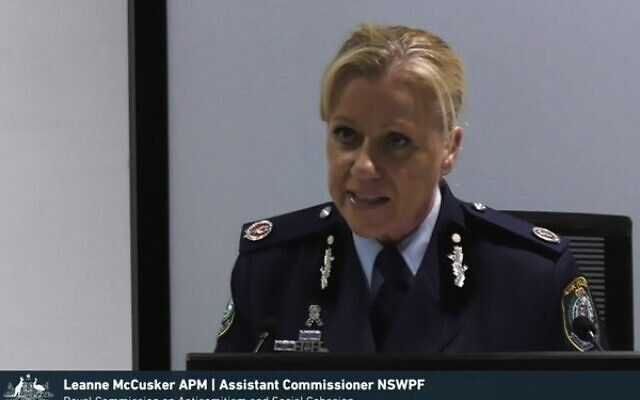
NSW Police Counterterrorism and Special Tactics Command commander Assistant Commissioner Leanne McCusker has told the Royal Commission that staff from the eSafety Commissioner stopped attending joint public presentations with police after feeling unsafe amid protest activity.
Giving evidence about the relationship between NSW Police and the eSafety Commissioner in addressing online hate and extremism, McCusker said the two bodies had worked together on combined presentations in various forums between 2022 and 2024. That collaboration stalled in 2024 when a scheduled presentation in the inner city did not proceed because of protest activity taking place at the time.
McCusker said the protest was not directed at the presentation or the venue, but appeared to have been “the catalyst” for eSafety staff subsequently feeling “some personal safety concerns” about attending presentations alongside police. Such joint appearances had not occurred since, she said, though she was confident the bodies could work through the issue, including through joint presentations or by adopting video presentations from the eSafety Commissioner. Police continued to raise eSafety’s role in their own presentations, she added.
The bulk of McCusker’s evidence concerned the protocols governing how NSW Police engages the eSafety Commissioner to remove harmful online content, particularly in crisis situations involving live-streamed material. She said such requests were made through the Online Content Incident Arrangement, a national protocol established after the Christchurch terror attack, and coordinated through the National Situation Room in Canberra, run through the Department of Home Affairs.
McCusker cited three instances of engagement between her command’s counterterrorism team and the eSafety Commissioner. Two occurred during particular operations — one involving a request to remove a manifesto and video content on the streaming service Twitch, another concerning right-wing hate and extremist material — both of which she said were dealt with in a timely and effective manner. A third involved a post referencing police officers and a firearm distribution webpage, which she said was not progressed for removal under the criteria at the time, adding that she would “use some caution” in discussing it.
While the arrangement worked well, McCusker said there was room to improve efficiency and timeliness by contacting both the National Situation Room and the eSafety Commissioner simultaneously, particularly where there was urgency in acting on live content. She said she was not aware of any delay having affected the two operations.
McCusker also described a memorandum of understanding signed by the then police commissioner and the eSafety Commissioner in February 2023, which formalised protocols for sharing information in both directions. She said it had been working efficiently as a “two-way street”.
Asked about the role of the command’s engagement and hate crime unit in educating the public, McCusker said the team had attended 34 principal forums over the past 12 months and had recently held a two-day hate crime conference attended by 280 people, featuring lived-experience testimony from the Jewish, Islamic, First Nations and LGBTQI communities under the theme “United Against Hate”.
The Australian Federal Police’s collaboration with the eSafety Commissioner has been “very positive and effective” in combating online antisemitism and extremism, the Royal Commission on Antisemitism and Social Cohesion has heard.
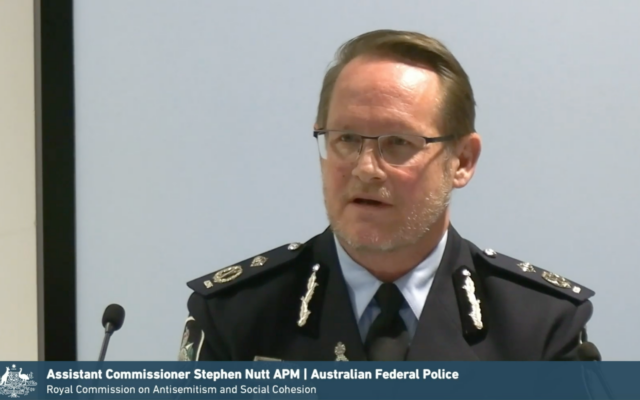
AFP assistant commissioner Stephen Nutt gave evidence about the agency’s engagement with the eSafety Commissioner across multiple operations, including a joint task force targeting criminal conduct against the Australian Jewish community.
Nutt told the commission the eSafety Commissioner’s expertise on how technology platforms operate had become integral to AFP investigations. He said eSafety representatives provided insights into “platform behaviour, what they’re seeing in terms of the operating environment, patterns of compliance by platforms, and also advice on the online safety framework”. That intelligence extended to understanding platforms’ terms and conditions, “which may provide options not only to victims but also to agencies on taking appropriate action in relation to restricting access of harmful material”.
Nutt also told the commission that Special Operation Avalite had drawn on eSafety’s expertise to identify prolific offenders spreading antisemitic material online, saying the information provided was “very useful” in helping the AFP prioritise its efforts.
AFP assistant commissioner Stephen Nutt giving evidence at the Royal Commission on Antisemitism and Social Cohesion. Photo: screenshot
Nutt also outlined AFP engagement with eSafety through Operation Pompilid, which focused on sadistic online extremism and coercive online violent extremism. He told the Commission these phenomena “don’t necessarily have a religious, political, or ideological content, and therefore not captured under terrorism legislation”, prompting the AFP to seek eSafety’s assistance with takedown powers and awareness material.
On Operation Kilchurn, the investigation into the alleged attack on Bishop Mar Mari Emmanuel in April 2024, Nutt said the eSafety Commissioner had sought AFP assistance in mitigating risks from the live-stream video being shared online. He provided an affidavit supporting eSafety’s takedown action after observing the video “was being used as propaganda by extremist groups and being used to encourage others to do similar acts”.
Nutt told the Commission that eSafety’s regulatory powers were an important mechanism for disrupting harmful content where criminal prosecution was not viable, noting some material “may meet more the definitions under the Online Safety Act, as opposed to the Criminal Code Act provisions”.
Nutt explained that while a Memorandum of Understanding between the AFP and the eSafety Commissioner expired in September 2025, a replacement letter of exchange covering a broader range of subject matter, including protocols for reporting antisemitic and extremist content, is currently being drafted. Under questioning from Bora Kaplan SC, Counsel for the Commonwealth, Nutt confirmed information sharing had continued since the MOU’s expiry under existing legislative provisions.
“Nothing has prevented a productive working relationship as it relates to counterterrorism and national security issues in the absence of having something,” he said.
He said the two agencies had “joint missions in relation to reducing online harm to vulnerable communities” and that the AFP commissioner was “very keen to have close working relationships” with the regulator, having last met with the eSafety Commissioner in February 2026.
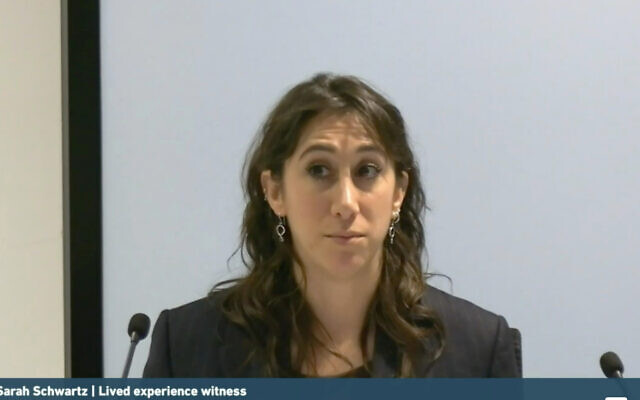
Sarah Schwartz, executive director and co-founder of the far-left, antizionist Jewish Council of Australia, told the Royal Commission on Antisemitism and Social Cohesion on Thursday morning that she has been targeted by both neo-Nazi and pro-Israel actors, and warned against government responses that locate the source of antisemitism in Palestinian and Muslim communities.
Schwartz, a human rights lawyer and Melbourne Law School lecturer, said the Jewish Council was formed in February 2024 to represent Jewish people opposed to Israel’s conduct in Gaza, which the organisation regards as genocide, war crimes and crimes against humanity. She said around 2500 Jewish people supported its work, making it, in her description, the largest progressive Jewish organisation in the country.
She told the commission that days after the Jewish Council’s launch she was targeted by what she believed to be far-right or neo-Nazi actors through phone calls, emails and messages referencing Jewish appearance and antisemitic conspiracy theories such as the Great Replacement. She said she took personal leave to seek advice and remove identifying information about herself online.
Sarah Schwartz speaks to the Royal Commission.
Schwartz said she was also targeted by pro-Israel accounts, describing voluminous material that depicted her as a rat, placed her image on a train to concentration camps, and labelled her a “capo”, “Judenrat” and “Hitler’s Jew”. She said such imagery rested on the idea that Jewish identity is inherently tied to Israel, so that Jews who criticise it are cast as “not really Jewish” or as traitors — a “flattening of Jewish identity” she said caused real harm and had a chilling effect on Jewish people wanting to speak out.
She was critical of media coverage, including by The Australian, which she said had republished offensive imagery of her in the course of reporting on a personal safety intervention order that police — not she — had applied for on her behalf. She said the coverage had made her less safe and deterred her from further reporting to police.
Schwartz argued that responses conflating antisemitism with criticism of Israel were dangerous, sending a message that Palestinian and Muslim communities must account for antisemitism “in a way that no other community is asked to”. She said the most effective responses were cross-cultural dialogue, education and a structural anti-racist approach.
Questioned by Commissioner Virginia Bell, Schwartz acknowledged that many in the mainstream Jewish community retain a close attachment to Israel, tied to ideas of Jewish safety after the Holocaust — a view she said she once held but no longer does.
The AJN is providing rolling coverage on the Royal Commission on Antisemitism and Social Cohesion.
The Australian Federal Police’s collaboration with the eSafety Commissioner has been “very positive and effective” in combating online antisemitism and extremism, the Royal Commission on Antisemitism and Social Cohesion has heard.
AFP assistant commissioner Stephen Nutt gave evidence about the agency’s engagement with the eSafety Commissioner across multiple operations, including a joint task force targeting criminal conduct against the Australian Jewish community.
Nutt told the commission the eSafety Commissioner’s expertise on how technology platforms operate had become integral to AFP investigations. He said eSafety representatives provided insights into “platform behaviour, what they’re seeing in terms of the operating environment, patterns of compliance by platforms, and also advice on the online safety framework”. That intelligence extended to understanding platforms’ terms and conditions, “which may provide options not only to victims but also to agencies on taking appropriate action in relation to restricting access of harmful material”.
Nutt also told the commission that Special Operation Avalite had drawn on eSafety’s expertise to identify prolific offenders spreading antisemitic material online, saying the information provided was “very useful” in helping the AFP prioritise its efforts.
AFP assistant commissioner Stephen Nutt giving evidence at the Royal Commission on Antisemitism and Social Cohesion. Photo: screenshot
Nutt also outlined AFP engagement with eSafety through Operation Pompilid, which focused on sadistic online extremism and coercive online violent extremism. He told the Commission these phenomena “don’t necessarily have a religious, political, or ideological content, and therefore not captured under terrorism legislation”, prompting the AFP to seek eSafety’s assistance with takedown powers and awareness material.
On Operation Kilchurn, the investigation into the alleged attack on Bishop Mar Mari Emmanuel in April 2024, Nutt said the eSafety Commissioner had sought AFP assistance in mitigating risks from the live-stream video being shared online. He provided an affidavit supporting eSafety’s takedown action after observing the video “was being used as propaganda by extremist groups and being used to encourage others to do similar acts”.
Nutt told the Commission that eSafety’s regulatory powers were an important mechanism for disrupting harmful content where criminal prosecution was not viable, noting some material “may meet more the definitions under the Online Safety Act, as opposed to the Criminal Code Act provisions”.
Nutt explained that while a Memorandum of Understanding between the AFP and the eSafety Commissioner expired in September 2025, a replacement letter of exchange covering a broader range of subject matter, including protocols for reporting antisemitic and extremist content, is currently being drafted. Under questioning from Bora Kaplan SC, Counsel for the Commonwealth, Nutt confirmed information sharing had continued since the MOU’s expiry under existing legislative provisions.
“Nothing has prevented a productive working relationship as it relates to counterterrorism and national security issues in the absence of having something,” he said.
He said the two agencies had “joint missions in relation to reducing online harm to vulnerable communities” and that the AFP commissioner was “very keen to have close working relationships” with the regulator, having last met with the eSafety Commissioner in February 2026.
Enjoy Unlimited Access To The Australian Jewish News Website And All Our Online Content For AUD$18/month Or Just AUD$120/year.




comments