Rise of extremism takes centre stage at Royal Commission
Hearing Block 8 continues looking at antisemitism and extremism in Australia, including religious, far-right and other ideologically motivated extremism and radicalisation.
The Royal Commission on Antisemitism and Social Cohesion has heard that New South Wales’ key counter-extremism intervention program lowered its minimum eligibility age from 14 to 10 after authorities identified children as young as 10 showing a capacity and willingness to carry out violent extremist acts.
NSW Department of Communities and Justice director Heather Jackson told the commission that the Engagement and Support Program (ESP), a voluntary program for individuals vulnerable to, supportive of, or engaged in violent extremism, had originally been offered to those aged 14 and above.
“Unfortunately, in the last few years, the landscape was indicating that there were young people, children, 10 years and above, that were indicating capacity, capability, and willingness to undertake a violent extremist event,” Jackson said.
She said the decision to lower the age was a multi-agency one, taking into account children’s cognitive reasoning abilities and their understanding of actions and consequences.
Jackson said the ESP caters for the full spectrum of violent extremism, including religiously inspired, far-right, mixed or unclear ideologies, and grievance-based concerns. Individuals do not need to have been charged with an offence to be eligible, and the program can be used as a diversionary step before criminal charges proceed.
Referrals can come from police, the Department of Education, the Step Together helpline, anyone in the community, or even as a self-referral. Once received, referrals undergo police deconfliction before an eligibility council of psychologists, case managers, police and other experts assesses suitability.
Jackson said case plans may include education pathways such as TAFE enrolment, mental and physical health treatment, connection to social activities, NDIS access, housing assistance and pro-social mentoring.
“Often, our case managers are quasi mentors to our clients due to the fact that a lot of our clients lack that pro-social, either parenting or direction in their lives,” she said.
An independent evaluation by ACIL Allen, completed in 2025, found the ESP’s design was “robust and closely aligned with the evidence base on effective practice”, but identified opportunities to improve quality and rigor in operational processes, including the design of case plans. The average length of client engagement was found to be 1.37 years.
Jackson said demand for the program had grown in recent years and was likely to continue increasing, noting that the pace of growth had at times outstripped the department’s ability to put the necessary structures in place.
“I think the ability for this evaluation to guide us into focusing where we need to improve in terms of our quality and rigor has enabled us to implement a much more structured environment,” she said.
A confidential witness told the Royal Commission on Antisemitism and Social Cohesion earlier during hearings that she had a negative experience calling the national Step Together helpline, having been directed to a police-led program in her home state when she was seeking access to a counsellor or psychologist.
NSW Department of Communities and Justice director Heather Jackson, who oversees the helpline, acknowledged the witness’s experience and told the commission that if the same call were made today, the outcome would be the same.
“If we were to receive that call again, the same action would be made,” Jackson said, noting that services available in that state remain limited.
The Step Together helpline, originally a New South Wales service, has been funded by the Department of Home Affairs to expand nationally across all states and territories. It remains operated by NSW DCJ staff, with calls referred to the relevant jurisdiction for action.
Asked whether Step Together could refer callers to community-based organisations or independent psychologists with expertise in violent extremism, Jackson said the department does not endorse or identify particular services outside its government partners.
Callers would instead be directed to publicly available resources such as the Australian Psychological Society website or services like Headspace, she said.
The confidential witness had reported a positive experience with Exit Australia, a community-based organisation. Asked whether the department could develop a list of endorsed community organisations for referral purposes, Jackson said, “That is something that we can certainly look into.”
However, she expressed caution, saying, “Would I refer to specific community-based programs that purport to be programs focused on violent extremism without all the information and rigor that I knew about the program? No, I wouldn’t.”
The commission also heard concerns about the helpline’s confidentiality arrangements. Jackson said callers are informed via a recorded message about limitations to confidentiality relating to community safety risks, and that call information may be shared with the caller’s home jurisdiction to facilitate intervention.
However, Jackson conceded this was not always raised directly during calls. Asked whether it should form part of the standard script, she said, “We can look at incorporating that to make it more transparent.”
Jackson confirmed calls are recorded for quality assurance purposes and to share information with other jurisdictions, so callers do not have to retell their story.
The commission heard the Step Together website is undergoing a complete rebuild with increased Commonwealth funding, incorporating improved message testing and broader consultation. Jackson agreed with observations by the confidential witness about areas for improvement on the website.
The Royal Commission on Antisemitism and Social Cohesion has heard that counter-extremism programs do not seek to change a person’s political, ideological or religious beliefs, with NSW Department of Communities and Justice director Heather Jackson telling the commission that individuals in a democratic country are entitled to hold beliefs, however extreme, provided they do not act on them violently.
Jackson was asked by Commissioner Virginia Bell about whether it was essential to try to change the beliefs of a person who held an aberrant ideological view, such as a belief that it was righteous to kill non-Muslims.
“People in a democratic country can hold a belief. They can hold a belief in what they believe to be true. It’s the second act of the violence [that] is the particular issue,” Jackson said.
She offered an example of a client who had completed the Engagement and Support Program but continued to hold extreme white supremacist views.
“In his own words, ‘I still believe that white people are the master race.’ However, ‘I don’t want to hurt anyone,'” Jackson said.
She said the program focuses not on the ideological endpoint but on understanding the individual’s journey to that belief.
“What are those aspects in their life that they are missing, or that they have been exposed to that has driven them to that sort of belief?” she said.
Jackson said young children with mixed or unclear ideologies were often more complex than adults holding fixed beliefs, describing them as “often more impulsive” and “often unclear in terms of their journey”.
Commissioner Bell pressed Jackson on whether there was a meaningful difference between a 12-year-old attracted to violence through online content and a young man from a cohesive family who had developed aberrant religious views. Jackson maintained that the program’s approach was to examine the drivers behind any belief rather than target the belief itself.
The question of how to reach people before they act on such beliefs also featured prominently, with prior evidence revealing that public awareness of the Step Together helpline and the ESP is not where it needs to be.
Jackson agreed, saying awareness efforts were being refined to target those most likely to encounter a person of concern, including parents, teachers, caregivers and community organisations. She said the department was using targeted online advertising and education sector training to improve reach, with a broader national awareness campaign being led by the Department of Home Affairs.
“I think a blanket advertisement of the service enables people to dismiss it and say, ‘Well, that’s not me. That’s not part of me. I don’t need to know that,'” she said.
However, when asked how a subset of parents could be targeted without reaching all parents, Jackson conceded, “Absolutely. It’s all parents. It’s all family members.”
A senior NSW official has told the Royal Commission on Antisemitism and Social Cohesion that a British-style mandatory referral duty would “open the floodgates”, even as she agreed that identifying extremists earlier gave a better chance of turning them away from violence.
Heather Jackson, a director at the NSW Department of Communities and Justice, was cross-examined by Nicholas Bender SC, counsel for a number of Jewish communal organisations, about the department’s voluntary counter-violent extremism programme, referred to in evidence as the ESP.
Jackson agreed that some clients arrived at the programme holding antisemitic views they had carried for years, in some cases through learned generational beliefs, and that disengaging them was difficult.
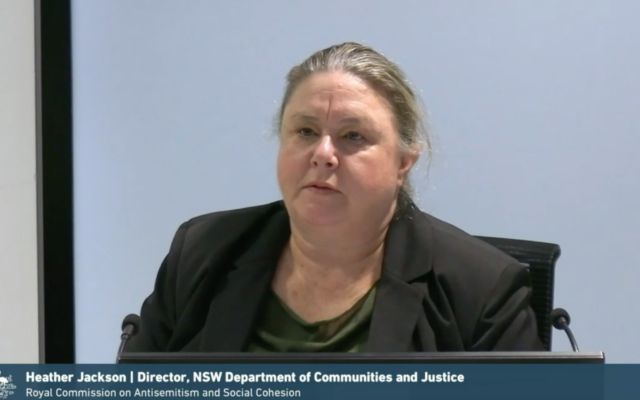
Heather Jackson, a director at the NSW Department of Communities and Justice. Photo: Screenshot
Asked whether earlier identification and referral improved the prospects of disengagement, she replied: “Completely, yes.” She also agreed that more referrals, and earlier ones, would be better.
Bender put to her the British prevent duty, under which specified institutions can be obliged to refer at-risk individuals to the Channel programme, and asked whether a similar scheme might deliver those earlier referrals.
Jackson said she was concerned about broadening what the programme was intended to do.
“I think there’s already a lot of noise in understanding and identifying who is vulnerable to violent extremism, and I think if we had mandatory reporting in those aspects where the threshold is low, that would contribute to that,” she said.
Racist graffiti or derogatory language might amount to broad racism rather than engagement with a violent ideology, she said.
She also raised the risk of introducing extremist ideas to people who did not hold them, describing “that pathway of violent extremism that may not have even entered their minds”.
The answer lay earlier in the system, she said. “I think there needs to be more function and focus on primary prevention.” By the time a referral reached her team, the person was “already engaged at the pointy end”.
There was also no formal process requiring the department to check on former clients at fixed intervals after they exited, Jackson said, although agencies or the individuals themselves could seek a re-referral at any time. Post-programme support had been discussed internally, but many who finished wanted to move on.
Because participation was consent-based, a person referred as a risk who declined to take part was not picked up by any other departmental programme. “This is a bespoke programme,” she said.
The refusal was recorded and the referring agency told, and two police officers attached to the team would know of it, although Jackson declined to comment on what NSW Police might do next.
The department did not approach mental health services, religious figures or community leaders about someone who had refused, because it lacked that person’s consent and would risk breaching privacy. Asked whether such a process would be useful, Jackson said it would have to be weighed against privacy obligations, but was “something that we can consider”.
Antisemitism is the predominant extremist belief system among prisoners referred to South Australia’s counter-radicalisation program, the Royal Commission on Antisemitism and Social Cohesion has been told.
Rebecca Barson, of the South Australian Department for Correctional Services, gave evidence about New Pathways, a program piloted in 2022 that works with people in prison and with those being supervised in the community.
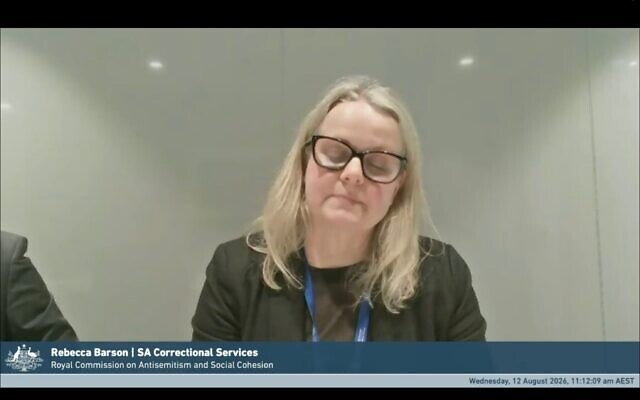
Rebecca Barson, of the South Australian Department for Correctional Services. Photo: Screenshot
Asked whether those referred to the program were ideologically diverse, Barson said she had put the question to her team before the hearing.
“It would be fair to say that antisemitism does present the predominant extremist belief system identified amongst the people that are referred to new pathways,” she said.
She agreed that antisemitism was frequently combined with other extremist ideologies, as the commission has heard elsewhere, although she said she could not point to specific examples.
Referrals have increased significantly this year, and Barson said the numbers might keep rising as correctional staff became more alert to the behaviours involved.
Corrections staff are the main source of referrals. People are identified by the nature of their offending, by conversations overheard in prison units, through clinical assessments and through beliefs expressed in other treatment groups, she said. The program’s clinician trains correctional officers, community corrections officers and trainee officers on what to look for.
Referrals are reviewed by a peer review committee, after which the program offers tailored interventions built around structured assessment tools and the clinician’s relationship with the individual.
That work rests on a single senior position. Barson agreed with counsel assisting that the role’s responsibilities, running from identification and assessment through case management, clinical advice, training and rehabilitation work, amounted to a significant scope for one person.
“It’s also quite specialised, so we’re very fortunate to have a very experienced clinician in that role, supported by a very experienced clinical team, but I do accept what you say that it’s a broad person specification,” she said.
If demand increased, additional resources might be needed, and the department would take that up with the Department of the Premier and Cabinet and with Home Affairs, she said.
An internal review of the program is being finalised. Barson said no external review had been considered during her time with the department.
She also confirmed the department is not involved in any programs in this area run by community or civil society organisations, and that its key stakeholders are other government agencies. New Pathways worked with a specific cohort inside the corrections system, she said, which made community organisations less relevant to its remit, although the department worked closely with the state’s Department of Human Services.
Asked to nominate priorities for improvement, Barson pointed to information sharing between agencies, particularly at the point a prisoner is released.
“It’s really important that we share information, and I think that that would probably be the most critical area that we would need to be working on as a group of government agencies,” she said.
South Australia’s community counter-extremism program will work with anyone in the state aged 10 or over, and increasingly takes referrals from schools before any criminal offence has occurred, the Royal Commission on Antisemitism and Social Cohesion has heard.
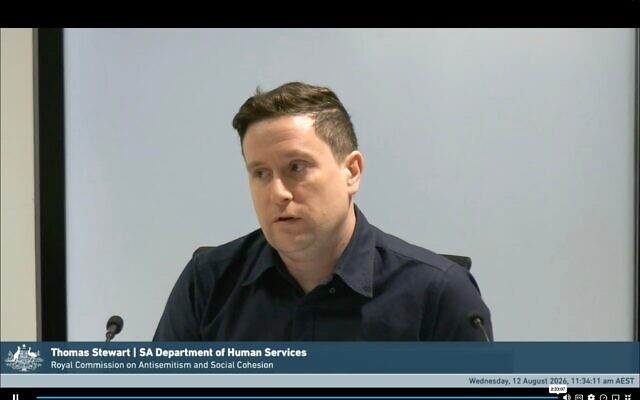
Thomas Stewart, general manager of inclusion support at the South Australian Department of Human Services, gave evidence on Wednesday about the Inclusion Support Program, which delivers the state’s countering violent extremism (CVE) interventions in the community. It is funded through the Commonwealth’s National Support and Intervention Program.
Stewart said the program was entirely voluntary and aimed at disengagement rather than at changing what people believed.
Thomas Stewart, general manager of inclusion support at the South Australian Department of Human Services. Photo: Screenshot
“Sometimes when the program is talked about in a media context, we’re described as a de-radicalisation program, but we’ve never marketed ourselves as a de-radicalisation program,” he said.
Clients ranged from people showing the earliest signs of heading down that path to people charged with terrorism offences who had returned to the community under extended supervision orders.
A significant stream of referrals comes through the state education department, where school staff can flag concerns about a student through a critical incident reporting process before the department’s Conditions for Learning team refers them on.
“Often it’s early in the piece, so the concerning behaviours may be emerging, but they’ve not manifested in anything criminal, but we can then take steps to intervene,” Stewart said.
He told the commission that running the program out of human services rather than police or corrections made families more willing to open the door.
“We get pretty good buy-in because we’re human services, social workers, psychologists turning up at a site to try and provide support,” he said.
The program operates alongside New Pathways, the corrections-based program run by the Department for Correctional Services, which gave evidence earlier in the day. Stewart said the two worked together on clients moving between custody and the community, but that the distinction was deliberate: corrections was not the right agency to approach a family whose child had not been charged.
Rather than send Adelaide-based clinicians to towns such as Port Lincoln twice a week, the program buys in local services and trains them. It has also paid for assessments families cannot afford, including a $3000 autism assessment for a young person whose behaviour had raised concern at school.
Asked whether funding was adequate, Stewart said the program had recorded an underspend last financial year, partly because the funding agreement had been slow to be signed, a matter of “good old-fashioned red tape”, leaving the budget unallocated until close to December.
Recruitment was also difficult. “It’s very difficult to get qualified social workers that want to work in this space,” he said.
Stewart also told the commission that calls from South Australia to the national Step Together helpline, extended beyond New South Wales last year, remained low, which the department attributed largely to a lack of public awareness.
The program employs a dedicated community engagement officer, recommended in a PricewaterhouseCoopers review of the sector and, Stewart believed, unique among smaller jurisdictions.
South Australia has begun a 12-month pilot program for young people being driven towards violent behaviour not by any political or religious ideology, but by coercive relationships formed online, the Royal Commission on Antisemitism and Social Cohesion has heard.
Thomas Stewart, general manager of inclusion support at the South Australian Department of Human Services, told the commission on Wednesday that the Coercive Online Violent Extremism pilot, known as COVE, began on 1 July and is open to people aged 10 to 25.
The pilot grew out of a case referred to the state’s mainstream counter-extremism program, the Inclusion Support Program, involving a young person in a coercive control relationship online. Without an identifiable ideology, such a person would ordinarily be ineligible for a counter-extremism program at all.
“The behaviours reflect violent extremism behaviours, but they’re not driven by ideological factors. They’re driven by this online coercive control relationship. We need a program that addresses that,” Stewart said.
Similar referrals followed. Stewart said the department had been seeing an increase in referrals connected to sadistic online exploitation, and had been working with the Australian Federal Police taskforce investigating the decentralised online networks behind it.
The department put a proposal to the South Australian Department of the Premier and Cabinet and was funded to run the pilot for a year.
The AFP has described sadistic online exploitation as a crime type in which victims, most often teenage girls, are coerced into filming themselves harming themselves, their siblings or their pets, with the material then traded within the network for status.
The same networks have been linked to cyber attacks, doxxing, swatting, where a false emergency call brings armed police to a victim’s home, and extremist-inspired violence. The AFP has asked media not to name the network, saying publicity feeds its recruitment.
Participants in the pilot will receive the same needs-based case management offered to other clients of the Inclusion Support Program, combined with an existing South Australian youth justice program that works with adolescents on coercive and violent behaviour in the home.
Stewart said the department was still deciding which assessment tool to use to measure results, given that the instruments available to the sector variously measure risk, threat and need. A South Australian university will conduct an independent evaluation, and the pilot will be reviewed before it concludes to determine whether it should continue.
The age range had been narrowed to 10 to 25 because the problem tended to affect adolescents and because funding was limited, he said.
Stewart gave no evidence on whether any of the referrals involved antisemitic content.
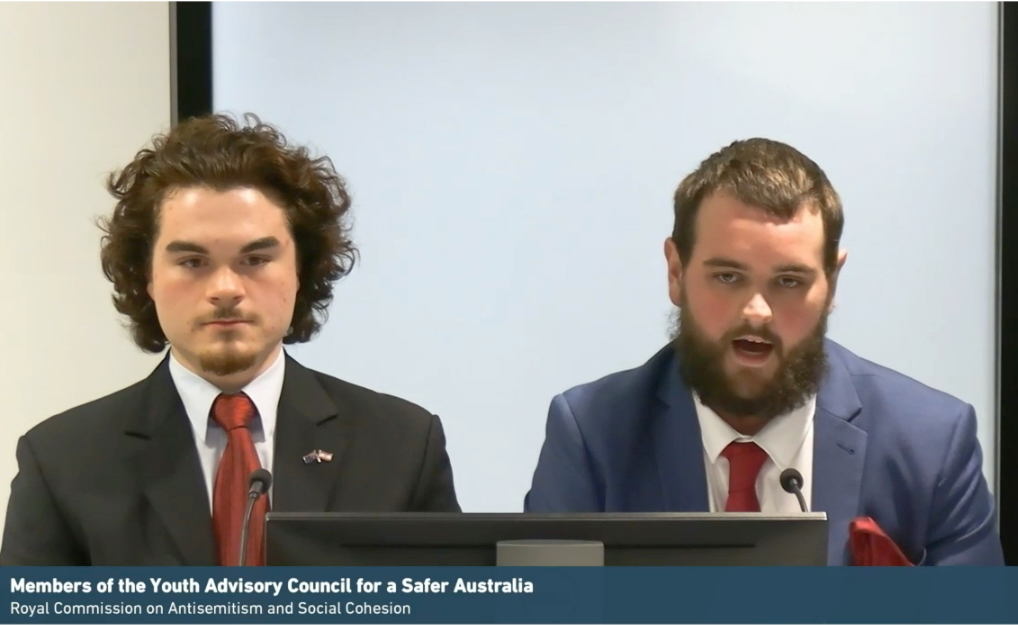
Members of the Youth Advisory Council for a Safer Australia (YACSA) told the Royal Commission on Antisemitism and Social Cohesion today that social media algorithms, unchecked online bigotry, and a string of barriers to seeking help, are combining to leave young Australians vulnerable to radicalisation.
Four YACSA representatives — Lou (from South Australia), Salim (NSW), Hayden (NSW) and Tinnan (Victoria) — gave evidence about the council’s work advising the Department of Home Affairs on preventing and countering violent extremism.
YACSA members Salim (left) and Hayden.
Tinnan told the Commission that online platforms curate content for individual users in ways that can prove harmful, with young people frequently exposed to material they should never see.
He said the council was troubled by the rise of controversial commentators whose growing followings reinforce the very algorithms that push extreme content to young users.
Lou added that an account can be created and, within as little as 15 minutes, be fed content that crosses into what is academically considered extreme — often while a young person is searching for answers about their own identity.
On the spread of bigotry online, Lou invoked “Brandolini’s law”, telling the Commission that far less energy is needed to produce and spread bigoted content than is needed to refute or moderate it.
Lou added, ordinary human tendencies towards gossip and tribalism are amplified in online spaces, where echo chambers mean harmful material is often all a young person encounters.
Salim outlined barriers preventing young people, particularly young men, from seeking help, citing stigma around appearing “weak”, confusion over what personal data is collected when help is sought, and distrust of law enforcement.
Hayden said many young people simply lack the critical thinking skills to distinguish concerning behaviour from jokes.
Commissioner Virginia Bell put to the panel that the Commission had heard evidence of primary school children telling Jewish classmates that Hitler should have “finished the job”, and of online memes referencing the gassing of Jews, asking whether young people understood the gravity of such material.
In his reply, Hayden, citing an example, said he had recently spoken to a boy in one of his programs, whose comments teetered on the edge of extremism, and that the encounter reflected a broader lack of understanding of historical severity and empathy among young people, rather than genuine radicalisation.
On solutions, Lou said approaches that ask young people to reflect through questions, rather than lecture them, were more effective, alongside youth-friendly interfaces, and involving young people in designing services.
Salim emphasised that young people should be “spoken with, not at,” while Hayden called for greater transparency around what happens after a report is made to services such as Step Together, so referrers know their concerns have been acted on.
The panel also briefly canvassed other initiatives, including YACSA’s “Notice the Shift” bystander awareness campaign targeted at 14 to 17-year-olds, which has been presented to the Australia New Zealand Counter-Terrorism Committee; work supporting counter-extremism capacity-building with youth in Indonesia and Malaysia; consultation with the Youth and Mental Health Advisory Group; and planned engagement with the eSafety Commissioner on alternatives to purely profit-driven, negativity-rewarding algorithms.
Salim described YACSA’s review of the government’s Step Together website as finding it overly “clinical” and institutional, while Hayden pointed to campaigns such as Are You Okay Day, and the UK’s Act Early campaign, as models for youth-friendly messaging that builds practical skills rather than relying on fear.
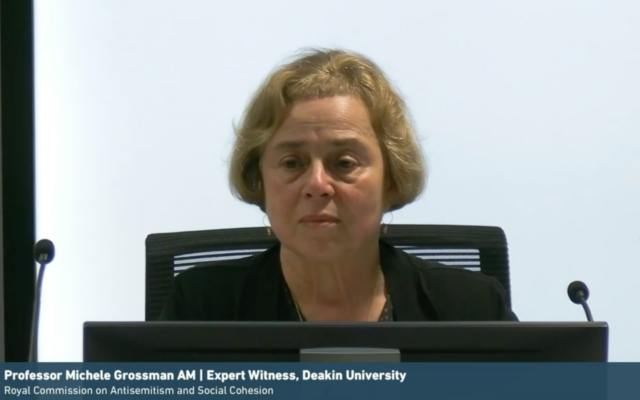
Deakin University research chair in diversity and community resilience Professor Michele Grossman has called for a national “saturation campaign” to raise public awareness of violent extremism, telling the Royal Commission on Antisemitism and Social Cohesion that a targeted approach alone is no longer sufficient.
Grossman, who has undertaken extensive research on terrorism and violent extremism, told the commission that awareness of both the Step Together helpline and violent extremism more broadly remains far too low.
“I actually think we need a saturation campaign around violent extremism in Australia,” she said. “Violent extremists do not arrive here from another planet. They are ordinary people in our communities, in our families, in our workplaces, and in our schools.”
She pointed to domestic violence awareness campaigns as proof that broadcast approaches work. “We have completely changed the conversation in Australia around domestic violence through broadcast campaigning. Things that were impossible to talk about in public 15 years ago are now able to be talked about in public.”
Grossman described the Step Together program as “a vital element of our countering violent extremism architecture” because it provides a critical point of contact for what she termed “intimate bystanders,” the family members and close friends who are typically the first to notice warning signs.
“What did it look like before we had Step Together?” she said. “People who had concerns, they had no place to turn. They didn’t know who to talk to.”
Grossman cited the UK’s Act Early program and the “See It, Say It, Sorted” public transport safety campaign as successful models, noting she and Professor Paul Thomas had served as academic advisors on the Act Early website and communications strategy.
“There is no one living in the United Kingdom today who does not know what See It, Say It, Sorted means, and what the phone number is,” she said.
While acknowledging the value of targeted approaches, Grossman argued both strategies should operate simultaneously. “Resilient systems always involve redundancy, so you don’t put all your eggs in one basket and then hope for the best.”
She also raised concerns about Step Together’s operating hours, which are limited to Monday to Friday, 9am to 5pm, down from a previously broader span. She was particularly concerned about young people’s access.
“Try to imagine a young person who is worried about a sibling. They’re at school during the day. They can’t make the call at home,” she said.
Grossman warned of a “leaky pipeline” where callers who cannot get through become discouraged and stop trying. “The more abandoned calls there are, the more disheartened they can become. They just drop out and think, no, it’s not worth the bother.”
She cautioned against launching a broadcast campaign without extending the helpline’s hours. “If you frustrate people, you’ve achieved the opposite of what is actually intended.”
All forms of violent extremism are ideological in nature, Deakin University research chair in diversity and community resilience Professor Michele Grossman told the Royal Commission on Antisemitism and Social Cohesion.
Grossman, who has published 95 scholarly items and conducted 36 government-funded research projects in countering violent extremism, said removing ideology from the equation fundamentally changes the classification of the behaviour.
“If you remove ideology from violent mobilisation, what are you left with? You’re left with a range of psychosocial and sometimes interpersonal reasons or accounts. But in my view, those don’t meet the threshold for the definition of terrorism or violent extremism,” she said, pointing to the Commonwealth Criminal Code’s requirement that terrorism must advance a particular cause or agenda.
She told the commission that ideology, properly understood, encompasses any set of collective, action-oriented beliefs designed to achieve a particular social or political change.
“If you look at violent extremist movements, networks, and ideas, all of them are oriented towards some sort of change or perceived solution. They diagnose a problem. Society is corrupt. Society has lost its way. And the solution is to X. That in effect is what violent extremist movements have to say,” she said.
Grossman also addressed the contested debate around de-radicalisation versus behavioural disengagement, noting it divides both practitioners and researchers.
“If you really are going to get people to disengage from violent behaviour, some level of transformation in how they think and also how they feel is going to be necessary,” she said.
She noted mentors working with terrorist offenders in formal programs had observed changes in thinking and feeling over time, “even though the mentoring focus has been on disengagement and not on de-radicalisation.”
Grossman cautioned that the term de-radicalisation itself can obscure more than it reveals, citing German de-radicalisation expert Daniel Koehler’s observation that vastly different programs with different approaches are frequently bundled together under the one umbrella. “You really need to be able to unpack the specifics of any given approach to understand how it relates to disengagement,” she said.
Turning to the role of schools, Grossman drew a distinction between “education as a practice,” encompassing curriculum-based approaches such as critical thinking and intercultural education, and “education as a system,” where principals, teachers and counsellors are positioned to observe early warning signs in students day to day.
“The sweet spot, of course, is those two working together in tandem,” she said.
She advocated for nationally coordinated training for school staff, noting that while several states and territories already have robust programs, inconsistency across jurisdictions can have unintended consequences. She was particularly concerned about the gap between metropolitan and rural or regional schools.
“One size does not fit all. That training has to be both consistent at one level, but also tailored to some of the more localised nuances and capacities that you find characterising both rural, regional, and metropolitan settings,” she said.
Deakin University Professor Michele Grossman has told the Royal Commission on Antisemitism and Social Cohesion that a mandatory reporting duty for teachers, similar to the United Kingdom’s Prevent Duty, should be avoided in favour of embedding early warning training within a broader safeguarding framework.
Grossman said framing the approach as safeguarding, covering harms such as bullying and family violence, would be “much more compelling and I think acceptable for the education sector than just wagging your finger at them and saying you’ve got a duty to report”.
She warned that a mandatory duty risked “disguised compliance” and cited the UK’s “cooker bomb” case, in which a teacher misheard a child saying “cucumber” and reported the family for alleged bomb-making. “You frighten a family to death,” Grossman said. “You alienate the community in which that family lives, all because there was an overzealous response.”
Grossman outlined the BRAVE measure – Building Resilience Against Violent Extremism – a tool she developed with colleague Dr Michael Ungar based on research with 475 young people in Australia and Canada. The measure identifies five protective factors: cultural identity and connectedness; bridging capital, or trust in interacting with people of different backgrounds; linking capital, or trust in government and institutions; and the rejection of violence-related behaviours and beliefs.
She said open-mindedness, empathy and critical thinking were also important protective qualities. Distinguishing empathy from sympathy, she said: “Empathy is when you’ve never been in that situation and you try to imagine yourself into somebody’s shoes.”
On individualised case management programs such as the Engagement and Support Program in New South Wales, Grossman said a single, tailored program was preferable to separate programs for different forms of extremism.
Asked whether a safeguarding framing could be combined with a maintained referral obligation on institutions, Grossman said this would not necessarily achieve the same result.
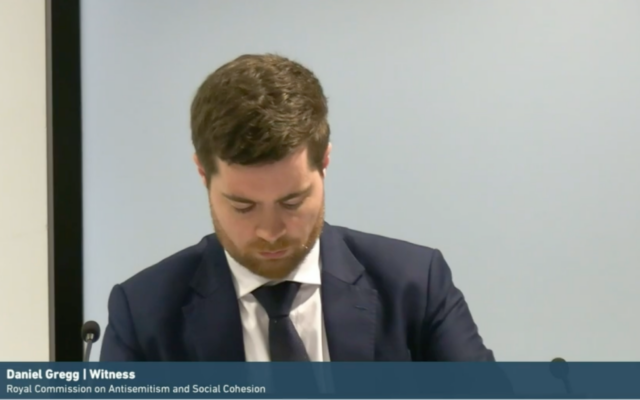
Psychologist Daniel Gregg has told the Royal Commission on Antisemitism and Social Cohesion that pathways into extremism have shortened dramatically since the COVID-19 pandemic, with self-radicalisation now more common than recruitment through extremist networks.
Gregg, a registered psychologist and clinical registrar who also serves as secretary of an approved shooting organisation in New South Wales, said his clinical experience showed a marked shift in radicalisation timelines. Before the pandemic, he said, clients typically took “about 12 to 18 months before they were … fully committed to that group ideology” after being recruited by extremist networks. Since COVID, he said, “what I’ve seen … is that they tend to be self-radicalised, and the radicalisation pathways are taking a lot less time,” in some cases “as little as … two to four weeks”, with social media forming a part of nearly 90 per cent of cases.
Photo: Screenshot
Gregg said shooting clubs occupied an important early-intervention role because mandatory attendance requirements gave clubs regular contact with members. He pointed to warning signs including a hardening of positions towards other groups and grievance ideologies, saying “if you taught clubs to notice those things and then refer those to the more appropriate pathways, that we could be preventing further radicalisation.”
He described developing a behavioural screening framework at his own club, based on “collective observation” by range officers, mentors and committee members, and said the framework was deliberately designed so lay assessors were trained “not to assess and just look” rather than making clinical judgements themselves.
Gregg said a key barrier to reporting was the “regulatory framework” in New South Wales, under which any report could see a firearms licence “immediately suspended and or revoked” regardless of its substance. “There is a cost if you make a report,” he said, adding this raised the threshold before club members would act.
He said referral pathways such as the Step Together service were poorly known among shooting clubs, as registry education focused on “compliance requirements” rather than extremism referral options. Gregg recommended a piloted, co-designed training program rather than immediate mandatory adoption of his framework, arguing clubs should help shape reporting pathways because they “see everything on the ground day to day”.
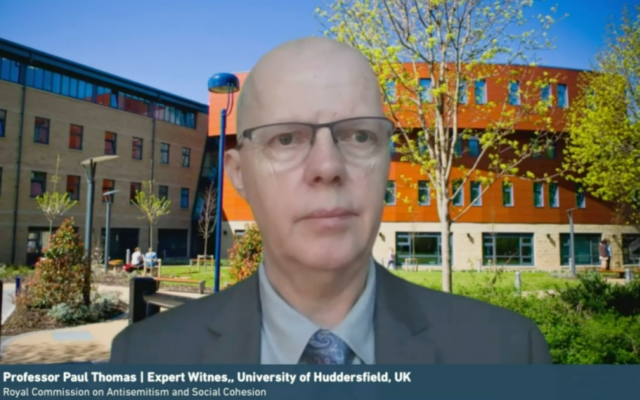
University of Huddersfield Professor of Youth and Policy Paul Thomas, has told the Royal Commission on Antisemitism and Social Cohesion that the United Kingdom’s Prevent duty was introduced in 2015 following a string of terrorist attacks and controversies, including British citizens travelling to join Islamic State in Syria and concerns about extremism in Birmingham schools.
Thomas said the duty required institutions including schools, health bodies, local authorities and prisons “to have due regard to the need to prevent people from being drawn into terrorism”, with each institution required to have a designated safeguarding and prevent lead responsible for making referrals to a multi-agency “channel panel”.
He said training had been extensive since the duty’s introduction, with “over a million professional practitioners in England and Wales” trained within two to three years, and said research showed “a very clear relationship between the volume and quality of training, and staff confidence and ability to make appropriate judgments” about referrals.
Thomas said the program’s focus had shifted substantially since its early years, when it was “explicitly only about British Muslims”, a legacy he said continued to drive “allegations that Prevent is Islamophobic or stigmatising of British Muslims”. He said the latest statistics showed Islamist extremism accounted for just eight per cent of referrals, with mixed, unclear or unstable ideologies now representing a growing proportion of cases.
Photo: Screenshot
On the program’s effectiveness, Thomas acknowledged persistent difficulties in evaluation, noting it was “obviously impossible to know systematically whether people referred to Prevent would have gone on to be actively involved in terrorist planning”. He pointed to cases of “disguised compliance”, including the perpetrator of the 2017 Parsons Green bombing, who had been through a full Prevent program before the attack.
Thomas said the so-called attrition rate, where referrals are not adopted for intervention, had been controversial, reaching “as high as 85 or 90 per cent” in some years, but a 2023 independent review found this was “exactly comparable with the attrition rate for broader safeguarding referrals for other types of social harm”.
He noted participation in intervention programs remained voluntary, with “only a little over 50 per cent of those offered Prevent support actually take it up”, and said those who declined were subject to ongoing “police managed” monitoring.
University of Huddersfield Professor Paul Thomas told the Royal Commission on Antisemitism and Social Cohesion that community-based counter-extremism strategies targeting entire ethnic or religious communities were “highly problematic”, warning they risked stigmatising communities as “suspect” while doing little to address the small number of individuals genuinely at risk.
Thomas said early UK, US and Australian approaches had focused heavily on Muslim communities, but this was “contrary to a parallel policy priority of community cohesion”, which instead emphasised “shared beliefs, shared identities, and contact between communities”. He said the number of community-based projects in the UK had substantially reduced in recent years.
Thomas gave detailed evidence about his research into “intimate bystanders” — the friends, family and community members most likely to notice early warning signs. He said perpetrators of extremist violence typically gave away their intent through “leakage”, but “people aren’t sure what they’re noticing or hearing, and also don’t know what to do with it”. He credited Deakin University’s Professor Michele Grossman with pioneering the concept in Australia, describing her “groundbreaking initial research” as the basis for later UK, US and Canadian studies.
Thomas said this research directly informed the UK’s Act Early campaign, launched in November 2020, which he and Grossman helped design as advisers. He said the campaign, comprising a website and phone line aimed at concerned friends and family, had been “very positively acknowledged” in the UK’s 2023 counter-terrorism strategy refresh, though referrals from the friends and family category remained around “one per cent of the total referrals”.
Responding to questions about the 2023 Shawcross Review, Thomas agreed antisemitism was “a common thread across forms of extremism”, noting a UK government research project into antisemitism within Prevent cases had not been made public.
Thomas also addressed the risks of individuals who were assessed as needing support but refused to participate, telling the commission this created a “significant gap” if not managed carefully, and confirmed adopted cases were reviewed at six and twelve months regardless of whether a person had engaged, which he described as “absolutely important” given the risk of relapse or disguised compliance.
The AJN is providing rolling coverage on the Royal Commission on Antisemitism and Social Cohesion.
All forms of violent extremism are ideological in nature, Deakin University research chair in diversity and community resilience Professor Michele Grossman told the Royal Commission on Antisemitism and Social Cohesion.
Grossman, who has published 95 scholarly items and conducted 36 government-funded research projects in countering violent extremism, said removing ideology from the equation fundamentally changes the classification of the behaviour.
“If you remove ideology from violent mobilisation, what are you left with? You’re left with a range of psychosocial and sometimes interpersonal reasons or accounts. But in my view, those don’t meet the threshold for the definition of terrorism or violent extremism,” she said, pointing to the Commonwealth Criminal Code’s requirement that terrorism must advance a particular cause or agenda.
She told the commission that ideology, properly understood, encompasses any set of collective, action-oriented beliefs designed to achieve a particular social or political change.
“If you look at violent extremist movements, networks, and ideas, all of them are oriented towards some sort of change or perceived solution. They diagnose a problem. Society is corrupt. Society has lost its way. And the solution is to X. That in effect is what violent extremist movements have to say,” she said.
Grossman also addressed the contested debate around de-radicalisation versus behavioural disengagement, noting it divides both practitioners and researchers.
“If you really are going to get people to disengage from violent behaviour, some level of transformation in how they think and also how they feel is going to be necessary,” she said.
She noted mentors working with terrorist offenders in formal programs had observed changes in thinking and feeling over time, “even though the mentoring focus has been on disengagement and not on de-radicalisation.”
Grossman cautioned that the term de-radicalisation itself can obscure more than it reveals, citing German de-radicalisation expert Daniel Koehler’s observation that vastly different programs with different approaches are frequently bundled together under the one umbrella. “You really need to be able to unpack the specifics of any given approach to understand how it relates to disengagement,” she said.
Turning to the role of schools, Grossman drew a distinction between “education as a practice,” encompassing curriculum-based approaches such as critical thinking and intercultural education, and “education as a system,” where principals, teachers and counsellors are positioned to observe early warning signs in students day to day.
“The sweet spot, of course, is those two working together in tandem,” she said.
She advocated for nationally coordinated training for school staff, noting that while several states and territories already have robust programs, inconsistency across jurisdictions can have unintended consequences. She was particularly concerned about the gap between metropolitan and rural or regional schools.
“One size does not fit all. That training has to be both consistent at one level, but also tailored to some of the more localised nuances and capacities that you find characterising both rural, regional, and metropolitan settings,” she said.
Enjoy Unlimited Access To The Australian Jewish News Website And All Our Online Content For AUD$18/month Or Just AUD$120/year.



comments