Hearing Block 5 of the Royal Commission begins today, examining security arrangements, government funding and police coordination for the Jewish community.
Former attorney-general Mark Dreyfus on the abuse he faced including being called a “genocidal Zionist” in a Melbourne street, vandalism of his electorate office with dual-loyalty slurs, and a stream of online hate drawing on the language of the Holocaust
Witness ACO, a senior figure from the Community Security Group (CSG) Victoria, on the situation CSG Vic has faced since October 7, including increased incident reports, the increase of volunteer hours required, the need for formal frameworks with Victorian Police and the unsustainable situation when it comes to funding
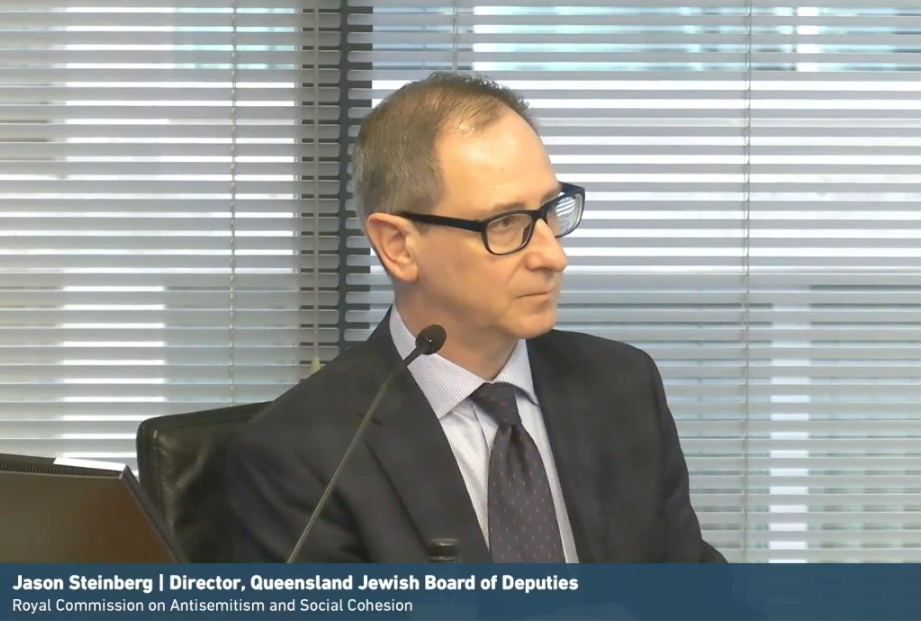
President of Queensland Jewish Board of Deputies, Jason Steinberg, on the Jewish experience in Queensland, including the “curve” of escalating hostility within the last three years that has culminated in physical attacks
Jason Steinberg, president of the Queensland Jewish Board of Deputies, gave evidence to the Royal this afternoon, describing a “curve” of escalating hostility within the last three years that has culminated in physical attacks on members of Queensland’s Jewish community – including an alleged car-ramming incident at Brisbane’s largest synagogue on February 20 this year.
Steinberg told the Commission that antisemitism in Queensland had “dwarfed any statistic which we’ve gathered” since October 2023, moving from low-level incidents to serious physical threats.
Of the ramming incident, he said when a vehicle was driven into the shule’s front gates, it narrowly missed any passers-by or congregants, and that “shook our community to its core.”
Findings of recent community surveys commissioned by the Board painted a stark picture of everyday impact of antisemitism on Queensland Jewry.
The August 2025 survey found 71 per cent of Queensland’s Jewish community had experienced antisemitism firsthand, citing hostility at street protests, graffiti and targeted posters, alongside eroding confidence in institutions such as workplaces, schools and universities.
A follow-up survey in March 2026 found more than half of respondents had withdrawn from social settings altogether, losing long-term friendships both online and in person.
“Their sense of place, their sense of being part of the Queensland society, had broken down,” Steinberg said.
He described the particular strain on Queensland’s Jewish leadership, who lack the paid communal infrastructure and staff compared to in NSW and Victoria, and instead rely on volunteers “double hatting” as media spokespeople, crisis managers and complaint triage officers, and that is “taking its toll”.
He added that some volunteers had turned down professional opportunities to meet the demands of community work.
On policing, Steinberg praised what he called a historically strong relationship with Queensland Police dating back to the Board’s founding in 1948, while acknowledging early difficulty by police in distinguishing unlawful antisemitic conduct from lawful protest.
He said new state laws passed in Queensland – including criminal penalties for hate speech and the recent Fighting Antisemitism Bill banning terrorist slogans and symbols – had allowed police to act more decisively.
Steinberg gave detailed accounts of two telling incidents. The first was an April 2024 event at a small Brisbane bookshop featuring musician Deborah Conway, where anti-Israel protesters banged on the glass from outside, an episode he said sent “shockwaves” through a community that included descendants of Holocaust survivors.
The second incident was a May 2025 gathering at a Brisbane pub for the Jewish festival of Shavuot, where a staff member allegedly tipped off protesters who blocked entry and threw water at attendees despite prior police coordination.
Steinberg said his recommendations to the Commission for improved protective security centred on a “proactive defensive posture” to pre-empt threats before they reach community events, arguing the threat to Queensland Jews mirrors that faced nationally.
He pointed to the Chanukah gathering in central Brisbane on December 14, 2025, attended by more than 500 people, as an example of effective crisis response.
As master of ceremonies that night, Steinberg received word via the Community Security Group of the unfolding Bondi Beach attack; police numbers were rapidly scaled from six to 30 officers, including tactical and counter-terrorism units, allowing the celebration to continue safely.
He said police subsequently maintained a protective presence at the synagogue for three weeks.
Steinberg closed his evidence by urging that the trust built between Queensland Police and the Jewish community be “replicated at a national level” to ensure consistent pre-emptive protection across Australia.
Witness ACU – who was raised Catholic in a small town before marrying into a Jewish family – told the Royal Commission this afternoon that her belief in Australia as a place of safety and coexistence began “unravelling” in the days after October 7, 2023.
ACU recalled how she had witnessed public celebration of the attacks on Israel, followed by anti-Jewish chanting, outside the Sydney Opera House on the evening of October 8, 2023, when the building was illuminated in blue and white.
She told the Commission that Jewish community members were asked to stay away from that same vigil for their own safety – a decision she found “very perplexing”, and the start of what she called her own naivety about Australian society.
The bulk of ACU’s evidence centred on her adult daughter, a long-time volunteer with the Community Security Group (CSG) NSW, and the mental and emotional toll that role has taken since October 2023.
ACU said her daughter now devotes hours to CSG equal to her full-time job, and “the intensity of it has definitely changed since October 7, adding her own view of her daughter’s volunteering had shifted from simple admiration to something heavier.
“I live in two separate time zones,” she told the Commission, “and when she’s on shift, one is actually in my chest, and the other one is on the clock.”
“I had never imagined that such an ordinary volunteering role could carry such extraordinary responsibility.”
Asked about pride in her daughter, ACU said it was “enormous,” but now “met with a little bit of uneasiness, because of incidents that have happened over the last few years.”
She described CSG as filling a gap that police cannot cover at every Jewish event, acting as a kind of informal seal of approval that determines whether community members feel safe enough to attend gatherings at all.
ACU said the whole family shares in the weight of her daughter’s ongoing responsibility.
Concluding her evidence, ACU referred to the October 2025 terror attack on a synagogue in Manchester, England, during Yom Kippur, in which Jewish security volunteers were harmed.
She said that attack was “profoundly sobering,” making “the unimaginable actually feel possible.”
She told the Commission that CSG volunteers protect the entire community regardless of political affiliation, and that since Manchester, and the more recent Bondi Chanukah terror attack, “every shift carries a different emotional weight.”
“It showed me that every volunteer has a family waiting for them to come home, and the volunteers there were targeted because of the service that they bring to the community, and because of who and what they actually protect.”
A senior Community Security Group (CSG) volunteer has told the Royal Commission on Antisemitism and Social Cohesion he has become desensitised to antisemitic incidents after years on the front line of protecting Melbourne’s Jewish community.
Witness ACS, a Jewish Australian in his 20s who works full-time in a corporate role alongside his CSG Victoria duties, gave evidence under pseudonym, and described the psychological toll of sustained exposure to antisemitic incidents since joining CSG in the early 2020s.
Before October 7, 2023, ACS said Victoria was already recording antisemitic incidents at a concerning rate.
“The frequency of anti-Semitic incidents in particular was around one in every three days within Victoria before October seven,” he told the commission.
The situation deteriorated rapidly after the October 7 attacks. ACS recalled that within 24 hours, a vehicle was reported driving around Caulfield North “yelling profanities and yelling abuse directly linked to the October seven attacks”, a moment he said made clear that what had happened overseas was resonating in Australia for those who wished to harm the Jewish community.
ACS described a psychological toll he characterised as a paradox.
“I quite quickly became desensitised to the impact. And even to this day, I’ll see something that is objectively shocking, yet not have the visceral response that I should have.”
He said the community’s capacity to manage the threat was masking its severity, “because we are adapting to that degrading environment, it’s much much easier to overlook that growing burden on volunteers, on financial resources, and on the quality of Jewish way of life.”
Since 2021, ACS has contributed approximately 8400 hours to CSG, including 3500 documented volunteer hours and 1500 hours of unpaid work on top of paid responsibilities, equivalent to a full-time role alongside full-time study or work.
He was frank about the long-term outlook.
“Long term it’s not sustainable. It’s not sustainable for anyone to be working essentially two full time jobs at once, especially given the risks associated with working Jewish communal security.”
ACS also told the commission that only about one in five antisemitic incidents were reported by victims to police, with many reluctant due to safety concerns or a desire not to expose their identity.
He said the reliance on volunteers working unsustainable hours compounded the problem, and called for professional psychological support to be embedded as a standard part of CSG work.
The number of antisemitic incidents reported across Australia rose 22 per cent in 2025, marking the highest annual figure ever recorded by the Community Security Group, the Royal Commission into Antisemitism and Social Cohesion heard..
Witness ACP, a former CSG NSW employee who authored the organisation’s annual analysis of reported antisemitic incidents from 2022 to 2025, gave evidence under pseudonym at the commission’s hearing in Sydney. The 2025 report is the third consecutive year to set a record, following an 88 per cent increase in 2023 and a further 26 per cent rise in 2024.
Examined by Counsel Assisting Richard Lancaster SC, ACP outlined the findings of the recently finalised 2025 report, which recorded 1276 antisemitic incidents nationally. Victoria recorded the highest number with 569, closely followed by New South Wales with 543, broadly mirroring the demographic spread of the Jewish community.
ACP told the commission the nature of incidents had shifted.
“In the cases of prior years, such as 2024, most of the incidents that occurred in public places were opportunistic in nature. That’s what we assess in 2025 when they were occurring at synagogues and other Jewish sites. In that regard, it’s assessed to be more targeted, and I guess in the areas in which Jewish people reside.”
The data revealed 247 incidents occurred on Shabbat, and 141 on a Jewish chag.
Fifty-one incidents involved Jewish schoolchildren, a figure ACP described as “still high compared to our previous records, but also on its own is quite substantial”, noting most involved children in Jewish school uniforms travelling to and from school on public transport.
Across the six subcategories, abusive behaviour was the most common at 605 incidents, followed by 237 acts of damage and desecration.
Police were notified of 346 incidents in 2025, resulting in charges relating to 67.
ACP highlighted a 97 per cent increase in charges laid nationally, noting, “I think that goes towards the efforts that have been made by the police to prosecute hate crimes.”
ACP said the 2025 report is expected to be made publicly available shortly.
A senior Jewish community security volunteer has told the Royal Commission into Antisemitism that safeguarding Jewish life in Australia has become “a second life” that keeps him awake at night and has drawn him away from synagogue, family occasions and ordinary community life.
Giving evidence under the pseudonym ACR, the witness said he had volunteered with the Community Security Group (CSG) in Victoria for almost 25 years, which he said made him “probably one of the organisation’s longest-serving members”.
Born and raised in Australia, the witness described himself as a proud Jewish Australian and a Zionist who had long regarded being fully Jewish and fully Australian “not as a contradiction, but as a privilege”. He said he held leadership roles in a Jewish day school and a medical research organisation, and worked full time in professional services.
He told the Commission the intensity of his security work had “escalated significantly” since October 7, 2023.
“Most of my days now begin with early morning CSG meetings, most evenings or nights end with either meetings or briefings or my own training sessions,” he said, adding that he was always on call, “because when my emergency alert goes off, I need to grab my equipment and run out the door and go and respond to whatever is going on in the community”.
The witness said the cost of that commitment was borne not only by him but by his wife and children, who lived with disruption, emergency alerts at all hours of the night and sudden departures. “The parenting burden, as well as the emotional drain and stress associated with that, is borne by my wife and family,” he said.
That burden had also reshaped his own relationship with communal Jewish life. The witness said he discouraged his family from attending Jewish events when he was present in a CSG capacity, and that even in a personal capacity he remained on alert throughout.
“I don’t really remember the last time I sat in synagogue with my father and properly participated in the service,” he said.
Asked about his family history, the witness said both his paternal grandparents survived the Holocaust. His grandmother had spent time in ghettos and a number of concentration camps, including Auschwitz, while most of his extended family were murdered by the Nazis. He said he had always understood that period as history, and had not expected it to press on the daily lives of his own children.
The Commission heard the witness had been holidaying in Israel with his wife and two young children over the High Holiday period in the weeks before October 7, 2023, leaving around three days before the attack. His parents remained in the country and spent October 7 hidden in bomb shelters and safe rooms before escaping via Dubai.
The witness said he had been on shift as part of the CSG response team during the violence that broke out at a Caulfield protest in November 2023, witnessing “those incidents and that violence and that aggression with my own eyes personally”. He was among community leaders who met the Victorian Premier, Cabinet members and senior Victoria Police the following day.
More recently, he said he had been at Melbourne Airport waiting to board a flight to Sydney on the evening of December 14, 2025 when news broke of the Bondi attack. “I walked out of the airport and I drove straight to CSG headquarters,” he said, where he assisted with crisis management until the early hours.
Reflecting on what he described in his witness statement as a heavy burden of responsibility, the witness said he carried concern both for the community that relied on CSG and for the safety and wellbeing of the volunteers themselves. Asked what might happen if protective security were not treated as a first-order priority, he said simply: “It keeps me up at night.”
The witness said his statement had sought to capture how the current environment was felt in everyday life. It was “not experienced only through the most serious incidents”, he said, but “through the steady accumulation of fear, vigilance and uncertainty that people carry into ordinary life”.
He told the Commission he now saw the security of the Australian Jewish community as a test for the country itself.
“If one group of citizens can’t live openly and safely and confidently without extraordinary security and vigilance and constant calculation, then I think something really important has gone wrong in our national fabric,” he said.
A senior leadership figure from the Community Security Group (CSG) Victoria, given the pseudonym ‘Witness ACO’, told the Royal Commission this morning that antisemitic incidents reported to the organisation have grown “exponentially” since October 7, 2023, escalating from graffiti and verbal abuse to physical threats and assaults on Jewish community members.
CSG Volunteer hours triple
The witness, who has volunteered with CSG Victoria for more than a decade, said CSG personnel nationally volunteered an estimated 62,749 hours in 2023, rising to just over 86,000 hours in 2024, and 113,712 hours in 2025.
The witness said these figures were “substantially underestimated,” excluding lengthy training sessions and unpaid on-call shifts.
Valued at commercial security guard rates, the 2025 hours were worth just over $9 million.
Asked about the toll on personnel, the witness said: “The pressure has been immense on all of our staff and our volunteers.
“We ask more of them now than we ever have. It’s completely unfair what we ask them to do.”
Operational requirements have “nearly doubled” since October 2023, with synagogue protection more than doubling, and staff numbers tripling.
Witness ACO said CSG has responded by offering psychological support, and mandating rest for volunteers at risk of burnout.
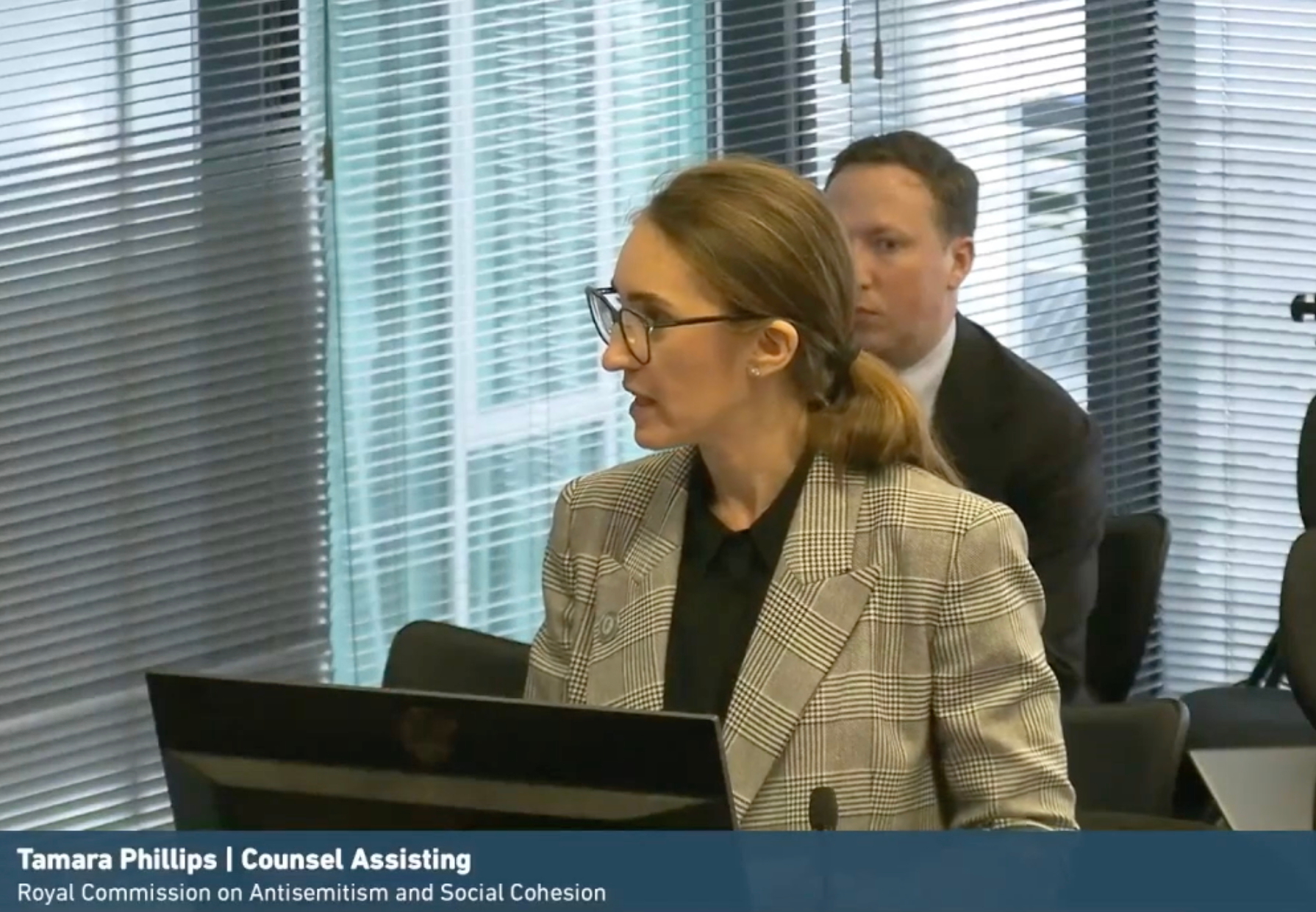
Counsel Assisting Tamara Phillips. Screenshot
Strong relationship with police, but formal frameworks lacking in Vic
Witness ACO praised the “incredibly strong” relationships with Victoria Police, describing CSG as supplementing rather than replacing police work, and noted a marked increase in meeting frequency since October 2023.
Relations with the Australian Federal Police, by contrast, were described as newer and less developed, though “hugely valuable” since being strengthened post October 7.
CSG Victoria also runs cultural awareness training for police, with attendance jumping from 186 Victoria Police members and four AFP members in 2024, to 247 Victoria Police members and 18 AFP members in 2025, and “they have been incredibly worthwhile”.
Counsel Assisting noted that, unlike NSW Police’s formalised Operation for the Jewish High Holy Days’ – an arrangement involving senior command and dedicated briefings – no equivalent structure exists in Victoria, with planning occurring at station level.
The witness agreed that a similar framework — potentially extended to other high-risk Jewish events — “would no doubt be something that would be very well received.”
Funding situation for CSG “unsustainable,” witness warns
CSG Victoria’s budget has “pretty much tripled” since October 2023, driven by increased staffing, additional casual security support, and heavy investment in technology.
Despite a significant government grant via the Executive Council of Australian Jewry, the organisation still relies primarily on community donations and levies.
The witness voiced serious concern about that model’s sustainability, saying “It is unfathomable for me to see us being able to continue to provide a fit-for-purpose community security mechanism based on the current threat environment.
“Without that government funding, our community simply cannot, and in fairness, shouldn’t have to support the security of the Jewish community.
“And so for me, it needs to be ongoing, committed amounts to our community, so that the CSG can continue to operate at this level.
“But more than that, it’s around the community’s need – and we should not have to carry this burden.
“There shouldn’t be this financial burden on being Jewish today, and I don’t see how this is sustainable, nor do I see why it should be sustainable.”
The witness confirmed government funding has not been sufficient to secure all Jewish sites CSG monitors, and that the organisation holds ongoing concerns about physical security at some locations.
Reflecting on CSG’s core mission, the witness said the organisation has, unfortunately, become “critical infrastructure for the community,” adding: “The amount of phone calls that I get asking… will you be present? Will you be at an event?
“And the sense of relief that we hear from them, when they hear that we’ll be there, is a little bit scary for us.
“I think without the CSG today, unfortunately, I don’t think many people would feel safe to go to synagogue to attend events or to live a Jewish way of life.”
The hearing session with Witness ACO concluded with a short closed session.
Former attorney-general Mark Dreyfus has told the Royal Commission that the Commonwealth should consider a broader criminal offence of serious vilification, an enforceable duty on social media platforms, and protest-exclusion zones around synagogues and Jewish schools, drawing on his experience overseeing hate-speech and security reforms in government.
Continuing his evidence on Monday, Dreyfus — who served as Attorney-General from June 2022 to May 2025 — said state and federal parliaments had circled the criminalisation of hate speech for years.
The offence he brought to parliament in 2024 was added to the Criminal Code with incitement to violence as an essential element. Victoria and New South Wales had since legislated more broadly to criminalise serious vilification, and Dreyfus invited the commission to consider whether the Commonwealth should follow.
He noted the Commonwealth had legislated again in January this year, after the Bondi attack, creating a power to proscribe hate groups similar to the proscription of terrorist organisations. Those provisions, law since February, had been used twice — to proscribe Hizb ut-Tahrir and a neo-Nazi group.
Such laws had a “normative” value, he said, setting standards and sending messages even where prosecutions were infrequent — which was itself desirable, since frequent convictions would mean a great deal of hate speech.
On the online environment, Dreyfus welcomed the government’s forthcoming “digital duty of care” legislation, placing a duty on large platforms to moderate dangerous and abusive content. He said enforcement could not be left to the eSafety Commissioner alone, whose work was constrained by budget against platforms whose revenues exceeded those of many countries.
He suggested a “private right of action” allowing anyone affected by online abuse to seek a takedown through a court or tribunal, potentially decided quickly and on the papers. Conscious of the disparity between complainants and “the original deep pockets”, he proposed a no-cost mechanism, analogous to the Competition and Consumer Act, shifting costs onto the platforms early. He stressed he sought a takedown remedy, not damages.
On physical security, prompted in part by Counsel Assisting Richard Lancaster’s opening, Dreyfus invited consideration — a matter for state and territory governments — of restrictions analogous to the safe-access zones around abortion clinics, referring to the High Court’s 2019 decision in Clubb v Edwards, in which Commissioner Virginia Bell participated, upholding Victoria’s law restricting protest that could cause distress to those attending clinics.
It was time, he said, to consider a similar restriction outside synagogues, schools and Jewish places of gathering — not to ban political protest, but to protect Jewish Australians going about their worship, schooling and communal life — noting such protests could also serve as cover for violence.
Asked about evidence given last week by University of Sydney vice-chancellor Mark Scott concerning a May 2024 letter from the Group of Eight universities about encampment chants, Dreyfus said he had read the letter as seeking legal advice from the attorney-general — which the attorney-general provides only to cabinet — and so had not given a legal opinion. As he recalled, he had instead invited the universities to consider how they ran their campuses, and had raised section 18C of the Racial Discrimination Act for their consideration.
Dreyfus said ensuring the safety and belonging of Jewish Australians was a primary responsibility of state and federal governments, though ultimately a whole-of-community effort. Jewish community security groups had stepped in through their own infrastructure and volunteers; he reflected that as the grandparent of children at a Jewish school, he had seen his son volunteer for security work in a way he had not needed to as a parent in the 1980s and 1990s.
Every Jewish school and synagogue in Melbourne had now hardened its buildings, funded partly by government but largely by the institutions themselves, with guards outside places of worship, schools and communal organisations — something no other religious group in Australia had to walk past to worship.
Former attorney-general Mark Dreyfus has told the Royal Commission that being abused as a Jew was a new development in his political life, describing being called a “genocidal Zionist” in a Melbourne street, the vandalism of his electorate office with dual-loyalty slurs, and a stream of online hate drawing on the language of the Holocaust.
Giving evidence on Monday not as a government representative but as a Jewish Australian and long-standing member of parliament, Dreyfus — the member for Isaacs since 2007 and now Australia’s special envoy for international human rights — began with his family’s history. Three of Dreyfus’s great-grandparents perished in the Holocaust. He said that history could not but shape how he thought about Australia, which had provided refuge to his father, uncle and grandparents, and after the war to thousands of Holocaust survivors.
That shared knowledge, he said, informed the shock he felt at the breach of the sense of safety that refuge had created. He reminded the commission that antisemitism was not new to Australia, citing an Australian minister who told the 1938 Évian Conference that “Australia does not have a racial problem, and we are not desirous of importing one” — words recorded at Yad Vashem — and a post-war Canberra Times editorial complaining in racial terms about the arrival of Jewish refugees.
He described the Hamas attacks of October 7, 2023 as having changed how it feels to be Jewish in the modern world. He recounted standing in central Melbourne on a Sunday morning in April 2024, waiting to join a march against violence against women, when a man crossing the road responded to his “good morning” by calling him a “genocidal Zionist” who should be ashamed of himself.
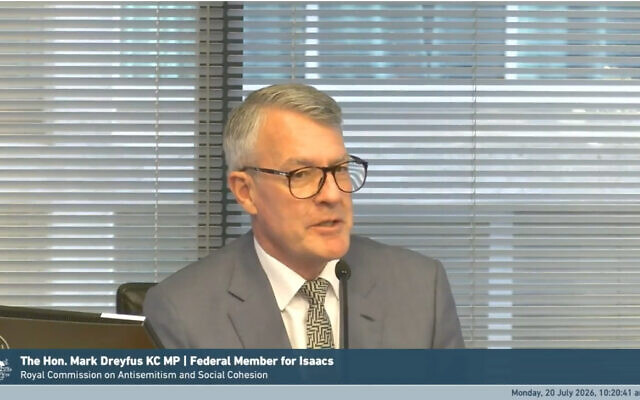
Mark Dreyfus testifies at the Royal Commission.
In some 17 years in parliament, Dreyfus said, no one had ever hurled abuse at him because he was Jewish; this was a new development, and he knew he was not alone. Asked by Commissioner Virginia Bell about his understanding of Zionism, he said it was simply support for the continued existence of Israel as a home for the Jewish people, which did not necessarily mean support for its current government, and that he was proud to call himself a Zionist in that sense.
Weeks later, in May 2024, his electorate office in Mordialloc was vandalised with red paint and the words “who does AG Dreyfus serve?” written on the footpath outside. Dreyfus said this invoked old antisemitic tropes of dual loyalty and treachery to Australia — all grossly false — and was a deeply wounding attack, probably intended as such.
He said he had also been subjected to frequent online abuse, listing 33 examples in his statement, and drew particular attention to the use of Holocaust language against Jews — being called a “Nazi”, or a “kapo”, a reference to certain Jews forced to operate within the concentration camps and a direct accusation of treachery to the Jewish people.
Dreyfus said some of these attacks had come from other Jewish Australians, and had been particularly painful during his time as a cabinet minister after October 7, when the constraints of office and cabinet confidentiality had left him unable to respond fully, or at all. He said he had felt freer to speak since returning to the backbench, including after the Bondi attack.
Dreyfus said there was a clear line between political criticism and antisemitism. Australians were free to criticise the Israeli government, as they might any government, but the line was crossed when criticism was directed at Jewish Australians simply for being Jews, or when they were held responsible for the actions of the Israeli government. That distinction, he said, was vital and needed to be clearly understood.
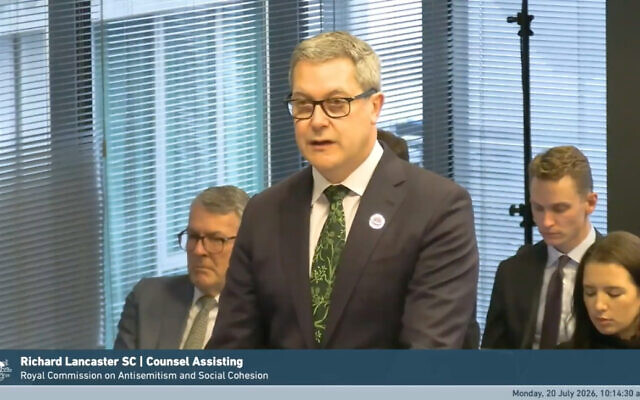
Counsel Assisting Richard Lancaster SC has told the Royal Commission on Antisemitism and Social Cohesion that no other religious or cultural community in Australia carries the security burden the Jewish community must bear simply to attend school, worship or gather, as the commission opened its fifth hearing block – examining Jewish community security.
Opening the block in Melbourne, which will run until the commission returns to Sydney next Monday, Lancaster said the evidence showed a substantial and ongoing threat to the safety and security of the Jewish community in Australia, existing on many fronts.
He cited ASIO’s Director-General of Security’s 2026 annual threat assessment, which noted that hatred of Jews was one thing virtually all violent extremist cohorts had in common — neo-Nazis, Islamic extremists and issue-motivated extremists among them — and that nation states could be antisemitic, as seen in the arson attacks against the Jewish communities in Melbourne and Sydney, perpetrated by criminals directed by Iran’s Islamic Revolutionary Guard Corps.
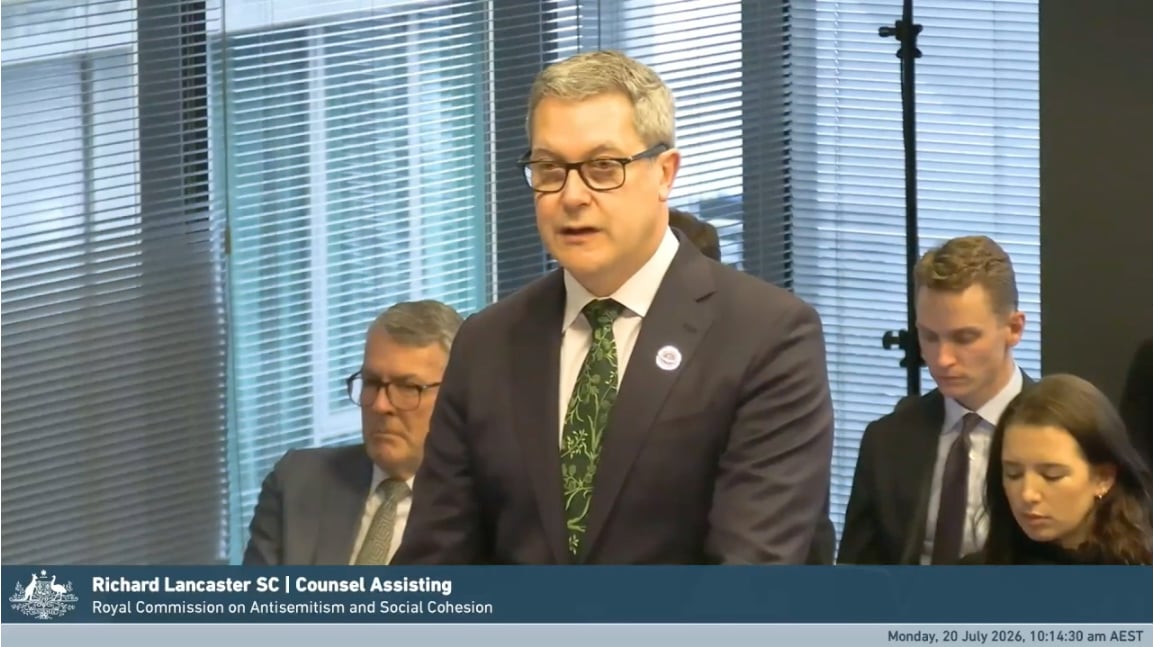
Counsel Assisting Richard Lancaster SC.
Lancaster said many Jewish institutions, in particular schools and synagogues, needed to arrange significant security resources over and above the coverage available from state and federal law enforcement, at significant financial, cultural and personal cost — a burden no other religious or cultural community in Australia had to shoulder simply to go to school, attend a religious service or take part in a community event.
He outlined five categories of evidence the block would examine. The first was the lived experience of Jewish Australians, including a board member of Adass Israel Synagogue, subject to an arson attack in December 2024, and evidence from Jewish leaders abused merely because they were Jewish — the first witness being former attorney-general and member for Isaacs, Mark Dreyfus.
The second concerned government grant funding for protective security, with evidence to come from Executive Council of Australian Jewry co-CEO executive Peter Wertheim on how funding is distributed and from the Department of Home Affairs on how decisions are made.
The third was the role of police, with the block to examine how policing had changed since the Bondi Beach Chanukah attack and to hear from police forces across several states. The fourth was the role of Jewish community security groups, the volunteer-staffed organisations that work alongside police to protect Jewish communities.
The fifth, to be led in Sydney next week, would address measures to prepare, from a security perspective, for any future attack similar to Bondi.
Lancaster said there was a limit to the detail that could be aired publicly without compromising the very security arrangements under examination, and that some evidence would be heard in closed sessions.
He said engagement sessions the commission had held with Jewish communities over the past month had revealed that the security environment was leading to a shrinking of Jewish communal life. A constant theme in submissions from synagogues was the time, energy and money that had to be committed to security, often diverted from religious or cultural programs.
Representatives of one synagogue described cancelling Friday-night services because they could not afford a guard; another that had once held barbecues to support asylum seekers, to which the whole neighbourhood was invited, said such gatherings were no longer possible. One synagogue that opened its premises to interfaith educational activities found an attendee had filmed inside and later used the footage in an antisemitic clip posted online.
Lancaster said the case underscored the difficulty facing the community: if they closed themselves off for security reasons, they risked being unfairly criticised as insular, but without the barriers they wished they did not need, they were left unduly exposed.
He said a school principal had asked commission representatives to imagine sitting final exams with 20 per cent of your brain switched off — the bandwidth Jewish students had to devote instead to the impacts of antisemitism and the security measures it required. No Australian community, the principal said, should face those conditions.
The AJN is providing rolling coverage on the Royal Commission on Antisemitism and Social Cohesion.
The number of antisemitic incidents reported across Australia rose 22 per cent in 2025, marking the highest annual figure ever recorded by the Community Security Group, the Royal Commission into Antisemitism and Social Cohesion heard..
Witness ACP, a former CSG NSW employee who authored the organisation’s annual analysis of reported antisemitic incidents from 2022 to 2025, gave evidence under pseudonym at the commission’s hearing in Sydney. The 2025 report is the third consecutive year to set a record, following an 88 per cent increase in 2023 and a further 26 per cent rise in 2024.
Examined by Counsel Assisting Richard Lancaster SC, ACP outlined the findings of the recently finalised 2025 report, which recorded 1276 antisemitic incidents nationally. Victoria recorded the highest number with 569, closely followed by New South Wales with 543, broadly mirroring the demographic spread of the Jewish community.
ACP told the commission the nature of incidents had shifted.
“In the cases of prior years, such as 2024, most of the incidents that occurred in public places were opportunistic in nature. That’s what we assess in 2025 when they were occurring at synagogues and other Jewish sites. In that regard, it’s assessed to be more targeted, and I guess in the areas in which Jewish people reside.”
The data revealed 247 incidents occurred on Shabbat, and 141 on a Jewish chag.
Fifty-one incidents involved Jewish schoolchildren, a figure ACP described as “still high compared to our previous records, but also on its own is quite substantial”, noting most involved children in Jewish school uniforms travelling to and from school on public transport.
Across the six subcategories, abusive behaviour was the most common at 605 incidents, followed by 237 acts of damage and desecration.
Police were notified of 346 incidents in 2025, resulting in charges relating to 67.
ACP highlighted a 97 per cent increase in charges laid nationally, noting, “I think that goes towards the efforts that have been made by the police to prosecute hate crimes.”
ACP said the 2025 report is expected to be made publicly available shortly.
Enjoy Unlimited Access To The Australian Jewish News Website And All Our Online Content For AUD$18/month Or Just AUD$120/year.



comments