Hearing Block 8 continues looking at antisemitism and extremism in Australia, including religious, far-right and other ideologically motivated extremism and radicalisation.
Assistant Commissioner of the WA Police Force, Joanne McCabe, on the WA Intervention and Support Program, aimed at steering people away from violent extremism
Dr Kelly Mischel, Commissioner for Preventing and Countering Violent Extremism, on the rise of extremism referrals
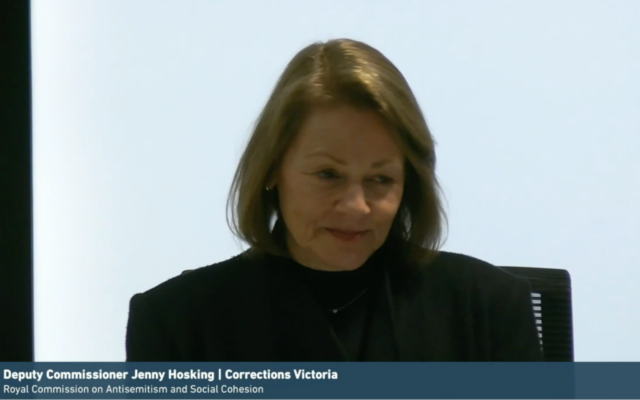
Corrections Victoria’s former deputy commissioner of sentence management, Jenny Hosking, has told the Royal Commission into Antisemitism and Social Cohesion that disengagement, rather than deradicalisation, is the aim of programs managing people convicted of terrorism offences or posing a risk of violent extremism in the state’s prison system.
Hosking, who ceased in the role on July 10 before taking long service leave ahead of retirement, told the commission that Corrections Victoria manages violent extremism through a “countering violent extremism service delivery model” covering identification, assessment, intervention and transition phases, applying to those in Victorian prisons, community correctional services and those under post-sentence supervision.
Asked about the goal of interventions, Hosking said disengagement was “removing a person’s propensity to use violence to promote their causes and beliefs” — what a person believed was not the issue, only whether they acted on it violently.
She said dispersing extremist prisoners, rather than housing them together, was Corrections Victoria’s approach, noting prisons were known locations of radicalisation and that spreading individuals with extremist views among the general population also exposed them to perspectives that might challenge their own.
Photo: Screenshot
Hosking outlined the roles of several internal units, including the Corrections Victoria Intelligence Unit, the Complex Classification Unit and forensic intervention services, which she said delivered offence-specific treatment through psychologists, social workers and occupational therapists.
She confirmed she personally conducted annual reviews with each convicted terrorism offender, describing the meetings as a “problem-solving forum” that fed into a prisoner’s broader sentence plan.
On funding, Hosking said current resourcing was “adequate” for present demand, though she flagged that short-term and retrospective funding cycles made it difficult to retain experienced staff. “If the funding’s not approved until May and the contract finishes in June, people are very uncomfortable remaining in a position, and we lose good people,” she said, adding that longer-term funding certainty was needed.
Hosking also gave evidence on two intervention programs — the Community Integration Support Program, targeting Islamic-motivated extremism and delivered by the Board of Imams Victoria under contract to Victoria Police, and the Network for Intervention and Tailored Engagement, focused on right-wing extremism — though she declined to elaborate on program benefits in open session.
She confirmed offenders convicted of terrorism-related offences were often found unsuitable for rehabilitation and reintegration permits allowing temporary release from custody.
The hearing adjourned before moving into closed session.
Victoria has recorded a sustained rise in referrals to its countering violent extremism programs since the Israel-Gaza war began, with further spikes after the Bondi attack, the state’s first Commissioner for Preventing and Countering Violent Extremism has told the Royal Commission on Antisemitism and Social Cohesion.
Dr Kelly Mischel, a forensic psychologist appointed in April to lead Victoria’s Strategy for Preventing and Countering Violent Extremism 2025-28, gave evidence on Friday that the conflict was being felt directly in the state’s intervention schemes.
“In the last three years since the conflict began, we have seen an escalation in referrals,” she said, describing people who had engaged with extremist content or been identified as vulnerable “based on some of that conflict that’s happening in the Middle East, and specifically how it reverberates in Australia and in a local context”.
Some had latched onto online material that “may be misinformation”, she said.
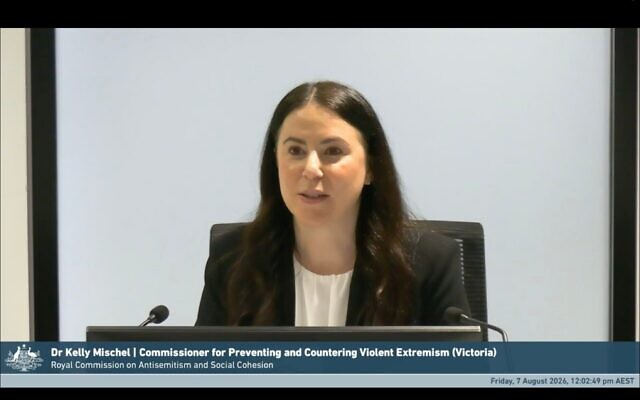
Dr Kelly Mischel, Commissioner for Preventing and Countering Violent Extremism for Victoria. Photo: Screenshot
Referrals also climbed after the Bondi attack and again after the launch of the national Step Together program, as public awareness of intervention pathways grew. Mischel said funding had to keep pace.
“It is incredibly important that we have sustained funding that not only supports the programs in the current state, but the way that the programs are growing and evolving,” she said.
She told the commission the ideologies themselves were changing shape. Categories once treated as distinct were now blending, with individuals holding fragments of several at once. She gave the example of people drawn to white supremacism who also promoted conspiracy theories, and others who supported elements of both ISIS and neo-Nazi ideology.
“Those categories which were clearly quite distinct previously are now merging,” she said.
Political polarisation was a related driver. Opinions that once admitted nuance had hardened into positions where “someone’s ideology or someone’s political opinion is either one thing or the other, without any space for nuance”, she said.
Victoria runs the country’s only legislated early intervention scheme, a voluntary case management program that became operational in September 2022 and received its first referral in January 2023. Eligibility begins at age 10. Mischel said she was not part of the decision to set that age, but that children that young had been referred.
“There have been cases, and we do have children as young as 10 that have been referred to programs,” she said.
Referrals come solely from Victoria Police, which collates notifications from government agencies and the community. A dedicated pathway exists between the Department of Education and Victoria Police for concerns raised by teachers.
The program is what Mischel called “ideologically neutral”, responding to any form of extremism, with case managers trained across the full ideological spectrum.
A parallel mandatory scheme, the support and engagement order, has never been used. Introduced in 2021 and available for anyone over 14 who is radicalising towards violence and has refused voluntary support, it remains the only mandated countering violent extremism order in Australia.
Mischel said the threshold was high and the decline rate for voluntary programs nationally was only 16 per cent. The government is reviewing how the order would be operationalised, but not the threshold itself.
Asked about measures specific to antisemitism, Mischel pointed to research on interpersonal perspective-taking conversations, sometimes called contact dialogue, between Jewish and non-Jewish community members. The evidence for its effectiveness was strong, she said, but it could not be scaled.
No Victorian program currently focuses on that approach.
“Our challenge is to try and identify other programs that have that same efficacy, but can be delivered in a way that is more comprehensive,” she said. The department is instead examining pre-bunking and critical thinking initiatives.
Mischel also described the toll the conflict was taking on both Jewish and Muslim Victorians, citing “a degree of vicarious trauma that sits across both communities”, including the experience of Islamophobia and the experience of antisemitism.
On countering hate online, she said the difficulty was less the content than the delivery. Information now spreads in short form digital formats driven by algorithms, “highly emotive and repetitive”, and counter narratives had to be built to match. She cited social psychology research showing people accept information more readily when it arrives from peers or trusted online communities.
Much of the work, she said, depended on people outside government noticing warning signs early, whether in schools, healthcare, sport or families. Citing the ASIO director-general’s observation that the agency does not have eyes and ears everywhere, she said countering extremism “is not just the responsibility of government; it’s the responsibility of the wider community”.
A Western Australian police program aimed at steering people away from violent extremism is commissioning research to better understand young people presenting with “mixed, unclear and unstable” ideologies that are increasingly difficult to assess, the Royal Commission has heard.
Assistant Commissioner Joanne McCabe of the WA Police Force gave evidence on Friday, via video link, about the WA Intervention and Support Program (WAISP), a countering-violent-extremism scheme that has operated since 2015. She described it as a voluntary, consent-based and non-punitive pathway that focuses on behavioural indicators, escalation risk and potential harm “rather than the mere presence of extremism beliefs”.
Western Australia Police Assistant Commissioner Joanne McCabe.
McCabe said the program took an “ideology neutral” approach, and had deliberately evolved away from focusing too heavily on categorising a person’s ideology towards a broader “needs-based model”. Shifting someone’s ideology was “not always a simple task” and was difficult to measure, she said, whereas the program was designed to steer people away from violence. “Sometimes we see that behaviour change in the extremism and the ideology happen as a result of that,” she said.
She said a research initiative, the “bridging the gap” project, currently at the procurement stage, would examine best-practice models and the program’s own data to improve the assessment of young referrals with unclear ideologies. Such presentations were “very varied”, she said, and hardest to categorise when “not clearly racist” or based on a clear religious ideology, often combining “political grievance and government grievance” with elements of religion and racism.
McCabe said referrals came from the community through Crime Stoppers and the program’s website, from internal police reports, and from agencies including education and health, as well as national security and counter-terrorism partners. Referrals were triaged at a daily intelligence briefing involving the State Security Investigations Group, the Fixated Threat Assessment Centre, the Countering Violent Extremism Unit, and external partners including ASIO and the AFP. Participation was voluntary, she stressed, and did not require any admission of wrongdoing or any criminal offending.
Interventions were highly individualised, McCabe said, and could focus on strengthening protective factors, reducing exposure to extremist influences — particularly online content encountered by young people — and addressing unmet psychosocial needs through health referrals. The program had access to operational psychologists and health practitioners.
She defended the program remaining police-led, while acknowledging “some debate” about the model. “All models have their limitations and strengths,” she said, but being police-led gave the program strong risk-assessment capability, access to intelligence and public-safety information and well-established referral pathways, while remaining “very therapeutically delivered”.
McCabe said funding had received “a significant uplift since about 2023”, which she considered appropriate, though she noted mismatched federal and state budget cycles and procurement timeframes had at times caused underspends that had to be carried into the following financial year. A second project, following a 2025 review, would engage a communications contractor to raise public awareness of the program and of the behavioural signs the community should watch for.
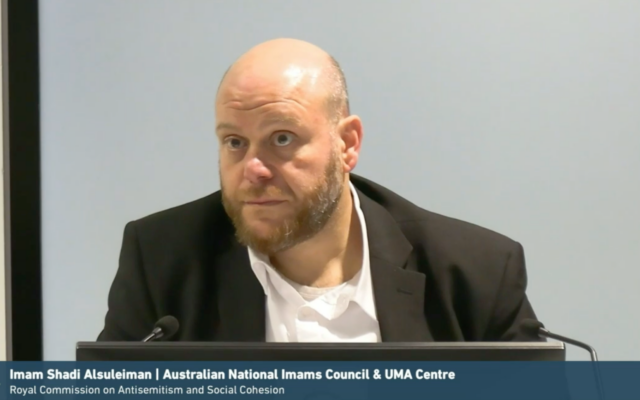
The president of the Australian National Imams Council (ANIC) has conceded that a Lakemba sermon delivered the day after the October 7 attack was “inappropriate” and “a mistake”, but was pressed at the Royal Commission over why the council’s only public statement defended the speech rather than acknowledging any problem with it.
Sheikh Shadi Alsuleiman gave evidence about a joint statement ANIC supported concerning a speech given by Imam Ibrahim Dadoun at Lakemba on October 8, 2023. In the speech, Dadoun said: “I’m smiling and I’m happy. I’m elated … It’s a day of pride. It’s a day of victory. This is the day we’ve been waiting for.”
Under cross-examination by Nicholas Bender SC, appearing for Jewish communal bodies, Alsuleiman accepted that ANIC’s leadership had regarded the language used on October 8 as inappropriate, that religious leaders needed to be more responsible in what they preached, and that he had personally counselled Dadoun about the speech.
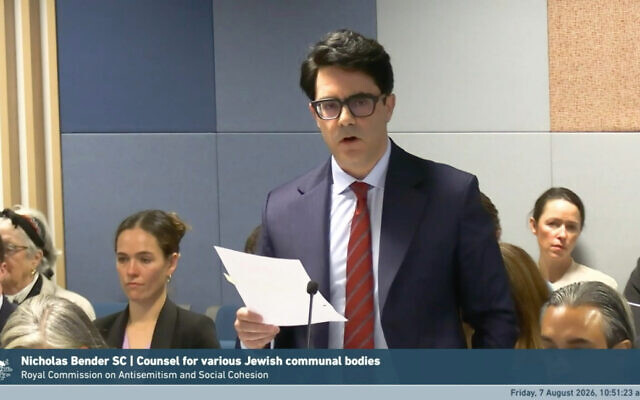
Nicholas Bender SC, Counsel for Jewish communal bodies.
He also accepted the speech, on its face and without explanation, could be understood as expressing pride in the October 7 attack.
But Bender pressed him on the fact that the statement ANIC supported — the council’s only public-facing comment on the speech until its evidence to the commission — nowhere described the sermon as inappropriate. Instead, the statement said it was “regrettable that certain media outlets and politicians took the words of an imam entirely out of context”, and “deplored” media coverage said to incite anti-Palestinian sentiment.
“Isn’t there a difficulty,” Bender asked, in ANIC privately viewing the speech as a mistake warranting counselling, while its public position was that the speech “is something that ought to be defended, and that those who had criticised it, including the media and politicians, ought to be attacked”?
Alsuleiman rejected that reading. “I don’t read the statement this way,” he said, adding that it addressed the marginalisation of the Muslim and Palestinian communities and the suffering of the Palestinian people. He said ANIC strongly condemned the killing of innocent people “regardless of their background, their ethnicity, and their race”, and that the statement had been drafted by others during a week of high tension, rising Islamophobia and threats against Muslim leaders.
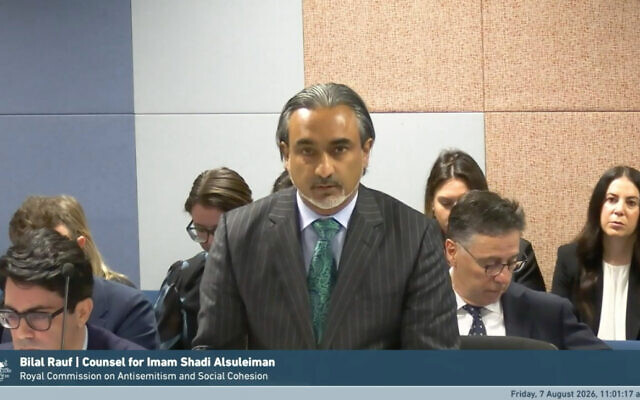
Bender put to him that if ANIC’s only response to such a speech was private counselling, with no public acknowledgement, the wider community and other imams “might proceed on the footing that ANIC supports the language of the speech”. Alsuleiman disagreed, saying the council had internal mechanisms to engage with imams but did not have authority over what they said. Bilal Rauf, counsel for the imam, objected that the questioning disregarded evidence about the clarifying of the statements and took too literal a view; Commissioner Virginia Bell ruled the question was within reasonable bounds.
Bell asked Alsuleiman whether ANIC had reached out to the Jewish community after the massacre of 15 people at Bondi on December 14 last year. He said it had. “While this is a targeted attack on the Jewish community, it is an attack on all communities, including the Muslim community, who stood shoulder to shoulder by the Jewish community post Bondi,” he said, adding that ANIC representatives had visited synagogues and met Jewish leaders.
Bilal Rauf, Counsel for the Sheikh Shadi Alsuleiman.
In re-examination by Rauf, Alsuleiman explained ANIC’s objection to the term “radicalisation”, telling the commission it was a term the council avoided because it could be “misunderstood” and “counterproductive”, preferring to speak of “guiding people when they are misguided”.
He also set out his views on the wider conflict, claiming more than 100,000 Palestinians had been “massacred and killed” since October 2023, and describing the situation in Gaza as an “illegal blockade” of more than 15 years that had been called “the largest open-air prison”.
He said the reference to breaking the blockade was how he had understood the speech, framing it as a humanitarian concern: “I don’t want to see any human being … endure the hardships [that] the Palestinian people [have] been suffering.”
Australia does not have a registered higher education provider capable of training Muslim religious leaders, the Royal Commission on Antisemitism and Social Cohesion has heard, with the president of the Australian National Imams Council describing a widening gap between overseas-trained clerics and the Australian-born community they serve.
ANIC president Sheikh Shadi Alsuleiman, who is also founder of the Australian Islamic Institute of Higher Education, told the commission that the institute was established to address the shortfall.
“That institute was established for the purpose of having the first Islamic higher education provider that can start producing homegrown imams and religious leaders for the next generation who are born and raised here in Australia from the Muslim community,” he said.
Alsuleiman noted the institute would also accommodate female religious leaders, not just imams. The institute is yet to receive registration from the Tertiary Education Quality and Standards Agency (TEQSA).
He told counsel assisting Richard Lancaster SC the current situation left two options: bringing imams from overseas or sending Australian Muslims to study abroad.
“One of the challenges that we see with imams who come from overseas, who are trying their best to accommodate for the community, is that there is a big gap with understanding the cultural understanding of the Australian context and the language,” he said.
He described the emergence of third and fourth-generation Australian Muslims and said the disconnect with religious leadership was growing.
“The vast majority of Australian Muslims are born and raised in Australia,” he said. “And as more generations continue to emerge, the gap continues to widen.”
Alsuleiman told the commission more than 800,000 Australians identified as Muslim according to the 2021 ABS census, with nearly 80 per cent of the community under 45. He said ANIC’s education and awareness work included guiding imams through the affiliated UMA (United Muslims of Australia) Centre in Padstow, which welcomes more than 1000 visitors daily.
He also detailed a sharp rise in Islamophobia since October 2023, saying reports to ANIC’s register had increased by more than 600 per cent, with women wearing hijab, elderly community members and young Muslims particularly targeted. He said ANIC was administering a safety and security uplift grant from the federal government to improve the physical safety of Muslim organisations across all sects nationally.
Commissioner Virginia Bell asked Alsuleiman about extreme strands of purportedly Sunni teachings. He told the commission he was placed on an ISIS kill list in 2017 alongside 38 religious leaders worldwide.
“ISIS is a terrorist, dangerous organisation that has no links to Islam,” he said. “We’ve made that publicly in the past, and they are the enemy of the entire humanity, including Muslims.”
Australian National Imams Council (ANIC) president Sheikh Shadi Alsuleiman has agreed that comments made by Imam Ibrahim Dadoun at Lakemba on 8 October 2023 could fairly be understood as celebrating the attack on Israel, but defended the council’s decision to counsel rather than discipline him.
Giving evidence at the Royal Commission on Antisemitism and Social Cohesion, Alsuleiman told counsel assisting Richard Lancaster SC he was not present at Lakemba that night but had since watched video of the comments and read a transcription obtained by commission staff.
Asked whether the comments could be understood as expressing pride and happiness in the violent attack on Israeli citizens in southern Israel, Alsuleiman replied: “On the face of it, without explanation, yes.”
He also agreed the comments could fairly be read as expressing happiness about individuals breaking through the border barrier, and conceded they were possibly likely to inflame the crowd.
Alsuleiman confirmed ANIC had no forewarning of the speech and that the comments did not represent ANIC’s position.
Lancaster asked about Dadoun’s standing within ANIC at the time. Alsuleiman said Dadoun had resigned from ANIC’s executive committee before October 2023 and remained an active member. However, Lancaster noted that ASIC records indicated Dadoun was still a director of ANIC Limited on 8 October. Alsuleiman said the records had since been updated.
ANIC asked Dadoun to clarify his position publicly, which he did via a Facebook post the following day. In it, Dadoun said he was “elated” about “Palestinian people breaking the blockade”. Alsuleiman conceded the post did not include an apology.
“We spoke to him, and we did raise the concerns with regards of the language that he used on that day, and the killing of innocent people must not be condoned in any way, in any form, in any shape,” Alsuleiman said. “And celebrating the killing of innocent people is not a responsibility, and it’s not right by a religious leader and anyone in the public.”
Asked why ANIC chose guidance over disciplinary action, Alsuleiman said the council’s philosophy was that “including our imams, even when they make mistakes or serious mistakes, and guiding them through those mistakes and keeping them within the fold of ANIC is a lot more healthier and helpful for the organisation, for the individual, and for the community.”
Alsuleiman confirmed ANIC does not control mosques or the conduct of individual imams, and that its role is advisory. Individual institutions exercise employment and managerial authority over their religious leaders, he said.
On 12 October 2023, four days after Dadoun’s speech, ANIC co-signed a joint statement with a number of other organisations condemning “all calls and incitement to violence and hatred of any people” including conduct that is “antisemitic, anti-Muslim, or Islamophobic”. Alsuleiman said ANIC did not author the statement but approved the use of its logo and reviewed it with the ANIC board.
Alsuleiman agreed Dadoun should not have made the comments.
The AJN is providing rolling coverage on the Royal Commission on Antisemitism and Social Cohesion.
Australia does not have a registered higher education provider capable of training Muslim religious leaders, the Royal Commission on Antisemitism and Social Cohesion has heard, with the president of the Australian National Imams Council describing a widening gap between overseas-trained clerics and the Australian-born community they serve.
ANIC president Sheikh Shadi Alsuleiman, who is also founder of the Australian Islamic Institute of Higher Education, told the commission that the institute was established to address the shortfall.
“That institute was established for the purpose of having the first Islamic higher education provider that can start producing homegrown imams and religious leaders for the next generation who are born and raised here in Australia from the Muslim community,” he said.
Alsuleiman noted the institute would also accommodate female religious leaders, not just imams. The institute is yet to receive registration from the Tertiary Education Quality and Standards Agency (TEQSA).
He told counsel assisting Richard Lancaster SC the current situation left two options: bringing imams from overseas or sending Australian Muslims to study abroad.
“One of the challenges that we see with imams who come from overseas, who are trying their best to accommodate for the community, is that there is a big gap with understanding the cultural understanding of the Australian context and the language,” he said.
He described the emergence of third and fourth-generation Australian Muslims and said the disconnect with religious leadership was growing.
“The vast majority of Australian Muslims are born and raised in Australia,” he said. “And as more generations continue to emerge, the gap continues to widen.”
Alsuleiman told the commission more than 800,000 Australians identified as Muslim according to the 2021 ABS census, with nearly 80 per cent of the community under 45. He said ANIC’s education and awareness work included guiding imams through the affiliated UMA (United Muslims of Australia) Centre in Padstow, which welcomes more than 1000 visitors daily.
He also detailed a sharp rise in Islamophobia since October 2023, saying reports to ANIC’s register had increased by more than 600 per cent, with women wearing hijab, elderly community members and young Muslims particularly targeted. He said ANIC was administering a safety and security uplift grant from the federal government to improve the physical safety of Muslim organisations across all sects nationally.
Commissioner Virginia Bell asked Alsuleiman about extreme strands of purportedly Sunni teachings. He told the commission he was placed on an ISIS kill list in 2017 alongside 38 religious leaders worldwide.
“ISIS is a terrorist, dangerous organisation that has no links to Islam,” he said. “We’ve made that publicly in the past, and they are the enemy of the entire humanity, including Muslims.”
Enjoy Unlimited Access To The Australian Jewish News Website And All Our Online Content For AUD$18/month Or Just AUD$120/year.




comments