Live updatesPublic hearings

Royal Commission hears from Jewish leaders and senior government officials

Hearing Block 5 of the Royal Commission continues today, examining security arrangements, government funding and police coordination for the Jewish community.

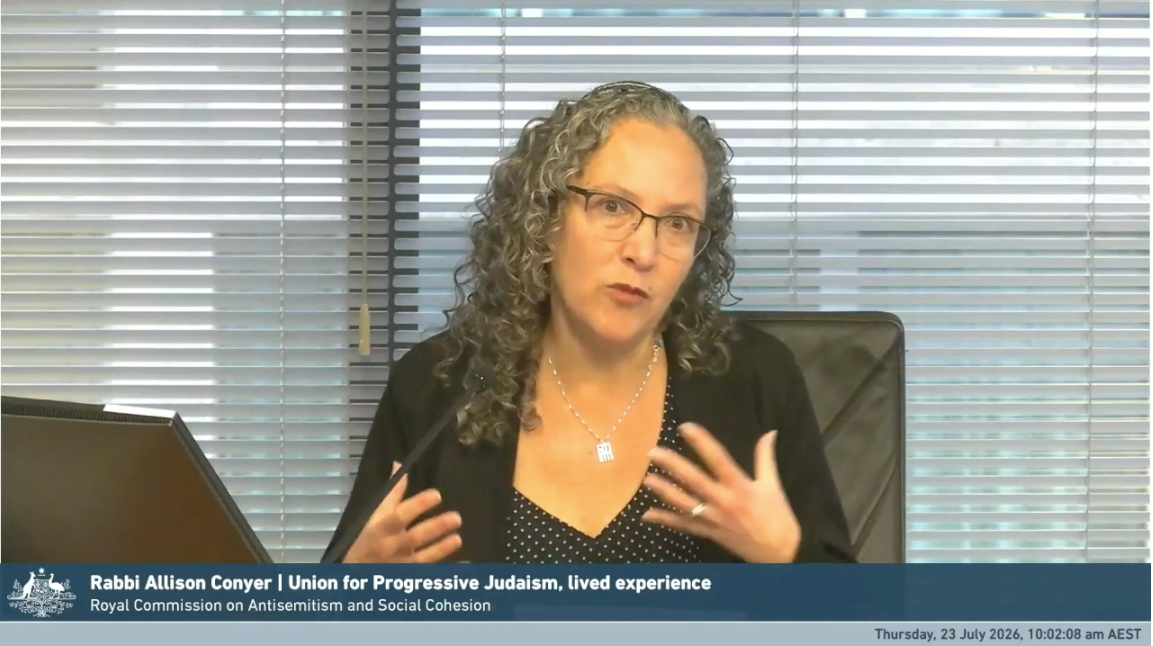
Temple Beth Israel senior rabbi Allison Conyer.

Read the reports

Temple Beth Israel Senior Rabbi, Allison Conyer, on the normalisation of Jew-hatred, which has persisted for thousands of years, mutating across eras and ideologies

Rabbi Allison Conyer on the financial and emotional burden that is straining congregations and driving families away from Jewish life

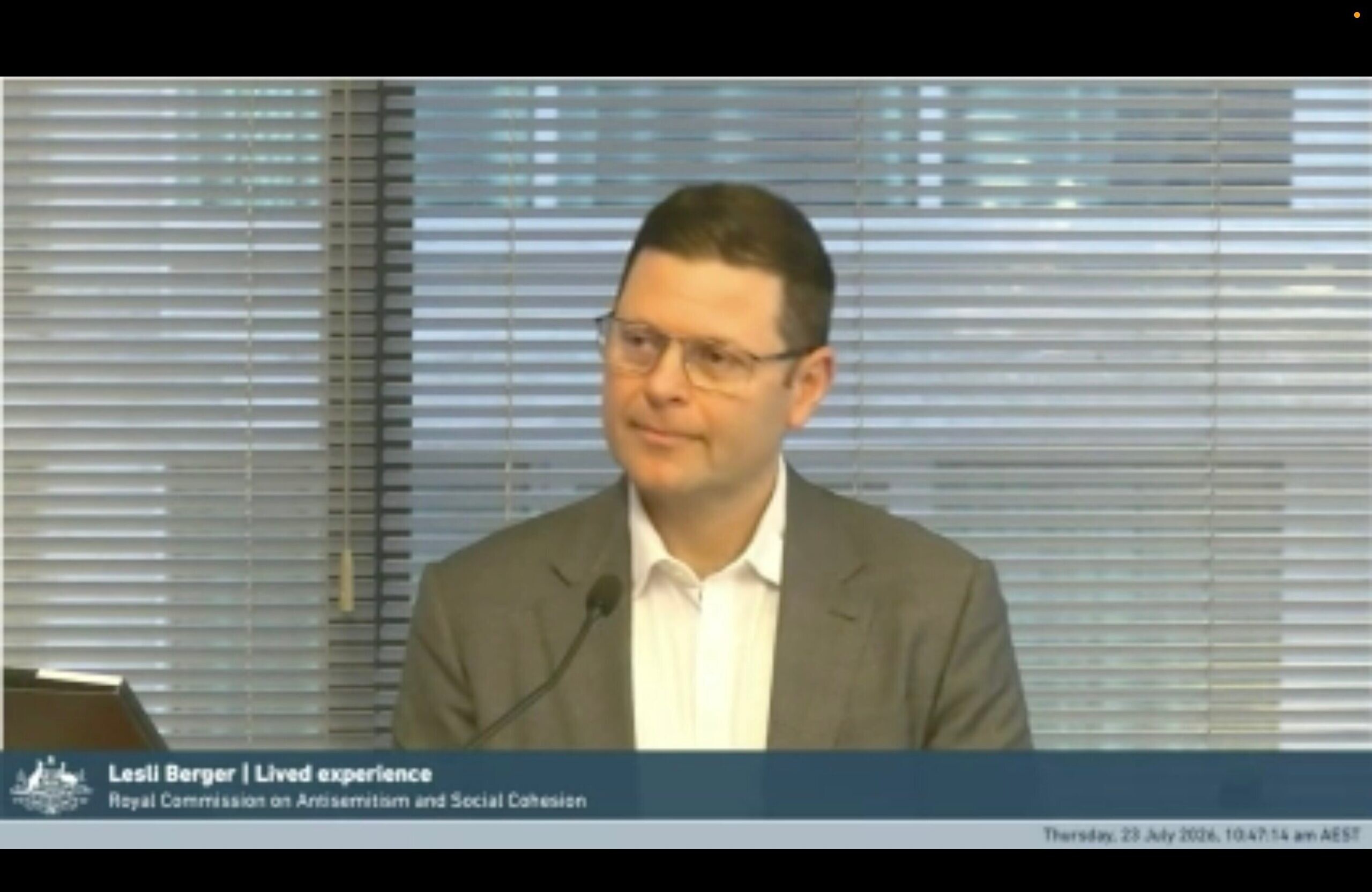
Immediate past president of the NSW Jewish Board of Deputies, Lesli Berger, on the impact on his family after a swastika was graffitied on the back fence of his property

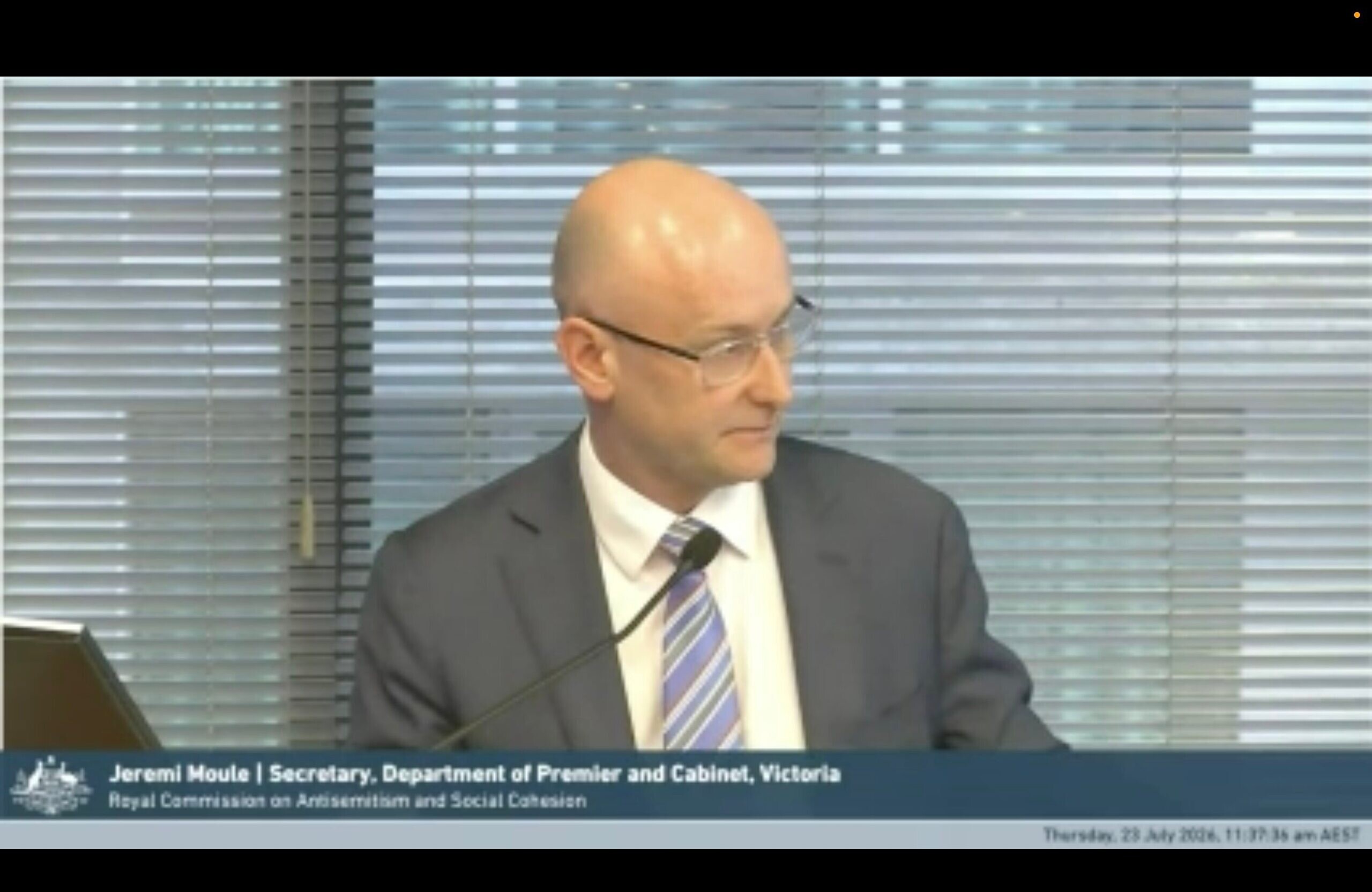
Jeremi Moule, secretary of the Department of Premier and Cabinet in Victoria, on funding for the Jewish community of Victoria

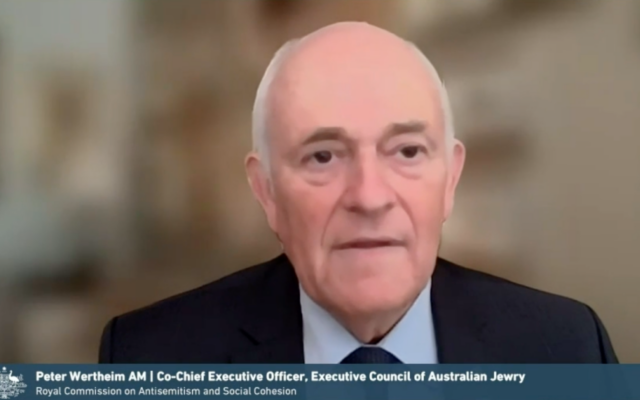
ECAJ co-CEO Peter Wertheim on the Jewish community covering costs of security despite current Commonwealth funding for Jewish community security as it always falls short of the community’s needs

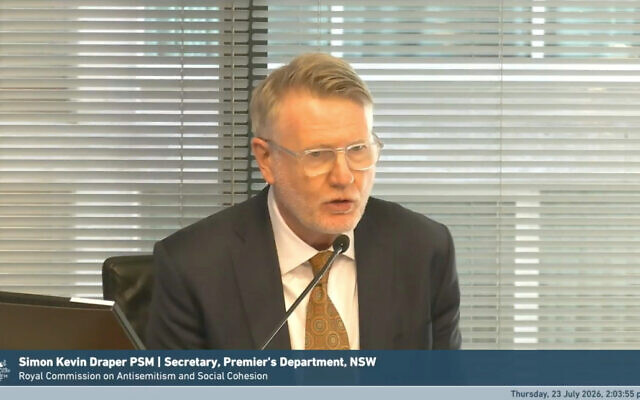
NSW Premier’s Department secretary Simon Draper on funding committed by the state government for Jewish community security

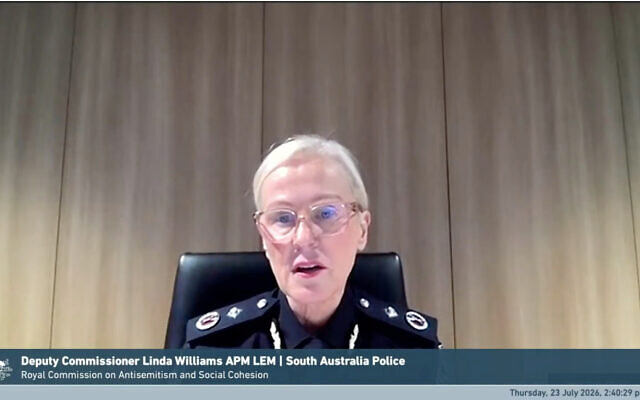
South Australia Police Deputy Commissioner Linda Williams on the increase in reported antisemitic conduct since October 7, 2023

Reported antisemitic incidents in SA rose two years running

South Australia Police Deputy Commissioner Linda Williams has told the Royal Commission on Antisemitism and Social Cohesion that reported antisemitic incidents in the state rose in 2024 and again in 2025 before easing in 2026, and that the force can extract antisemitic-incident data from its systems despite having no specific hate-crime classification.

Giving evidence on Wednesday by video link, Williams — a deputy commissioner since 2015 with 46 years of policing experience — said South Australia Police intelligence holdings showed an observable increase in reported antisemitic conduct immediately after October 7, 2023. Numbers rose in 2024 and increased again in 2025, she said, before falling in 2026 to July 1. The volumes were not particularly high, she said, but had been recorded in the system.

Williams said the force’s records management system, known as Shield, classified offences according to South Australia’s legal framework — assaults, stalking, harassment, threats and the like — rather than under any specific hate-crime category, the exception being a Summary Offences Act provision dealing with the display or publication of particular symbols, which captured some antisemitic material.

South Australia Police Deputy Commissioner Linda Williams appears via videolink.

Officers could, however, flag an incident as hate-related, including on the basis of religion or Judaism, using drop-down fields supported by a narrative record, and could attach flags of concern to a person where behaviour suggested an ideological motivation. That meant, she said, that figures such as the number of antisemitic incidents in a given year could be extracted from the database if required.

Asked whether resourcing pressures had affected the force’s ability to provide sustained, visible policing at Jewish community sites, Williams said they had not, as the force rebalanced its resources and adjusted deployments to meet priority risks as they arose. Identifying those priority risks, she agreed, required data alongside on-the-ground reports and the relationships police maintained with communities.

Monitoring of hate-related incidents drew on recorded data, the ASIO threat assessment, incoming intelligence and community sentiment, with each district and region maintaining its own intelligence capability to assess local trends — an ongoing process, she said, not a once-a-year exercise.

Williams confirmed a report of an attack on an Adelaide home on July 11, in which antisemitic slurs and swastikas were applied to a fence at a residential property occupied by a Jewish family.

She said a strong, visible police presence mattered in such cases, both to reassure victims and to send a message about the seriousness with which police treated the conduct, noting the acting assistant commissioner had held a press conference on the day to condemn it and appeal for witnesses. The investigation remained ongoing, she said, which was all she was comfortable saying in an open hearing.

The commission directed that the remainder of Williams’ evidence be heard in a closed session.

NSW government committed almost $2.5m to Jewish community security

NSW Premier’s Department secretary Simon Draper has told the Royal Commission on Antisemitism and Social Cohesion that the state government committed almost $2.5 million to Jewish community security between October 2023 and June this year, drawn from discretionary funds.

Giving evidence on Wednesday, Draper, who has led the department since September 2023, said the most profound escalation of antisemitism had come in late 2024, when a series of attacks struck Jewish homes, places of worship, schools and other sites. That, he said, was the most significant trigger for the government’s security funding response.

NSW Premier’s Department secretary Simon Draper.

Draper said the department had not historically had a dedicated grants program for protective security, and had instead drawn on two discretionary sources he or the Premier administer — the Premier’s Discretionary Fund, which holds $2.3 million a year, and the Premier’s Department Contingency Fund, which holds $5 million. The funds were designed for urgent or one-off needs that could not be foreseen, such as natural disasters, he said, and could be topped up through Treasury if exhausted. The government did not undertake security measures itself, but funded community groups to do so through binding funding deeds.

Between October 7, 2023 and June 22, 2026, he said, the department committed $2,463,590 to Jewish community security. He detailed several grants: about $338,000 approved from the contingency fund in December 2024 as attacks mounted and Chanukah approached; a further $340,000 from the Premier’s fund to extend that support as the rate of attacks accelerated; about $109,000 in early 2025 for security for a place of worship and an individual; a grant for a synagogue security fence; and $1.5 million approved on December 23, 2025, to the NSW Jewish Board of Deputies for key Jewish sites in the immediate aftermath of the Bondi Beach attack. In each case, he said, the department acted on advice from the NSW Jewish Board of Deputies, CSG and NSW Police about what police taskings could and could not cover.

Draper said none of the grants required a co-contribution from the community — unlike the Victorian model the commission had heard about earlier — as such conditions might slow the delivery of urgent security. He acknowledged the Jewish community already provided much of its own security, but said that was not a condition of funding.

After the Bondi attack, he said, the Commonwealth had offered to jointly fund security measures given the national significance of the event, with the two governments working closely at an officer-to-officer level. Draper suggested a shared register of available funding would help governments coordinate and move even faster, and said pre-agreed funding packages for terrorist incidents — modelled on the disaster recovery funding arrangements used for natural disasters — could be worth developing. He said the department was also moving towards a more sustainable community-focused grants program to sit alongside its agile discretionary funds.

Jewish community ‘always playing catch up’ on security costs

ECAJ co-CEO Peter Wertheim has told the Royal Commission on Antisemitism and Social Cohesion that despite significant Commonwealth funding for Jewish community security, rising costs mean the community is perpetually falling short.

Wertheim outlined a three-year funding agreement executed between the Department of Home Affairs and ECAJ, totalling $124 million from May 2026 to June 2029. 

Counsel assisting Richard Lancaster SC took Wertheim through the evolution of Commonwealth security funding since 2007, including a $25 million emergency grant after October 7, 2023, and a further $32.5 million following the Adass Israel Synagogue firebombing in 2024.

“The amounts that we’ve requested are always estimates based on what has occurred up to the point where we provide that estimate. So in a sense, we’re always playing catch up because the costs keep increasing and the level of need for security measures keeps increasing,” Wertheim said.

The current funding round has attracted 192 applications.

Wertheim used his testimony to push back forcefully against public claims that the ECAJ could spend the funds without oversight. Responding to a senator’s media release asserting the ECAJ was “at liberty to allocate the funds as it sees fit”, Wertheim said, “The suggestion that we can allocate these funds as we see fit is just an outrageous falsehood.”

Photo: screenshot

He said the claim had fuelled antisemitic commentary online, including assertions that the ECAJ was funnelling money to Israel or using it for political advocacy.

“It’s worse than that because it gives rise to the kind of hostile sentiment in the wider community that produces antisemitism and produces the need for security funding that we’re … we’d much rather do without if we could have a safe community,” Wertheim said.

Wertheim pointed to a recent incident at Bondi Beach to illustrate the environment the community faces. He told the Commission two of his colleagues were verbally abused during a goodwill visit by a football club to the site where 15 people were killed, despite police and media being present.

He told the Commission the Jewish community’s “overwhelming sentiment” was a preference to live without antisemitism and without the security spending it necessitates, before the hearing moved to closed session to examine grant administration details.

No Victorian funding for aged care or leaders’ security, inquiry told

Jeremi Moule, Secretary of the Victorian Department of Premier and Cabinet. Photo: Screenshot

Victoria has no dedicated funding programme for security at Jewish aged care facilities or for the protection of Jewish communal leaders, the state’s most senior public servant has told the Royal Commission on Antisemitism and Social Cohesion.

Jeremi Moule, secretary of the Department of Premier and Cabinet, gave evidence on Thursday, adopting a witness statement dated 2 July 2026 with a correction to paragraph 11.

Moule told the commission that since the 2023-24 state budget, the department had provided $3.7 million through its multicultural and multifaith portfolio for 22 Jewish community projects that were primarily security related.

Asked about aged care, he said the sector was a Commonwealth responsibility.

“I’m not aware that there is a specific Victorian funding programme that supports Jewish aged care facilities,” he said.

Counsel assisting took him to correspondence tendered in an earlier hearing block through the statement of Jewish Care Victoria chief executive Gail Smith. A departmental officer had told the organisation it was not assessed as eligible under the Jewish Community Security Infrastructure Programme because it “primarily provides health and related services”, which fell under other ministerial portfolios.

Moule said the government would consider the question if it were put to it.

“If representations were made to the government in relation to security funding for aged care facilities in Victoria, then that is certainly a matter the government would consider,” he said.

On the security of communal leaders, he said, “There is not a specific programme to support security arrangements for individuals in leadership positions in any multicultural, multi-faith organisations,” he said, including leaders of the Jewish community.

An existing programme covers security assessments for ministers and, in recent times, for members of parliament across the chamber where a threat has been assessed as requiring a response. Asked whether that model was designed to assist parliamentarians of particular faith backgrounds, Moule said: “It is not set up to do that in particular.”

He told the commission that the Bondi Chanukah attack had produced a shift in what state security grants would pay for. Programmes had previously concentrated on physical infrastructure such as fences and gates.

Following direct engagement with the Local Escalation and Help group and other parts of the community after the attack, the government announced a package covering operational costs, including security for events, youth camps and gatherings scheduled for December and January.

“There were specific concerns about those youth camps and security in relation to those,” he said.

Moule would not say whether operational security funding would become a permanent feature of Victorian grants programmes.

“I think this funding package was designed to deal with a very acute need at that time and some very pressing issues,” he said, adding that enduring funding of that kind had not previously been raised with him and that his department had never advised government on it as a policy matter.

He said the evidence before the commission and conversations with government meant the question would now be “under active consideration”, and described the prospect as “certainly a welcome conversation”.

The commission also heard that the Victorian Safer Faith-Based Schools programme, which has run annually since 2023-24 with $2 million allocated each year, is administered by the Department of Education and is open to both Jewish and Islamic schools on a competitive, merit-based basis. Moule agreed the programme was intended to lessen the security burden on those schools, but said full offset of their costs was not its objective.

He was also asked about co-contribution requirements, which apply to the 2025-26 multicultural infrastructure and security programme. Two Jewish organisations received security-related funding through that stream in 2025-26.

Moule said co-contributions were sought where government needed confidence that an organisation could deliver and maintain a project, and agreed that the case for requiring one differed between a community hall renovation and an urgent security upgrade. More direct or expedient allocations could be made where the need was urgent.

Security for the Jewish Pillars of Light Festival at Federation Square is procured directly through the Melbourne Arts Precinct Corporation, he said, as an extension of the precinct’s existing security contract rather than a separate grant.

Moule said the department had increasingly coordinated with the Commonwealth on grant assessments, at times inviting federal representatives onto assessment panels, and suggested a more formal state-Commonwealth arrangement could follow.

He said no security funding model could remain static.

“The rise in antisemitism in Australia and in Victoria is an issue to which the government has needed to be responsive,” he said.

Berger tells inquiry of swastika on his home

Lesli Berger, immediate past president of the NSW Jewish Board of Deputies. Photo: Screenshot

The immediate past president of the NSW Jewish Board of Deputies has told the Royal Commission on Antisemitism and Social Cohesion that his two youngest children were so frightened after the Bondi Chanukah attack that they refused to stay in the family home.

The attack came about a year after a swastika was graffitied on the back fence of the property.

Lesli Berger, who led the Board of Deputies from August 2018 to August 2022, gave evidence on Thursday.

Berger told the commission he was confronted by the graffiti at the end of December 2024.

“I got a big shock because on the back fence of my home, a Nazi swastika had been graffitied with some words,” he said, adding that the symbol had been painted the wrong way around.

“Even when I look at this picture now, I can’t believe this happened to my home.”

Asked what the image meant to him, Berger pointed to his family history. Both his paternal grandparents survived concentration camps before settling in Australia after several years in Israel.

“It’s the symbol of hatred of the political movement that wanted the extermination of the Jewish people. It’s the political movement that killed most of my family on my father’s side,” he said.

The graffiti was reported to police, and the deputy mayor of Woollahra Council offered to have it removed immediately, an offer Berger said he appreciated. Police asked that it remain in place for a day or two while they investigated. He was told months later that there were no firm leads.

Berger said the incident prompted him to shut down his social media accounts, remove his address from public records and spend tens of thousands of dollars on home security.

He became emotional describing 14 December, when his two younger children were home alone as news of the Bondi attack spread through social media and WhatsApp. His middle son called his best friend, whose mother collected both children and took them to her home.

“He didn’t feel safe in our home,” Berger said.

“Sorry, I find it difficult to talk about this. I felt that I had failed as a parent.”

Berger, who has three children aged 19, 16 and 12, said he had been in an Uber on Bondi Road with his wife when police cars sped past, and it was more than an hour before he could confirm that his eldest son, who was in the Bondi area at the time, was safe.

He said the experience had made him question the value of the outreach and interfaith work he had undertaken as president.

“At that moment, I felt that it really was all for naught.”

Berger, who also served as a vice-president of the Executive Council of Australian Jewry and sat on the board of the Community Security Group, said the threat environment was now a serious disincentive to communal leadership. He remains an ECAJ councillor.

“There are constant threats being made against prominent members of the Jewish community, so it is a huge impediment, huge disincentive, if anyone wishes to stand up and be a leader of the Jewish community,” he said.

“One of the ways that you can destroy a community is to target the leadership,” he said, “to make the environment so hostile and make it so unpleasant for political leaders to be willing to serve. That is one of the ways to destroy a community, and we’re seeing that happen in Australia today.”

Berger told the commission he had become involved in communal leadership because he could see a growing movement hostile to Israel that had the potential to produce hostility towards Australian Jews. He dated his own concern in the Australian context to hostile resolutions passing at NSW Labor conferences.

He described his position on Israel as Zionist, defined as the right of the Jewish people to self-determination in their ancestral homeland, and said he believed “two states for two people” was “the only long-term viable solution to achieve peace” once the security situation allowed.

Under the heading “Why this matters”, Berger’s statement said it was important for the commission to understand the psychological and social impact of antisemitic incidents on families “even when they are not the direct victims of violence”.

Asked to expand on that, he said the community had been traumatised, first after 7 October 2023 and then more acutely after 14 December 2025.

“There has been a profound psychological effect on the entire community, and that means the community needs a lot of support,” he said.

He said it had “made it far more challenging to be openly Jewish in Australia now than it was a few years ago”.

Progressive shules spending up to $50,000 a year on security

Progressive synagogues are spending as much as $50,000 each a year on security, Rabbi Allison Conyer told the Royal Commission on Thursday warning that the financial and emotional burden is straining congregations and driving families away from Jewish life.

Giving evidence in her capacity as a spokesperson for progressive Jewish organisations, Rabbi Conyer said the movement’s roughly 19 synagogues had been forced to divert scarce resources to security since October 7, 2023. Larger congregations were spending up to $50,000 a year, she said, money drawn away from religious, educational and community programs.

Conyer described a climate of fear that had reshaped the daily operation of Jewish institutions. Synagogues had received abusive telephone calls and bomb threats, and had been placed into lockdown. Events that had once been open to the public were now held behind security screening or moved online. She said the constant need for guards, cameras and hardened buildings had become a feature of ordinary Jewish life that no other faith community in Australia was expected to bear.

The burden, she said, fell especially heavily on smaller and older congregations. Some progressive synagogues were small, ageing communities without the fundraising capacity of larger institutions, and the government grants available for security were difficult for them to access, requiring a level of administrative resource and co-contribution that the smaller congregations did not have. Conyer said the result was an uneven playing field, in which the communities least able to afford protection were also those least able to secure government help to pay for it.

She said the strain was already showing in the movement’s institutions. Enrolments at one progressive Jewish preschool had fallen by about 25 per cent, which she attributed to parents’ fears about safety, and she warned that some early learning centres and congregations could be forced to close if the situation continued. The loss of such institutions, she said, would do lasting damage to the fabric of progressive Jewish life in Australia.

Conyer stressed that the cost could not be measured in dollars alone. The heaviest toll, she said, was on the young. She described Jewish children and young adults concealing their identity — removing or hiding Magen David necklaces, staying silent about their background, withdrawing from Jewish youth activities — for fear of abuse or exclusion. That a generation of young Jewish Australians was learning to hide who they were, she said, was among the most damaging consequences of the current climate.

Despite the strain, Conyer ended on a note of cautious hope, describing the support of interfaith partners and others in the wider community who had reached out to progressive congregations. While some relationships had broken down since October 7, others had held firm or deepened, and she said those bonds offered a foundation on which trust and social cohesion could, in time, be rebuilt.

Progressive rabbi: ‘antizionism is a cover for antisemitism’

A progressive rabbi has told the Royal Commission on Antisemitism and Social Cohesion that antizionism is being used as a cover for antisemitism, pointing to Jewish Australians on the political left who have been targeted despite opposing Zionism or the Israeli government.

Temple Beth Israel Senior Rabbi Allison Conyer, who gave evidence on Thursday, appeared in three capacities: as an individual religious leader, on behalf of her congregation — Australia’s oldest progressive Jewish congregation — and as a spokesperson for progressive Jewish organisations.

Temple Beth Israel senior rabbi Allison Conyer.

She noted she was giving evidence on Tisha B’Av, the fast day mourning the destruction of the two temples in Jerusalem and, she said, every calamity that had befallen the Jewish people throughout history.

Rabbi Conyer said the antisemitism the commission was examining was, in one sense, nothing new. Jew-hatred had persisted for thousands of years, mutating across eras and ideologies, and what had changed was not its existence but its normalisation and the willingness of people to express it openly. The events since October 7, 2023, she said, had given people licence to voice hatred that had previously been kept private.

She described abuse directed at her personally and recounted a stream of accounts from her congregants. One had been walking in Melbourne when a group chanted “we’re hunting Jews”; another was refused service in a chemist; a third found a swastika daubed near their home. Many congregants, she said, had lost lifelong friendships, been abandoned by professional networks or been made to feel unwelcome in the political and social movements to which they had devoted themselves.

It was that last theme Rabbi Conyer developed most forcefully, arguing that antizionism frequently served as a socially acceptable cover for antisemitism. She said the claim that the hostility was directed only at Israel or Zionism, and not at Jews, was belied by the experience of Jewish Australians who had themselves opposed Zionism or been fiercely critical of the Israeli government, and who had nonetheless been cast out and abused once their Jewishness became known.

She cited the example of a congregant, a committed member of a left-wing socialist collective, who had been active in progressive causes for years but was expelled from her political community after October 7 simply because she was Jewish, despite sharing its politics.

Another congregant, who identified as queer and had found belonging in LGBTQI activist spaces, lost that community and the sense of safety it had given her. Rabbi Conyer said some Jews who were openly antizionist had still received death threats, which demonstrated that the hatred was ultimately about their being Jewish, not about their political views on Israel.

Rabbi Conyer said this was one of the most painful dimensions of the current climate for progressive Jews, who had often built their lives around the very movements — for social justice, for human rights, for the marginalised — that had since turned on them. She said the Jewish commitment to those causes was long-standing and principled, and that to be told they were not welcome in that work because they were Jewish was a profound betrayal.

She rejected the proposition that criticism of Israel was inherently antisemitic, drawing a distinction between legitimate political criticism and the targeting of Jews. But she said the line was crossed when Jewish people were held responsible for the actions of the Israeli government, when they were required to denounce Israel as a condition of participation in public life, or when antizionism became a vehicle for the age-old tropes of Jew-hatred.

The AJN is providing rolling coverage on the Royal Commission on Antisemitism and Social Cohesion.

For full coverage of the Hearing Blocks, visit the Royal Commission section of The AJN website.

read more:
comments
Live updates Public hearings

Berger tells inquiry of swastika on his home

Lesli Berger, immediate past president of the NSW Jewish Board of Deputies. Photo: Screenshot

The immediate past president of the NSW Jewish Board of Deputies has told the Royal Commission on Antisemitism and Social Cohesion that his two youngest children were so frightened after the Bondi Chanukah attack that they refused to stay in the family home.

The attack came about a year after a swastika was graffitied on the back fence of the property.

Lesli Berger, who led the Board of Deputies from August 2018 to August 2022, gave evidence on Thursday.

Berger told the commission he was confronted by the graffiti at the end of December 2024.

“I got a big shock because on the back fence of my home, a Nazi swastika had been graffitied with some words,” he said, adding that the symbol had been painted the wrong way around.

“Even when I look at this picture now, I can’t believe this happened to my home.”

Asked what the image meant to him, Berger pointed to his family history. Both his paternal grandparents survived concentration camps before settling in Australia after several years in Israel.

“It’s the symbol of hatred of the political movement that wanted the extermination of the Jewish people. It’s the political movement that killed most of my family on my father’s side,” he said.

The graffiti was reported to police, and the deputy mayor of Woollahra Council offered to have it removed immediately, an offer Berger said he appreciated. Police asked that it remain in place for a day or two while they investigated. He was told months later that there were no firm leads.

Berger said the incident prompted him to shut down his social media accounts, remove his address from public records and spend tens of thousands of dollars on home security.

He became emotional describing 14 December, when his two younger children were home alone as news of the Bondi attack spread through social media and WhatsApp. His middle son called his best friend, whose mother collected both children and took them to her home.

“He didn’t feel safe in our home,” Berger said.

“Sorry, I find it difficult to talk about this. I felt that I had failed as a parent.”

Berger, who has three children aged 19, 16 and 12, said he had been in an Uber on Bondi Road with his wife when police cars sped past, and it was more than an hour before he could confirm that his eldest son, who was in the Bondi area at the time, was safe.

He said the experience had made him question the value of the outreach and interfaith work he had undertaken as president.

“At that moment, I felt that it really was all for naught.”

Berger, who also served as a vice-president of the Executive Council of Australian Jewry and sat on the board of the Community Security Group, said the threat environment was now a serious disincentive to communal leadership. He remains an ECAJ councillor.

“There are constant threats being made against prominent members of the Jewish community, so it is a huge impediment, huge disincentive, if anyone wishes to stand up and be a leader of the Jewish community,” he said.

“One of the ways that you can destroy a community is to target the leadership,” he said, “to make the environment so hostile and make it so unpleasant for political leaders to be willing to serve. That is one of the ways to destroy a community, and we’re seeing that happen in Australia today.”

Berger told the commission he had become involved in communal leadership because he could see a growing movement hostile to Israel that had the potential to produce hostility towards Australian Jews. He dated his own concern in the Australian context to hostile resolutions passing at NSW Labor conferences.

He described his position on Israel as Zionist, defined as the right of the Jewish people to self-determination in their ancestral homeland, and said he believed “two states for two people” was “the only long-term viable solution to achieve peace” once the security situation allowed.

Under the heading “Why this matters”, Berger’s statement said it was important for the commission to understand the psychological and social impact of antisemitic incidents on families “even when they are not the direct victims of violence”.

Asked to expand on that, he said the community had been traumatised, first after 7 October 2023 and then more acutely after 14 December 2025.

“There has been a profound psychological effect on the entire community, and that means the community needs a lot of support,” he said.

He said it had “made it far more challenging to be openly Jewish in Australia now than it was a few years ago”.

Enjoy Unlimited Access To The Australian Jewish News Website And All Our Online Content For AUD$18/month Or Just AUD$120/year.

Subscribe Now