



Live updatesPublic hearings
A wrap-up of Hearing Block One
The Royal Commission on Antisemitism and Social Cohesion has begun; inquiry opens with lived experiences of the Jewish community.
Sheina Gutnick. Photo: screenshot
A Jewish woman who volunteered for more than a decade as a telephone counsellor with a national crisis counselling service told the Royal Commission on Antisemitism and Social Cohesion that she resigned after a wave of antisemitic calls following 7 October 2023.
The witness, who gave evidence anonymously and can be referred to only as “ABJ”, said she had volunteered for many years, working a regular weekly shift after completing initial training.
She said that in the years before October 2023 she had received antisemitic calls only occasionally, but that immediately afterwards the content changed.
From her very next shift she began receiving at least one antisemitic call per shift, and sometimes two or three of the five to eight calls she would typically take.
She said the calls began as commentary on Israel and the conflict but quickly broadened to conspiracy theories about Zionism, Jews and the Jewish lobby in Australia.
She recounted callers ranting that Jared Kushner controlled Donald Trump “through this Jewishness”, a caller who said she was in crisis because she could no longer eat at McDonald’s given “the Jews own everything”, and an unemployed caller who refused to apply for jobs because he believed Jews ran all the companies in Australia.
She said many callers did not appear to be in genuine mental health crisis and compared the calls to anonymous social-media posts.
Counsellors were required to issue multiple warnings before terminating a call, with limited exceptions.
fter one particularly hateful call, she said she told the caller they were speaking to a Jewish volunteer and then ended the call.
She raised concerns with management seeking an exemption from the standard warnings process for clearly antisemitic calls but said those concerns were not acted on.
She contrasted the response to her concerns with other workplace accommodations she had seen handled promptly. She resigned from her volunteer role in early 2024.
ABJ told the Commission she believed antisemitism was present in sections of society but emphasised that not all Australians were antisemitic, citing support from non-Jewish neighbours and the absence of antisemitism in her adult children’s workplaces.
“I think it is a section of our society that’s ruining it,” she said.
University student Maya Hockey has told the Royal Commission into Antisemitism and Social Cohesion she endured sustained anti-Jewish bullying across multiple schools, including repeated references to Nazi-era atrocities, social exclusion, and inadequate institutional responses.
Hockey described moving from the United States to Sydney at age 10, initially attending a public high school where she was unaware of any other Jewish students. She told the hearing that after her identity became known at age 12, she was subjected to repeated antisemitic abuse.
“The immediate recognition of what a Jew was, was associated with antisemitic comments such as coming up to me and Heiling Hitler or telling me that I should be gassed,” she said. She added that the behaviour came from peers she considered friends, leaving her feeling “an extreme sense of embarrassment” and leading her to hide her Jewish identity.
When her mother raised concerns with the school, she said she was told action could only be taken if she identified perpetrators, which she couldn’t do. She also recalled a swastika appearing in a classroom, which was later removed after being reported.
When Hockey transferred to a Christian school similar conduct continued once her identity was known. “Again, my friends would harass me, would do the Heil Hitler salute, would tell me that I should be gassed,” she told the Commission. She also described being told antisemitism was “just a word made up for Jews to victimise themselves.”
She said she initially hoped studying the Holocaust in Year 10 would improve understanding among peers, but instead recalled what she described as a “Hitler sympathy session,” where early lessons focused on Hitler’s background.
“It was brushed over. Very little of the effects on the Jews and the antisemitic tropes that are still brought around and reframed as jokes in schools 80 years later, was not really identified. And it really disappointed me that my peers didn’t get the experience to really understand the depth of their comments,” she said.
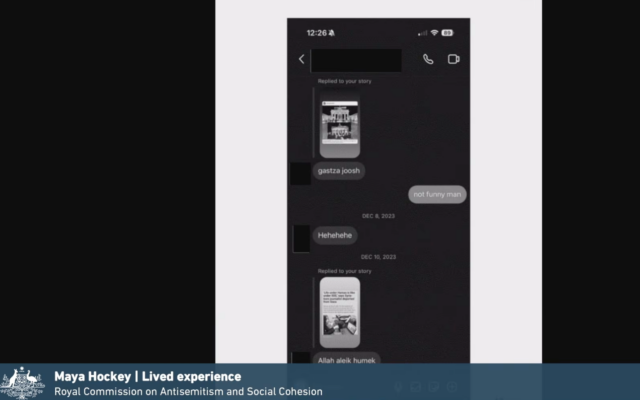
After the October 7 attacks in 2023, she said antisemitic remarks intensified, including confrontational comments such as “Free Palestine” and accusations directed at her personally. “I was expected to represent everything that was happening in the war,” she said, adding it became “exhausting” and happened repeatedly at school.
She also gave evidence about antisemitic messages received on social media, including a post celebrating Chanukah that was met with the coded phrase “gas the Jews”.
Now at university, she told the Commission she has found stronger support within the Australasian Union of Jewish Students (AUJS) and feels “accepted and comfortable.”
However, she also described a recent incident at AUJS event where a man allegedly shouted antisemitic abuse, including accusations of “baby killers” and “genocide”. Hockey explained that the group was asked to leave, as the man refused to.
Hockey concluded that better education and clearer school responses are key to addressing antisemitism.
“I really feel that a lot of the antisemitism in schools is based on ignorance and lack of education,” she said.
Melbourne Jewish studies educator Sharonne Blum, has given detailed evidence arguing that antisemitism has “mutated” in contemporary Australia into what she described primarily as anti-Zionism.
Blum told the Commission she had been forced to explain to students why some public displays of hostility toward Jews appeared to attract different consequences from other extremist activity.
“They saw Neo-Nazis parading on the steps of the Victorian Parliament House, and that was very alarming,” she said. “They wondered… why when they saw really violent, menacing mobs gathering on the steps of the Opera House after October 7, why those people didn’t receive any consequences … I had to explain to them that it’s because the society we live in hasn’t yet properly diagnosed the anti-Jewish bigotry we’re experiencing.”
Blum outlined what she called “three distinct stages” of anti-Jewish vilification: anti-Judaism in medieval Europe, classical antisemitism emerging in the Enlightenment, and modern anti-Zionism, which she said frames the Jewish collective together with the State of Israel as a global demon.
“Anti-Zionism is a hate movement that charges that a central part of Jewishness… is evil,” she said, adding that modern discourse maps “colonisation, apartheid and genocide” onto Israel.
While Blum accepted that criticism of any government is fine, she maintained that anti-Zionism went further. “It’s not about the current war,” she said. “It’s a hate movement aiming to dismantle the Jewish state.”
She was shown a newspaper cartoon featuring Israeli Prime Minister Benjamin Netanyahu and Donald Trump.
Students, she said, reacted with visible shock. Some reportedly showed disbelief, while others immediately began discussing whether such imagery was acceptable in modern media. Several questioned aloud how such depictions could be published in a major newspaper, while others expressed discomfort at recognising familiar antisemitic motifs in a contemporary setting. The class, Blum said, became “intensely reflective”.
The Commission also heard Blum describe a university lecture reported by a relative as an example of “Holocaust inversion”, where Auschwitz was compared with the war in Gaza. “It’s historical lunacy,” she said. “It distorts the gravity of the Holocaust.”
Pressed on whether strong criticism of Israel could be antisemitic, Blum replied that context mattered, but reiterated that calls to “globalise the intifada” or references to “from the river to the sea” were experienced by many Jews as threatening.
In an emotional closing exchange, Blum became visibly distressed while speaking about personal loss.
“Six months ago, I buried my husband,” she told the Commission. “When I buried him, we sprinkled some earth from the land of Israel in his grave. That is Zionism. Even when we pass, part of us returns to our ancestral land.”
A non-Jewish woman has told the Royal Commission she was subjected to sustained antisemitic abuse at a Sydney inner west pub after a stranger mistakenly assumed she was Jewish.
The witness, known only as ABG, was with two friends when a group of men sat at their table.
After brief banter about whether one of the men was Italian, he looked at ABG, pointed at her and said: “You’re a Jew.”
“I didn’t find that offensive. I’ve been mistaken for being Jewish before. It’s not offensive to me. So I said, ‘I get that a lot, but no, I’m not’,” ABG said.
The man then began saying things like: “I can tell by your big nose and your curly hair, you look like a Jewish rat.”
“He kept calling me a Jewish rat throughout this conversation. And then he said some other very strange things, like, ‘You have a rat nose and you’re sniffing shit out’,” she said.
When ABG said “that’s racist”, the man replied: “Jews aren’t a race. You can’t be racist towards Jews.”
When she said she wasn’t Jewish but that he couldn’t say such things, he replied: “That would be just like a sneaky Jew to deny being a Jew.”
ABG said the comments were made in an aggressive tone rather than light-hearted.
“The way that he said it struck me as quite aggressive. He was sort of spitting the words out at me. He wasn’t whispering them. It was daylight. He wasn’t trying to hide his face or anything about what he was saying. It was very blatant and with no shame whatsoever,” she said.
In her witness statement, ABG wrote: “Having these statements targeted at me made me feel subhuman. I can’t imagine how I would have felt during this interaction if I had been Jewish myself.”
She told the Commission: “I have studied a bit of European history, and I’m aware, in a very basic sense, of some of the tropes that were used to dehumanise Jewish people before the Nazis came into power. I’m aware of the rat kind of trope that was used in propaganda around that time.”
“I just had this thought of, I can’t believe it’s almost 100 years later, I’m in a pub in the inner west of Sydney, it’s the 21st century, and this trope is still being used,” ABG said.
“If I was actually Jewish, and I had generations of my family have to suffer through antisemitism and to hear that, I can’t imagine how that would feel. It was really alienating enough not being a Jewish person to hear that.”
The man also made racist comments and gestures to ABG’s friend who has an Asian background, saying “all Asians look the same” and pulling his eyelids sideways.
ABG did not report the incident to police at the time, saying she thought about it but didn’t know what police would make of it since she wasn’t actually Jewish, and whether charges would result.
But after the Bondi attack in December 2025, she reconsidered.
“I thought back over this incident and how quickly things can move from someone just having an opinion and then expressing that opinion and moving into violence,” ABG said.
“I thought that potentially, if I had made a report, then police could have at least had some intelligence on this person. If in future, this person tried to get a gun licence, for example, there would be the report of what he had said, and potentially that would be strong evidence against him being the type of person that should have a gun licence.”
A non-Jewish Sydney resident known only as ABH has told the Royal Commission she and her husband were forced to leave the Opera House precinct on the evening of October 9, 2023, after encountering what felt like a “dark and ominous” atmosphere while trying to show solidarity with victims of the October 7 attacks.
ABH, who has Israeli and Jewish friends, said she went to the area that evening with her husband after learning it would be lit up in blue and white, the colours of the Israeli flag. One of her friends lives in a kibbutz in southern Israel that was attacked on October 7.
“We parked the car and got out ready to view the Opera House in the blue lights that we thought would be there,” ABH said.
“We didn’t get out at first because there was a lot of commotion around, and we were wondering what that was. But then we got out of the car and we walked under the Harbour Bridge, because that’s a great vantage point to view the Opera House.”
She said it “felt like a lot of commotion”, with many boats in the harbour displaying large Palestinian flags and tooting their horns, and people running past in groups.
“We we were a bit shocked. My husband was actually quite scared,” she said.
“Being around there for a few minutes, I realised it was dark and ominous sort of feeling. And then my daughter called up on the mobile phone and said, ‘Get out of the city. Get out of the city’.”
The next day, ABH made a social media post saying she and her husband had gone to show “solidarity and support for Israel” but had to leave.
She received a message from a friend in response that said: “Although the behaviour of the few is disappointing, please remember that Israel has been killing Palestinians since 1946 and the world has been watching and doing nothing.”
“I was very surprised,” ABH said, noting she doesn’t often make political posts on Facebook, which is normally “family oriented, grandchildren”.
At a later date, she shared an Instagram post of a statement issued by six former Australian prime ministers that condemned the Hamas attack, expressed support for both Jewish Australians and the Australian Palestinian community, and called for the unconditional release of hostages and for humanitarian aid to reach Gaza.
She received comments from people within her circle that were critical of her reposting the joint statement.
“One person that I know said in their comment that Israel is committing genocide and using the Hamas attack as an excuse. And that was very disappointing to see that from a friend,” she said.
ABH also described observing protest activity in the Sydney CBD and collecting her granddaughter from her weekend job after the teenager said she felt unsafe on protest days.
“They were very loud and boisterous, running through that area. So she felt – she’s not Jewish, she’s just a young teenager with a weekend job – so we used to go and pick her up.”
ABH said she and her husband used to go into the city on Sundays for museum visits or to show visitors around.
“But with all the police presence, it wasn’t feeling like we wanted to do that anymore. So we didn’t go – we didn’t hardly ever go at all after a few Sundays of seeing that,” she said.
Asked about her sense of the protest activity, ABH said: “I feel that Israeli people and the Jewish people are hated, and that there are parts of Australian society who think that they’re not entitled to have a life.
“I feel that there are people who are influencing others to be anti-Jewish, and that the weekly protests have influenced many people to join a campaign to hate Jewish people, and to indoctrinate people to be radical against the Jewish people,” she said.
“I feel the protests have erupted in our city in a way that actually incites violence and hate.”
A Melbourne father has told the Royal Commission that chants of “death to the Zionists” are calls for his death, as he described how escalating antisemitism has fundamentally changed how he and his family live.
Aaron Guttman, an ethics and compliance officer whose parents are Holocaust survivors, said he stopped catching public transport after October 7, 2023, due to fears for his safety.
“When you see things like ‘Zionists are terrorists’, or ‘death to the Zionists’ – I am a Zionist. You’re basically asking for my death,” Guttman told the Commission.
“And in my role of integrity and ethics, I can’t imagine anyone wanting death to anyone.”
He said the rallies he sees for Israel “tend to be in song and dance and peace, and we all need to live together”, while rallies from the other side feature “death to this, death to that, death to people like me, because we’re Zionist”.
Guttman told the Commission he first became “really scared” after October 7, 2023, when he was working in the Melbourne CBD near the university.
“Around the place of work, there were stickers with the Star of David crossed out. There’d be on shops, Star of Davids crossed out. There were signs on people’s homes, all sorts of things that were quite derogatory towards Jewish people and gave an impression that Jews are not welcome here,” he said.
He stopped catching public transport after reports of people driving around Melbourne saying “Where are the Jews? We want to get them”, and Neo-Nazis going on trains looking for Jewish people.
“I didn’t know how I would react if I was approached on a train to say, ‘Are you Jewish?’ Because I am proud of being Jewish, but I also know my personal safety was at risk,” Guttman said.
“My job is to assess risk and mitigate risk. So for me, one of the key things to avoid that risk was don’t catch public transport.”
Guttman recalled his first experience of antisemitism around 1983 or 1984, when he was 13 or 14 years old, walking between synagogues in a Melbourne suburb wearing a kippah.
“All of a sudden, without any sort of warning, I had eggs thrown at me, and I heard ‘Jew’ – I think they said ‘dirty Jew’. I was in a little bit of shock,” he said.
Guttman described how security at Jewish schools has dramatically escalated since his own school days at Mount Scopus Memorial College in the 1980s, where there were open gates and no security guards that he recalled.
He also described incidents involving his son, who played football for Jewish club Ajax.
“There were comments made – about ‘gas the Jews’, ‘Hitler was right’, those sorts of comments, and these kids are 11 to 14, 15 who just don’t know how to react to that sort of sentiment,” he said.
“It’s traumatic for parents to hear what the kids are listening to, let alone the kids themselves.”
He also recounted an incident at little athletics where children playing with leftover change from the canteen called their coin toss game a “jewtoss”.
Guttman described a recent incident at his pickleball club, which he said has been tremendously supportive, particularly after Bondi, where people asked his views on the Iran-US conflict.
“There were comments made like ‘it’s only happening because Israel has convinced Donald Trump to invade Iran. That’s why it’s happening. It’s Israel’s fault’,” he said.
Concluding his testimony, Guttman reflected on the security measures now in place at Jewish schools and synagogues.
“I understand the need for it and security, but it doesn’t address the key problems,” he said.
“We really need to address the root cause of this problem and hate that comes out of people’s mouths … I think Nelson Mandela said it: people aren’t born antisemitic or racist. They learn it. So they’re either learning it from homes, schools, friends – that’s the real problem that we need to fix.”
A Melbourne father has told the Royal Commission that chants of “death to the Zionists” are calls for his death, as he described how escalating antisemitism has fundamentally changed how he and his family live.
Aaron Guttman, an ethics and compliance officer whose parents are Holocaust survivors, said he stopped catching public transport after October 7, 2023, due to fears for his safety.
“When you see things like ‘Zionists are terrorists’, or ‘death to the Zionists’ – I am a Zionist. You’re basically asking for my death,” Guttman told the Commission.
“And in my role of integrity and ethics, I can’t imagine anyone wanting death to anyone.”
He said the rallies he sees for Israel “tend to be in song and dance and peace, and we all need to live together”, while rallies from the other side feature “death to this, death to that, death to people like me, because we’re Zionist”.
Guttman told the Commission he first became “really scared” after October 7, 2023, when he was working in the Melbourne CBD near the university.
“Around the place of work, there were stickers with the Star of David crossed out. There’d be on shops, Star of Davids crossed out. There were signs on people’s homes, all sorts of things that were quite derogatory towards Jewish people and gave an impression that Jews are not welcome here,” he said.
He stopped catching public transport after reports of people driving around Melbourne saying “Where are the Jews? We want to get them”, and Neo-Nazis going on trains looking for Jewish people.
“I didn’t know how I would react if I was approached on a train to say, ‘Are you Jewish?’ Because I am proud of being Jewish, but I also know my personal safety was at risk,” Guttman said.
“My job is to assess risk and mitigate risk. So for me, one of the key things to avoid that risk was don’t catch public transport.”
Guttman recalled his first experience of antisemitism around 1983 or 1984, when he was 13 or 14 years old, walking between synagogues in a Melbourne suburb wearing a kippah.
“All of a sudden, without any sort of warning, I had eggs thrown at me, and I heard ‘Jew’ – I think they said ‘dirty Jew’. I was in a little bit of shock,” he said.
Guttman described how security at Jewish schools has dramatically escalated since his own school days at Mount Scopus Memorial College in the 1980s, where there were open gates and no security guards that he recalled.
He also described incidents involving his son, who played football for Jewish club Ajax.
“There were comments made – about ‘gas the Jews’, ‘Hitler was right’, those sorts of comments, and these kids are 11 to 14, 15 who just don’t know how to react to that sort of sentiment,” he said.
“It’s traumatic for parents to hear what the kids are listening to, let alone the kids themselves.”
He also recounted an incident at little athletics where children playing with leftover change from the canteen called their coin toss game a “jewtoss”.
Guttman described a recent incident at his pickleball club, which he said has been tremendously supportive, particularly after Bondi, where people asked his views on the Iran-US conflict.
“There were comments made like ‘it’s only happening because Israel has convinced Donald Trump to invade Iran. That’s why it’s happening. It’s Israel’s fault’,” he said.
Concluding his testimony, Guttman reflected on the security measures now in place at Jewish schools and synagogues.
“I understand the need for it and security, but it doesn’t address the key problems,” he said.
“We really need to address the root cause of this problem and hate that comes out of people’s mouths … I think Nelson Mandela said it: people aren’t born antisemitic or racist. They learn it. So they’re either learning it from homes, schools, friends – that’s the real problem that we need to fix.”
After October 7, Mia Kline said she became increasingly isolated and withdrawn at university, postponing exams while searching for new accommodation after feeling unsafe. She described relying on friends for temporary housing while her parents travelled to Canberra to help her find somewhere to live. Kline said the experience left her feeling alone and misunderstood, particularly after her former housemates refused to engage in meaningful conversations, rather simply kicking her out of their home.
She also spoke about “de-Jewing” herself on campus, removing jewellery including her Magen David and Hebrew name necklace, and avoiding openly discussing attending synagogue or Shabbat dinners.
Kline said she felt pressure to make herself “digestible” to others because being visibly Jewish often led to assumptions about her politics and support for Israel, leaving her feeling unable to express her identity freely.
“People aren’t necessarily speaking to you as a person,” Kline stated. “They see you as part of this greater Zionist lobby machine … So I just thought it was easier to filter myself down to my most digestible, which is just another student on campus who doesn’t necessarily declare herself as Jewish.”
In May 2024, Mia Kline revealed to the Commission that she was kicked out of her home for being Jewish. During a house meeting, her housemates said their home was no longer a safe space for them to have political conversations and they couldn’t reconcile her views with their values.
“They said that they couldn’t live with me. They then asked if I had anything to say. I was sitting there distraught. I was sobbing, and I said, ‘No, I’m going to go for a drive’. I left the house, got in my car, started driving around the streets of Canberra,” Kline recalled.
Kline described a dramatic shift in university life after October 7. Kline said political conversations about Israel and Jewish identity became unavoidable on campus, and she and other Jewish students were frequently questioned about Israel, Hamas and the war, often being treated as spokespeople for the Jewish state. The atmosphere left her feeling overwhelmed, scrutinised and “put on trial”.
Reading from her statement, Kline said, “It is apparent to me that my housemates conduct resulted from their perception of me as a Jew. My housemates never asked me about my connection to Israel. In their eyes, I was a Zionist who must be presumed to support genocide, ethnic cleansing and a litany of crimes against humanity, which is untrue. I regard myself as a Zionist because I believe that the Jewish people have a right to self determination in part of their ancestral homeland. I have never advocated harm to Palestinians or denied their right to self determination.”
When asked what he understands antisemitism to be, Benjamin F said people need to understand the full range of experiences.
“It’s the everyday occurrences. It’s the underlying fear that you feel. It’s the conversations you have around a Shabbat table where you hear your friends telling you terrible stories about their experiences of going into cultural spaces and and hearing things or being excluded from social circles, or feeling that they’re not welcome into cultural spaces, feeling fear of wearing identifiable Jewish or Judaica symbols.
“It’s also the constant obsessive fixation that people have on Israel… It’s so mainstream now for people to have a derogatory comment about Israelis, about Jews, about Israel … People have replaced the word ‘Jew’ with ‘Zionist’ and feel that that’s an acceptable way to say heinous things about the community or Jewish people.
“I know that Israeli Australians are experiencing deep and significant levels of racism in Australia. I don’t think that’s been properly identified. And the experiences that they’re having, I find that in progressive spaces, particularly in the Inner West, people talk about diversity and inclusion and anti-racist programs, but that seems to always exclude Jewish people or Israelis.”
“I feel in terms of my personal identity that I can’t live a true and authentic Jewish life because I need to hide away clear and religious items of Judaica. I have a kippah in my pocket I’m too scared to wear … I was scared walking in here today. I asked members that perhaps are in this room, whether there would be hecklers, whether there would be members of the public that could potentially heckle me while I’m giving this statement. These are real and genuine concerns that I never had pre-conversion. It just wasn’t on my radar. There was no way I would have ever thought about concealing a cross around my neck or any other identifiable Christian symbols.
“Being Jewish is difficult. I have a mezuzah on my door. However, when it’s Chanukah, when I light the candles, and I try and display them in my windows, I’m scared each night when I light the candles, I’m scared that someone’s going to throw a brick through my glass windows.”
Benjamin F explained that he would never walk around his neighbourhood wearing his Jewish symbols, and that although his immediate neighbours know that he is Jewish, he has not told anyone else around where he lives.
“It just very difficult to lead a true and authentic Jewish life when you’re hiding a big part of your identity. I think growing up Jewish and having Jewish family and friends and perhaps going to a Jewish school, it might be perhaps different … I didn’t have those experiences of growing up within that Jewish tight community, or having friends and family. So for me, stepping into that space has been very, very difficult.”
Benjamin F also described removing Judaica from around his home when renovating his home including a chanukiah, books and even his Ketubah.
“I’m scared of having people who are strangers in my house, and knowing that I’m Jewish … I just don’t know who those people are and what their beliefs are, and what level of safety I have if they knew that I was Jewish.”
Describing his “real and genuine” concerns before marching in Mardi Gras with Dayenu, Benjamin F told the Commission that he feared for his life.
“I was scared to reveal myself as a Jewish person walking up Oxford Street in an area that I once thought was safe and progressive. I was, to be honest, and I’m very mindful, I’m saying this under oath, I was scared for my life. It was a guttural fear that I genuinely thought we were going to be attacked. I genuinely thought that it wasn’t going to end well.
“Prior to the March, I sent a message to my sister telling her where I was, that if anything should happen to me, that I love her.
“I messaged a work colleague to tell her that if she was to hear anything on the news, that that’s where I was, so that she knew she could be my point of contact.
“It was a real and genuine fear.”
Benjamin F also explained that Dayenu decided not to go to the usual marshalling area due to safety concerns, that they were escorted up Oxford St by armed police and that the group were approached throughout the evening by people accusing them of being “genocide supporters”.
Through tears, a witness only known as Benjamin F shares that when he chose to convert to Judaism, he was abandoned by lifelong friends and subjected to slurs.
“It was quite horrific, actually … When I began the process of telling people that I was embarking on this Jewish journey, I lost a significant number of friends. I’ve had people who I would have considered lifelong friends and companions who have abandoned me. I’ve been subjected to slurs. I’ve been called a genocide supporter. I’ve been told that I’m immoral. I’ve been told that, ‘how could I support Israel’, even though Israel wasn’t, or has never been in a conversation with those people. I’ve been questioned why I would do something like that, and not necessarily in the sense of moving from Christianity to Judaism, that didn’t seem to be the problem. It was more, why would I align myself with the Jewish community?
“The level of hatred that I felt towards myself and those around me has been profound.”
Australia’s Special Envoy to Combat Antisemitism, Jillian Segal, told the Royal Commission today that antisemitism in Australia has undergone a dangerous transformation since the October 7, 2023 Hamas attacks, shifting from the fringes of society to become increasingly normalised.
Giving evidence before the Commission, Segal described four distinct forms of antisemitism operating in Australia: Islamist extremism, far-right white supremacism, far-left anti-Zionist activism, and — the fastest growing — a broader conflation of hostility towards Israel’s government with Jewish Australians as a whole.
“That fourth one has helped push antisemitism from the margins to be normalised to the centre,” she said.
“It’s a mask of blaming the Jews, but they really focus on what the Israeli policy has been, or on the way it’s carried out the war in Gaza – but they use the ancient tropes as well, so they’re bringing some of that old-fashioned antisemitism, if I could put it that way, into it as well. “It’s almost fashionable,” Segal added, warning that social media influencers were driving the trend.
Segal pointed to the events of October 9, 2023 as a defining turning point, recalling that Jewish Sydneysiders were advised by police to stay away from the Opera House forecourt for their own safety as demonstrators gathered, while she herself received a personal warning not to attend, despite being President of the Executive Council of Australian Jewry at the time.
On the critical question of defining antisemitism, Segal was emphatic. She told the Commission that a shared definition was central to everything. “We must define it,” she said, backing the International Holocaust Remembrance Alliance (IHRA) definition, which has been adopted by Australia on a bipartisan basis, 47 other countries, universities in the UK, US and Australia, and more than a thousand institutions globally.
Segal also noted the April release of her office’s handbook, Understanding Antisemitism in Australia, which she said provides Australian case studies to help institutions — including universities — distinguish legitimate criticism of Israeli government policy from conduct that crosses into antisemitism.
Commissioner Virginia Bell thanked Segal, and said that Segal will be called to provide further evidence in future hearing blocks too.
Daniel Onas, the president of AJAX Junior Footy Club revealed at this afternoon’s Royal Commission hearing session that players at the club as young as seven, have been targeted with antisemitic abuse on the football field, with incidents rising between 2024 and 2025, and continuing into the current season.
Among the most disturbing incidents Onas described was an U14 boys finals match in 2024, in which an opposition player told an AJAX player — a boy who had recently celebrated his bar mitzvah — that “Hitler should have finished you off.”
In an U18 boys finals match, he said AJAX players were subjected to a barrage of slurs including “effing Jews” and “Jewish dogs,” a parent on the sideline was targeted, and one player attempted to remove the kippah from an AJAX player’s head. He added, the Community Security Group Victoria CEO was there, and witnessed the events firsthand.
Onas said the toll of these incidents on players, parents and club administrators is immense. Young children had returned home from games distressed and confused, asking their parents why they had been singled out for being Jewish.
Many AJAX players, he said, who had been targeted, approached subsequent matches wondering whether it was safe or not to take the field, instead of thinking only about footy. “For the 25 other clubs that play football in the South Metro Junior Football League (SMJFL), that’s not a consideration for them at all,” he said.
On the complaints process, Onas acknowledged improvements since early 2025, when the SMJFL introduced a new and improved policy. However, he stressed that the burden of driving change had still fallen almost entirely on AJAX.
“It shouldn’t be our responsibility to be the key player in finding a better way to resolve these issues,” he said.
He said incidents targeting the club’s players, of an antisemitic nature, are continuing, including one that occurred as recently as last Sunday.
Onas concluded by emphasised that lasting change required prevention, not just dealing with incidents after they happen.
“Unless education is the focus, and steps are put in place around prevention and learning, we will continue to see more incidences,” he told the Commission.
A Sydney doctor has told the Royal Commission how two women shouting “Free Palestine” disrupted his wedding ceremony on Sydney Harbour in June 2024.
Dr Laurence Schneider, a specialist medical doctor who emigrated to Australia from South Africa in 1998, said the interruption occurred while he and his wife were exchanging vows under a chuppah – a Jewish wedding canopy.
“Two young women walking down the boat ramp, because this was on the harbour, so there was a boat ramp, they obviously recognised this as a Jewish function, and started yelling, ‘Free Palestine’,” Dr Schneider said.
“And this carried on for a number of minutes, which obviously stopped the ceremony. They did it quite joyously. They kind of danced down the boat ramp shouting ‘Free Palestine’.”
The interruption lasted about two minutes before the women stopped.
Dr Schneider said that on the day, they put the incident aside and had “a wonderful day”, but subsequent reflections raised deeper questions.
“There’s a lot of questions that are raised as to future Jewish events. The safety of Jewish events? Do we actually have Jewish events in public? Do we have to now have security at all of our Jewish events?” he said.
“There were no political symbols, flags or anything. There really aren’t at Jewish weddings,” Dr Schneider said.
He said the incident was particularly concerning because the women “felt emboldened and secure in being able to disrupt a Jewish function, that they felt secure enough that there wouldn’t be repercussions”.
“If I went to any other religious ceremony and I disrupted it, I would think there would be consequences. I would think there would be legal consequences and consequences of the guests doing something to me,” he said.
“But these two women didn’t feel that, and I think they felt incredibly empowered because of the nine months preceding that, where every single week they had their friends and family and whoever they were with saying the same slogans and having no consequence.
“I think we as a community know that when these slogans are said, whether it’s ‘Free Palestine’, whether it’s ‘Globalise the Intifada’, ‘From the river to the sea’, we don’t see political statements. We see blatant antisemitic statements,” he said.
He said he accepted that people are entitled to hold and express views about the Israeli government’s actions and policies.
“Sure, we can absolutely criticise governments. I’ve got no problem with that. I don’t think any of our community has a problem with criticising governments. It’s when that criticism takes on a much older form of message. And it’s not just a political message, it’s a deeply embedded antisemitic message,” Dr Schneider said.
He said that for the first time in his 27 years of living in Australia, he is hearing people in the community talk about leaving.
“Around personally, around friends who are talking about leaving, about escape plans, and we’ve never spoken about that. Why would you want to leave the life that we have here? But people are now talking about that, and the only place that they’re talking about leaving is to the middle of a war zone, is to go to Israel, because that’s the only place that we’re really going to feel safe,” he said.
Food writer and journalist Dani Valent has told the Royal Commission she now understands what her grandfather meant by “open hiding” – a term describing his experience as a child survivor of the Holocaust living as a Christian in Budapest.
Reading from her essay in the book Ruptured, a collection of reflections by Jewish women in Australia post-October 7, Valent described how she has worn a Star of David necklace and hidden it under her top, taken it off before going out, or left it at home because she was scared.
Her niece, who at age nine visited sites of her grandfather’s Holocaust-shadowed childhood in Bratislava and Budapest, had said: “I didn’t know what open hiding meant, but I am starting to understand it more.”
“So am I,” Valent said.
Valent’s father, now 86, survived the Holocaust as a child. At a gathering of child survivors in Melbourne in October 2024, Valent’s brother said: “Some families suffer from intergenerational trauma. Our family is not one of those.”
But Valent told the Commission: “I used to feel the same as my brother. We did not suffer intergenerational trauma, but I have realised it was waiting in my blood. My cells are seized with it, and they have not eased.”
She described the period since October 7 as overwhelming, with rhetoric around the Hamas attacks and Israeli response “like screams in my face, footfalls chasing me from behind”.
As a restaurant critic and freelance food journalist, she said her “trade is in opinion”, but she has held back from publishing reviews. The week before October 7, 2023, she visited an Israeli restaurant she loved but decided not to publish her review, thinking “they might get harassed”.
“I thought about slotting in the story months later, every month, actually. No, not now. Not yet. And not yet,” she said. “I berate myself for a lack of courage. I tell myself it’s fine to stay quiet. I am brave. I am scared.”
She concluded: “I am here for my father who survived the worst expression of Jew hate. I am here for my children who are at least Jewish enough to be persecuted by the old rules. I am here for my relative whose best friend was killed at Bondi. I am here for anyone who needs to see Jews standing up.”
Responding to questions from counsel assisting about promoting social cohesion, Valent said: “It’s good to be talking about antisemitism … but I don’t believe hate for Jewish people will ebb simply by airing it. Stern words and legislation can quash some expressions of racism, but they can’t dismantle it or dissolve it in the heart.”
She said if Australia really wants to solve antisemitism, “we need to make this country better for everyone”.
“We need to ensure everyone lives in safety and dignity, has a well-resourced and rounded education, and lives with a sense of purpose and belonging found in the real rich world we all share, not down algorithmic rabbit holes,” Valent said.
Asked about her reaction to learning of the events in Israel on October 7, Valent said the week leading up to those events was also the week before the referendum for the voice to parliament.
“To me, the way Australians have responded to the events of October 7 and the war that followed is very much tied in with the no vote. And I think an underlying shame that is inherent in Australia around that,” she said.
“Obviously I was devastated by what had happened in Israel on October 7. I’m also devastated by what’s happened following that in Gaza. I have no answers to the big problem of the Middle East, but I think we have an opportunity in Australia to be a place where people gather in community, and I want to be part of that. And I think this commission is part of that as well.”
A Jewish employee known only as ABM has told the Royal Commission she was asked to use a different, less obviously Jewish name at work over fears her “identifiably Jewish” name could upset a stakeholder.
She said she was told “that my identifiably Jewish name could potentially add some complexity to the relationship and to that partnership, and it could, in turn, potentially have negative commercial outcomes”.
She said there was an underlying assumption that because she is visibly Jewish, she might somehow be associated with particular views about Israel.
“This, in the end, that situation was really simply about me being Jewish. I was perceived through that geopolitical lens on a conflict on the other side of the world,” ABM said.
She described the emotional impact as “quite profound and really multifaceted”.
“I felt a sense of shame that I hadn’t felt before. And not because I was ashamed of being Jewish – I’m a proud Jew – but because I was suddenly made aware that something so deeply personal to me could be negatively viewed by others, and that there was an expectation that I should alter myself just to fit in,” she said.
“Instead of being excited and showing up in a new job and focusing on building relationships and putting my best foot forward, I found myself questioning my value and questioning my impact, and part of my energy was being consumed in monitoring and managing that part of my identity.”
ABM, who has since left that company, said the experience impacted how she approaches her work.
“Prior to this event, I sort of took comfort in the assumption that if you worked hard, you were capable, you acted professionally, that that was the basis on which you were judged, and I was proven that that does not always ring true,” she said.
She said the experience made her question whether she would have equal employment opportunity in the future, whether she would have to hide part of herself to progress in her career, and whether she can be outwardly and openly Jewish in professional workplaces.
Reflecting on the broader implications, ABM said: “If history shows us anything, it’s that discrimination rarely begins with overt exclusion. It often starts with small, seemingly practical concessions, which are framed as minor adjustments.”
“That was similar to what I experienced – it was presented as something that was rational, in the best interest of business, it was pragmatic.”
She drew parallels with historical examples, including Jews in 1930s Germany who were asked to hide parts of their identity, where early limitations and social exclusions escalated to far more severe and systemic discrimination.
“While my experience certainly does not measure comparable in scale, it raised a concern about how easily the early stages of exclusion can be rationalised and embedded in everyday decisions and not necessarily recognised for what they are,” ABM said.
A psychologist known only as Sarah has told the Royal Commission that Jewish children as young as nine are asking her in therapy sessions: “Why do they hate us?”
“When a nine year old comes and asks, ‘Why do they hate us? Why do I have to hide my uniform? What is it about me that they don’t like? What have I done?’ – and that’s a nine year old, a 14 year old, a 17 year old, a 22 year old at uni, the same questions get asked,” she said.
“How do you answer that? It’s not a question that actually has legitimacy in an answer. There is no real good reason. It’s a question we’ve been trying to answer for a very, very long time.”
Sarah, whose children attend a Jewish school, described how security concerns have fundamentally changed the school experience since October 7, 2023.
The school’s cross country, normally run at a public park, had to be relocated to an athletics track. Swimming carnivals and other events have been moved from their traditional locations.
“There has been significant increases in the security for the kids at the school. Things have to be reviewed as to whether or not they can walk to the local park to participate,” she said.
“Because of what’s happened since December 14, there’s been massive increases in the risk analysis of can our kids go on certain school excursions?”
She said part of her decision to send her children to a Jewish school was for safety.
Sarah recounted experiencing antisemitism during her years at school, including peers asking where her horns and tail were upon learning she was Jewish.
“It was one of the first times where you recognise that there’s something different about you,” she said.
She later transferred to a Jewish school, describing the shock of going “from a school that you could just walk in the gate to having to go through security guards, and there being people with guns on premises, and there being actual gates that you have to go through security to be able to enter a school”.
Sarah described feeling increasingly marginalised in professional circles following October 7.
“It’s very hard when, as a professional in this space, we’re meant to be able to hold dualities. I’m meant to be able to be neutral, or at least be able to hold two competing ideas at once, understand suffering on both sides, understand and provide compassion for both,” Sarah said.
“I need to be able to see someone in my room, and no matter what colour, what religion, what creed, what sexuality, I have to be able to hold compassion for them. That is part of the requirement for me to be a good therapist.”
Sarah said she no longer felt comfortable participating in some professional forums. “It no longer became a safe place for us,” she said.
”If these groups proliferated these ideas for support for everybody, it would be different. But it is so targeted for what’s happening in Israel and Gaza that it becomes and it goes into being antisemitic rather than political.”
Walkley award-winning journalist Michael Gawenda has told the Royal Commission on Antisemitism and Social Cohesion that a young Jewish journalist holding the views he has expressed publicly would today be unable to secure the editorship of The Age, the paper he himself once led.
Gawenda, a former editor-in-chief of The Age, former senior editor at Time Magazine and a Member of the Order of Australia, told the commission that an ideological bar had emerged in Australian journalism that effectively excluded Jewish writers who supported Israel or were not anti-Zionist.
Gawenda said his concern is for the future rather than for himself.
“I believe that if I was now a young, up and coming journalist with the views that I’ve expressed, which are complicated and nuanced about being a Jew, I wrote a book about how I feel about that, I don’t think that I could ever be chosen to be an editor of the newspaper of which I was the editor.”
Gawenda told the commission he was born in a displaced persons camp in Austria after his parents fled their town as the Nazis invaded, spending the war in the Soviet Union. He arrived in Australia as a two-year-old and grew up speaking Yiddish at home, with a father deeply involved in the Labor Party.
He said that for most of his four decades in journalism, his Jewish identity had not been a professional impediment, and that he had covered subjects including alleged Nazi war criminals living in Australia and an Israeli election without his background being treated as a conflict of interest.
Gawenda said he had observed a fundamental shift in journalism from around 2021, when journalists began signing letters and petitions calling for pro-Zionist voices to be excluded from media coverage and openly declaring themselves activists for the pro-Palestinian cause.
“I thought this was the wrong direction,” he said. “This was a denial of the ethical positions that have existed in journalism from the time I joined, became a journalist in 1970, that we don’t be activists.”
Gawenda launched his 2023 book “My Life as a Jew”, about Jewish identity and his sense of banishment from the political left on 4 October 2023, three days before the Hamas attacks on Israel.
On the morning of 7 October, he gave an interview on a public broadcaster that featured his children’s Yiddish band.
Gawenda told the commission that interview was the last time he recalled his Jewishness being celebrated by a public broadcaster.
Within days, scheduled bookshop events in Melbourne and Sydney were cancelled, with one bookshop telling him staff felt unsafe hosting a book about Jews.
Gawenda told the commission he had felt the 9 October Sydney Opera House protest viscerally.
“This is where what I wrote about in the book was going to end up, that … these people couldn’t even for a moment be silent. Let what happened sink in.”
Long-term friendships had ended after 7 October, including with one fellow journalist who had told him his distress required psychiatric help.
“My upsetness didn’t make sense,” Gawenda said the friend had told him.
The witness reserved his sharpest criticism for what he described as a failure of Australian journalism to cover the lived experience of both Jewish and Muslim communities since 7 October.
“Where is the coverage in the media of what these actual communities are experiencing? Where is the coverage which went out to the Jewish community, not to leaders of the Jewish community, but to ordinary Jews?”
He said sections of the Australian media, including outlets where he had worked, had minimised antisemitism and published pieces suggesting it was a concocted notion deployed by a powerful lobby to silence criticism of Israel.
Gawenda said an ASIO assessment from approximately 18 months ago identifying the Jewish community as facing the major threat in Australia had gone largely unexamined by reporters.
“I reckon it was basically not believed, and that’s why it wasn’t examined.”
He recounted a young journalist approaching him in the commission foyer that morning to say she had been shocked and saddened by the testimony she had heard over recent days.
“My thought was, this is a failure of journalism. Why weren’t these stories told before? Why was there a need to have a Royal Commission to tell these stories?”
Gawenda emphasised he did not consider himself a victim and was proud of his Australian public life. His concern, he said, was for younger Jewish writers, journalists and artists who would not have the opportunities he had been given.
The national president of the National Council of Jewish Women Australia has told the Royal Commission on Antisemitism and Social Cohesion that her organisation has been forced to abandon its traditional focus on women’s issues to deal with the impact of antisemitism on its members.
Lynda Ben Menashe, a fifth-generation Australian Jew on her mother’s side and the 17th president of the 103-year-old organisation, told the commission that a listening campaign conducted at the start of her tenure 18 months ago had found that almost 70 per cent of Australian Jewish women identified antisemitism as their primary concern.
Ben Menashe said the organisation had historically focused on gender equity, domestic violence, social inclusion and reconciliation with First Nations women.
“We didn’t give them a list of things to choose from. We said we, it was open, because we wanted to hear from them, and that’s what they said.”
She said her own experience of antisemitism began in early childhood, when a classmate told her she could not visit because she was “a Jew with a black heart who’d killed Christ”.
At age 11 she was beaten on the ground and called “a filthy effing Jew”, and as school captain she received hate mail in the school suggestion box including messages such as “Hitler should have killed more of you”.
On the day she sat her HSC, the school was covered in antisemitic graffiti.
“That’s that antisemitism that we used to experience in this country,” she said. “But then by the time I was at university, I think the morph into anti Zionism, a hate movement against the Jewish collective, really.”
Ben Menashe lived in Israel from 1986 to 1988 and again from 1993 to 1998, experiencing the beginning and end of the First Intifada.
“For the first time in my life, I was scared I might be murdered for being a Jew.”
She told the commission her three adult children, who are half Yemenite and have a different skin colour to her, experienced what she described as intersectional discrimination.
Her son, a sixth-generation Australian Jew now living in Israel, had experienced racism, antisemitism, anti-Zionism and homophobia.
October 7 had been a turning point both for the country and for her personally, Ben Menashe said. She singled out the silence of feminists.
“The silence of many people that I knew and grew up with about that event, the fact that I had at that point, my son had been living in Israel for quite some time. Now my youngest daughter also lives there. People not asking how we were, how we felt.”
She described being told by a friend of her partner that he would not attend her birthday party because she was “an apologist for a genocidal regime”.
“He has never asked my opinion on politics of the region, on the conflict. How could I be a supporter of genocide?”
“It is so Orwellian to me that ignorance drives abusive comments towards us and insult to us insult on top of the injury that we feel.”
Ben Menashe told the commission that after October 7, she had been asked to return to consult to the New South Wales Jewish Board of Deputies, where she had previously worked as education manager, community relations manager and head of engagement.
She had developed a programme of resilience workshops that she called “navigating this upside down world”.
“The most important thing was to bring people together, and to bring people together in their homes,” she said.
The sessions were never advertised. In the first six months she ran them five or six times a day, in living rooms with anywhere from 50 to 120 people present, ranging from teenagers to people in their eighties.
“You’d get people who said that they weren’t, you know, part of the organised Jewish community, or that they hadn’t identified as Jewish for ages, but they just needed to be with each other.”
Ben Menashe said she had run more than 100 sessions reaching approximately 5000 people, with the workshops continuing to evolve.
“Yesterday I had three calls from Jewish women asking about how to navigate something that was happening in their life right now.”
She told the commission the organisation had received messages including: “You are bullies, spoiled brats, murderers. Hope Israel runs out of weapons and fuel.”
The volunteer-run organisation received such messages constantly, she said, regardless of where members sat on the political spectrum.
“There’s just such a cognitive dissonance between who we are, who we are in this country, what we do, and the avatar of the invented Jew and the invented Israel.”
Ben Menashe concluded her evidence by quoting the American author Toni Morrison.
“The function, the very serious function of racism, is distraction. It keeps you from doing your work.”
“We can’t focus on domestic violence right now, because we’ve got to work out how to deal with the hate speech and violence being directed to us right now. It is visceral now that our priority has to be protecting our children and holding our families together.”
A Jewish health worker has told the Royal Commission she is “for the first time in my career, ashamed to be a healthcare worker”.
The witness, known only as AAV, who has worked in healthcare for decades, gave emotional testimony on Thursday about her experiences working for NSW Health since October 7, 2023.
“In 2022 we had supportive messages for the Ukraine on our intranet pages, posters in the corridors, on the notice boards. It was very openly supported,” she said.
“And then in 2023 when the [October 7] attack occurred, there was just silence in NSW Health. There was nothing. There was no acknowledgement.”
AAV said she had been subject to comments from other healthcare workers, including being told “shame on you”, being called “Zionist scum”, and having staff tell her “you must be really ashamed to belong to a group of child killers”.
“It’s generally not done extremely overtly. It’s under the breath or in passing, just a comment thrown at me,” she said.
She was also asked if she was a Zionist. “We are expected to be apolitical. You can have your own personal opinions outside of work, and that’s fine. But in the workplace, we shouldn’t know anything really about one another’s background.”
She said some staff were wearing “Free Palestine” pins and arriving at work with keffiyehs, which felt like “a real stab at me, a statement to make it clear that I wasn’t welcome”.
AAV also described being “paralysed with fear” before a scheduled surgery after seeing reports about two nurses at a Sydney hospital who had taken to social media threatening to kill Jewish patients.
“I spent probably the worst 24 hours of my life imagining all the ways I could be killed legitimately in a hospital, particularly in the operating theatre, from putting toxic drugs into an IV to overdosing me on anaesthetic.”
She considered cancelling the surgery but her children persuaded her not to, as she had been on the waiting list for 15 months.
For that admission, she removed reference to her religion from her health record and did not order kosher meals, instead having her sons bring food from home “so that no one would know”.
AAV said she had lost the trust she once had in the healthcare system and was concerned for other community members who cannot advocate for themselves.
“Over the last 37 years … I have given my all to treat everybody equitably at the highest standard of care that I could possibly provide any family, regardless of their colour, their background, their immigration status, their religion, whatever.”
She said NSW Health had “definitely targeted Israel and the Jewish situation, separate to how they’ve responded to other situations”.
AAV remembered how her grandparents, Holocaust survivors, kept a packed suitcase in the top of their cupboard for as long as she could remember.
“I used to think that was really funny. I don’t think it’s funny anymore. I can actually feel now their fear and their anxiety about, how long are we welcome in this country? Do we have a place in Australia ongoing?”
She concluded: “In the 1930s and 40s, it was not only Hitler and his regime that killed six million people, it was the good people who didn’t speak out, turned to face the other way and pretended they didn’t know what was going on. And that is what’s happening now in Sydney, across Australia, across the globe.”
Stephanie Cunio has told the Royal Commission that she was gaslit, ostracised and pressured to adopt hardline anti-Zionist positions by colleagues in the progressive left following the October 7, 2023, Hamas attacks on Israel.
Cunio, who identifies as a Sephardi and Mizrahi Jew with ancestral roots in Iraq, Spain and the broader Middle East, has worked for three decades in the trade union movement and a decade in the climate justice sector.
She told the hearing that antisemitism became a direct presence in her life after October 7, with colleagues in progressive organisations responding to the attacks by immediately focusing on Israel’s anticipated retaliation, with no acknowledgement of the attacks themselves and no expressions of solidarity with Jewish colleagues.
“I could count on one hand the sisters and brothers that reached out to me and said, are you okay,” she said.
She described being made to feel personally responsible for the actions of the Israeli government, and told the hearing that the only Jewish voices accepted in her professional circles were those who held firmly anti-Zionist views.
“They kept saying, ‘we work with Jews all the time, and we’ve got great Jews’. And the Jews they were working with had hardcore anti-Zionist beliefs that said Israel should not exist,” she said.
“So if I wasn’t taking that position, I was cancelled and gaslit.”
Cunio said the gaslighting extended to a climate-focused NGO board on which she served, where she was eventually called by a fellow board member and advised to consider resigning. It was an experience she likened to earlier encounters with workplace sexual harassment, in which she knew what needed to be said but could not find the words.
“The words were actually: you need to keep me safe. I’m a board member and I deserve safety, and I deserve cultural safety,” she told the hearing.
She also described the emotional impact of language used about Israel in workplace emails and on stickers displayed near her union office.
“When I think about Israel, I think about the beauty of the country, the Old City, civil society and all the good people, Israeli, Palestinians, others, working for a world of equality. I think about friends and family there,” she said.
“The word Israel is used as a demonised word… it’s the way that the word Israel was used that made me feel offended, humiliated.”
Cunio also told the hearing she was forced to exit a culturally diverse climate justice chat group she had co-founded after it pivoted entirely to discussion of Palestine following October 7, with no acknowledgement of the attacks or of her as the sole Jewish member of the group.
“One of the things I’ve reflected on so much since then is that Jews are often not seen as part of multicultural Australia. We’re often seen as separate, seen as part of power structures, and seen as white,” she said.
Cunio acknowledged though that since the Bondi massacre, she has received support, however she struggles to understand why those who gaslit her after October 7, reached out to her now.
“It was my first nations comrades, my Muslim comrades, my Palestinian colleagues. They were the people that reached out first,” she said. “There were hundreds of people I hadn’t heard from in years, who reached out, as did lots of people who I felt had gaslit me. So I’m very curious about this, because it had a very big impact on people, clearly, because it was on home soil.
“I forgave in many ways, because of the solidarity that was there. But I still am curious about why, when 1200 Israelis and migrants and festival goers, many of them who have progressive views, by the way, were killed in southern Israel, there was none of that solidarity, so I’m curious about that. But I know forgiveness is important.”
“The fact that broadly the left could not stand in solidarity with Jews, as we were increasingly experiencing racial hatred and antisemitism since October 7, extreme, and you’ve heard much of this extremity,” Cunio said.
“And if any other group of migrants was experiencing that. We know what happened with Afghanistan a few years ago, the left would be marching in solidarity, speaking out in solidarity. There was silence. The university sector, the arts sector, the trade union movement, the climate justice movement, they could only see one truth, which was the horrible things that were happening in Gaza, which is an absolute truth, and, as I say, a greater harm. So I think I don’t know whether it’s naivety, or it’s political manoeuvring, but I don’t find it forgivable.”
“I work in progressive organisations. I’ve been three decades in the trade union movement and a decade in the climate justice space.
“And my immediate experiences were a denial of what had happened on seventh of October, 2023 and my what I call my comrades, the people who are my people you know that I’ve spent decades with, leapt straight to a concern, which I shared about Netanyahu. His retaliation, what that would be like, and what that would be like for the people of Gaza. So I shared that concern that they shared, but I felt completely gaslit.
“There were no words, there was no compassion. I could count on one hand the sisters and brothers that reached out to me and said, ‘Are you okay?’. So the immediate experience was that feeling of being gaslit.”
A father giving evidence today under the pseudonym ‘Witness AAT’ told the Royal Commission on Antisemitism and Social Cohesion of the sustained antisemitic bullying his 13-year-old son endured at a Darwin public school — and the repeated failure of both the school, and the Department of Education, to adequately address it.
The witness is the son of a Holocaust survivor who fled communist Hungary, and he described how the bullying began in early 2025, after his son returned from a family trip to Israel, and began wearing a Star of David necklace.
Within weeks of the new school year, his son was being called by several students in his year, a “dirty Jew” and a “stinky Jew”, he was subjected to Nazi salutes, and was told “Hitler didn’t finish the job.”
Witness AAT said his son endured the abuse for weeks before telling him and his mother, and the principal was immediately informed.
The boy was asked to identify the culprits, and did so, and Witness AAT said his sone then “knew it was likely the beginning of the end of his time at that school.”
Weeks after some suspensions were served by the students responsible, the bullying resumed, and escalated. Witness AAT described physical abuse that included his son “being squeezed until he couldn’t breathe”, and “being thrown into the garbage bin.”
By term four of last year, his son’s anxiety made it impossible for him to return to school in term four.
The response from the school, the witness said, was woefully inadequate. “My son was offered no support at all,” he told the Commission.
“The Department [of Education] was taking more care of the victimiser than the victim.”
Most troublingly, when the vice principal finally responded to his complaint, ten days later in an email about his investigation, the witness noted that the reply “referred only to the physical bullying, and nothing about the racism. He [the vice principal] completely ignored anything to do with the racism.”
Having relocated to regional NSW, the family hoped for a fresh start.
But Witness AAT revealed he had only learned the previous day [May 5] that antisemitic bullying had already begun at his son’s new school — including a boy fashioning a Hitler moustache from black tape, and classmates using money-related Jewish tropes, telling his son: “If I threw a dollar coin on the floor, would you pick it up?”
His son, Witness AAT said, “has been given a message, in multiple different sneaky ways, that he doesn’t belong because he’s a Jew.”
The Counsel Assisting then invited the witness to read from a part of his written statement to the Commission in which he addresses antizionism, which he did:
“I believe that Jewish hatred has become an ever morphing phenomenon. I’ve personally experienced a new form of antisemitism, which I call antizionism, but it’s not just me that’s calling it antizionism. I understand antizionism as a hate movement, that spreads the libels that Israel is a coloniser, apartheid and genocidal. This movement cleverly disavows classic antisemitism, while denying indigeneity of Jews to Israel and Jewish sovereignty. It creates an imaginary Zionist — a Jew — based on libel and inversion of the truth. For example, [a Zionist is] said to be a baby killer. And real Jews suffer the consequences. I consider that this form of antizionism undermines social cohesion, and is antisemitic at heart.”
Asked whether this form of antisemitism had been isolating, the witness said it had cost him friendships.
He attributed much of the problem to media coverage, saying that “the best intentioned people will be believing in those three antizionistic tropes, largely not because they are antizionistic or antisemitic, but they hear it over and over from our public broadcaster, and from the Sydney Morning Herald and other media.”
He told the hearing that Israel and Zionism were covered in the mainstream media “to a degree that is so extremely unbalanced in our society” that even close friends would not hear him out when he simply sought to provide them with some information and a different perspective to what they had.
“This, for me, has broken many friendships,” he said, “because I’m worried that my friends think that I’m supporting a genocide. But I know that Israel is not doing that.”
The president of the Zionist Federation of Australia has told the Royal Commission on Antisemitism and Social Cohesion that his 13-year-old son had so normalised the security infrastructure at Jewish schools that he was momentarily confused at the sight of an unguarded state school.
Jeremy Leibler, a partner at law firm Arnold Bloch Leibler and president of the Zionist Federation of Australia for the past eight years, told the commission of a Saturday afternoon walk with one of his identical twin sons earlier this year, after the December 2024 Bondi attack.
“He sort of suddenly turned to me and said, Dad, I don’t understand. Why are the fences so low? Where are the guards?” Leibler said. “It’s like he’d forgotten where he was. And then he caught himself, and he said, I forgot. I forgot. It’s cool so they don’t need the fences and the guard.”
In his statement dated 4 May 2026 and tendered as Exhibit 1.50, Leibler said his son’s observation reflected the deeper change in Australian Jewish life since 7 October 2023.
“What has changed is not that there was no antisemitism, and suddenly that there is. For my 13 year old son to have now normalised this situation that Jewish schools, Jewish children, need high fences and guards and security and to be protected, but other children don’t, and other schools don’t. And that is normal.”

Leibler told the commission his maternal aunts had survived Auschwitz as child twins experimented on by Dr Josef Mengele. His paternal grandparents had escaped Belgium on the last boat out before the war, with many extended family members murdered in the Holocaust.
He said the 9 October 2023 protest at the Sydney Opera House had marked a profound rupture, particularly because it had occurred before Israel had mounted any significant military response.
He recounted a phone call from his Auschwitz-survivor aunt Eva, then in her early 90s, after he had given a media interview shortly afterwards.
“She said, I just never thought that I would see this in Australia that gave us everything,” Leibler said. He said his aunt saw the chants as “the beginning of a call for a pogrom”.
“That is what her reference point was from her childhood.”
Leibler told the commission that what fundamentally shifted on 7 October was “the normalisation of antisemitism within mainstream society”, with rhetoric that would have been completely unacceptable before becoming acceptable.
The failure of leaders across society to call this out had created an “absence of psychological safety” before any physical acts of violence had begun.
He said online abuse directed at him had escalated dramatically. Where it had previously come from anonymous accounts, it had become socially licensed for figures of standing to attack openly Jewish leaders.
The abuse had included photographs of his children, sourced from a profile published in The Australian Jewish News when he assumed the Zionist Federation presidency in 2018.
Leibler said his middle son, then aged 13 or 14, had asked him a clinical question that had unsettled him deeply.
“He said, Dad, I don’t understand. Why aren’t we leaving?”
His son had told him they were studying the lead-up to World War II at school. To the boy, Leibler said, the parallels felt “irreversible”.
The lawyer said his firm had received a flood of calls after 7 October from Jewish Australians experiencing exclusion and discrimination, particularly in the arts, in progressive spaces and in academia.
Holocaust survivor families who had become major philanthropists and effectively built the Victorian arts sector through their generosity had been particularly traumatised.
“Their covenant that was shattered was that their success, their contribution to this country, bought them a seat at the table, not with but as an equal, and discovered after October 7 very quickly that the seat was conditional, conditional on them being a core part of their Jewish identity.”
Leibler said decisions by leaders to “take the middle path” and not speak out had sent damaging messages, citing an education minister who had initially equivocated on whether “globalise the Intifada” was a violent call.
He described the recent visit of Israeli President Isaac Herzog, extended at the recommendation of the Prime Minister after the Bondi attack, as a model of moral leadership.
The visit had proceeded despite significant protests, including a lockdown of an 8000-person event.
“It was a very different Jewish community, because it was clear that our leaders had our back.”
Pressed on the distinction between legitimate criticism of Israel and antisemitism, Leibler said the line was not difficult to draw.
“It is perfectly acceptable to criticise policies of the Israeli government. It is perfectly acceptable to criticise Israel’s conduct of the war. It is not legitimate, it is not acceptable, and it does cross the line to describe the right to self determination as something that is inherent or immoral.”
Jewish Care Victoria is spending $1.8 million a year on security guarding alone, with the not-for-profit unable to recover any of those costs from aged care residents under Commonwealth regulations, the Royal Commission on Antisemitism and Social Cohesion has heard.
Chief executive Gayle Smith told the commission Jewish Care is the only aged care provider in Australia that has guards stationed at its facilities, a measure she described as deeply uncomfortable but unavoidable given the surge in antisemitic incidents since 7 October 2023.
In her statement, Smith said the organisation provides services to around 370 active Holocaust survivor clients in the community, with additional survivors living in its three residential aged care homes, which house approximately 400 beds.
Smith, who is not Jewish and described herself as “an ally”, said antisemitic incidents had been so rare before October 2023 that they were not separately recorded.
“They would have been really classified as behaviours of concern or property damage, but they were certainly very low volume,” she said.
“We immediately noticed a marked increase in the number and frequency of incidents and the severity of them.”
The organisation began recording antisemitic incidents as a discrete category in late October 2023.
Entries on the register tendered to the commission included abusive phone calls, hate mail, threatening voicemails, and on 17 December 2023, an email threatening explosives.
A separate threat targeting a residential aged care facility stood out, Smith said.
“We had a call to say that someone was going to blow up a golf course, and one of our residential aged care facilities and our administration building is located … about a one kilometre from the golf course,” she said.
“So we immediately went into a bomb threat emergency response, and really had to shut down the building.”
Smith said the situation for Jewish aged care is distinct from that of schools or synagogues, given recent reforms following the aged care royal commission.
“The change that came through the aged care reform was a change to a rights based act, and therefore a respect for the individual and respect for their dignity and their rights.”
Armed guards sat in tension with that framework, she said, particularly given the resident profile.
“We have a number of direct Holocaust survivors, and then second and third generation Holocaust survivors who are using our facilities, who are now walking past the guarded building for their aged loved ones. And no other aged care provider in Australia will be needing to do the same thing.”
She told the commission that a choice not to provide guards was “not tenable”.
“If we did not take that action and something happened, I personally would never be able to forgive myself.”
Smith said multiple applications for government security funding had been rejected.
An application to the Commonwealth’s Security at Faith Based Places programme in September 2023 was unsuccessful, as was a November 2023 application to the Commonwealth and a May 2024 application to the Victorian Department of Premier and Cabinet’s Jewish community security infrastructure programme.
Funding eventually received through a programme administered by the Executive Council of Australian Jewry covered approximately 5 per cent of operational security costs from January 2024 to March 2025, with further funding in August 2025 covering around 30 per cent.
Smith said community donors had stepped in to cover the shortfall, but at significant cost to other services.
“We have incredibly generous donors within the community, and we did approach them about security funding, but they cannot give more than once. When they gave funds for security, they then could not give funds for what otherwise would have been service delivery.”
She told the commission the human cost of the security measures was significant, particularly for residents living with dementia and trauma from wartime experiences.
Smith recounted the experience of one resident who, after the December 2024 attack on the Adass Israel synagogue in Ripponlea, told staff she had been vindicated in her choice to take a room as far from the front door as possible.
The CEO said staff at Jewish Care, many of whom are not Jewish, have also been affected.
“People describe how they don’t wear their lanyards in public. When asked, they say they work at an aged care provider, they don’t say, I work at Jewish Care.”
Smith also detailed an incident in September 2025 in which a multicultural youth services organisation withdrew from a co-designed mental health programme partnership with Jewish Care, citing “a misalignment of values”.
At a follow-up meeting on 9 December 2025, Smith said the organisation could not articulate what those values were.
“They then advised that, and I’m paraphrasing, advised that they were unable to work with us because their constituents and stakeholders would not approve of them working with a Jewish organisation.”
She told the commission the other organisation had said “Jewish youth didn’t need their services because they weren’t poor”.
Jewish Care wrote to the Victorian Premier and the Minister for Mental Health on 23 December 2025. Both offices and the subsequently engaged Minister for Multicultural Affairs referred the matter to the Victorian Equal Opportunity and Human Rights Commission.
Smith said the organisation involved was, to her knowledge, primarily if not wholly government-funded.
“We get a lot of acknowledgement and sympathy, but we get very little action. And when I get discordance between words and action, I believe the action, and I think we came to the conclusion that we had to deal with it again on our own.”
Also this afternoon in the Royal Commission hearings, a UK-born Jewish resident of Perth, using the pseudonym ‘Witness AAS’, told of her experience of the First Intifada between the late 1900s and early 1990s, when she was living and working in Israel.
She recalled how “There were bombings of supermarkets in public places like a Dolphinarium and the bus bombings were a daily occurrence.
“Suicide bombers were the method of choice to cause chaos and fear and disruption. And so you get on the bus and you would always be looking around.
“I used to get the bus the same day [to get to work], and one day, I got off the bus and further down the road it blew up. Thank God, you know, I wasn’t still on it. It was a very close call.
“There was a shopping centre down the road that had a bomber . . . they didn’t make it inside, but they blew themselves up outside.
“So, that’s what Intifada is. It is killing people for the sake of the cause – you know, this is the holy war to eliminate Israel, and Jews, off the planet.
“And that, for me, is what I see here, what I see in the UK, it’s what’s happening in America, and happening across Europe.
“This is the ‘globilisation of the Intifada’.
In 2006, Witness AAS went on a holiday to Perth, and decided to migrate there, and got a job within months – for the next 13 years – at a university in the Western Australian capital.
In part of her written statement to the Royal Commission, Witness AAS provided details of an incident in May 2025, when she had visited that same university with her godson, and at a cafe in the campus, she had looked up the café’s Facebook site to find out more about it, and noticed antisemitic material in its posts.
When asked during the hearing session what she experienced when she viewed those posts, Witness AAS said, “I was immediately shocked and taken aback.
“It was very clear from those posts that Jews weren’t welcome, that Zionists weren’t welcome, and there were derogatory comments mocking Jews and their religion.
“I was affronted. This was a business on Australian soil, blatantly excluding part of the community, on a university campus – and so very publicly.”
She told the hearing that she’d felt it was the role of the university to directly address the matter.
That particular cafe is no longer operating at the site, but Witness AAS said there were “other reasons” for that, and that all the university confirmed was that there was “a separate department that organises the leasing of businesses on campus”, and after that, “they had nothing to say”.
When asked in the hearing session if she had felt dissatisfied with the university’s response, Witness AAS said, “I was so disappointed.”
Witness AAS also mentioned in her written statement that there should be some conditions imposed on leases or licences at universities [of retail or other spaces on campuses] to deal with discriminatory conduct like that.
She told the hearing, “I don’t think any business operating on Australian soil should be outside of the law – we have laws in place for that, and I don’t believe that they’re really enforced.
“In the first instance, if it’s reported to a university, they should be handling it, as it is a multicultural environment, where everyone should be welcome.”
Witness AAS also said the particular university used to have a pro-Palestine encampment, “and, you know, a lot of issues with demonstrations”.
She briefly then mentioned being told by a rabbi that, when he had visited the campus of the same university when the encampment was in place, he didn’t feel safe, and that “they [the university] told him that, for your own safety, we don’t suggest you walk through this way [via the campus’s front entrance beside the encampment].
“So, for me, its provisions like that that are being made for the wrong reasons.
“It is not a holistic environment where everyone feels safe and protected as they should be.”
A Melbourne nurse who was 30 weeks pregnant had her first ever panic attack after overhearing a group of strangers in a public park praising the October 7 attacks and repeating antisemitic conspiracy theories, the Royal Commission on Antisemitism and Social Cohesion has heard.
The witness, known only as ABF and the subject of a non-publication order, told the commission the incident had fundamentally changed how she carries herself in public and how she and her husband are raising their two children.
In her statement, ABF described herself as a secular but traditional Jew who identifies as Israeli and Zionist. Her father is Israeli, her mother is Australian, and she speaks Hebrew at home with her children.
Asked what Zionism meant to her, ABF said, “Zionism means it’s the belief that Jews have a right to nationhood and self determination.”
The witness said her maternal great grandparents had fled Warsaw in 1928 after her great grandfather found his shop covered in antisemitic slurs.
“He went home to his wife and said that they had to leave, and he predicted that the worst was yet to come. So him and his wife and two children left to Australia, and the rest of their family unfortunately perished in the Holocaust.”
Her paternal grandparents left Morocco in the 1950s shortly after the establishment of Israel, she said, “due to rising antisemitism and hostility in the Middle East and the Arab world”.
ABF told the commission that in December 2023, while approximately 30 weeks pregnant with her first child, she had taken her lunch break in a Melbourne park and sat on a bench near a group of about six people.
“They were discussing the recent viral antisemitic Kanye West videos that went viral at the time, where he described Jewish people as being evil and controlling the media,” she said.
“One of them [was] talking about these videos and saying that since October 7 and listen[ing] to the news … they realised that he wasn’t that crazy in what he was saying about Jewish people as them being evil,” she said.
“And then the group went on to discuss how Jews control the media and that we control all the banks.”
The conversation had then turned to the October 7 attacks themselves.
“One of them had made [comments] that they believed that Jewish and Israeli people deserved the October 7 attacks that happened in Israel, along with jokes praising Hamas and wishing that more murders had taken place at the time.”
ABF said the experience had been particularly confronting precisely because it was not violent or unusual.
“My experience of overhearing antisemitic comments in a public setting in Melbourne is not particularly unique, and it’s not overtly violent, but I guess that’s what made it so confronting for me. It pointed to something much deeper. It was sort of the normalisation of antisemitism and conspiracy theories and everyday conversation.”
She told the commission she had instinctively hidden the Magen David necklace she was wearing.
“For most people that know me, I’m a very openly and proud Jewish and Israeli person, and I don’t shy away from a conflict. But this incident left me feeling quite fearful and silenced.”
ABF said she had returned to work shaken and locked herself in a toilet cubicle, where she rang her husband.
“I remember hiding in a toilet cubicle and having my first ever panic attack and calling my husband, not really knowing what was going on.”
She said she had felt unable to confide in colleagues.
“I was the token Jew at work, so I was only the Jewish person there. My colleagues were all very kind, but I felt at the time that they wouldn’t understand the fear that I experienced.”
The witness said the incident, occurring two months after the October 7 attacks, did not feel isolated.
“For many Jewish people, our identity is shaped by a long history and understanding of persecution, most notably, obviously, the Holocaust. And since then, October 7. That history isn’t distant. It lives in our education, it lives in our family stories and our collective memory as a community.”
Antisemitic incidents felt like “an echo, even a warning sign of something worse to come”, she said.
The experience had reshaped her family life, ABF told the commission. She no longer wore her Star of David necklace in public and had stopped speaking Hebrew to her children in public spaces.
“My husband, I’ve had multiple conversations around whether our two year old daughter’s Jewish daycare may ever become a target, like so many other noticeably Jewish institutions have, and whether we should remove her from there or not.”
The couple were also reconsidering their daughter’s future schooling.
“We’ve also reconsidered our child’s future schooling, including moving her to a Jewish school, due to safety concerns as a visible minority in a non Jewish setting, even though this would cause quite a financial strain for the both of us. And while it’s quite unsettling that Jewish schools need guards and security, it also offers reassurance that our child will be better protected.”
A Sydney university lecturer threw a microphone at a student who questioned her account of the conflict in the Middle East, the Royal Commission on Antisemitism and Social Cohesion has been told.
The evidence came from a university student known only as AAD, who is the subject of a non-publication order.
The witness, who is not Jewish, said she had also been removed from a university society group chat within five minutes of posting on Instagram in support of Israeli hostages.
In her statement dated 28 April 2026 and tendered as Exhibit 1.47, AAD described an incident in a recent law class in which discussion turned to the war in the Middle East.
“The lecturer was discussing the war overseas in the Middle East, and a student raised his hand and said that he disagreed with what she was saying and that there had to be room in the discussion for people with different perspectives,” she told the commission.
“She started yelling at him, saying how he was being inappropriate. She said she’d been teaching that course for like, a number of years, and that how dare he questioned her, and she ended up throwing the microphone towards him, at him.”
AAD said the exchange highlighted a wider problem of dissenting views being silenced in university classrooms.
“People who don’t agree with the fact that maybe Israel isn’t committing a genocide, or isn’t, you know, killing people out of spite or just for religious hatred, people who don’t agree with that cannot be heard, and we are forced to conform with the opinions of teachers and professors,” she said.
“Education should be unbiased, and it should be a balance of opinions, and I don’t believe that in this instance that is occurring.”
The witness said she had submitted a complaint through an end-of-semester feedback form, the only avenue she knew of, but had little confidence in the process.
“The conveners are usually the lecturers, so it kind of just doesn’t really eventuate into anything if it’s the lecturer doing the thing,” she said.
AAD also told the commission she had been removed from a university society after posting on Instagram about the release of the final hostages held in Gaza.
“I posted on my story that I was sympathetic to those people and that they’d spent two years in captivity,” she said.
She said members of the society’s executive viewed her story and removed her from the group chat almost immediately.
“Within five minutes of them adding and viewing that I was removed from the society group chat, and it appears I’ve also been removed from the emailing list.”
She said she had received no further communications from the society.
The witness told the commission that students in her classes regularly conflated Australian Jews with the actions of the Israeli military.
“I don’t see how the Jewish people in Australia are responsible for the actions of a military overseas,” she said. “People in my class have said all the Jews are bombing the Middle East or Iran or Gaza and those types of things.”
AAD said her interest in Jewish history had begun when she was 11, when she completed a research project on the Danish Jews during the Holocaust. She subsequently studied Holocaust denial and the Dreyfus Affair, and had recently completed an online course on the history of Israel.
Her research had revealed a consistent historical pattern, she said.
“During times of economic grievances, people or society sees a rise in antisemitism. I think that’s a very relevant thing for today.”
The witness was critical of the way the Holocaust was taught in New South Wales schools, describing the Year 11 modern history syllabus as offering “a very brief perspective of the Jewish story and its history”.
“It focuses only on one element, and not on all elements collectively, which I think is quite dangerous, and it only shows a negative side of the Jewish story, and it fails to emphasise the positive aspects of religion and culture,” she said.
AAD said she had never expected to encounter the antisemitism she had read about in historical texts.
“I never thought that I’d actually see antisemitism in the way that I had researched it. That was kind of almost fictional to me.”
The Chief Operating Officer of the Australasian Union of Jewish Students has told the Royal Commission on Antisemitism and Social Cohesion that antisemitic abuse directed at his political campaign is deterring talented Jewish Australians from entering public life.
Joshua Kirsh, who has served with AUJS since 2019, gave evidence about his decision to run as an independent candidate for the NSW Legislative Council and the torrent of online hatred his campaign attracted.
Kirsh, who established the party Josh for NSW, said he made the decision to run after hearing concerns from family members at the Shabbat table about whether Australia remained a safe place for Jews to live.
“I wanted to be part of making sure that they felt safe and heard by the political system,” he told the Commission, noting there is currently no Jewish member of the NSW Legislative Council.

His marketing team produced a series of social media advertisements featuring people close to him explaining why he would make a good representative, with several framed around the importance of Jewish representation in Parliament. None referenced Israel or Israeli policy.
The advertisements were “deluged with antisemitic comments,” Kirsh said. Commenters accused him of being a Zionist, promoted conspiracy theories that Israel was paying people to firebomb Australian buildings, and claimed the October 7 massacre was a false flag.
Others asserted Jews held too much power in Australian political life.
As a startup political movement without staff, Kirsh personally managed the social media accounts and reviewed the commentary in real time.
“It saddened me that the only thing that they knew about that person was that they were Jewish, and so that was the way that they would respond to a Jewish person existing in public life,” he said.
He told friends he had received “some more lovely messages from my fans today” to avoid feeling overwhelmed.
One comment caused him to fear for his safety. A woman left a vitriolic comment beneath a video of his aunt, suggesting he would feel more comfortable in Israel.
Clicking on her profile, Kirsh recognised the profile picture as a fellow university student who had sent him a friend request the previous day. He believed the commenter was the student’s mother.
“It frightened me,” he said, recalling that he messaged friends from his class saying that “if I get murdered today, this is why.”
Kirsh documented the abuse for the Executive Council of Australian Jewry’s annual antisemitism report but described the process as a drain on his time.
He cited Toni Morrison’s observation that racism functions as distraction, consuming time that would otherwise be spent living a normal life.
Kirsh also gave evidence about a threat received by AUJS in March 2019, days before Purim.
The message, sent through the organisation’s contact form under the name “kill the Jews kill the Jews,” stated; “Me and my friends have already purchased six automatic rifles as we plan to kill hundreds of Jewish students on the eve of Purim festivals.”
As AUJS political affairs director at the time, the threat was referred to Kirsh, who was overseas. He immediately instructed colleagues to contact the Community Security Group, which advised police involvement.
“My heart sank,” he said. “Just the images that flash into your head immediately, having been to Purim parties myself, the images that flash into your head of the idea of those events which are supposed to be a joyful moment for Jewish students being shot up. That was terrifying.”
Kirsh was 23 at the time. The Purim events proceeded under security without incident. Students were not informed of the threat.
He also raised concerns about a 2019 television interview on campus free speech, in which he was paired with a university tutor who had been stood down for wearing a badge bearing Houthi slogans including “Death to Israel, death to Jews, curse on the Jews.”
Kirsh said he had not been informed the tutor would appear and was given no opportunity to respond to the tutor’s conduct.
Concluding his evidence, Kirsh said his paternal grandparents had fled Vienna after the Holocaust. His grandfather had lost three of five sisters; his grandmother all but two members of a family of around 100.
Despite some in the community urging him to prepare to leave Australia, Kirsh was emphatic.
“I would rather die an Australian if the climate got that bad than be something else, because this is my country, and I shouldn’t have to not be here in order to be safe.”
He warned that bright and talented members of the Jewish community were declining to enter politics for fear of the backlash he had experienced.
“If we continue to go down that path, it’s a very slippery slope, and it’s a dangerous place for our country to be.”
Dean Cherny provided testimony to the Commission about his concern for the future of Jewish Australians post 7 October 2023.
“I’ve got two daughters… I was concerned just with the way everything changed after probably more so October 8, and with the hatred that had sort of erupted within Australia, I felt like I had the need to be able to protect them. So, you know, this 56 year old guy just decided to start training in martial arts and just having the ability that should something happen, you know, to the best of my ability, I could protect my family,” he said.
Cherny said he also joined the Community Security Group (CSG) which includes guarding Jewish schools.
“It was just one of those things that I felt the need to do… I do CSG, every time I go on shift, I call my wife to tell her I love her and my kids… I don’t get to sit next to my 85 year old dad in synagogue on the High Holidays because I’m out protecting other synagogues… I don’t know how many more of those I’ll have with my father, but I give those up to protect our community,” he said.
Cherny highlighted the “stark” difference between the high-level of security at the Jewish school one of his daughter attends, compared with very little security at the non-Jewish school his other daughter attends.
“There was one night in late October 2023 when I was lying in bed, sort of putting my 10-year-old daughter to bed at the time, and the rise in antisemitism had sort of really kicked up a notch, so much so that just my 10-year-old daughter was aware of it… and she says to me… ‘Dad, if Israel is not safe and we’re not safe in Australia, like, where are we going to go?’ And I didn’t have an answer. I don’t have an answer. And it broke my heart,” he said.
Cherny shared he told this story at his daughter’s Bat Mitzvah and a non-Jewish friend came up to him and said, “Dean, I need you to know that, if it comes down to that, you know, we’ve got a farm and we’ll take you and we’ll hide you”.
Cherny said it was sad these conversations were being had in Australia: “I just think we need to stop and think about that’s happening in Australia… That people are thinking like that… I broke down and cried.. I needed to leave the function and… compose myself.”
He added, “I know people that have moved to Israel because they feel living in an active war zone, they feel safer than being in Australia. And I just don’t understand how that can be something that our country can accept, that the government of our country can accept, that the universities who have allowed this to happen and grow…unabated, can allow this to happen. It just saddens me beyond belief.”
“I think antisemitism needs to sort of sit in that shameful extreme where every other form of racism sits, and it doesn’t currently, it’s laughed off or it’s played down… and I still believe in Australia.. I put myself out here to do this… because I believe in Australia, and I believe in a better Australia and I hope that’s what this will lead to.”
A mother of a Jewish child who was on an excursion and harassed, has given evidence to the Commission expressing her disappointment with the response from the Department of Education and the Victorian Equal Opporuntity and Human Rights Commission. She said the incident occurred in 2025 when her child was in Grade 5.
She said her child called her that day and said, “These secondary kids made comments to me and my friends, and one of them tapped me on the shoulder and said to my face, words like, ‘Free Gaza’, ‘Free Hezbollah’. And then they said… ‘dirty Jews’ in front of me and my friends.”
The mother said she contacted staff from that school in the first instance to try and find out more about what had happened, and then engaged with the Department of Education to find out if there were to be consequences.
“So one of the things that I had ascertained from speaking to other parents and teachers following the incident was that the teacher from the other school, when he was asked to stop his students from abusing the innocent Jewish children. He didn’t do so, and that really bothered me, and I also understand that the museum didn’t do very much to prevent the abuse from continuing. And so the message that those secondary students got that day from the inaction of their teacher and from the inaction of the museum was that their behaviour was tolerated and it’s okay to abuse innocent Jewish children because they’re Jewish, and I wanted to make sure that they underwent an educative process to understand the impact that their words had had on our children, and to understand that the teacher had also faced consequences for their actions,” she said.
In August of 2025 she received a letter from the department in response to your report, which said that they were going to investigate the incident and that the school had provided a written apology.
She commented, “But not that the students had provided any apology and that the high school would be reviewing the incident.”
She then sent a second email to the Department of Education asking for more clarity but didn’t receive a response. After the Bondi attack, she sent another email to the Department, and in January it replied that due to confidentiality requirements, she wasn’t permitted to know the identity of the students or the teacher or the consequences that were given to the students or the teacher.
“They also had said that they needed to make further contact with the school and clarify the outcomes with the principal, which indicated to me that they hadn’t made proper inquiries and they didn’t thoroughly investigate, contrary to their promises that they had made to me in August,” she said.
Then she said she received a letter from the department on the 23 March 2026, it said “That there was a delay in identifying the students, but they were identified, that the teacher was identified, and that I wasn’t permitted to know their identities or the consequences that were given to them, but that there were consequences and the department also informed me that the school engaged Courage to Care, to provide some educative services to the school.”
She added, “So I contacted them [Courage to Care] directly to seek clarification about what programs they had provided to this high school. And the CEO expressly told me in writing that they have never been engaged by this high school to provide any educative process.”
The mother was asked, “And is the reason that you made that inquiry, because the correspondence that you got from the Department said that the high school engages with external providers such as Courage to Care, and you weren’t sure whether that meant that they had, in fact, engaged Courage to Care.”
She replied, “Yes, I wasn’t confident that they had and I’m still very disappointed that an independent statutory body provided me with misleading information.”
The mother also reached out to the Victorian Equal Opportunity and Human Rights Commission after the museum incident in July last year.
“They said that I couldn’t progress my complaint, or they couldn’t deal with it unless I knew the names of the high school students who had engaged in the racial abuse against my son,” she said.
“They wouldn’t progress my complaint. I was unable to make a complaint. And… if I can just add they’re also an independent statutory body that’s supposed to protect and promote human rights and prevent discrimination, and they have failed the Jewish community and the Australian public.”
The mother also reflected on the sadness that Jewish schools require high levels of security.
“I’m disappointed and saddened that we need them, and my six year old doesn’t understand why there’s three armed guards outside her school every morning, and she said, ‘Mummy, there’s baddies, and I don’t want to go to school’, but I’m grateful that we have the security because it gives me some level of comfort that my children are safe.”
She said this year her son refused to come to an event to celebrate Israel’s independence because he was worried about security.
“So we had to attend the celebration without him, and I was really devastated that he missed out,” she said.
The Commission noted her written statement in which the mother worries “whether someone will choose to act on their hatred”.
The mother replied, “I think, as a Jew, we know from studying Jewish history that for thousands of years, people have wanted to target us and potentially want dead Jews, but now it’s prolific in Australian society, antisemitic behaviour, and there was so much vile rhetoric on social media that I read every day, and constant incidents of antisemitism being perpetuated, especially since October 7, so that we all knew that it was going to culminate in something terrible like that [Bondi attack], and we all still worry that something like that is going to happen.”
Blake Shaw gave evidence to the Commission that he works at a Jewish school and was present when Grade 5 Jewish students were harassed at the Melbourne Museum in July 2025 with older students from another school saying “Free Free Palestine”. He was also present at another excursion in Canberra when Jewish students were told “Heil Hitler”.
Shaw said at the Melbourne Museum he had approached a staff member from another school and asked him to tell his students to stop harassing the Jewish students, but received a negative response.
“His reaction was, he sort of went, shrugged it off and scoffed at the suggestion of what I had said, which was obviously quite insulting and belittling, because he was undermining everything that I and my students were feeling. So I got quite defensive, and I said, these students are 10 or 11 years old. They don’t need to be dealing with this right now. He said, ‘My students are just kids as well’. And I said they’re significantly older and should know much better, to which he said, well, ‘That’s just their beliefs’. And I said, ‘I don’t care if it’s their beliefs. We’re here at a museum to learn. You guys should be doing the same.’ And he repeated to me in a quite aggressive sort of way, ‘What do you want me to do about it?’ I said, I’ve already told you what I want you to do about it. You’re going to tell your students to stay away from my students. And he said, ‘Alright’. And that was the end of the first interaction we had with this school,” Shaw said.
Shaw told the Commission some Jewish students became “visibly quite upset”, and some hid the Jewish and Hebrew emblem on their uniforms.
As they were walking out of the Melbourne Museum, Shaw said another student yelled at the Jewish students “Free Hezbollah”.
Then in March 2026 working at the same school, Shaw was present when the same year level of students on an excursion to Canberra were confronted with students from another school saying “Heil Hitler” to them.
Shaw said he was currently at university and felt antisemitism had been “normalised” there.
Witness AAE spoke about living in Israel during the intifada, when suicide bombers with strap themselves with explosives and detonate the vest in a busy cafe, saying sitting out an identifiably Jewish outdoor cafe was extremely uncomfortable.
A frequent visitor to Avner’s, which closed in the wake of the Bondi Beach terror attack due to safety concerns for staff and patrons, Witness AAE shared she would often worry about the cars and people going past.
“This was literally just a terror attack waiting to happen,” she said. “There was once a guy who was walking up and down and was circling the block on a Sunday morning. And I went up to Eddie, the owner of Avner’s, and I said, ‘Listen, you might think I’m paranoid, but I’ve seen this movie before, and I have to say something, that this guy’s literally gone around the block now, like six, seven times, and something is not right’. I said, ‘I would rather be seen as paranoid than be dead’.”
Witness AAE recalled wanting to call the police to alert them but believing that “the police will think I’m nuts,” as the incident occurred pre-Bondi.
“It felt like living in the Second Intifada all over again.”
“After having survived multiple near misses of terrorist attacks, living in Jerusalem to know that we have returned to Australia to start a family and to give our children a better life, and the irony is that my daughters are now less safe living as Jews in Australia than they would be living in Israel is just devastating,” Witness AAE, and the mother of AAF and AAG said.
“And I can’t believe that how quickly society has unraveled in in three years. And I’ve actually spoken to the girl’s father about maybe they need to move back to Israel, because I don’t know what our future is here anymore.”
On teachers and the education system, Witness AAE said, “When you are teaching children… the national education system is not a place to express those political views, and certainly not at the expense of the well being and safety of their students. They’re guardians of their education and of their well being, and we send them every day and trusting that they will be safe.
“They’re so driven and motivated by this political activism that it actually blinds them to their moral duty.
“If you swapped out Jew with any other minority, be they a person of colour or someone who you know is gay, and you swap that out, they would absolutely see that as a slur, and they would do anything to defend and protect and make changes and take action to protect those children,” Witness AAE continued. “But it seems like when you’re talking about Jewish students, we’re not equal, and it’s completely fine to dehumanise Jewish children. And again, the political activism just blinds them to their their morals, it’s perverted.”
A former teacher in Tasmania, who is not Jewish, provided evidence to the Commission about the antisemitism she witnessed at a school while teaching the Holocaust from 2012 to 2024, which she said became worse after October 7 2023. She called for better professional development for teachers to counter antisemitism. She also noted that there was one Jewish family who ended up leaving the school due to antisemitism in 2021.
The former teacher told the Commission that in Tasmania the Holocaust is taught as part of a wider unit on World War Two history, but how much time is spent on it depends on individual teachers.
“It is only given one or two dot points in the elaborations in the Australian curriculum, and those are optional, so you’re not required to teach the Holocaust or antisemitism or Nazi ideology,” she said, but she would spend a term teaching it.
She expressed concern that children in Grade 9 are given the fictional book ‘The Boy in the Striped Pyjamas’ to learn about the Holocaust.
“It is problematic because it’s historically inaccurate, and I think it fuels misconceptions, so it centres on German suffering rather than the Jewish victims… between teaching it in Grade 9 and students learning about the Holocaust in Grade 10, you would kind of have this cognitive dissonance stemming from what they learned in the book, meaning that for some reason, and I’m not sure why, they would be more likely to believe what they learned in the book rather than the historical facts that they were being presented with in learning history in Grade 10,” she said.
She gave testimony that over her teaching career she witnessed antisemitism in the classrooms.
“There would be students graffitiing swastikas on their desks, in their exercise books, on lockers, on the walls of toilets. There would be a fascination with Hitler. So, students would be shouting ‘Heil Hitler’. They’d be performing a Nazi salute to each other in classrooms or hallways or in the schoolyard. You would see fingers under their noses to emulate… Hitler’s moustache, students would be muttering ‘effing Jews’… and then also parrot a lot of tropes such as Jews are rich, or Jews control money despite not having the faintest idea of the meaning of this trope or the fact that it’s false, refusing to engage in dialogue with me if I tried to discuss it with them,” she said.
The former teacher said the antisemitic behaviour of students became worse after October 7, 2023, providing “a license to students to be more openly antisemitic”, and adding there was a shift from ‘causal antisemitism’ to “morphing into Jew hatred that came more from the left than the right.”
She said that when she tried to address it with students she would be “gaslit”, with some students claiming they didn’t realise it was offensive.
The former teacher said that when she tried to address it with the school’s senior leadership it was generally “brushed off”.
“On one occasion, the principal came and spoke to the students, and this was after we had been watching Schindler’s List, and some… antisemitic comments had been made during the viewing of that. And I got quite upset about that, and I brought it up with the principal, and he spoke with the students, but the implication was that I was being emotional and that I should not be becoming as upset or as offended as I was about this so and really it went no further than that,” she said.
She called for improved professional development for teachers to counter antisemitism.
“I often felt like I was butting my head up against a brick wall. I think it speaks more broadly to perhaps teachers, principals and leadership, not having the tools or the ability to deal with that type of behaviour, even if they wanted to. And I will note as well that professional learning for staff in how to address antisemitism among students was non-existent.”
The former teacher noted that every year since at least 2017 a local Holocaust survivor came to the school to speak with students, but that in 2024 he was made to feel unwelcome.
“He’s speaking about his experience in the holocaust, this was kind of brushed aside by the students, and they were asking him questions about the conflict between Israel and Hamas, and making comments to the effect where they were essentially blaming him for what was happening over there,” she said.
She noted she received two or three phone calls from parents complaining about his visit to the school.
“They were quite irate that a Jewish person had been to the school to speak to their students, and were quite defensive, and wanted to know why a Jewish person was… speaking to the students,” she said.
The impact of seeing antisemitism amongst students while teaching about the Holocaust impacted the teacher’s mental health and she left the school in 2024.
Discussing her motivation for wanting to teach the Holocaust, she said:
“My attempts to teach this topic were always from a place where I wanted students to be able to understand what had happened in the lead up to the Holocaust and why it happened, but I often felt that this was not particularly well received,” she said.
“I feel like there needs to be some very explicit professional learning, not only for teachers who are teaching the history of antisemitism and the Holocaust, but for all teachers,” she said.
“It was not something that was isolated to just the classroom… things that were happening out in the schoolyard… I think we need to we need the tools to be able to not only know how to deal with this behaviour, but know that when it’s passed on to leadership, that it is going to be adequately dealt with.”
She is currently studying educational design with the hope to improve the ways in which education can counter antisemitism.
In more heartbreaking testimony from today’s hearing, a young witness described how freeing it was being in Israel because she could be herself.
“I didn’t have to think twice about wearing my Magen David necklace which I don’t wear anymore, which I stopped wearing many years ago, because I didn’t want people knowing that I was Jewish,” Witness AAF said, explaining that her dad was able to speak freely on public transport, something he cannot do in Australia.
Witness AAF said, “You have to watch what you say, because you don’t know who’s going to be sitting behind you. Or even we don’t want to go to specific areas, because we know that those areas have a higher propensity for antisemitism.
“So it felt very free. And then I came back and I was like, ‘Oh, I can’t say these things anymore. I can’t wear these necklaces that I want to wear’.”
Now at university, AAF said antisemitism is much worse than the antisemitism she experienced at school.
“I think in high school, you could kind of dodge it if you didn’t tell people you are Jewish. Whereas at uni, because it’s a more politically active climate, it’s a lot more in your face. So whenever I leave the library, there’s a table right bang in front of me as soon as I leave. It’s basically anti-Israel, pro Palestine, in which you’ll have a bunch of people with Arabic words on their shirts, and they have their signs, like chanting.”
A teenager has shared that at a public high school, she has been subjected to bullying, taunting, antisemitic slurs and even Heil Hitler salutes simply because she is proud to be Jewish.
While she has supported other Jewish children in her school who have been subjected to such abuse, Witness AAG shared that very few people have stood up for her.
“Not many people want to let other people know that they are Jewish because of safety reasons, and they think that it’s just best to just let it go,” she said, sharing that non-Jewish children only tell each other off once she has shared her experience with a teacher.
However, Witness AAG shared that the school leadership team hasn’t addressed the issue, with many telling her “they’re just trying to rile you up. Just ignore it.”
When asked by Counsel Assisting Tamara Phillips what she wants her teachers to do, Witness AAG said she wants them to address it head on.
“I want the teachers to focus on addressing anti semitism and specifically saying the word anti semitism. And to educate the people who do these sort of things that most of the time, they think it is a joke, but I don’t think that they understand that what Jewish people have gone through.”
The principal of Melbourne Jewish school Bialik College told the Royal Commission hearing this afternoon that there has been an “avalanche” of antisemitic incidents since the Hamas massacres in Israel on October 7, 2023.
Jeremy Stowe-Lindner said that before then, antisemitic incidents occurred perhaps once every few months. Since then, the school’s security staff have logged around 50 notable incidents — including people driving past the school shouting abuse like “f**k the Jews’, giving Nazi salutes at sporting events, directing antisemitic slurs to students, and in one incident involving a Bialik student – off campus at a Melbourne university fuction – being spat on.
He said Bialik College students can no longer travel into Melbourne’s CBD in school uniform “because of what we’ll face”.
Stowe-Lindner also disclosed that he had personally been subjected to vile antisemitic slurs including “Zionist Nazi” and fascist genocidal”, and he had no other option than to upgrade his home security.
“None of that would have taken place before October 7,” he said.
Stowe-Lindner told the Commission the school’s security levy — paid by parents on a cost-recovery basis — has risen sharply to fund upgraded infrastructure. But he said he had come to reject the idea that this burden should be accepted as normal.
“The obligation to protect Australian citizens from other Australian citizens should not fall on those citizens themselves,” he said.
As per his submitted statement, Stowe-Lindner suggested that the Royal Commission is in the position to make “recommendations which, if implemented over time with refinement and commitment, could contribute to improvement.
He offered several of his own thoughts about what those could be.
These included, provision of systemic and transparent government funding for security at Jewish institutions on a cost recovery basis rather than grants that often end up watered down; incorporation of the IHRA definition of antisemitism into professional codes of conduct in sectors such as healthcare, education, and the public service, and the prohibition of slogans he characterised as calls to violence targeting Jews, including “from the river to the sea” and “globalise the Intifada”.
The son of an Auschwitz survivor and a lawyer who spent three decades defending working Australians, Peter Wertheim has spent most of his life believing this country was different.
On Tuesday, the co-chief executive of the Executive Council of Australian Jewry told the Royal Commission on Antisemitism and Social Cohesion that he no longer takes that belief for granted.
Giving evidence in Sydney, Wertheim — who has led the ECAJ as executive director since 2009 — delivered testimony that moved between the deeply personal and the starkly statistical, painting a picture of a Jewish community that has been profoundly altered by what he called a succession of traumatic events since October 7, 2023.
Wertheim opened by describing his family background with quiet gravity.
His father arrived in Australia from Germany in July 1938, fleeing Nazi persecution, and brought his own parents out just six weeks before the outbreak of war.
His mother was transported to Auschwitz-Birkenau at age 16, losing both her parents and three younger siblings in the selection process overseen by Josef Mengele. She survived; her siblings did not.
“Not even a photograph survives of her younger siblings,” Wertheim told the Commission. “I don’t even know what they looked like.”
He said this family history shaped his identity profoundly, even though the Holocaust was rarely spoken of at home.
“I picked up a sense of what they’d gone through, obviously by the fact that I grew up without one set of grandparents and without aunts and uncles.”
Turning to statistics, Wertheim described the ECAJ’s long-running antisemitism audit, compiled annually since 1989, and the unprecedented spike it recorded in the year following the Hamas attacks of October 7.
In previous peak years, incident numbers had climbed by 35 to 50 per cent. In the year after October 7, the ECAJ recorded 2,062 incidents – a rise of 316 per cent.
“It was a different order of magnitude,” he said. “And so it has changed our perspective. And I think it has changed the country.”
Wertheim walked the Commission through what he termed “the summer of terror” – a sequence of incidents from late 2024 including the attack on a Bondi kosher catering business, the torching and vandalising of cars and buildings in Woollahra, an arson attack on a kindergarten mistaken for a nearby Jewish school, and the fire-bombing of the Adass synagogue in Melbourne, in which five Torah scrolls were damaged beyond use and had to be ritually buried.
“My emotional reaction was to think of the burning of synagogues on Kristallnacht,” he said, “because my paternal grandparents had been at home when Nazis invaded their home. Even though I know it was not Nazi Germany and it was not state orchestrated — the emotional reaction is triggering.”
He said that the attacks on the kosher business and the synagogue were subsequently been found to have been sponsored by elements of Iran’s Islamic Revolutionary Guard Corps, now a proscribed organisation.
One of the most striking passages of Wertheim’s testimony concerned the growing number of community members who had begun asking whether they needed “a Plan B” – whether Australia was still safe enough to call home.
While Wertheim said he was not among them – “this is my country, and it’s going to take a lot more than that to get me out of here” – he said the very fact the conversation was happening at scale was a profound shock.
He described Jews removing Stars of David from their necks, placing baseball caps over kippot, and self-censoring in taxis and Ubers.
“There’s a sense, once again, that it is dangerous to be Jewish,” he said.
Wertheim reserved some of his sharpest analysis for what he characterised as a deliberate campaign to re-stigmatise Jews through the collective attribution of genocide – “the same process,” he argued, as the mediaeval deicide charge now repudiated by all major churches.
“This is quite clearly an attempt to re-stigmatise the Jewish people as a whole with collective guilt,” he told the Commission.
“And I think quite consciously by some, unconsciously or unwittingly by others.”
Australians are “desperately looking to the Royal Commission to be the catalyst which identifies this moment in our country as an inflection point – as a moment to push antisemitism back to the margins, and to restore this country, and repair the fracturing of social cohesion”.
That was the concluding comment by Dr Vic Alhadeff – the former NSW Jewish Board of Deputies CEO, former AJN editor, and former chair of Multicultural NSW – when he appeared this afternoon in the Royal Commission hearing.
Alhadeff elaborated on several examples provided in his written statement to the Commission about antisemitic incidents he had observed or dealt with.
One example was speaking to several year 11 students at a prominent Sydney girls’ school – at the school’s invitation – after they had made social media posts including ‘it’s time to burn the Jews’, and a photo of their arms forming a swastika shape.
He showed them a photo he’d kept of his paternal grandparents, who were murdered at Auschwitz, and asked if that was what they were calling for.
“It seemed to be the first time that those students had been confronted with the potential impact of what they were actually calling for,” Alhadeff said.
He spoke of an antisemitic road rage incident that he experienced, and attending a Sydney Writers’ Festival session about antisemitism, in which a woman stood up to ask a question and referred to ‘Jewish tentacles’ as “the elephant in the room’.
“The most concerning part was about all of that was the unashamed brazenness with which anybody could stand up in front of 400 people and put out this appalling racist trope . . . and sadly there was no rebuttal.”
Alhadeff then relayed a conversation he’d had about the rise in antisemitism in Australia with “one of the most senior members of a particular faith group” post-October 7, who told him, “quote, but look what’s happening to the Palestinians in Gaza?”.
Alhadeff told the Commission, “My response was, you have to be made of stone not to care about what is happening to the Palestinians in Gaza, however, why are you holding me responsible?”
“And this is one of the issues which is informing a lot of the antisemitism which has been rocking this country for the last 2.5 years – holding Jewish Australians accountable for what is taking place on the other side of the world..
“Jewish Australians have no agency in what the Israel Defence Force does, or indeed what the Israeli government does.
“And yet, so much of the manifestation of antisemitic incidents and attacks [here] is interlaced with, and references, what is taking place on the other side of the world.
“We [Jewish Australians] are not accountable [for that] and we are not responsible.
“Yet, that was the disillusioning response I got from someone with whom I had worked with across interfaith boundaries for three decades.”
When asked about his concern about the current unprecedented level that antisemitism has reached, Alhadeff answered, “I know I’m confident that I speak for most Jewish Australians when I say that we fear the next Bondi.
“Will there, God forbid, be another Bondi? That is our truth, that is our normal, that is our new reality. We ask, are our children safe? Are we safe?
“People are asking, do we have a long term future in this country, and should we be packing our bags and looking elsewhere?”
A Melbourne woman has told the Royal Commission that a stranger sitting next to her at the Australian Open in January said the Bondi shooters “should have killed more” Jews and that “Jews are the worst” who “kill their babies”.
The witness, known only as AAO under a non-publication direction, was at Rod Laver Arena on January 13, 2026, with a friend when the unprovoked tirade began.
“She was just ranting about Jewish people and how terrible we are, bad for society, and how [the alleged shooters] should have done a better job,” AAO said.
“It was just out of nowhere, and an amazing sporting event in Melbourne, which is in the height of summer, everyone’s in a good mood … it was just totally unexpected.”
AAO described the woman as “very Australian” and in her 60s, someone she would never have thought would harbour such hatred.
When the woman asked which school AAO had attended, she gave the name of a non-Jewish school rather than identifying her actual Jewish school.
Asked if she often concealed her connection to a Jewish school that way, AAO said: “I don’t conceal it. I just don’t advertise it. I think, whereas I used to be very openly – not proud, I am proud – I just feel I need to be more discreet in this time.”
She said the change began on October 7. “I think we felt safe in Australia and secure, and just like every other Australian. I think now we live in daily fear and are concerned about the future here. So we’re just kind of quiet,” AAO said.
AAO reported the Australian Open incident to security, who called police immediately. Officers arrived within two minutes, took a written statement, and removed the woman from the tennis precinct.
“I thought they took it seriously, and I was really pleased actually with the police,” AAO said. “They were very, very helpful. And so was the security staff and Tennis Australia.”
She said the incident and broader experiences of antisemitism across society have made her family very careful about where they go.
“There’s a Jewish event in a public space, we think about, should we go? We think about the security that’s going to be there. But not even an event – I’m actually just saying day to day things,” she said.
“My friends’ kids are at the point of having engagements and weddings and parties and celebrations. We have to have a lot of security. There’s always a couple of security guys at every private event and public event that I attend.
“Everything we do has to be considered whether there’s the right amount of security, whether my family and I should go,” she added.
“Where there’s a Jewish event or Jewish gathering, you never know. Whether you’re walking on the street, you just don’t know.”
A Melbourne businessman whose parents were Holocaust survivors has told the Royal Commission he refuses to stop wearing his kippah in public despite repeated antisemitic abuse, saying: “If we do that, we let the bastards win.”
Kovi Paneth, 54, gave evidence on Tuesday afternoon about an incident on a Sydney airport train in November 2025, when a large, dishevelled man screamed at him: “How many babies would you need to kill in Gaza before you will be happy, you effing Jew?”
Paneth, an Orthodox Jew who wears a yarmulke all day, said what struck him most wasn’t the abuse itself – such events weren’t rare in the community – but that nobody else on the train said anything in his support.
“It just felt to me that this was normal. This is how things occur, where in Australia, Jews get abused, and that’s just the way how it is,” he said.
After the incident, Paneth’s wife suggested he should perhaps not be so visibly Jewish. “I absolutely refuse to do that. I said, if we do that, we let the bastards win,” Paneth said.
However, he said his children don’t wear their Star of David necklaces in public and have “toned down their Jewish visibility when in public, out of concern and fear”.
Paneth said his family no longer walks alone at night in their Jewish neighbourhood, even on Shabbat when they traditionally don’t drive. “I won’t let my wife or children walk by themselves at night in the dark, especially in light of recent events that have occurred in our neighbourhood. It’s just not safe,” he said.
“I live around the corner from my local synagogue, and it is jarring for me to see police on horseback patrolling up and down our streets. It’s jarring for me when I go to synagogue to see police SWAT vehicles outside my synagogue on both sides of the road.
“This isn’t the Australia that I grew up in. This isn’t a society that I want our next generations to grow up in.”
Paneth’s father came to Australia in 1949 from Hungary after going through Theresienstadt concentration camp. His mother’s family fled Germany in 1939 shortly after Kristallnacht.
“We come from a family who have nothing but gratitude for Australia for allowing both my mother’s family and my father’s family to come and settle the year after the Holocaust,” he said.
Paneth said that growing up over 54 years in Australia, there would be the occasional antisemitic comment because he was visibly Jewish, but he didn’t think it was necessarily “real antisemitism”.
“If they called you an effing Jew or whatever the case is, they’re just as likely to see an English person, if they even talk with an accent, and call them a Pom, or an Italian a derogatory term. It’s just the way how it is,” he said. “But I think since October 7, antisemitism has gotten real. Antisemitism, as we’ve seen, has gotten violent.”
Paneth said he had been telling his work colleagues and non-Jewish clients that “things are going to be really bad”.
“I think that the overwhelming theme, I think you may realise through this commission, is that nobody is really surprised about what happened. And we all felt that something terrible was going to happen, and there just wasn’t a degree of surprise,” he said.
“Post the massacre, quite a lot of clients reached out to me, and many of them commented that they thought I was being melodramatic, but they now realise that what we’re going through is really frightening.”
A Jewish paramedic has told the Royal Commission how a firefighter pulled out a large hunting knife and threatened to skin him “the way my family skinned yours in the camps” while they were working together at a New Year’s Eve music festival.
Joshua Gomperts gave evidence on Tuesday afternoon about repeated incidents of antisemitism throughout his life and career in emergency services.
The most shocking occurred at a regional Victorian music festival over the 2011-12 New Year period, when Gomperts was volunteering with St John’s Ambulance. While sitting in an emergency service compound accessible only to fire services, ambulance, police and security, one of the firefighters looked at him and said: “You’re a Jew.”
“He pulls out a large hunting knife and looks at me and goes, ‘I would skin you the way my family skinned yours in the camps’,” Gomperts recalled. “I was shocked at that moment. Luckily, I had fantastic commander staff who stood up for me on the spot.”
The commotion was overheard by police in the compound. Fire service management had to come down from Melbourne on New Year’s Eve to relieve that fire crew.
Gomperts, an observant Jew whose Dutch Jewish grandparents lost family members in Auschwitz, described experiencing antisemitism from age 13, when someone threw and broke a glass bottle over him while he was walking home from synagogue. At 14, walking to synagogue with his family, a group of people threw eggs at them from a moving vehicle while screaming antisemitic slurs. He was egged again around age 20 outside a police station while coming home from synagogue. All the perpetrators were caught and had to do community service.
At age 16, while enrolled in a culinary course at TAFE, a classmate would respond to any mistake with “fucking Jew”. When Gomperts called him out, the student said: “You know, the Jews are the bane of existence,” but couldn’t explain why. The student was later removed from the class.
In 2020, while working as an ambulance transport attendant, he and his colleague arrived to pick up a 90-year-old man from a hospital emergency department. The man said: “I won’t have a Jew touch me. As an old Nazi, I’m not letting you touch me as a Jew.”
Gomperts and his partner arranged for another ambulance crew to pick up the patient. When their manager called the next day asking why they needed another ambulance, Gomperts said if the manager couldn’t understand the reasons, “there’s a bit of a problem going on with management as well”.
In the weeks following the October 7, 2023 Hamas attacks on Israel, a paramedic colleague asked Gomperts while they were sitting at standby for an emergency event: “As a Jew, how can you support the killing of babies?”
Another colleague called the paramedic out for being “ignorant and stupid” and unable to differentiate between being Jewish and Israeli politics.
Gomperts volunteered with Hatzolah Melbourne, a Jewish community emergency response organisation, between 2021 and 2025. He emphasised that Hatzolah treats anyone regardless of religion, race or background.
News that Hatzolah ambulances were set alight in London in March this year affected the entire organisation worldwide, Gomperts said.
“All these organisations are there to treat all the sick and heal the wounded. We don’t discriminate, we don’t look at the patient and their background that we’re treating, looking at them as a person, what’s wrong with them in that time,” he said.
“To hear that organisations like Hatzolah are being firebombed and aren’t able to go out and help those in the community that need it, it’s a shock to all, but it’s not a surprise.”
A Jewish father has told the Royal Commission he is coming forward publicly to share his experiences of antisemitism because “it is time that we stand up”, despite being targeted online for agreeing to give evidence.
Nir Golan, 45, who became an Australian citizen last Australia Day, told the hearing on Tuesday afternoon that over the past few years “we’ve created an environment where it seems to be okay to continue to have these escalations, and it is not okay anymore”.
He revealed that since publicly stating he would give evidence to the Royal Commission, he and his family have been targeted online.
“People have been posting vile and disgusting and threatening comments. We understand that that is allowed, but it is a calculated risk that we have taken because we feel that this message is very important to get out,” he said.
Commissioner Virginia Bell reminded the hearing it was a criminal offence to interfere with witnesses giving evidence before the Royal Commission.
Golan, who was born in Israel and grew up in the United States, has lived in Australia since 2020 with his Australian wife and three children. The family identify as Orthodox Jews.
He described an incident in late October 2023 when he was walking in Bondi Junction wearing his kippah, as he ordinarily would.
A white man wearing military-style clothing and a military backpack approached him and started shouting racial slurs including “dirty Jew”, performed Nazi salutes and directed a gun finger gesture at his forehead “imitating like he wanted to kill me”.
The incident, which took place in broad daylight during rush hour with many people around, lasted one to two minutes.
When Golan took out his phone to record and said “this is a hate crime and I’m going to be reporting it”, the man became enraged and started getting physical. No one intervened except for an American tourist, who was “bashed pretty badly”.
“I broke down and started shaking uncontrollably and crying,” Golan said. “No one came to aid, no one came to help, no one came to do anything.”
He described the incident as “the beginning of a sustained deterioration in my sense of safety in this country”.
When contacted by an ABC journalist investigating the rise of antisemitism after October 7, Golan agreed to give an interview but requested complete anonymity. “We were scared. We did not want retaliation. We did not want to be targeted,” he said.
Reflecting on that decision, he said: “I think it is part of the systematic and increasingly hostilities directed towards the Jewish people in this country. And I think that me not willing to go publicly just speaks to the fact of this toxic environment that has been allowed to develop.”
In late 2023, Golan became one of the founding organisers of the Say No to Antisemitism campaign, launched in November 2023.
The campaign was prompted after he reached out to non-Jewish colleagues and friends asking them to post on behalf of the Jewish community, and “every single one of them said, ‘This is not our fight. We do not want to get involved'”.
The campaign ultimately garnered more than 10,000 signatures, including 19 former heads of state and executives of public companies.
Golan said he now covers his kippah with a baseball cap when out and about. At home, the family has changed their children’s behaviour.
“Our children go to a Jewish school here in Sydney, their school uniform has very identifiable Jewish symbols on it, and so we make sure that as soon as they come home from school, they take their uniform off,” he said.
“We don’t let them out of the house with their kippah on. We make them cover their heads. They also wear tzitzit string garments that hang outside of the pants, and we make them take that out as well, so that they cannot be identified visibly as Jewish.”
Golan’s children’s school community was particularly impacted by the Bondi attack.
“My six year old daughter refuses to go to Bondi beach. My two boys won’t go to any public Jewish event unless there is visible security present or police,” Golan said.
“When we drop the kids off at school, they won’t get out the car until they see both our armed guards and police presence, and so it’s completely changed how we act in this country.”
Lea Levy grew up in France with a secular Jewish family and emigrated to Australia in 2015. She told the Commission she came to Australia because the security for Jews in France had deteriorated amid “rising attacks against Jewish people.”
“In 2012 an Islamic terrorist shot and killed three very young Jewish kids in front of a Jewish school and the school Rabbi, and in 2014 only a few days before I left for Australia, there was an attack on a kosher supermarket in Paris that killed four Jewish people. So, it became very clear that it was no longer safe, and not only as a Jews, but also more broadly, because these attacks were followed by large scale Islamic terrorist attacks on many other targets, and that’s the main reason why we decided to come to Australia,” Levy said.
Levy said that since October 7 2023, she has heard disturbing antisemitic comments from friends and colleagues, “It wasn’t the first time that I heard this kind of comments, and it probably it’s not going to be the last time, either. So I know these views are relatively common…. I was disappointed because they came from people who are respected and people with a good education. What I found surprising is how casually they can be brought up in conversation like it was the most normal thing to say.”
Levy expressed concern that she sees a similar “pattern” emerging in Australia to what has happened in France for Jewish communities.
“In France, I saw how quickly it can escalate to a point where Jews are no longer safe and decide to leave the country. And you would notice I’m saying they are no longer safe, not they feel no longer safe, because it’s not just a feeling or not just a sentiment anymore, like there are existing threats against them. And it’s very distressing to see similar pattern emerging here in Australia, such as normalisation of stereotypes of… Jews and weekly aggressive protests and calls for Intifada in the streets, and biased media reporting and a kind of lack of moral clarity and political courage from leaders, and, most importantly, a hesitation, or even a refusal to name and identify the main threat to Jewish lives, which is radical Islam and all of that. I’ve seen it in France, and now I see it happening here, and it is very hard because the place that I chose for safety no longer feel as secure.”
Levy said after October 7 2023, she had wanted her daughter to learn more about Judaism and went to the Chanukah by the Sea event in Bondi.
“We participated in the Chanukah by the Sea event in Bondi. And that was my first initiative to be closer to the community and show some Jewish culture to my daughter.”
Asked by the Commission if after having been at the that event, she still wanted to take her daughter to Jewish celebrations and Jewish places, Levy replied, “I don’t want her to be a target again, so I’m not forcing it because, well, I think it’s unfair. So yeah, for the moment, we haven’t really been to any other Jewish event.”
A Victorian mother has told the Royal Commission her high school children came home soon after October 7, 2023, saying they didn’t want to be Jewish anymore due to the negative sentiment they encountered at school and online.
The witness, known only as AAP under a non-publication direction, gave evidence on Tuesday morning that her son and daughter attend Catholic schools where they are likely the only Jewish students.
AAP told the Commission her children’s close friends know they have a Jewish background, but many classmates do not.
“Very soon after [October 7, 2023], the sentiment towards Jewish people became very negative, and that was shown through the way that the kids spoke at school, through social media,” she said.
“Very soon after, both my older kids came home telling me that they didn’t want to be Jewish.”
She said her children had shown her shocking comments on social media platforms including TikTok and Instagram, including: “We owe Hitler an apology”; “The Nazis should have finished them off”; “Jews are controlling the government”; and under a Holocaust Memorial Day video, “I’m so happy. This makes me so happy.”
Under another Jewish video, a commenter wrote: “Why are we normalising racism? Racism only applies to humans.”
“For them to hear this, especially to hear it from mates or contacts at school – they can’t understand it. They can’t understand why people don’t like Jews,” AAP said.
She described common insults thrown around in the schoolyard by “ordinary kids from good families”, including “you dirty Jew” used as a joke or insult between non-Jewish students.
“We hate Jews. There’s a chant, Jew, Jew, Jew, Jew. Things about Jews and money, just all the time. It’s prolific,” she said.
Her son mostly says nothing when he hears such phrases, preferring not to draw attention to himself. Her daughter is more likely to speak up but often lets it go as well, particularly if the comments come from people she doesn’t know well.
AAP recounted an incident where her son heard “you dirty Jew” shouted in his vicinity and was scared, thinking someone had discovered he was Jewish, before realising it was directed at someone else.
She said classmates had joked about dressing up as Adolf Hitler or the Bondi shooters for their year 12 muck-up day, and told her son he would make “a good SS guard” – without knowing he was Jewish.
AAP said there was essentially no education about Judaism or Jewish history at her children’s Catholic schools.
“Even for a teacher to stand up and say, ‘Hey, do you know what, there might be Jewish students in our school? You just don’t know that they’re here.’ Even that would be saying something,” she said.
She described a recent religious education class where students laughed and made jokes when a video mentioned someone’s mother was Jewish, and the teacher said nothing.
When the family planned to attend a Jewish community street festival in Melbourne, her children initially didn’t want to go, saying they might be shot.
She said she felt friends had distanced themselves from her after October 7, making it “quite an isolating place to be”.
“It feels like the majority of ordinary, everyday Australians that are adults around my age, they don’t know what to do with that. It’s too hard. They don’t know what to think, they don’t know what to feel. And so it’s best just to not speak about it, or not to do anything about it,” she said.
“It seems to me that we’re heading towards major trouble if people don’t want to speak up or can’t speak up.”
Tali Pinsky provided evidence to the Commission that as an Israeli Jew, she and her family came to Australia in March 2025 and had hoped to make Australia their home, but “if nothing changes” in relation to antisemitism, plans to return to Israel later this year.
Pinsky works as an academic at a university in Victoria in scientific research and her children attend a public school, she said they received “negative responses” towards being Israeli.
Pinsky said that after the Bondi terror attack, the response from many colleagues was, “It’s unfortunate that this happened. It’s terrible, but it’s understandable that there is a lot of hate towards Israel.”
She expressed that there was a lack of sympathy and blame placed on Israel, “We felt that that the victims, because of them being Jewish, are not considered to be truly Australians, in a sense.”
Pinsky went on to criticise the “almost singular focus” on Israel compared to other conflicts,
“People are personally targeted and blamed for the actions of the Israeli government, in a way that the citizens of other countries involved in conflicts are not on campuses. This is inconsistent with the principle of academic integrity on which academia was founded, which includes welcoming collaborations and sharing knowledge without discrimination. I believe that the underlying reason for this conduct is antisemitism,” she said.
Pinsky discussed antisemitic content she has seen online and reported in her written submission. Pinsky said she had reported the content to Facebook and other social media platforms but was later informed the content was not removed for not breaching “community standards”. The content included a “Hitler was right” post, comparing Israelis to rats with the caption “The real plague”, a post blaming Jews for tragic global events including the 9/11 terror attack on the twin towers, and a post with a Star of David mixed with Swastikas.
Discussing the failure of Facebook to act on these posts, Pinsky said, “I find that very disappointing. Also, there’s a large gap in time between when you submit the report and when you get back the answer… Also escalation at this step is quite ineffective, because, in any case, the views of every post and comment go quickly down with time.”
She added, “About the social media. I bring it up because… it’s not necessarily the main driver of antisemitism, but it’s certainly a great amplifier, and I think it’s a very actionable part of what’s going on. So I certainly think that the reports should have been acted upon quickly and… the entire spread of hate and disinformation should be not allowed to continue.”
“Now, when I come to Bondi, I think about dying,” the crying eight-year old daughter of witness Dina (surname withheld) told her mother recently when their family went for dinner in the beachside suburb.
“I can understand why she feels that. Now when you hear the word Bondi, it’s associated with the massacre, with the terrorist attack, with the death of Jews,” Dina, who has three primary school-aged children, said at the Royal Commission on Tuesday morning.
“It’s so painful, even if you weren’t there, because the reality is they came to kill us. We just weren’t there. And it’s living with that truth that makes it very hard to feel safe as a Jew in Australia.”
She also recalled her children discussing with their friends that “they would all feel too scared to ever go to a Chanukah party again” following the massacre on December 14. ” I might be too scared to even take them to one. I mean, I hope that that feeling changes,” she added.
Dina described how following the Opera House protest on October 9, 2023, she and her husband discussed removing the mezuzah from the door of their home.
“When you hear angry, violent protesters burning an Israeli flag and shouting, ‘where are the Jews’ encircled by police who are not interfering, as a Jew you feel scared. And so I said to my husband, I think we should take the mezuzah off our door,” she said.
And while they ultimately left it up at the time, she revealed they are yet to put it up at a newly built home they have recently moved into.
“We’ve made the decision that we’re not going to put a mezuzah on until all the tradies don’t need to come in anymore, because it feels vulnerable and exposing and scary,” she said. “I think it’s a common feeling amongst Jewish households, how safe they feel to have that identifying feature on their door, which I would I feel I could confidently say, certainly for myself and I feel for many others, pre-October 7, was never a consideration.”
Dina also recalled having to rush her daughter to hospital after she broke her nose at school, shortly after a video featuring two Bankstown nurses bragging about supposedly killing Israelis hit the headlines.
“I just remember sitting in the waiting room of the emergency department wishing that she wasn’t in her school uniform, because I was so worried that a doctor or a nurse might not treat her in the way that she should be treated because she was identifiably Jewish,” she said.
Addressing the security needed at her children’s Jewish school, Dina recalled how it felt “surreal” when she recently visited a non-Jewish school and “just walked in”.
“I can’t tell you how many times I’ve dropped my children off and left and cried, because this is not how they should be going to school,” she said.
CSG volunteer Natalie Levy told the Royal Commission on Tuesday morning that the safety and security she had felt her entire life “was shattered” on December 14.
“Not in my wildest imagination, would I ever have thought that those guns were being pointed at Jewish people, that was the biggest shock and the most horrific thing that’s ever happened being an Australian Jew,” she said.
Describing the increasing normalisation of antisemitism, Levy said, “The chants and the protests and the words and the online rhetoric, it feels so surreal. I can’t believe that this in 2026 in this beautiful country, that antisemitism has become so normalised, and people are unashamedly being antisemitic and saying the most vile things about Jewish people, Jewish children.”
She revealed that over the last two-and-a-half years, security “has tripled” outside her son’s Jewish school, while her daughter, who attends a public school, “Sees things that no 15 year old should see.
“She sees swastikas etched all around the school, children saying ‘Heil Hitler’ and putting up their arm in a salute,” Levy said.
“She’s a very proud Jewish young lady, but she’s scared. She’s scared for me being here today.”
On her own social media, Levy said she has been called “a Kike, a dirty Jew, a dirty Jewish pig, a baby killer, a baby eater and genocidal”.
“It’s heartbreaking. I truly grew up believing that this kind of rhetoric was a thing of the past, and to see it resurface so aggressively is a real shock and a real disappointment,” she said.
Recalling the “absolute shock” of October 7, 2023, she expressed disbelief regarding the Opera House protest two days later.
“I couldn’t believe that people had come out to protest and say the most devastating and awful things about Jews out loud, and I couldn’t believe how quickly this group got together to do this,” she said.
Probed by Commissioner Virginia Bell if non-Jewish friends had expressed support following October 7, she said they had not. “That support only came on the evening of December 14,” she said.
Reading from her testimony, she added, “I had the privilege of growing up feeling safe and protected in Australia, and was able to live my Jewish identity openly and without fear.
“Sadly, I cannot say the same for my children. They are growing up in an environment where Jewish identity must be guarded, where visibility feels risky and where hatred is louder and more emboldened than ever before. It is not the Australia I believed I was raising my children in.”
Asked about the “bee” pin she was wearing, Levy said it represented “everything that we lost, all the people that we lost in our community due to two years of unchecked and vile antisemitism”. “We can’t afford to ever be in this situation, and we can’t afford to lose any more people … we’re all broken, and it’s a pain that won’t go away,” she said.
Peter Halasz OAM – a Holocaust survivor and longtime volunteer for Courage to Care and the Sydney Jewish Museum – was asked when giving speaking this afternoon at the Royal Commission to further reflect on his written statement – particularly the following segment about the unprecedented wave of antisemitism experienced in Australia since October 7, 2023.
He had written: I found myself, for the first time since childhood, afraid to wear my Star of David in public. I found myself, for the first time since I fled Hungary, feeling that my identity was something I should hide. When we attended synagogue, there were armed guards at the door. My grandchildren at the universities needed protection. People who identified themselves as Jewish were targeted for harassment and intimidation on campuses, in workplaces and in public spaces.
Halasz answered “I It brings back memories. I mean, for 17 years living in Hungary, I lived with antisemitism next to me.
“And during communism, being a capitalist was one thing that was bad, and being a Jew was another thing that was equally bad.
“And there was no escape except to leave. And that’s what we’re worried about – that we’d have to do in Australia, is that if things don’t improve, one day, we might have to think about leaving – which is not something that I ever thought.
“You know, leaving is not an option in in my mind. But on the other hand, I know what I know – what history had done – and I’m afraid for my children, my grandchildren, my great grandchildren.”
When asked why he had chosen to come and give testimony to the Royal Commission, Halasz answered: “I think it’s really important for people to learn that there are words that have consequences, and that actions have consequences.
“And I hope that the Royal Commission will achieve what we’re all hoping for, and that is – bring in either laws to prosecute those who are full of hate, or find some other ways of combating antisemitism, and what we’re experiencing.”
Dr Jeffrey Engelman, provided evidence to the Commission, following video testimony of his late mother Yvonne Engelman who was a Holocaust survivor. He said both his parents were survivors and came to Australia after World War II and were proud Australians.
His parents were involved in the establishment of the Australian Jewish Holocaust Association, the Australian Jewish Museum, and Kingsford Maroubra Hebrew congregation. His mother also shared her testimony at the Sydney Jewish Museum and spoke of the importance of not being a bystander.
Dr Engelman said his mother was concerned about rising antisemitism in Australia after October 7, 2023.
“My mother was not naïve.. After October 7, she saw she saw hatred. She saw vitriol. She saw people attacking the Jewish people and also the State of Israel, and it was without any provocation. And from there, she became much more concerned about… the welfare of her children, her grandchildren, and the wider community.”
“She felt very concerned and unfortunately, being a Holocaust survivor triggered a lot of past experiences,” he said.
Dr Engelman said he was also worried about antisemitism after October 7.
“I recognised, unfortunately, to my disbelief, that we were potentially at risk… all the graffiti… the arson attacks, educated people saying very silly things on the media. You recognise that we were… vulnerable.”
Engelman is a cofounder and current inaugural Chair of Community Health Support (CHS), a not for profit, which provides emergency medical response which has around 120 volunteers.
He said after October 7 CHS was preparing for a “mass casualty incident” which sadly came true with the Bondi attack on 14 December 2025.
“The need for us and our incident numbers have increased incrementally since December 14,” he said of CHS.
“After December 14, we also recognise that with the mass casualty incident that occurred, that we need to change some of our processes. In fact, we recently published a paper in the Medical Journal of Australia of our experiences and how we are going forward with the different techniques or ways that we can empower our volunteers to be more helpful on that day.”
Discussing mental health in the Jewish community Dr Engelman said, “We do not specifically look after mental health, but we are getting a lot of calls about mental health and then redirecting to the appropriate places.”
Regarding CHS’s response to the Bondi attack he said, “We had 20 volunteers down there within… the first 10 minutes, we were…side by side with the ambulance and with also the people on site that were helping, and we provided a service, which we’ve been acknowledged by the ambulance, that if we weren’t there, more lives would have been lost.”
The Commission heard pre-recorded video testimony of Holocaust survivor Yvonne Engelman who passed away in 2025. Engelman described the horror of being taken to Auschwitz and never seeing her parents again.
“The cruelty is in the hatred… Whilst working there, you could hear children coughing, choking from the gas, burning of the human flesh, and also with the great fear that maybe you’ll be the next victim,” she said.
“They never succeeded to break my spirit… I wanted to fulfill the promise to my dad that I will survive, and I did. I have three children, two sons and a daughter. I have got seven grandsons and two granddaughters, and I have got 17 great grandchildren… I am the victor. I survived. I have four generations and I had an opportunity that Australia gave us to start a new life.”
Engelman volunteered at the Sydney Jewish Museum sharing her testimony.
Vice president of Newtown Synagogue Toby Raphael provided evidence at the Royal Commission this afternoon about his living experience of antisemitism with two powerful examples – one involving direct verbal and physical abuse, and the other vandalism scrawled onto the front of the shule.
He recalled driving home from a service at Newtown Synagogue during Passover in 2024, and stopping when he heard and saw a protest in a square near the University of Sydney along City Road, just to find out what was happening.
“I was inquisitive. I still had my yarmulke on from being at shule,” he said.
“Then some guy just came up to me and said ‘you dirty f**king pig Jew!’ right up to my face – this close – and spat in my face . . . and the security did nothing . . . you felt like an inferior individual.
“I was shellshocked, I was in trauma – I couldn’t believe it.”
Raphael’s submission to the Royal Commission included photos taken of swastikas scrawled across Newtown Synagogue’s front wall in the early morning of January 11, 2025.
“There were swastikas all over the fence. I wasn’t surprised – as I write in my statement – [because] the week before, the Allawah [Southern Sydney] synagogue had faced the same type of antisemitism, and you could feel there was a pattern of things occurring.
“And the State Member for Newtown – and this was quoted by Alex Ryvchin – had previously said things that were antisemitic tropes – about octopuses and tentacles.
“So, I wasn’t surprised in that respect, but I’m horrified at the same time.
“Most congregants were obviously scared . . . and I think the kids are scared.
“And now the congregants are telling me to frost the [shule’s] new windows, because everyone’s petrified of being attacked.”
When asked by Commissioner Bell if, before the Hamas attack on Israel, he had felt anything like this level of apprehension, Raphael replied “No, never.
“Now, everyone is scared all the time. It’s not right.
“I was on duty for a parent security group at my son’s school last Friday, and out the front there were three other parent security volunteers, four security guards with guns, and two police officers from Operation Shelter.
“Why dod kids have to go to school, like that, just because they’re Jews? It’s not normal.”
Anthony Halas provided evidence to the Commission following testimony from his father
Peter Halas, a Hungarian Holocaust survivor.
Halas told the Commission he was applying for citizenship to Hungary, saying, “If things don’t improve, we’ll need a plan B. We’ll need somewhere else to go.”
“I don’t want to leave. I don’t intend to leave, but at some point, the safety of my children and my future grandchildren take priority over what I want,” he said.
Halas noted that after October 7 2023, there was a “multi-directional attack” from the far right and far left. He said the antisemitic demonstration at the Sydney Opera House on 9 October 2023 was “absolutely chilling”.
“And then what was even more chilling was that nobody did anything about it. It was just allowed to happen, and it just shocked us all,” he said.
To counter antisemitism, Halas established the Jewish Centre for Law and Justice.
He said the legal centre has been criticised as a “Zionist legal body”, which he believes “serves to convince people that we’re not a legitimate voice.”
Discussing Zionism he said, “All it means is that we believe that Israel has the right to exist, and so fundamentally, what this is trying to do is to say that if you have that belief, your voice is not legitimate.”
Halas expressed concern that regarding some of the worst cases of antisemitism, people may be too afraid to make submissions to the Royal Commission.
“A lot of the people who have suffered the most in the two and a half years since October 7th, are too scared to sit here, too scared to put their submissions in, even though they know that there’s this option for privacy, they’re scared. They don’t trust the system. People who have been physically threatened, people who have received death threats, people whose businesses have had to be closed down, people who have been doxxed. People have had to leave their homes because… their personal address has been leaked and they’re no longer safe to live in their homes. They’ve had enough.”
“So the danger of that, of course, is that the Commission will hear a lot of stories, but if you’re not hearing the worst… there’s a lot of people out there that would like to delegitimise the work of this Commission, and you know, I worry that if… our stories aren’t serious enough, that… we will be accused of exaggerating the problem, which we just aren’t. So, I think it’s important for the Commission to understand that,” he said.
Halas also described experiencing antisemitism in his philanthropic work, including an incident in which a board member allegedly said, “I’m sick of white Jewish power.”
He also discussed a campaign against his family’s charity Thread Together, which rescues clothing and redistributes them to people in need, for being “Zionist”.
Halas suggested the attack on Zionism was the “new incarnation” of antisemitism.
He concluded: “If the current trajectory continues, this country will not be a safe place for my children or their children, and we will have to leave. But I’m a proud Australian. I love this country, and I’ll fight with all my might to make sure that doesn’t happen. And I ask the Commission to take this issue seriously and help us achieve that outcome.”
Sydney’s Great Synagogue has been subjected to sustained antisemitic harassment since the October 7 attacks, including a threat to “come and get” staff, a caravan thought to contain explosives addressed to the synagogue, and physical assaults on congregants, the Royal Commission into Antisemitism has heard.
Rabbi Benjamin Elton, who has led the Great Synagogue since late 2015, has given evidence describing what he called two and a half years of mounting fear that has fundamentally altered how Australia’s oldest Jewish congregation worships, gathers and simply goes about its life.
Rabbi Elton told the commission that a caravan discovered in Dural and thought at the time to contain explosives was found to carry a note bearing the words “f— the Jews” along with the address of the Great Synagogue.
He said the reaction among congregants was one of “extraordinary concern” that the synagogue had been targeted, possibly while filled with worshippers.
“The terror that it unleashed in the minds of the congregation was just as potent,” he said, adding that members had begun asking whether they were safe and whether they could continue to attend services.
Congregants walking home from Shabbat dinner were verbally and physically assaulted after being recognised as Jewish.
A caller to the synagogue’s office telephone line told staff, “We’re coming to get you.”
Staff became reluctant to come to work, and some of their families urged them to seek employment elsewhere.
In the absence of permanent security personnel, office staff have been required to operate a two-stage airlock entry system, effectively serving as surrogate security guards.
“The pressure on any human being in that situation, month after month for now two and a half years, is going to take a toll,” Rabbi Elton said.
The commission heard that protest activity in Hyde Park, directly across from the Great Synagogue on Elizabeth Street, had repeatedly disrupted the synagogue’s activities.
In July 2024, a large banner reading “Sanction Israel” was paraded across the full width of the synagogue’s facade. Free Palestine stickers were affixed to the front gates.
Rabbi Elton drew a clear line between legitimate political protest and antisemitism, explaining that displaying such a banner outside a synagogue, rather than outside parliament, created a direct and dangerous equivalence between Australian Jews and the Israeli government.
“Hatred for Israel becomes hatred for Jews, because now Jews are identified as responsible for Israel, and then that hatred eventually leads to violence,” he said.
He told the commission he would not consider a “Sanction Israel” sign displayed outside parliament to be antisemitic.
A bat mitzvah was relocated from the Great Synagogue at short notice to another synagogue some distance away because the family did not feel safe. Rabbi Elton described it as a source of deep regret for a family whose lifecycle events had always taken place at the Great Synagogue.
Congregants told the rabbi they now never enter the synagogue’s address into rideshare apps, instead booking to a nearby cafe or hotel so as not to be identified as Jewish. Others have stopped leaving by the synagogue’s main entrance on the advice of the Community Security Group.
Rabbi Elton also described a Women of Worth event from which attendees had communicated “deep concerns about attending and what they’d be faced with if they tried to come through the door.”
The rabbi shared with the commission remarks he had delivered at an interfaith memorial on the steps of St Mary’s Cathedral on 17 December 2025, following the Bondi Beach attack, in the presence of the Prime Minister, the Archbishop of Sydney and the NSW Premier.
“Over the past two years, antisemitism in Australia has run riot. It has not been checked. It has not been stopped. Whatever has been done has been insufficient,” he told the gathering.
He called on the federal government to act on a report already delivered by the Special Antisemitism Envoy, and rejected the idea that the Jewish community’s safety could be secured by higher walls or increased security alone.
“The answer cannot be ghettos for our own protection. That is both impractical and immoral.”
Executive Council of Australian Jewry CEO Alex Ryvchin has told the Royal Commission into Antisemitism that Jewish families have been approaching him to ask when the time has come to leave Australia, but that he intends to stay regardless.
“I’m not going anywhere. I’m going down with the ship, if that’s what is required. I love this country and I will continue to fight for the future of this country and the future of my community in this country,” he told the commission.
Ryvchin said he entirely understood why families were developing exit strategies and “Plan Bs,” but drew on his own family’s history as a reason to remain and fight.
Born in Ukraine, Ryvchin came to Australia as a refugee at age four after his family fled Soviet antisemitism. He told the commission the thing that most terrified his parents and grandparents was not the threat of pogroms but the everyday indignity of life as a Jew in the Soviet Union.
“It was the daily ridicule, the humiliation, the street abuse that they faced in the shop queue, on the trolley bus, in the school yard,” he said.
He described his family rebuilding their lives in Australia from nothing, his father cleaning toilets in a synagogue, driving a cab and selling goods at Flemington Markets.
Ryvchin told the commission that before 6am on 17 January 2025, his wife woke him with footage of cars daubed with graffiti reading “after Jews,” surrounded by smouldering embers and firefighters. The target was his former family home in Sydney’s north.
He said he recognised the property only when he spotted a yucca plant his children had rescued, named and watered daily.
“To see that plant at the scene of an arson attack really brought home what had happened,” he said.
Counter-terrorism police, ASIO, the Prime Minister and the Premier all contacted Ryvchin that morning. He sent his three daughters to their grandmother’s home before officers arrived to brief the family on security.
Court documents later revealed the organiser had instructed perpetrators in the use of Molotov cocktails and handguns. The bedroom shared by two of his daughters was directly above where the fire burned.
Ryvchin told the commission the volume of threats against him required a dedicated security agency, because reviewing the material himself “would consume my life and I’d have time for nothing else.” Reports documented death threats, threats against his wife and daughters, and fixated individuals reposting photographs of his children.
He had also been called “a Jewish dog” on the streets of Sydney. “It stopped me in my tracks and it made me realise the low point to which we’ve fallen as a society,” he said.
Ryvchin described the Chabad Bondi community, built largely by Soviet Jewish migrants, as central to his life. He said the loss of Rabbi Eli Schlanger in the Bondi attack had affected him most deeply.
“He was one of the dearest people in my life. Day or night you call him for anything, and he picks up. No one picks up these days. He would always pick up.”
He was careful to contextualise his own grief. “My loss and our loss is minuscule compared to Rabbi Schlanger’s widow and his five children.”
Ryvchin told the commission that October 7 had given licence to antisemitic behaviour that might previously have remained hidden, and that the absence of consequences had driven its escalation.
He said he retained faith in the fundamental goodness of Australians and called for firm legal, social and political consequences for antisemitic conduct. He emphasised that education and direct engagement between Jewish and non-Jewish Australians remained the most powerful tools against hatred.
“I’m concerned for the future of this country, for the safety of my own children,” he said. “I think it’s tragic.”
The president of Mount Sinai College has told the Royal Commission into antisemitism that last summer’s antisemitic graffiti attack on the Maroubra Jewish day school was intended to intimidate children on the eve of the new school year.
Stefanie Schwartz, who attended Mount Sinai herself 35 years ago and now leads the school board, gave evidence describing the emotional and operational toll the January 2025 attack has had on staff, students and families, as well as the collapse of a long-running interfaith programme with a local Muslim school following October 7.
On the night of 29-30 January 2025, antisemitic graffiti including the phrase “Jews are real terrorists” was spray-painted on the school’s gates and a neighbouring property.
Schwartz told the Commission she believed the timing was deliberate.
“It was clear that the intent was to intimidate children who they probably suspected would be starting school that day,” she said.
Because police were treating the site as a crime scene, the school was unable to remove the graffiti before students arrived.
Schwartz recalled a neighbour’s child, not Jewish, stopping to look at the words on the school gates.
“Aussie kids growing up in an environment where this was normal and this was happening,” she said, describing the child going home having to ask his parents about the phrases “Jew dogs” and “Jews terrorists.”
In the immediate aftermath, the school board received multiple emails from parents saying they did not feel safe sending their children to school.
Some families kept their children home. Schwartz said she cut short her own working day for several weeks to collect her children rather than allow them to travel home by bus.
The school has since put in place round-the-clock security and increased engagement with the Community Security Group and NSW Police.
A dedicated board committee now focuses solely on safety, a function Schwartz contrasted sharply with the security concerns of a typical primary school.
“I can imagine that other schools would probably have a safety committee, but I think that they would probably be focused on when does the fire extinguisher expiry date occur,” she said.
“At our school, it’s about do we have round-the-clock police presence in the event of a terror attack. It’s not a normal process for a primary school to have to think about.”
Schwartz said she had heard from multiple sources that some families had decided not to enrol their children at Mount Sinai or other Jewish day schools, and that the principal had noticed a marked decline in applications from teaching candidates, apparently deterred by the risks associated with working at a Jewish school.
She described the loss of the school’s interfaith programme as among the most painful consequences of October 7 and its aftermath.
From the early 2000s until 2023, Mount Sinai had maintained a close relationship with a local Muslim school, involving reciprocal school visits, joint excursions to a mosque and a synagogue, and shared recreational activities.
After October 7, the Muslim school ceased all contact.
A letter expressing solidarity and urging the continuation of the programme received no response. Subsequent attempts by the school’s principal to re-engage also went unanswered.
“We tried to engage with many other schools,” Schwartz said.
“None of these schools were willing to engage with us. There was a clear lack of appetite to engage with the Jewish day school.”
At midday today on day one of the Royal Commission into Antisemitism, a witness given the pseudonym AAM – a married mother of four in her 50s – described seeing the “chaos” and ‘mayhem” and “terrifying” scenes – involving large groups of pro-Palestine protesters wearing black masks – while she was on duty for the Community Security Group (CSG) Victoria on the night of November 10, 2023, patrolling a shule facing Princes Park, where a riot occurred.
Witness AAM recalled that while patrolling the area, she’d asked a man milling around nearby the shule what he was doing, and he’d said he was going to the protest, and when she asked which one, he’d said, “the one about the f**king Jews”.
She then spotted a group of about 20 or 30 people hiding in bushes, and “they had black masks” and were all in black clothing”, and also that more protesters were gathering in Princes Park – many having walked there from an earlier protest outside the Burgertory restaurant in Caulfield, where there had been unrest.
After helping people move safely from the evacuated synagogue to their nearby cars or homes, and putting herself between them and people wearing keffiyehs and Palestine T-shirts and flags, “and instructing them to “move away and back off”, she drove to another nearby synagogue and around the streets surrounding the park, where “it was just chaos, everywhere” and “I knew it wasn’t safe”.
“I couldn’t believe my eyes – the police and the pro-Palestine entourage seemed to be on the left hand side (the side of the park), and there were Jews I think on the other side of the road, and the police were trying to hold back the mob.
“I understand that rocks were thrown, and bottles.”
Later when about to have Shabbat dinner at home, she could still hear shouts and chants from a distance, of things like “F**k the Jews”, “Free Palestine”, and “kill the Jews”.
“I stood outside my house and I went, how did we get here . . . how can it be?”
AAM also noted how the night was the 85th anniversary of Kristallnacht, and her husband had later remarked how it was “ironic and tragic” that his late grandfather had been posted on Kristallnacht at his synagogue in Central Europe to warn Jews in the area that it wasn’t safe and to go home.
“And the irony that we were doing the same thing on the anniversary of Kristallnacht, in Australia, was not lost on us,” she said.
The family were originally from the United Kingdom, but migrated to Australia many years ago when they noticed the rise in antisemitism, and that nothing was really being done about it.
“We could see where it was going, and guess what, we were right.
“And we saw Australia as a safe haven.”
Another witness who chose to remain anonymous but was giving evidence in person said that unless the root cause of antisemitism is totally stamped out, Australia has no hope.
“This is not the Australia that I chose to call home,” the witness who emigrated to Australia in the eighties said. “This is not the Australia which I believed my grandchildren would grow up.
“Unless the root cause of antisemitism, which is a vitriolic, despicable preaching of antisemitic diatribes at schools, at mosques, at public gatherings, unless that is absolutely totally stamped out, this country has no hope. You just look at what’s happened in the UK. Look what’s happened in France. Look what’s happened wherever there’s an Islamist, not Muslim, I’m talking about radical Islam that is the root cause of this problem. And until that is dealt with properly by the government, forcibly, we, not only the Jewish population, which is only about 100,000 people, but the Australian population, is going to suffer dramatic, dramatic change. And that has to change.”
Sheina Gutnick has told a Royal Commission of the profound and lasting impact antisemitism has had on her daily life, her sense of safety, and her freedom to move through Australia as a visibly Jewish woman and mother.
Gutnick, whose father Reuven Morrison was killed in the Bondi attack, described a steady escalation of antisemitism since October 2023, telling the Commission it had become “socially, morally acceptable” for antisemitic comments to be made openly in public discourse in a way that was “completely unprecedented.”
She told the Commission that as a mother she now constantly weighs up the safety of everyday activities, including public transport, shopping centres, festivals, based on real incidents affecting her community.
She said, “In December 2024 I was walking through Westfield Bondi Junction holding my 12 month old baby. A man pointed at my Star of David necklace and called me an effing terrorist. I felt shocked, exposed and unsafe. There were many people around me, but no one intervened… It left me feeling deeply vulnerable as even in a busy public place, I could be targeted for being visibly Jewish and still be completely alone.”
She included several recommendations in her submission, including the importance of education.
“Education around antisemitism, Jewish identity and real world consequences of hatred should be embedded early, before hateful attitudes are formed and normalised. This should include building critical thinking skills so that students are better equipped to assess information, question sources and recognise misinformation.”
Gutnick closed her testimony with a reflection on Jewish resilience, drawing on the story of Chanukah and noting that the Bondi attack occurred on the festival’s first night. “We answer darkness with light,” she said. “We are proud Australians, and this is our home.”
Commissioner Virginia Bell has reaffirmed her commitment to using the International Holocaust Remembrance Alliance (IHRA) working definition of antisemitism, saying it “makes sense” to adopt the same definition as Australian governments if her recommendations are to be useful. Opening the first block of public hearings into the Royal Commission on Antisemitism and Social Cohesion on Monday, Bell acknowledged criticism that the IHRA definition could be “weaponised” to suppress criticism of Israel, but said such criticisms proceed on a misconception.
comments