Antisemitism did not begin on October 7, 2023, but that was when it exploded in speed and scale, the Royal Commission has heard.
Tahli Blicblau, CEO of the Dor Foundation – a not-for-profit established in 2024 to combat rising antisemitism – told the Commission on Monday that while antisemitism had been rising in Australia for at least a decade, “what changed on October 7was the speed and scale at which it took hold and its prevalence within Australia that had otherwise been largely protected”.
She said that while the October 9 protest at the Sydney Opera House was widely seen as a key turning point, “it was actually 24 hours earlier, the evening of October 8 that was pivotal in setting the trajectory”.
“On that evening, there was a protest, a gathering in Western Sydney where the events of the October 7 were described as a ‘day of pride and courage, one of elation’. And cars were driving through Western Sydney, setting off fireworks,” Blicblau said.
“That glorification of violence that night, at a time where Israel was still counting its dead, really set the tone for a permissive environment in which glorifying violence was accepted and permissible.”
Blicblau identified antisemitism as coming from four converging extreme ideologies: radical Islam, the extreme far right, racial movements and conspiratorial ideologies, and activist elements of the contemporary far left “who direct collective grievances of Israel’s actions towards Jewish Australians”.
“What we saw was a convergence of those four ideologies, all centring on Jew hatred and really growing within our society,” she said.
Tahli Blicblau addresses the Royal Commission. Screenshot: YouTube
She said those four ideological extremes always existed and always had antisemitism as part of their fundamental ideology, “but what changed, first of all was the convergence and conflation of those and, second of all, their movement away from shameful radical fringes and into mainstream discourse”.
“A lot of this took place online in a way that was then amplified and normalised. The concentration of that rhetoric really made its way into mainstream discourse,” Blicblau said.
She said the Dor Foundation’s research shows that many Australians are not able to recognise antisemitic tropes when they are presented.
“So the lack of awareness, together with the concentration of this really allowed it to take hold, and then the other thing we saw was the presentation of antisemitic actions and words in places that were previously considered safe, in hospitals and schools and workplaces and in cultural institutions.”
She said antisemitic incident data – like other forms of victim-based crime – relies largely on victim reporting, and incidents are often under-reported.
“A study on antisemitism in sport in Australia indicates that up to 75 per cent of incidents on the sporting field are never reported,” Blicblau said.
Asked about trends in antisemitic incidents since October 2023, Blicblau said simply: “It skyrocketed.”
She said the spike started to escalate sharply on October 7, 2023, with “the pinnacle, the most severe incident that we saw” being “the massacre at Bondi on the 14th of December 2025”.
“But we saw an escalation in severity of incidents prior to that with arson attacks at synagogues and childcare centres, a caravan laden with explosives. There are endless examples that have been given in this room,” she said.
The Dor Foundation commissioned a national social acceptance study in early 2024 that found most Australians are not antisemitic, but identified risk factors particularly in younger Australians and those with less familiarity with the Jewish community.
A follow-up study in April 2026 “paints a much bleaker picture”, Blicblau said.
“It demonstrates a decline in tolerance overall. It demonstrates a declining belief in a multicultural Australia. It shows that attitudes towards the Jewish community have fallen, both in the judeophobia subscale and the antizionism subscale. And one of the most significant falls was in the willingness of Australians to have Jewish friends.”
Asked about the relevance of attitudes relating to Zionism, Blicblau said many people don’t self-identify as antisemitic, but “the research shows that when you replace the word Jew with the word Zionism, the same hatred, the same prejudice exists. It’s just that the language changes”.
The Dor Foundation has developed a national framework to combat antisemitism across four domains: media, education, civil society, and government and its institutions.
Blicblau said the framework recognises that combating antisemitism through legislation and enforcement alone is insufficient.
“It may solve for incidents at the pointy end, but in order to be effective, we need to start earlier. We need to build connection between different faith groups to improve tolerance and cohesion, we need to educate at an early age,” she said.
“The Dor foundation is the guardian or the custodian of this framework, but we don’t, and we can’t deliver all of it. This is about working in partnership across community, civil society and government.”
Concluding her testimony, Blicblau said: “The problems that I have described demonstrate a deep fracturing of our multicultural society. I’ve told you that attitudes are declining, not only towards Jews, but belief in a fair, tolerant and multicultural Australia are also declining.”
“That’s not something that the Jewish community can or should solve for alone, and this commission, by nature of its very existence, recognises that if we don’t intervene decisively to tackle hateful actions, words and inoculate against hateful attitudes, the trajectory is going to continue to spiral downwards.”
“That’s something that needs to be done in partnership by government and community together, and as Australians, we all share that obligation.”
Antisemitic incidents in Australia surged by 316 per cent in the year following the October 7 attacks, the Research Director of the Executive Council of Australian Jewry (ECAJ) has told the Royal Commission on Antisemitism and Social Cohesion.
Julie Nathan, who has authored the ECAJ’s annual antisemitism report since 2013, gave detailed evidence on her methodology, the recent rise in incidents, and the personal harassment she has faced because of her work.
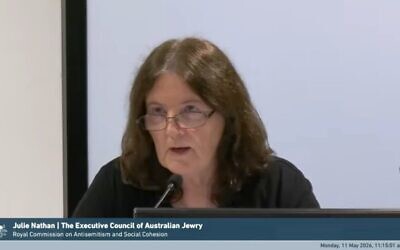
Julie Nathan, Research Direction for the executive Council of Australian Jewry (ECA). Photo Screenshot.
Ms Nathan told the Commission that incidents recorded in the 2024 report rose to 2,062, up from 495 in 2023.
The most recent tally for 2025 stood at 1,654 incidents, a 19.7 per cent decrease on 2024 but still more than three times the pre-October 7 figure.
Physical assaults rose from 11 in 2023 to 65 in 2024, before falling to 24 in the most recent reporting period.
Ms Nathan said the scale of incidents following October 7 had changed the reporting process.
She told the Commission she had issued incident-only reports in 2024 and 2025 because of the “massive amount of antisemitism incidents and discourse that occurred after the seventh of October 2023 attack in Israel”.
She described new forms of antisemitism that had emerged since the Hamas attacks, including convoys of cars driving from western Sydney through the eastern suburbs with Palestinian flags.
She also pointed to a series of arson and attempted arson attacks on Jewish premises including the Adass Israel synagogue, Lewis Continental Kitchen and Newtown synagogue.
“What we’re getting is, apart from the normal incidents that we’ve had for the last 20 years, now, we’re getting much more brazen and much more confident coming out and not ashamed or worried about being considered antisemitic,” she said.
Ms Nathan was at pains to explain that the ECAJ does not treat criticism of Israel or pro-Palestinian advocacy as inherently antisemitic.
She said the IHRA working definition was used as a guide, alongside guidelines drawn from the 1991 National Inquiry into Racist Violence.
Material is classified as antisemitic when it deployed older anti-Jewish tropes, Nazi analogies, or called for the destruction of Israel as the Jewish state, she said.
Pro-Palestinian material became antisemitic when used to target Jewish individuals, venues or residential areas.
She cited the example of “Free Palestine” stickers placed on soccer balls kicked into a Jewish community facility, which she said amounted to “targeting the Jewish community” rather than political expression.
The accusation that Israel is committing genocide, which she described as untrue, was not counted as antisemitic in itself.
Ms Nathan explained that every incident is counted as a single entry in the annual tally regardless of severity.
She told the Commission she had confirmed with the Community Security Group (CSG) that even an attack involving multiple victims would be recorded as “one incident”.
Ms Nathan said there was “massive under reporting” of antisemitic incidents, citing the Gen17 survey which recorded 43 physical attacks in a period when her own report counted 12.
Ms Nathan also commented on sexualised caricatures and antisemitic memes targeting her personally, which she said circulated on platforms such as Gab and Telegram around the time of each annual report.
She said critics who accuse the ECAJ of falsifying statistics needed only to read the published reports, which include brief descriptions and, where available, photographs of each recorded incident.
ABB, a 15-year-old Year 10 student at a public high school in Perth has testified about being antisemitically bullied from around 2024, both at school and online in a video game.
While playing Minecraft, a video game, a student posted in the chat that ABB was a “yarmulka wearing, bank owning iron doming, Hashem following Jew”.
Asked by Zelie Heger, SC, counsel assisting the Royal Commission on Antisemitism and Social Cohesion, how the comment made him feel, ABB responded, “Well, it made my stomach turn upside down, really. Just had to step away from my computer for a little bit, and then when I came back, I think I just closed and logged off for the day.”
At other times the chat had comments describing ABB as a “filthy penny sniffer” and “please give me a naught percent interest loan”.
The verbal attacks “ made me feel kind of abandoned and alone”.
ABB said that at one point, when he told the other students his father was watching, they quickly changed tack, “like cover it up with a blanket by putting Israel, an Israel flag emoji with a heart next to it to seem as if it was them loving it instead of hating it”.
Asked whether he’d told anyone about these incidents, ABB responded that he had told his parents after first keeping it to himself. But when he realised he couldn’t handle it alone, he reported it to his parents.
“I walked into the room and said, ‘I have no friends left, I have no friends left’.”
ABE, who is ABB’s father, told the hearing that when his son reported the slurs, he did so reluctantly, and “we had to drag the rest of the story” out of him.
“So there was a bit of conversation, and then he explained that there were these comments that he took screenshots of which he offered to show us.
“My first reaction was to go to the parents of the kids that he was playing and confront them with this. My son wasn’t very keen on that and talked me out of it. I also had ideas of going to the police.
“The school responded very well. They were immediately concerned, and we went in and had a meeting with the principal and the year coordinator, and they were very upset that this sort of thing was going on, and also extremely supportive.”
ABB said three of the children later apologised. After that, ABB “ felt a little more relaxed.”
But one student persisted with a frequent, threatening fist-pumping gesture.
At one point, at a school basketball event, ABB overheard a conversation among a group of Year 12 boys, with one of them saying, ‘Hitler was right to kill them all’.
ABB said his year coordinator checks in with him. “Every time he sees me, he always comes up to me, or I come up to him and he asks me how I’m doing with everything, and if everything’s okay.”
ABE said that as the boy’s father, he was deeply saddened by how his son “has normalised [the attacks] … has come to make his peace with it and accept it as part of his school life”.
ABD, the mother of ABB, said she had proposed to the school that they conduct student excursions to the Holocaust Institute of WA.
“I made suggestions that some sort of policy, some sort of school policy, or maybe even state policy, or maybe even national policy, should be introduced for children to just have that knowledge … it’s confronting and unpleasant, and we don’t want to expose our children to unpleasant things. But in the same way as we did with [Indigenous] truth telling, I think eventually our country will be the better for it.”
In the first session this afternoon, Witness ABD and Witness ABE – the parents of Witness ABB – returned to answer further questions.
ABD said she wanted to see real consequences for vilification and disrespect directed at any ethnic group in Australia — what she called “enforced respect.”
“We have to make sure that is not lip service,” she said, arguing that enforced respect protects something far greater: the peace and sense of belonging that all Australians share.
She called on the Commission to develop a framework to prevent the “importing of the war into Australia.”
Revisiting the December night her son first disclosed the bullying, ABD described him walking into the room with tears in his eyes to tell a story of what she called “radical abandonment”.
She also noted that her son had endured the harassment for more than a year — suffering in silence while they remained unaware.
Witness ABE, the boy’s father, said he had grown up proud of the fact that Australia’s successive waves of immigrants had not brought their overseas conflicts with them. That, he said, had now changed.
“I don’t recognise the place anymore. This has changed in the last decade or so, and I don’t like it,” he told the hearing. “We were a lot more tolerant. People had a fair go — all of those Australian idioms that we have for people having a fair go. That seems to have been lost.”
ABE said he wanted the Commission to “chart a course back towards that Australia — that attitude that we had in Australia.”
Both parents also spoke about the broader social atmosphere since the Hamas attacks of October 7, 2023.
ABD noted that despite a directive from her department’s director-general urging support for Jewish staff following the Bondi attack, no formal space was created at a group level for that to occur. Individual colleagues had offered support, but nothing institutional followed.
ABE said colleagues of his own age — including an Egyptian-born colleague and a Muslim woman — had approached him after 7 October to express sorrow, and condemn what happened. But he said the parents of the boys who had bullied his son were “astonished” the antisemitism had been going on, suggesting the attitudes had not come from his home environment.
ABD said this pointed to a troubling pattern of radicalisation targeting young people specifically. “Where do the children get these terms from?” she asked, noting the students had weaponised religiously specific language — such as the Hebrew word “Hashem” — that she would not have expected non-Jewish teenagers to know.
“What I’m worried about is the radicalisation of young people that is happening,” she said.
Rabbi Daniel Rabin, Senior Rabbi at Caulfield Hebrew Congregation (Caulfield Shule) provided testimony to the Royal Commission. He is also vice president of the Rabbinical Council Victoria, serves as a volunteer police chaplain, and serves as an advisor to the multi faith advisory group to the Premier.
Discussing his experience of antisemitism for being visibly Jewish in Melbourne he said, “Whether it’s walking to the synagogue, or, let’s say, on Friday night… and obviously being visibly Jewish, with a beard and kippah, I’ve had on numerous occasions. This is before October 2023, where people threw eggs and all sorts of horrific slurs…So this would, this would happen quite regularly… and of course, that increased after October 7”.
He mentioned that in one instance he was walking with his ten-year-old son immediately after October 7 2023 and a car drove by and the occupants said “horrific things,” and his 10-year-old said to him, “Why do these people hate us?”
Discussing him time as a Jewish chaplain for a University in Melbourne in 2009 to 2011, Rabbi Rabin said he witnessed antisemitism amid the flotilla incident from a group on campus.
“I was sort of told in certain terms, and unless I sort of apologised on behalf of what Israel has been doing, there will be repercussions on campus, and there will be consequences.”
He added, “There were a few sort of flare ups after that time and I know that the Jewish students had a function on south lawn in Melbourne where someone came and cut their cables to their sound system and sort of… pushed the table over.”
Rabbi Rabin observed a growing sense of unease in the Jewish community who are involved with his shule:
“I think what has been happening is seeing this blatant, unabashed ability for the wider community… protest every week in the city saying ‘All Zionists are terrorists’…. ‘genocidal killers’, ‘baby killers’, and then, of course, spreading into all areas… the arts and academia… that if you are have any connection or any affiliation with Israel or any connection to Zionism, you are inherently evil.”
He said congregants have said to him, “We don’t feel comfortable in Australia anymore.” He added, it was shocking that people were asking “Should they leave Australia?”
Asked how he responds to that, Rabbi Rabin said, “I’m not an alarmist, but I’m a realist. So, I’m not telling people they should leave. I think we still the fact that we’re even having a Royal Commission… and so my encouragement to them is to not give up”.
As to what Zionism means to him, Rabbi Rabin explained the connection between Judaism and Israel.
“Fair criticism of Israel is fine. I criticise Israel… but what we’re seeing is not criticism of Israel… These are huge lies, huge propaganda lies, like ‘genocide’ is just this word that’s been thrown into everything. You know that no matter what you say, it’s well, ‘You’re committing genocide’…
“So there’s nothing that you can say….they’re saying Zionism is colonialism. Zionism… is racism. And for me, what Zionism is… our right to be in ancestral homeland, indigenous homeland, but Zionism, if anybody knows anything about Judaism, it’s they’ll see that the land of Israel is so much part of our faith. It’s not just some separate part of our identity. We pray about it… most our holidays are revolved around it. So many of our commandments are applicable only in the land of Israel. So, it’s not just some distant sort of political thing that was created recently.”
Rabbi Rabin said Caulfield Shule had also experienced antisemitic harassment including phone calls saying, “You guys are baby killers”.
Rabbi Rabin also reflected on the problem of incident reporting given that many religious Jews don’t have a phone on Shabbat and therefore cant record incidents, and police are reluctant to act without evidence:
“If you’re walking on a Saturday on a Shabbat as an observant Jew, you keep Shabbat, which means you don’t sort of have your phone… it’s a 10 second event… What are you going to do? … go to the police station…. and they’re like, ‘Well, do you have any evidence?… And if there’s no cameras in the area, it’s really unfortunate they might sort of record it, just to keep their data of incidents.”
Rabbi Rabin said he felt the narrative that Zionists were committing genocide was impacting social cohesion, and that his shule was engaged with positive engagement with the non-Jewish community including thanking first responders on Christmas.
To improve social cohesion he said, “It’s going to require, of course, political leadership, religious leadership, business leadership, the higher levels, to call out these lies. But of course, we can’t rely solely on government. You know, we’ve got to do our bit.”
An award-winning Melbourne saxophonist and composer has given harrowing evidence to the Royal Commission on Antisemitism and Social Cohesion this afternoon about the torrent of abuse he and his wife suffered after being doxxed, the repeated vandalism of their North Melbourne shop, and the abrupt and public destruction of his music career – all in the wake of October 7, 2023.
Joshua Moshe, who was born in South Africa, raised in New Zealand, and moved to Melbourne to study music, told the hearing he had experienced antisemitism since his school days. But nothing, he said, had prepared him for what unfolded in Australia, after the Hamas attacks in Israel.
A music career dismantled
The fallout for Moshe’s music career was severe. His successful and award-winning band of seven years [not referred to during the hearing session by name], publicly expelled him via a social media post — not even by contacting him directly — condemning “all forms of Zionism.
Moshe said he was removed from his record label, and threats related to him were made at two performance venues he was to perform at, requiring additional security for him.
A fellow musician pulled out of a booked performance, telling him they feared losing work by association. A collaborating artist withdrew performance rights from a song.
He lost a residency and countless performance opportunities. His bandmates later published an apology, after litigation between them was resolved.
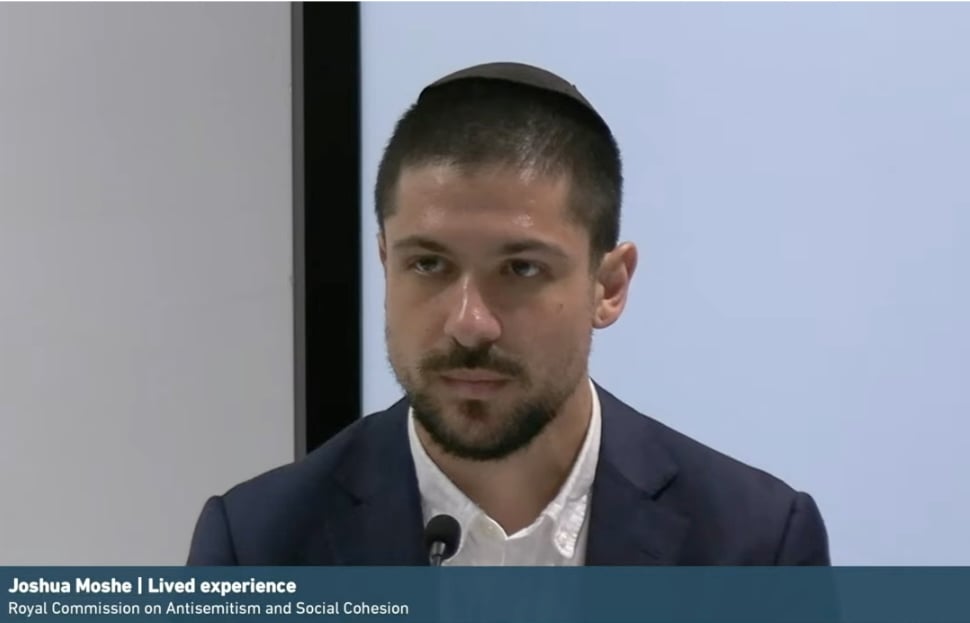
Joshua Moshe giving evidence at the Royal Commission on May 11, 2026. Photo: Screenshot
Targeted as a Jewish business owner
Moshe and his wife ran a gift and homewares shop in North Melbourne. Though it was not a Jewish business in any explicit sense, the couple made no attempt to hide that they were Jewish, and from 2021 they had already begun noticing a hostile shift in creative and arts communities.
In November 2023, a customer sent a message to the shop, asking whether they were “supporting a family-owned business that supports Palestine” — citing their Jewish identity, and their silence on the Gaza conflict. Moshe told the Commission he found it “profoundly unfair to target any member of any ethnicity and ask them to be a representative of anything you deem unacceptable.”
In December 2023, while rushing his wife to a hospital emergency department and wearing a kippah, Moshe was screamed at from a passing car: “You f—ing Jewish rat” and “Take another f—ing photo, you filthy Jew” — the latter in response to him photographing the car for evidence.
He told the Commission the “rat” imagery in that abuse struck him deeply. “If you read about the Holocaust and you learn about it, there’s a lot of rat imagery that was used,” he said.
“It’s unbelievable that someone in Australia in 2023 feels empowered to use the same vitriolic language against me.”
He reported the incident to police, but was informed in July 2025 that the driver refused to identify the passenger, and no charges could be laid.
Doxxed from a private WhatsApp group
In early November 2023, Moshe had joined a private WhatsApp group of Jewish creatives and academics — a space to share experiences, discuss antisemitism and support one another through what he described as an increasingly hostile climate. He made comments criticising a writer whose posts he considered antisemitic, including what he saw as an attempt to have audiences boycott an Australian artist simply for performing at a Jewish event.
In late January 2024, the group’s contents were leaked after someone had been added to the chat, exported it, and then left. Within days, Moshe and his wife were subjected to a co-ordinated online pile-on across every channel — Instagram, Facebook, email, Google reviews and direct messages — falsely accusing him of conspiring against other artists.
Posts labelled him a “Zionist,” plastered boycott stickers over images of his music press shots, and described the couple as “Zio Characters.”
His wife was called a “media whore” and a “practised media slut.” The abuse, he said, was “relentless” — leaving him with anxiety, night sweats, an elevated heart rate and an inability to sleep.
On 31 January 2024, a threatening voicemail was left on the shop’s phone — “Better keep watching your MF back. We know where you are now” — accompanied simultaneously by a text message containing a photograph of the couple’s son sourced from social media.
The following morning, the shop front was plastered with boycott stickers bearing the Star of David crossed out. Repeat stickering and spray-painted graffiti — including “Zionism Shmayanism” on the shop windows — followed over subsequent weeks, sometimes during trading hours.
The couple ultimately relocated the shop to another part of Melbourne; as they packed up, passers-by screamed “Good, we don’t want Zionists in our area,” and one called his wife a “Zionist bitch.”
Both the police and the eSafety Commissioner declined to take formal action over the doxxing, with officers telling Moshe they could not classify the abuse as antisemitic because it used the word “Zionist” rather than “Jew.”
Moshe challenged that distinction, arguing “Zionist” was being used as a proxy, and the effect on Jewish Australians was the same. He received no satisfactory response from either authority.
When asked by the Counsel Assisting about the personal impact of the abuse on him and his wife – who is in the process of converting to Judaism – he said it was “devastating.
“I was feeling extremely anxious, devastated, feeling like my life was starting to unravel – not knowing what would happen. I was fearing for my safety. I struggled to sleep. I had an elevated heart rate.”
Why he came forward
Moshe told the Commission he had come forward because he hoped his experience could drive real change, so that “no one else has to go through anything like this.”
He pointed to two specific failures: the use of “Zionist” as a legal loophole that shields antisemitic abuse from accountability, and the failure of authorities to enforce existing laws.
“No one in this whole sorry story has been held accountable,” he said. “If you don’t hold people accountable and enforce laws, then people become more empowered to do more and more extreme things.”
He closed with a broader plea. “Any society that endorses antisemitism — if you learn through history — it never goes well for the broader society.
“I want Australia to be a thriving and successful country. It’s the country I moved to. And that’s why I came forward today.”
Rabbi Menachem Dadon provided testimony to the Commission. He is the Rabbi at Bet Yosef Synagogue in Bondi, which is also known as the ‘Chabad for Israelis’, which co-hosted the 2025 Chanukah by the Sea event in Bondi where 15 people were murdered. It was co-hosted with Rabbi Eli Schlanger who was killed, who he described as “a man of action, an amazing human being.”
Rabbi Dadon’s daughter was injured in the Bondi attack, and she said to him, “Why [do] they hate us so much? Why [do] they want to kill?”
He said he had also experienced antisemitic incidents in Sydney as a visible Jew: “Unfortunately, to be a religious Jew in Sydney is to accept the fact that from time to time we walk in Shabbat, and people will drive and just they will allow themselves to say certain things to you, to curse you, and obviously saying, ‘Free Palestine’. It’s a regular thing.” He added he had also been called a “baby killer.” The Rabbi is a teacher and said his students shared they have also been harassed.
Describing an offensive incident, he said a mezuzah had been taken off a door and inside of the mezuza instead of the parchment with the Shema prayer, he found the words ‘Free Palestine’.
“Someone went to his house, took out the mezuzah… and just put the ‘Free Palestine’ inside the mezuzah, enclosed it,” he said.
Rabbi Dadon called for improved education in the community to counter antisemitism.
Musician Deborah Conway provided testimony to the Royal Commission discussing the abuse she had experienced for being a ‘Zionist’.
Asked what being a Zionist meant to her, Conway said, “being a Zionist… is believing that the Jews have an internal, profound relationship with their ancient homeland in the land of Israel, where we originated three and a half thousand years ago.”
“There’s many ways to be a Jew, and Zionism is often a very elemental expression of being a Jew, and I think they’re interchangeable. And I think the idea of trying to somehow remove Israel, or the idea of Zionism out of from being a Jew… it’s a false narrative that has it’s a convenient lie for which people who want to throw slurs at Jews are happy to hide behind,” she said.
Conway added, “Zionism is not to do with politics. It’s not to do with the left or the right of Israeli politics. Everybody disagrees about politics, both there and within the Jewish community here, but that doesn’t mean that you don’t have this relationship with Israel at the very core of your Judaism… Most diaspora Jews and Israeli Jews would agree with that. I think there’s been surveys that talk about 85 per cent of Jews that feel that way.”
Discussing the hostility she has faced which she feels is antisemitic Conway said, “There’s been a kind of atmosphere of anger directed at Israel, and subsequently directed at anybody who feels that connection with Israel and it… tends to peak every time Israel is in a conflict with one of its neighbours.”
Regarding the Hamas attack on October 7, 2023, she said: “What happened on the 7th of October, this barbaric attack. We had so many details about it, and it was so horrific. And initially there was a little bit, there was a bit of sympathy. People were initially, you know, horrified themselves, but within a couple of days, the idea of a gathering of angry men chanting, ‘Gas the Jews’. ‘Where’s the Jews?’ ‘Fuck the Jews’. On the steps of our iconic Sydney Opera House. And the only person that gets taken away from that scene by the police is the man who turned up there to wave an Israeli flag… But the Glee, the jubilation, these celebrations, or protests, or whatever you want to call them, that were taking place in in the shadow of the Opera House… was a wake up call… I just thought, am I living in 2023 Australia, or is this 1933 Berlin? It just was so bizarre.”
Conway discussed the backlash she received from a radio interview in November 2023: “My husband and I had performed at a huge concert event in Melbourne at the Rod Laver Arena, and I wore a very large Magen David and we both wore white suits with blue shirts, and he wore a yarmulke and then a few days later, there was the event in Sydney where some actors performed a play and wore their keffiyehs for the encore. And there was kind of a collapse within this particular organisation because of that event, and I had been invited to discuss the comparison between those two events on the national broadcaster…. And it wasn’t long before the interviewer decided that she wanted to talk about what was happening on the ground in Israel and she said something like, ‘Well, the kids, the kids, there’s so many kids dying’. And I said, ‘Well, it depends what you call kids, because Hamas are putting guns in the hands of underage soldiers, and then they’re cynically counting them in their casualty lists. And I think that’s an absolutely shocking form of child abuse’. But those few words were taken out of context, and they were weaponised, and then I was a ‘baby killer’. I was ‘revelling in Palestinian blood’. The accusations were… so shocking, so utterly devoid of any truth and unanchored from the meaning of my words. It took me a while, but I realised it was a tactic… if you can call someone a baby killer, there really is nothing worse than that.”
Conway talked about being doxxed as part of a WhatsApp group of Jewish creatives:
“The Prime Minister mentioned my name several times… I guess what happened was that people then presumed that I had been a designer of the group in the first place that I and that I had gone after other people’s careers. Neither of … these charges were true. I very rarely commented on the group,” she said.
Conway noted she had written a memoir published just before October 7 2023, and received backlash at Australian writers festivals.
“Because I… had written this book, I had a whole series of writers festivals lined up. And one of the first writers festivals that had booked me was the one over in Western Australia. And I received a call from the festival director saying, ‘Look, I don’t want you to worry, but there’s been quite a lot of pushback about your being part of our program’.… he said, ‘Don’t worry… it’s all fine, it’s under control’. So, I thought, Okay, well, it’s under control. Then I received a couple more phone calls and I thought, well, maybe it’s not as under control as they thought… I turned up to this Writers Festival, there was a whole slew of security people that were there to keep me safe, maybe the audience safe, and they had included another bunch of writers”
Asked what happened in those sessions Conway said, “The first two sessions were sold out, and they were fine… And the third session was a panel… and all these people rose to their feet within the auditorium and unfurled their signs and started screaming things at me, and I was shocked… offstage security came in, they removed these people, and then we resumed the discussion. But I did feel very shaken by it, and one of the other panellists said, ‘Oh, I understand how tempers run really high in these situations, but I didn’t feel that was quite the right thing to say.’”
Conway said that a series of appearances and bookings were cancelled:
“I think one of the most horrific things that I had to encounter was a bookshop in Brisbane, a small suburban bookshop in Brisbane… and there’s a dozen people outside, and they’re wearing masks, and they’ve got massive signs saying, ‘Globalise the Intifada’… and they’re screaming at us, and they literally screamed for the next 45 minutes and pounded on the glass. And one of the worst things was that the police turned up, and there were a lot of police, maybe 10, maybe more, and they just stood there, and they thought that was okay, because that was freedom of speech. And for some reason, this freedom of speech thing has become so enshrined, so holy, that it’s okay to vilify someone, and not just us, but everybody who walked in or out of that shop felt deeply threatened by these people. And that was really astounding.”
Conway noted that at another gig, “70 people turned up with their balaclavas and their pots and pans and their cameras, the police were also in attendance, and they also did not deem that a protest that they needed to disperse, because that’s free speech”.
Conway said she released a new album in 2025 ‘Right-Wing Propaganda’ and it was difficult to receive reviews and to secure performance spaces.
Asked about an offensive post calling Conway a Zionist, Conway said: “At this point, I feel that Zionist… is completely interchangeable with Jew, and they might say that it’s only people who support the State of Israel, but… they know”.
She added, “Post 1948, I believe that discussing whether Zionism is a valid entity, or whether… Israel should exist, I believe that’s a genocidal impulse. I don’t think you can see it in any other way if you don’t believe that Zionism should exist after the State of Israel has been created, after there is a community there, living there after 78 years, where there are 8 million Jews and 2 million Arabs and Christians and Druze and Bedouins, and they’re all there. And you want to take the entire land and turn it into the 54th Muslim state, then I believe that is a genocidal impulse.”
Royal Commissioner Bell asked Conway, “Do you appreciate that there are Australians who appear to have become very staunch supporters of Palestinians living in the West Bank and Gaza, and who hold a view that Israel has under the present administration behaved in a disproportionate way, both in Gaza and in relation to the activity of some of the more extreme settlers in the West Bank?”
Conway replied, “Of course, I acknowledge that that view is very prevalent in this country. I mean, it’s impossible to avoid that view… I do feel… there is a lot of one sided rhetoric about the conflict, and that not enough of the other side is perhaps presented, and that it’s a very complex history, and that everyone I know would love peace. I know Israelis want peace. Everyone wants peace. Peace has been attempted so many times and… peace is something very elusive at this point. That doesn’t mean people aren’t trying for it, but it also but, but it is incumbent upon any democratic country to defend its citizens if they are under attack. And I think what happened on the seventh of October and subsequently was an existential crisis. I’m not saying that they prosecuted the war perfectly. They certainly didn’t, but it is one of it is one of the most difficult things to prosecute… an urban war where one of the sides is happy to use their own civilians as casualties for the propaganda that it offers. I think that’s an absolutely awful and brutal truth, but I think that my reading tells me that’s exactly what’s been going on.”
Commissioner Bell also asked, “You were described as an outspoken Zionist and a supporter of Israel, and that moved us to a discussion about Zionism. But it’s probably fair to say, is it not that, in the context of the debate in Australian society today, you are a supporter of Israel because you view Israel as defending itself and in a sense against a fairly hostile environment in the Middle East. Would that be a fair view?”
Conway said, “I think it’s really important to say that I support Israel’s right to exist. I don’t support… all of the Israeli government’s ways of prosecuting the war… I don’t think that’s a subtle difference. I think that’s a massive difference. But, you know, we didn’t ask for America to be dismantled because it prosecuted the war in Afghanistan or Vietnam or Iraq badly… I think that idea of antizionism is, in fact, a genocidal impulse”.
Conway also discussed online abuse she received including wishing her dead, which a social media platform did not remove, and noted she made a submission of them to the eSafety Commissioner in Australia.
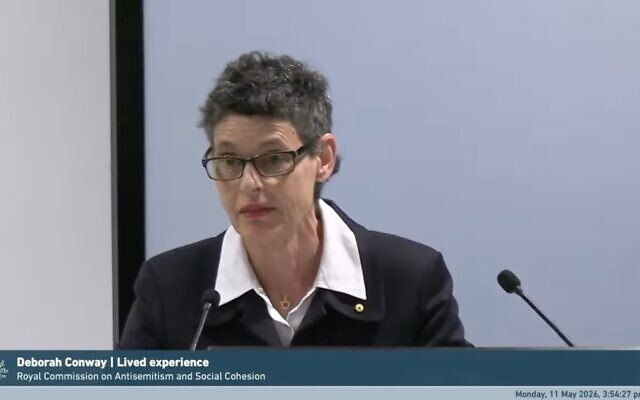
Deborah Conway provides testimony at the Royal Commission on 11 May 2026. Photo: Screenshot.
Asked how her bookings are for 2026 she said, “There’s not many”.
Discussing the impact on her family Conway said: “My middle child is a musician as well, and.. I think there has been great difficulty for her. She has, you know, lost musician friends who have refused to play with it… Definitely been hard. I think the some of the major festivals who would definitely have booked her have not. My youngest daughter has actually been targeted even more viciously. She doesn’t play music… she’s an online influencer in some way, and she makes food… she’s been told that she’s adding to the suffering of Palestinians because she’s making hummus…They’ve threatened to turn up a place that she sells her food at markets, and she had to pack up and leave. She was so freaked out. She’s been targeted online by influencers with 90,000 strong platforms… I can’t bear the bullying and the injustice… It’s unfathomable. She’s never made a statement about anything… There’s a business of madness. There’s a madness about all of this.”
Concluding Conway said, “I speak for myself, but I also speak for an entire cohort of young artists, young musicians, who have really struggled in this climate to get work, to be seen as who they are, as opposed to what they represent…. these are young people, and they’ve got their careers in front of them, and they are being targeted and vilified and persecuted by people that have no basis to do that…. the more they target them, the more the more young people actually go and live in Israel. So, they’re achieving the opposite of what they want to achieve.”
The AJN is providing rolling coverage on the Royal Commission on Antisemitism and Social Cohesion. Read all the updates from Hearing block one, week one.
Musician Deborah Conway provided testimony to the Royal Commission discussing the abuse she had experienced for being a ‘Zionist’.
Asked what being a Zionist meant to her, Conway said, “being a Zionist… is believing that the Jews have an internal, profound relationship with their ancient homeland in the land of Israel, where we originated three and a half thousand years ago.”
“There’s many ways to be a Jew, and Zionism is often a very elemental expression of being a Jew, and I think they’re interchangeable. And I think the idea of trying to somehow remove Israel, or the idea of Zionism out of from being a Jew… it’s a false narrative that has it’s a convenient lie for which people who want to throw slurs at Jews are happy to hide behind,” she said.
Conway added, “Zionism is not to do with politics. It’s not to do with the left or the right of Israeli politics. Everybody disagrees about politics, both there and within the Jewish community here, but that doesn’t mean that you don’t have this relationship with Israel at the very core of your Judaism… Most diaspora Jews and Israeli Jews would agree with that. I think there’s been surveys that talk about 85 per cent of Jews that feel that way.”
Discussing the hostility she has faced which she feels is antisemitic Conway said, “There’s been a kind of atmosphere of anger directed at Israel, and subsequently directed at anybody who feels that connection with Israel and it… tends to peak every time Israel is in a conflict with one of its neighbours.”
Regarding the Hamas attack on October 7, 2023, she said: “What happened on the 7th of October, this barbaric attack. We had so many details about it, and it was so horrific. And initially there was a little bit, there was a bit of sympathy. People were initially, you know, horrified themselves, but within a couple of days, the idea of a gathering of angry men chanting, ‘Gas the Jews’. ‘Where’s the Jews?’ ‘Fuck the Jews’. On the steps of our iconic Sydney Opera House. And the only person that gets taken away from that scene by the police is the man who turned up there to wave an Israeli flag… But the Glee, the jubilation, these celebrations, or protests, or whatever you want to call them, that were taking place in in the shadow of the Opera House… was a wake up call… I just thought, am I living in 2023 Australia, or is this 1933 Berlin? It just was so bizarre.”
Conway discussed the backlash she received from a radio interview in November 2023: “My husband and I had performed at a huge concert event in Melbourne at the Rod Laver Arena, and I wore a very large Magen David and we both wore white suits with blue shirts, and he wore a yarmulke and then a few days later, there was the event in Sydney where some actors performed a play and wore their keffiyehs for the encore. And there was kind of a collapse within this particular organisation because of that event, and I had been invited to discuss the comparison between those two events on the national broadcaster…. And it wasn’t long before the interviewer decided that she wanted to talk about what was happening on the ground in Israel and she said something like, ‘Well, the kids, the kids, there’s so many kids dying’. And I said, ‘Well, it depends what you call kids, because Hamas are putting guns in the hands of underage soldiers, and then they’re cynically counting them in their casualty lists. And I think that’s an absolutely shocking form of child abuse’. But those few words were taken out of context, and they were weaponised, and then I was a ‘baby killer’. I was ‘revelling in Palestinian blood’. The accusations were… so shocking, so utterly devoid of any truth and unanchored from the meaning of my words. It took me a while, but I realised it was a tactic… if you can call someone a baby killer, there really is nothing worse than that.”
Conway talked about being doxxed as part of a WhatsApp group of Jewish creatives:
“The Prime Minister mentioned my name several times… I guess what happened was that people then presumed that I had been a designer of the group in the first place that I and that I had gone after other people’s careers. Neither of … these charges were true. I very rarely commented on the group,” she said.
Conway noted she had written a memoir published just before October 7 2023, and received backlash at Australian writers festivals.
“Because I… had written this book, I had a whole series of writers festivals lined up. And one of the first writers festivals that had booked me was the one over in Western Australia. And I received a call from the festival director saying, ‘Look, I don’t want you to worry, but there’s been quite a lot of pushback about your being part of our program’.… he said, ‘Don’t worry… it’s all fine, it’s under control’. So, I thought, Okay, well, it’s under control. Then I received a couple more phone calls and I thought, well, maybe it’s not as under control as they thought… I turned up to this Writers Festival, there was a whole slew of security people that were there to keep me safe, maybe the audience safe, and they had included another bunch of writers”
Asked what happened in those sessions Conway said, “The first two sessions were sold out, and they were fine… And the third session was a panel… and all these people rose to their feet within the auditorium and unfurled their signs and started screaming things at me, and I was shocked… offstage security came in, they removed these people, and then we resumed the discussion. But I did feel very shaken by it, and one of the other panellists said, ‘Oh, I understand how tempers run really high in these situations, but I didn’t feel that was quite the right thing to say.’”
Conway said that a series of appearances and bookings were cancelled:
“I think one of the most horrific things that I had to encounter was a bookshop in Brisbane, a small suburban bookshop in Brisbane… and there’s a dozen people outside, and they’re wearing masks, and they’ve got massive signs saying, ‘Globalise the Intifada’… and they’re screaming at us, and they literally screamed for the next 45 minutes and pounded on the glass. And one of the worst things was that the police turned up, and there were a lot of police, maybe 10, maybe more, and they just stood there, and they thought that was okay, because that was freedom of speech. And for some reason, this freedom of speech thing has become so enshrined, so holy, that it’s okay to vilify someone, and not just us, but everybody who walked in or out of that shop felt deeply threatened by these people. And that was really astounding.”
Conway noted that at another gig, “70 people turned up with their balaclavas and their pots and pans and their cameras, the police were also in attendance, and they also did not deem that a protest that they needed to disperse, because that’s free speech”.
Conway said she released a new album in 2025 ‘Right-Wing Propaganda’ and it was difficult to receive reviews and to secure performance spaces.
Asked about an offensive post calling Conway a Zionist, Conway said: “At this point, I feel that Zionist… is completely interchangeable with Jew, and they might say that it’s only people who support the State of Israel, but… they know”.
She added, “Post 1948, I believe that discussing whether Zionism is a valid entity, or whether… Israel should exist, I believe that’s a genocidal impulse. I don’t think you can see it in any other way if you don’t believe that Zionism should exist after the State of Israel has been created, after there is a community there, living there after 78 years, where there are 8 million Jews and 2 million Arabs and Christians and Druze and Bedouins, and they’re all there. And you want to take the entire land and turn it into the 54th Muslim state, then I believe that is a genocidal impulse.”
Royal Commissioner Bell asked Conway, “Do you appreciate that there are Australians who appear to have become very staunch supporters of Palestinians living in the West Bank and Gaza, and who hold a view that Israel has under the present administration behaved in a disproportionate way, both in Gaza and in relation to the activity of some of the more extreme settlers in the West Bank?”
Conway replied, “Of course, I acknowledge that that view is very prevalent in this country. I mean, it’s impossible to avoid that view… I do feel… there is a lot of one sided rhetoric about the conflict, and that not enough of the other side is perhaps presented, and that it’s a very complex history, and that everyone I know would love peace. I know Israelis want peace. Everyone wants peace. Peace has been attempted so many times and… peace is something very elusive at this point. That doesn’t mean people aren’t trying for it, but it also but, but it is incumbent upon any democratic country to defend its citizens if they are under attack. And I think what happened on the seventh of October and subsequently was an existential crisis. I’m not saying that they prosecuted the war perfectly. They certainly didn’t, but it is one of it is one of the most difficult things to prosecute… an urban war where one of the sides is happy to use their own civilians as casualties for the propaganda that it offers. I think that’s an absolutely awful and brutal truth, but I think that my reading tells me that’s exactly what’s been going on.”
Commissioner Bell also asked, “You were described as an outspoken Zionist and a supporter of Israel, and that moved us to a discussion about Zionism. But it’s probably fair to say, is it not that, in the context of the debate in Australian society today, you are a supporter of Israel because you view Israel as defending itself and in a sense against a fairly hostile environment in the Middle East. Would that be a fair view?”
Conway said, “I think it’s really important to say that I support Israel’s right to exist. I don’t support… all of the Israeli government’s ways of prosecuting the war… I don’t think that’s a subtle difference. I think that’s a massive difference. But, you know, we didn’t ask for America to be dismantled because it prosecuted the war in Afghanistan or Vietnam or Iraq badly… I think that idea of antizionism is, in fact, a genocidal impulse”.
Conway also discussed online abuse she received including wishing her dead, which a social media platform did not remove, and noted she made a submission of them to the eSafety Commissioner in Australia.
Deborah Conway provides testimony at the Royal Commission on 11 May 2026. Photo: Screenshot.
Asked how her bookings are for 2026 she said, “There’s not many”.
Discussing the impact on her family Conway said: “My middle child is a musician as well, and.. I think there has been great difficulty for her. She has, you know, lost musician friends who have refused to play with it… Definitely been hard. I think the some of the major festivals who would definitely have booked her have not. My youngest daughter has actually been targeted even more viciously. She doesn’t play music… she’s an online influencer in some way, and she makes food… she’s been told that she’s adding to the suffering of Palestinians because she’s making hummus…They’ve threatened to turn up a place that she sells her food at markets, and she had to pack up and leave. She was so freaked out. She’s been targeted online by influencers with 90,000 strong platforms… I can’t bear the bullying and the injustice… It’s unfathomable. She’s never made a statement about anything… There’s a business of madness. There’s a madness about all of this.”
Concluding Conway said, “I speak for myself, but I also speak for an entire cohort of young artists, young musicians, who have really struggled in this climate to get work, to be seen as who they are, as opposed to what they represent…. these are young people, and they’ve got their careers in front of them, and they are being targeted and vilified and persecuted by people that have no basis to do that…. the more they target them, the more the more young people actually go and live in Israel. So, they’re achieving the opposite of what they want to achieve.”
Enjoy Unlimited Access To The Australian Jewish News Website And All Our Online Content For AUD$18/month Or Just AUD$120/year.





comments