Live UpdatesPublic hearings

‘Not sure what spaces are safe’

Royal Commission hearings continue focusing on the dissemination of antisemitic content and other forms of hateful speech in the media.

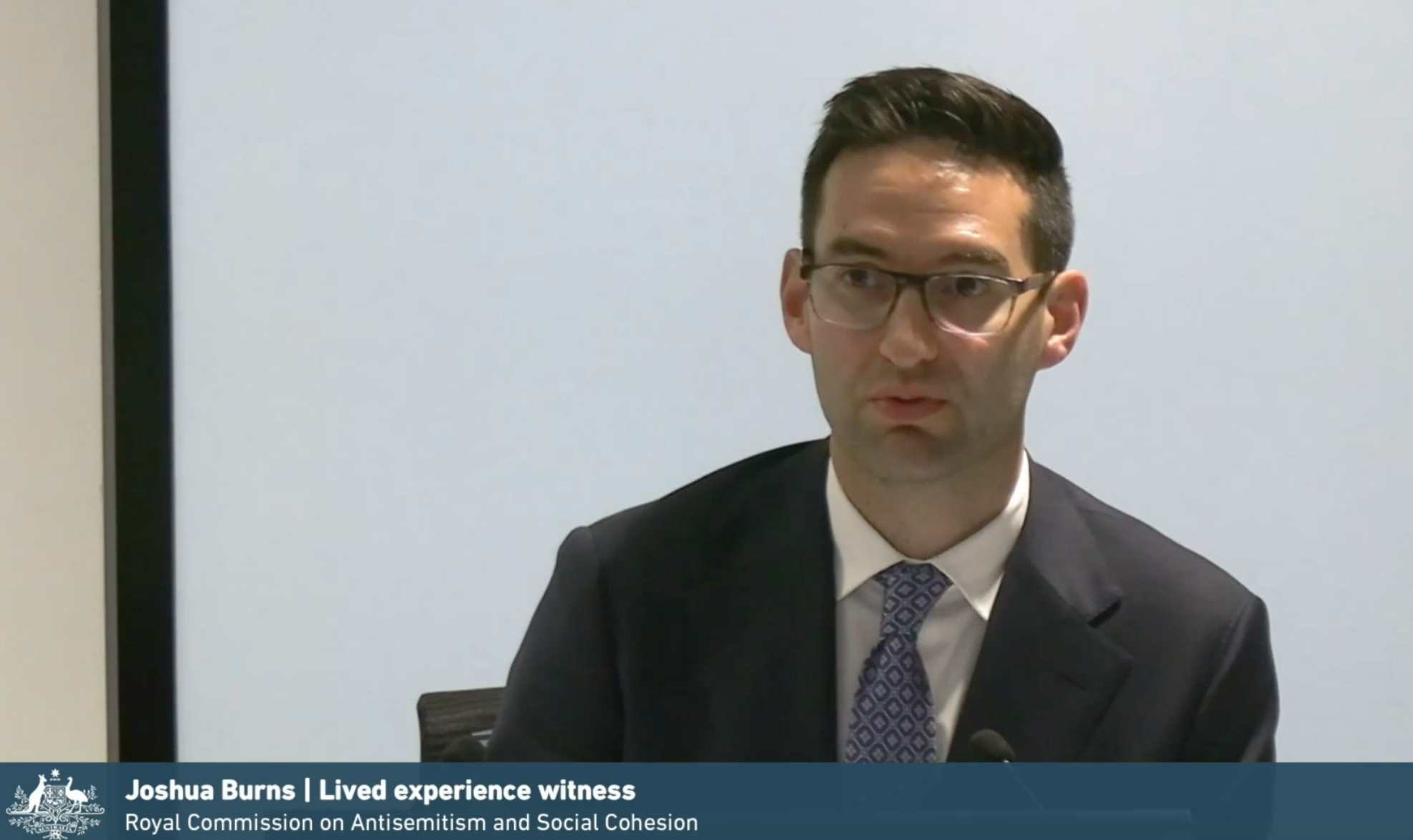
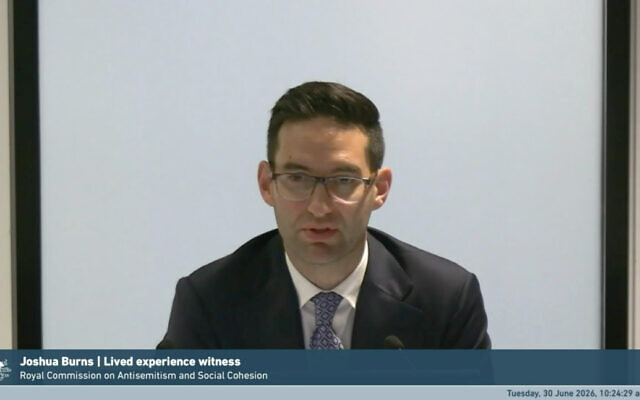
MP Josh Burns at the Royal Commission on Antisemitism and Social Cohesion. Photo: screenshot

Read their stories

Federal member for Macnamara Josh Burns on ‘relentless’ abuse

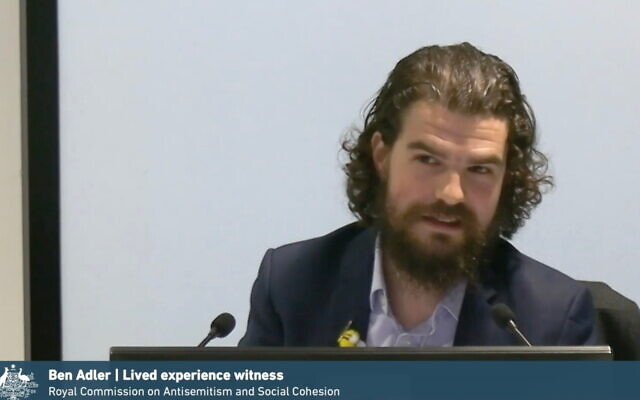
Ben Adler on the systematic erasure of Jewish artists

Cr Daniel Rosenfeld on feeling unsafe as an elected councillor of Randwick City Council in NSW

Dor Foundation CEO Tali Blicblau on monitoring the response online to witnesses giving evidence

Witness ACH on the online antisemitic abuse over the sale of his Holocaust survivor grandparents’ home

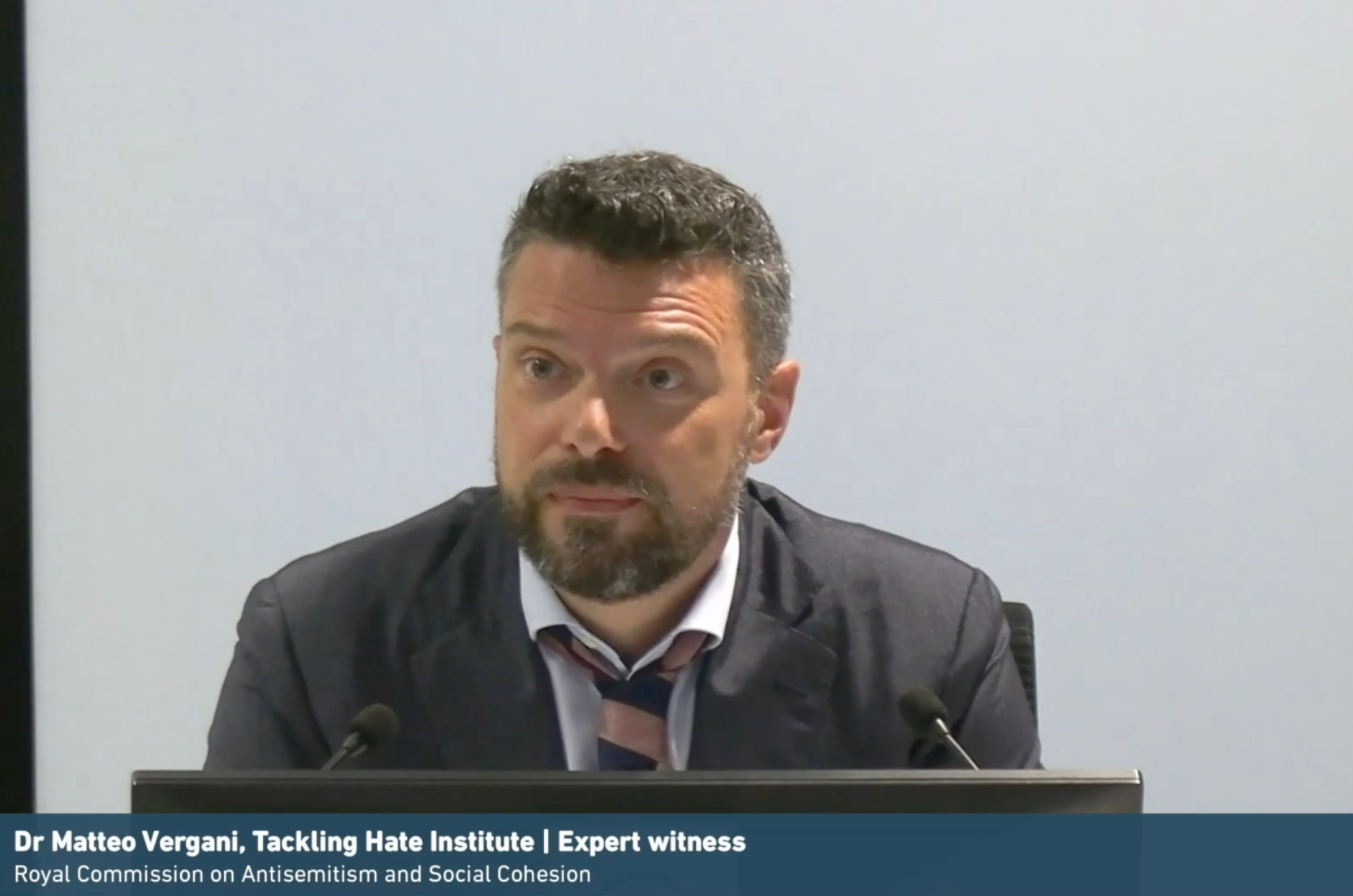
Associate Professor Dr Matteo Vergani, co-director of The Tackling Hate Lab (TTHL) at Deakin University, who detailed the key findings of a major report into anti-Jewish hate on the social media platform X

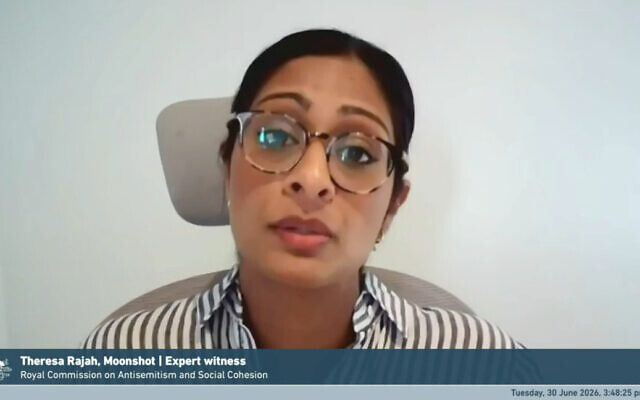
Theresa Rajah from Moonshot on the radicalisation of children online

Children as young as 12 being radicalised online, commission hears

Online violence prevention expert Theresa Rajah told the Royal Commission on Tuesday afternoon that children as young as 12 are being radicalised online, and that the pathway to extremism is increasingly driven not by ideology but by a fascination with violence itself.

Rajah, director of online violence prevention at Moonshot, gave evidence on the basis of a report she co-authored with the organisation’s chief executive, Vidhya Ramalingam.

Moonshot, founded in 2015, works with the Five Eyes governments — Australia, Canada, New Zealand, the United Kingdom and the United States — and with platforms including Google and Meta, operating in what Rajah called the “pre-criminal space” before individuals come to the attention of law enforcement.

Online violence prevention expert Theresa Rajah gives evidence to the Royal Commission.

Rajah cited a study by forensic psychologist Jonathan Kenyon and colleagues, which examined 235 individuals convicted of extremist offences in England and Wales and found the internet had played a central role in nearly every case. She described the online environment as “an active incubator” for grievances, identity formation and behavioural escalation, in which algorithmic targeting steadily feeds users more extreme content.

Individuals might begin with material that is “quite normalised” before gravitating towards specific influencers, communities and fringe platforms hosting the most violent content. There was no real divide between the online and offline worlds, she said, with violent actors frequently operating in both.

Moonshot’s central method, she explained, uses behavioural signals rather than belief or ideology. Drawing on a database of more than 10 million targeting indicators — keywords, hashtags, community names — the organisation serves advertisements offering support to people consuming violent content, redirecting them to trained counsellors.

The messaging, she said, was “ideologically agnostic” and aimed at the underlying drivers of loneliness, anger and hopelessness. The same offer of support was used regardless of how far along the pathway a person had travelled, with risk assessment occurring once they made contact.

In New Zealand over a 12-month period, she said, the approach generated 3,643,000 offers of support, more than 17,000 engagements, and 47 people who directly contacted the service. A multi-year Canadian program saw 77 people request help. The sharp filtering of those numbers was “intentional by design”, she said.

Rajah outlined three recent shifts. First, a “sharp rise” in minors engaging with extremist content, with the New Zealand program finding up to 49 per cent of those searching for violence-inciting material may be under 18.

Second, ideology was “no longer central” to radicalisation, with pathways increasingly beginning in spaces organised around nihilism, misogyny and graphic violence rather than political extremism — “people seeking out violence for the sake of violence”.

Third, general exposure to violent content was at its highest level, with 66 per cent of New Zealanders reporting having seen illegal or extremely harmful content online.

Asked by Commissioner Virginia Bell about the risk posed by young people absorbing antisemitic memes about Hitler and gassing Jews, Rajah said normalisation and desensitisation could happen “quite rapidly”.

She warned that organised networks worked in a “considered, strategic and planned way” to find young people on gaming and other adjacent platforms and lure them into more extreme spaces. What began as harmless activity could escalate, she said, with no real prevention infrastructure offering young people an “off ramp”.

Deakin Uni expert: Spike in online antisemitism a structural shift

The Royal Commission on Antisemitism and Social Cohesion this afternoon heard evidence from Associate Professor Dr Matteo Vergani, co-director of The Tackling Hate Lab (TTHL) at Deakin University, who detailed the key findings of a major report into anti-Jewish hate on the social media platform X.

Dr Vergani said the report’s central finding was a sharp and persistent increase in hostility targeting Jews following October 7, 2023, which he described as a significant structural shift rather than a temporary reaction.

He noted that this elevated baseline had not returned to pre-October 7 levels, remaining heightened right up until March 2026, when TTHL stopped collecting data for the report.

He pointed to subsequent trigger events, including the Bondi Chanukah terror attack, as producing further noticeable spikes, layered on top of that sustained elevation.

When asked about the second key finding, concerning the relationship between online hate and real world incidents affecting Jewish communities in Australia, Dr Vergani said the lab’s analysis showed a statistically significant connection, that offline incidents were found to trigger surges in online hate.

He explained that serious incidents reported in the media gave “haters” a platform, and an opportunity to air their views – a mechanism he said also helped explain the elevated baseline, since local incidents – not only events overseas – reinforced what he called a “spiral of hate”.

Dr Vergani said that statistical relationship between offline incidents and online language was not present in the data before October 7, but became clear and consistent afterwards, indicating the online and offline spheres had become more tightly interconnected since.

He said the findings had practical value for digital platform governance, as it offered “intervention points” – allowing authorities and platforms to anticipate when spikes in harmful language were likely to occur and to act pre-emptively, rather than only responding after the fact.

Also spoken about in this hearing session was a more sophisticated causal analysis centred on the Addas Israel Synagogue attack, in which TTHL had matched users who engaged with a conspiracy theory that suggested that the attack on the shule was self-inflicted, against comparable users who did not suggest that.

Those who engaged with the conspiracy theory subsequently showed 10.6 percentage points more anti-Jewish posting, and 3.5 percentage points more toxicity, than matched controls, suggesting exposure to such conspiracy theories can shift attitudes and behaviour even where the content itself breaches no legal regulation.

Antisemitic abuse over Holocaust survivor’s house sale

A human rights lawyer who is the grandchild of Holocaust survivors has told the Royal Commission on Antisemitism and Social Cohesion how antisemitic comments flooded a social media post advertising the sale of his late grandmother’s home, the very house where he grew up hearing her accounts of surviving Auschwitz-Birkenau and Bergen-Belsen.

Witness ACH said he had practised human rights law for approximately two decades. His late grandparents were both Holocaust survivors who volunteered at the Sydney Jewish Museum and spent decades educating students and the public about the Holocaust.

He told the hearing that discussions about their experiences dominated his childhood.

“The breakfast table, the lunch and dinner table tended to be dominated by discussion of the Holocaust. So our acquisition of learnings from that multiplicity of events began early and seated itself in our psyche from an adolescent age,” he said.

After his grandmother’s death in 2024, the family listed the property for sale. Its distinctive features attracted an article on realestate.com.au, and a Facebook post promoting the property drew antisemitic responses. One read, “Yes, I’d occupy that, then I’d tear it down, just like Palestine is being torn down by hypocritical Zionists.”

Witness ACH said neither grandparent had ever identified publicly as Zionists, and commenters were making assumptions about his family’s politics.

Another comment referenced a “cool tattoo,” a veiled allusion to tattoos forced on Auschwitz inmates, which the witness described as “deeply upsetting and very confronting.” A third read, “Typical. Jew playing the victim to try and cash in, burn the filthy Jew house down.”

Of that comment, Witness ACH said, “The use of the word burn is a very loaded term, for obvious reasons, because of the Holocaust, but also because the history of burning Jews is much longer.”

He traced the language to 12th-century pogroms and said the word “filthy” invoked centuries-old disease conspiracy tropes.

The witness described a second incident in September 2025, when he was tagged in a LinkedIn post seeking non-dogmatic voices for debate. A commenter responded, “Given how several of them loudly support Israel and its genocide, I’m not sure how they fit any filter of ‘left wing’. Since when has brutal racism been leftist?” He characterised the remark as “akin to a kind of blood libel.”

Witness ACH said he was struck by “how brazen people were prepared to be, and the seeming impunity with which they made the comments,” and that platforms lacked “the resources or capacity or will” to moderate such content effectively.

He said the events of the past three years, including the October 7 attack and the Bondi terror attack, had changed his behaviour.

“I notice myself at times at particular events becoming more hyper vigilant than I would ordinarily be, for example, assessing the people around me, looking for where entry and exit points were, trying to discern whether a person was a member of the community, a safe person, what their intentions are,” he said.

“There’s a certain degree of the world feeling like it’s sort of shrinking in because you’re not sure what spaces are safe.”

Dor Foundation reports on antisemitism targeting witnesses

Dor Foundation CEO Tali Blicblau told the Royal Commission her foundation has been monitoring the response online to witnesses giving evidence during Hearing Block One of the commission’s work and prepared a report as evidence.

“To summarise, we found that witnesses who came to the Royal Commission during Hearing Block One to give evidence about their experience in antisemitism were subjected to more of it. They were targeted and abused online at volume and across social media platforms, and that was true both for witnesses who held positions within the Jewish community, and also witnesses who chose to give evidence under a pseudonym,” Blicblau said.

The report to the Royal Commission included 275 examples of antisemitic and/or abusive posts directed towards witnesses, and in one case, a person who was not a witness, but who was engaging with the commission in relation to making a submission.

“Those posts sit across seven different social media platforms to summarise the general nature of the post. I should say that… 275 examples comes from a much larger body of examples of many hundreds more, but we chose those that were illustrative of key themes and trends,” she said.

“Those themes and trends included the following: first of all, explicit calls for violence against witnesses and Jewish people generally, including calls to kill Jews and bring back the gas chambers. It includes dehumanising language comparing witnesses to cockroaches, vermin, and parasites. It includes misogynistic, homophobic, and sexually degrading abuse, often paired with typically antisemitic abuse. It includes Holocaust glorification, distortion, and mockery, including expressions of admiration for Hitler, and it includes antisemitic tropes and conspiracy theories, and accusations that witnesses were crisis actors or were falsifying their evidence.”

Blicblau noted that a small number of the posts had been removed, but the vast majority of antisemitic posts documented were still there. “I will say that that was less than 10 [removed] out of a batch of over 1000,” she said.

Asked about the foundation’s approach for collating the posts, she said: “It’s been a process of multiple layers of assessment and review. The ones that we’ve chosen to include, we consider to be either overtly antisemitic or abusive or contextually antisemitic, that is, by virtue of the fact that they were posted in relation to witness in relation to evidence given by a witness about their experiences of antisemitism, and indeed giving evidence at this commission on antisemitism, I would submit that they are arguably contextually antisemitic.”

Blicblau said across social media monitoring a common theme was that a significant subset of posts included either Holocaust glorification or Holocaust denial – she pointed an antisemitic trope “that asserts that only 271,000 Jews were killed in the Holocaust”.

She noted that witnesses were targeted generally with sexually degrading abuse, often incorporating antisemitic slurs including accusations of paedophilia.

Another theme was calls for the expulsion or deportation of Jewish Australians. “There were many of them less coded and quite direct, calling for Jews to leave Australia or be forcibly expelled, deported, or removed. Some of them are as blatant and clear as ‘Expel all Jews’,” Blicblau said.

She discussed the antisemitic trope ‘109’ calling for the expulsion of Jews – “The trope is expressed in different ways, but most commonly appears as the number 109, suggesting that that Jewish people have been expelled from 109 different countries across history, and it often comes with calls for countries to be the 110th to expel their Jewish populations,” she said.

Blicblau spoke to the theme of false flags and false victimhood on the part of Jewish people: “This theme can probably be divided into two sub-themes: antisemitic commentary regarding false flag or staged victimhood. There’s a whole body of examples in the annexure that relates specifically to the Bondi terrorist attack being fake, staged, or self-inflicted, and… separate further examples of false victimhood generally,” she said.

Discussing examples of  coded language for Jews online, Blicblau pointed to examples including the juice box emoji and deliberate misspellings such as ‘JOS’.

“Our team went through an exercise of reporting every single post that is in that annexure, so part of the reason that the annexure contains only 275 examples and not the much larger data set is that, as you can imagine, it is a painstaking exercise to report all of those to the platforms, but we’ve done that, and in some cases we’ve reported them more than once, the data set has also separately been shared with the eSafety Commissioner, the AFP, and the community security groups who are point of contact with state-based police forces. In general terms, very few comments, including many of the ones that we’ve just, we’ve just reviewed, have been removed by the platforms,” she said.

Asked for her general observations Blicblau noted that people and institutions seeking to respond effectively to antisemitism are themselves targeted and attacked with antisemitic abuse, and that posts and comments to the platforms “demonstrates a grossly inadequate response.”

She added, “It’s clear that the platform response is entirely out of step with normal communal expectations of how people should treat one another, and I think it’s fair to say that either the legislation or policies are not effective or are not being effectively enforced.”

Cr Daniel Rosenfeld: “I felt quite unsafe”

Cr Daniel Rosenfeld, an elected councillor of Randwick City Council in NSW, provided testimony to the Royal Commission. Rosenfeld told the hearing he is Jewish and the grandson of Holocaust survivors.

Rosenfeld said he witnessed antisemitism increase after 7 October 2023, and discussed antisemitic comments he received after he posted a picture attending a reception for the President of Israel on 9 February 2026.

“There was one comment that basically said Jews don’t belong in Australia, which I found very offensive, given that my family came to Australia to escape antisemitism. So that was very, very confronting, and there were quite a few other comments, basically saying that I’m happy to be attending war criminal, and I found that very, very confronting as well, and there were many comments in that, and I felt quite unsafe, to be honest. Seeing all those comments made me feel quite unsafe as a Jewish person in Australia, and it was quite disturbing in that way.”  He noted another comment pointed to a picture of Adolf Hitler, suggesting Hitler was right in his opinions of Jewish people.

Rosenfeld also discussed antisemitic graffiti in the neighbourhood:
“After October 6 [2023], there was quite a few incidents of antisemitic graffiti, and we as a Council decided to resolve to clean that up as soon as we could.”

Ben Adler: Jewish artists face systematic erasure

Sydney violinist and klezmer musician Ben Adler told the Royal Commission on Antisemitism and Social Cohesion that the majority of his professional energy is spent not rehearsing or performing, but fighting to prevent Jewish art from being cancelled.

Adler, 33, leads the klezmer fusion band Chutney and directs the Shir Australian Jewish music festival. Giving evidence on June 30, he described the systematic erasure of Jewish cultural presence from public life since October 7, 2023, telling the commission that his once-unchallenged sense of Australian belonging had fundamentally shifted. “There have been significant and successive experiences I’ve had in the past two and a half years which have made me feel highly unwelcome in Australia,” he said.

Even before external pressure mounted, the band had begun self-censoring. A gig scheduled for October 12, 2023, in Marrickville was deliberately stripped of all Jewish references. “We call ourselves folk funk fusion, not a mention of the J word or the I word,” Adler said, describing a conscious effort to avoid provoking hostility in the area. The gig was ultimately cancelled after October 7.

Adler outlined a two-part thesis on why Jewish artists face erasure. The first driver, he said, is anti-Zionist ideology, which he framed as the latest in a historical progression from religious anti-Judaism to racial antisemitism to modern anti-Zionism. The second, and more common in his experience, is people with no hostility towards Jews who act against them out of fear. “They fear repercussions from the bullying tactics of those people,” he said.

In a notable exchange, Commissioner Bell asked whether those sidelining Jewish artists were simply critical of Israel’s current government. Adler pushed back, arguing anti-Zionism at its core is “an eradicationist, eliminationist movement that seeks the removal of Israel” rather than good-faith criticism. “It doesn’t matter what Israel does, they will have problems with Israel,” he said. He acknowledged that many well-intentioned people are drawn to the movement out of genuine humanitarian concern, but maintained the outcome is the same: “It is the new hate movement of the day.”

Ben Adler at the Royal Commission on Antisemitism and Social Cohesion. Photo: screenshot

Adler described being headhunted by a Victorian music festival in August 2023 to headline a public klezmer performance. After October 7, the festival told him it was no longer appropriate, citing “the nuanced situation overseas” and a vocal pro-Palestinian contingent among attendees. He successfully argued the band’s position should be retained, writing that the logical extension of removing Jewish art to avoid offence was “the erasure of Jewish cultural presence from Australia.”

In the spirit of supporting fellow artists, Adler shared a de-identified version of that letter in a WhatsApp group for Jewish creatives. The group, he said, existed for two purposes: to provide a space for Jewish artists to support each other navigating the post-October 7 reality of cancellations, and to encourage advocacy on their behalf.

“It had nothing to do with Israel. It was not a political group whatsoever,” he said. His intention in sharing the letter was to offer a template to other artists facing similar deplatforming.

He was subsequently doxxed, listed among a “top 100 Zio” compilation, and accused of engaging in Zionist propaganda for having successfully advocated for his own band’s performance. Adler told the Commission the accusation illustrated precisely how anti-Zionism functions to silence Jewish Australians. “There’s no relation whatsoever,” he said.

In further questioning, Nicholas Bender, Counsel for Australia’s mainstream Jewish communal organisations, established that the letter was a private communication and that Adler was exercising the same right as any other minority group to discuss shared professional experiences. Adler agreed, adding that the suggestion the group had anything to do with positions on Israel was “completely fallacious.”

The commission was shown social media abuse targeting the band, including comments on a video of the Yiddish Holocaust song Papir Rosen that predates modern Israel by decades, and responses to Shir festival advertisements featuring an AI-generated “victim card” image and the description of Jews as “cancer on the world.” One commenter threatened to use Molotov cocktails at a Melbourne concert. Adler reported the threat to the venue and police, but told the commission the venue subsequently dropped the band, forcing them to find an alternative within eight days. He said he had followed up with Victoria Police at least 15 times since September 2025 with no substantive response.

Adler urged the commission to consider the role of arts and culture in building social cohesion, warning that if Jewish cultural expression continues to be suppressed, the community will remain dehumanised. “If these unelected gatekeepers, be they festivals or venues or awards or media or radio, continue to lock us out … we will never have a chance to be humanised properly,” he said.


Burns tells of office firebombing and ‘relentless’ online abuse

Federal member for Macnamara Josh Burns has told the Royal Commission on Antisemitism and Social Cohesion that the firebombing of his St Kilda electorate office and the relentless online abuse directed at him and his family carry a common message to Jewish Australians: that they do not belong.

Giving evidence on Tuesday, Burns described being woken about 6am by a panicked call from a staff member. “Josh, someone’s attacked the office, turn on the news,” he recalled being told. He initially thought someone had shot at the office, before realising attackers had used a hammer to smash it and had set alight communications pits in the street.

The attack, which he said cost about $100,000 to repair, was accompanied by graffiti reading “Zionism is fascism” over an image of Burns with horns drawn on his head.

“If they thought that smashing up my office was going to bring about peace in the Middle East … all it did was cost $100,000 to fix it and scare a lot of people,” he said.

Member for Macnamara Josh Burns at the Royal Commission on Tuesday morning.

Burns, who is a proud member of the Jewish community, said the deeper danger was not overt hatred but the subtler logic that holds Jewish Australians responsible for the actions of the Israeli government. “I’m not an Israeli citizen. I’ve never been an Israeli citizen. I have no desire to be an Israeli citizen. I’m a proud Australian,” he said. To attribute dual loyalty to a Jewish person, he said, was “a complete dehumanisation”.

He described the experience of being blamed for the antisemitism directed at him as “like being stabbed twice — once for the antisemitism and once being blamed for being stabbed in the first place”.

Burns told the commission he had submitted 44 reports of offensive and antisemitic material to Meta, of which only three resulted in removal, nine received no response and 32 resulted in no action taken. He said he had lost faith in the reporting process and no longer reported everything.

He identified what he regards as a significant gap in the Online Safety Act: the eSafety Commissioner can act when an individual is targeted, but not when a group is vilified. “You can’t be critical of a Jewish person and name them, but you can be critical of the Jewish people,” he said, describing it as a restriction worth reforming — one that should protect “Jews, Muslims, First Nations people, LGBTQI people. This isn’t just about the Jews.”

Burns recounted meeting a group of year nine girls from a school in his electorate during a civics visit to Canberra. When he asked who had experienced antisemitism, every girl raised her hand. Many, he said, had been screamed at in the street because their school uniforms identified them as Jewish.

He also spoke of the abuse directed at his partner, Victorian Legislative Council member Georgie Purcell, who is not Jewish. She faced the same questioning of loyalty and attribution of blame that he did, he said, with “a layer of misogyny and a layer of … violent, sexualised comments on top of it”. Knowing she had to endure abuse because of her relationship with him was, he said, “devastating”.

Burns said advocacy for Palestinian rights was “a legitimate and important cause” that should not be mistaken for what he was describing. He recalled a Palestinian member of parliament calling him after the Bondi attack and asking to attend a community event with him. “There is room for both,” he said. “They are not in conflict.”

He closed by reflecting on what he called the erosion of a sense of belonging. The Australia he grew up in, he said, was a place where he never had to hide the Magen David under his shirt or worry about being identifiably Jewish. “We always felt that this was the golden Medina,” he said. He urged the commission to consider how to protect people from vilification while preserving full and free participation in democracy.

The AJN is providing rolling coverage on the Royal Commission on Antisemitism and Social Cohesion.

For full coverage of the Hearing Blocks, visit the Royal Commission section of The AJN website.

read more:
comments
Live Updates Public hearings

Dor Foundation reports on antisemitism targeting witnesses

Dor Foundation CEO Tali Blicblau told the Royal Commission her foundation has been monitoring the response online to witnesses giving evidence during Hearing Block One of the commission’s work and prepared a report as evidence.

“To summarise, we found that witnesses who came to the Royal Commission during Hearing Block One to give evidence about their experience in antisemitism were subjected to more of it. They were targeted and abused online at volume and across social media platforms, and that was true both for witnesses who held positions within the Jewish community, and also witnesses who chose to give evidence under a pseudonym,” Blicblau said.

The report to the Royal Commission included 275 examples of antisemitic and/or abusive posts directed towards witnesses, and in one case, a person who was not a witness, but who was engaging with the commission in relation to making a submission.

“Those posts sit across seven different social media platforms to summarise the general nature of the post. I should say that… 275 examples comes from a much larger body of examples of many hundreds more, but we chose those that were illustrative of key themes and trends,” she said.

“Those themes and trends included the following: first of all, explicit calls for violence against witnesses and Jewish people generally, including calls to kill Jews and bring back the gas chambers. It includes dehumanising language comparing witnesses to cockroaches, vermin, and parasites. It includes misogynistic, homophobic, and sexually degrading abuse, often paired with typically antisemitic abuse. It includes Holocaust glorification, distortion, and mockery, including expressions of admiration for Hitler, and it includes antisemitic tropes and conspiracy theories, and accusations that witnesses were crisis actors or were falsifying their evidence.”

Blicblau noted that a small number of the posts had been removed, but the vast majority of antisemitic posts documented were still there. “I will say that that was less than 10 [removed] out of a batch of over 1000,” she said.

Asked about the foundation’s approach for collating the posts, she said: “It’s been a process of multiple layers of assessment and review. The ones that we’ve chosen to include, we consider to be either overtly antisemitic or abusive or contextually antisemitic, that is, by virtue of the fact that they were posted in relation to witness in relation to evidence given by a witness about their experiences of antisemitism, and indeed giving evidence at this commission on antisemitism, I would submit that they are arguably contextually antisemitic.”

Blicblau said across social media monitoring a common theme was that a significant subset of posts included either Holocaust glorification or Holocaust denial – she pointed an antisemitic trope “that asserts that only 271,000 Jews were killed in the Holocaust”.

She noted that witnesses were targeted generally with sexually degrading abuse, often incorporating antisemitic slurs including accusations of paedophilia.

Another theme was calls for the expulsion or deportation of Jewish Australians. “There were many of them less coded and quite direct, calling for Jews to leave Australia or be forcibly expelled, deported, or removed. Some of them are as blatant and clear as ‘Expel all Jews’,” Blicblau said.

She discussed the antisemitic trope ‘109’ calling for the expulsion of Jews – “The trope is expressed in different ways, but most commonly appears as the number 109, suggesting that that Jewish people have been expelled from 109 different countries across history, and it often comes with calls for countries to be the 110th to expel their Jewish populations,” she said.

Blicblau spoke to the theme of false flags and false victimhood on the part of Jewish people: “This theme can probably be divided into two sub-themes: antisemitic commentary regarding false flag or staged victimhood. There’s a whole body of examples in the annexure that relates specifically to the Bondi terrorist attack being fake, staged, or self-inflicted, and… separate further examples of false victimhood generally,” she said.

Discussing examples of  coded language for Jews online, Blicblau pointed to examples including the juice box emoji and deliberate misspellings such as ‘JOS’.

“Our team went through an exercise of reporting every single post that is in that annexure, so part of the reason that the annexure contains only 275 examples and not the much larger data set is that, as you can imagine, it is a painstaking exercise to report all of those to the platforms, but we’ve done that, and in some cases we’ve reported them more than once, the data set has also separately been shared with the eSafety Commissioner, the AFP, and the community security groups who are point of contact with state-based police forces. In general terms, very few comments, including many of the ones that we’ve just, we’ve just reviewed, have been removed by the platforms,” she said.

Asked for her general observations Blicblau noted that people and institutions seeking to respond effectively to antisemitism are themselves targeted and attacked with antisemitic abuse, and that posts and comments to the platforms “demonstrates a grossly inadequate response.”

She added, “It’s clear that the platform response is entirely out of step with normal communal expectations of how people should treat one another, and I think it’s fair to say that either the legislation or policies are not effective or are not being effectively enforced.”

Enjoy Unlimited Access To The Australian Jewish News Website And All Our Online Content For AUD$18/month Or Just AUD$120/year.

Subscribe Now