Government scrapped broad antisemitism and extremism programs
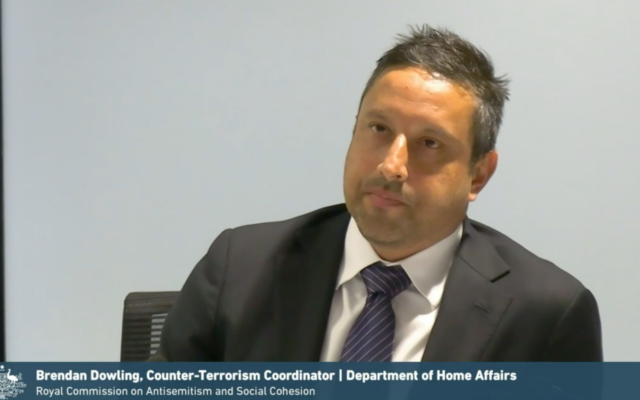
Department of Home Affairs counter-terrorism coordinator Brendan Dowling has told the Royal Commission on Antisemitism and Social Cohesion that the Commonwealth has deliberately moved away from broad-based community programs and social media campaigns to combat extremism, replacing them with targeted intervention for at-risk individuals.
Dowling, who commenced in the newly full-time role on May 14, told the hearing that the position was made a dedicated focus in response to the commission’s interim report.
He outlined a significant restructuring of the Commonwealth’s countering violent extremism (CVE) architecture, including the consolidation of two longstanding programs, Living Safe Together and the High Risk Rehabilitation and Reintegration Program, into the National Support and Intervention Program (NSIP), which now receives $85.9 million over three years and approximately $30 million on an ongoing basis.
Dowling said the previous programs had suffered from “variable, patchy, inconsistent” data collection that did not give a clear national picture of CVE caseloads or the effectiveness of interventions.

“The broader strategic goal was to really mature our CVE programs into a more consistent national approach with better data collection, clearer reporting, easier administration arrangements,” he said.
Two strategic communications programs called Wrapped and Fearlessly Australian, which operated across social media platforms to foster belonging among individuals vulnerable to extremist narratives, ceased in October 2024.
Dowling was critical of the approach, describing it as a “sort of scattergun approach” with no reliable way to assess whether target audiences were engaging with the material.
“You’re pushing a message out into the ether and hoping that the right people engage with it,” he said.
“It’s arguable to say that the Australian government pushing out messages of positive engagement to someone who feels disconnected and isolated from their community might have zero effect.”
The Safe and Together Community Grants program was also discontinued. Its first round had allocated $2.3 million across 27 grants from 109 applications, including a Jewish Museum of Australia program intended to address antisemitism and increase cultural understanding of Judaism in schools and communities. Planned second and third funding rounds did not proceed.
Dowling said the grants “were relatively untargeted in the sense that they weren’t addressing the at-risk individuals that we are concerned about engaging in radicalisation”.
“Community programs that address prejudice, hate have their place and are merited. However, [they] are not direct enough of an intervention in the at-risk caseloads that we are most concerned about,” he said.
He stressed other Commonwealth and state agencies continued to fund community programs of that nature, but within counter-terrorism work specifically, the shift had been toward targeted intervention.
An extremism social media insights reporting program operating from 2015 to mid-2025 was also wound up after a 2024 review found it redundant.
Youth radicalisation referrals surging as CVE system faces scrutiny
Referrals into Australia’s countering violent extremism programs are trending sharply upward, with a growing gap between the number of people flagged for concern and those who become active participants, the Royal Commission on Antisemitism and Social Cohesion has heard.
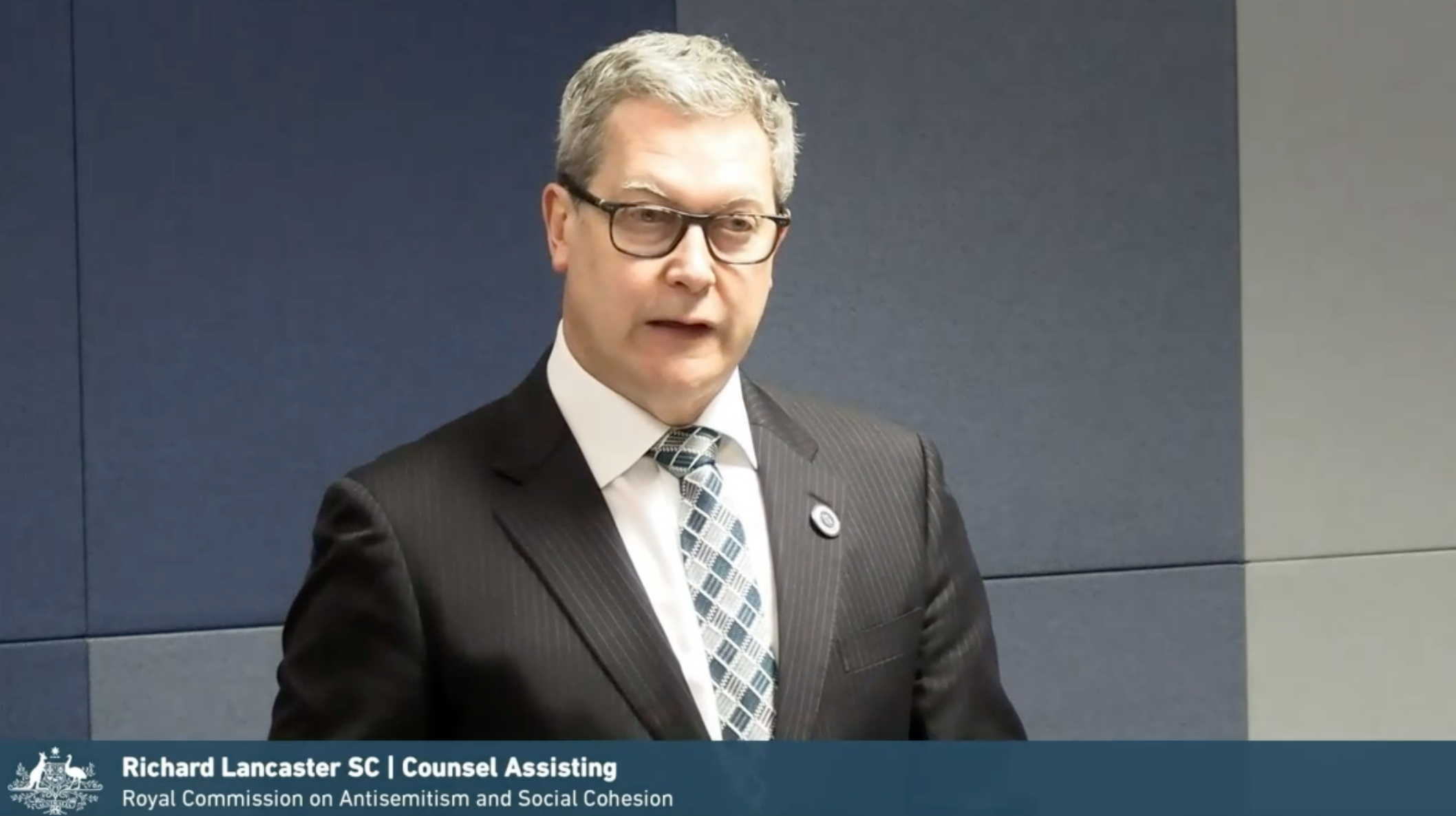
Department of Home Affairs counter-terrorism coordinator Brendan Dowling presented referral data from the National Support and Intervention Program (NSIP) showing 447 reports submitted by jurisdictions in the first quarter of 2025-26, rising to 461 in the second quarter and 582 in the third.
Active participants were significantly lower: 248 in the first quarter and 253 in the second. Counsel assisting Richard Lancaster SC put to Dowling that in the third quarter, despite 582 new referrals, only about 40 became active participants. Dowling broadly agreed, noting some variation.
Asked about the fourth quarter, Dowling said referral numbers were “certainly not going down” and the upward trend continued.
He said the gap reflected several factors, including individuals declining to participate in the voluntary programs, panels determining a person’s needs were better addressed by mental health services, and cases where the program was not equipped to manage someone presenting a risk of violence.
Dowling described the trends in youth radicalisation as “disturbing”.
“Whether it be neo-Nazi material, white supremacist material, anti-government material, jihadi material, we’re seeing an increasing number of young people engaging with this material,” he said.
CVE eligibility in some jurisdictions began at the age of 10, consistent with the trend toward younger radicalisation.
“When you’re talking about a person at that age, a law enforcement response is sometimes going to be the right response, but in many cases, a CVE intervention outside of the law enforcement domain might be a far more appropriate response for a child who’s engaged in extremist material,” Dowling said.
The commission also heard that the Step Together helpline and digital support service, originally a New South Wales program, had been rolled out nationally from July 1, 2025 with Commonwealth funding. Inquiry numbers were rising across all reported quarters.
However, Dowling acknowledged the program had not been formally evaluated since 2019, agreeing with a recommendation from Professor Michele Grossman that a rapid, independent assessment was needed.
“I do think it’s important and timely,” he said, citing the national rollout and the evolution in caseloads since the last evaluation.
He said New South Wales, in partnership with his office, was close to commencing the evaluation.
Dowling also acknowledged community awareness of the service remained far too low, saying research indicated only a very small percentage of the population knew it existed.
“It is critical that we raise broader awareness of the Step Together program,” he said.
Extremist material easier to find online, commission told
Australia’s Counter-Terrorism Coordinator has told the Royal Commission on Antisemitism and Social Cohesion that major social media companies are doing less to police extremist content than they once did.
Brendan Dowling said: “If you were to go online today, you would have no trouble finding violent extremist material.”
Dowling, appointed in May as Australia’s first dedicated, full-time Counter-Terrorism Coordinator on the recommendation of the commission’s interim report, was continuing evidence begun earlier in the hearing block.
His written statement had used the word backsliding to describe the risk posed by the platforms. Asked to explain, he said the risk had already materialised.
“Mainstream social media platforms are less active than they used to be about policing content on their platforms that was extremist,” he said. He singled out X for having wound back many of the trust and safety measures it once used to limit extremist content, and named the Meta-owned Facebook and Instagram alongside it.
“I don’t believe social media platforms are doing as much as they can and should to address the availability,” he said, describing the problem as a major concern for his department and for police around the country.
Gaming platforms compounded the difficulty, he said, because traditional methods of monitoring do not work when people are communicating by voice inside a gaming community.
Asked whether Commonwealth-funded intervention programmes target particular ideologies, Dowling said they are built to respond to any ideology a person presents with, because the underlying drivers of radicalisation are often common across them.
So, he said, are the grievances, with “antisemitism, I think, being probably the most prominent commonality, which goes from jihadi extremism to right-wing or white supremacists or anti-government extremism”.
He returned to the point when discussing digital literacy, which he described as crucial to preventing radicalisation.
“We see people engaging with content which fuels their grievances, whether that be, as we’ve seen, antisemitism in Australia, hatred and anger at the Jewish people,” he said. “People are sometimes engaging with this material and ideas without critical thinking, believing what they’re seeing online.”
Dowling also gave evidence on Diversions Australia, a pilot that began in January and works with platforms to identify users searching for violent extremist material. Those users are served a pop-up directing them to information, and in higher-risk cases to a referral.
The pilot has run on TikTok. Between January and early May, 6500 users connected to the pilot site, 779 of them classified as engaged users who clicked through. Forty-two opened contact options and 12 went on to speak with practitioners.
Dowling said he was not aware of the model having been tried anywhere else in the world, and that the results justified expanding it. The gaming service Roblox is next.
The commission also heard that $1.7 million has been spent or committed on raising awareness of the Step Together helpline, with a further $5.2 million allocated in the 2026-27 budget.
On foreign interference, Dowling said divisive and extremist material circulating in Australia is largely home-grown or American in origin, but that foreign actors work to amplify it.
He described Russian government propaganda operations and bot campaigns as a matter of public record, and said groups associated with the Iranian government may engage in similar activity.
“When you see material that is promoted and available online because of its level of views or its virality, that is not necessarily natural or organic,” he said.
He said he had been following a French government programme that analyses the extent of foreign information manipulation, and that his role was to press Commonwealth agencies on whether they are doing enough to address it.
Dowling flags five-year cycle and looser high-risk offender rules
The Commonwealth is weighing a move to longer funding cycles for its countering violent extremism (CVE) programs and a loosening of the narrow rules governing its high-risk terrorist offender scheme, so that intervention money can reach a broader range of at-risk people, the Royal Commission heard on Tuesday.
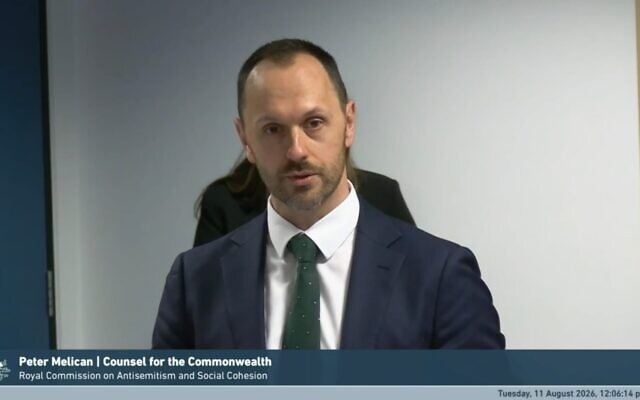
Responding to questions from Counsel for the Commonwealth Peter Melican, Department of Home Affairs counter-terrorism coordinator Brendan Dowling said the government was looking at whether it could move to a five-year funding cycle for the National Support and Intervention Program (NSIP), up from the current three years. Delivery agencies in the states had given regular feedback that certainty of funding was important to retain and develop staff. “I’m sympathetic to feedback from jurisdictions that longer-term funding arrangements would better equip them to build their service,” he said.
Dowling also questioned whether the high-risk terrorist offender regime — narrowly defined in law and applying to only a small number of offenders subject to continuing detention or extended supervision orders — was “too restrictive”. Given the “broadening” range of at-risk individuals now being seen, he said there was “a valid question” as to whether the funding could be freed up “to better unlock some of the intervention and therapeutic programmes for a broader range of people”.
The comments followed evidence that Victoria had recorded an underspend on one part of the scheme and an overspend on another, with the Commonwealth declining to allow the funds to be reallocated — a decision Dowling said was “correct in a technical sense” but “maybe didn’t get the outcome that we needed”.
Prison extremism program doesn’t try to change beliefs, inquiry hears
New South Wales prison programs for radicalised offenders do not seek to change their beliefs or ideology — even where an inmate holds neo-Nazi views — but instead focus on changing behaviour, the Royal Commission on Antisemitism and Social Cohesion has heard.
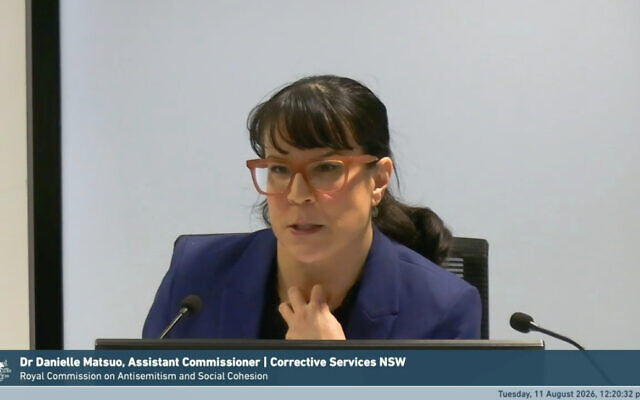
Dr Danielle Matsuo, Assistant Commissioner, Community at Corrective Services NSW, gave evidence about the agency’s countering violent extremism (CVE) services, which have operated in some form since 2016 and were consolidated under a single banner in 2025. The services are voluntary, available only to sentenced adults in custody or under community supervision, and open to those presenting with the full range of extremist ideologies — religiously inspired, far-right, mixed, or what Matsuo described as “grievance-fuelled violence”. Offenders under 18 are managed separately by youth justice.
Matsuo said the services deliberately did not attempt to challenge an offender’s beliefs directly. Asked whether staff working with an inmate holding neo-Nazi views or a belief in racial inferiority would test that belief, she said: “That’s correct” — they would not. Instead, the program targets behaviour, building coping and problem-solving skills and strengthening social connections, with any shift in ideology flowing indirectly.
She said change was possible but slow, as offenders often arrived with entrenched views. “By the time people have come to us, their journey isn’t necessarily linear,” she said. “Sometimes they can fall back into bad habits … but change is possible.”
Matsuo said the program guarded against what she called “disguised compliance”, or impression management, by monitoring whether an offender’s conduct matched their words. “It’s about whether someone who’s talking the talk can actually walk the walk,” she said, adding that this could only be determined by observing behaviour over time.
The services include psychological risk assessments, individually tailored interventions and family support, and since August last year have been expanded to include a forensic psychiatrist. A recently commenced pilot funds ancillary support for participants after release, including paying for the removal of tattoos — such as swastikas — to assist reintegration into the community.
Matsuo said the CVE team’s religious support officer was from an Islamic background, and that there were no commensurate roles for other faiths, though the agency was “very open” to considering this. She said credible, properly screened religious mentoring could provide “protective factors”, but had to sit within the program’s broader approach rather than being treated as an answer in itself. Corrective Services employs Jewish chaplains, she said, who could be a conduit for participants seeking that support.
She said evaluating the program’s success was difficult given the small cohort and low base rate of offending, and that an Australian National University evaluation led by Dr Emily Corner was under way, though its second phase had been delayed.
Terror offenders kept apart at Supermax to stop radicalisation, inquiry told
High-risk terrorism offenders in New South Wales are separated not only from the general prison population but from one another at Goulburn’s Supermax facility, to prevent them radicalising each other, the Royal Commission heard on Tuesday.
Dr Danielle Matsuo, Assistant Commissioner, Community at Corrective Services NSW, said offenders designated as extreme high-risk or a national security risk were initially housed at the High Risk Management Correctional Centre at Goulburn, formerly known as the Supermax, where they were held separately from the general population and from each other under a high level of security.
Commissioner Virginia Bell questioned “the wisdom of putting together a whole group of people who present that high risk”. Matsuo said Corrective Services adopted what she described as a “hybrid model”: while high-risk offenders were initially placed in the secure environment so staff could assess what was driving their behaviour, the agency then attempted to progress them out into mainstream centres. She said there was no clear evidence-based consensus on which approach was better, so the agency did both.
Some inmates who held extremist ideologies but had not been convicted of a terrorism offence were managed in mainstream centres, she said, with placement determined by a risk and needs assessment.
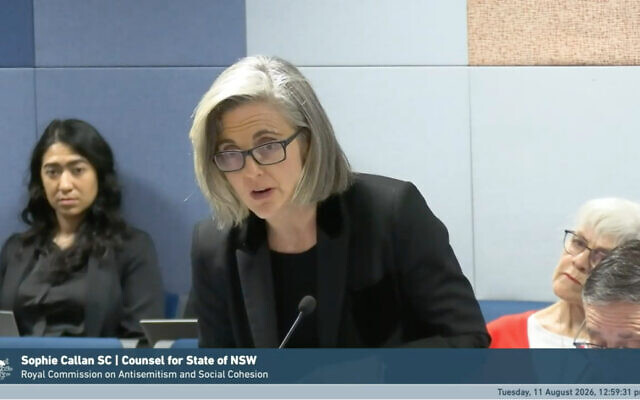
Questioned by Sophie Callan SC, appearing for the state of NSW, Matsuo said the rationale for progressing offenders into the general population was to reduce isolation, increase inclusion and reintegrate them into “more normative social environments” that replicated the community they would eventually return to.
Asked how that was balanced against the risk of one offender radicalising another, Matsuo said the agency relied partly on intelligence operations, but also on observing how offenders engaged in education, employment and programs, and how they responded to situations that would previously have triggered a strong reaction. “That’s really what we’re trying to observe,” she said, returning to her earlier point about whether offenders were “talking the talk and walking the walk”.
Antisemitism is present across youth extremism but is rarely its core
Antisemitic narratives appear across several strands of violent extremism among young offenders in NSW, but are seldom the defining feature of a young person’s beliefs, the Royal Commission on Antisemitism and Social Cohesion was told on Tuesday.
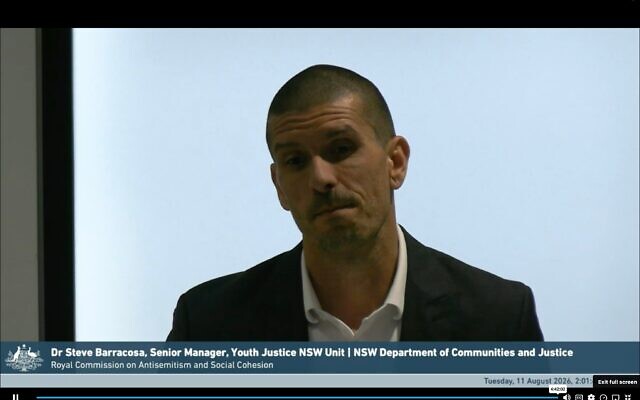
Dr Steven Barracosa, senior manager of the Youth Justice NSW Specialist Support Unit in the Department of Communities and Justice, gave evidence in Sydney about the state’s response to radicalised young people in the criminal justice system.
Asked how often antisemitism featured on the unit’s caseload, Barracosa said his team had “observed antisemitic narratives, ideas, and in some cases ideologies across different pockets of the extremism landscape, particularly religious and right-wing extremism”.
It was “seldom, in our experience in the criminal justice system, the core or defining feature of a young person’s beliefs or extremist profile”, he said, but was “certainly present”.
Barracosa, who holds a PhD in criminology from the University of Queensland focused on youth radicalisation, described a caseload that has changed markedly since NSW established a countering violent extremism (CVE) framework for the youth justice system in 2018.
“We very quickly moved from what felt like a heavily influenced religious extremist Islamic State-inspired climate to a really broad and convoluted right-wing extremism landscape with many different themes and ideas intertwined,” he said.
The unit was also dealing with misogynistic extremism and with young people making targeted threats, particularly against government institutions, while consuming mixed extremist material.
More recently, he said, “nihilistic violent extremism” had become a catch-cry for misanthropic and violent online spaces where incoherent ideas were meshing together.
The unit was renamed from the Countering Violent Extremism Unit after its cohort broadened beyond young people charged with terrorism offences. Barracosa said the change gave the team more scope in the services it could provide and “a softer, more youth feel” in a sensitive area.
He told the commission the unit was, to his knowledge, the only standalone youth justice CVE response in Australia, although other states and territories run programmes that case-manage young people on legal orders.
Its staff include forensic and clinical psychologists, youth caseworkers, an intelligence analyst and a project officer. Psychologists carry the comprehensive risk assessment work, while caseworkers coordinate cases and work with families.
Barracosa said no single discipline had a standalone answer to youth radicalisation.
He also rejected the idea of a typical offender, telling the commission there was no specific demographic, psychosocial or clinical profile for young people who engage in extremism.
Cases are referred to a High Risk Young Offender Review Panel, which includes senior representatives from justice, health and child protection. The panel decides whether the unit takes on a case and receives regular updates on those it endorses.
Barracosa said the external gatekeeper was introduced because the presence of young people at risk of extremism in the criminal justice system was a particularly sensitive matter, and the agency wanted transparent, shared decision-making.
Extremist content now tailored to children, royal commission told
Extremist material online is increasingly designed to appeal to children and is reaching them faster than before, the Royal Commission on Antisemitism and Social Cohesion has heard.
Dr Steven Barracosa, senior manager of the Youth Justice NSW Specialist Support Unit, told the commission in Sydney on Tuesday that the volume, packaging and accessibility of extremist content had all shifted in recent years.
“It’s hard to ignore the role of the internet and the proliferation of extremist content for the process of youth radicalisation,” he said.
Material was being built around imagery, video games and messages “developed for young people to digest”, he said, and was easier for children to find than in the past.
“It feels almost inevitable in the current climate that young people will cross paths with harmful and offensive content on the internet, whether we like it or not.”
Barracosa agreed with the finding of an independent evaluation of the unit by consultancy ACIL Allen, completed in January 2023, that younger people are increasingly involved in violent extremism.
He pointed to a complex, divisive and emotive socio-political climate, and said inconsistent and divisive leadership around the world had probably contributed to it, compounded by post-COVID uncertainty.
Not every young person was radicalised quickly, he said, but the unit had “absolutely seen cases of short, sharp, very intense radicalisation trajectories”.
The unit works mainly with offenders aged 14 and over who are under supervision in custody or in the community. Barracosa said internal provisions allowed it to engage children under 14 in the rare cases where they are sentenced to supervision and extremism concerns arise.
Assessments run for roughly 10 to 12 weeks and involve clinical interviews conducted with the young person’s voluntary consent. They also draw on multi-agency file checks to test the information available, standardised psychometric testing and specialist violent extremism risk assessment tools.
Barracosa said the assessments existed to guide intervention and risk management rather than to label, with the resulting work targeting both extremist behaviour and the vulnerabilities behind it across family, school and social life.
Family work was central. The literature was clear that instability and dysfunction at home were core to understanding why young people become vulnerable, he said, and intervening only with the individual ignored the environment around them. He described the family component as imperative but “incredibly difficult work”.
The unit provides little of the intervention itself, instead building the skills of caseworkers, psychologists, teachers, mental health clinicians and child protection staff.
It has run youth countering violent extremism training for the best part of a decade, including an induction package for new youth justice officers and tailored packages for schools and child protection agencies.
Misconceptions were common among those who attend that training, he said, in a field that breeds emotion and attracts heavy media commentary.
The ACIL Allen evaluation also found frontline workers were often ill-equipped to identify violent extremism and called for a whole-of-government response. Barracosa said NSW had long-standing cross-agency structures, now coordinated through a steering committee run by the Premier’s Department.
He identified the transition out of custody as a persistent weakness. “We face some real challenges transitioning young people from the criminal justice system back to the same environments that bred the vulnerabilities,” he said, adding that holding on to early gains required service providers to stay involved with a young person for as long as possible.
The AJN is providing rolling coverage on the Royal Commission on Antisemitism and Social Cohesion.
For full coverage of the Hearing Blocks, visit the Royal Commission section of The AJN website.

comments