



Live updatesPublic hearings
Expert witnesses take the stand for day three
Royal Commission hearings continue focusing on the dissemination of antisemitic content and other forms of hateful speech in the media.
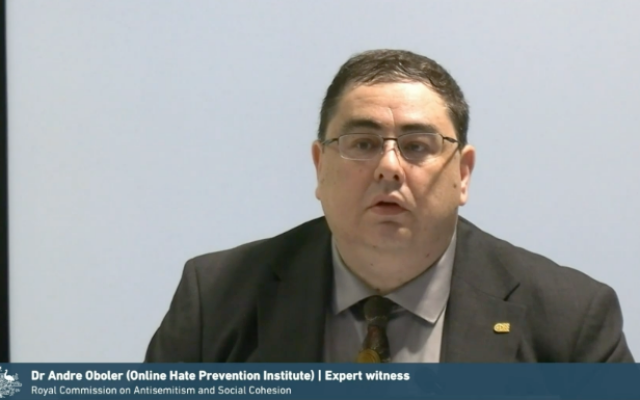
Dr Andre Oboler, founder and chief executive of the Online Hate Prevention Institute (OHPI), gave evidence to the Royal Commission on Antisemitism and Social Cohesion this week, detailing findings from his second report to the Commission.
OHPI’s monitoring runs on a rotating cycle in which two analysts each spend one hour on a given platform before moving to the next, working through seven platforms over four weeks and then repeating the process. Content is coded against 27 subcategories drawn directly from the International Holocaust Remembrance Alliance’s working definitions of antisemitism and Holocaust denial.
On Facebook, Oboler said levels in January and April this year had climbed significantly above the post-October 7 baseline, with every subcategory rising simultaneously in April. Asked by Commissioner Bell whether he had a view on the cause, he pointed to overseas events and coordinated activity.
“I believe what we’re seeing as a result of the Iran situation, so there is a tie in to events overseas… some of what we’re seeing in our data, particularly when we break it down, sometimes we see one form of antisemitism increasing when others on the same platform are not increasing, which could indicate that there’s some sort of campaign or activism or something that is pushing it up from a particular community of antisemites.”
Giving evidence about X, Oboler said Australian users received far less platform engagement than European counterparts, where regulatory pressure had prompted the company to station staff alongside monitors. He described the platform’s approach to reporting as akin to interfering with a thermostat rather than fixing the temperature.
“If you remove the stuff that’s the only thing being monitored publicly, you can reduce the level, but it doesn’t change the real situation, it just changes the situation of what’s being monitored.”
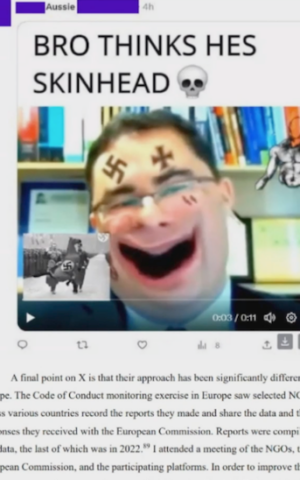
Oboler said Elon Musk’s acquisition of the platform led to about 80 per cent of trust and safety staff being dismissed and a shift toward permitting more extreme speech. He told the Commission he was personally targeted with a doctored antisemitic video after testifying before the European Parliament, and that a reply from the platform’s representative took more than 15 days.
On Telegram, Oboler said one source of content dominated the platform.
“Telegram is a platform where most of the data we’re gathering is coming from the far right. That symbolises a large part of the audience there, but it also symbolises the particular content we seem to capture on it.” He said channels linked to Iran were operating as resource pools of antisemitic material shared elsewhere.
On Reddit, Oboler said Israel and Zionist-related antisemitism was growing faster than traditional antisemitism and, at current rates, could surpass it within months. He observed a broader pattern across platforms in which bad publicity prompted an intervention and a temporary correction, only for levels to climb again. He also warned that Reddit’s reliance on volunteer community moderators, rather than professional trust and safety staff, made it harder to respond to evolving forms of antisemitism.
On TikTok, where levels have nearly doubled since October 7, Oboler said the reels-based format itself was being exploited to evade moderation.
“Some people are deliberately using the reels format, where they can post something problematic, and by the time the system can deal with it, it’s not there anymore anyway.”
He said the platform’s removal rate on reported content was strong, but reliance on public reporting meant proactive detection was falling short.
The hearing continues.
Providing evidence to the Royal Commission, CEO and Managing Director of the Online Hate Prevention Institute (OHPI) Dr Andre Oboler when asked if traditional antisemitism is more observable by people monitoring a platform, he noted its conflation with politics:
“A lot of this traditional antisemitism is being included in political content, and some of the platforms are having a problem, and we’ve heard this argument in Australia… ‘It’s not antisemitic because it’s political’… Racism is always political, almost always political. So, if we were to exclude any form of racism when it’s political – we’re saying the White Australia policy was not racist it was a political policy, we’re saying Nazism was not racist because it was literally a political policy… that logic really is flawed. The first question is not whether it’s political, the first question is whether it’s racist. If it is racist, that’s it. We don’t need to consider whether it’s political.”
Oboler noted that some platforms use an automated approach to removing hate speech including YouTube, which was first implemented by Meta but removed in January 2025.
Explaining the process for YouTube for videos and comments he said, “It’s all assessed automatically, and if it is deemed clearly to be hate speech or another policy violation, the content does not go up. If it is highly likely to be a violation of policy, but the system is not completely sure… then it gets queued for human moderation, so it might go up, but it’s going to get looked at before a member of the public has to actually report it.”
“After it’s up, the next step is that a member of the public can report it, and if a member of the public reports it, then it goes into the queue to be reviewed by a human, and this could be because the AI didn’t flag it at all and said this is fine, and a person’s now picked up something that the AI couldn’t,” he said.
Discussing the challenges of this process, Oboler pointed to the volume and scale of hate speech, as well as putting the burden on the communities that are being subjected to this hate, to respond. He suggested there be criminal charges for hate speech, which was the intention of hate speech laws that went to the Senate but were blocked. “The reason for having criminal sanctions is because it shifts the burden from the individual having to take it through the process to the state,” he said.
Explaining the role of his organisation he said, “Our job is not to try and find and report all of the hate speech, that is simply impossible… The job of civil society organisations and experts is firstly to find new trends when the language of racism changes, when hate is expressed in new ways or in new mediums, but also to find the gaps where platforms are not identifying something that their policy should cover, but their understanding the training for their staff just isn’t picking it up.”
Regarding the platform LinkedIn he said, “We don’t have data from before October 7, but it’s the spike after October 7, and then on the anniversary, and the other thing we see is this is the only platform where Israel/Zionist related antisemitism is actually the dominant form”.
Oboler said when this was raised LinkedIn defended their standards. “LinkedIn basically said we have a very good system – our system works if the data is showing a problem on our system, that’s a problem with your data,” he said.
Oboler said OHPI is a member of Meta’s Combating Hate Speech Advisory Group in Australia, where it can raise concerns directly with Meta for their assessment.
“So Facebook Australia, which is the Australian arm of Meta runs this group, brings the group together [organisations specialised in hate speech], and when we meet very often, they’ll bring in people from Meta Platforms Incorporated, so the US entity, the people that actually make the policies that enforce the policies, they will consult with us on upcoming changes or ideas for new policies or new features,” he said.
Discussing the use of generative artificial intelligence in antisemitism he said, “The creation risk with generative AI is about the ability for the AI to be used to create new antisemitic content… What it’s doing is allowing someone to upload a volume of new antisemitic content very rapidly”.
Asked about algorithms Oboler noted that they varied between platforms but generally, “algorithms that are feeding content to people are trying to give them content that they’re most likely to interact with,” whether positively or negatively.
“So, for a Jewish person… [the algorithm is] likely to give them content that they spent time looking at in the past, and that means that for a Jewish person, the amount of content that is either reporting on antisemitism or is antisemitic content that other people reacted negatively to.”
He said this can lead to “clustering Jewish people and antisemitic people together in a sort of public square” which exposes those Jewish people to higher levels of antisemitism than the average person would see.
Discussing data on antisemitism from the social media platforms Oboler said, “We don’t have disaggregated data for Australia, so what we’re getting is a global level statistic on all forms of hate speech, and some unknown fraction of that is antisemitism.”
He noted anecdotally within the Australian Jewish community there was feeling of fatigue regarding reporting antisemitism online, but nevertheless it needs to be done to remove hate speech from social media platforms.
Regarding YouTube’s monetising policies introduced in February 2026, in respect of controversial content, Oboler said: “Generally speaking, content that is more emotionally engaging will boost views and retention… that’s a general proposition of why the platforms end up promoting a lot of negative content. It goes much further and gets more reactions and therefore more revenue than content that is positive or neutral.”
Terry Flew, Professor of Digital Community and Culture for the Faculty of Arts and Social Sciences at the University of Sydney, provided a written expert report for the Commission on platform regulation and misinformation. He is also a co-director of the Centre for Artificial Intelligence Trust and Governance at the University of Sydney, established in 2023.
Discussing the concept described as “mediated trust” to explain the process by which communications between individuals within society are now mediated through new methods of communication, in particular online communication, he said: “This means that increasingly we’re reliant upon institutional providers of information as the basis on which we make decisions. So, communications has moved from a primarily face to face activity to unmediated at different points of time through different technologies and in the digital space”.
Regarding platform moderation and regulatory design, he noted the United States Communications Decency Act of 1996 established that platforms are understood not to be media in the traditional sense, and there is no broadly applicable Australian equivalent legislation.
“There’s s.5 and s.7 of the Online Services amendments to the Broadcasting Services Act 1992 which were passed in 1998 which set certain parameters around content online and around co-regulatory frameworks, but I think it would be fair to say that their effectiveness has been limited, and to some degree I’d say to some degree they’ve lapsed… I would say… they do give the Australian Communications and Media Authority, jurisdictional authority with regards to online content, which is similar to countries such as the UK… but quite different to the United States, where the Federal Communications Commission, by law, does not have jurisdictional power with regards to online content.”
Commenting on the challenges of moderating harmful online content, Flew noted: “Some of the issues that arise – the scale and velocity, the volume of content uploaded to the internet every second is phenomenal…the virality of harmful content often goes viral within minutes, meaning that by time a post is flagged, reviewed, and removed, that content has already been viewed by a very large number of users and downloaded and shared, and so on. Coded language is often used to evade automated filters. Context is relevant here…. the question of universal standards.”
Discussing the frameworks for moderating harmful online content described as involving ‘soft law’ – the approach adopted by the eSafety Commission under the Online Safety Act, he said:
“Soft law occupies a middle position between no government interference at one end and complete government involvement at the other. It typically involves the application of code standards, protocols, boards of review – means by which there are therefore they’re typically forms of self-regulation, but I don’t think that the term self-regulation captures all forms of soft laws.”
Flew discussed the principle of “safety by design” meaning, “ratcheting up standards by working with the companies around design decisions made on their platforms that can improve the user experience while also addressing online harms and possibly being good for the commercial interests of the companies themselves.”
Asked about the UK Online Safety Act as a comparative for Australia’s future direction, which involves a series of multiple narrower duties rather than one general digital duty of care, and which he preferred, he said there were “pros and cons to each framework”.
Regarding tackling disinformation he referred to the proposed Communications Legislation Amendment Combating Misinformation and Disinformation Bill that the federal government initially proposed, but then withdrew in November 2024, and agreed that the absence of federal legislation in this area is a notable gap.
“I think it’s unlikely that a misinformation bill will return to the parliament at any time in the near future, so we would be looking at other options in that regard, which a digital duty of care may be, may well be relevant as a preferable mechanism by which to approach the problem,” Flew said.
He noted a change to the US regulatory approach to social media platforms following the second Trump presidency. “The very strong alliance between many of the leading tech companies and that presidency,” had significant consequences. “It certainly involved the dismantling of a range of mechanisms that have been applied within the companies, such as the operation of trust and safety councils,” he said.
Discussing the extent to which nation-state governments have a role in setting content moderation rules and guidelines, he said there should be five principles that govern their activity or their actions.
“The five principles are legality, legitimacy, proportionality, due process, and harmonisation to the greatest degree possible. So the principle of legality is that terms of service should be clear and comprehensive, and that any applications of restrictions on online speech should be based on… legally clear criteria, legitimacy…this is where the questin of whether platforms can effectively self-regulate partly comes around the legitimacy question… Are there avenues to appeal… also that remedies should be proportionate to the matters raised, and to guarantee online and offline security without unduly inhibiting upon freedom of speech, and that some form of due process exist, and that to the greatest degree possible, nation-states should look to harmonise their laws and regulations in this space with other certainly comparable nation states and international law.”
On the importance for governments to actively support trusted sources of information, Flew said, “We don’t want the existing news media infrastructure to collapse… I think over time we’re possibly looking at government support for commercial news.”
Australia should impose a legally binding “digital duty of care” on social media platforms, backed by new powers to force companies to switch off the algorithms that amplify hateful and borderline content, a technology regulation expert told the Royal Commission into Antisemitism and Social Cohesion this afternoon.
Dr Robert Nicholls, a senior research associate at the University of Sydney’s Centre for AI Trust and Governance, appeared before the Commission to give evidence on an expert report he submitted in June.
The report examines how existing Australian regulatory tools — including copyright site-blocking laws, telecommunications licensing rules, scam-prevention legislation and critical infrastructure laws — could be adapted to tackle the spread of antisemitic and other extremist content online.
It identifies seven broad challenges facing regulators of offshore platforms, including jurisdictional reach, corporate structuring that allows companies to “snip” local liability, difficulty locating the “directing minds” behind algorithms, enforcement of judgments, technical evasion such as VPN use and encryption, and constraints imposed by international trade agreements.

Under questioning from Counsel Assisting late in the session, Dr Nicholls elaborated on his central recommendation: a tiered, mandatory registration or licensing scheme paired with a statutory duty of care and “algorithmic accountability obligations”.
He explained that amplification — the process by which platforms surface content to users likely to share it — is central to how hatred spreads online, warning that during major incidents “the amplification makes it worse.”
His proposed fix is to sort content into three tiers — prohibited, restricted and borderline — and to impose a legal obligation not to amplify borderline material.
“We actually end up with three levels of material… and to impose an obligation not to amplify borderline material,” he told the Commission, noting platforms already have the technical capacity to do this because amplification is how they sell advertising.
“The fact that they’re using algorithmic amplification means that they also have the ability, then, to control it.”
Dr Nicholls said this went further than comparable overseas laws, arguing that failing to directly address amplification was “one of the things that the UK Online Safety Act misses.”
He told the Commission his broader framework was not novel, but a synthesis of approaches already converging across the UK, the EU — particularly Germany — and, to a lesser extent, the United States.
Hannah Rose, senior researcher and policy manager for antisemitism at the Institute for Strategic Dialogue (ISD) and a PhD candidate at King’s College London, gave evidence this week to the Royal Commission on Antisemitism and Social Cohesion, based on a report tendered to the commission on June 27, 2026.
Rose told the commission that online antisemitism has surged dramatically since the October 7, 2023, Hamas attacks, with social media platforms failing to enforce their own policies against hate speech.
According to Rose, far-right, far-left and Islamist online spaces all fostered antisemitism, and October 7 had triggered “cross-ideological hybridisation”, with previously opposed extremist movements uniting around shared antisemitic hostility.
An ISD analysis found antisemitic content on YouTube videos about the conflict increased 51-fold in the immediate aftermath of the attacks. A separate case study of Australian-linked posts across five platforms between May 2025 and May 2026 identified almost 42,000 antisemitic posts. Spikes coincided with the Israel-Iran conflict in June 2025 and the assassination of Charlie Kirk in September, 2025.
Rose described a joint study with the UK’s Antisemitism Policy Trust in which researchers created 10 fake accounts belonging to 15-year-olds and monitored what content TikTok’s recommender algorithm served them. None of the search terms used referenced Israel, Jewish people or antisemitism.
“A young 15-year-old boy… was served content glorifying the IRGC, Holocaust denial content, and antisemitic conspiracy theories,” Rose told the commission, describing the result as emerging within a single 90-minute session.
Describing how extremist actors deliberately design content to slip past moderation systems, Rose said, “They’ll change a letter in a word to a number to avoid content moderation” and rely heavily on emojis, memes and “inferred humour” that is only decipherable to audiences already familiar with the coded references.
She noted this content is often not illegal, nor in clear breach of platform terms, allowing perpetrators to “stay under that line of detection” while expressing more overt hatred elsewhere, including on podcasts or fringe platforms.
Rose said transparency requirements, such as those under the European Union’s Digital Services Act, remained the most effective accountability tool available, but were inconsistently applied and often failed to disaggregate antisemitic content from other hate speech categories. She also noted that transparency reporting varied significantly by platform, undermining any consistent measure of how much antisemitic content was actually being removed.
“We can’t do this research without data access,” Rose said, adding in her report that “transparency is the foundational precondition for every other accountability mechanism.”
The AJN is providing rolling coverage on the Royal Commission on Antisemitism and Social Cohesion.
For full coverage of the Hearing Blocks, visit the Royal Commission section of The AJN website.
Australia should impose a legally binding “digital duty of care” on social media platforms, backed by new powers to force companies to switch off the algorithms that amplify hateful and borderline content, a technology regulation expert told the Royal Commission into Antisemitism and Social Cohesion this afternoon.
Dr Robert Nicholls, a senior research associate at the University of Sydney’s Centre for AI Trust and Governance, appeared before the Commission to give evidence on an expert report he submitted in June.
The report examines how existing Australian regulatory tools — including copyright site-blocking laws, telecommunications licensing rules, scam-prevention legislation and critical infrastructure laws — could be adapted to tackle the spread of antisemitic and other extremist content online.
It identifies seven broad challenges facing regulators of offshore platforms, including jurisdictional reach, corporate structuring that allows companies to “snip” local liability, difficulty locating the “directing minds” behind algorithms, enforcement of judgments, technical evasion such as VPN use and encryption, and constraints imposed by international trade agreements.
Under questioning from Counsel Assisting late in the session, Dr Nicholls elaborated on his central recommendation: a tiered, mandatory registration or licensing scheme paired with a statutory duty of care and “algorithmic accountability obligations”.
He explained that amplification — the process by which platforms surface content to users likely to share it — is central to how hatred spreads online, warning that during major incidents “the amplification makes it worse.”
His proposed fix is to sort content into three tiers — prohibited, restricted and borderline — and to impose a legal obligation not to amplify borderline material.
“We actually end up with three levels of material… and to impose an obligation not to amplify borderline material,” he told the Commission, noting platforms already have the technical capacity to do this because amplification is how they sell advertising.
“The fact that they’re using algorithmic amplification means that they also have the ability, then, to control it.”
Dr Nicholls said this went further than comparable overseas laws, arguing that failing to directly address amplification was “one of the things that the UK Online Safety Act misses.”
He told the Commission his broader framework was not novel, but a synthesis of approaches already converging across the UK, the EU — particularly Germany — and, to a lesser extent, the United States.
comments