Live updatesPublic hearings

Communal security, law enforcement in focus on day 5

Hearing Block 5 of the Royal Commission continues today, examining security arrangements, government funding and police coordination for the Jewish community.

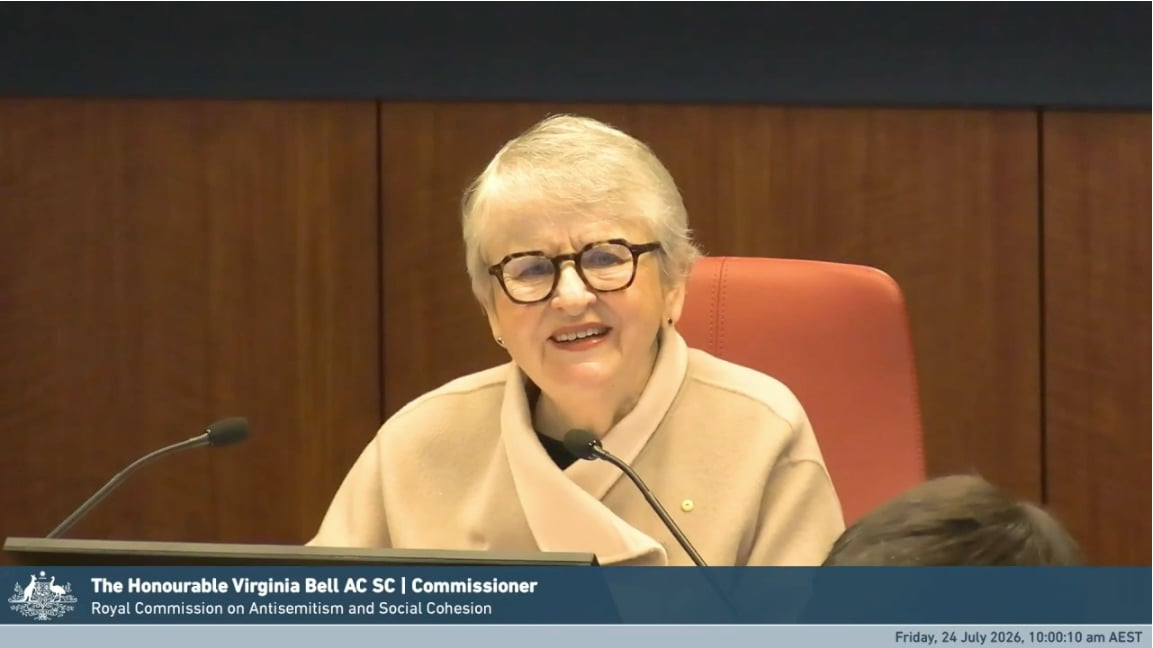
Commissioner Virginia Bell.

WA Police approved long arms on foot patrols after Bondi

Western Australia Police increased its security presence around Jewish community sites and approved the physical carry of high-powered long arms by officers on foot patrols following the Bondi Beach attack, the state’s assistant commissioner has told the Royal Commission.

Assistant Commissioner Joanne McCabe, who oversees specialist and support services and was acting deputy commissioner earlier this year, gave evidence on Friday before the hearing moved into a closed session. She said the force’s protective security posture had increased significantly after the December 14, 2025 attack in Sydney and was subsequently refined.

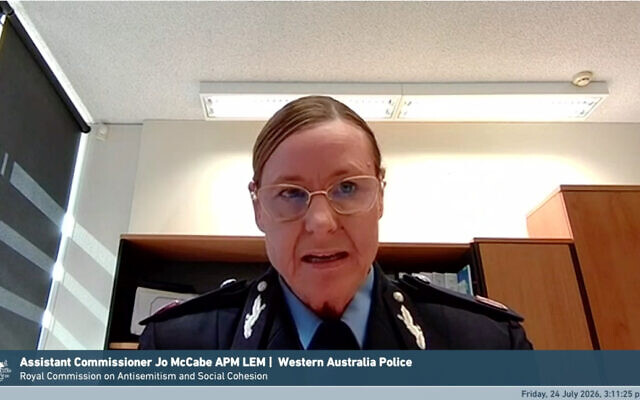
Western Australia Police Assistant Commissioner Joanne McCabe.

McCabe said patrols around Jewish places of worship and other significant sites had been stepped up, in consultation with the Jewish community, through both vehicle and foot patrols. After the Bondi attack, the commissioner had also approved officers physically carrying AR-15 long arms on patrol.

While the force’s regional operations group had always had the AR-15 capability, she said, the weapons had previously been kept in vehicles rather than carried, and officers now carried them on foot patrols around Jewish communities and other sites considered highly vulnerable, including crowded places, events and shopping centres.

The change followed the nature of the weapons used in the Bondi attack and the difficulty officers had faced responding, McCabe said. “That was certainly in the forefront of the mind for our workforce around how we were going to respond to a threat of that nature,” she said, adding that carrying long arms “made absolute sense”.

She said the force had increased its community reassurance patrols since 2023, following the outbreak of the Middle East conflict, with that presence becoming significant after Bondi. Deployment decisions were now guided by risk assessments made through a daily intelligence briefing.

McCabe also detailed a new hate-crimes framework the force established in 2025, prompted by legislative change at both state and Commonwealth level. It began with a policy defining what constituted a hate crime and a hate incident, and setting out how officers should record, report and investigate them, as well as how victims and communities should be supported.

The force then introduced a mandatory 30-minute annual training package for all officers and staff, which McCabe said was designed in part to help frontline officers identify the underlying motivation of an offence. Officers attending an incident such as an assault, she said, would not necessarily recognise that it was hate-motivated.

Since November 2025, the force’s incident management system has included a “hate crimes checkbox” with subcategories covering age, sex, gender, impairment, disability, political conviction, race, religion and sexual orientation. Flagging an incident alerts the state security investigations group, which provides guidance to investigating officers or takes on the investigation itself. An algorithm also runs over the system to catch incidents officers may have failed to flag.

A dedicated hate crimes team, with detectives and specialist resources, was established within that group in April 2025. McCabe said the team allowed communities to build trusting relationships with officers they knew, and had recently consulted a Perth rabbi to better understand antisemitic terms and how hurtful they could be. The system, she said, allowed the force to identify trends, such as the same language appearing in graffiti across different Perth suburbs.

Leeser urges commission to make universities adopt antisemitism definition

Federal member for Berowra and Shadow Minister for Education Julian Leeser has urged the Royal Commission to recommend that the government legislate to require all universities to adopt a single definition of antisemitism, alongside audits of course materials and stronger accountability for university leaders.

Giving evidence on Friday, Leeser said he had been concerned about antisemitism at universities since before October 7, 2023, having launched a survey by the Australasian Union of Jewish Students in August 2023 with fellow MPs Josh Burns and Allegra Spender, and having called in November 2023 for a judicial inquiry into campus antisemitism, introducing a private member’s bill he repeatedly sought to have debated.

As Shadow Education Minister since October 2025, Leeser said he had met vice-chancellors and put a series of questions to them, and had been particularly unhappy with their responses on the definition of antisemitism, their failure to properly audit what was being taught about Jews and Israel, and their failure to ensure balanced teaching of the Israel-Palestine conflict.

Julian Leeser (centre) with fellow Parliamentary Friends of IHRA co-chairs Josh Burns and Allegra Spender in 2022. Photo: Peter Haskin

He set out a series of recommendations he asked the commission to consider. The first was that the government legislate for all universities to adopt the International Holocaust Remembrance Alliance (IHRA) definition of antisemitism, in the manner and form set out in the report by Professor [Greg] Craven. The second was that all universities undertake a desktop audit of what was being taught about Jews and Israel in their classrooms, and remove antisemitic materials where present.

For courses dealing with the Israel-Palestinian conflict, Leeser said, universities should ensure teaching materials came from credible sources on both sides, and that the material was balanced to allow students to draw their own conclusions. He said it was not enough to present one strong argument alongside a weak one and call it balance.

“Sometimes … you will see people say, ‘we’ve got balance here, because we’ve got one perspective from the Palestinian side and one perspective from the Israeli side,'” he said. “But one of those perspectives is a full-throated defence … and the other perspective is not that at all. It is weak and doesn’t really represent that position.” Universities were producing the next generation of leaders, he said, and students should hear the best arguments made by advocates for both sides.

Leeser also recommended that universities examine whether funding from foreign governments, received through academic or other sponsorship, was being used to promote antisemitism on campus. He said university governing bodies should be ultimately responsible for making their campuses free of antisemitism, in the same way they were responsible for workplace health and safety.

On security, Leeser drew a distinction between two situations. Where registered religious student groups ran a religious activity on campus, such as a sukkah, they should not be expected to pay for its security. But where universities and student organisations hosted visiting Jewish speakers, those speakers should not face hostility and danger as guests of the university.

Leeser said the commission presented a rare opportunity to address antisemitism. Asked about his hopes for the future, he said he wanted his children to grow up in the country his family had come to in 1849 — his thrice-great-grandfather having arrived to serve as the first cantor of the Adelaide Hebrew Congregation. “If you work hard and play by the rules, there’s a place for you here, and … you can live and practise your religion freely and be proud of it, whatever that religion may be,” he said. “That’s the Australia I grew up in, and I want to make sure that not just Jewish Australians, but all Australians have that opportunity in the future.”

Federal MP Julian Leeser: ’It’s not the Australia I want for my children’

Federal member for Berowra Julian Leeser has told the Royal Commission how his then seven-year-old son cried inconsolably at a Chanukah event on the night of the Bondi Beach attack, repeatedly asking whether the family would be safe.

Giving evidence by video link on Friday, Leeser — the first Jewish person to represent the Liberal Party in the House of Representatives from a New South Wales seat — described attending the Chanukah on the Green event at St Ives, in Sydney’s north, with his family on December 14. Just before the candles were lit, one of the rabbis pulled him aside to tell him shots had been fired at Bondi.

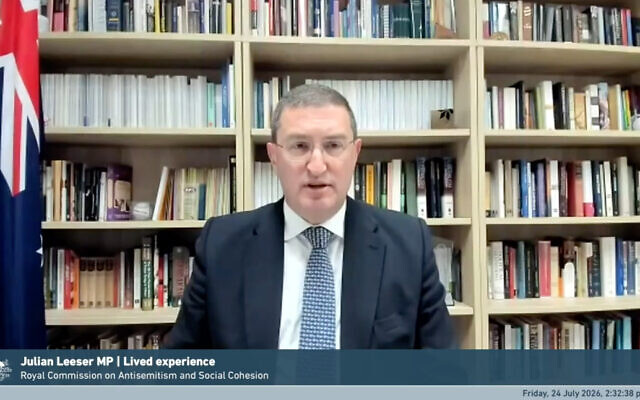
Federal member for Berowra Julian Leeser.

Leeser said he and Rabbi Nochum Schapiro went up on a cherry picker to light the 10-metre Chanukah candles, and that he urged they descend as quickly as possible after the prayers, not knowing whether the attack was part of something more coordinated that could reach St Ives. By the time he came down, it was apparent people had been killed.

His son, then seven, had overheard adults talking about the shooting. “He cried inconsolably — the sort of cry that you see where a child is in deep pain,” Leeser said. “He sat with his legs crossed, saying, ‘Dad, are we going to be safe? Dad, why are they shooting at us? … How do you know they won’t come for us?'”

There were no police at the event, Leeser said, and he obtained the number of the Hornsby police superintendent from a state colleague to request resources, feeling the crowd was exposed in what was largely a fenced-off paddock. The family returned on the eighth night of Chanukah to the commemorations at Bondi, where his son watched the drones and searchlights overhead and held his hand tightly, again asking whether they would be safe.

Leeser said the effect had lingered. Attending a recent bar mitzvah at the synagogue he had grown up in, his son gripped his hand and asked how he knew they would be safe, even with a police car visible outside. “What sort of Australia are we setting up, where an eight-year-old child doesn’t feel safe going to a place of worship?” he said. “It’s not the Australia I know and love, and it’s not the Australia I want for my children or anyone’s children.”

Leeser, who before entering parliament chaired the NSW Jewish Board of Deputies’ community relations committee and served on the executive of the Executive Council of Australian Jewry, said antisemitism had changed over time. “In the Middle Ages, Jews were hated for their religion. In the 19th and 20th century, they were hated for their race. Today, they’re hated for their nation-state,” he said, identifying its sources in the far right, radical Islamists and the academic and cultural left.

He described antisemitic attacks on his own election materials. In the 2019 campaign, posters outside his campaign office were defaced with dollar signs over his face, Hitler moustaches and swastikas, and later with neo-Nazi stickers.

In the 2025 campaign, a banner in Epping was graffitied with devil horns, Hitler moustaches and swastikas, and was removed by police as evidence; Leeser said the $35,000 banner was not replaced, diminishing his capacity to campaign. He had also decided after 2019 against having an electorate office with a street frontage, fearing it would be a target.

Leeser said the abuse had frightened his staff and deterred campaign volunteers, some of whom faced comments about Jewish donors funding his campaign.

But he stressed that the overwhelming majority of contact with his office was supportive, and closed with accounts of solidarity from non-Jewish Australians — a local church bringing flowers, strangers stopping to hug him after October 7, and, that very morning, the Catholic Apostolic Administrator of Broken Bay, Father David Ranson, lending him a Hebrew Bible to take his oath after he had forgotten his own.

“It’s humbling and it’s uplifting,” he said. “Ordinary Australians are with the Jewish community … This isn’t the Australia that they want for their kids either.”

Home Affairs official: ECAJ is administering security funding “very effectively”

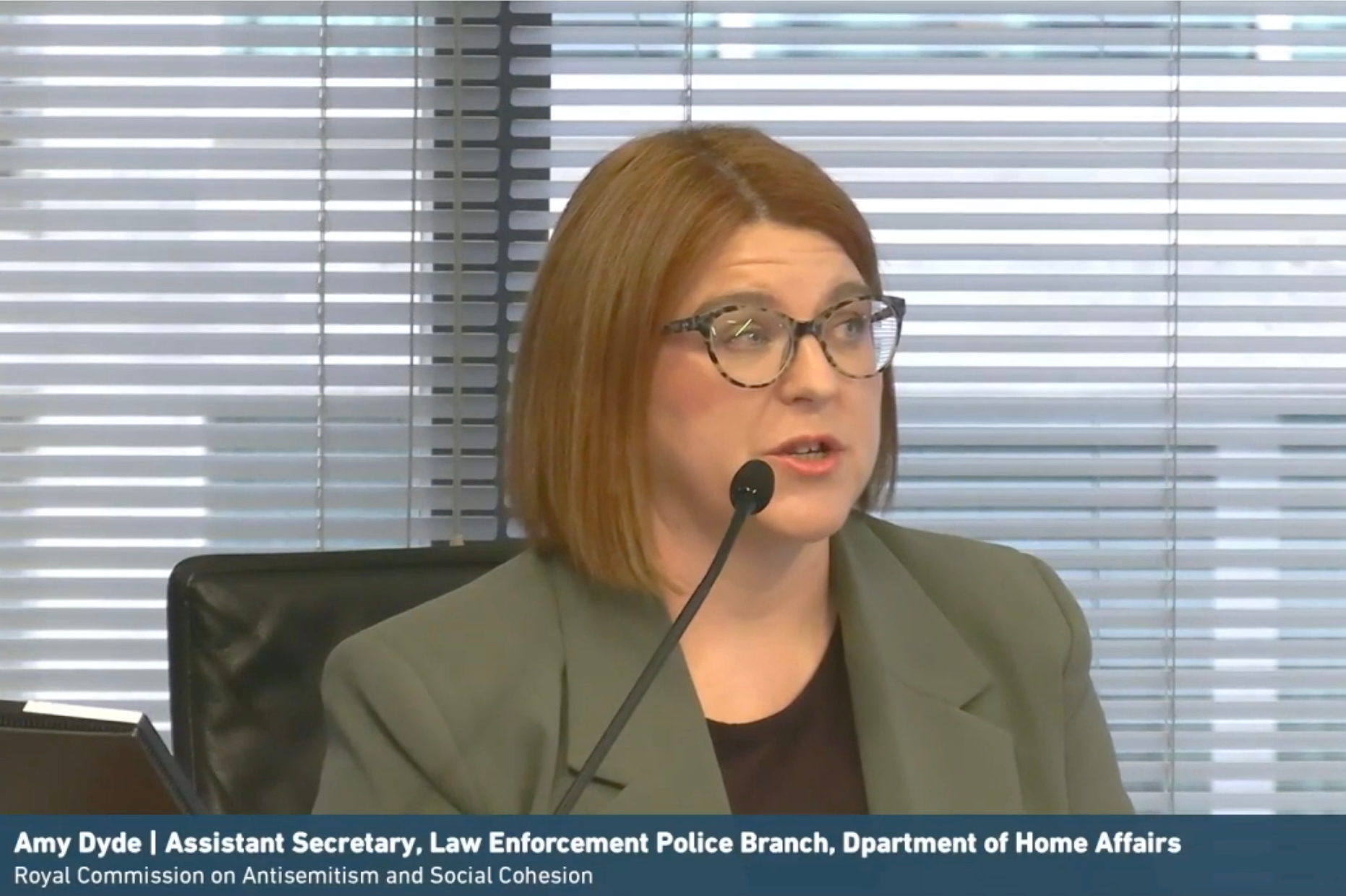
Amy Dyde, the Assistant Secretary of the Law Enforcement Policy Branch at the Department of Home Affairs, gave a detailed account at the Royal Commission on Antisemitism today of how Commonwealth protective security grants for the Jewish community are designed, funded and delivered.

Ms Dyde said her branch of the Department inherited responsibility for community safety and crime prevention grants from the Attorney-General’s Department in July 2025.

Under the Securing Faith-Based Places program, up to $50 million was made available go grant recipients across all faiths, with $21 million ultimately granted to Jewish sites.

Applications closed in 2023, but the program runs until 2027, with recipients given until February 2027 to spend their allocations.

Across five separate programs running from 2023 to 2029, just over $209 million has been made available for Jewish community protective security, Ms Dyde confirmed.

The centrepiece is the Enhancing Security for Jewish Communities program. An initial $25 million tranche launched in October 2023 was later varied and extended into a three-year program, and a new, separate iteration — requested by the Executive Council of Australian Jewry (ECAJ) in July 2025 — was signed on 1 May this year, worth $124 million over four financial years.

Much of this money flows first to the ECAJ, which runs its own application process to allocate funds within the community.

Ms Dyde said this arrangement was chosen because Commonwealth grants can take months to establish, whereas the ECAJ could move quickly and had “a very important role in sitting across the Jewish community.”

She said the department had identified no issues with the ECAJ’s decisions or its administration of funds, describing the relationship as involving contact “at least every month” and adding plainly: “the ECAJ are administering the grant very effectively.”

Ms Dyde acknowledged a one-month gap in the funding profile around April this year, referenced in earlier evidence from ECAJ’s co-CEO Peter Wertheim.

Ms Dyde confirmed built-in flexibility already exists in the grant guidelines: the initial $25 million tranche was itself allocated following the attack on the Adass Israel synagogue, with a further $32.5 million later added by varying that same grant, and separately, half a million dollars approved within 24 hours to fund security guards at Jewish youth camps following the Bondi Chanukah terror attack in December.

On new-build costs, Ms Dyde clarified the department’s position: full construction of new buildings remains ineligible, but security hardening within a build — bollards, CCTV, blast-proof windows — “are currently covered by the existing grant guidelines.”

She also confirmed physical protection for individual Jewish community leaders has never been covered by these grants, noting that separate protective arrangements exist only for Commonwealth politicians and cabinet members, working with the Australian Federal Police.

On the National Hate Crimes and Incidents Database, now led by Home Affairs following a National Cabinet agreement in January 2025, Ms Dyde said phase one is published on the Australian Institute of Criminology’s website, with a national definition of hate crime and incident targeted for agreement by the end of 2026.

Police guidance has no examples of Israel-based antisemitism

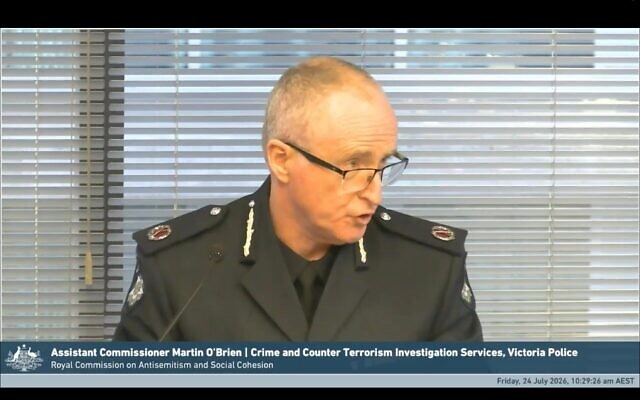
Assistant Commissioner Martin O'Brien, Victoria Police. Photo: Screenshot

Victoria Police’s core guidance material on prejudice-motivated crime contains no examples of antisemitism expressed through language about Israel, the Royal Commission on Antisemitism and Social Cohesion has heard.

Assistant Commissioner Martin O’Brien, who heads the force’s Crime and Counter Terror Investigation Service, was asked whether guidance existed on expressions of antisemitism framed as grievance or blame directed at Jews because of the conduct of the State of Israel.

“Not that I’m aware of, no,” he said.

O’Brien, who has served 46 years with Victoria Police, provided three witness statements dated 11 July 2026, dealing with training, data recording, and data compilation and collation.

The force’s Practice Guide: Prejudice Motivated Crime is the primary guidance document for all Victoria Police employees involved in investigating and prosecuting prejudice-motivated crime.

The guide itself does not contain worked examples, but has attached to it a scenario matrix illustrating how offences might manifest for particular protected groups.

O’Brien described the matrix as a means of operationalising the legislation.

The matrix sets out offences alongside illustrations of prejudice against different groups.

In one example concerning Jewish people, non-Jewish people wear fake beards and black clothing in mock imitation of Orthodox Jews and attend a polling centre during an election.

In another, a person tells a group of Jewish schoolchildren travelling to school on a train that they will tear down the Star of David on a sign outside their school and spray paint the school gates.

Counsel assisting put to O’Brien that the commission had heard considerable evidence about antisemitic conduct expressed as grievance over Israel, and asked whether guidance material might be improved by including language such as calling Jewish people “genocidal”.

O’Brien agreed, saying more examples would be “a much better way of providing advice to members”.

He told the commission that hate-related incidents, including those targeting the Jewish community, were recorded in one of three systems: the Law Enforcement Assistance Program (LEAP), the Interpose case management and intelligence system, and the Incident Fact Sheet (IFS) system.

Where an offence is logged in LEAP, information can be added to indicate it is a prejudice-motivated crime, but recording officers are not required to do so.

O’Brien said his understanding was that work was underway on mandatory reporting of that information.

Under the Victoria Police Manual on prejudice-motivated crime, any incident relating to racial, political or ideological circumstances requires an incident fact sheet, which must be compiled as soon as possible.

O’Brien said the IFS system existed less for intelligence purposes than for the flow of information across the organisation, giving managers a near real-time picture of what was occurring and allowing incidents to be matched against other intelligence.

He described a layered system of proactive scanning across the force, including a state command coordination centre operating 24 hours a day since December 2025, which monitors live social media, crime reporting and incident fact sheets.

Analysts at state, regional and divisional level also scan incoming material daily, and counter-terrorism units conduct automatic daily scanning.

The commission also heard that identifying total numbers of antisemitic incidents recorded as intelligence reports in Interpose would require what an earlier witness described as a deep dive into narrative entries.

Counsel assisting took O’Brien to a confidential weekly executive summary from Operation Park covering the period from 29 September to 13 October 2025, which was not displayed publicly.

One entry recorded that a synagogue congregation had received a phone call on 3 October 2025 in which an unknown woman abused the person who answered.

Using expletives, she called the Jewish community “genocidal”, said their days were numbered and called them “maggot rat Jews”.

A second entry recorded graffiti of a swastika approximately 5.5 metres long spray-painted across a concrete slab at a construction site.

Neither entry carried an incident fact sheet reference number in the relevant column of the table.

“There’s certainly none logged there, not to say there wasn’t one submitted,” O’Brien said.

He said it was difficult for him to draw inferences from the document, which had been compiled at executive level from other sources and which he did not receive himself.

He agreed, however, that he would expect such a document to collate entries from the various systems where they existed.

Philanthropy should not be expected to fund security

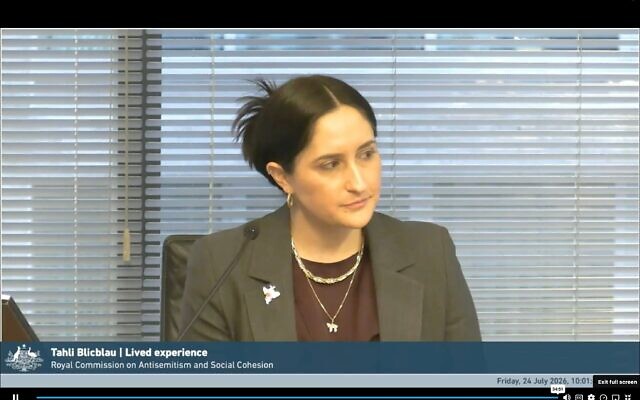
Tali Blicbau, CEO of the Dor Foundation. Photo: Screenshot

Jewish philanthropy can no longer be expected to carry the cost of protecting the Jewish community, the Royal Commission on Antisemitism and Social Cohesion has heard.

Tahli Blicblau, chief executive of The Dor Foundation and chair of the Jewish Communal Appeal’s (JCA’s) allocations committee, told the commission that “it is no longer possible, and it should not be expected for Jewish philanthropy to cover the cost of protective security”.

Blicblau, who was principal intelligence analyst with the Community Security Group (CSG) in NSW between 2006 and 2009 and spent 14 years at the NSW Crime Commission, finishing as director of strategic intelligence and capabilities, has previously given evidence to the commission.

She said the JCA, which has supported the community since 1967 and allocates funds to 24 member organisations, used the analogy of a walled garden to describe the pressure on communal giving.

“The garden being Jewish religious, cultural, and education causes, those things that make a vibrant community thrive, and the wall, quite literally, being the community’s defence systems, that is, its security and its advocacy,” she said.

“In an ideal world, we wouldn’t need that wall. Certainly, we don’t want that wall, but unfortunately, it’s needed.”

Blicblau said that in a world where philanthropic funds were finite, there was constant debate within the JCA and within Jewish philanthropy more broadly about investing in the wall at the expense of the garden, “which could leave that garden to wilt”.

Over the past three or four years, she said, “there has been a need to invest far more heavily in the wall than the garden”.

The JCA is a primary funder of the Community Security Group (CSG) NSW, and Blicblau holds a board observer role with the security organisation in her capacity as an allocations committee member.

She told the commission the Jewish community faced the most serious threat environment in its history, describing four converging radical ideologies “which have little in common other than their willingness to resort to violence to further their cause and their shared hatred for Jews”.

She identified those as Islamic extremism, the extreme far right, radical elements of the far left, and conspiratorial movements.

Alongside that, she said, there was a convergence of threat actors including domestic and foreign terrorist organisations, state actors and, increasingly, transnational serious and organised crime groups working with them.

The result was a security environment that “demands an unprecedented level of sophistication and integration in its response”.

Blicblau served on the Jewish community’s crisis leadership team established after the Bondi Chanukah attack on 14 December 2025, and subsequently on its recovery task force.

She said she went onto autopilot on the night of the attack and was at the crisis centre in the CSG’s office within minutes.

The team was led by the CSG and included representatives of the NSW Jewish Board of Deputies, the Executive Council of Australian Jewry, the Rabbinical Council of NSW and expert advisers in security, intelligence, and mental health and trauma.

She said community leaders had carried an enormous burden in making impossible decisions about safety at a time when the community needed and wanted to gather.

Those decisions were being made with access only to open source information and communal knowledge, unlike those of law enforcement and intelligence agencies.

While relationships between the community and the authorities were “overwhelmingly positive” and had strengthened since December, Blicblau said goodwill alone was not enough.

“There is a need to formalise and embed those relationships institutionally and organisationally to recognise how protective security can be understood as part of our crisis and counterterrorism frameworks.”

On her time in law enforcement, Blicblau said her own career had been largely free from structural antisemitism and that being openly Jewish had not limited her opportunities.

She described “a casual normalisation of antisemitic language” that extended to other minority groups, and “low levels of awareness” of Jewish history, culture and the threat environment among senior colleagues.

“Law enforcement is not traditionally a career that Jewish people go into,” she said.

Asked by the Commissioner whether her reference to the far left was directed at the pro-Palestine movement, Blicblau said she was describing “an extreme fringe radical element” that was “anti-democratic, anti-Australian, anti-colonial generally, which extends not only to Israel but also to Australia”.

Asked whether she was suggesting people who march in pro-Palestinian protests were motivated towards violence against Jews, she replied: “I would say the vast majority of them are not.”

The AJN is providing rolling coverage on the Royal Commission on Antisemitism and Social Cohesion.

For full coverage of the Hearing Blocks, visit the Royal Commission section of The AJN website.

read more:
comments
Live updates Public hearings

Federal MP Julian Leeser: ’It’s not the Australia I want for my children’

Federal member for Berowra Julian Leeser has told the Royal Commission how his then seven-year-old son cried inconsolably at a Chanukah event on the night of the Bondi Beach attack, repeatedly asking whether the family would be safe.

Giving evidence by video link on Friday, Leeser — the first Jewish person to represent the Liberal Party in the House of Representatives from a New South Wales seat — described attending the Chanukah on the Green event at St Ives, in Sydney’s north, with his family on December 14. Just before the candles were lit, one of the rabbis pulled him aside to tell him shots had been fired at Bondi.

Federal member for Berowra Julian Leeser.

Leeser said he and Rabbi Nochum Schapiro went up on a cherry picker to light the 10-metre Chanukah candles, and that he urged they descend as quickly as possible after the prayers, not knowing whether the attack was part of something more coordinated that could reach St Ives. By the time he came down, it was apparent people had been killed.

His son, then seven, had overheard adults talking about the shooting. “He cried inconsolably — the sort of cry that you see where a child is in deep pain,” Leeser said. “He sat with his legs crossed, saying, ‘Dad, are we going to be safe? Dad, why are they shooting at us? … How do you know they won’t come for us?'”

There were no police at the event, Leeser said, and he obtained the number of the Hornsby police superintendent from a state colleague to request resources, feeling the crowd was exposed in what was largely a fenced-off paddock. The family returned on the eighth night of Chanukah to the commemorations at Bondi, where his son watched the drones and searchlights overhead and held his hand tightly, again asking whether they would be safe.

Leeser said the effect had lingered. Attending a recent bar mitzvah at the synagogue he had grown up in, his son gripped his hand and asked how he knew they would be safe, even with a police car visible outside. “What sort of Australia are we setting up, where an eight-year-old child doesn’t feel safe going to a place of worship?” he said. “It’s not the Australia I know and love, and it’s not the Australia I want for my children or anyone’s children.”

Leeser, who before entering parliament chaired the NSW Jewish Board of Deputies’ community relations committee and served on the executive of the Executive Council of Australian Jewry, said antisemitism had changed over time. “In the Middle Ages, Jews were hated for their religion. In the 19th and 20th century, they were hated for their race. Today, they’re hated for their nation-state,” he said, identifying its sources in the far right, radical Islamists and the academic and cultural left.

He described antisemitic attacks on his own election materials. In the 2019 campaign, posters outside his campaign office were defaced with dollar signs over his face, Hitler moustaches and swastikas, and later with neo-Nazi stickers.

In the 2025 campaign, a banner in Epping was graffitied with devil horns, Hitler moustaches and swastikas, and was removed by police as evidence; Leeser said the $35,000 banner was not replaced, diminishing his capacity to campaign. He had also decided after 2019 against having an electorate office with a street frontage, fearing it would be a target.

Leeser said the abuse had frightened his staff and deterred campaign volunteers, some of whom faced comments about Jewish donors funding his campaign.

But he stressed that the overwhelming majority of contact with his office was supportive, and closed with accounts of solidarity from non-Jewish Australians — a local church bringing flowers, strangers stopping to hug him after October 7, and, that very morning, the Catholic Apostolic Administrator of Broken Bay, Father David Ranson, lending him a Hebrew Bible to take his oath after he had forgotten his own.

“It’s humbling and it’s uplifting,” he said. “Ordinary Australians are with the Jewish community … This isn’t the Australia that they want for their kids either.”

Enjoy Unlimited Access To The Australian Jewish News Website And All Our Online Content For AUD$18/month Or Just AUD$120/year.

Subscribe Now