Live Now

Social cohesion in the spotlight

Hearing Block continues begins today focusing on strengthening social cohesion, including how it is understood and measured.

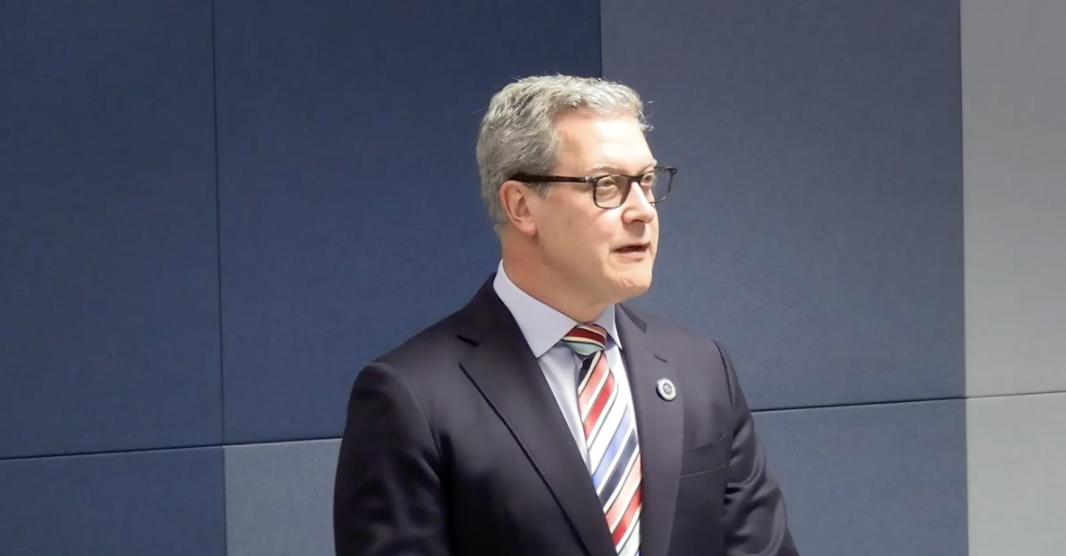
Richard Lancaster SC, counsel assisting on day two of Hearing Block 9 of the Royal Commission on Antisemitism and Social Cohesion. Photo: screenshot

Gonski: Jewish identity should be embraced as part of everyday Australian life

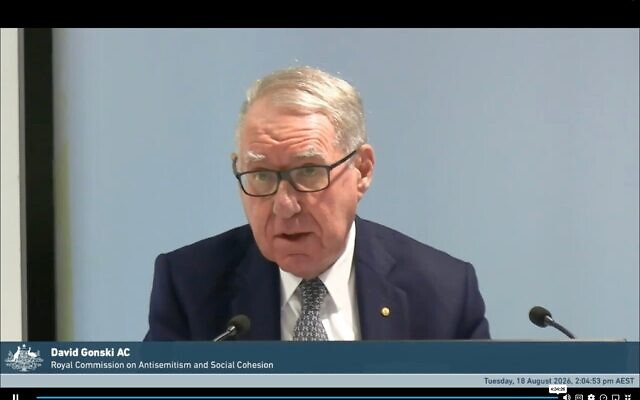
Gonski used the closing minutes of his evidence to the Royal Commission this afternoon, when prompted, to reflect on the unique, shifting nature of antisemitism, and the depth of Jewish historical trauma.

Questioned by Leon Zwier, representing Arnold Bloch Leibler, on whether antisemitism differs from other forms of racism by constantly changing form, Gonski said he could not be certain, but agreed it was consistently among the first expressions of hostility in society, and that anyone who believed such hostility would stop there was gravely mistaken.

Asked whether Jewish trauma predates the Holocaust, stretching back through centuries of persecution and expulsion, Gonski agreed emphatically, pointing to historical episodes such as the expulsion of Jews from Spain.

He noted the Holocaust nonetheless holds a distinct place in Australian memory, given the sacrifices of Australian servicemen who fought against Nazism.

Gonski also spoke about the significance of support from non-Jewish Australians since 7 October, describing how contact from prominent people outside the Jewish community had deepened his respect for them, and had reinforced his own resolve to offer similar solidarity to others facing hardship in future.

And when answering a question from Commissioner Virginia Bell, Gonski said he believed most Australians genuinely valued social cohesion, describing diversity as a strength rather than a burden, and said Jewish identity and its festivals should be embraced as part of everyday Australian life, just as other faiths’ traditions are.

“Commissioner, I think the existence of your commission has already done something, and I compliment all those who come in here each day and so on. I think talking about it is very important.

“And what I would hope your commission and your thoughts going forward will help people understand that fair go is something for everybody, and we should all be open and enjoy diversity.

“If you happen to be Jewish, you shouldn’t be seen as ‘badly’ diverse . . . you should be [seen as] part of [Australian] life. That’s the way I see it.”

Gonski hopes curriculum review will go beyond the Holocaust

David Gonski has told the Royal Commission on Antisemitism and Social Cohesion thathe hopes the review of the Australian Curriculum will go beyond Holocaust studies to cover Jewish history and the Jewish contribution to Australia.

That’s a broader ask than the antisemitism education taskforce he chairs first made.

Gonski, the businessman appointed by the Prime Minister in December to chair the taskforce and best known for the 2011 review of school funding that bears his name, said the argument for a wider treatment had been put to the taskforce and had changed his thinking.

“The Holocaust must never be forgotten, but it is only one part, and it’s a very important part of all Jewish families, sadly,” he said. “But there’s a lot of contribution by Jews to Australia, to the history of Australia.”

He said there were “many precepts that are very useful in the community, generosity, etcetera”, and that the taskforce had listened. “Because we were pushing for Holocaust studies alone into the change to the curriculum, we are hopeful that ACARA will now look more broadly at not just Holocaust studies, but also more generally the contribution of the Jews and indeed the Jewish faith.”

The Australian Curriculum, Assessment and Reporting Authority is conducting a focused review of the national curriculum with antisemitism education in mind, covering both primary and secondary schooling. Gonski said he had underestimated the task.

“I looked at it and thought this is going to be simple. That was a premature thought. It’s a difficult thing, and they’re doing well.” The review has run focus groups and is expected to report within the taskforce’s 12-month term, which ends in December.

The taskforce has also been considering where programs of the kind run by Together for Humanity sit within the curriculum.

Rabbi Zalman Kastel, who gave evidence to the commission earlier the same day, spent an hour with the taskforce making the case that such material belongs in curriculum content rather than in the general capabilities.

Gonski said the point was well made. “There is space in the curriculum for this sort of thing, but it has to be clearly mandated and mapped, and that’s something ACARA are very professional at doing.” ACARA chief executive Stephen Gniel sits on the taskforce and was present when Kastel appeared.

Gonski praised Together for Humanity’s method of bringing Jewish and Muslim students together and sustaining the contact afterwards. “Obviously, you’re bringing people together who may not naturally come together, and the result can be very, very harmonious and greatly advantageous social cohesion.”

He also singled out the Monash Initiative for Rapid Research into Antisemitism, developed by the Australian Centre for Jewish Civilisation, describing it as a train-the-trainer program pitched at universities and substantially concerned with unconscious bias.

Academics at his own former university had found it valuable, he said, and he rated Professor David Slucki as a teacher, having sat through sessions himself.

The taskforce will not issue recommendations when it reports in December. Gonski said the government was expected to establish a permanent social cohesion education advisory council in its place.

“It shows that at the end of the year, it’s not the end of the game,” he said. “I hope some of our green shoots will be very well cultivated and harvested.”

Gonski open to universities choosing between IHRA and UA definitions

The chair of the Prime Minister’s antisemitism education taskforce has told the Royal Commission he would personally regard it as “a very good solution” if universities were permitted to adopt either the IHRA definition of antisemitism or the competing Universities Australia definition.

David Gonski, the businessman appointed by the Prime Minister in December to chair the taskforce, said the choice of definition was not a matter the taskforce itself had resolved, and repeatedly stressed he was speaking for himself.

A former chancellor of UNSW, he holds the titles of emeritus chancellor and emeritus professor there.

“UA’s definition has been around for two years. We were quite happy with the Finkel report. We thought it was a well-written, well-argued situation,” he said. “There are many who prefer the IHRA definition, and indeed the federal government has adopted that definition, and a number of state governments have too. So I don’t think it’s for me to say which one.”

But he added: “If the interpretation were to give, say, universities an alternative of those two, I personally would regard that as a very good solution.”

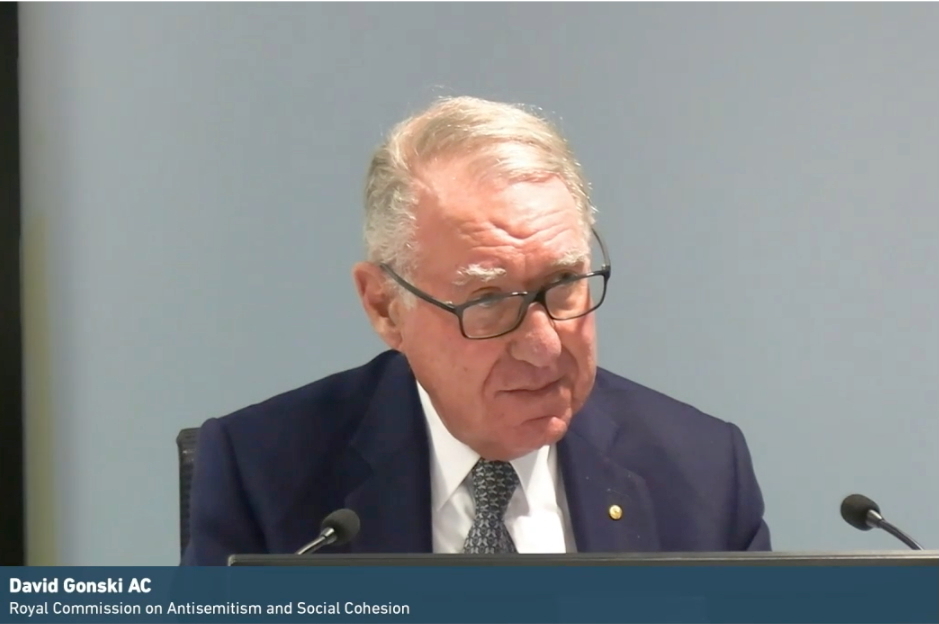
David Gonski, the chair of the Prime Minister’s antisemitism education taskforce Photo: Screenshot

The “interpretation” is a statement expected from the federal government later this calendar year, following changes to the higher education threshold standards announced by Education Minister Jason Clare on 13 July.

Those standards now require universities to define all forms of racism — antisemitism, anti-Muslim racism and racism directed at First Nations people among them.

Gonski said the standards grew directly out of Professor Greg Craven’s initial report to the special envoy to combat antisemitism, which found that while some universities had endorsed a definition, none had formally adopted one.

“He was very concerned that in order to work out whether there had been antisemitism, he felt you had to define it,” Gonski said. The taskforce, working through its secretariat in the federal education department, had helped refine what a standard could look like, though the final decision was the minister’s.

He said he hoped the coming interpretation would not be permissive. “We are hopeful that it will not be an all-encompassing ‘you can do what you like’. I don’t believe it should be, but it will actually maybe state one or two definitions that are acceptable under the standard.”

The Group of Eight universities commissioned Dr Alan Finkel to advise them on antisemitism, and the resulting report endorsed the Universities Australia definition. Finkel addressed all 24 members of the taskforce, Gonski said.

Asked about the Finkel report’s treatment of the model code on free speech drafted by former chief justice Robert French in 2019 – specifically its easing of French’s restrictions on conduct affecting student health and wellbeing – Gonski again offered a personal view.

“I was around as a chancellor in 2019, so I’m well aware of the excellent work that he did, and at that stage, we felt it was the right thing, but that was seven years ago, and a lot has happened,” he said.

“Reading the Finkel report, I think it was a wise suggestion.”

Multi-faith pilot expanding to government schools

A religions and worldviews education pilot that took four years to develop with input from multiple faith communities is expanding into Victorian government and Catholic schools, the Royal Commission on Antisemitism and Social Cohesion has heard.

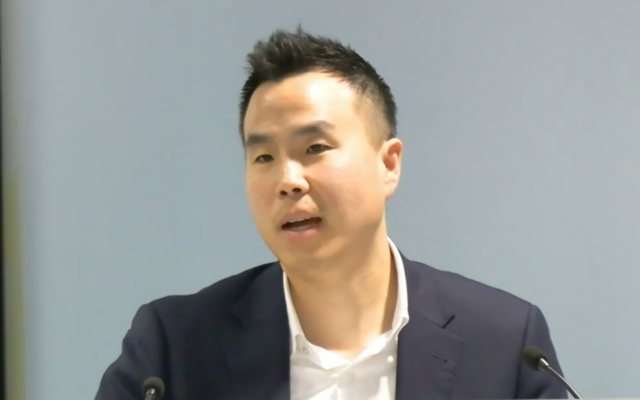
Faith Values chief executive Herbert Um told the commission the pilot, which has already reached about 1200 students across 15 independent secondary schools including a Jewish school and a Muslim school, has received ethics approval to recruit up to 100 teachers across 10 Victorian government schools, with the Scanlon Foundation funding the expansion.

The program consists of eight lesson plans aligned to the Victorian Curriculum 2.0 civics and citizenship strand for year seven and eight students, a teacher’s guide and in-person professional learning. It covers six major religious traditions — Buddhism, Christianity, Judaism, Islam, Hinduism and Sikhism — as well as humanism and rationalism.

Um said the approach was non-confessional and curriculum-aligned, distinguishing it from special religious instruction. Rather than teaching individual religions in isolation, lessons are structured around shared questions such as the purpose of life and what it means to be a good citizen, with each tradition providing its own response.

“It’s not a lesson on Islam, a lesson on Judaism, a lesson on Christianity or Sikhism. It’s an integrated approach,” Um said.

He described a “nervousness towards the topic of religion, especially in the classroom” across the education sector, warning that when schools avoided the subject, students turned to social media and other unreliable sources for information about unfamiliar religions.

“That lack of confidence at times, especially from a teacher’s perspective, in some ways diminishes students’ own sense of identity or belonging in the classroom,” Um said.

Teachers who participated reported the resources were “practical and balanced” and “long overdue”, while students said the program prompted them to think more critically about how media influenced their beliefs.

The University of Melbourne Faculty of Education is evaluating the pilot through pre and post surveys measuring teacher confidence and student attitudes towards diverse religions and worldviews.

Um, who sits on the Australian Curriculum Assessment and Reporting Authority’s Australian Values Advisory Group, said religions and worldviews literacy should be recognised as a contribution to social cohesion and to preventing prejudice, stereotyping, conspiracy narratives and extremism.

He said teachers did not need to be experts on every religion. 

“It’s about helping teachers feel confident about modelling that humility and that curiosity, as well as fostering a sense of safety in the classroom,” Um said.

Together for Humanity urges curriculum and teaching standards reform

Together for Humanity has urged the Royal Commission on Antisemitism and Social Cohesion to reform the Australian curriculum and teaching standards, warning that intercultural capabilities are embedded in general capabilities that “almost nobody teaches”.

Rabbi Kastel told the commission that intercultural learning needed to move from curriculum elaborations into content descriptions, saying teachers consistently reported a crowded curriculum with no time for general capabilities.

“We need to give teachers freedom to not do more than they have time to do, but to ensure that essential learning, such as that articulated within the general capabilities, there is time for that at school,” Kastel said.

He also urged reform of teaching standards, currently under review, noting that of four levels of teacher accreditation, only one addresses dispositions. 

“Content and skill is not the whole picture. It’s actually the character of teachers, their capacity to make ethical professional judgments, their capacity to develop connection across culture,” Kastel said. Reforming the standards would flow through to university teacher education and professional development.

Dr Hu-Jia recommended establishing mandatory mechanisms for schools to record and report incidents of racism, antisemitism and Islamophobia as specific sub-groupings, rather than under a general banner.

Hu-Jia also called for investment in professional learning for education system leaders, not just individual school principals, and for a national framework for student wellbeing and social cohesion that embedded intercultural capabilities as a longitudinal priority rather than isolated interventions.

“Education is important, plays a very important part in creating social cohesion. But education alone is not sufficient,” Hu-Jia said. “A whole society approach to looking to those challenges facing our young people.”

Kastel told the commission that some schools had become hesitant to engage with antisemitism and Islamophobia, perceiving them as politically sensitive topics. 

He also warned that schools in wealthier areas were better positioned to access programs because they had volunteers who could write persuasive applications, while disadvantaged schools with greater need struggled to articulate their case.

Kastel said addressing prejudice should not be limited to schools with affected communities.

“Hatred doesn’t just harm the victim. Hatred harms the hater,” he said. “If we’re going to have social cohesion in Australia, it means all of us need to be part of these, not just the schools with the Jewish students.”

School went from “horrific” racism to zero incidents

A school that recorded students being called “gas inhalers” and pushed into narrow spaces and sprayed with deodorant to evoke gas chambers had zero incidents of antisemitism or racism within months of completing a Together for Humanity partnership program, the Royal Commission on Antisemitism and Social Cohesion has heard.

Together for Humanity founder Rabbi Zalman Kastel told the commission that the school, which also had anti-Chinese racism including students being called “slaves”, initially approached the organisation for a one-off student session.

“There were some horrific and antisemitic things that were said at that school, that were very distressing to some students,” Kastel said. “There was a culture of pretending this was okay.”

After an initial intervention involving Jewish community youth leaders, the school applied for a formal partnership administered by Together for Humanity’s program coordinator Dr Beau Hu-Jia.

Kastel described the partnership as “a game changer” because it shifted ownership to the school itself. Teachers trained older students to become in-house facilitators, who then developed their own programs for younger students.
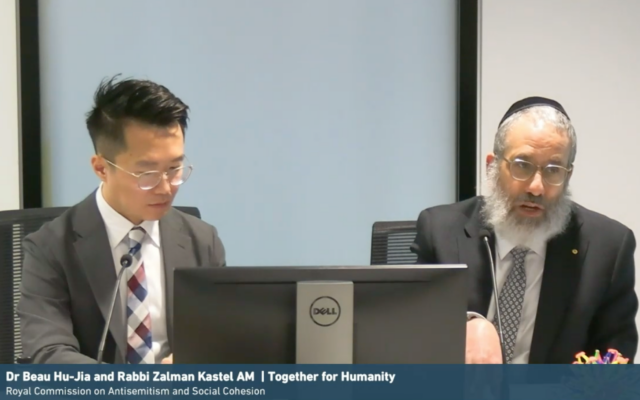
“In May 2026 I visited the school, and I bumped into one of the school leaders, and she said, ‘I just want you to know that in 2026 we’ve had no incidents,'” Kastel said. “In 2025 and 2024 they had a lot of incidents, and from February to May 2026 there were no incidents of antisemitism, no incidents of racism within that school.”

The partnership cost $10,000 in government funding.

Hu-Jia told the commission Together for Humanity evaluates its programs using quantitative student surveys across five areas — intercultural understanding, respect, perspective taking, confidence engaging across difference and ability to challenge stereotypes — alongside qualitative feedback and focus groups.

Independent evaluation by Western Sydney University found the programs helped students challenge stereotypes, reduce fears of cultural difference, respond to prejudice and develop empathy and belonging.

Hu-Jia cited feedback from a Victorian government primary school partnership focused on Aboriginal and Torres Strait Islander, Pasifika and Burmese student inclusion, where a parent reported, “We feel part of the school now; it’s not just about education, it’s about connection.”

A staff member at the same school said, “This is how you address racism. You create a sense of belonging.”

Kastel also described a 2019 workshop that brought together Jewish students and public school students of mostly Lebanese Muslim background. The students, aged around 15, were asked to step forward if they had experienced various forms of hardship, including being ridiculed for their religious background, their accent or their appearance.

One student proposed their own prompt: step forward if you find yourself scrolling your phone, seeing things overseas that upset you, but feeling powerless to do anything about it. The entire group crossed the room.

“Obviously, the specifics of what they were scrolling and the specific details of that would be quite different for various students, but they were able to be united in their difference at that moment,” Kastel said.

Those Jewish-Muslim student exchange programs have not taken place since October 2023. Kastel said he hoped they would resume in 2027.

Students should not carry weight of a nation’s politics

The Royal Commission into Antisemitism and Social Cohesion has heard testimony from the founder and a senior staff member of the Together for Humanity Foundation about the organisation’s work fostering intercultural understanding in Australian schools.

Together for Humanity Foundation founder and dean Rabbi Zalman Kastel told the commission the organisation grew out of an informal visit to a Sydney primary school in the early 2000s, when he attended alongside a Catholic and a Muslim colleague. He said the foundation, formally established a few years after that visit, worked with schools through five main activities: direct engagement with students, support for teachers, online engagement, work with families, and school partnerships.

Kastel said the foundation deliberately addressed all forms of prejudice rather than focusing on one, and its board reflected the same diversity as its educators, including a Muslim president and a Buddhist chairman.

“It was fascinating for me to see these young people really motivated by their own version of the idea of a mitzvah,” Kastel said.

“Our success is very much driven by the fact that we are impartial, politically impartial, and we are inclusive and care about all communities.”

Photo: Screenshot

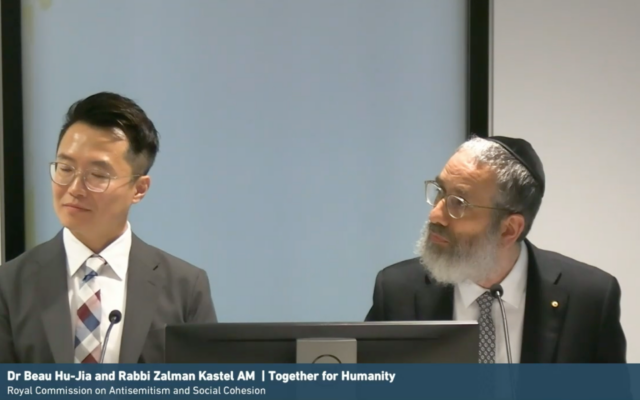
Together for Humanity Foundation national school partnerships manager Dr Beau Hu-Jia, who has held the role since August 2023, told the commission his work centred on the Intercultural Understanding Partnership Program, funded by the federal Department of Education.

Hu-Jia, who holds a PhD in education from the University of Melbourne researching Australian-born Chinese children’s identity formation, told the commission that questions of identity and belonging were highly personal for many students from migrant backgrounds.

He gave the commission an example from his research of a primary school student in Melbourne, the only non-Anglo-Australian student in her class, who was repeatedly positioned by peers as a representative of her country of origin whenever related political issues arose in class discussion, causing the student significant stress.

“I do believe Australian children in our classroom should not be held account for government of another country or the culture of another country,” Hu-Jia said.

Hu-Jia said the partnership program favoured a “whole-of-school approach” involving leadership, teachers, students and community members, with the aim of embedding sustainable change — such as curriculum or policy revision — rather than funding one-off activities such as Harmony Week celebrations.

No academic can teach without bias, commissioner told

A Monash University historian has told the Royal Commission on Antisemitism and Social Cohesion that no academic can teach free of bias, after Commissioner Virginia Bell pressed him on whether lecturers put a slant on Israeli and Palestinian history.

Daniel Heller, who teaches Israeli and Palestinian history and co-directs the Brave Conversations Project, was questioned by Bell on Tuesday after counsel assisting Richard Lancaster SC finished.

Bell asked whether Middle East studies teachers sometimes avoided contentious issues out of concern about harming students. Heller said he hesitated to speak for all educators, but that the concern existed alongside a fear of criticism on social media, and that fear narrowed people’s capacity to make wise decisions.

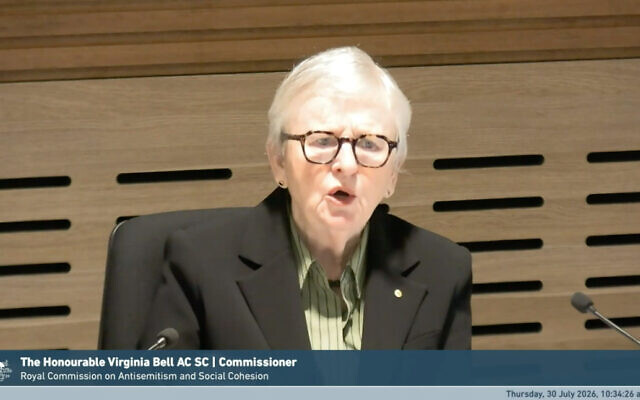
Commissioner Virginia Bell.

Bell then put to him that there must be room for facts, giving the example of a student of Palestinian background upset that the community of nations accepted Israel in 1948 or 1949.

“That is a fact. It may be that it is upsetting for some students, but that’s hardly an issue at the university level, is it, for a person teaching Middle Eastern history?” she asked.

Heller said he had never heard a student express upset on that basis, and that how the meaning of facts is interpreted is highly contingent.

“We have to teach to the best of our ability what happened, but we also have to teach why it is that these different communities interpret what happened in such fundamentally different ways,” he said.

When Bell suggested lecturers taught from a foundation of facts “but putting a slant on it”, Heller said every educator did so, consciously or not.

“None of us can teach or can speak in a way that isn’t biased. Bias is an inherent part of our makeup as humans,” he said.

Heller said he told students on the first day not to trust him, because he did not trust himself, given the limits of his own knowledge, languages and sources. The course is taught by a team including an Israeli, a Palestinian, an Iranian, an Egyptian and an Australian, and he said naming them that way told students nothing about the individuals.

Heller described a class in September 2024, at the height of the war, in which a Muslim student and an Orthodox Jewish student began sharing stories of people they knew who had lost children.

“Somehow everyone in that room knew about a minute in … something is happening that is sacred,” he said. “It was a moment of such deep humanity and such connection, and I had nothing to do with it.”

Fear driving academics from contested subjects, commission hears

Fear is driving university educators to avoid contested subjects, leaving students to learn instead from what one witness called conflict entrepreneurs online, the Royal Commission on Antisemitism and Social Cohesion has heard.

Monash University academics Daniel Heller and Farid Zaid, co-directors of the Brave Conversations Project, gave evidence by video link on Tuesday.

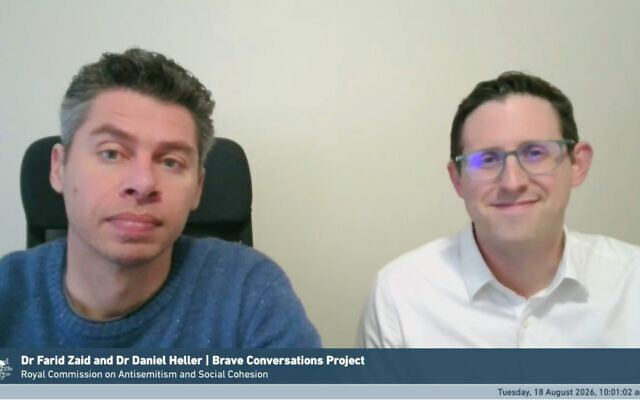
Brave Conversations Project co-directors Farid Zaid (left) and Daniel Heller.

Heller, a senior lecturer who teaches Israeli and Palestinian history, told counsel assisting Richard Lancaster SC that two Jewish colleagues were killed when Hamas invaded southern Israel on October 7, and that about 10 days later a colleague’s father-in-law lost some 75 family members when a missile struck their apartment building in Khan Younis.

“I don’t really know how to say this in a sanitised way. My heart kind of broke open, and I felt this sense of crisis,” Heller said.

Zaid, a cognitive scientist and senior lecturer in psychology, said he had been surprised by students’ inability to distinguish discomfort, necessary for learning, from distress, and that the line between the two had narrowed over his career. Classroom conversations played out along rigid lines, he said, producing two responses the pair found problematic.

“One is self censorship and silence, and the majority of students adopt that perspective … The other way that students and our colleagues sometimes respond is to perform certainty. We know what’s virtuous, what’s moral, what’s right, and anyone who disagrees is, in one way or another, morally reprehensible,” Zaid said.

Asked what happens when educators are afraid to address contested issues, Heller said the typical response was to avoid the topic entirely, particularly for sessional staff without job security, citing fear of official complaints, teaching reviews and “the public trial that can happen over social media”.

“In the absence of being able to talk about this in the university, our students are going to be looking for information elsewhere,” Heller said. “The conflict entrepreneurs that are deliberately looking to inflame emotions, to radicalise in whichever way you might imagine, they are the ones that our students are turning to.”

The project has been endorsed by the Group of Eight’s Expert Advisory Committee on Combating Antisemitism. Heller said that while it was not a project about antisemitism, he believed it reduced antisemitism, because single-issue training prompted participants to ask only what to avoid saying.

Zaid said they disagreed with colleagues who believed caring for students meant sanitising classrooms of any contention. The pair have run workshops for about 1200 to 1300 Monash educators and 600 to 700 nationally.

The AJN is providing rolling coverage on the Royal Commission on Antisemitism and Social Cohesion.

For full coverage of the Hearing Blocks, visit the Royal Commission section of The AJN website.

read more:
comments
Live Now

Gonski hopes curriculum review will go beyond the Holocaust

David Gonski has told the Royal Commission on Antisemitism and Social Cohesion thathe hopes the review of the Australian Curriculum will go beyond Holocaust studies to cover Jewish history and the Jewish contribution to Australia.

That’s a broader ask than the antisemitism education taskforce he chairs first made.

Gonski, the businessman appointed by the Prime Minister in December to chair the taskforce and best known for the 2011 review of school funding that bears his name, said the argument for a wider treatment had been put to the taskforce and had changed his thinking.

“The Holocaust must never be forgotten, but it is only one part, and it’s a very important part of all Jewish families, sadly,” he said. “But there’s a lot of contribution by Jews to Australia, to the history of Australia.”

He said there were “many precepts that are very useful in the community, generosity, etcetera”, and that the taskforce had listened. “Because we were pushing for Holocaust studies alone into the change to the curriculum, we are hopeful that ACARA will now look more broadly at not just Holocaust studies, but also more generally the contribution of the Jews and indeed the Jewish faith.”

The Australian Curriculum, Assessment and Reporting Authority is conducting a focused review of the national curriculum with antisemitism education in mind, covering both primary and secondary schooling. Gonski said he had underestimated the task.

“I looked at it and thought this is going to be simple. That was a premature thought. It’s a difficult thing, and they’re doing well.” The review has run focus groups and is expected to report within the taskforce’s 12-month term, which ends in December.

The taskforce has also been considering where programs of the kind run by Together for Humanity sit within the curriculum.

Rabbi Zalman Kastel, who gave evidence to the commission earlier the same day, spent an hour with the taskforce making the case that such material belongs in curriculum content rather than in the general capabilities.

Gonski said the point was well made. “There is space in the curriculum for this sort of thing, but it has to be clearly mandated and mapped, and that’s something ACARA are very professional at doing.” ACARA chief executive Stephen Gniel sits on the taskforce and was present when Kastel appeared.

Gonski praised Together for Humanity’s method of bringing Jewish and Muslim students together and sustaining the contact afterwards. “Obviously, you’re bringing people together who may not naturally come together, and the result can be very, very harmonious and greatly advantageous social cohesion.”

He also singled out the Monash Initiative for Rapid Research into Antisemitism, developed by the Australian Centre for Jewish Civilisation, describing it as a train-the-trainer program pitched at universities and substantially concerned with unconscious bias.

Academics at his own former university had found it valuable, he said, and he rated Professor David Slucki as a teacher, having sat through sessions himself.

The taskforce will not issue recommendations when it reports in December. Gonski said the government was expected to establish a permanent social cohesion education advisory council in its place.

“It shows that at the end of the year, it’s not the end of the game,” he said. “I hope some of our green shoots will be very well cultivated and harvested.”

Enjoy Unlimited Access To The Australian Jewish News Website And All Our Online Content For AUD$18/month Or Just AUD$120/year.

Subscribe Now