Live updatesPublic hearings

Royal Commission turns focus to strengthening social cohesion

Hearing Block nine begins today focusing on strengthening social cohesion, including how it is understood and measured.

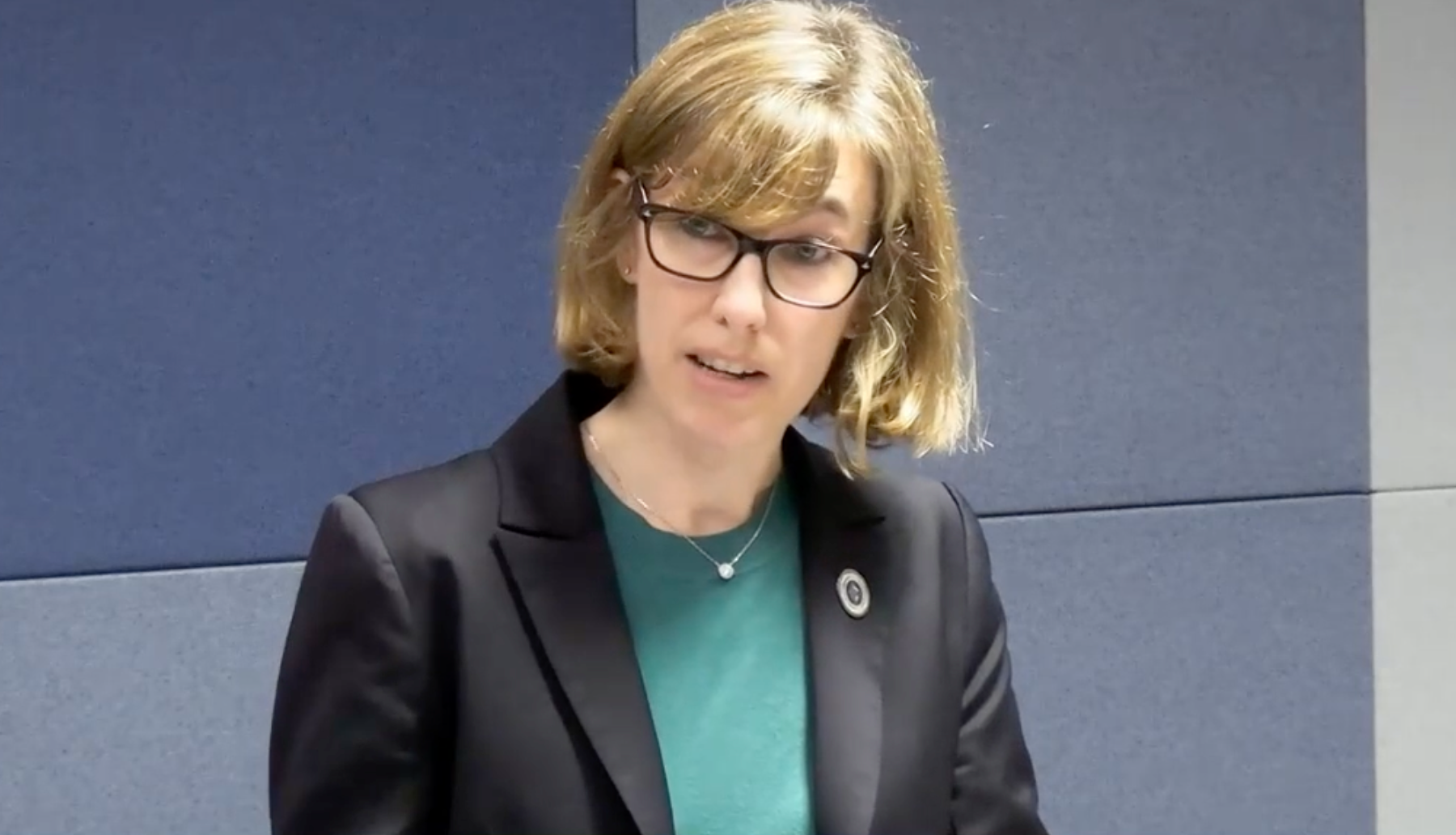
Zelie Heger SC, Counsel Assisting opening Hearing Block Nine. Photo: screenshot

Read the reports

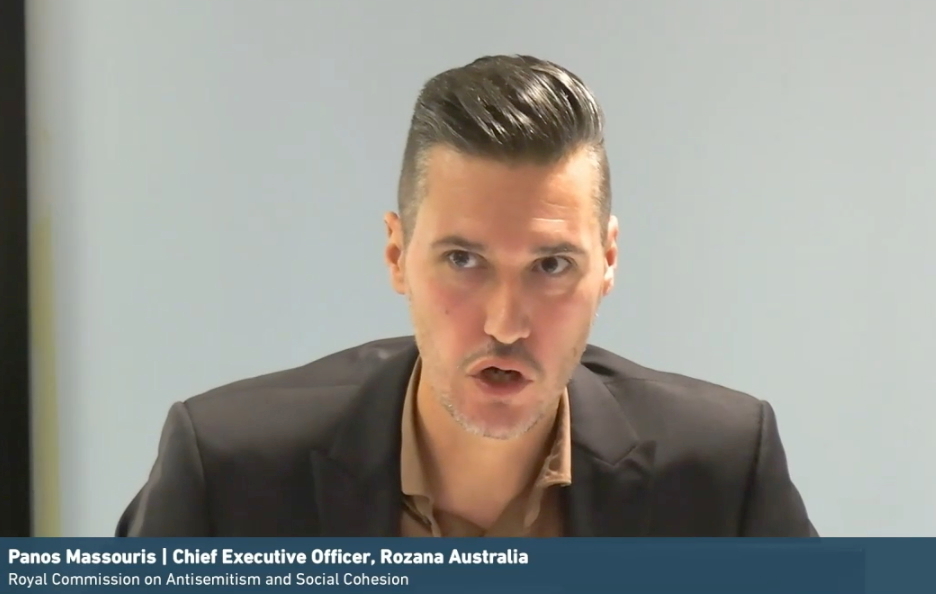
Panos Massouris, CEO of Rozana Australia, on the lack of sustained, structured contact between Jewish, Palestinian, Lebanese and Syrian Australians and how that impacts social cohesion

Ahmed Hegazi, a Muslim Australian academic, mediator and community leader, and Joel Lazar, a Jewish Australian lawyer and CEO of the Jewish Climate Network, on trust as the foundation for social cohesion

Hegazi and Lazar on the need for public solidarity

Dr Rana Dadpour, co-founder of Iranian-Australian advocacy group AusIran, on the solidarity between Iranians and the Jewish community

Dr Dadpour on the need for education to counter antisemitism and racism

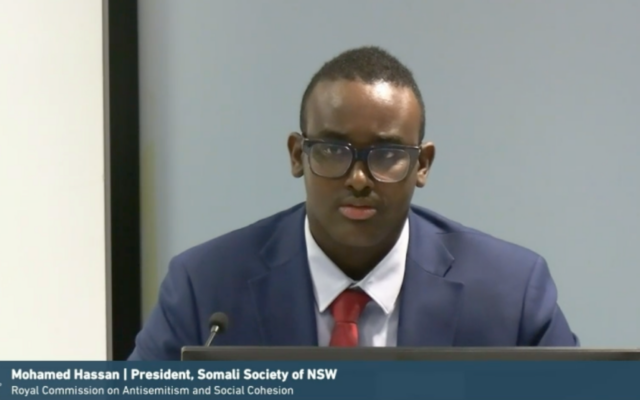
Mohammed Hassan, president of the Somali Society of New South Wales, on the call for a federal multiculturalism envoy 

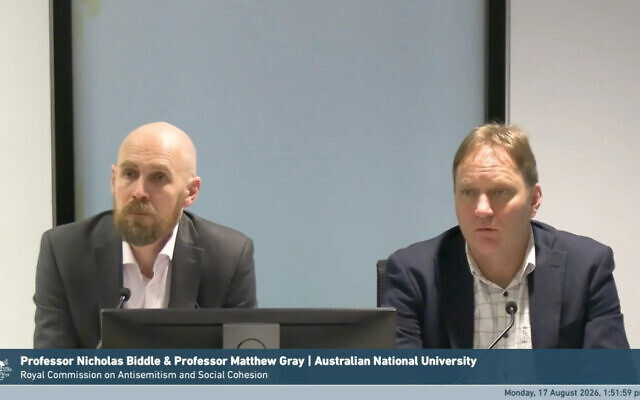
Australian National University professors, Nicholas Biddle and Matthew Gray, on the younger generation’s support for democracy in Australia

Professors Nicholas Biddle and Matthew Gray on how to counter antisemitism by tackling social media 

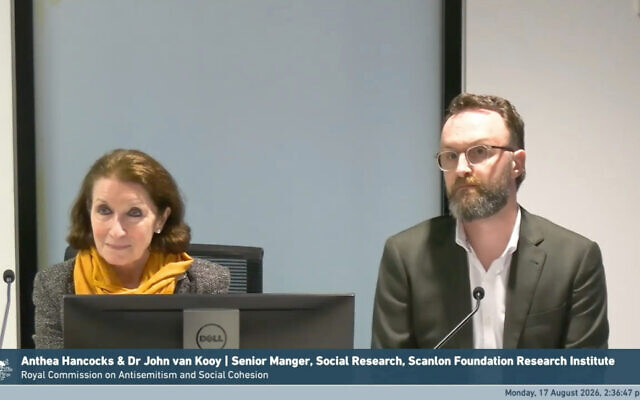
Scanlon Foundation Research Institute CEO Anthea Hancocks and the institute’s senior manager of social research, John van Kooy, on countering criticisms of the term ‘social cohesion’

Hancocks and van Kooy on the way Australians view the Jewish community 

Hancocks and van Kooy on the fact that neighbourhoods and faith organisations are among the strongest sources of resilience in Australian society

Hancocks and van Kooy on the acceptance and belonging of younger Australians

Young Australians most accepting, least likely to feel they belong

Australians aged 18 to 24 record the highest levels of acceptance of diversity of any age group and the lowest sense of belonging, the Royal Commission on Antisemitism and Social Cohesion has heard.

Evidence from the Scanlon Foundation Research Institute showed the youngest age group sitting 52 points above the national average on acceptance and rejection, and 50 points below the average on belonging. Acceptance and rejection is the domain covering attitudes to immigrants, support for ethnic minorities and experiences of discrimination.

Australians aged 65 and over showed the reverse pattern, with a high sense of belonging and a level of acceptance well below the average.

Institute chief executive Anthea Hancocks said the acceptance figure for young people was “just something that I think we should all be capturing as much as we possibly could”.

She attributed their low sense of belonging partly to life stage and partly to circumstance. Young people were “just starting out on life, and so they really don’t necessarily know what the world has got in store for them”, she said. The result also related “as much to their economic uncertainty about the future as well as their own place in the world”.

The pattern is not confined to the young. The 2025 Mapping Social Cohesion report finds national pride and belonging at the lowest levels recorded since the study began in 2007, driven by considerable declines among younger generations and associated with personal and financial wellbeing, social isolation and disconnection.

Migrants who have been in Australia for less than 10 years show a comparable profile. The institute’s data placed recent arrivals 37 points below the national average on belonging and 26 points below on participation, but 35 points above on social justice and 38 points above on acceptance.

Senior manager of social research Dr John van Kooy said the pattern was consistent with a sense of optimism among new permanent migrants, with belonging building as people settled and the higher measures drifting down over time “as people perhaps become as cynical as the rest of us”.

Ms Hancocks linked financial hardship directly to the conditions in which prejudice takes hold. People who said they were poor or struggling to pay bills recorded considerably lower scores on worth, belonging and social justice, she said.

Public narratives could then direct that resentment. “If you’re given to believe that it’s somebody else’s fault, then if somebody tells you who that other person might be,” she said, there were people prepared to believe what they were told.

She added that awareness of inequality also pulled down cohesion scores, though not as sharply as experiencing economic insecurity directly.

Asked whether the age data pointed to where policy effort should go, Dr van Kooy said it showed there were opportunities in engaging with young people, and things to consider at the other end of the age bracket, but that it did not go far enough. The data “doesn’t tell us enough, really, about the diversity within the population and within any one of those age groups to be really definitive about policy decisions”, he said.

Both witnesses told the commission that better local-level data was needed. The study surveys about 8000 people nationally, which Dr van Kooy said was too few to describe attitudes within individual local government areas. The institute has attempted to estimate index scores at that level through statistical modelling, in a tool it calls the social cohesion compass, but he stressed those figures are estimates rather than measurements.

Neighbourhoods and faith groups hold the social fabric together

Local neighbourhoods and faith organisations are among the strongest sources of resilience in Australian society, the Royal Commission on Antisemitism and Social Cohesion has heard, even as national measures of belonging fall.

Scanlon Foundation Research Institute chief executive Anthea Hancocks told the commission that about 80 per cent of respondents agreed people in their local area were willing to help their neighbours, that people from different backgrounds got on well together, and that they felt they belonged in their neighbourhood.

“Neighbourhoods are really one of these areas where we gain the greatest resilience and strength for social cohesion,” she said.

The institute’s 2025 Mapping Social Cohesion report reaches the same conclusion, finding that people living in close neighbourhoods are the most likely to have maintained a sense of national belonging, trust in government and acceptance of diversity through recent years.

Ms Hancocks said neighbourhoods gave people a sense of place and familiarity that made them less isolated and more prepared to participate locally. She added that shared economic pressure could itself be binding.

Where people under financial stress lived among others in the same position, she said, “you sort of have a common bond that is bringing you together”.

The institute’s evidence pointed to social infrastructure as the mechanism. Ms Hancocks described this as the things within local areas that bring people together or allow them to cross paths, listing community legal centres, sporting clubs, neighbourhood houses, cultural associations, faith organisations and local initiatives such as youth councils.

Bringing people together from different backgrounds around a single issue, she said, created a sense that everyone was dealing with the same sorts of things.

The weakest of the local indicators was whether people felt they had a voice in their own area. Ms Hancocks described this as an area where councils could grow and develop, pointing to the use of resident surveys by many local governments.

“This really does strengthen trust, and it really signals that people can influence the decisions that might have an impact on them as well,” she said.

On faith communities specifically, Ms Hancocks said the research showed people who identified as particularly religious participated at markedly higher rates than those who were not religious at all.

“There’s more civic activity. There’s more interaction with the broader community, and they’re making friends from a broad range of different backgrounds,” she said. “All of which are very positive contributions to social cohesion.”

Asked what she meant by describing religious participation and intercultural connection as mutually reinforcing, she said belonging to something and being able to contribute to it also returned a sense of welfare and worth, which encouraged people to get involved in other community activities.

Ms Hancocks cited the Greater Dandenong Interfaith Network, which she described as Australia’s first local government interfaith network and a model for communities across the country. She pointed to the number and diversity of faith groups involved, and to the network’s resilience through a drug crisis affecting young people in the area before COVID-19.

The pandemic brought its own test, she said, when residents from culturally and linguistically diverse backgrounds struggled to access information and understand public health orders. The network played a role in facilitating connections during that period, and “it is still in operation and still a resource for the community”.

Negative views of Jewish Australians climb for a second year

15 per cent of Australians reported a negative or very negative attitude towards Jewish people in 2025, up from 13 per cent in 2024 and 9 per cent in 2023, the Royal Commission on Antisemitism and Social Cohesion has heard.

The figures come from the Scanlon Foundation Research Institute’s annual Mapping Social Cohesion study, given in evidence by the institute’s chief executive Anthea Hancocks and its senior manager of social research, Dr John van Kooy.

Dr van Kooy told the commission the 2023 result was not a starting point but the end of a long plateau. The 9 per cent recorded that year, he said, was “essentially a sort of consistent level, more or less” of between 8 and 9 per cent from July 2020, and it “began to increase starting in 2024”.

Negative attitudes towards other faith groups increased over the same period. Respondents reporting negative views of Muslims went from 27 per cent in 2023 to 34 per cent in 2024 and 35 per cent in 2025. Negative views of Hindus and Sikhs also rose.

Dr van Kooy cautioned against reading the Jewish figure as a measure of antisemitism. The survey carries a single item on attitudes towards people of different faith backgrounds, he said, which made it “a necessary but not sufficient” condition for understanding the problem. Capturing antisemitism properly would require a multi-dimensional instrument the study does not have.

Nor does the survey record what people do. “We don’t capture those sort of behavioural elements,” he said. “It’s very much an attitudinal survey.”

He also warned against comparing the percentages between groups. “We can’t take these percentages to mean that any one group is more or less persecuted or feels … more or less affected than another group,” he said.

The chart put to the commission omits respondents who answered neutrally. Dr van Kooy said the institute could not know why people chose that option, and that movement was not necessarily from positive to negative, as positive responses may have shifted to neutral or the reverse.

Since 2020 the survey has been administered almost entirely online, with about 99 per cent of responses collected by web form. Dr van Kooy said telephone interviewing carried a risk of social desirability bias, with respondents more likely to give an acceptable answer to a person. When the institute ran both modes side by side in 2019, it concluded the differences in responses were a mode effect rather than a change in attitudes.

Attitudes towards migrants from several countries also worsened. The 2025 study recorded small increases in negative attitudes towards people from China, India, Iraq and Sudan between 2024 and 2025, and an increase in negative attitudes towards people from the United States from a lower base.

The overall Scanlon Index of Social Cohesion stood at 78 in 2025, against a base of 100 in 2007.

Asked about the conditions behind the figures, Dr van Kooy pointed to declining perceptions of fairness in Australia, declining financial security, and falling levels of belonging, pride and support for diversity.

aken together with rising negative attitudes towards people of different backgrounds, he said, the past three years of the study showed “a fairly consistent picture … and a concerning one”.

Social cohesion ‘not about telling people to be quiet’

The head of the country’s leading social cohesion research body has told the Royal Commission on Antisemitism and Social Cohesion she does not accept that the term imposes assimilation on minority communities, while acknowledging some read it that way.

Scanlon Foundation Research Institute CEO Anthea Hancocks and the institute’s senior manager of social research, John van Kooy, gave evidence on Monday.

Scanlon Foundation Research Institute CEO Anthea Hancocks and senior manager of social research John van Kooy.

Counsel assisting Zelie Heger put to Hancocks recent criticisms of the term “social cohesion”, including that it may be seen as placing conditions of assimilation on minority communities.

“Some people are certainly interpreting it that way, and I think that’s because it is used by different spokespeople from all sorts of different segments in different ways, and so the language that is used can give that particular impression,” Hancocks said.

“I don’t think that’s what is intended. I certainly don’t think that’s what it means … But some people do absolutely think of it as either it’s all about law enforcement or it’s all about trying to get people to be just quiet and not actually raise concerns. But all of those things are part of social cohesion. It is very much something that is part of negotiation and contestation as society progresses.”

Hancocks said the institute used a short definition borrowed from Canadian researcher Dick Stanley — the willingness of members of society to cooperate with each other in order to survive and prosper — while acknowledging there was no definition everybody agreed on.

Hancocks said a review of dozens of academic journals, government sources and civil society publications found different groups used the language differently. Researchers treated social cohesion as a concept to be interrogated and problematised, governments focused on shaping the conditions for cohesion, and civil society took a more practical, advocacy-focused approach emphasising lived experience.

She said the Scanlon Foundation was created around 2002 because there appeared to be little research in the area, with the first Mapping Social Cohesion survey run in 2007 and every year since bar 2008.

The survey runs to about 100 questions dealing only with social cohesion. Hancocks said it was the only one of its kind anywhere in the world and the only one independently funded, meaning it was not tied to any particular agenda. Data is collected through the Life in Australia panel with the Social Research Centre, and the report has been led since 2022 by James O’Donnell, and before that by Emeritus Professor Andrew Markus, who began the research.

Hancocss said the separate Australian Cohesion Index, produced in 2021 and 2023, was encouraged by the Department of Home Affairs and drew together subjective and objective data.

ANU: Countering antisemitism requires tackling social media

Efforts to counter antisemitism will be limited unless they also address social media platforms, the Royal Commission heard on Monday afternoon.

Australian National University (ANU) professors Nicholas Biddle and Matthew Gray were taken by counsel assisting Zelie Heger to the policy implications of their March 2026 paper on social cohesion and democracy.

Gray said the paper identified four. The first was that targeted measures were needed rather than universal ones, “particularly at younger Australians with low educational attainment who show strikingly low levels of principal democratic support”.

The second was that because trust in core institutions was strongly associated with democratic commitment, government agencies, education systems and public communications should be made more transparent, accountable and credible, especially in communities experiencing disadvantage.

The third concerned social media. Gray said the negative association between trust in social media and support for democracy highlighted the importance of information environments, and that the paper concluded efforts to counter antisemitism would be limited unless they addressed the platforms through which distrust, polarisation and extremist narratives circulate.

Among respondents who trusted social media, 55.9 per cent said democracy was always preferable, against 69.9 per cent of those who did not. Gray said the direction of causality was difficult to establish. The fourth was that law enforcement, legal and post-crisis responses, while critically important, were not likely to be sufficient.

On interpersonal trust, Biddle said a composite measure rose during the COVID-19 period before falling back, standing at 5.47 on a zero to 10 scale in December 2025 against 5.53 in early 2020. Those with high trust supported democracy at 72.3 per cent, against 60 per cent among those with low or moderate trust.

Heger turned to a June 2026 report, Steady but not recovering, drawing on a survey of 3543 Australians conducted between June 18 and July 6. Satisfaction with democracy fell from 66.9 per cent in December 2025 to 65.7 per cent in March and 62.8 per cent in June. Interpersonal trust fell to 5.32, the lowest recorded this decade.

Principled support rose to about 72 per cent, however, with the largest increase among younger Australians. Support for the right to join peaceful protests rose from 72.6 per cent to 77 per cent, the only one of 16 measures of democratic attitudes to change significantly between March and June. Biddle said that was consistent with other data showing trust in institutions declining while principled measures held steady or increased.

The report also found satisfaction was more closely associated with how Australians viewed their country and each other than with their own material circumstances.

Support for democracy weakest among young Australians, commission hears

Fewer than half of Australians aged 18 to 24 believe democracy is always the preferable form of government, against nearly nine in 10 of those aged 75 and over, the Royal Commission on Antisemitism and Social Cohesion has heard.

Australian National University professors Nicholas Biddle and Matthew Gray gave evidence on Monday. Biddle heads the ANU School of Politics and International Relations and Gray directs the ANU Centre for Social Policy Research.

Counsel assisting Zelie Heger took them to a March 2026 paper analysing the ANU poll, a survey of about 3500 people run three or four times a year since 2008 and weighted against population benchmarks.

Australian National University professors Nicholas Biddle (left) and Matthew Gray.

Gray distinguished between satisfaction with democracy, meaning how it is operating, and principled support, meaning whether people think it is the best form of government in all circumstances. He said satisfaction varied far more, being influenced by whether people agreed with the policies of the day and backed the party in power, while support was “perhaps a more deeper or fundamental belief”.

In December 2025, 66.9 per cent said they were satisfied or very satisfied with the way democracy was working. On principled support, 66.9 per cent agreed or strongly agreed that democracy is always preferable, 26.3 per cent were neutral, 5.5 per cent disagreed and 1.4 per cent strongly disagreed.

Heger put to them the paper’s observation that outright rejection of democracy is rare, but a deep commitment far from universal. Biddle agreed, pointing to the large proportion in the middle and the small share expressing the strongest support.

Support ran at 43.8 per cent among 18 to 24-year-olds, rising steadily to 89.1 per cent among those aged 75 and over. It was 70.7 per cent among men and 63.1 per cent among women.

Biddle said education had one of the strongest relationships with support for democracy, and that its interaction with age was the most striking finding in that part of the analysis. Among Australians aged 18 to 34 who had not completed Year 12 or held a post-school qualification, only 22 per cent thought democracy always preferable, against 62.9 per cent of young Australians with a degree.

“The difference within the youngest age cohort by education is greater than the difference across the whole population by age,” he said.

The paper found no significant variation by geography or migrant status, with 66.8 per cent of those born in Australia agreeing, against 67.9 per cent of those born overseas.

Somali-Australian leader calls for federal multiculturalism envoy

The president of the Somali Society of New South Wales has urged the Royal Commission on Antisemitism and Social Cohesion to recommend the federal government establish a special envoy for multiculturalism and social cohesion.

Mohammed Hassan told the hearing that minority communities were being overlooked by governments focused on larger population groups.

“Sometimes when you have a specific community in an electorate, the government are not interested,” Hassan said. “They focus more on the bigger community. So even when you look at the funding side, communities who are quite big, they get funding, which they can get the support that they need, but the minority communities, they struggle.”

Hassan, who was born in Somalia and emigrated to Australia via Kenya at age 11, said the Somali Society’s submission called for an equity-based approach to government engagement with diverse communities, rather than one driven by population size or electoral visibility.

He told counsel assisting Tamara Phillips that social cohesion should be pursued with communities rather than for them.

“Sometimes communities feel that when social cohesion is mentioned, that they are the target, not something that we need to work together as Australians,” Hassan said.

Hassan drew a distinction between consultation and genuine engagement. 

“Engagement is you talk, you discuss with a policy that you want to make a difference. Consultation, you just put a survey and you ask them what they think, and sometimes you might not even take the time to look at it,” he said.

The Somali Society’s submission also raised concerns about media representation of African-Australian communities. Hassan described an incident in Footscray, Melbourne, several weeks earlier where media coverage of an individual’s actions led cameras to focus on the broader African community in the area.

“When the news comes and you see an African person who is doing well in life, you won’t see it on the major news. But when you see someone who has made a mistake, all the communities will be questioned,” Hassan said.

The submission called for a shift “from a problem-community narrative to a whole-community narrative”.

Hassan, who is completing a law degree after finishing a business degree, said youth engagement was central to the society’s work. The organisation has planned a film and arts night for 150 young people this Saturday, with 30 per cent of attendees drawn from other cultural communities.

He said the Somali Society was also developing a program called Youth Connect of New South Wales, designed to reach young people through activities such as sport rather than formal presentations.

“Rather than asking them to come to an event, go to what they do,” Hassan said. “Young people should be engaged before problems become crises.”

The submission’s recommendations also included establishing state-based community leadership and social cohesion partnerships, and adopting an equity of engagement test requiring government programs to demonstrate how they engage communities of different population sizes.

Iranian-Australian leader urges education and dialogue to counter antisemitism

Discussing ways to counter antisemitism, Dr Rana Dadpour urged the Royal Commission on Antisemitism and Social Cohesion to invest in cross-community education and ensure that efforts to counter antisemitism do not stigmatise entire communities.

Dadpour told the commission that the Islamic Republic of Iran systematically promotes anti-Jewish hatred through official discourse, but that millions of Iranians in the diaspora had fled that very ideology.

“Many Iranians in Australia have fled actually that ideology, the extremism that exists in Iran,” Dadpour said. “We reject it wholeheartedly, and we share solidarity with the Jewish community.”

Dadpour told counsel assisting Jane Taylor it was essential to distinguish between the Iranian regime and the Iranian people.

“Millions of Iranians have left Iran, and they seek refuge in other countries, including Australia, because of the human rights violations in Iran and the oppression that exists,” Dadpour said. “One of the pillars of its ideology is basically anti-Jewish and antisemitism.”

Dadpour also drew the Royal Commission’s attention to the long history of Jewish life in Iran, stretching back more than 2500 years to the Persian Empire.

“Jewish people have been a part of the history in Iran. There has been a large Jewish community in Iran, but after the revolution in 1979 and the treatment of the regime towards the Jewish community, many of them had to leave the country,” Dadpour said.

“The long history of the Jewish community in Iran shows how different people inside Iran used to live together in harmony and peace.”

Dadpour outlined three recommendations for the Royal Commission. The first called on government and civil society organisations to support initiatives bringing Jewish Australians together with other communities from the Middle East, with a particular focus on younger generations.

The second recommended investment in education and historical awareness, including greater understanding of the Holocaust and shared cultural histories between communities in the Middle East.

The third urged that responses to antisemitism not stigmatise communities, noting that the antisemitism of the Iranian regime and the IRGC should not be attributed to Iranian Australians who have rejected that ideology.

Dadpour concluded by reading from the final paragraph of the witness statement: “Australia’s strength lies in being a country where communities from different cultures and religious backgrounds can coexist within a shared commitment to democracy, human rights and rule of law.”

Iranian-Australian group stands with Jewish community, Royal Commission hears

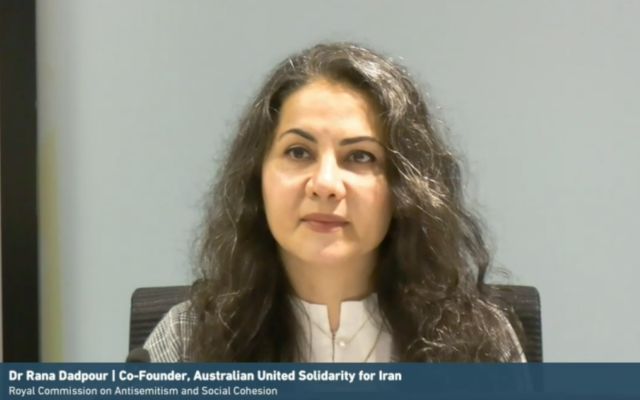
The co-founder of Iranian-Australian advocacy group AusIran has told the Royal Commission on Antisemitism and Social Cohesion that Iranian Australians felt a deep sense of solidarity with the Jewish community after October 7, 2023.

AusIran co-founder and Cairns Institute research fellow Dr Rana Dadpour told the hearing that many in the Iranian-Australian community had personal experience of the ideology behind the attack.

“As the victims of this type of ideology, we really felt close to the Jewish community at that moment, and we tried to reach out and show our solidarity,” Dadpour said.

“We felt that it is very important that we show to them that we reject that ideology, although it is being used by the regime that is ruling over our country, over Iran. We do not accept it, and in totality, we reject it.”

AusIran sent a delegate to a memorial and prayers for hostages held in Melbourne, and subsequently deepened its engagement with Jewish communal organisations.

Dadpour described a series of cross-community initiatives, including an online discussion with the Executive Council of Australian Jewry that explored shared Persian-Jewish history and culture, and an International Women’s Day event co-hosted with the National Council of Jewish Women of Australia.

AusIran also hosted a Persian-language discussion for community members processing concerns about conflict in the Middle East.

“In all of those, we made sure that we distinguish between what governments do, their policies, and what is our role as Australians, basically Australian diaspora people, to show solidarity to each other,” Dadpour said.

Dadpour told counsel assisting Jane Taylor that AusIran had identified an important parallel between the experiences of Jewish and Iranian people in Australia.

“Sometimes the policies of the IRGC, which is a terrorist organisation in Australia, or the regime in Iran, would be linked to Iranian people,” Dadpour said. “The same is happening with the Jewish Australian community. Some policies of the Israeli government are being linked to the Jewish community here.

“Regardless of our connection to a country or a community, people and civilians are not responsible for the policies that a government does, and they should not face violence or harassment because of the policies of a foreign government.”

Hegazi and Lazar call for public solidarity

Hegazi and Lazar’s testimony continued with a plee that Australia must build “infrastructure for solidarity” rather than retreat from cross-community dialogue, presenting a model of mutual advocacy they argued could counter the polarisation that has deepened since October 7, 2023.

“As an Australian Muslim, antisemitism is my issue. I don’t want to see Joel at the front line of his community alone fighting against antisemitism,” Hegazi told the hearing.

Lazar said he felt the same obligation in reverse. “It’s firmly my responsibility as an Australian Jew to fight Islamophobia and not wanting to see Ahmed and his community on the front line every day with mosques experiencing bomb attacks, the women in hijabs walking down the street being attacked. It’s my responsibility,” he said.

Counsel assisting Tamara Phillips noted that the Royal Commission had heard evidence suggesting a retreat from public-facing dialogue between the Jewish and Muslim communities since October 7. She asked what had prompted the pair to come forward publicly.

Lazar said Australia was “at a fork in the road” and that existing approaches were failing both communities.

“The path that we’re currently on is no longer serving us. It’s no longer serving the Jewish community. It’s no longer serving the Muslim community, and it’s no longer serving Australia,” Lazar said.

“This model that Ahmed and I have been discussing is an offering. It’s an invitation for something new that’s different, and we’re under no illusions that it will be easy.”

Hegazi said the divisive voices in public discourse had grown louder while constructive dialogue often remained behind closed doors.

“The divisive voices and the polarisation machines, they do not shy away from being divisive and loud and public, and every day they get louder,” he said. “We should be louder when it comes to the voice of balance and wisdom.”

“We need to build this infrastructure for solidarity. Love is the answer, not hate.”

Both men drew on a deeply personal motivation. Lazar told the hearing his wife had given birth to their second child three days earlier, while Hegazi and his wife are expecting their next child within weeks.

“My child and Ahmed’s new child, they’re going to be the same age. They’re going to grow up in this country together, and we’re doing this work so that they don’t have to,” Lazar said.

Hegazi told the hearing their co-authored academic paper had been presented in July at the International Public Policy Association workshop in Ottawa, where it received positive feedback from global public policy scholars and practitioners.

Commissioner Bell thanked the pair for their evidence and expressed her hope “that those children do grow up firm friends”.

Hegazi and Lazar: Trust, not agreement, is the foundation of social cohesion

The Royal Commission on Antisemitism and Social Cohesion this morning heard concurrent evidence via videolink from Ahmed Hegazi, a Muslim Australian academic, mediator and community leader, and Joel Lazar, a Jewish Australian lawyer and CEO of the Jewish Climate Network.

The pair told Counsel Assisting, Tamara Phillips, that they have spent the past 18 months jointly developing the Australian Community Mediation Model – a framework for using trusted go-betweens to defuse intercommunal conflict, built on relationships the two men have themselves formed across Australia’s Muslim and Jewish communities.

Much of the session focused on an academic paper authored by Mr Hegazi, titled “The Infrastructure of Solidarity,” which the Commission formally admitted into evidence.

Mr Hegazi said the paper began as “a structured reflection” on why Australians who have lived and worked together for decades still experience deep division, arguing that “social cohesion is just a symptom” of daily relational infrastructure — or its absence.

He observed that “people who know their neighbours… don’t feel they are threats and they don’t fear them.”

Mr Hegazi introduced the paper’s central concept of the “citizenship broker” — someone who represents the interests of society as a whole, rather than a single community.

He described it as “an invitation to everyone to think in the best interest of everyone around us,” contrasting it with older models of “ethnic” or “religious” brokers who advocate for one group alone.

He linked the idea to Stephen Covey’s concepts of the “third alternative” and “smart trust,” arguing that genuine cohesion means rejecting the idea that “it’s either my safety or your safety” — insisting instead that “we can always build something together.”

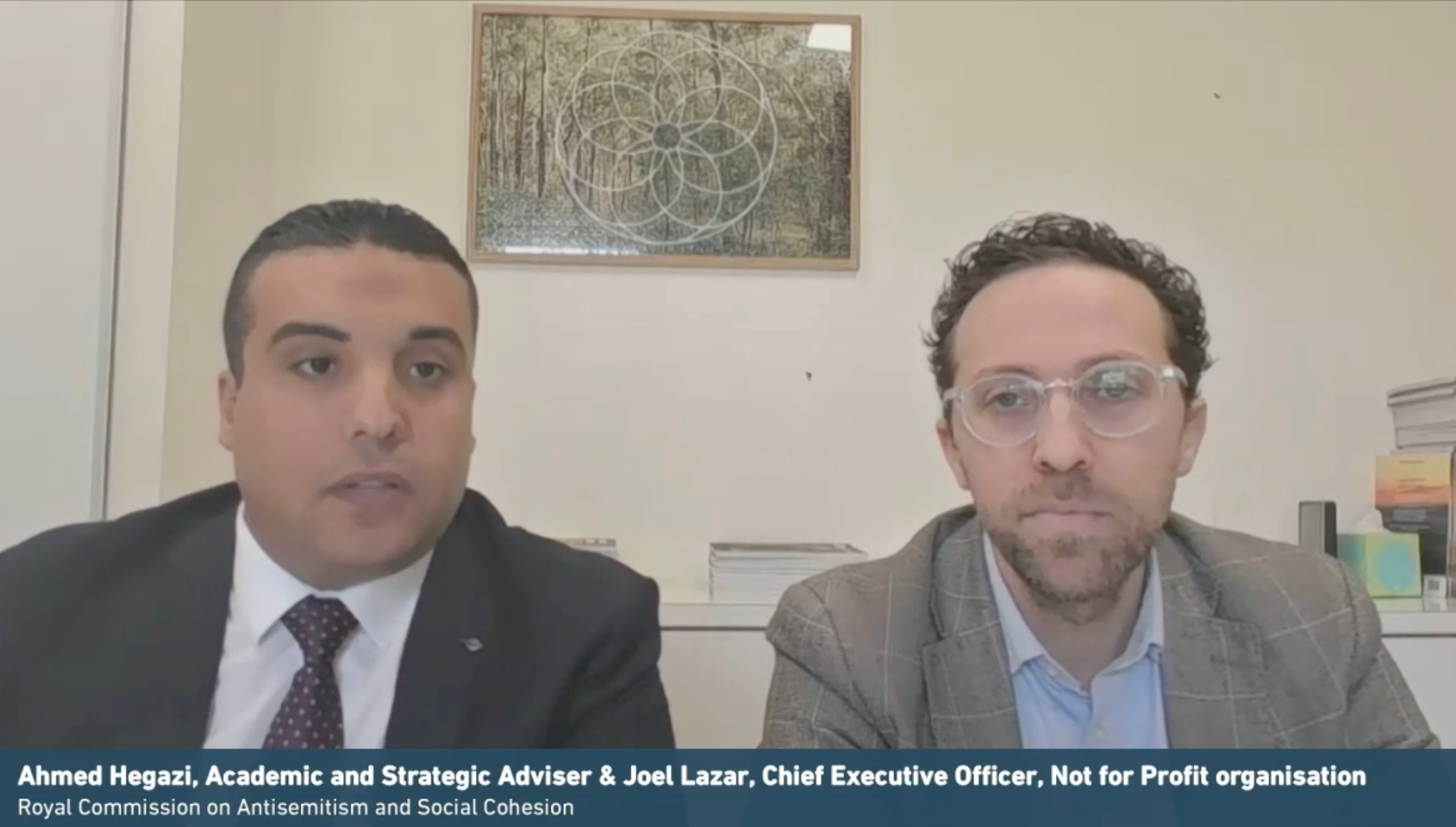
Ahmed Hegazi (left) and Joel Lazar, giving evidence to the Royal Commission this morning via videolink. Photo: Screenshot

On policy, Mr Hegazi proposed what he called the “Keystone Compact,” under which government funding would reward sustained, demonstrated cross-community collaboration rather than one-off events.

He was careful to frame this as a redesign rather than a rebuke: “We’re not asking to defund, deregister, or cause any threat to any institution… the tools of the policy need to change.”

He argued Australia’s multicultural settlement, while a genuine success, had inadvertently entrenched “silos,” leaving strong “bonding capital” within communities, but weak “bridging capital” between them.

Mr Lazar described how his climate advocacy work unexpectedly became a foundation for intercommunal trust.

He said relationships built over years with non-Jewish colleagues in the climate movement meant that, after 7 October and the Bondi Chanukah terror attack of December 2025, colleagues sought him out to understand the Jewish community’s experience — and that this was possible only because of trust accumulated well before the crisis.

Crucially, he said, “I didn’t need to erase any aspect of my identity in order to have these really important conversations… and they didn’t need to either.”

Explaining the mediation model itself, Mr Lazar said its logic was simple: “within a trusted relationship, almost anything can be discussed, whereas outside of a trusted relationship, almost nothing can be discussed.”

He described the proposed mediators as not necessarily formally accredited, but individuals who hold genuine trust within their communities through long service, who could help communities jointly approach government to “find co-benefits” and reduce unintended harms from policy reform.

Both witnesses stressed the model does not require communities to suppress disagreement.

Mr Hegazi said “we’re not ignoring the differences. We’re celebrating them,” while affirming the legitimacy of both Jewish and Palestinian self-determination.

Mr Lazar agreed, adding that affirming shared values was as important as managing disagreement: “that right that Palestinians have is very important to me… I speak about that with Ahmed all the time.”

Mr Hegazi replied: “the right of the Jewish people as well in the homeland, of course, is acknowledged and protected. And we trying to figure out how to always discuss these differences. So, we echo each other on these rights and identities.”

Rozana Australia CEO: A “relational absence” drives division between communities

The Royal Commission on Antisemitism and Social Cohesion this morning heard evidence from Panos Massouris, CEO of Rozana Australia, who told the Commission that a lack of sustained, structured contact between Jewish, Palestinian, Lebanese and Syrian Australians — rather than any failure of goodwill — is a key driver of division within Australian communities.

Questioned by Counsel Assisting, Jane Taylor, and by Commissioner Virginia Bell, Mr Massouris described the phenomenon as “relational absence”: a structural lack of sustained, meaningful engagement between communities that often live in different suburbs, send their children to different schools and rarely share civic spaces.

He said this separation intensifies during periods of international crisis, when “fear gets created, and they tend to talk about the other without talking with the other.”

Meaningful contact, he said, does not require communities to resolve every disagreement, but it does allow them to “build a relationship” and have “a humane discussion” capable of shaping outcomes for future generations.

Mr Massouris outlined Rozana’s broader mission, describing an organisation with 13 years of experience convening Jewish, Israeli and Palestinian communities internationally through professional exchanges, institutional partnerships, women’s leadership groups and structured dialogue.

He pointed to a notable piece of research: a 2023 dialogue program involving 70 health professionals, surveyed both before and after the outbreak of war.

Willingness to collaborate stood at 92.5 per cent before the war and remained almost unchanged, at 91.5 per cent, afterwards — evidence, he said, that structured relationship-building can withstand external conflict.

He emphasised that healthcare had merely provided the “occasion” for that work, not the “mechanism”; the mechanism, he said, lies in how sessions are facilitated to create an equal, safe environment for participants.
Turning to Rozana Australia’s federally funded Day After Project – run in partnership with the Department of Home Affairs – Mr Massouris said delegations of Jewish and Palestinian Australians had shown strong appetite for collaboration, and that participants often left believing they could become genuine agents of change within their own institutions.

However, he identified a recurring shortcoming: because these delegations are one-off events, there is no long-term structure to sustain the relationships formed, meaning gains can “break down” over time.

The bulk of the session concerned Rozana’s proposed “Constellation model,”- a response to that gap. Mr Massouris said the model draws on five theoretical foundations — intergroup contact theory, social identity research, professionally facilitated group work, conflict transformation, and collective leadership — and is designed to build “community leaders of tomorrow.”

The pilot would bring diverse cohorts (mixed in gender, generation and identity) from Jewish, Palestinian, Lebanese and Syrian backgrounds together in Sydney and Melbourne over 18 months, progressing through five stages: orientation and engagement, trust and understanding, dialogue, collaboration, and community-led action.

A “narrative hub” would document honest, non-sanitised accounts of the dialogue process, while an “innovation hub” would support participants translating their experience into community impact.

Asked how Rozana identifies participants, Mr Massouris said the organisation already has strong ties within the relevant communities through its existing delegation work, and would use a dedicated recruitment and retention team to identify young, emerging and established leaders willing to take part.

Reflecting on the final paragraph of his statement, Mr Massouris told the Commission that social cohesion “is not the absence of difference,” but rather “a presence of relationships strong enough to carry it.”

He concluded by outlining Rozana Australia’s four recommendations to the Commission: recognition of relational absence as a driver of division; sustained government investment in long-term, professionally facilitated social cohesion programs; establishment of a national evidence base for relationship-centred programs with embedded research; and acknowledgement that structured, evidence-informed models of this kind already exist and warrant support.

The AJN is providing rolling coverage on the Royal Commission on Antisemitism and Social Cohesion.

For full coverage of the Hearing Blocks, visit the Royal Commission section of The AJN website.

read more:
comments
Live updates Public hearings

Hegazi and Lazar: Trust, not agreement, is the foundation of social cohesion

The Royal Commission on Antisemitism and Social Cohesion this morning heard concurrent evidence via videolink from Ahmed Hegazi, a Muslim Australian academic, mediator and community leader, and Joel Lazar, a Jewish Australian lawyer and CEO of the Jewish Climate Network.

The pair told Counsel Assisting, Tamara Phillips, that they have spent the past 18 months jointly developing the Australian Community Mediation Model – a framework for using trusted go-betweens to defuse intercommunal conflict, built on relationships the two men have themselves formed across Australia’s Muslim and Jewish communities.

Much of the session focused on an academic paper authored by Mr Hegazi, titled “The Infrastructure of Solidarity,” which the Commission formally admitted into evidence.

Mr Hegazi said the paper began as “a structured reflection” on why Australians who have lived and worked together for decades still experience deep division, arguing that “social cohesion is just a symptom” of daily relational infrastructure — or its absence.

He observed that “people who know their neighbours… don’t feel they are threats and they don’t fear them.”

Mr Hegazi introduced the paper’s central concept of the “citizenship broker” — someone who represents the interests of society as a whole, rather than a single community.

He described it as “an invitation to everyone to think in the best interest of everyone around us,” contrasting it with older models of “ethnic” or “religious” brokers who advocate for one group alone.

He linked the idea to Stephen Covey’s concepts of the “third alternative” and “smart trust,” arguing that genuine cohesion means rejecting the idea that “it’s either my safety or your safety” — insisting instead that “we can always build something together.”

Ahmed Hegazi (left) and Joel Lazar, giving evidence to the Royal Commission this morning via videolink. Photo: Screenshot

On policy, Mr Hegazi proposed what he called the “Keystone Compact,” under which government funding would reward sustained, demonstrated cross-community collaboration rather than one-off events.

He was careful to frame this as a redesign rather than a rebuke: “We’re not asking to defund, deregister, or cause any threat to any institution… the tools of the policy need to change.”

He argued Australia’s multicultural settlement, while a genuine success, had inadvertently entrenched “silos,” leaving strong “bonding capital” within communities, but weak “bridging capital” between them.

Mr Lazar described how his climate advocacy work unexpectedly became a foundation for intercommunal trust.

He said relationships built over years with non-Jewish colleagues in the climate movement meant that, after 7 October and the Bondi Chanukah terror attack of December 2025, colleagues sought him out to understand the Jewish community’s experience — and that this was possible only because of trust accumulated well before the crisis.

Crucially, he said, “I didn’t need to erase any aspect of my identity in order to have these really important conversations… and they didn’t need to either.”

Explaining the mediation model itself, Mr Lazar said its logic was simple: “within a trusted relationship, almost anything can be discussed, whereas outside of a trusted relationship, almost nothing can be discussed.”

He described the proposed mediators as not necessarily formally accredited, but individuals who hold genuine trust within their communities through long service, who could help communities jointly approach government to “find co-benefits” and reduce unintended harms from policy reform.

Both witnesses stressed the model does not require communities to suppress disagreement.

Mr Hegazi said “we’re not ignoring the differences. We’re celebrating them,” while affirming the legitimacy of both Jewish and Palestinian self-determination.

Mr Lazar agreed, adding that affirming shared values was as important as managing disagreement: “that right that Palestinians have is very important to me… I speak about that with Ahmed all the time.”

Mr Hegazi replied: “the right of the Jewish people as well in the homeland, of course, is acknowledged and protected. And we trying to figure out how to always discuss these differences. So, we echo each other on these rights and identities.”

Enjoy Unlimited Access To The Australian Jewish News Website And All Our Online Content For AUD$18/month Or Just AUD$120/year.

Subscribe Now