Live updatesPublic hearings

ABC and SBS front the Royal Commission

ABC and SBS take the stand today, as the Royal Commission continues its focus on the dissemination of antisemitic content and other forms of hateful speech in the media.

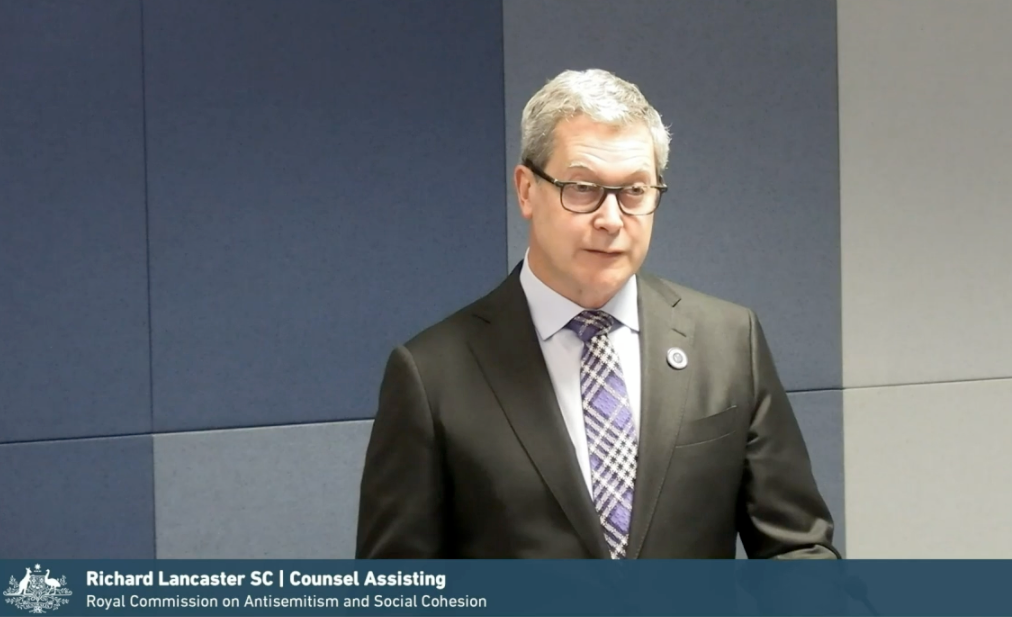
Counsel Assisting Richard Lancaster SC. Photo: screenshot

Read their stories

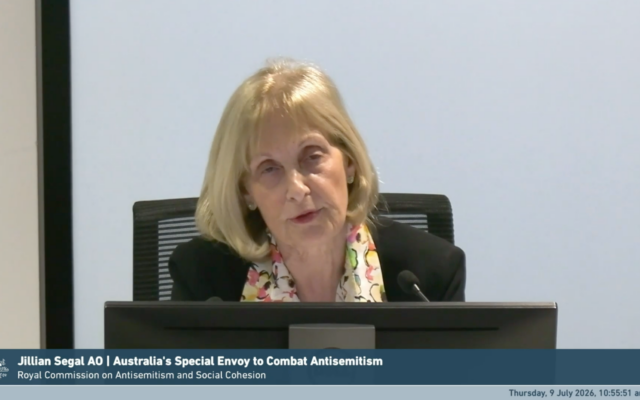
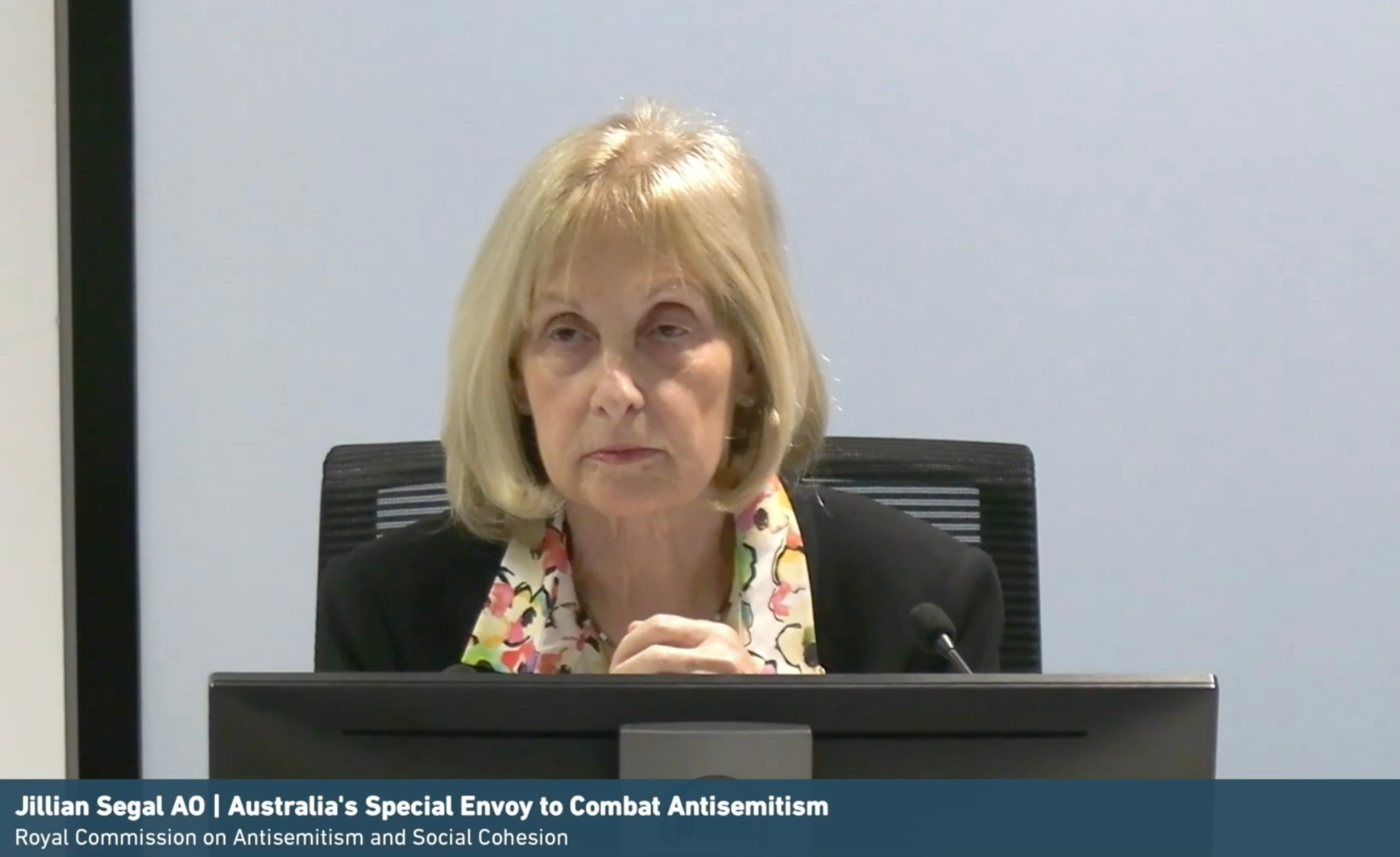
Australia’s Special Envoy to Combat Antisemitism, Jillian Segal, on the need for an independent oversight committee to scrutinise the ABC’s coverage of the Gaza conflict

Jillian Segal on SBS’s reporting of Gaza casualty figures and the push for an external broadcaster watchdog

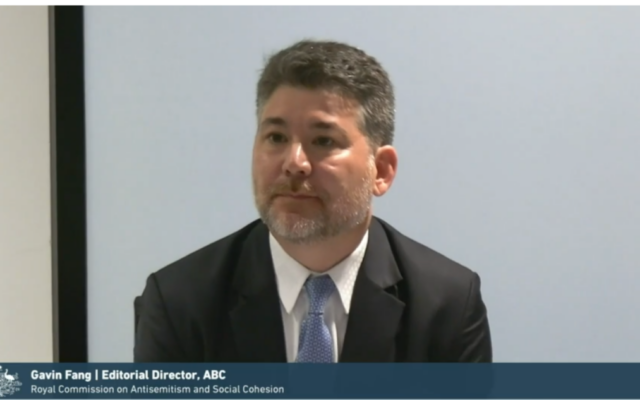
Gavin Fang, the ABC’s editorial director, on the IHRA definition of antisemitism

Gavin Fang on ABC’s attempts to correct mistakes as soon as possible

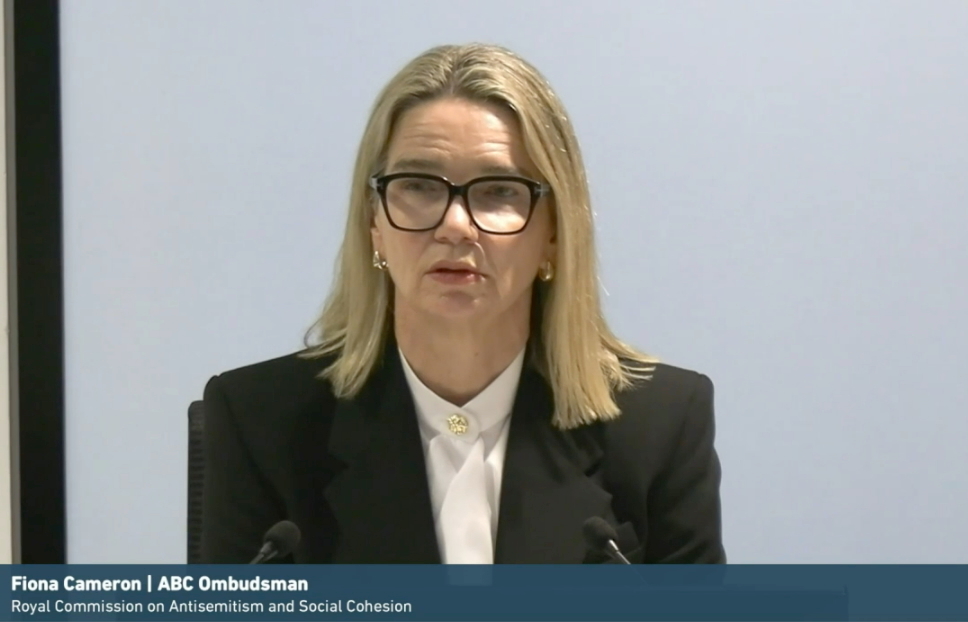
Fiona Cameron, the ABC’s Ombudsman, on how her office handles complaints about the broadcaster’s Middle East coverage

David Hua, SBS’s director of audio and language content, on the increased resourcing to its Hebrew-language service

Amanda Wicks, director of news and current affairs at SBS, on the  antisemitism definition

Amy Stockwell, SBS Ombudsman, on whether SBS staff have specific antisemitism training

SBS Ombudsman says no specific antisemitism training

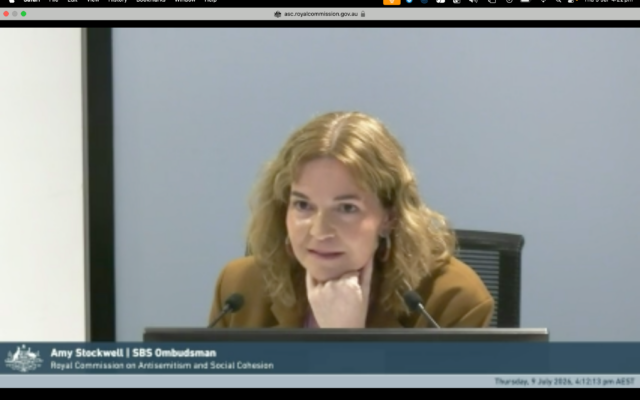
Amy Stockwell, SBS Ombudsman. Photo: Screenshot.

SBS Ombudsman Amy Stockwell has confirmed to the Royal Commission into Antisemitism that the broadcaster’s mandatory staff training does not include any content specifically addressing antisemitism.

This is despite a marked rise in code complaints linked to Middle East conflict coverage.

Giving evidence, Stockwell said all SBS employees complete an inclusion programme that includes an anti-racism module of around ten hours, on top of training in the SBS Code of Practice.

Asked directly whether that training included antisemitism-specific content, Stockwell answered simply: “No.”

Asked whether SBS had considered introducing specific antisemitism training modules, given the extent of its Middle East conflict coverage and the prevalence of antisemitism in Australia, Stockwell said, “That would be outside my role. The matter [is] for SBS.”

Stockwell told the Commission that code complaints had risen sharply, with 157 received and investigated in the second half of 2025 alone.

She said the financial year just completed (FY26) was the highest for valid code complaints in six years, with numbers last approaching that level in FY21.

She attributed the rise to “a mix of things,” including “global conflicts, foreign contentious foreign policy,” as well as the use of artificial intelligence by complainants generating multiple near-identical complaints.

Stockwell confirmed that impartiality and accuracy were, as is almost always the case, the dominant concerns raised by complainants.

The Commission was taken to SBS’s full-year ombudsman report, which recorded 86 pieces of content investigated in relation to the Middle East over the reporting period, with eight breaches upheld, five for accuracy and three for balance and impartiality.

Stockwell said a clear majority of those complaints related to SBS’s Eurovision broadcast and commentary.

Asked what she made of the spread of complaints alleging pro-Israeli bias against those alleging pro-Palestinian bias, Stockwell said complaint volume alone was a blunt measure, noting that people making complaints “may just be pro-fair reporting.”

The Commission also examined a 2023 complaint regarding an SBS News podcast about a visit to Israel by the then US Secretary of State.

Stockwell had rejected the complainant’s claim that the podcast suggested IDF soldiers were terrorists, but during her review she independently identified a separate breach.

She told the Commission that the podcast had described the killing of a Palestinian man, attributed to IDF soldiers, without including the IDF’s position in its first reference to the incident, only including that perspective two minutes later.

Stockwell said the two accounts “read like two different stories,” and she found an absence of a relevant and material perspective in the reporting, resulting in a finding of a breach.

She said SBS subsequently issued an apology, the relevant journalist was addressed by the Director of News and Current Affairs, and the training and content were removed.

On the question of the Ombudsman’s independence, Stockwell rejected the suggestion that the SBS complaints committee, which can review her adverse findings at a content director’s request, compromised her role.

She said the committee provided “an opportunity for lively discussion,” with the Managing Director then making a final decision.

Responding to evidence given earlier in the hearing by the special envoy, who suggested public broadcaster ombudsman functions could be moved to an independent external body, Stockwell defended the internal model.

She noted that SBS had operated an ombudsman role for 21 years and that comparable internal models operate at the ABC, BBC, CBC, PBS and NPR.

She said she held no concerns that the current arrangements at SBS infringed on her independence or ability to carry out her functions.

Wicks grilled over antisemitism definition

The director of news and current affairs at SBS, Amanda Wicks, told the Royal Commission that the broadcaster does not adopt the International Holocaust Remembrance Alliance (IHRA) working definition of antisemitism, despite using it as reference material for journalists.

Wicks said SBS’s style guide defined antisemitism broadly as prejudice or discrimination against Jewish people, with the IHRA definition provided as context rather than binding guidance.

“We neither accept it or reject it,” she said, adding SBS was “never in a position where we’re making a determination that something is antisemitic,” instead attributing such findings to police, the legal system or affected communities.

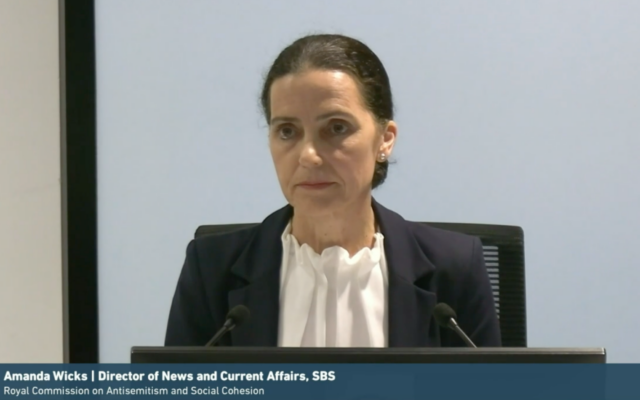
Amanda Wicks, director of news and current affairs, SBS. Photo: Screenshot

Wicks was questioned over SBS’s 2023 editorial guidance document, which sets out three definitions of antisemitism — the IHRA definition, the Jerusalem Declaration on Antisemitism, and a definition from the United Nations Special Rapporteur on freedom of religion or belief — but includes critiques only of the IHRA definition, covering issues such as its treatment of Zionism, self-determination and freedom of speech.

Wicks conceded there was no equivalent critique of the other two definitions in the document.

It was also noted that the document, produced in 2023, had not been updated to reflect the federal government’s reaffirmation of the IHRA definition in December 2025, nor did it mention that the definition had by then been adopted by 43 countries. Wicks said SBS had reported on the reaffirmation at the time, though she agreed the guidance document itself “could” be updated.

Pressed on why the broadcaster’s written response to the Commission about its decision not to adopt the IHRA definition omitted the critiques contained in the editorial guidance, Wicks said the style guide remained the “official” editorial document and the guidance was a secondary, dated reference tool.

Asked whether any Jewish cultural awareness training had been implemented at SBS, Wicks said none had, despite suggestions from staff, though she noted broader training on prejudice and discrimination had occurred, along with internal conversations about antisemitism and Islamophobia.

On SBS’s use of Gaza Health Ministry casualty statistics, Wicks said the broadcaster also referenced Israeli government figures and frequently identified Hamas as a terrorist organisation and as the governing authority in Gaza, citing an informal search that found roughly 400 such references across SBS content in a single week.

Hua: SBS boosted Hebrew-language resources after October 7 and Bondi

David Hua, SBS’s director of audio and language content, told the Royal Commission that SBS increased resourcing to its Hebrew-language service twice in response to discrimination and vilification experienced by the Australian Jewish community.

Hua said that the executive producer role was expanded from part-time to a full-time equivalent position after October 7 and increased further following the Bondi attack.

He told the Commission SBS conducts a language services review every five years, aligned with the Australian census, weighing factors including population size, English proficiency, length of time in Australia, household income and community age. An additional criterion considers whether a group experiences discrimination or vilification or is part of a humanitarian intake influx.

“SBS Hebrew is commissioned or maintained on the basis of that third criteria,” Hua said.

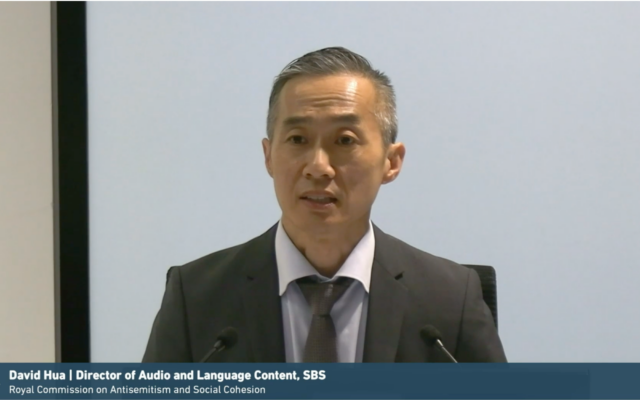
Director of audio and language content, SBS, David Hua. Photo: Screenshot

The most recent review, following the 2021 census, concluded in March 2023. Hua said Hebrew speakers numbered about 11,000 according to the 2021 census, a relatively small language community compared with others served by SBS, which broadcasts in more than 60 languages.

He said SBS’s coverage of antisemitism extended across its language services, including a centralised program, SBS Examines, which produces in-depth reporting later re-expressed across other language channels. He pointed to coverage of the special envoy to combat antisemitism on SBS Arabic, Chinese, Hindi and Persian services, and explainers on antisemitism and Zionism produced by SBS Chinese.

On the Bondi terror attack, Hua said SBS coordinated coverage across multiple language services, noting the attack’s impact extended beyond the 15 victims to other communities present, including Chinese-Australians.

Asked whether SBS did enough to ensure balanced reporting, Hua said all SBS services were required to meet the same editorial codes and guidelines independently, rather than one service existing to counterbalance another, though he acknowledged scope existed to improve resourcing generally.

Hua said capacity could be surged between five-yearly reviews if a business case was made to management, as occurred after the Bondi attack.

ABC Ombudsman acknowledges “at times the ABC is slow to correct and clarify”

The Royal Commission heard this afternoon from Fiona Cameron, the ABC’s inaugural Ombudsman, who gave a detailed account of how her office handles complaints about the broadcaster’s Middle East coverage — and defended her decision not to find a systemic pattern of erroneous, anti-Israel reporting at the ABC.

Ms Cameron, who has served in the ABC-board-appointed role since 2022, was asked directly whether she had identified “a broader problem” of erroneous reporting critical of Israel that was corrected too late, as suggested by special envoy Jillian Segal.

She rejected the characterisation of a systemic issue, but was frank in conceding a genuine problem with delay.

“I would not say that’s been a systemic issue,” she told the Commission.

“I would say that at times the ABC is slow to correct and clarify, and that’s something I’ve expressed to them.”

She contrasted two cases discussed earlier in the hearing to illustrate the point.

The correction of the false claim that 14,000 babies had died in Gaza was, in her assessment, “slow.”

She explained that delays of this kind often arise because ABC staff are “looking to find all incidences” of an error before acting, and are “looking to do the right thing” — but that this diligence can come at the cost of speed.

By contrast, she said the Al-Ahli Arab hospital explosion story, drawn from a Reuters wire report, was handled quickly.

The ABC’s fault there, she explained, was attributing Hamas’s claim about the blast, without noting Israel’s denial that its rockets were responsible — a lapse corrected “within half an hour,” which she said was fast enough that it did not amount to a breach, unlike the ‘14,000 babies’ episode.

The cause of the Al-Ahli hospital blast in Gaza was a misfired rocket from within Gaza by  Palestinian Islamic Jihad.

Cameron said the context, and the speed of correction, were decisive factors in distinguishing the two outcomes in those reviews, and that her office’s investigation into the babies claim — a piece of work she said the Commission had “quoted extensively” — was carried out by “a very impressive investigations officer” and cross-checked with her counterpart at the BBC.

Ms Cameron said ABC Ombudsman office’s model’s strength lay in “action taken” outcomes, rather than formal breach findings.

In the six months to December, she said, 28% of all complaints resulted in some form of action — “an editorial note, an apology, a clarification, a correction, the program coming down… a change in editorial guidelines.”

She described the system as “robust” and “dynamic,” while acknowledging “is it perfect? Of course not.”

Responding to Commissioner Virginia Bell, who asked about the significance of complaint numbers given Australia’s small Jewish population, Cameron said complaint volumes reflected “the perception of the complainant” and organised campaigns “on both sides,” adding: “I just don’t know how much stake you can put in the numbers at all, to be perfectly honest.”
Earlier, she told the Commission that from October 2023 to May 2026 her office settled 19,000 content complaints, 42% — some 8,000 — about Israel-Gaza coverage.

She said one outlier campaign, nearly 2,000 near-identical complaints about a post-October 7 Q&A episode alleging pro-Israel bias, skewed the figures; stripping it out, 52% of complainants said ABC coverage was pro-Palestinian and 45% pro-Israel.

On her office’s structure, Ms Cameron said its independence rested on reporting solely to the ABC board rather than the editorial director, avoiding what she called “an obvious conflict of interest.”

Content complaints — those about material already broadcast or published — are separated from “general complaints” about staffing or scheduling, which are handled elsewhere.

She said content complaints had risen 85% year-on-year, aided by “email activist” campaign tools.

She also confirmed that her office also has a “unique complaint function” in that “we investigate and we review.

“So essentially, when we assess a complaint, we decide through proportionality criteria whether it goes to the divisions – and ABC divisions are often in the best place to respond to complainants.

“So we’re also a review body, and of course, as you’ve heard, also if they’re unhappy with my review, they can go externally to ACMA.”

Fang: ABC attempts to correct as soon as possible

ABC editorial director, Gavin Fang, has disputed the government’s special envoy on antisemitism Jillian Segal’s observation that when the ABC does make mistakes, the corrections are provided in a very delayed and not very prominent way.

Grilled by Nicholas Bender SC, representing ECAJ and other Jewish organisations, on whether there was any internal training for ABC journalists to distinguish where criticism of Israel flowed over into antisemitism directed against Jewish Australians – a distinction that is included in its editorial guidance document — Fang responded that his role does not cover training of editorial staff, only the shaping of editorial policy guidelines.

Fang said complaints to the ABC about its Middle East coverage were about half and half that it was either too pro-Israel or too anti-Israel.

“I accept that there are strongly held views, and that people respond to the coverage in different ways depending on their perspective, and I reflect on the purpose of the public broadcaster and the purpose of our role, which is to provide accurate and impartial information to Australians to make up their own mind about events,” he stated.

Editorial director, ABC, Gavin Fang. Photo: screenshot

Fang acknowledged “a bad mistake” when the ABC failed for days to correct  a 2025 report that 40,000 Gazan babies would starve within 48 hours if urgent aid was not delivered – originally reported but quickly determined to be false and then withdrawn by the BBC.

“Yes, it was a bad mistake. The correction came on the news channel, the same channel that hosts News Breakfast, later in the afternoon.

“Ordinarily, we would try to do one of two things, try to get a correction as soon as possible, but also do a correction to the same or similar audience, so the news breakfast audience. In this case, the correction was done on the news channel that afternoon.

Lancaster asked, “Would it have been appropriate to make a correction the following morning in the next edition of the News Breakfast program [where it had initially been headlined]? Fang replied, “Yes.”

Lancaster put to him that Segal “has made a suggestion that there is some sort of pattern of late and not very prominent corrections if the initial reporting of the ABC does turn out to be inaccurate. Do you have a general response to that?”

“I don’t agree with that broadly. I think that what occurs is that we try to make a correction or an apology or a clarification as soon as we can to the audience. It’s really important principle to try to reduce the harm if you would like, if you would, of inaccurate information being out there.

“So our attempt is to make sure that we correct it as soon as we can, where it’s where we needed to do an apology, we do as quickly as we can, but sometimes it does take time, particularly if there’s an independent ombudsman investigation into something.

“Sometimes it takes time for that to be resolved, and we want to make sure that we allow that process to work its way through before we make a final statement about whether something is right or wrong, or whatever might be the response we’d take to a breach finding, for example,” said Fang.

Fang stated he disagreed that the status of the ABC’s Ombudsman is not sufficiently distanced from the ABC itself, a point made by Segal in earlier testimony today.

ABC: IHRA definition includes ‘contested’ points

The IHRA definition of antisemitism “may be useful” but the ABC sees some of its guidelines as “contested”, which is why it has decided not to adopt it, a senior executive of the national broadcaster has told the Rtoyal Commission today.

Gavin Fang, the ABC’s editorial director stated, “My advice has related to the application of that type of definition in an editorial policy setting. So how that would relate to our content. The IHRA definition or the examples in the definition in particular are contested, and it is important for us to maintain not just our independence but the perception of independence.

“And it’s my view and has been my advice, that adopting a definition that is contested would not help us with both our the perception of independence and our independence more broadly, and that our current framework, as it relates to our editorial policies, is effective in doing that.”

Editorial director, ABC, Gavin Fang. Photo: screenshot

Fang was responding to questions from Richard Lancaster SC, counsel assisting, who put to him a recommendation given in testimony today by the government’s special envoy on antisemitism Jillian Segal, that the ABC should in fact adopt the IHRA definition.

Fang said he had no information on whether the ABC had consulted with Jewish community groups in formulating its internal editorial guidance policy.

Segal renews push for external broadcaster watchdog

Australia's Special Envoy to Combat Antisemitism, Jillian Segal, at the Royal Commission on Antisemitism. Photo: Screenshot.

Australia’s Special Envoy to Combat Antisemitism, Jillian Segal, has told the Royal Commission into Antisemitism that SBS’s reporting of Gaza casualty figures lacked necessary context.

She also renewed her call for an external, Ofcom-style complaints body to oversee the national broadcasters.

Giving evidence during a return appearance before the commission, Segal said her criticism of SBS centred on its reliance on casualty statistics from the Gaza Health Ministry without making clear the ministry’s position within Hamas, which she noted is a listed terrorist organisation in Australia.

“My criticism is that I think they needed to draw to their viewers’ attention the fact that the Gaza Health Ministry, controlled by Hamas… was the determinant of the numbers,” she said, adding the figures had since been reported as not distinguishing between combatants and non-combatants.

Segal was referred to a statement from SBS director of news and current affairs, Mandi Wicks, which said the broadcaster’s practice was to refer to the ministry by its function rather than who controls it.

Segal rejected that this conveyed the situation accurately to both the Jewish and non-Jewish communities.

She pointed to other examples she said had contributed to a broader pattern, including early reporting of the Al-Ahli Hospital explosion, which was initially attributed to an Israeli strike with a death toll of around 500, before it emerged the blast was caused by a misfired Palestinian Islamic Jihad rocket and involved a substantially smaller number of casualties.

She said the correction received far less prominence than the original claim.

Segal also referenced the ABC’s handling of a UN official’s inaccurate claim regarding the deaths of babies in Gaza, noting the ABC Ombudsman had already found a breach of standards over the incident.

Counsel put to her that this showed the existing ombudsman model was functioning effectively, an assessment Segal did not fully accept.

She argued Australia’s broadcasters would be better served by an external, independent complaints mechanism modelled on the United Kingdom’s Ofcom, rather than internal ombudsmen who report to their own boards.

Segal was critical of the Australian Communications and Media Authority, saying it dealt with few complaints, moved slowly, and lacked transparency compared with Ofcom’s fortnightly public reporting.

Central to her evidence was what she described as “conflation”, the tendency of some Australians to hold ordinary Jewish Australians responsible for the actions of the Israeli government.

Segal said negative coverage of Israel, particularly when later found to be inaccurate, correlated with spikes in antisemitic incidents in Australia, regardless of whether Israel’s conduct in a given case was itself justified.

She said that a small number of upheld complaints against the ABC and SBS does not demonstrate that their coverage has been free of bias.

Segal was taken through evidence showing that of thousands of complaints made to the ABC since 7 October 2023, only four had been found to breach ABC standards, three for accuracy and one for impartiality, the latter relating to a radio programme rather than ABC News.

“I find that a very difficult question to answer, because I don’t know what it shows,” Segal said, when asked whether this indicated only a tiny proportion of complaints were substantiated.

She said the ombudsman process tested individual complaints against existing standards, but did not examine “the overall issue” of tone, prominence and framing across coverage as a whole.

She singled out an ABC Q&A episode as illustrating community concern, recalling a panel she believed included three or four Palestinian perspectives against one from the Jewish community, saying the imbalance contributed to a sense of “conflation” regardless of whether the host had challenged panellists.

On SBS specifically, Segal said the broadcaster’s code of conduct, addressing prejudice, racism and discrimination, was insufficient because “racism doesn’t pick up the important different aspects of antisemitism.”

She was shown SBS’s style guide, which references the IHRA definition without formally adopting it, and states that anti-Israel criticism is not the same as antisemitism.

Segal said this reflected a limited grasp of “modern-day antisemitism”, though she accepted the guide did not use the word “any” before “anti-Israel criticism” when this was put to her.

Segal reiterated her view that neither the ABC nor SBS had adopted the IHRA definition despite having standards covering other issues such as harassment and genocide, calling this difficult to understand given the definition “doesn’t stop criticism of Israel” or debate.

Segal: The ABC should not be “marking its own homework”

At this morning’s Royal Commission hearing session, Australia’s Special Envoy to Combat Antisemitism, Jillian Segal, pressed her case for an independent oversight committee to scrutinise the ABC’s coverage of the Gaza conflict, telling Counsel Assisting that the national broadcaster should not be “marking its own homework”.

Segal, appearing on the anniversary of the release of her national plan to combat antisemitism, was questioned about complaints from the Jewish community that ABC reporting on the Israel-Gaza war has been unbalanced.

Asked whether it was difficult to test such complaints when expressed only in general terms, she said the perception was nonetheless serious and widely held.

“A community under attack here in Australia feels that the trusted national broadcaster is not presenting the situation in the Middle East in a way that they think is not biassed and accurate,” she said, adding that bias could show up not just in what was reported but in “where in the broadcast, how long the focus is, what other stories about other conflicts are covered”.

Under questioning from Commissioner Virginia Bell, Segal compared the ABC’s reviewing structures unfavourably with the UK’s media regulator, Ofcom [Britain’s Office of Communications], which she said had investigated BBC coverage of Gaza and found reporting “was incorrect, was not accurate” — including a widely circulated story about a starving child in Gaza later found to be suffering a rare genetic illness rather than malnutrition.

That finding was serious enough, she noted, that Ofcom’s director-general resigned.

“We don’t have that structure here,” she said, “where there is a strong regulator looking over, and of its own motion, assessing and testing and reporting.”

Segal rejected the idea that a roughly even split of complaints from pro-Israel and pro-Palestinian viewers proved the ABC had the balance right, pointing out the Jewish community is a small proportion of the population.

“It’s a disproportionate number of members of the Jewish community who are feeling pretty aggrieved,” she said.

Put to her that ABC editorial director Kevin Payne had said the broadcaster took particular care to represent a wide variety of perspectives, Segal replied she had not assessed that claim herself — precisely the job she wanted an independent panel to do.

In the hearing’s most pointed exchange, Segal said of the ABC’s internal complaints system: “I just don’t know how they [the ABC] think that they can set the rules, which are their standards.

“They can review them… it’s an ombudsman – but it’s internal – appointed by the board, reporting to the board.

“I mean, they are with respect, judge, counsel, and jury. I’m just saying that I don’t think anyone accepts the fact that you can always mark your own homework.”

“And what harm is there in having an independent committee look at the overall reporting [of the ABC]? I do not see what harm it does. It doesn’t in any way detract from their independence. In fact, it might give them an extra verification.”

Shown ABC ombudsman data recording that 89 per cent of 573 complaints about Israel-Gaza coverage alleged bias — split 52/47 between those saying Hamas or Palestine was favoured and those saying Israel was favoured — Segal maintained the even split did not establish accuracy.

“I don’t accept that equal numbers of complaints means that you’ve got the story right,” she said, citing widespread ABC and BBC coverage of a UN claim that 14,000 babies would die within 48 hours in Gaza, later found to be wrong.

She said the story ran all day on the ABC, and stayed online for a week, and “painted Israel… into a very negative light,” even after the ombudsman found it breached editorial standards.

The sheer audience reach carried its own obligation, she argued, adding, “They [the ABC, as a publicly-funded national broadcaster] have a special responsibility to get it right.”

Segal claimed that corrections were consistently published with far less prominence than original reports.

“The first story of the day, big headlines, shock, horror… the correction much later, if it happens, very small,” she said, noting the correction was not posted online by the ABC for seven days.

Counsel Assisting confirmed the ombudsman’s finding concerned inaccuracy rather than impartiality; Segal agreed, saying the problem was “insufficient investigation and scepticism” in reporting an emotionally charged story, adding she did not believe there was “malevolence or bad intentions” on the ABC’s part.

Segal stressed that the ABC “needs to understand this particular hatred [antisemitism] we are focussed on better”.

The AJN is providing rolling coverage on the Royal Commission on Antisemitism and Social Cohesion.

For full coverage of the Hearing Blocks, visit the Royal Commission section of The AJN website.

read more:
comments
Live updates Public hearings

Hua: SBS boosted Hebrew-language resources after October 7 and Bondi

David Hua, SBS’s director of audio and language content, told the Royal Commission that SBS increased resourcing to its Hebrew-language service twice in response to discrimination and vilification experienced by the Australian Jewish community.

Hua said that the executive producer role was expanded from part-time to a full-time equivalent position after October 7 and increased further following the Bondi attack.

He told the Commission SBS conducts a language services review every five years, aligned with the Australian census, weighing factors including population size, English proficiency, length of time in Australia, household income and community age. An additional criterion considers whether a group experiences discrimination or vilification or is part of a humanitarian intake influx.

“SBS Hebrew is commissioned or maintained on the basis of that third criteria,” Hua said.

Director of audio and language content, SBS, David Hua. Photo: Screenshot

The most recent review, following the 2021 census, concluded in March 2023. Hua said Hebrew speakers numbered about 11,000 according to the 2021 census, a relatively small language community compared with others served by SBS, which broadcasts in more than 60 languages.

He said SBS’s coverage of antisemitism extended across its language services, including a centralised program, SBS Examines, which produces in-depth reporting later re-expressed across other language channels. He pointed to coverage of the special envoy to combat antisemitism on SBS Arabic, Chinese, Hindi and Persian services, and explainers on antisemitism and Zionism produced by SBS Chinese.

On the Bondi terror attack, Hua said SBS coordinated coverage across multiple language services, noting the attack’s impact extended beyond the 15 victims to other communities present, including Chinese-Australians.

Asked whether SBS did enough to ensure balanced reporting, Hua said all SBS services were required to meet the same editorial codes and guidelines independently, rather than one service existing to counterbalance another, though he acknowledged scope existed to improve resourcing generally.

Hua said capacity could be surged between five-yearly reviews if a business case was made to management, as occurred after the Bondi attack.

Enjoy Unlimited Access To The Australian Jewish News Website And All Our Online Content For AUD$18/month Or Just AUD$120/year.

Subscribe Now