Live updatesPublic hearings

Campus culture examined in second day of university hearings

Hearing Block 4 continues focusing on antisemitism on university campuses including lived experiences and responses by the university sector.

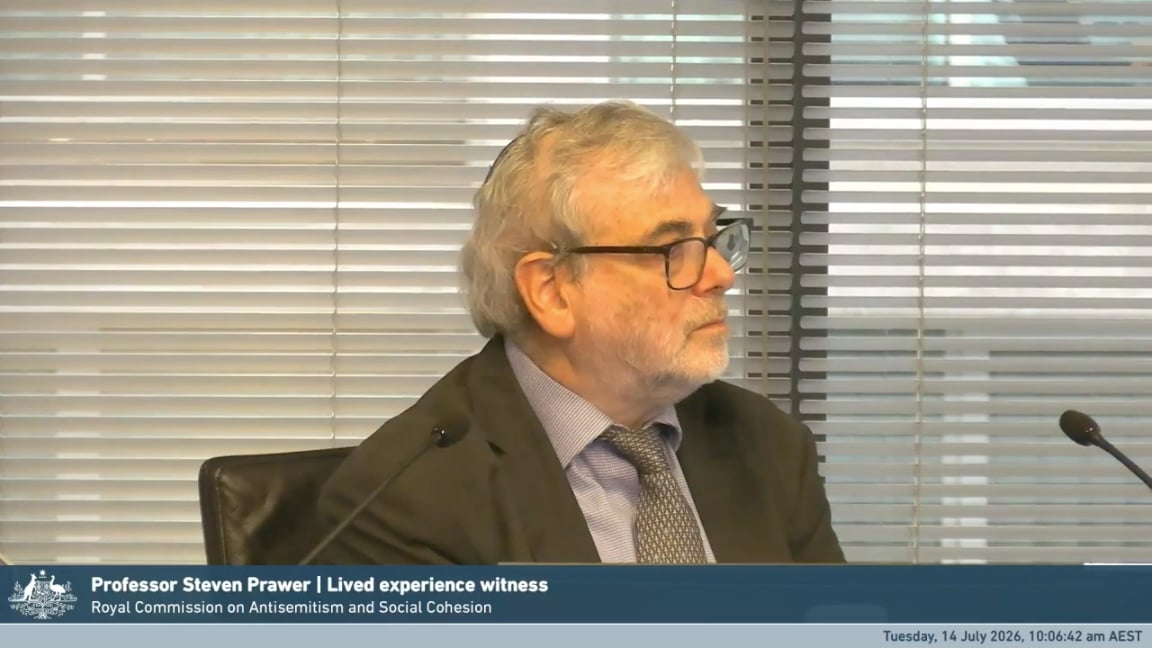
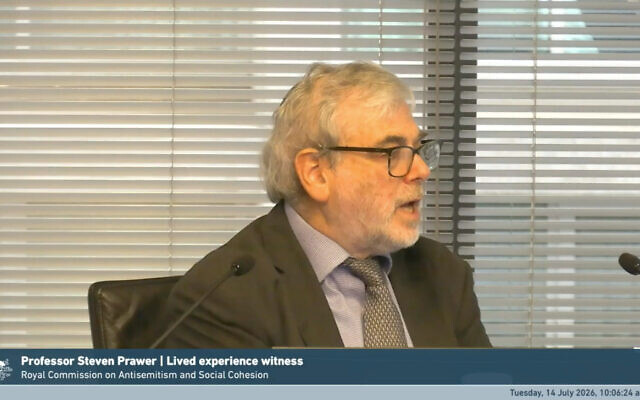
University of Melbourne professor Steven Prawer gives evidence to the Royal Commission on Tuesday.

Camp Shalom founder tells Royal Commission of UQ ordeal

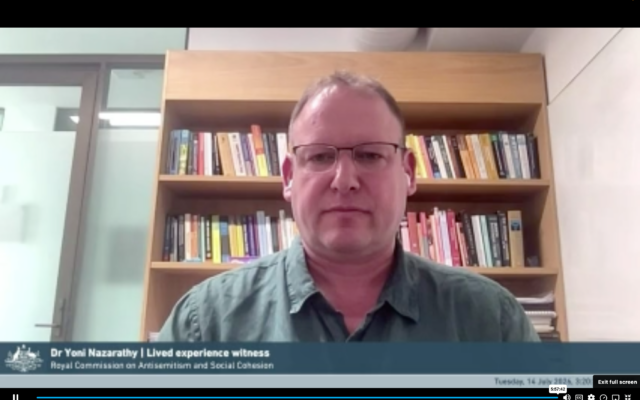
Dr Yoni Nazareth. Photo: Screenshot.

The University of Queensland academic who founded the Camp Shalom counter-encampment has told the Royal Commission on Antisemitism and Social Cohesion that he still feels like “a risk to be managed and not an asset to be cherished”.

Dr Yoni Nazarathy, an associate professor in UQ’s School of Mathematics and Physics, gave evidence on Tuesday about incidents during the pro-Palestinian encampment on the university’s Great Court in 2024, and about an anti-racism conference at Queensland University of Technology last year which he perceived as vilifying Zionists.

Born in Israel, Nazarathy migrated to Australia in 2011, joining UQ the following year.

“I proudly identify as a Zionist, as I believe that Israel has a right to exist, just like every other country,” he said, adding that he has been openly critical of Israeli government policies, yet has been called a “Zionist infiltrator”.

Nazarathy said he learned on 26 April 2024 that an encampment demanding UQ cut ties with Israeli universities would be established on the Great Court of the St Lucia campus.

“I felt that the Gaza Strip is being brought over to my lucky Brisbane,” he said. “It suddenly came to my front yard.”

He emailed the vice chancellor that day asking that no encampments be permitted, and advised that if they were, he would pitch a tent himself.

When the encampment was established on 29 April, Nazarathy set up Camp Shalom about 150 metres away at the opposite end of the Great Court. He said it brought together a Jewish community he could previously have counted “on one hand”, was later taken over by young Jewish students, and led to the establishment of an Australasian Union of Jewish Students (AUJS) branch at UQ.

Nazarathy described numerous incidents during the encampment period, including an alleged student who urinated in the office of an Israeli expatriate staff member and wrote “resign” on the wall, verbal harassment such as being called “baby killers”, a smashed classroom window with 50 students inside, antisemitic stickers, and the flying of the flag of the Popular Front for the Liberation of Palestine, a designated terrorist organisation in several countries.

He also described a video, reported in The Courier-Mail, of two people at the encampment, one of whom said: “If I lived in Palestine, I’d be a terrorist, and 100% I would join Hamas.”

To his knowledge, he said, the urinating student, who was suspended, was the only student the university acted against. The university directed the removal of the PFLP flag but could not identify who displayed it, and could not identify the person who smashed the window.

Of one sticker, he said: “This is your classic good old Holocaust down the road antisemitism.” It was only after that sticker appeared, he said, that the vice chancellor first used the word antisemitism in an email to staff and students. “The two weeks before that it was activism, activism.”

When the vice chancellor asked encampments to discontinue on 17 May 2024, Camp Shalom packed up the next day. The pro-Palestinian encampment remained for a further three weeks, he said, during which protest chants included “out, out, Israel, out”.

Nazarathy praised UQ’s executive as responsive and respectful, but said an ongoing concern is the involvement of outside actors who are not students in student life.

“The university prefers not to rock the boat,” he said. “At the end of the day, I still feel that I’m a risk to be managed and not an asset to be cherished.”

Nazarathy also gave evidence about the National Symposium on Unifying Anti-Racist Research and Action, held at QUT in early 2025, the day after the arson attack on the Maroubra childcare centre in Sydney. He attended the opening event, said the attack received no mention, and perceived some of what was said as belittling concerns about antisemitism and equating Zionism with racism.

A QUT investigation by a retired judge followed, but Nazarathy said he was not given a chance to explain which content he found antisemitic.

He said the Bondi attack and the ramming of Brisbane’s Margaret Street synagogue strengthened his Zionist identity.

“It only takes one or two people that deviate from the norm to then cross the lines,” he said.

Deakin tutor learns assault complaint was dismissed

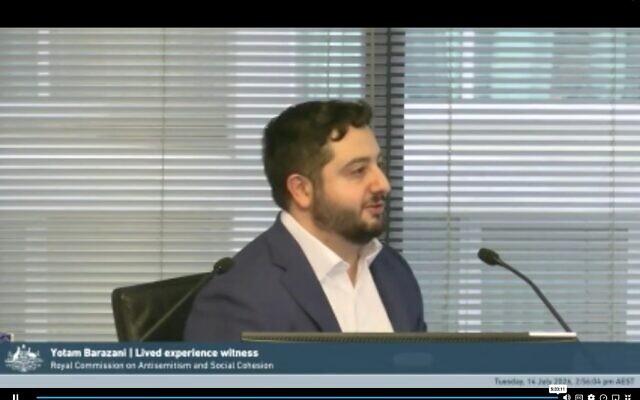
Yotam Barazani giving evidence. Photo: Screenshot

A Jewish Deakin University tutor who says he was assaulted at a pro-Palestinian encampment learned only in the witness box that the university had dismissed his complaint.

Deakin never told him the outcome, the Royal Commission on Antisemitism and Social Cohesion heard on Tuesday.

Yotam Barazani, 29, a cybersecurity professional and former IDF paratrooper, attended the encampment on 7 May 2024 holding a sign reading “I want peace for all. Let’s talk.”

Born in Israel to Israeli and Australian parents, Barazani grew up in Jerusalem and moved to Australia at the age of 12.

He returned to Israel to complete two years of national service as a paratrooper before commencing a Bachelor of Cyber Security at Deakin, where he has worked as a sessional tutor since 2021.

Barazani told the commission that since October 7, Jewish students and staff had felt the need to hide their identity on campus, and that as an IDF veteran and staff member he felt a responsibility to be present and to show it was okay to be visibly Jewish and Israeli.

He said he spoke with 30 to 40 people at the encampment, many of them pro-Palestinian, and that some conversations ended in handshakes and hugs.

Several protesters comforted him over the loss of his cousin, who had been killed on duty with the IDF only days earlier.

Around noon, he said, a Deakin student rushed him as he sat on a wooden stage, shoving him and tearing the sign from his hands.

When he picked up a protester’s sign in the hope of exchanging it for his own, “the moment I touched the sign, I just got rushed by what seemed to be 20 to 30 people”.

A second man, whom Barazani later learned was neither a student nor a staff member at Deakin, then allegedly attacked him.

“He began assaulting me, just repeatedly shoving me over and over again, a very large man, until I was at the edge of the stage, and the one final push knocked me off of it,” he said.

Barazani fell to the ground, sustaining injuries to his hip, leg and arm. He credited Deakin Security with intervening within seconds to help him.

He gave a statement to police at the scene, but told the commission he was disturbed to later watch the same officer speaking with the man he alleges knocked him off the stage.

“They were laughing, and he was patting him [on] the back, and he shook his hand, and he walked off,” Barazani said. “It felt very gross in the moment, the way they were laughing like they were buddies.”

Police later advised him there was no evidence and nothing could be done, he said.

After the incident, a senior figure in Deakin’s School of Information Technology emailed to check on his wellbeing.

When Barazani replied that he did not feel safe returning to campus, the university offered to arrange for him to teach from home.

“I’m not trying to compare what we’re experiencing today to the Holocaust, but before the Holocaust, there were decades that preceded it that probably had similar sort of behaviours,” he said of the offer, describing it as well intentioned but missing the mark.

Barazani lodged a student misconduct report against the student involved in the first incident, but said months of follow-up emails yielded no information.

The university told him outcomes were confidential unless they related directly to him, and that in his case “the outcomes do not relate directly to you and cannot be disclosed”.

During Tuesday’s hearing, counsel assisting showed Barazani the committee’s outcome letter for the first time.

It revealed that at a hearing on 30 July 2024, the committee had found all allegations relating to the incident involving him unsubstantiated on the balance of probabilities.

The letter recorded the student’s account that he had not torn the sign, but had instead intervened to separate protesters after seeing a scuffle break out.

“I’ve never seen this piece of fiction,” Barazani told the commission.

He said CCTV overlooking the stage should have provided ample footage of what happened, and that learning his entire claim had been dismissed without any repercussions for the student was “quite significant”.

Barazani told the commission he has not been on campus in more than 18 months.

“I did feel scared in a way, which is ironic because the whole point of me being there was to show Jewish students it’s okay to be here, it’s okay to show who you are, and to have conversations, and that day just proved the opposite,” he said.

Asked to reflect on Deakin’s handling of antisemitism, he said the university’s response had been poor.

“It’s not the behaviour you expect from anyone who does care about all their staff and students, regardless of religion or political belief or country of origin,” he said. “They’ve allowed the abuse, harassment of Jewish students and staff.”

The committee’s outcome letter was received as an exhibit by the commission.

Antisemitic remarks ‘hang in the air as if completely acceptable’

A non-Jewish interpreter working in Victoria’s tertiary education sector has told the Royal Commission on Antisemitism and Social Cohesion that antisemitic comments have become so normalised in classrooms that they pass without challenge, and that reporting them cost her paid work.

The witness, testifying under the pseudonym ACK and protected by a non-publication direction, is an accredited interpreter with the National Accreditation Authority for Translators and Interpreters, credentialled since 2016 and working across roughly six Victorian educational institutions since 2017. In the role, she facilitates all communication in classrooms and lectures, and is bound by a professional code of ethics that requires neutrality, meaning antisemitic comments must be faithfully interpreted regardless of personal objection.

ACK told the commission, “I have certainly witnessed antisemitic comments prior to October 7, but I have noticed more the normality of antisemitic comments post-October 7. They hang in the air as if it’s completely acceptable”.

She described being profoundly affected by the material she is required to interpret.

“Is that because I have a relationship with the Jewish community, or is that because I’m human? I’m not sure,” she said.

ACK, who is not Jewish but has close Jewish friendships and described a visit to Israel as “a core memory”, detailed several incidents across multiple institutions.

In one pre-October 7 incident, a student made a comment distorting the Holocaust. ACK told the Commission, “A student in class had said words to the effect of Hitler didn’t have anything against Jewish people. He just didn’t want them to suffer”. She said what was most disturbing was the absence of any reaction from others in the room. “No individual in the room, other than myself, found that comment inappropriate, offensive, or distressing.”

ACK reported the incident. The result, she said, was “not a single change” in how the institution addressed antisemitism on campus. Instead, she stopped receiving work from that institution from the day after the complaint was lodged.

That experience had a chilling effect. When a student in a February 2024 drug and alcohol counselling class made an unprompted statement opposing Israel and the Jewish community without any acknowledgement of October 7, ACK did not report it. She told the Commission the earlier retaliation influenced that decision.

In a separate incident in September 2025, a teacher referred to a former employer as a “nasty old Jewish man” and made remarks about a nearby Jewish school, suggesting its high fencing existed to hide that no real teaching was taking place and to keep the Jewish community separate because “they think that they’re better than us”.

ACK raised the matter with a colleague in the staff room but said the response left her feeling as though she was “living in an upside down world”. She later wrote an anonymous letter to the institution’s CEO, recommending antisemitism awareness training through the Melbourne Holocaust Museum. ACK said, “I genuinely thought that in a staff memo, I would see that all staff are expected to have antisemitic training because of my letter, and I never saw anything”.

In closing, ACK called for educational institutions to adopt clearer definitions of antisemitism aligned with internationally recognised frameworks and mandatory training for academic staff.

Students chanted ‘we won’t stop until people like you are kicked off campus’

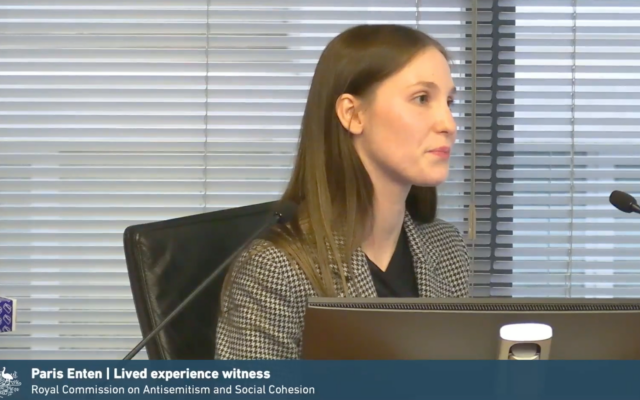
Federal Circuit and Family Court of Australia legal associate Paris Enten, the granddaughter of three Holocaust survivors, gave evidence to the Royal Commission on Antisemitism and Social Cohesion on Tuesday about years of antisemitism she experienced as a student at Monash University.

Enten, who studied a Bachelor of Arts/Laws at Monash from 2020 to 2025, told the Commission she grew up in a traditional Jewish home and attended two Jewish day schools. The idea that anyone could harbour hatred toward her community was foreign to her. But before she even attended a class, fellow students warned her that certain groups targeted visibly Jewish students through shouting in lectures, confrontations on campus and organised protests.

That warning proved prescient on her first day of in-person classes in March 2021. Walking to the bus stop after a tutorial, Enten encountered socialist students handing out flyers. She mentioned she had visited a kibbutz in Israel and knew about socialism. When she confirmed she was Jewish, another student began chanting that they would not stop until people like her were kicked off campus. Others joined in and asked if she liked killing Palestinians.

In 2022, when the US Supreme Court overturned Roe v Wade, Enten signed the same group’s petition about women’s reproductive rights, telling them she was glad they could find common ground. They crossed her name out.

Enten reported the 2021 incident through Monash’s Safer Communities unit. After a lengthy investigation, the university identified the students from CCTV but declined to act, citing poor camera quality, no audio, and denials from those accused.

Paris Enten at the Royal Commission on Antisemitism and Social Cohesion. Photo: screenshot

Enten also told the Commission that the hostility extended into classrooms.

In a subject called The Modern Middle East, students said Holocaust survivors were “inherently genocidal” and should have been barred from the British Mandate. The professor did not intervene.

Enten also described a 2024 Holocaust study tour of Poland, Germany and the Czech Republic, where she said the majority of students behaved appallingly, filming TikTok dances in concentration camp car parks and complaining about early starts.

She told the Commission her mental health deteriorated significantly, particularly after the Monash encampments when she could hear protest chanting from her nearby apartment.

In her closing evidence, Enten was emphatic that Monash had known long before she began that its policies and reporting procedures were inadequate to address antisemitism on campus, and had “actively [chosen] every day to do nothing about it”. She called for the university to reassess how it allocates funding to student unions and to ensure students can reach and leave campus safely.

Commissioner Virginia Bell requested clarification regarding the March 2021 incident, noting Enten had been willing to engage with the students even after learning they were anti-Zionist. Bell said, “And it was then that one of them asked if you were Jewish, and you naturally said you were … and that’s when the chanting started, and you were made to understand that Jewish students weren’t welcome … Because you were Jewish”.

Enten agreed. “They didn’t know if I was a Zionist, so I believe … it was because I was Jewish.”

ZFA survey: 64 per cent of Jewish students experienced campus antisemitism

Australia/Israel & Jewish Affairs Council Director of Special Projects Dr Bren Carlill provided evidence to the Royal Commission on Tuesday.

It was noted that Carlill is not Jewish but has worked with the Australian Jewish community on and off since 2006 and was previously Director of Public Affairs at the Zionist Federation of Australia (ZFA).

It was also noted that the ZFA with the support of other organisations, commissioned the Social Research Centre to undertake the Jewish University Experience Survey, which was conducted prior to 7 October 2023.

Asked what prompted the survey, Carlill replied that many students had come to the ZFA with complaints of antisemitism and the universities had asked for data.

Carlill was responsible for organising the survey, and it was carried out by the Social Research Centre between 14 March and 3 April 2023, with a report published in August 2023. It received 563 responses across 32 different universities.

“Our survey represented about 7 per cent of Jewish tertiary students at the time,” Carlill said.

The survey asked questions, including whether the student had experienced any of the following on campus or online, including antisemitism based on religion or race, and antisemitism based on perceptions of Jewish money, power, or influence.

A finding of the survey was that 64 per cent of those who responded had reported at least one incident of antisemitism during their time at university, and 88 per cent had occurred within the last 12 months.

The most reported was people or events that make you feel intimidated because of your Jewish identity, and after that, the next most reported was antisemitism based on perceptions of Jewish money, power, or influence, with these incidents were reported equally as occurring within the classroom as outside the classroom. Ninety per cent of
respondents said that it was university students who were the active participants, and 29 per cent said staff were the active participants.

He noted that only 14 per cent of respondents said they had made a complaint in response to the most impactful incident that they had experienced. Of those who made a complaint, 61 per cent were dissatisfied overall with the university’s response to their complaint, with 35 per cent were “very dissatisfied” and 26 per cent being “dissatisfied”.

The survey noted two key barriers to submitting a complaint, being “a belief that complaining would not make a difference” which was held by 61 per cent of students, and 48 per cent of students thought that the university would not think the incident was serious enough.

Carlill said the results suggested that Jewish students would feel more confident if the university had adopted a definition of antisemitism.

“I remember having a chat with Alissa Foster, who then was the president of the AUJS, and one thing that she raised to me is university anti-racism policies. The word antisemitism didn’t appear. Like often, different types of discriminatory conduct were identified as things you can’t do, and antisemitism wasn’t one of them. And she was saying, look, even a university acknowledgement that antisemitism exists and is a problem would provide the students confidence,” he said.

The Social Research Centre then analysed the themes emerging from those responses – and a top theme was anti-Israel sentiment crossing into antisemitism.

He said the ZFA sent the survey and survey results to all the universities that were represented in the survey and meetings were requested.

Summarising university responses, he said: “Everyone we met with were generally shocked at not just that antisemitism was happening on their campus, but the extent that it was. They were also very eager to tell us about their anti-racism policies that they already had on their books, and there was there was almost always genuine engagement as to the findings of the survey, particularly how it related to their university. Then, when we said, well, you know, this is what we think you should do in order to remedy this problem, sometimes there was there was genuine, you know, sort of we’ll take that on notice type ideas” and said others rejected their advice.

Carlill said the ZFA recommended to universities to adopt a definition of antisemitism.

“Specifically said that you should adopt the IHRA definition, but the reality is, as long as the definition that is adopted is agreed to and done in collaboration with the representative Jewish community bodies, not least AUJS and the ECAJ and ZFA, then then that would be okay… My personal position is that the IHRA definition is the best one out there,” Carlill said.

Carlill said another recommendation was that complaints handling processes needed to be reformed to create a system that Jewish students believe would take them seriously, protect their confidentiality, and produce meaningful outcomes. And it was also recommended that staff responsible for dealing with complaints should receive compulsory education.

“If there was a complaints handling officer who was unaware about as to how modern antisemitism manifests in Australian society, then then their approach to a student complaining about antisemitism would ultimately be founded in ignorance. And so we said, look, you need you need training on on exactly that how antisemitism manifests in in society, and that training would obviously have to be, if not delivered, certainly organised and arranged in collaboration with the representative Jewish community organisations,” Carlill said.

It was further recommended that reporting procedures and examples of prohibited conduct should be promoted to students during orientation week and through other avenues.

Another recommendation Carlill viewed as important is universities holding regular and ongoing meetings or roundtables with Jewish students and staff.

“We said you need to fix your complaints process, which would obviously increase the number of people willing to make complaints. But at the same time, you need to find different ways as to understanding what’s happening,” he said.

“Imposed silence”: AUJS COO details antisemitism complaint

Australasian Union of Jewish Students (AUJS) Chief Operating Officer Josh Kirsh provided evidence to the Royal Commission on Tuesday.  His evidence was based on his leadership at AUJS, as well as having attended UNSW from 2015 to 2020 for undergraduate degrees, and attending the University of Sydney from 2024-2025 while a Master’s in Public Policy.  Kirsh was the Political Affairs Director of AUJS in 2019 and a significant part of this role involved handling complaints about antisemitism.

Kirsh attended campus during the 2024 encampment at the University of Sydney and said he felt “very worried” about his safety going onto campus.  Asked about the procedures the University of Sydney put in place during the encampment, Kirsh said the university facilitated alternative modes of entry and access.

Discussing an antisemitic incident during a lecture, he said the lecture was about qualitative evidence, and a guest lecturer gave the example that a study had shown that participants in research, who were asked, “Do Jews have too much power?” were less likely to respond affirmatively when they thought that the person interviewing them was Jewish. The lecturer said he did not believe the statement to be true, and a student replied that it was true and had been proved empirically by Malcolm Gladwell “that Jews have all the power.” The lecturer said in response, “We’re not going to go into that” and moved the conversation on.

Kirsh informed the regular lecturer who directed him to the university’s wellbeing resources and complaints process.  He decided to make a complaint about the student to the university.

“I made a decision to put in a complaint through the process, because I felt that it was important that that incident be reflected in the university’s understanding of what campus life is like for Jews, and also to understand that this sentiment does exist, and that there perhaps might be other incidents that come up, and so that if this does take place, it’s not a one-off,” he said.

Kirsch said after it was investigated the university decided “there was insufficient evidence that the student had intended to make a discriminatory comment” and “provided counselling to the student that this should not take place again.”

Kirsch said the university also considered the respondent’s English language capability, forming the view he didn’t have sufficient English language to express himself effectively in the environment. The university decided not to take it any further.  Kirsh said he had hoped education would have been provided to the student.

“I read first in the outcome that the university had counselled the student that they should be reminded of the impact their words can have on others in the learning environment in the current global and political environment,” Kirsh said.

Kirsh received an apology from the student. “The apology said something to the effect of that we should be cautious in the current climate… He provided in his apology a view that it was the current conflict that was the problem, and not necessarily the underlying nature of the remarks,” Kirsh said.

He also expressed frustration that he was told the complaint must remain confidential or it would be a matter of academic misconduct.

“It was also challenging because the university, in its final outcome, told me that I had to keep the whole affair confidential… But for me to be told that it would be a matter of academic misconduct to tell people about what I have experienced, you know, this is the first time I’ve spoken publicly about what happened because I feel safe to do that in this environment. I don’t feel I could have done that anywhere else, even after having graduated at the university…. So that does really impose quite an unfair burden on people who’ve experienced, and I assume this is something that extends not just to antisemitism but all manner of complaints,” Kirsh said.

“Imposed silence means that if anyone else wanted to compile a picture of what is happening on campus and connect the dots between different incidents, it would be difficult to do that without the vantage point of the university. And as I understand it, the university doesn’t seem to collect that information in that particular way, and so it doesn’t typically get reported as part of a broader set of issues. It certainly hasn’t, in my experience, been reported as part of a broader set of issues.”

Providing his observations on complaints about antisemitism at universities, Kirsh said: “There was a pretty consistent theme, which was that people had experienced traumatic incidents of antisemitism… They felt targeted. They felt victimised. They felt like people on campus held an unfairly negative view of them. In some cases, they had experienced… actual violence, physical violence, and in almost every circumstance, they had attempted to avail themselves of the existing policies and procedures to respond to those matters, and in almost every circumstance, the policies were said not to apply to their particular case for particular reasons. The universities failed to address the underlying matters because they said that they couldn’t because the policies didn’t address those issues, and the students left feeling even more abandoned, let down, and hurt than they were from just having experienced the incident itself.”

Kirsh reflected that there are “institutional failures that compound other institutional failures,” creating an “appalling cycle of trauma and retraumatisation for Jewish students and staff at universities.”  He called for universities to adopt a more “proactive” response to address antisemitism.

AUJS president: Unis avoid action on antisemitism until “public pressure reaches a point”

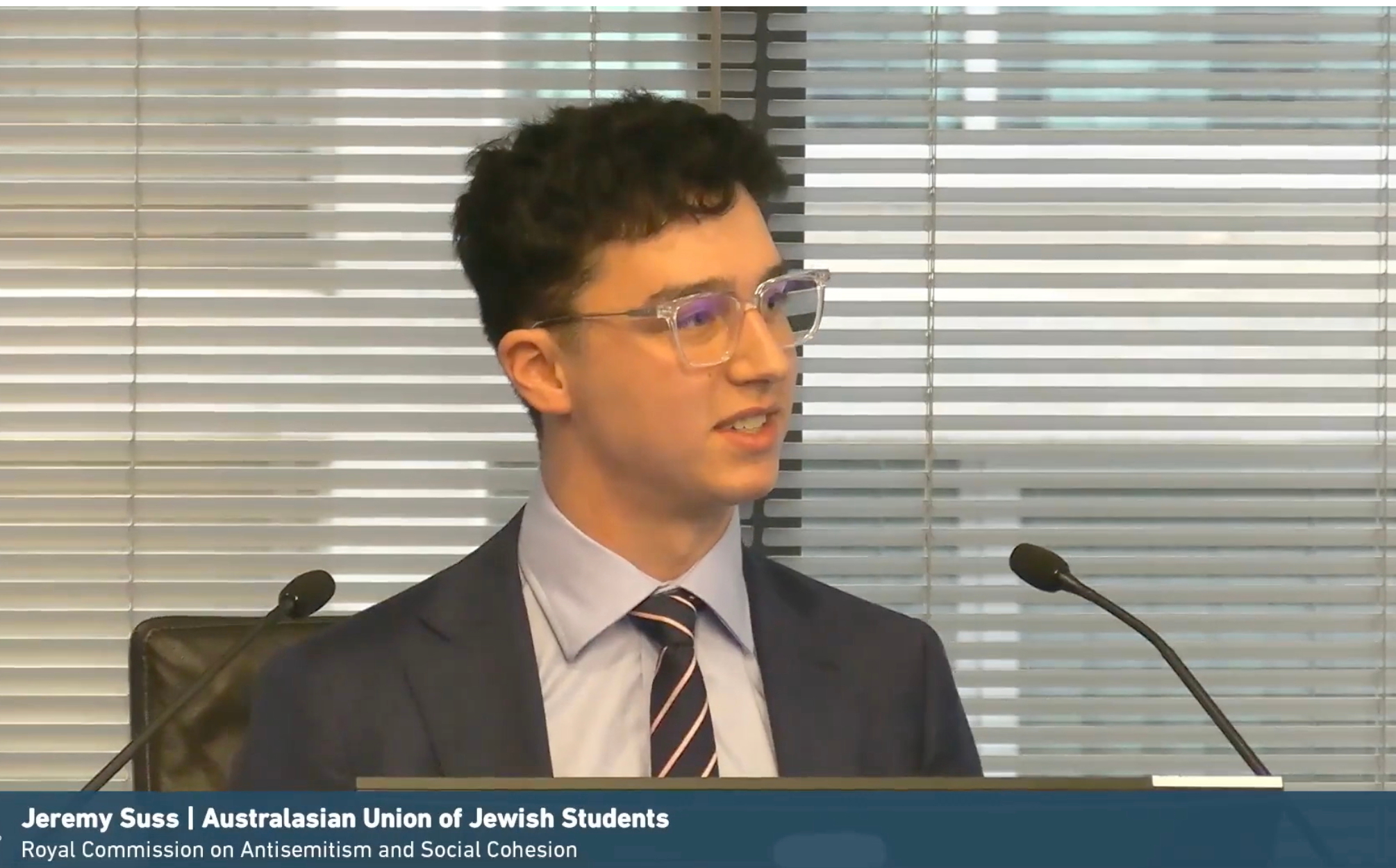
Jeremy Suss, the president of the Australasian Union of Jewish Students (AUJS) and a third-year law and global studies student at Monash University, gave evidence today at the Royal Commission, detailing how the December 2025 Bondi Chanukah terror attack reshaped AUJS’s operations, and describing a university sector that’s reluctant to act on antisemitism without external pressure.

Suss, 21, told the Commission that work once considered unusual for a student union has become routine at AUJS since the Bondi attack.

The organisation now employs a full-time advocacy and public relations manager, whose role largely involves cataloguing incidents and supporting affected students – a function he said is “used at an alarming rate.”

Suss said AUJS is also dealing with a new and “quite alarming” security risk-assessment framework that the university sector has introduced, under which a growing number of on-campus events have been flagged as ‘high-risk’ by universities, using what Suss called “opaque criteria.”

As one example, he cited a kosher lunch event on a Jewish holiday, with no Israeli flags or political material present, that was nonetheless deemed ‘high-risk’ simply because it was a Jewish gathering.

He said universities have at times asked Jewish student societies to fund their own security, which he argued unfairly shifts the burden onto Jewish students, rather than addressing the actual behaviour that makes them feel unsafe.

He also explained AUJS’s internal database of antisemitic incidents.

While it helps AUJS follow up with individual students, Suss said the more important reason for keeping it is that universities have “not dealt with incidents in a productive or meaningful way,” with students telling AUJS they “don’t trust their university to handle it appropriately.”

Some students have “waited months to hear back,” he said, and are sometimes never contacted at all.

Suss also reflected on the personal toll of the presidency. He said there is “certainly an emotional impact” in hearing daily accounts of what students are going through, compounded by the deep distrust students hold toward the institutions meant to protect them.

Numb to mistreatment – that many now expect, simply by walking onto campus – he described as something “incredibly upsetting.”

He added, AUJS aims to remain “a partner with universities” in fixing the problem, but that reporting mechanisms have too often become a source of exhaustion and distrust.

He pointed out that some institutions act quickly when an incident is reported, while others let complaints “drag on for months” as they argue over whether conduct is technically antisemitic, rather than simply asking whether it constitutes harassment, bullying or doxing already banned on campus.

Suss raised concerns about the personal cost of leadership roles within AUJS.

He revealed that a number of his predecessors have been doxed online, with their workplaces published, and said it is “a really distressing reality” that taking on a role in the country’s only Jewish student union can be treated as “an inherently immoral or nefarious act.”

He warned this treatment risks discouraging young Jewish people from getting involved in student life altogether.

In his closing remarks, Suss said his year in the role had shown him that universities “don’t want to take risk,” delaying action on antisemitism while awaiting legal advice or external review, with meaningful change occurring “only when public pressure reaches a point that they can’t delay any longer.”

He said he has inherited years of campaigning on this front, referencing universities’ continued failure to adopt the IHRA definition of antisemitism, a definition first put to universities in 2017, and pointed out that the Australian National University and the University of Adelaide still have not adopted it.

He referenced this month’s Craven report, which found no Australian university had “meaningfully adopted” a definition of antisemitism.

Suss stressed that universities are places that should be “modelling what we want the future of our society to look like,” and warned that if institutions cannot uphold basic standards of acceptable conduct, “they can’t be expected to play that crucial role of strengthening Australian social fabric.”

La Trobe academic claims universities are “shutting down debate” on Israel-Palestine

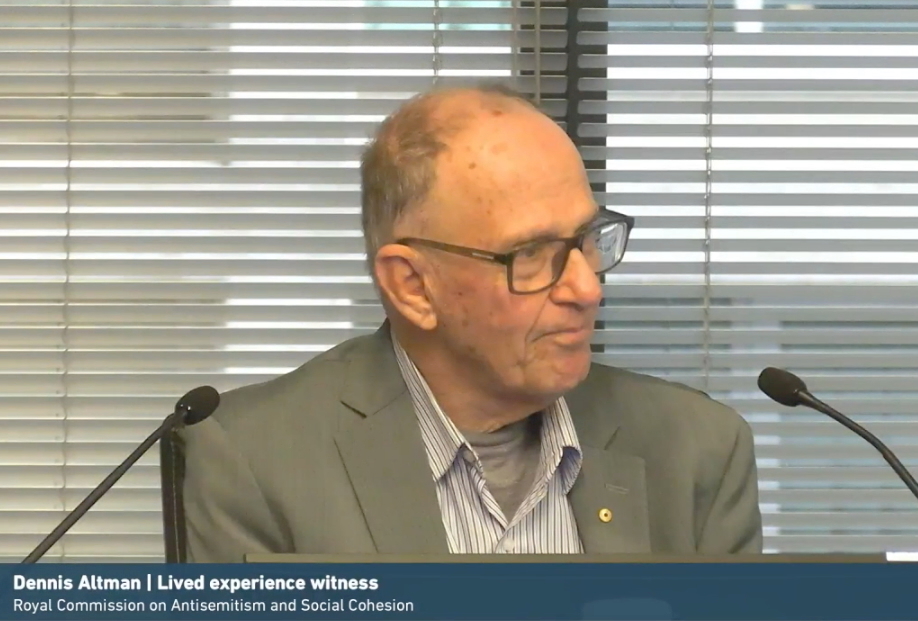
La Trobe University academic Dennis Altman told the Royal Commission on Antisemitism and Social Cohesion today that Australian universities have failed to foster “respectful debate” on the Israel-Palestine conflict, warning that shutting down discussion “promotes all sorts of conspiratorial stories.”

Altman sits on the advisory board of the Jewish Council of Australia – a far left-wing, antizionist organisation – but confirmed that he was not appearing before the Commission in that capacity.

Altman said he has become more conscious of his Jewish identity since October 7 2023, and that people often assume his political views on the Middle East because of his background.

Asked whether people make assumptions about his politics because of his Jewishness, he said: “I think inevitably yes… one has to spend a certain amount of time actually unpacking the problem, which is that for me, Israel is a foreign country, and I don’t feel any sense of allegiance to it.

“I’m very aware of the fact that large numbers of Jews in Australia would strongly disagree with my position.

Altman told the Commission that at the couple of pro-Palestinian rallies he had attended, he had never heard any antisemitic statements — but that he had been “discomforted” at those rallies “by the inability to acknowledge the trauma that so many Israelis are feeling, and of course, I would say, that equally applies to the mainstream Jewish organisations, which also, I think, have failed in the other direction, to recognise the trauma of Palestinians.

“And if there’s one thing [to emphasise], and I think I end my statement with this, it is my sense that what we most need in this country at the moment on this issue is a mutual recognition that people are hurting.”

He criticised La Trobe’s decision to shut down a proposed Israel-Palestine session in its “Ideas in Society” public lecture series, calling it “a great mistake,” and said universities needed to “step up and provide space and encouragement for real discussion.”

“I think that the biggest problem of the universities is they have actually not found ways of encouraging – and I guess I use that phrase – respectful debate.

“I think that the tendency has been the opposite. It’s been to shut down discussion, and that I think in turn promotes all sorts of conspiratorial stories.

“And I’m very conscious of the fact that there are people who use this to argue, which I would not argue, that somehow Jews are all powerful, [that] we have too much power, we control the media, we control the universities [etc].

“[So] I think that there’s a real need for the universities to step up and provide space and encouragement for real discussion of the issue.”

On language, Altman said he accepted the term “Zio” was sometimes used as “a stand-in for Jews” and could be alarming when directed at individuals, but he defended debate over Zionism itself as a political ideology.

When asked if he acknowledges that for many Jewish people, the chant ‘from the river to the sea, Palestine will be free’ causes deep hurt and even fear in some cases, Altman answered “Look, I think there are many things that people say that might cause hurt. I’m not sure that in a liberal democracy we ought to be banning things because somebody might be hurt or offended.”

At the end of his hearing appearance, Alman said building bridges between Jewish and Palestinian communities was “essential”.

He pointed to a “huge upsurge” in both antisemitism and Islamophobia, arguing recognition of “shared trauma felt by many Jews and many Muslims in Australia” was vital to social cohesion.

He also backed expanded anti-racism education in schools and universities.

‘You’re guilty of genocide’: professor describes office occupation to commission

University of Melbourne professor Steven Prawer has told the Royal Commission on Antisemitism and Social Cohesion how a group of up to 20 masked people occupied his office and chanted that he was “guilty of genocide”, part of a sustained campaign of targeting over his academic collaboration with an Israeli university that he said the university and authorities failed to address.

Prawer, a physicist, is the academic lead of the University of Melbourne’s joint PhD program with the Hebrew University of Jerusalem, which he said involved fundamental science, medical and engineering projects with no military application. From mid-2024 he was singled out in posters distributed around campus headed “weapons, PhD programmes and scholarships”, which named him and alleged the university had “ties to genocide”. He described the accusations as “ridiculous”, saying they implied his research collaboration was somehow illegitimate and facilitated the war in Gaza.

The campaign escalated on September 10, 2024, when a rally called by a group he understood to be Students Against Warfare marched on his office, prompting university security to intercept him and take him to a safe location. Security measures including an emergency button and additional CCTV cameras were installed outside his office.

University of Melbourne professor Steven Prawer at the Royal Commission.

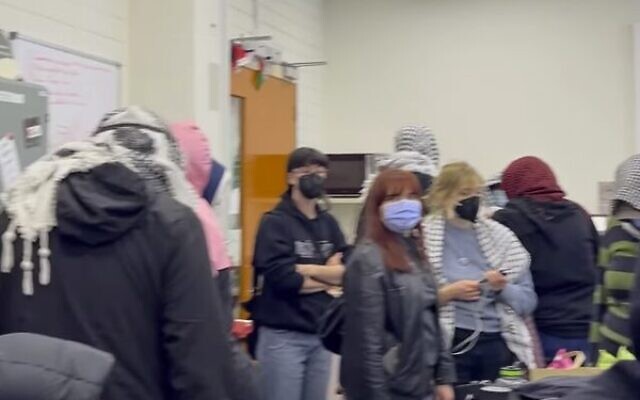
On October 9, 2024, Prawer arrived at his office to find a Palestinian flag draped over the anteroom door and between 15 and 20 masked people inside, most with their faces covered by keffiyehs. He said the group told him “we’ve been waiting for you” and refused his requests to leave and make an appointment. He described his alarm at the scene, saying that to a Jewish person familiar with events in Israel, the sight of masked figures was “a classic terrorist pose”, coming only a year after the October 7 attacks.

When he attempted to photograph the intruders, he said, they tried to draw him into the room, and two followed him and put a foot in the door as he sought to reach a secure area to call security. As he left, the group chanted: “Prawer, Prawer, you can’t hide, you’re guilty of genocide.”

He said security told him they were awaiting instructions and that, at that stage, only the vice-chancellor could call police, who arrived later to remove the group. Prawer said the intrusion was highly organised and disciplined, with those involved knowing “exactly how far to go” before police would make an arrest. Police made no attempt to obtain names or ask the group to remove their face coverings, treating the matter as though no offence had been committed once they left.

Photographs tendered to the commission showed stickers reading “Zionists are genocidal maniacs” and a boycott sticker applied over a photograph of Prawer, along with signs bearing his name and an inverted red triangle, which he interpreted as a marker designating him a target. He said the intrusion was “a highly personal attack” and that the intruders had left behind a manifesto citing his administrative role in the joint PhD program and his Australian Research Council-funded joint research projects with Israeli academics.

University of Melbourne students occupying a Jewish professor’s office

Prawer said the then vice-chancellor issued a statement the next day condemning the intrusion as “completely and utterly unacceptable”, which he considered appropriate. But he said 150 university employees and affiliates subsequently signed a petition published in the journal Overland defending the sit-in as a legitimate form of protest and opposing disciplinary action against the students — a development he found “very disappointing”. He drew a sharp distinction between protesting at the well-protected office of the vice-chancellor, “the seat of power”, and targeting him as “a clearly identifiable soft target”.

He described the disciplinary process that followed as “very opaque”. In May 2025, he was told four protesters had been identified as students, and in June two were expelled and two suspended for a year — an outcome he learned of not from the university but through the students themselves publicising it. On appeal, the expulsions were overturned in favour of one-year suspensions. Prawer said he was kept “at arm’s length” throughout, was not given the investigation report or the students’ identities on privacy grounds, and was told at one point that the original penalty had not taken into account the students’ human rights, a comment he found “mysterious”. He said the university’s own regulations allowed it to release information to concerned persons, and that it had “preferred to interpret cautiously its privacy obligations over its obligations of safety to staff”.

He said the failure to publicise any outcome removed any deterrent for the 10 to 15 people who were never identified, who “must be having a giggle about how they’ve managed to remain hidden” after intimidating a professor without consequence.

Prawer also described graffiti painted on a university noticeboard at the main entrance reading “Death to Israel, death to USA, death to Stephen Prawer”. He said the graffiti was posted around February 11, 2025, but he did not learn of it until March 28, when police contacted him for a welfare check about the death threat. University security had removed the graffiti without informing him. He said he was “flabbergasted” the university could ignore such a threat, and found it “very hard at that point not to feel that this university was trying to hide it”.

He said police later identified three people who had been in his office but declined to proceed with a prosecution, and would not disclose their identities to allow him to seek a personal safety intervention order. An application to the Magistrates’ Court without naming the individuals was rejected, and a freedom-of-information request lodged nearly a year earlier remained unanswered.

The university has since introduced extensive security measures, including swipe-card lockdown of his entire department, security at his home, an optional campus escort and a university-funded Uber account so he can avoid public transport. While he understood why the measures were in place, Prawer said they had curtailed the openness of academic life, requiring talks by Israeli visitors to be relocated, pre-registered and held in secure locations. He said the events had left his family more security-conscious, and recounted his grandchildren asking why screens now monitored the family home.

The AJN is providing rolling coverage on the Royal Commission on Antisemitism and Social Cohesion.

For full coverage of the Hearing Blocks, visit the Royal Commission section of The AJN website.

read more:
comments
Live updates Public hearings

“Imposed silence”: AUJS COO details antisemitism complaint

Australasian Union of Jewish Students (AUJS) Chief Operating Officer Josh Kirsh provided evidence to the Royal Commission on Tuesday.  His evidence was based on his leadership at AUJS, as well as having attended UNSW from 2015 to 2020 for undergraduate degrees, and attending the University of Sydney from 2024-2025 while a Master’s in Public Policy.  Kirsh was the Political Affairs Director of AUJS in 2019 and a significant part of this role involved handling complaints about antisemitism.

Kirsh attended campus during the 2024 encampment at the University of Sydney and said he felt “very worried” about his safety going onto campus.  Asked about the procedures the University of Sydney put in place during the encampment, Kirsh said the university facilitated alternative modes of entry and access.

Discussing an antisemitic incident during a lecture, he said the lecture was about qualitative evidence, and a guest lecturer gave the example that a study had shown that participants in research, who were asked, “Do Jews have too much power?” were less likely to respond affirmatively when they thought that the person interviewing them was Jewish. The lecturer said he did not believe the statement to be true, and a student replied that it was true and had been proved empirically by Malcolm Gladwell “that Jews have all the power.” The lecturer said in response, “We’re not going to go into that” and moved the conversation on.

Kirsh informed the regular lecturer who directed him to the university’s wellbeing resources and complaints process.  He decided to make a complaint about the student to the university.

“I made a decision to put in a complaint through the process, because I felt that it was important that that incident be reflected in the university’s understanding of what campus life is like for Jews, and also to understand that this sentiment does exist, and that there perhaps might be other incidents that come up, and so that if this does take place, it’s not a one-off,” he said.

Kirsch said after it was investigated the university decided “there was insufficient evidence that the student had intended to make a discriminatory comment” and “provided counselling to the student that this should not take place again.”

Kirsch said the university also considered the respondent’s English language capability, forming the view he didn’t have sufficient English language to express himself effectively in the environment. The university decided not to take it any further.  Kirsh said he had hoped education would have been provided to the student.

“I read first in the outcome that the university had counselled the student that they should be reminded of the impact their words can have on others in the learning environment in the current global and political environment,” Kirsh said.

Kirsh received an apology from the student. “The apology said something to the effect of that we should be cautious in the current climate… He provided in his apology a view that it was the current conflict that was the problem, and not necessarily the underlying nature of the remarks,” Kirsh said.

He also expressed frustration that he was told the complaint must remain confidential or it would be a matter of academic misconduct.

“It was also challenging because the university, in its final outcome, told me that I had to keep the whole affair confidential… But for me to be told that it would be a matter of academic misconduct to tell people about what I have experienced, you know, this is the first time I’ve spoken publicly about what happened because I feel safe to do that in this environment. I don’t feel I could have done that anywhere else, even after having graduated at the university…. So that does really impose quite an unfair burden on people who’ve experienced, and I assume this is something that extends not just to antisemitism but all manner of complaints,” Kirsh said.

“Imposed silence means that if anyone else wanted to compile a picture of what is happening on campus and connect the dots between different incidents, it would be difficult to do that without the vantage point of the university. And as I understand it, the university doesn’t seem to collect that information in that particular way, and so it doesn’t typically get reported as part of a broader set of issues. It certainly hasn’t, in my experience, been reported as part of a broader set of issues.”

Providing his observations on complaints about antisemitism at universities, Kirsh said: “There was a pretty consistent theme, which was that people had experienced traumatic incidents of antisemitism… They felt targeted. They felt victimised. They felt like people on campus held an unfairly negative view of them. In some cases, they had experienced… actual violence, physical violence, and in almost every circumstance, they had attempted to avail themselves of the existing policies and procedures to respond to those matters, and in almost every circumstance, the policies were said not to apply to their particular case for particular reasons. The universities failed to address the underlying matters because they said that they couldn’t because the policies didn’t address those issues, and the students left feeling even more abandoned, let down, and hurt than they were from just having experienced the incident itself.”

Kirsh reflected that there are “institutional failures that compound other institutional failures,” creating an “appalling cycle of trauma and retraumatisation for Jewish students and staff at universities.”  He called for universities to adopt a more “proactive” response to address antisemitism.

Enjoy Unlimited Access To The Australian Jewish News Website And All Our Online Content For AUD$18/month Or Just AUD$120/year.

Subscribe Now