LinkedIn and ACMA take the stand for the final day of Hearing Block 3, which focused on antisemitic content and other forms of hateful speech in the media.
Nerida O’Loughlin, chair of the Australian Communications and Media Authority (ACMA), told Counsel Assisting, Richard Lancaster SC, on Friday that many complainants from the Jewish community were frustrated when ACMA, in following its procedures, referred them back to the broadcasters where they believed antisemitic material had breached standards.
“It certainly presents some challenges to us, and I think it also presents some challenges to complainants,” she said.
She also highlighted an anomaly where ACMA has jurisdiction over broadcast content but not over related websites or over the same video content when it is streamed.
“We’ve had a range of complaints come to us over the last few years, which have been out of our jurisdiction, which must be very frustrating for a complainant when they’re proposing to complain about something which is on broadcast on the ABC, where they can come to us, but we’ve had to go back to them to say that because that was on a podcast, or it was delivered through WhatsApp, or it was on a website, it’s out of our jurisdiction.”
Asked whether she thought antisemitism should be explicity proscribed under ACMA’s regulations, she said the existing ACMA code has not constrained it from looking at these breaches.
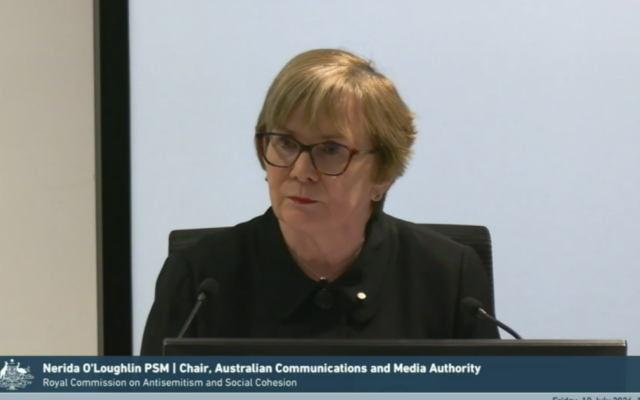
Nerida O’Loughlin, chair of the Australian Communications and Media Authority (ACMA). Photo: screenshot
“I think that we have been able to look at that type of content under the existing code provisions. That has not constrained us in looking at those.
“I think it would be a matter for the broadcasters themselves to consider whether or not specific provisions need to be put into their codes, or to assure themselves that this type of content can be dealt effectively under their code,” she stated.
O’Loughlin said a key ACMA research document, What Audiences Want, was written in 2022. Asked by Lancaster whether the paper has been updated, as the volume of hate speech had changed significantly since then, she confirmed that it has been.
Noting that codes of practice differ significantly between commercial and public media, she said most complaints to ABC and SBS would fall under a ‘harm and offence’ provision and an ‘accuracy and impartiality’ provision.
She said assessing complaints made to the ABC is more complex because standards are divided between its Code of Practice, a short document, and its Editorial Guidance provisions.
“It’s fair to say that much of the detail of how the ABC interprets that Code of Practice is contained in their editorial guidelines.
“Our primary responsibility is to look at what is identified in the [ABC] Code of Practice.
“But the the ABC has urged us to also make sure that we’re not only looking at the Code of Practice, we are also looking at their editorial guidance. Whereas with the other codes for, say, the commercial industry, we only really rely on the codes of practice.”
ACMA does not have any staff training relating explicitly to antisemitism, said O’Loughlin, but will be looking closely at training on antisemitism which is to be offered by the Australian Public Service Commission, she said.
Counsel Assisting the Royal Commission into Antisemitism and Social Cohesion, Richard Lancaster SC, has delivered a scathing assessment of X Corp’s cooperation with the inquiry, accusing the social media company of ignoring repeated requests to engage despite extensive evidence of antisemitic content on its platform.
Closing submissions revealed the Commission made numerous attempts to contact X Corp through its Australian solicitors and legal offices in the United States but received no substantive response.
“Despite all those numerous attempts to obtain X Corp’s engagement, X Corp has remained silent,” Lancaster said.
The Commission heard evidence from academics, online safety experts and Jewish community representatives describing X as a significant source of online antisemitism.
Evidence presented included claims that the platform’s removal rate for antisemitic content had fallen sharply and that Jewish Australians who gave evidence to the Commission had been targeted with abuse.
Lancaster said X had become “a major online contributor to online antisemitism” and criticised the company’s conduct towards Australian regulators.
While acknowledging that X was legally entitled to challenge decisions by the eSafety Commissioner, Lancaster questioned the company’s broader corporate responsibility, saying its actions “show a shocking disrespect and disregard for the Australian community”.
The Commission also heard that other platforms responded differently to its requests. Reddit provided documents and a corporate statement, while OpenAI, Twitch and Australian platform Kick cooperated to varying degrees. Senior executives from TikTok and Anthropic also participated in hearings.
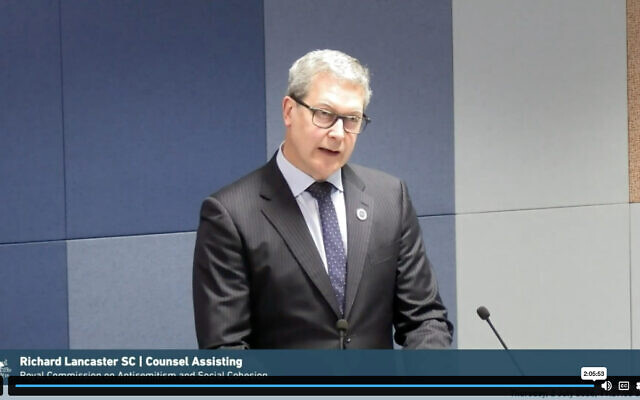
Counsel Assisting Richard Lancaster SC. Photo: screenshot
Lancaster argued that voluntary action by technology companies was proving to be insufficient. “The social media companies are not sufficiently addressing antisemitism online,” he said. “Regulatory obligations must be imposed on them because they are not taking care of the problem themselves.”
He concluded that if online platforms “are capable of inflicting harm upon Australians, the laws of Australia must be capable of securing accountability for those harms.”
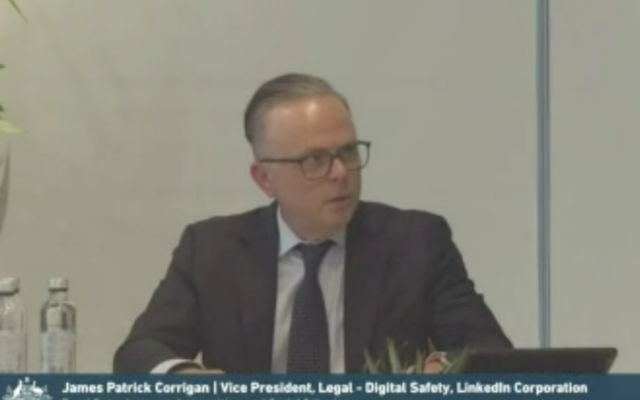
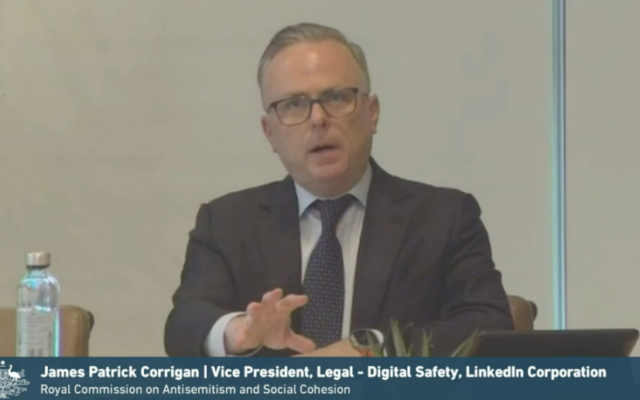
LinkedIn Corporation vice president legal for digital safety James Patrick Corrigan. Photo: screenshot
LinkedIn regards the use of terms such as “Zionist”, “Zionism” and “Israel” as a proxy to attack Jewish people as a breach of its policies, but has never published that position, a senior executive has told the Royal Commission into Antisemitism.
James Corrigan, LinkedIn’s vice-president for legal and digital safety, said the platform’s internal rules were clear on the issue even though its public-facing policies did not spell it out.
“If Zionism, Zionists, Israel are used, if the context shows that those are being used as a proxy to attack, they’re proxies for Jewish people being Jewish, that is a policy violation,” he said.
“Which policy depends on what is actually happening. It could be hate speech. It could be harassment. It could be threats of violence. But those are policy violations.”
Pressed on why LinkedIn did not publish the rule so that “the world can see” its position, Corrigan conceded it was “a fair question”.
“Our internal policies are very clear and do go into that level of detail, and just we haven’t historically,” he said.
Corrigan told the Commission that removals of hateful or derogatory content had risen in the first half of 2024, and linked the increase to the aftermath of the October 7, 2023 Hamas attacks in Israel. He said the rise coincided with “the six-month period that followed the October 7 attack and all of the online content that … led to”.
LinkedIn’s transparency reporting recorded 26,141 removals for hateful or derogatory content in the second half of 2023.
Removals for harassment or abusive content reached about 250,000 in the second half of 2024 before spiking significantly in the first half of 2025. Corrigan said he could not explain the increase or recall the reason.
The inquiry also heard that LinkedIn had issued urgent internal guidance to content moderators after October 7, 2023, dealing in part with how to treat particular slogans. Corrigan declined to explain the reasoning behind the treatment of two slogans, citing confidentiality.
He acknowledged that users often slightly changed words or phrases to avoid content moderation, describing it as “a very, very difficult problem”.
On enforcement partnerships, Corrigan said LinkedIn would be open to adopting an appropriately vetted Australian body focused on antisemitism as a “trusted flagger” whose reports would be prioritised. Asked directly whether LinkedIn would work with such a body, he answered: “Yes.”
He said the platform would invest in measures that improved its ability “to keep the platform clean”, and would not necessarily wait for such a scheme to be mandated by Australian law.
LinkedIn Corporation vice president legal for digital safety James Patrick Corrigan confirmed that when a user reports a post, it disappears from their own feed but continues to be seen by all other users until a determination is made. Meaning antisemitic content reported by LinkedIn users remains visible to everyone on the platform except the person who reported it.
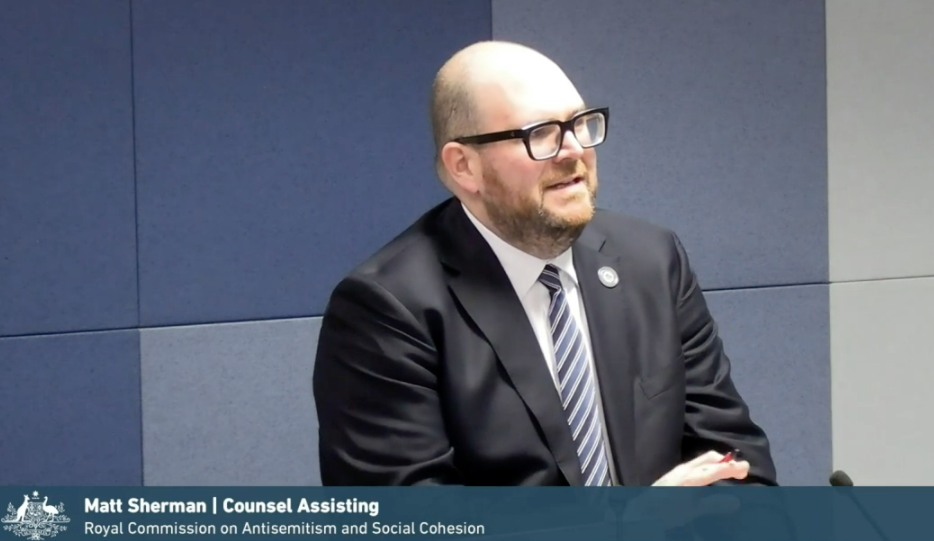
Counsel assisting Matt Sherman pressed Corrigan on whether a reasonable person might believe their report had succeeded in removing the content entirely. Corrigan conceded they could.
“Could somebody interpret that as meaning nobody can see it after I click report? Potentially, I guess I’m not sure,” he said.
Sherman also explored whether hateful content carries a heightened risk of harm on LinkedIn, given it is a real-identity platform where posts are visible to current and future employers, colleagues and business partners. Corrigan agreed, saying “certainly yes.”
He told the Commission that LinkedIn’s professional environment generally encourages better behaviour. “I think it’s intuitively correct that because we are a real identity platform of a professional nature, people are generally less likely to act and behave on the platform in an unprofessional manner,” Corrigan said. “But of course, these are not hard and fast rules.”
Corrigan acknowledged that some users deliberately push the boundaries of LinkedIn’s content policies, and that human reviewers sometimes err on borderline calls.
“There’s a variety of reasons for that. Some of that is some users know how to walk the tightrope right between the line. Others are just challenging,” he said.
Sherman took Corrigan to confidential internal documents showing LinkedIn relaxed its strike thresholds for hate speech violations in 2025. Corrigan said the changes were connected to a shift toward “feature gating”, where repeat offenders lose the ability to post content but retain access to other functions such as applying for jobs.
He said the previous thresholds were revised in part because “mistakes were more likely being made by members and by reviewers, and the hypothesis was that if we allow educational intervention type events by LinkedIn and give members an opportunity to learn the policies and abide by them, that they might rehabilitate.”
Corrigan stressed that the changes related solely to penalties for users, not to whether violating content was removed.
“There was never a moment where this content wasn’t removed,” he said.
Corrigan maintained the relaxed thresholds were unrelated to commercial considerations, telling the commission, “These changes have absolutely nothing to do with revenue. I can tell you that.”
LinkedIn has no trust and safety staff based in Australia, does not explicitly reference antisemitism in its content policies and cannot quantify the prevalence of antisemitic content on its platform, the Royal Commission on Antisemitism and Social Cohesion has heard.
LinkedIn Corporation vice president legal for digital safety, James Patrick Corrigan, gave evidence from the company’s headquarters in Sunnyvale, California, during the final day of the commission’s third hearing block in Sydney.
Under questioning from counsel assisting Matt Sherman, Corrigan confirmed the professional networking platform serves approximately 17 million Australian members and employs more than 200 full-time staff locally, but said the majority are in sales-related roles.
Asked whether any trust and safety staff are located in Australia, Corrigan replied, “No.”
LinkedIn Corporation vice president legal for digital safety James Patrick Corrigan. Photo: screenshot
He confirmed LinkedIn has approximately 180 full-time trust and safety employees globally, supported by up to 1800 contractors, with none based in Australia. The company’s content policy team, which sits within Corrigan’s division, is also entirely based offshore.
Corrigan told the commission LinkedIn’s content policies apply globally and do not explicitly reference antisemitism. Asked whether that was a deliberate decision, he said, “To my knowledge, there was no intentional decision to affirmatively exclude that from this policy.”
He confirmed the platform does not track subcategories of hate speech, including antisemitic content.
“We don’t have tracking data of subcategories of policy violations, which would include anti-Semitic content. That’s across the board,” Corrigan said.
On the question of whether the term “Zionist” used as a proxy for Jewish people constitutes a policy violation, Corrigan confirmed it does.
“Using Zionist or Zionism as a proxy in hateful content for someone who’s Jewish, or the Jewish religion is a violation of our policies in the same way,” he said. However, he acknowledged this position is not explicitly stated in LinkedIn’s published policies.
LinkedIn’s hateful and derogatory content policy includes a prohibition on “Holocaust denial or misappropriation of Holocaust symbology”. Asked what the platform means by misappropriation of Holocaust symbology, Corrigan conceded: “That’s a good question. I’m not sure. That’s something that a policy expert would need to explain to me.”
Sherman put it to Corrigan that LinkedIn removes approximately 76 items of hate speech content per month in Australia, roughly five per day across a platform of 17 million users.
Corrigan said the figure did not surprise him.
The AJN is providing rolling coverage on the Royal Commission on Antisemitism and Social Cohesion.
LinkedIn has no trust and safety staff based in Australia, does not explicitly reference antisemitism in its content policies and cannot quantify the prevalence of antisemitic content on its platform, the Royal Commission on Antisemitism and Social Cohesion has heard.
LinkedIn Corporation vice president legal for digital safety, James Patrick Corrigan, gave evidence from the company’s headquarters in Sunnyvale, California, during the final day of the commission’s third hearing block in Sydney.
Under questioning from counsel assisting Matt Sherman, Corrigan confirmed the professional networking platform serves approximately 17 million Australian members and employs more than 200 full-time staff locally, but said the majority are in sales-related roles.
Asked whether any trust and safety staff are located in Australia, Corrigan replied, “No.”
LinkedIn Corporation vice president legal for digital safety James Patrick Corrigan. Photo: screenshot
He confirmed LinkedIn has approximately 180 full-time trust and safety employees globally, supported by up to 1800 contractors, with none based in Australia. The company’s content policy team, which sits within Corrigan’s division, is also entirely based offshore.
Corrigan told the commission LinkedIn’s content policies apply globally and do not explicitly reference antisemitism. Asked whether that was a deliberate decision, he said, “To my knowledge, there was no intentional decision to affirmatively exclude that from this policy.”
He confirmed the platform does not track subcategories of hate speech, including antisemitic content.
“We don’t have tracking data of subcategories of policy violations, which would include anti-Semitic content. That’s across the board,” Corrigan said.
On the question of whether the term “Zionist” used as a proxy for Jewish people constitutes a policy violation, Corrigan confirmed it does.
“Using Zionist or Zionism as a proxy in hateful content for someone who’s Jewish, or the Jewish religion is a violation of our policies in the same way,” he said. However, he acknowledged this position is not explicitly stated in LinkedIn’s published policies.
LinkedIn’s hateful and derogatory content policy includes a prohibition on “Holocaust denial or misappropriation of Holocaust symbology”. Asked what the platform means by misappropriation of Holocaust symbology, Corrigan conceded: “That’s a good question. I’m not sure. That’s something that a policy expert would need to explain to me.”
Sherman put it to Corrigan that LinkedIn removes approximately 76 items of hate speech content per month in Australia, roughly five per day across a platform of 17 million users.
Corrigan said the figure did not surprise him.
Enjoy Unlimited Access To The Australian Jewish News Website And All Our Online Content For AUD$18/month Or Just AUD$120/year.



comments