Read the reports
Mika on the cumulative pattern of antisemitism on campus in South Australia
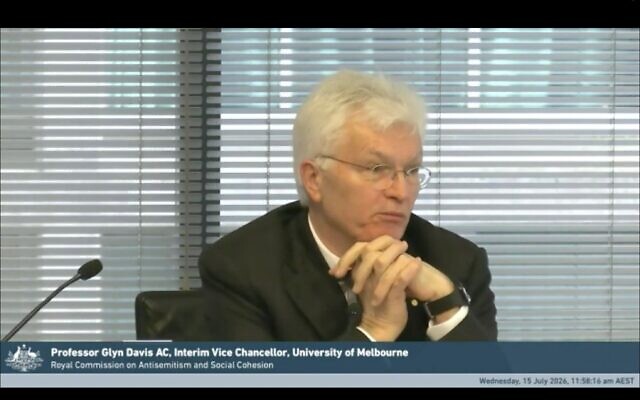
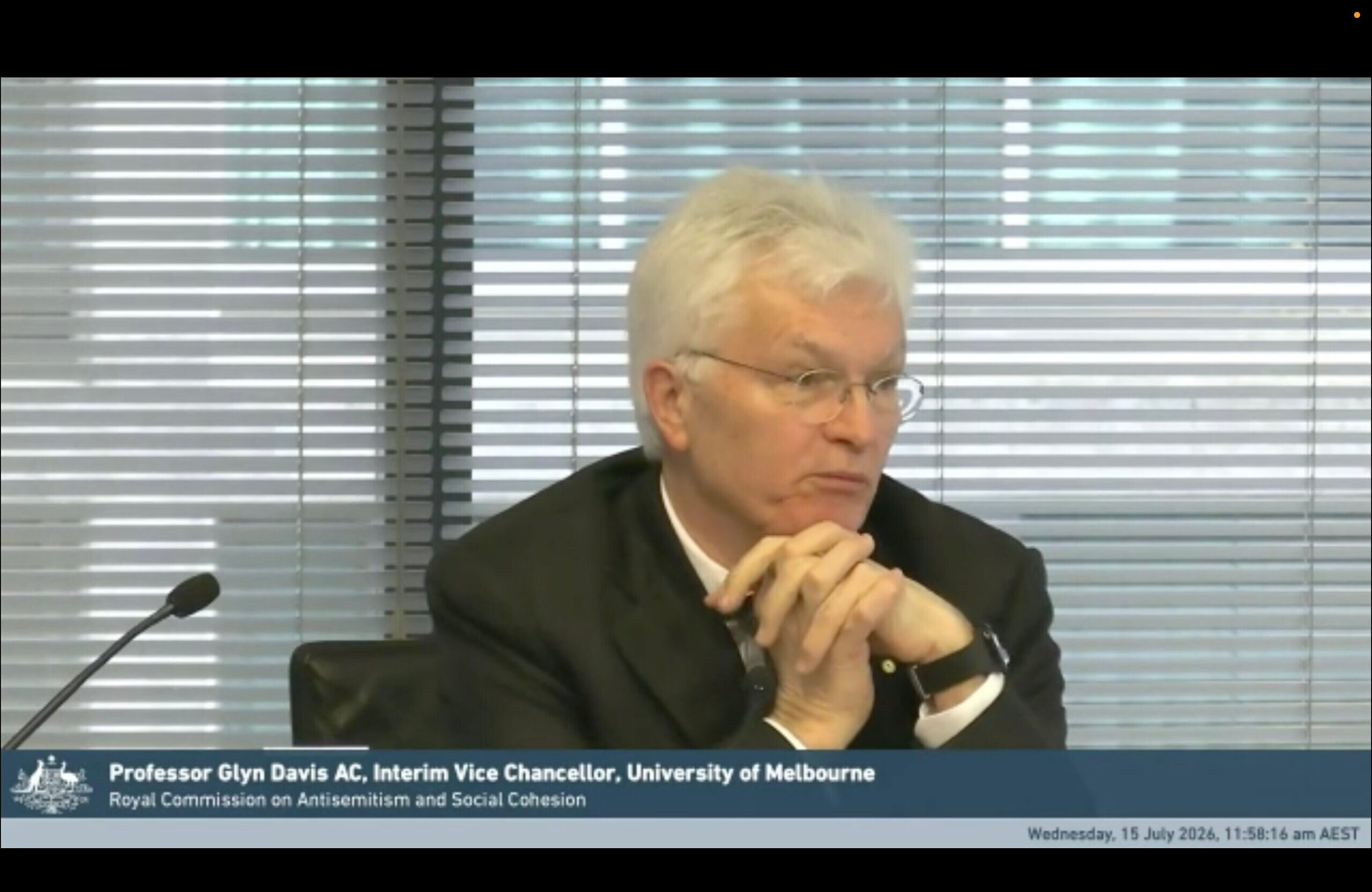
Professor Glyn Davis, Interim Vice Chancellor at the University of Melbourne, on campus life at the university
Professor Glyn Davis, on Jewish involvement in designing the university’s antisemitism education programs
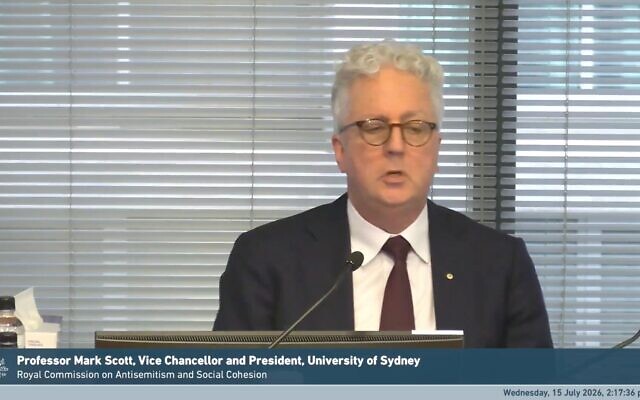
Mark Scott, Vice-Chancellor of the University of Sydney, on the university’s failure with Jewish community engagement
Professor Mark Scott on the safety of Jewish students and staff
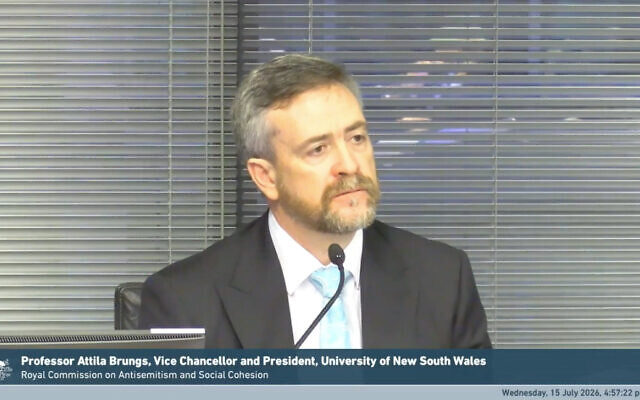
University of New South Wales vice-chancellor and president Attila Brungs on the university’s measures to combat antisemitism and avoided the encampments seen elsewhere
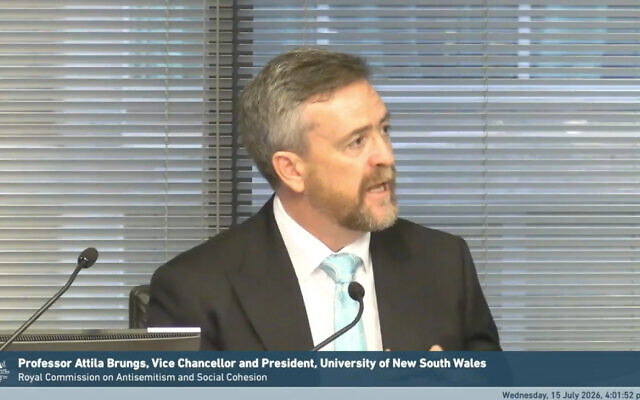
Attila Brungs on the UNSW’s three competing definitions of antisemitism
Three antisemitism definitions to become one, UNSW head concedes
University of New South Wales vice-chancellor and president Attila Brungs conceded under cross-examination that the university’s three competing definitions of antisemitism may cause confusion, and committed to moving to a single definition and to co-designing an action plan to restore the full participation of Jewish staff and students on campus.
Brungs was questioned by three counsel on Wednesday afternoon.
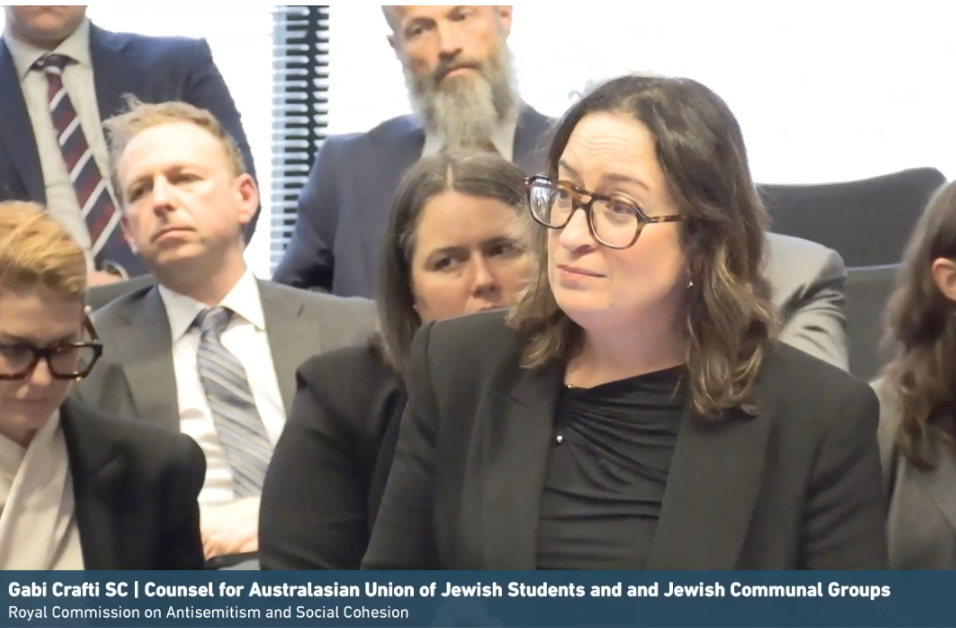
Gabi Crafti SC, appearing for seven mainstream Jewish communal organisations and the Australasian Union of Jewish Students, pressed Brungs on the university’s use of the three definitions. He accepted people might be confused, but said complaints handlers had not found the arrangement problematic and that it had been thought helpful for understanding all aspects of antisemitism. He accepted the Finkel report, the Craven report and the government position that moving to one would be simpler, and said the university was doing so well ahead of the January deadline.
Crafti put to Brungs that the International Holocaust Remembrance Alliance (IHRA) definition reflected best practice, having been adopted by the Commonwealth, and that consistent adoption across universities would allow longitudinal research. Brungs agreed it would be preferable for all universities to share a definition, but declined to accept that IHRA specifically would deliver that consistency, noting its flexibility could see different practices at different universities. The Finkel report, he said, had identified the Universities Australia definition as more readily operationalised — the definition UNSW was likely to adopt.
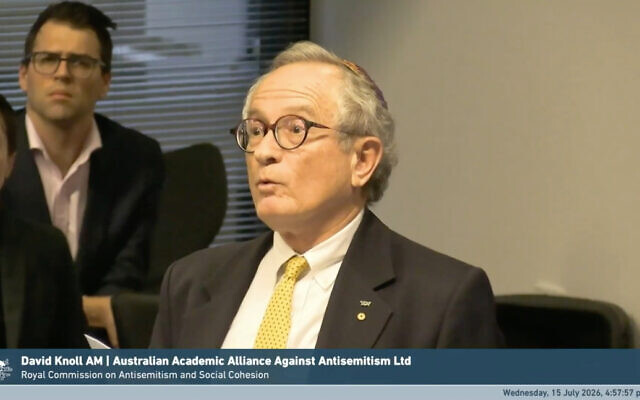
David Knoll, appearing for the Australian Academic Alliance Against Antisemitism (5A), asked how a complaints officer would know which of the three definitions to apply. Brungs said such a matter would be escalated to senior staff trained in antisemitism, but would soon be moot once the university moved to one definition.
Taken to the Universities Australia definition’s reference to conduct that impedes Jews’ ability to “participate as equals”, Brungs was pressed on whether the university had guidelines on what kind of equality was meant, pointing to the code of conduct, which Knoll suggested did not define how equality was measured. Presented with a hypothetical of students chanting “intifada revolution” and “Zionists out” as Jewish students walked past a library lawn feeling intimidated, Brungs said he assumed such conduct would impede a Jewish person’s ability to participate.
Knoll secured a commitment that the university would work with representative organisations of Jewish academics and students to co-design an action plan to restore Jewish visibility and belonging, as it did with Indigenous and LGBTQI communities. Brungs agreed the university lost out when Jewish staff and students felt unable to participate, and said he had already developed ideas with AUJS students this year aimed at moving beyond safety toward full belonging. Told that 5A members at UNSW felt “completely excluded”, he said he would be delighted to work on a plan.
Jim Hartley, counsel for the Jewish Council of Australia, pressed Brungs from a different direction, on academic freedom. Brungs agreed universities were spaces for controversial ideas, that academic freedom was a core purpose incorporated in the enterprise agreement, and that the university’s code adopted the French model code, which prevailed in any inconsistency.
Hartley put to him that in courses such as public international law or Middle Eastern history, staff and students had to be free to express lawful but controversial views — including that Israel had contravened a treaty — even if that shocked others. Brungs agreed, noting the model code held that the duty to foster wellbeing did not extend to protecting people from being offended or shocked. He accepted a risk that academics or students fearing accusations of antisemitism might avoid such content, but said the university sought to balance openness with reasonable steps to keep people safe.
UNSW avoided encampments but concedes antisemitism gaps, commission hears
University of New South Wales vice-chancellor and president Attila Brungs has told the Royal Commission on Antisemitism and Social Cohesion that the university took a wide range of measures to combat antisemitism and avoided the encampments seen elsewhere, while conceding under questioning that its complaints system still cannot categorise a complaint as antisemitic and that students receive no training specific to antisemitism.
Giving evidence on Wednesday afternoon, Brungs said UNSW had responded to the aftermath of October 7, 2023 with what he repeatedly described as “a multiplicity” of measures, rejecting the idea of a single solution to a complex problem. He said his concern for the wellbeing of the university community had begun in October 2023, and that the university had put in place around five or six initiatives in anticipation of what was coming.
Chief among them was a “response group” of the university’s most senior leaders, which met twice a week for about a year and continues to meet weekly. Brungs said he and the chancellor had reached out to Jewish organisations, staff and students, holding one of the first formal meetings in his office in November 2023, where Jewish staff described feeling hurt, fear and anguish, many with direct connections to those killed or held hostage on October 7.
He said the measures the university adopted flowed from four things Jewish staff and students had asked for: that the university take the matter seriously and respond quickly, which prompted the response group; stronger communication, including all-staff and all-student emails roughly twice a month for a year acknowledging the hurt across the community, spelling out expected behaviour and calling out racism and antisemitism; a “speak up” campaign encouraging complaints, with QR codes placed in every bathroom and a complaints button on every UNSW web page; a review of policies, producing a new campus policy, an anti-religious vilification policy, a posters policy and a single code of conduct; and a significant increase in protective services, working more closely with police.
Asked why UNSW had avoided an encampment when other universities had not, Brungs said he could only speculate, attributing it to the range of measures taken rather than any single factor. He pointed to the new campus policy approved in late May 2024, which he described as risk-based and designed to protect the whole community, including protesters.
Under the policy, demonstrations by staff and students are permitted in open public spaces but banned inside buildings, must be orderly and peaceful, and must not make others feel harassed or intimidated. Organisers must notify security at least 48 hours in advance so a risk assessment can be conducted, a requirement Brungs said had met almost complete compliance.
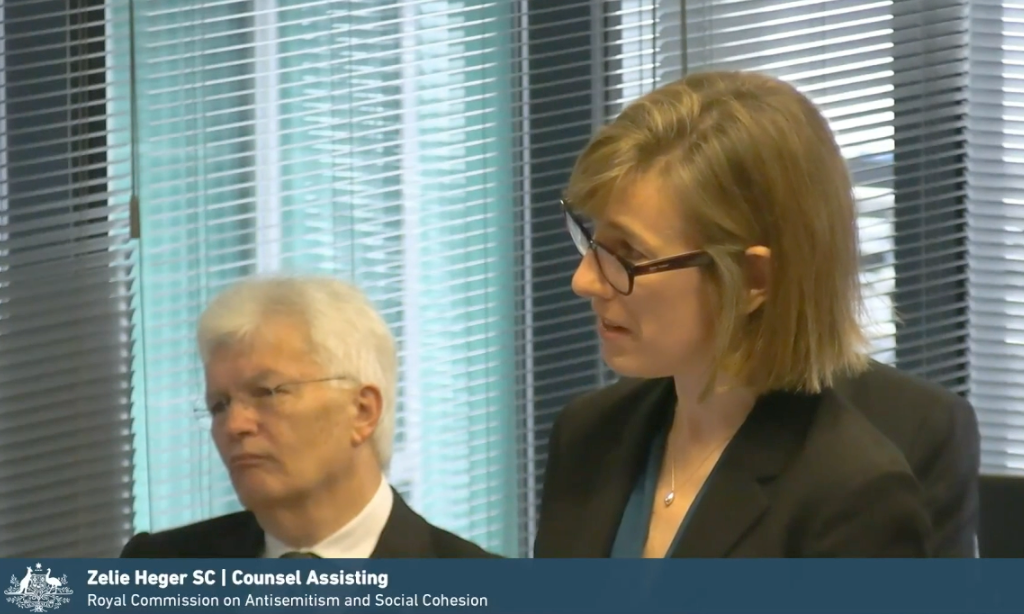
Counsel Assisting Zelie Heger took Brungs to complaints data reported to the university council, which showed complaints of racism and religious vilification had risen sharply from 22 in 2024 to 136 in 2025, with 83 per cent relating to the situation in the Middle East. Of those, four were complaints of Islamophobia and 109 of antisemitism. Brungs confirmed that 57 per cent of the antisemitism complaints were “campaign” complaints — form letters from members of the public — relating to two particular incidents, one concerning the public stance of an academic that was resolved after the academic clarified their comments and apologised. He accepted the remaining number was still significantly higher than the previous year, and said the increase had concerned the council and prompted further training, communication and protective resources.
Brungs acknowledged several shortcomings drawn out in questioning. The university’s Case IQ complaints system does not currently contain a category to identify a complaint as antisemitic, though he said that feature would be completed by the beginning of August. He confirmed that public reporting of complaints was currently limited to student data and did not yet include complaints by or against staff, but said all complaints would be reported publicly from August. He also accepted a July 2025 internal review had found the university’s complaints procedure was overly complex, inconsistently structured, lacking in trauma-informed practices and prone to delays, and outlined steps taken since, including a central complex-case management group and further training.
On training, Brungs said all staff and students completed mandatory anti-racism training and that those handling antisemitism complaints had received face-to-face antisemitism training, but he accepted that students received no antisemitism-specific training and that, ultimately, all staff should. He said the university was considering how to roll out broader training, using antisemitism as a case study within wider anti-racism education.
Brungs said UNSW had adopted the International Holocaust Remembrance Alliance (IHRA) definition and the Jerusalem Declaration in February 2024, adding the Universities Australia definition in July 2025, all referenced in its anti-racism and anti-religious vilification policy.
Heger put to him that the three definitions appeared only as supporting material on the final page of the policy, meaning a student would have to link racism earlier in the document to three separate definitions to work out whether their conduct crossed the line — and that this matched what Professor Craven’s report had described as “obscurity”, a category of sector-wide failure to properly adopt a definition.
Brungs said he did not entirely agree, arguing the definitions were binding and that a dedicated web page made them accessible, but conceded it could be clearer and said the university would place a definition directly in the policy. Which definition remained under consideration, he said, though the Finkel report had recommended the Universities Australia wording.
Scott pressed on Jewish student safety and unanswered complaints
When under cross-examination this afternoon, Professor Scott was first questioned by Gabi Crafti, Counsel for AUJS and other Jewish communal groups.
She began by asking him whether views that were expressed by former student Yasmine when she had delivered a speech on the University of Sydney [USYD] campus in August last year in which, as Crafti described it, she’d called for “the destruction of the State of Israel” and “spoke in praise of the use of violence”, should be tolerated at USYD.
Scott said he had not been aware Johnson was speaking at that particular event at that time, but was unequivocal in his answer: “I totally reject her [Ms Johnson’s] views. I do not believe that that is an appropriate use of academic freedom and discourse, and I in no way support or associate myself with her comment.”
Under further questioning about Jewish staff and students feeling particularly unsafe during the prolonged period of pro-Palestine on-campus encampment at the university, Scott said, “I accept one of the issues I think we have needed to focus on, and I think is a major change in the legal settings [applied] in recent years, is how we create an environment where all in our community feels safe and welcome.
“And I appreciate that there was a period of time when the encampment was on, in particular, that there were [Jewish] students and staff members who did not feel as safe.”
Crafti quoted former AUJS vice-president Zach Morris’s assessment that Sydney was “probably one of the worst places to be a Jewish student right now” and put that to Scott for comment.
Scott accepted and recalled that comment, saying it was one reason the university had since worked closely with Jewish academics, staff and community leaders, adding “we were not as attentive as we needed to be.”
Pressed on whether he took responsibility for the lack of safety experienced by Jewish students and staff in 2024, Scott dismissed that proposition, and instead pointed to two years of policy reform, increased security, expanded CCTV, a new safety app, and a consultative group convened by the Chancellor, including Jewish and Muslim community leaders, saying “we are in a much, much stronger place than we were two years ago.”
Counsel for the Australian Academic Alliance Against Antisemitism, David Knoll, then took Scott through four specific policy failures. The first concerned a March 2024 incident in which a delegation from Tel Aviv University was prevented from meeting Sydney students by a sit-in, with visitors “quietly escorted away.”
Scott agreed such an incident could not happen again under the university’s amended campus access policy, but could not say whether any disciplinary action had been taken against the students involved, and undertook to find out.
Second, Knoll raised a complaint about a May 2025 medical lecture containing what he described as “biased and, put bluntly, horrible comments about Israel,” which took six months to resolve.
Scott acknowledged that this “feels very unsatisfactory”, but resisted agreeing the six months was too long, citing industrial-relations protocols and staff leave.
He accepted the university had not disclosed to other staff, even de-identified, what conduct had led to the lecturer being counselled, conceding: “confidentiality does not build confidence in the system”. And he committed to considering de-identified guidance as part of an end-to-end complaints review.
Third, Knoll detailed how the university’s Vere Gordon Childe Centre ran a 2025 lecture series featuring an antizionist perspective on the Israeli-Palestinian conflict, while a proposal from Jewish academics for balancing lectures, submitted in February 2026, went unanswered for months, bar a brief acknowledgment of receipt.
Scott, said he was not across the detail, but accepted the delay would have been “frustrating and deflating” for those involved.
Knoll closed by securing a commitment from Scott that Jewish student and academic organisations would be involved not merely as consultees but as active partners in co-designing a programme to restore “unconditional visibility” for Jewish people at the university, to which Scott replied: “Yes, I do.”
Then, Counsel for the Australia Palestine Advocacy Network, Rachel Doyle, questioned Scott about a 2025 amendment inserting a definition of “civility” into the university’s freedom of speech charter, put to him as going beyond the French Model Code’s original intent.
Asked to explain that change, Scott said the law had shifted since the code’s 2019 adoption.
“The law has injected responsibilities of psychosocial safety on all organisations, including universities, and my feeling was and is to be able to look not just at an individual’s freedom of speech, but how you create a culture that enables the freedom of speech of many to hear the other voice, to listen as well as speak, to respond as well as dominate the discourse,” he said.
University of Sydney admits failures in Jewish community engagement
Mark Scott, Vice-Chancellor of the University of Sydney, provided evidence to the Royal Commission on Wednesday, about the university’s handling of the anti-Israel encampment, which ran from 23 April to around 24 June 2024. He said there had been roughly 42 protests of a pro-Palestinian, anti-Israel or anti-Zionist character since 7 October 2023.
Scott said there was little policy or security readiness in place beforehand to deal with encampments. He identified the Student Representative Council as the leaders of the encampment, alongside the Muslim Students Association, Socialist Alternative and Students for Palestine.
Scott said the university’s guiding priority was de-escalation, driven by concern about preventing violence. He acknowledged the encampment had a real “psychosocial impact” on Jewish staff and students, many of whom found its constant presence distressing, particularly chants such as “from the river to the sea” and “globalise the intifada.” Scott said the university did not ban these chants because they were not unlawful under state or federal law, and legal advice indicated this was a matter for university judgement rather than blanket prohibition, though he accepted context could render such phrases antisemitic.
Regarding claims of Hizb ut-Tahrir involvement in the encampment, Scott said the university was alerted to the presence of the group, but Police indicated it was not a threat.
Following a 60 Minutes report and correspondence from the Zionist Federation of Australia about the presence of Hizb ut-Tahrir, he met NSW Police and sought assurances; he was told there was no adverse security information about individuals involved in the encampment, though he accepted in hindsight that suspicion about Hizb ut-Tahrir’s presence had existed.
“What I would say is that Hizb ut-Tahrir had been raised. It had been raised with our security people. It had been raised through the phone call that you identified. We had had no advice from the police to be concerned about groups in and around the encampment. Then, when the detailed report landed in the nine newspapers and on 60 Minutes, identifying specific individuals at university campuses, that’s when we sought further undertaking from New South Wales Police,” Scott said.
On removing non-staff/student “outsiders,” Scott said legal advice indicated the university fell outside the Enclosed Lands Protection Act, limiting enforcement to civil rather than criminal remedies. The university has since sought inclusion under that Act and introduced bollards and signage, though Scott said legal uncertainty remains.
The encampment ended after negotiation with the remaining Muslim Students Association group, involving undertakings for independent reviews of investment and defence-related research transparency. Scott said the agreement provoked a strong adverse reaction from parts of the Jewish community, which blindsided him, as he had expected relief that the encampment was ending. He accepted the university did not consult Jewish organisations before this resolution, calling this a likely failure, and said closer, more sustained engagement with Jewish students and staff throughout the encampment was needed.
“I think subsequent to the encampment meetings I had with Jewish community leaders, Jewish staff and students, some of the antisemitism training I did gave me greater insight into the into how testing and how challenging some of our Jewish students and staff found the encampment, and so I think I was more conscious of the psychosocial impact afterwards. Even though I was aware at the time that the nature of the protest and the sense that the encampment was there every day was very challenging and very testing for some in our community,” he said.
Scott added, “One of the reasons I apologised to Jewish students and staff for our inability to have kept them closer and to talk with them more effectively throughout the encampment, and why we have made some changes subsequent to the encampment.”
Scott noted subsequent reforms: a campus access policy, banning camping, indoor protests, and requiring demonstration organisers to be staff or students with prior notification; poster authorisation requirements; the Safe Zone reporting app; and a new complaints portal. He acknowledged no antisemitism-specific complaints data is yet reported publicly, though this is planned given new government threshold standards.
On antisemitism definitions, Scott said the university had adopted the Universities Australia definition which has been endorsed by the university Senate, used in complaints and disciplinary processes, while acknowledging the code of conduct’s referencing structure was not sufficiently accessible and needed better incorporation into formal policy documents.
Melbourne VC open to Jewish help with antisemitism
The University of Melbourne’s interim vice-chancellor, Professor Glyn Davis, has accepted in principle that Jewish staff and students should be involved in designing the university’s antisemitism education programs, while conceding that existing anti-racism material makes no mention of antisemitism at all.
Professor Davis was cross-examined at the Royal Commission on Antisemitism by counsel for Jewish communal organisations, academic groups, pro-Palestinian bodies and the university itself.
Gabi Crafti, appearing for major Jewish organisations and the Australasian Union of Jewish Students, took Professor Davis to the university’s published examples of unacceptable conduct, among them the filming of individuals without permission.
Professor Davis confirmed that student activists in 2024 had entered classes, invited students to vote on matters connected to the Middle East conflict, and photographed the result.
“You’re filming people without their permission, but you’re also identifying people who don’t vote for your proposition, and you’re putting it on social media,” he said. “So it’s a form of intimidation and unacceptable.”
Asked what consequences followed, Professor Davis said the students were not identified. With some 10,000 classes held in any teaching week, he said, the university had instead amended its educator’s guide to end the long-standing tradition of students addressing lectures before they began.
Ms Crafti sought to tender a letter written on 13 May 2024 by five Jewish day school principals to the vice-chancellors of four Melbourne universities, imploring them to take greater care of the safety of Jewish students. Professor Davis had not seen it, and the commissioner, citing time pressure, directed that it be tendered rather than put to him.
David Knoll, appearing for the Australian Academic Alliance Against Antisemitism, known as 5A, asked about Professor Steven Prawer, a physicist at the university, whose office was occupied by masked protesters.
Professor Davis said he had written to Professor Prawer personally after the event, describing it as conduct he could never countenance.
“It is intimidating to have 20 people in your room wearing face masks and threatening you,” he said.
Professor Prawer’s view that the students involved should be expelled was not shared by the appeals process, Professor Davis said, and he respected that outcome because the appeals body had heard evidence he had not.
Asked whether protection of the students’ identities had been placed ahead of a senior academic’s safety, Professor Davis said he did not accept the two considerations could be weighed against each other as a single proposition.
He told the commission the four people concerned may have no contact with Professor Prawer, direct or indirect, may not enter the section of the university where he works, and that security staff know their identities.
Mr Knoll said he had been unable to find any mention of antisemitism in the university’s Critical Conversations program, its Joining Melbourne modules, or its guidelines on addressing racism in teaching spaces.
Professor Davis did not dispute this, saying the programs were not principally focused on antisemitism, and agreed that whether something is antisemitic would make a useful future Critical Conversations topic.
Pressed on how the IHRA definition had informed the university’s first anti-racism action plan, Professor Davis said the working group had discussed it, but that he had not been in the meetings.
“I don’t have a window into other men’s souls,” he said.
Drawing a comparison with the university’s Indigenous strategy, built on First Nations lived experience, Mr Knoll asked whether Jewish lived experience was equally necessary to co-design an effective antisemitism plan. Professor Davis accepted that it was.
“I’m absolutely accepting in principle. Staff and students with lived experience need to be part of it,” he said, adding that he was “willing to have the conversation about external groups as well joining those discussions”.
Rachel Doyle, for the Australia Palestine Advocacy Network, established that no disciplinary finding arising from the Arts West occupation or the South Lawn encampment involved the anti-racism policy, which Professor Davis could not confirm was in force at the time.
“I am not aware of any complaint of antisemitism in either event,” Professor Davis said.
Ms Doyle also revealed that the standard operating procedure governing removal of “offensive” posters is subject to a full confidentiality claim, meaning that neither students nor parties to the commission can read it. Professor Davis said he was unaware of this.
“I’m surprised. It’s not our practice to have confidential documents, confidential policies, because otherwise, how does anybody see them in order to act on them?” he said.
He confirmed that security staff decide whether material is offensive, using an app to refer images for advice.
Jon Hartley, for the anti-Zionist Jewish Council of Australia, questioned Professor Davis about the IHRA definition and Universities Australia’s statement that Zionism is a core part of Jewish identity for most Australian Jews. Professor Davis said he understood the controversy around at least two of the IHRA examples, and accepted a non-Zionist Jew might perceive the Universities Australia wording as marginalising.
Asked about conflation, Professor Davis said the occupation of Professor Prawer’s office was precisely why he objected to Jewish identity being equated with the actions of a nation state.
Renee Enbom, for the university, re-examined briefly, establishing that an express prohibition on racism entered the student conduct policy only from 11 March this year.
University of Melbourne scrutinised over campus antisemitism
Professor Glyn Davis, Interim Vice Chancellor at the University of Melbourne, provided evidence to the Royal Commission on Wednesday, noting he was appointed Interim Vice Chancellor in February 2026.
Asked about the anti-Israel encampment at the university which began in April 2024, Davis said there were no bylaws governing it as there was no previous history of encampments at the University of Melbourne. He said then Vice Chancellor Duncan Maskell determined the encampment would be tolerated so long as it remained peaceful and did not compromise health and safety, consistent with the university’s protection of the right to protest. However, he acknowledged that staff and students had reported feeling intimidated by the encampment and that the university’s 2024 quality-of-learning-and-teaching scores were its worst on record, which reflected dissatisfaction.
Counsel Assisting Zelie Heger referred to a letter from 9 May 2024, when the Deputy Commissioner of Victoria Police wrote to the chancellors of universities in Victoria and noted that since the establishment of the encampments police had received a number of reports in relation to the safety and well-being of students, and reports of unlawful assaults.
Davis said Police attended the encampment periodically but concluded they lacked legal grounds to intervene absent a breach of law. Davis noted the university set up a committee, the Middle East Crisis Incident Committee, which reported incidents on campus.
Regarding the occupation of the Arts West Building by students and staff protesting against Israel on 15 May 2024, Davis said the university adopted a tougher approach – changing its bylaws and asked for them to leave – as they were trespassing and damaging property.
“The university was very clear in each of the things that happened in that building that this was unacceptable behaviour. On the other hand, the university does not have a police service, doesn’t have its own enforcement agency. Security guards who work at the university are not empowered to move people on, are certainly not empowered to arrest people who are breaking the law, and only the Victorian police can decide that something is trespass and act on it, not the university.”
The occupation of the Arts building, and the encampment ended on 22 May 2024 following an agreement between the university and protestors regarding transparency on defence related contracts.
Asked whether negotiating with the protestors would encourage further protests, Davis said the university’s priority was about avoiding violence.
Disciplinary findings were made against both students and staff, partly using Wi-Fi location data and CCTV – later found by the Victorian Information Commissioner to have breached privacy law due to insufficient warning to users. Davis said the university disagreed publicly with that finding but subsequently revised its Wi-Fi terms in consultation with the regulator.
After the encampments, changes were made to the university’s policies including prohibiting camping on site, and requiring that protests be outside.
Turning to the targeting of Prof. Steven Prawer, Davis condemned a poster circulated on campus about Prof. Prawer, stating it amounted to antisemitism. He confirmed security measures were increased around Prof. Prawer’s office, including swipe access and CCTV, and that an email filter had been implemented to block abusive messages.
Heger noted that Prof. Prawer had called for posters to require identification of who made them if displayed on campus.
Regarding the student protest in Prof. Prawer’s office, Davis said the actions of the protestors were condemned by the university.
Heger noted that Prof. Prawer was frustrated by the disciplinary process for the students as he was unable to make a submission and know the identity of the students, and that no public comment was made by the university after the disciplinary proceedings.
Davis defended the university’s confidentiality principles, explaining that student privacy protections meant complainants were not given the students’ identities nor told the outcome via public statement, though he personally believed, in hindsight, a de-identified public statement about consequences would have been appropriate.
Davis said the university has taken a number of actions including an anti-racism action plan, an accompanying annual public report on racism incidents, and the “Student Complaints Framework Project” to improve complaint pathways via a single web portal, which went live in June 2026. He said other changes would likely be made after the findings of the Royal Commission.
Regarding the university adopting a definition of antisemitism, Davis said the University of Melbourne was the first Australian university to adopt the IHRA definition of antisemitism and had also adopted the Universities Australia definition in February 2025.
Heger said, “You’ve obviously read Professor Craven’s report from Australia this year, and you’re aware he described a sector-wide failure by universities to adopt a definition of antisemitism.” Adding, “One category of failure that he identified was a symbolic adoption of a definition that is one that’s been endorsed that has no identifiable operative character”, and “Would you accept that’s a fair characterisation of the University of Melbourne’s current approach?”
Davis rejected this was the case.
“Well, it has been adopted in the same sense that the Commonwealth Government has adopted it. That is, as a statement of principle and as a working definition of antisemitism, and that’s crucial. And that is the point of the IHRA definition… it isn’t the definition by itself that takes you to disciplinary actions. It was not written for that point. That isn’t its character. That’s why the university has looked at the Universities Australia definition and to others in order to actually turn a general concern about antisemitism into a series of questions, and I keep coming back to vilification, humiliation, to discrimination. To say these are this is the form antisemitism takes that we need to take action against. And in that sense, I don’t accept that we haven’t engaged with the definition, drawn it into our policies, use it to inform our discussions. It’s part of the protocol for our appeals process. It informs appeals panels when they come to make decisions. So, in that sense, I think it’s perhaps an overstatement,” Davis said.
Davis said that antisemitism-specific staff and governance training is being delivered by Monash University’s Professor David Slucki.
Adelaide student tells of cumulative pattern of antisemitism on campus
A Jewish student leader in Adelaide has told the Royal Commission on Antisemitism and Social Cohesion that years of incidents have left Jewish students adjusting their daily risk assessments, from whether to wear a Magen David necklace to whether they feel safe entering club spaces on campus.
The witness, identified only as Mika under a non-publication order, gave evidence on Wednesday during Hearing Block 4 in Melbourne.
Mika, who has held leadership positions at the Australasian Union of Jewish Students in South Australia since 2023, described Adelaide’s Jewish community as tightly knit despite its size, telling the commission, “Even between our synagogues, we do all feel as one in Adelaide … we’re a small but very close community.”
That closeness, Mika said, meant a targeted antisemitic incident against a Jewish family’s home earlier this week, involving vandalism of swastikas and other antisemitic imagery, had shaken the community. “The feeling is different. Being a targeted attack, which shakes a lot of us in a small region,” Mika said.
Mika described the incidents as part of a cumulative pattern, beginning with a 2017 student house party where a fellow student retrieved a swastika flag and waved it after learning Mika was Jewish.
Mika said, “It’s still fresh in my memory, but it has had an effect on how I feel comfortable sharing my identity in public.”
The testimony also addressed a 2024 comedy club incident in which an Israeli student travelling in Adelaide was singled out by a performer. Mika told the commission, “We became disproportionately the centre of attention, starting with a line to the effect of ‘You better not take over Australia.’ The incident made us all feel humiliated and ridiculed.”
A significant portion of the evidence focused on campus life at the University of Adelaide, including a 2022 student magazine article containing language such as “Death to Israel” and “Glory to the Intifada.”
Mika said the article’s author repeated such language at a student representative council meeting, causing a friend in the room to have a panic attack. Mika’s statement also referenced protest activity entering classrooms, with pamphlets containing language demanding students take a political side distributed during lectures.
Mika identified anti-Israel sentiment as the key driver of distress for Jewish students on campus, telling the commission, “It’s this hostility towards Israel which is projected onto them, and it’s regardless of citizenship or what they say outwardly.”
Commissioner Virginia Bell asked whether the University of Adelaide had in fact banned students from displaying a Magen David. Mika confirmed it had not, but said the broader pattern of being viewed through the lens of Israeli politics had “reduced the sense that we’re Jewish people with a Jewish ethnicity or a Jewish religion or a Jewish culture.”
The AJN is providing rolling coverage on the Royal Commission on Antisemitism and Social Cohesion.
For full coverage of the Hearing Blocks, visit the Royal Commission section of The AJN website.


comments