Lived experiences in the spotlight at Royal Commission
The Royal Commission's sixth hearing block continues in Sydney, examining frameworks to counter antisemitism in government, healthcare, schools and the arts.
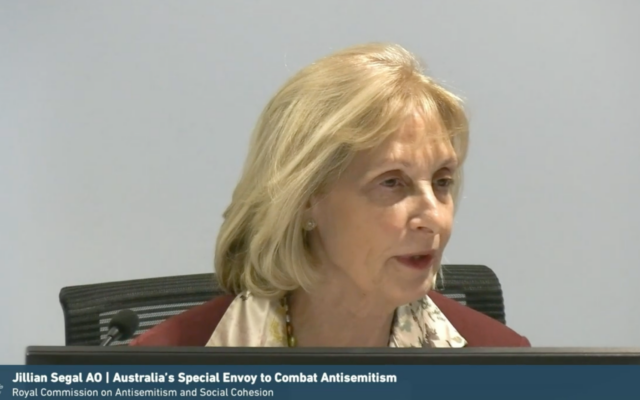
Australia’s Special Envoy to Combat Antisemitism Jillian Segal on the plan to implement antisemitism training across government, business and law enforcement
A member of the Jewish Community Council of South Australia, giving evidence under the pseudonym ‘Paul’, told the Royal Commission this afternoon that antisemitism in Adelaide, including in schools, has become markedly worse since 2022, with primary school children now enduring “quite elaborate bullying” simply for being Jewish, including incidences of being called “dirty Jews”.
Paul said that shift began in 2022 – predating the October 2023 Hamas attack in Israel – and pointed instead to a rise in antisemitic sentiment in South Australia “from the left wing of society”, whereas it had previously been “almost the providence of the far right.”
He linked this to what he called the “algebra of antisemitism” — a chain of reasoning whereby Israel is conflated with Jews generally, so hostility to the former curdles into hostility to the latter.
That conflation, he said, plays out constantly in the media, where “Israeli” and “Jew” are used interchangeably even when only Israelis, not Jews generally, are the subject of a report.
He said the pattern also shapes how Jews are perceived socially, recalling a university encounter in which a fellow student, on learning he was Jewish, immediately began questioning him about the Balfour Declaration and Israel’s borders.
Paul said he had no objection to discussing such issues, but objected to the underlying assumption — that “every Jewish person must have a view” on Israel, and that, depending on who is asking, “you’ll either be a good Jew or a bad Jew.” He called that expectation “really problematic”.
He explained that because most South Australians have never knowingly met a Jewish person, casual antisemitism can go unchallenged — and told how a friend recently overhead a workplace comment that “Hitler didn’t get everything wrong”.
Security concerns had also curtailed the small Jewish community of South Australia’s traditional interfaith and cultural events, leaving the burden of public education to fall on a handful of volunteers.
While acknowledging “all racism is abhorrent”, Paul said that folding antisemitism into a generic anti-racism framework risked minimising it by placing it “in a bucket with everything else”.
In light of the Bondi terror attack, and the broader rise in antisemitism, he said a specific, dedicated response was needed — one deployed in a way that is “contextually appropriate” for smaller, differently resourced Jewish communities, such as those in South Australia, Western Australia and Queensland.
On the term Zionism, Paul offered a personal definition: the right of Jewish people to self-determination in their ancestral. He lamented that the term had become toxic in progressive circles he identifies with: “We see in Australian discourse that Zionism is a dirty word… if I were to say that I was a Zionist to many of my peers in my progressive circles, I would be — people would be disappointed, if not worse.”
The witness became emotional describing an exchange with his six-year-old daughter, who asked why a security guard stood outside their synagogue. “I didn’t want to answer her, because at the moment, as a six-year-old, she doesn’t know… that the fact that she’s Jewish could lead to her being targeted.” He said giving evidence under a pseudonym was “antithetical” to his values, but necessary to protect his family.
On education reform, Paul told the Commission that legislation alone could not change hearts and minds: “If we’re not addressing the causes of hate, if we’re not addressing and humanising the perception of Jews within society, particularly in a place where they are not visible, like South Australia, we’re not going to be able to combat antisemitism.”
He offered his view of how anti-racism education should evolve as children age – that it should begin with “recognition and celebration of difference” across Australia’s multicultural society, before progressing to how hatred develops, how micro-aggressions surface in schoolyards, and how children can learn to be an “upstander” who actively responds to behaviour indicative of hate.
He stressed that any curriculum, when educating about antisemitism, must not dwell solely on Jewish adversity, but should also strongly focus on and highlight Jewish Australians’ positive contributions to the nation.
Paul also warned that national initiatives on addressing antisemitism that had a “one-size-fits-all” approach, risked ignoring the specific needs and environments of small, under-resourced Jewish communities like South Australia’s.
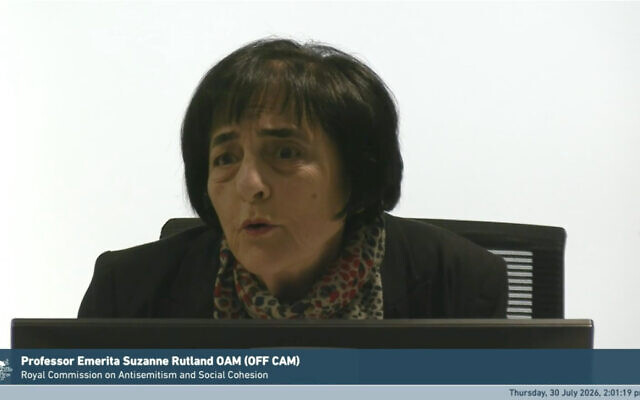
Holocaust education that is not delivered properly can itself generate antisemitism rather than combat it, University of Sydney professor emerita Suzanne Rutland warned the Royal Commission on Thursday.
Rutland, a member of the Australian delegation to the International Holocaust Remembrance Alliance (IHRA) since 2015, said she strongly supported making Holocaust education compulsory but that teaching the historical facts alone was not enough. “Unless Holocaust education is done properly, it can actually create antisemitism,” she said. “It was so clear in the Kaplan case, and it’s heartbreaking.”
Rutland was an expert witness in Kaplan v State of Victoria, the 2023 Federal Court case in which Jewish students succeeded in obtaining a declaration of unlawful discrimination against a Victorian school over antisemitic bullying.
She told the commission that professional development for teachers was vital, and that effective Holocaust education had to begin “where the students are at.” For Muslim students, she said, a teacher might start with the genocide in Bosnia, building from the message that “hate, any form of hate, is bad” and that verbal abuse can lead to physical abuse.
She invoked the late Holocaust scholar Yehuda Bauer, who she said reminded IHRA meetings again and again that “what begins with the Jews doesn’t end with the Jews,” and that the Holocaust is “the paradigm of genocide.”
Rutland said Holocaust education also needed to encompass Jewish life before and after the Holocaust, warning that concentrating only on the period between 1939 and 1945 carried particular risks with adolescent boys at an age when “there can be sort of admiration for things that are aggressive,” now magnified by social media. Teaching content had to be paired with empathy. “We have to enable school kids to understand Jews are people. There was a Jewish life before the Holocaust. There’s Jewish life now,” she said.
The professor also described an emerging phenomenon she called “Holocaust inversion,” which she distinguished from Holocaust denial and distortion. She said it was captured by a line from a recent Italian survey: “Jews were the victims. Now they’re the aggressors.” That framing, she said, underpinned accusations that Jews were “genocidal” baby killers, and drew on an older trope — familiar from her research on Soviet Jewry — that Jews had collaborated with or were themselves Nazis.
Rutland linked the phenomenon directly to the surge in antisemitism since October 7, 2023, which she described as a “tsunami.” “If Jews support Israel, that means they’re supporting a Nazi state, and that means they’re Nazis,” she said, explaining the logic of inversion. “That’s what inversion is.”
She said understanding Holocaust inversion was crucial to explaining what had happened since the October 7 attack, and expressed hope that the Royal Commission would help drive further research into its causes.
Jewish students in New South Wales government schools described their special religious education classes as “a safe place” away from the antisemitism they were experiencing elsewhere in the schoolyard, a study found — a result its author says shocked her research team.
Giving evidence to the Royal Commission on Thursday afternoon, University of Sydney professor emerita Suzanne Rutland said the finding emerged from a study she and her colleague Zehavit Gross conducted between 2008 and 2015, interviewing more than 90 participants across Jewish day schools and government-school scripture classes in Sydney and Melbourne, home to almost 90 per cent of Australia’s Jewish population.
University of Sydney professor emerita Suzanne Rutland.
Rutland said the study had not set out to research antisemitism at all, but to examine how Jewish education was working. “We were not expecting the students’ response, and remember, this is 2009,” she said. “This is a safe place. We were shocked. What do you mean this is a safe place?”
She said students had given “regular, if not unanimous” reports that they saw the classes — colloquially known as scripture classes — as a refuge. One recurring account was what she called the “coin story,” which she traced to an 1899 cartoon depicting a Jewish pawnbroker urging his son to fight back against a bully, with the son replying that he could not because he had his foot on a coin. The same story surfaced independently in a separate study in Canberra and in the Brighton Secondary College discrimination case in Melbourne. “It is horrific for Jewish kids that they are being attacked in school with this libel, this trope: all Jews care about is money,” she said.
Rutland, who was appointed a Member of the Order of Australia (AM) in 2008 for service to Jewish education and history, said the pattern was not confined to Jewish students. Through her later work with Better Balanced Futures, representing six major faiths, four of the six religious groups reported experiencing religious discrimination in the playground.
Hindu girls were teased about their jewellery, Muslim girls about wearing the hijab, and Jewish and Muslim boys faced taunts related to circumcision. Only Buddhist and Baha’i students did not report such discrimination.
She argued that grounding children in their own identity through religious education, alongside broader “worldviews” education about the faiths present in Australia, was essential to social cohesion — but that schools remained deeply resistant to teaching about religion at all. “If you do not put religion on the table, it’s going to operate under the table,” she said.
Rutland said one of the articles arising from the study, “Creating a Safe Space,” had recommended using special religious education as a strategy for combating antisemitism in schools. She said the classes gave children of the same faith a chance “to reinforce and ground themselves in who they are, not to be afraid … not to be afraid of hiding their identity, but to feel that their identity enriches them” — something she described as especially important since October 7.
She criticised the pace of reform, noting that only now was Victoria trialling such a program. “Why isn’t it being trialled everywhere?” she said.
Australia’s Special Envoy to Combat Antisemitism Jillian Segal has told the Royal Commission that Jewish patients are hiding their identity in hospitals and delaying medical care, while doxed Jewish artists remain excluded from the creative sector.
Segal outlined three manifestations of antisemitism in healthcare during her evidence.
“Patients being very scared to go into hospital, and therefore hiding their identity,” Segal said. “A large proportion of Jewish patients have indicated that they were very apprehensive about going into hospital and didn’t want to write down their religion, and those that, for example, had a particularly Jewish name or Israeli accent were even more fearful and were hesitant to answer any questions.”
Patients were also refusing or delaying treatment after feeling unsafe with clinicians, while some practitioners were directing overt antisemitism at Jewish colleagues.
Segal recommended the establishment of a time-limited national health task force reporting to the health ministers’ meeting, modelled on the education task force that has coordinated the schools antisemitism program.
“Because of the disparate and dispersed nature of health regulation and health delivery, it would be a way to bring everyone to the table,” she said, adding that the task force would bring together regulators, health boards, public and private hospitals, and state and federal departments.
The recommendations draw on the UK’s Lord Mann report into antisemitism in the health system. Segal noted the UK government had accepted that all 1.8 million people in its health system should receive antisemitism training.
“We’ve really learnt from what’s going on overseas, and quite striking that they’ve had the same experiences,” she said.
On the arts and creative sector, Segal drew a distinction between publicly and privately funded organisations, arguing public money carried additional responsibility.
“It’s devastating for the Jewish community that the Jewish artists have been so excluded following the doxing, and they were always such participants and engaged, whether it was on the boards of the organisations or actually as participants, as actors and musicians, and as philanthropists,” she said.
She pointed to a major theatre company that had developed a code of conduct making clear that all participants had a right not to be threatened and that political statements were not expected from the stage. The code was communicated to artists on contract and, Segal said, “it hasn’t dulled their vibrancy or the willingness of people to participate or perform. It has just set boundaries that everybody has accepted.”
Segal also recounted a story of a non-Jewish gallery owner who was threatened by other artists with departure if she did not drop a doxed Jewish artist from her roster.
She recommended that publicly funded arts organisations be required to maintain antisemitism policies and codes of conduct, that Creative Australia conduct regular data collection on antisemitism in the sector, and that all grants panel members undertake antisemitism training.
Segal proposed a special government-funded grant to support Jewish and non-Jewish artists collaborating on shared themes to rebuild social cohesion, replacing an earlier idea for a dedicated month celebrating Jewish artists, which she moved away from after artists expressed concern about backlash and tokenism.
“What they want is a proper reintegration, rather than a special one, and I can understand that too,” she said.
Australia’s Special Envoy to Combat Antisemitism Jillian Segal has revealed a new national centre has been established to deliver antisemitism training across government, business and law enforcement, as a UNESCO school pilot program expands to 200 schools nationally.
Giving evidence before the Royal Commission on Antisemitism and Social Cohesion, Segal said the standalone National Centre for Education Against Antisemitism had been incorporated with an independent board co-chaired by Jennifer Westacott and Catherine Fritz-Kalish.
“How do we capture the hearts and minds of good people to understand what antisemitism is, and that there should be an independent organisation that does that,” Segal said.
The centre will initially use training material trialled in the Department of Home Affairs and Attorney-General’s Department, before developing products for the business and private sectors.
Segal detailed the expansion of a UNESCO-developed antisemitism education pilot from 20 public secondary schools in New South Wales and Victoria to 200 schools nationally, backed by federal government funding. The rollout begins in Western Australia from August, with Catholic, independent and Islamic schools also set to participate.
“I am meeting with the president of the Islamic Schools Association next month to discuss how that might roll out,” she said.
The program is teacher-focused, equipping educators with knowledge, confidence and classroom materials rather than teaching students directly. Segal said teachers had told her “the most difficult thing for them was answering questions from students that they didn’t have the knowledge and the wherewithal to appropriately deal with the questions”.
She recounted school incidents that had personally affected her.
“I was very upset to hear of one student who had been accosted in the corridor and had his head pushed into an enclosed area and sprayed with deodorant as if it was gas from the chambers,” Segal said. In another incident, students returned from recess to find desks and chairs rearranged in the form of a swastika.
The Australian Curriculum, Assessment and Reporting Authority has been tasked with a targeted review of the national curriculum to identify opportunities for antisemitism education and critical thinking. An education task force chaired by David Gonski meets monthly and brings together education departments, curriculum bodies and teachers’ organisations nationally.
Five evaluation streams will assess the program, with initial results due in October and a comprehensive national assessment in October 2027.
Segal also recommended trauma-informed antisemitism training for police, drawing on a trial with the Australian Federal Police and international models including the New York Police Department.
The chief executive of an education charity founded by the Jewish community has told the Royal Commission on Antisemitism and Social Cohesion that his organisation was falsely accused in a flyer handed out at a Victorian teachers’ conference of embedding anti-Palestinian racism in schools.
Mike Zervos, CEO of B’nai B’rith Courage to Care Victoria since August 2018, gave evidence on Wednesday, tendering a statement dated 6 July 2026 alongside a submission lodged in the name of Courage to Care Australia.
Mike Zervos, CEO of Courage to Care Victoria. Photo: Screenshot
Zervos said the charity was made aware in November last year that a flyer circulating at a Victorian Association for the Teaching of English conference was headed “How government-funded programmes embed anti-Palestinian racism in Victorian schools” and named Courage to Care as the organisation responsible.
“This was simply not true. It completely misrepresented who and what we are,” he said.
The material described the charity as pro-Israel, he said, and its footnoted reference pointed not to Courage to Care but to the B’nai B’rith Victoria website. He said the flyer also criticised him over an opinion piece he wrote last October about the Melbourne Marathon, in which he contrasted city streets closed for a collaborative purpose with streets filled with hate speech and division.
Zervos said he emailed the group three times seeking a meeting between educators to correct the errors. He received one reply asking him to set out his concerns, and no response to two further emails, the last sent in the first week of December.
He told the commission the charity’s programmes deliberately avoid geopolitics, using documented history instead, and that raising current conflicts in a classroom where presenters do not know students’ backgrounds would be “educationally irresponsible”.
Days after the conference, the charity received an unsolicited evaluation form from a school it had visited weeks earlier. Zervos said it did not comment on the programme but criticised the organisation as pro-Israel. He acknowledged the link was his own inference, but said the timing was highly unusual, and that his greater concern was how widely the flyer’s claims had travelled.
Zervos, who describes himself in his statement as a Greek Orthodox Christian, said the wellbeing of staff and volunteers was heartbreaking.
“This is my 50th year working. I’ve never experienced anything like this before,” he said.
He said volunteers now ask whether it is safe for a child or grandchild to wear a school uniform that identifies them as Jewish. One told him they were glad their parents were not alive to see what the Jewish community was being exposed to, after coming to Australia for a better life.
Zervos said he remained unable to accept that an armed guard outside a meeting at a school or synagogue was now treated as “typical and normal and acceptable”, adding that he struggled to understand how that happened in Australia in 2026. After each news report of an antisemitic incident, he said, he had to ask his team whether anyone they knew was involved. Ahead of his appearance at the commission, staff discussed reviewing security at the charity’s office.
Courage to Care was established by B’nai B’rith in 1992 to show what happens when discrimination goes unchallenged, and to highlight those who intervene. It has reached more than 500,000 students nationally.
Its 90-minute Upstander programme is delivered free to government, Catholic and independent schools. It runs from grade five to year seven and at secondary level, and about a third of the Victorian work is in regional and rural schools.
The programme opens with a video on pre-war Germany and the rise of the Nazis, often the first time students encounter the Holocaust. That is followed by testimony from a survivor or a family custodian, then a facilitated discussion on stereotyping, using images including a student in a wheelchair, a student of a different skin colour and a girl in a hijab.
Students are also shown a pyramid of hate running from stereotyping through prejudice, discrimination and violence to genocide, with recent Australian examples including the firebombing of places of worship and the Bondi murders.
Zervos said more than 90 per cent of teachers recommended the programme to colleagues, and school bookings had tripled since COVID. Free digital lesson plans for year 8 and year 9, introduced two years ago, have reached about 100,000 students.
He stressed the charity was not an advocacy or political organisation, and that its universal focus was by design.
Courage to Care made three recommendations: sustained funding for education addressing all forms of discrimination, not antisemitism alone; building teacher capability across the system; and recognising community organisations as delivery partners, with Zervos urging the commission to consider “partnership rather than short-term grant funding”.
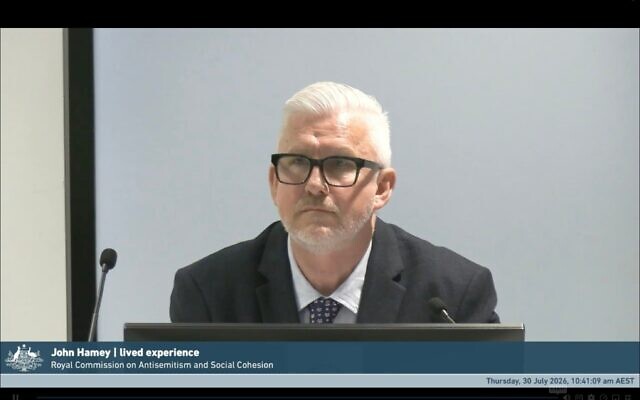
The chief executive of the NSW Board of Jewish Education has told the Royal Commission on Antisemitism and Social Cohesion that students at a Sydney public school invented a points-scoring game called “Trip a Jew”, in which Jewish classmates were targeted to be tripped over.
John Hamey said the incident was reported to the BJE in May. Students scored a set number of points for making a Jewish student stumble and a higher number for making one fall, tallied the results at the end of the day, and named the highest scorer “king of the Jews”.
Hamey, a practising Roman Catholic, spent 11 years at Moriah College, five as head of high school and seven as principal, before returning to Jewish education as BJE chief executive in 2024. He worked at the school between 2007 and 2018.
John Haney, chief executive of the NSW Board of Jewish Education. Photo: Screenshot
In his witness statement he said that although he is not Jewish, “antisemitism has profoundly shaped both my professional life, my identity, and my understanding of social cohesion in Australia”.
He told the Commission that when he arrived at Moriah in 2007, what troubled him most was the “matter of fact resignation” among students that antisemitism was an ordinary part of their lives. Many saw no point in reporting it, he said, because “nothing would happen”.
During his years as principal, Jewish students at interschool events had coins thrown in front of them to see whether they would pick them up.
Swastikas appeared on desks and lockers. Boys had their kippot flicked off their heads as they walked through the gates of other schools. Taunts invoked the gas chambers and the claim that “Hitler should have finished the job”.
On one occasion, a visiting school left swastikas drawn across the lockers of Moriah’s gymnasium. On another, members of the public stormed a school bus and chanted antisemitic slurs at primary school children.
Responses from counterpart principals varied, Hamey said. Some contacted him immediately to repair relations between the students involved. Others never returned his calls, instead referring the matter to a deputy or a head of year.
“That suggested to me that they didn’t understand the seriousness of the matter,” he said.
Responsibility was often shifted onto the Jewish student, he told the Commission, recalling one principal who suggested the boys would not be targeted if they did not arrive wearing kippot.
Hamey said that amounted to an expectation “that they conceal their identity in order to exist and be present in that space”.
The BJE delivers special religious education in NSW public schools alongside camps, youth programmes and trips to Israel. Since taking up the role, Hamey said, reports have reached him from parents, students and BJE educators.
He described being asked to join a restorative meeting at a school after a Year 7 student was told that Hitler should have killed all the Jews.
Jewish students were also being called to account for the actions of the Israeli government, he said. On two occasions reported to him, a teacher had asked a Jewish student to explain to the class “why Israel is doing what it’s doing”.
Hamey told the Commission he had visited a public primary school earlier this year and found a teacher sitting in on a BJE lesson with a laptop bearing a “Free Palestine” sticker beside an Israeli flag sticker with a red cross drawn through the Star of David.
When he raised it afterwards, the teacher said she was “proud to be anti-Israel”. He said he told her the stickers created “a hostile environment for students that were Jewish” and that she was not meeting her obligation to remain apolitical in the classroom. Most principals he had approached about political posters in school corridors were responsive, he said, and had simply not realised there was an issue.
Schools with only two or three Jewish students were often the least equipped to respond, Hamey said, lacking both cultural knowledge and “the language of antisemitism”, and tending to treat incidents as ordinary bullying because the subject was politically contentious.
He said BJE teachers felt they were under a degree of scrutiny not applied to educators from other faith traditions, while carrying their own grief. Some knew victims of the Bondi terror attack. He also told the Commission that local residents had left flowers and notes of support at the BJE’s door after October 7 and again after Bondi.
The BJE’s submission recommends antisemitism and anti-Zionism training in teacher education, a clear definition of antisemitism for educators to work from, and trauma-informed wellbeing responses.
It also calls for formal reporting of incidents within existing departmental frameworks, accountability for school leaders through their performance processes, and structured access to faith community leadership for schools across all sectors.
On trauma, Hamey said “the sum total of all of these little incidences” could shape what children came to believe about their worthiness, whether they were accepted, and whether they should conceal things about themselves.
Asked by the Commissioner whether restorative meetings between students worked, Hamey said their impact was minimal because it was confined to the immediate aftermath.
“The bigger question is not what the student said, but why the student has said that.”
A mother has told the Royal Commission on Antisemitism and Social Cohesion that her son endured 12 antisemitic incidents at his school across 2023 and 2024, ranging from Nazi salutes and praise for Hitler to a student yelling “f**k the Jews” at him during recess.
Giving evidence as Witness ACZ, she said her older son had been told by one student that he wanted to “carpet bomb Israel”, while another repeatedly invoked Kanye West, who had made antisemitic comments around that time. At a school camp, her son was subjected to comments including “I don’t like Jews, Hitler was great” and “Heil Hitler”. One student later told him “I love Hitler”, and when asked why he hated Jews, replied that Jews “will take over your business”.
The witness said the school had responded seriously and supportively, speaking to students individually and, on some occasions, securing apologies. But her son had come to feel that handling incidents “on a spot fire sort of basis” was not enough, and emailed school leadership requesting a school-wide presentation on antisemitism.
Witness ACZ said she had been “blindsided by the explosion of Jew hatred in Australia after October 7” and had undertaken training with a charity, the Movement Against Antizionism, to better understand contemporary forms of the hatred. She drew a distinction between “anti-Zionism” written with a hyphen — which she described as a historical debate largely between Jews in the late 19th and early 20th centuries — and “antizionism” as a single word, which she called “a form of bigotry that trades on being conflated” with that debate.
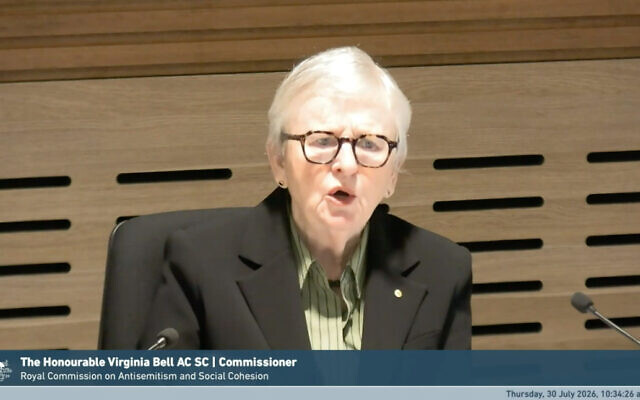
Commissioner Virginia Bell questions Witness ACZ.
“They say that they’re critics of Israel, but actually they don’t believe Israel should exist. They have an eliminationist perspective,” she said. Questioned by Commissioner Virginia Bell, she said genuine critics of Israel discussed peace and a two-state solution, whereas antizionists did not. “You criticise something you want to improve it, but they’re not doing that. They’re just wanting to see it gone.”
She also described a teacher who entered her son’s classroom wearing a large “Free Palestine” badge featuring a fist of resistance in the Palestinian flag colours. Her son told the teacher he felt uncomfortable, left the room and reported it. While she did not believe the teacher was antisemitic, she said the fist of resistance was, for many Jewish people, associated with violence, and political badges “just shouldn’t, in my view, be worn into schools”.
The witness advocated education reform across three areas: contemporary Jew hatred including antizionism, the Holocaust, and Jewish civilisational history and contributions. The third, she said, was “probably the piece that’s missing”, noting that of 35 history lessons her son had this year, only one covered the Holocaust. Grounding students in Jewish history could “inoculate” them against the “libels and conspiracies” circulating online.
She strongly supported interfaith initiatives, citing programs such as Together for Humanity, but said that in “a post Bondi Australia” they needed to run alongside programs focused specifically on Jew hatred.
The AJN is providing rolling coverage on the Royal Commission on Antisemitism and Social Cohesion.
A mother has told the Royal Commission on Antisemitism and Social Cohesion that her son endured 12 antisemitic incidents at his school across 2023 and 2024, ranging from Nazi salutes and praise for Hitler to a student yelling “f**k the Jews” at him during recess.
Giving evidence as Witness ACZ, she said her older son had been told by one student that he wanted to “carpet bomb Israel”, while another repeatedly invoked Kanye West, who had made antisemitic comments around that time. At a school camp, her son was subjected to comments including “I don’t like Jews, Hitler was great” and “Heil Hitler”. One student later told him “I love Hitler”, and when asked why he hated Jews, replied that Jews “will take over your business”.
The witness said the school had responded seriously and supportively, speaking to students individually and, on some occasions, securing apologies. But her son had come to feel that handling incidents “on a spot fire sort of basis” was not enough, and emailed school leadership requesting a school-wide presentation on antisemitism.
Witness ACZ said she had been “blindsided by the explosion of Jew hatred in Australia after October 7” and had undertaken training with a charity, the Movement Against Antizionism, to better understand contemporary forms of the hatred. She drew a distinction between “anti-Zionism” written with a hyphen — which she described as a historical debate largely between Jews in the late 19th and early 20th centuries — and “antizionism” as a single word, which she called “a form of bigotry that trades on being conflated” with that debate.
Commissioner Virginia Bell questions Witness ACZ.
“They say that they’re critics of Israel, but actually they don’t believe Israel should exist. They have an eliminationist perspective,” she said. Questioned by Commissioner Virginia Bell, she said genuine critics of Israel discussed peace and a two-state solution, whereas antizionists did not. “You criticise something you want to improve it, but they’re not doing that. They’re just wanting to see it gone.”
She also described a teacher who entered her son’s classroom wearing a large “Free Palestine” badge featuring a fist of resistance in the Palestinian flag colours. Her son told the teacher he felt uncomfortable, left the room and reported it. While she did not believe the teacher was antisemitic, she said the fist of resistance was, for many Jewish people, associated with violence, and political badges “just shouldn’t, in my view, be worn into schools”.
The witness advocated education reform across three areas: contemporary Jew hatred including antizionism, the Holocaust, and Jewish civilisational history and contributions. The third, she said, was “probably the piece that’s missing”, noting that of 35 history lessons her son had this year, only one covered the Holocaust. Grounding students in Jewish history could “inoculate” them against the “libels and conspiracies” circulating online.
She strongly supported interfaith initiatives, citing programs such as Together for Humanity, but said that in “a post Bondi Australia” they needed to run alongside programs focused specifically on Jew hatred.
Enjoy Unlimited Access To The Australian Jewish News Website And All Our Online Content For AUD$18/month Or Just AUD$120/year.



comments