



Live updatesPublic hearings
Arts sector in focus at Royal Commission
The Royal Commission's sixth hearing block continues in Sydney, examining frameworks to counter antisemitism in government, healthcare, schools and the arts.
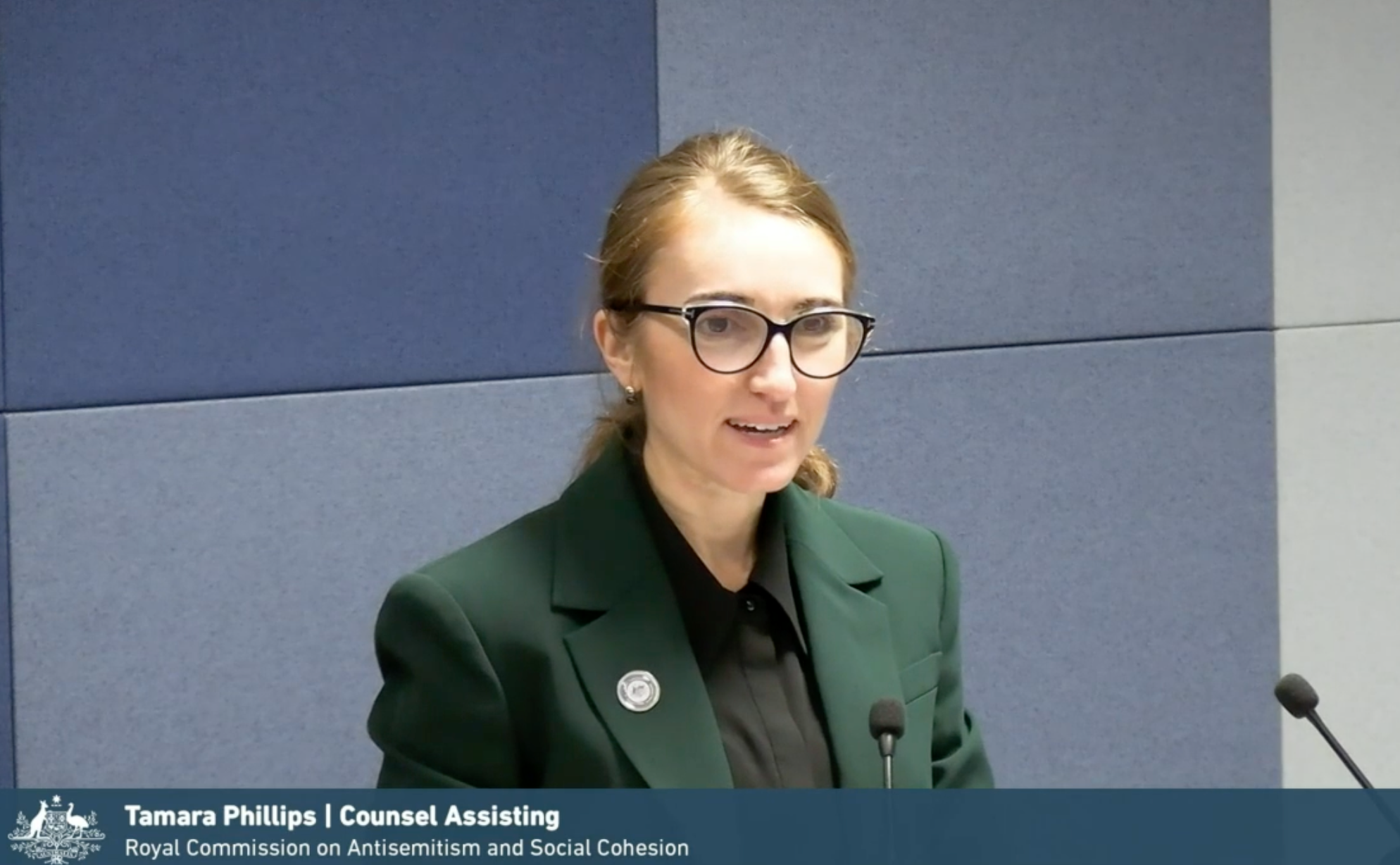
A person in a senior role at Creative Australia made social media posts that the arts body’s acting CEO has agreed were inappropriate and did not comply with its bullying and harassment policies, the Royal Commission heard on Friday afternoon.
Tim Blackwell, executive director and acting CEO, was shown an anonymised set of the posts during cross-examination by Zoe Hillman, appearing for a various Jewish organisations, who asked him to assume they had been made by someone who “was in a senior role within Creative Australia”.
Blackwell agreed the posts were inappropriate for a person in a senior leadership role, and agreed they did not comply with the organisation’s bullying or harassment policies.
Asked what steps Creative Australia could take, Blackwell said the matter had been handled by the then chief executive, who spoke to the person involved. That person agreed to take the posts down and issue a statement. Blackwell, who said he had not dealt with the matter directly, confirmed that was “the end of the matter”.
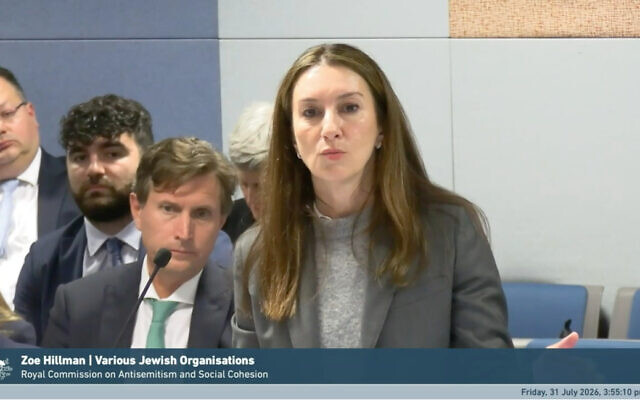
Hillman also questioned Blackwell about the management of conflicts of interest among the agency’s peer assessors — the industry figures who assess grant applications — who remain eligible to apply for Creative Australia funding themselves during their tenure. Blackwell agreed a robust conflicts policy was “all the more important” as a result, but said conflicts were managed primarily through self-declaration by the assessors. He said he was not aware of any “formalised programme” of audits or sample checks to verify those declarations against underlying documentation.
On the handling of complaints, Blackwell agreed Creative Australia’s feedback management policy did not offer differentiated pathways for employees, artists and members of the public, and confirmed there was no policy governing when a complaint should be referred to another authority such as the Australian Human Rights Commission or police.
He said the agency was giving consideration to improving its grievance-handling framework, including better classification and reporting of complaints.
Creative Australia has no framework defining antisemitism or hate speech to guide staff deciding whether to award funding, and relies instead on the “experience” and “judgement” of its people, its acting CEO has told the Royal Commission on Antisemitism and Social Cohesion.
Tim Blackwell said the agency’s decision-making policy contained a “contentious issues” section that could take an applicant’s history into account, including through examples such as projects or applicants “likely to attract significant media attention”.
But under questioning from Counsel Assisting Zelie Heger, he agreed much of the policy was directed at the project rather than the applicant.
Heger put to him that the policy provided no guidance on “recognising what hate speech is, or what various manifestations of hate speech might look like”, and asked how a decision-maker was expected to understand what they were looking for. Blackwell said that was “based on the experience of the people that we have working in our organisation, and the judgement that they can exercise”.
Asked whether a more prescriptive policy would be useful, Blackwell agreed. He said the executive had on May 27 approved a learning and development plan including specific training on antisemitism, Islamophobia and racism, drawing on material from Monash University, the Sydney Jewish Museum and SBS, to be rolled out during the current financial year.
The inquiry also heard about the agency’s administration of the Australian Cultural Fund, a platform for tax-deductible donations to artists. Heger raised correspondence about the fund allowing donations to an online journal, Pearls and Irritations, after a complaint that an article had expressed support for Hamas and the October 7 attack on Israel.
Blackwell said Creative Australia had responded by introducing three amendments to the fund’s requirements, aimed at ensuring money raised was used only for arts and cultural activities.
Asked how those amendments addressed the concern about support for a listed terrorist organisation, he acknowledged they did not do so directly, and said a proposed expansion of the fund’s policy to capture breaches of anti-discrimination law would be a “more direct response”.
Creative Australia interprets its power to recover taxpayer funding from arts grantees so narrowly that it does not apply where a recipient’s alleged misconduct is unrelated to the specific project funded, the Royal Commission on Antisemitism and Social Cohesion has heard.
Tim Blackwell, executive director and acting CEO of Creative Australia, told the inquiry that the agency’s standard funding agreements allowed it to terminate an agreement and recover funds where a recipient breached work health and safety or anti-discrimination laws.
Counsel Assisting Zelie Heger took him to a clause requiring compliance with all applicable state, territory and Commonwealth work health, safety and anti-discrimination laws, and a further clause providing for repayment where a recipient did not comply.
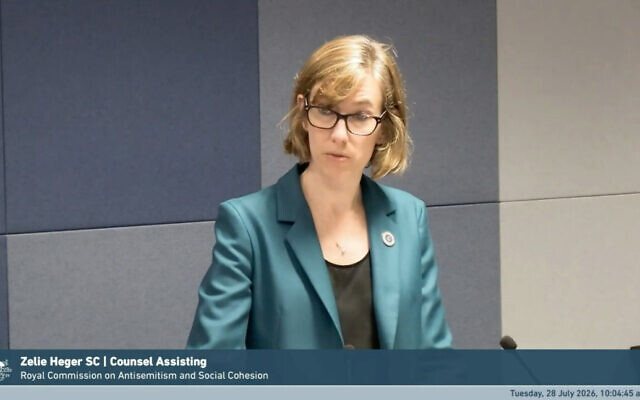
But Blackwell said Creative Australia had interpreted the condition as applying only in relation to the particular funded project. Heger suggested the clause was, “on one view, a little broader than that”, capturing conduct “in any context, not just in respect of the particular project”. Blackwell replied: “Well, we’ve interpreted it as in relation to that particular project.”
He was asked about the case of an artist, Matt Chun, referred to in his statement, where a complaint was raised after funds had already been provided. Blackwell said the grant, made from memory in June 2023, was for a project unconnected with the substance of the complaint, and so Creative Australia did not have the power to withdraw it.
Asked whether it would be desirable to have a funding condition capturing a broader range of conduct, Blackwell said that would be “very, very difficult”, as the agency would then be “assessing the character of a particular person, rather than the project that they’ve applied for funding for”.
Creative Australia has no policy setting out what it should do when it receives a complaint that a funding recipient has engaged in antisemitism, and no power to investigate such complaints itself, the arts funding body’s acting CEO told the Royal Commission on Friday afternoon.
Tim Blackwell, executive director and acting CEO of Creative Australia, said the organisation had “no ongoing monitoring or investigatory powers” and was reliant on law enforcement agencies such as the Australian Federal Police, ACMA and the eSafety Commissioner to determine whether particular conduct was unlawful before it could consider the impact on any funding.
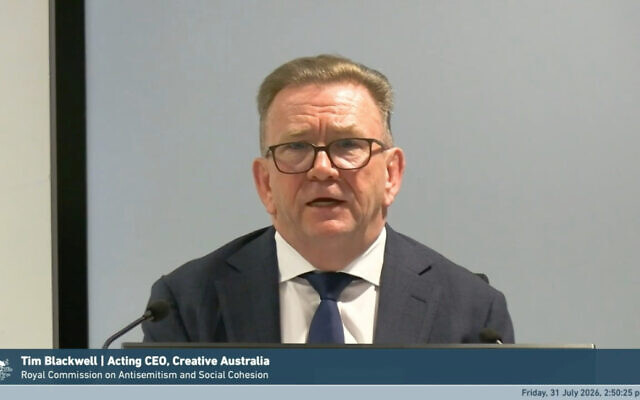
Under questioning from Counsel Assisting Zelie Heger, Blackwell agreed that Creative Australia would not conclude a grantee had breached the anti-discrimination conditions of its funding agreement unless it had received advice from police or another relevant body. He said the organisation could not compel anyone to provide information. “It is difficult for us to investigate with any compulsion,” he said.
Asked whether any policy set out what should happen between a complaint being referred to police and a court reaching a final determination, Blackwell said he did not recollect “that specific wording in any of our policies”. He also confirmed that none of the agency’s policies defined antisemitism, relying instead on anti-discrimination provisions to cover “all forms of racial discrimination”.
Heger put to him that there was “a gap in the existing policies of Creative Australia” over what to do on receiving such a complaint. Blackwell said a significant matter would be escalated to the executive and dealt with “on a transactional basis” with legal advice, but conceded: “We don’t have a codified policy that sets out how we would refer something, say, to the Australian Federal Police.”
Asked about the prospect of Creative Australia being given its own investigatory powers, Blackwell said that would be “very novel”, would require additional funding and might duplicate the work of other government bodies. He pointed instead to the agency’s Creative Workplaces arm, which develops model codes of conduct and workplace policies for arts organisations to adopt.
Creative Australia has no power to investigate complaints that the artists and organisations it funds have engaged in antisemitism, racism or hate speech, the Royal Commission on Antisemitism and Social Cohesion has heard.
Tim Blackwell, executive director of corporate resources and acting chief executive of the federal government’s principal arts investment body told the commission he had been acting chief executive for about four and a half weeks, his second such stint while chief executive Adrian Collette is on medical leave.
Asked what Creative Australia could do where a grant recipient was alleged to have engaged in hate speech, racism or antisemitic conduct, Blackwell pointed to the standard funding agreement.
It requires recipients to comply with all applicable state, territory and Commonwealth work health and safety and discrimination laws. He agreed that a breach of those laws could result in funding being cancelled.
Organisations on multi-year funding agreements carry an additional obligation to have a policy in place ensuring they comply with relevant discrimination law.
Blackwell said that condition applied to those organisations because they were funded to carry out activities over a period of time, rather than for a single project.
Creative Australia does not formally monitor compliance, he said, relying instead on reporting from multi-year funded organisations. Asked whether the agency had received notifications alleging that a grantee had breached anti-discrimination laws, Blackwell said he was “not aware of any of those”.
The commission heard that Creative Australia is a statutory body established under the Creative Australia Act, continuing the work of the Australia Council for the Arts, which has had statutory form since 1975. Its board is appointed by the Minister for the Arts.
In 2024-25 the agency invested about $286 million in the arts sector and supported more than 5000 artists and creative organisations. Investment ranges from multi-year funding agreements with Opera Australia, the symphony orchestras and the major theatre companies through to short-term project grants for individual artists, alongside indirect investment in research and capability building.
The agency also administers the Australian Cultural Fund, a platform for tax deductible private donations to artist-led campaigns, which facilitated about $17 million in 2024-25 and represents roughly five per cent of total investment.
Funding decisions are applicant led and assessed by peer assessors, industry advisers or, for a small proportion of programmes, staff. Decisions are made on the basis of artistic or creative merit and impact, under guidelines published for each programme.
Blackwell confirmed those decisions are made at arm’s length from the arts minister. He said the Act specifically provides that the minister must not direct Creative Australia in the making of individual funding decisions, though the minister may issue general direction through a statement of expectations.
The commission was taken to the statement of expectations issued in August 2025, which called on Creative Australia to develop and implement clearly documented risk management policies for its programmes. In its statement of intent in reply, the agency said its documented approach to risk management was under review.
Asked where that review had reached, Blackwell said the work was not finished.
“I think it’s a continual process,” he said, describing work on tools to assist at various stages of the granting process, including assessing whether applicant organisations had good governance over their own funds.
Blackwell said the agency’s function of upholding freedom of expression in the arts, set out in the Act, had to be balanced against its obligations under the Public Governance, Performance and Accountability Act to use public money effectively and efficiently, and against its other statutory functions.
He agreed that the function of promoting fair, safe and respectful workplaces could at times sit in tension with freedom of artistic expression.
Pressed on how the agency’s expectation that grantees obey the law sat with its lack of monitoring, Blackwell said it was important to understand what powers Creative Australia did not have.
“We’re not an investigatory body. We don’t have classification and those sorts of powers,” he said.
Holocaust education cannot be expected to carry the burden of fighting antisemitism on its own, the Royal Commission on Antisemitism and Social Cohesion has been told.
Professor David Slucki, director of the Australian Centre for Jewish Civilisation at Monash University, returned after the lunch break to give further evidence, turning to his centre’s recent report on Holocaust education in Australia.
Slucki said the report had grown out of his earlier research in the arts sector, where his team had spoken to Holocaust institutions and educators about the expectations placed on them.
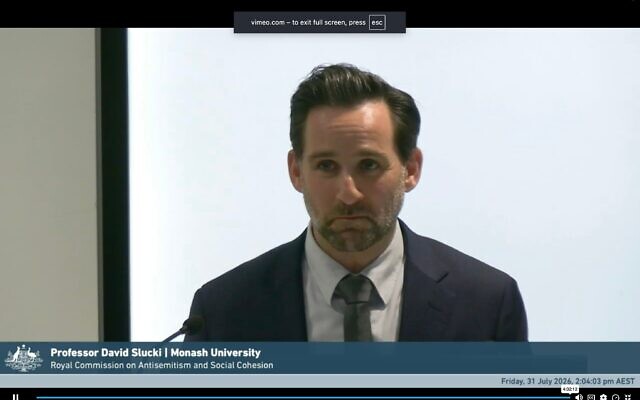
“The cliché has become someone says or does something antisemitic, and the response is you send them to the Holocaust museum,” he said, on the assumption that offenders would be confronted with “the logical endpoint” of antisemitism.
That expectation did not match how educators understood their own work. “Many of them don’t see it as their role specifically to combat antisemitism,” he said, adding that the foundations of Holocaust education in schools, universities and museums had rarely been built around that goal.
Holocaust education had expanded since the 1990s and was now mandated in some state curriculums, he said, but its impact had not been measured well enough.
“What we’ve done really well is promote awareness of the Holocaust, but knowledge and lessons and things like that, that’s a bit trickier.”
He pointed to the Melbourne Holocaust Museum’s evaluation mechanisms as an example of newer practice, and said the sector needed to be “a bit cautious about any single approach as a kind of silver bullet”.
Asked whether he agreed with the evidence of the MHM’s CEO, Dr Breann Fallon, earlier in the week that Holocaust education was a form of civics education, Slucki said he could not agree more, and that his own research bore it out. He said he would like to see compulsory civics education in universities and more broadly.
Slucki, a grandson of survivors, said a narrow focus carried its own risk. “If that’s all people learn about Jews, then all they see is ageing victims, not as real life breathing humans, and they see it in black and white.”
For students now aged 18 to 20, he said, even September 11 was ancient history, and the Holocaust could feel as remote as the Napoleonic Wars. That distance “puts antisemitism in the past and … Jewish life in the past, not as part of Australian society”.
When his son’s Year 10 class studied the Holocaust recently, Slucki said, the experience was visceral for his son but closer to a World War I lesson for his classmates. He said the community also needed to be mindful of how it transmitted that history without traumatising the next generation.
Earlier in his evidence, Slucki addressed governance in arts organisations after October 7.
Boards had been caught out by the speed and ferocity of the discourse and of the targeting of Jewish artists, and had scrambled over whether to issue statements and what those statements should say.
Their attempts to balance the distress of Jewish Australians against the concerns of Muslim, Palestinian and Arab staff and artists satisfied nobody.
What was missing, he said, was “really meaningful, robust consultation”, both with Jewish staff and artists and with the wider communities those organisations worked with.
Many organisations lacked the capacity to do better. The sector was “chronically underfunded”, he said, and smaller companies operating “on the smell of an oily rag” could not build out policy suites or complaints procedures.
In those organisations one person was acting as chief executive, chief financial officer and head of people. Witnesses at small galleries had been left without recourse when a board proved unsupportive.
On social media, Slucki said the boundary between private citizen and representative had eroded.
“Increasingly it’s hard for us to consider ourselves private citizens,” he said, arguing the test should be conduct towards other artists, philanthropists and audiences, and that Australians should hold “high expectations around the ways people conduct themselves in a democratic country like Australia”.
Asked how the sector could centre Jewish lived experience, he began with consultation. “There’s about 117,000 Jews in Australia, and probably about 500,000 different ways of being Jewish among that population,” he said.
Leaders too often relied on a single Jewish friend or colleague for approval, producing echo chambers. “What sector leaders have to do is consult widely around the Jewish community, not just with people with whom they agree.”
He said the community already had a substantial calendar of festivals, including Melbourne Jewish Book Week, the Sydney Jewish Writers Festival and In One Voice, though audiences tended to be drawn from within the community.
Partnerships with major arts organisations, of the kind pursued by Sydney’s Shalom Collective and Melbourne’s Kadimah, mattered more.
He warned against “ghettoising” Jewish cultural creativity, a word he said he used deliberately and knew was loaded, and against “only allowing Jews of a particular political persuasion to participate in the sector”.
That, he said, “is going to have the opposite effect”.
A leading Jewish studies academic has told the Royal Commission today that punitive responses to antisemitism are “not a very large piece of the puzzle”, and that the arts sector instead needs deeper cultural change to address what he called the “all or nothing thinking” now pervading debate around Israel and Gaza.
Professor David Slucki, director of the Australian Centre for Jewish Civilisation at Monash University, returned to give further evidence on the findings of the Monash Initiative for Rapid Research into Antisemitism (MIRRA), whose report “Antisemitism in the Cultural and Creative Industries” drew on 64 interviews and 31 workshop attendees across the arts.
Professor Slucki said the research deliberately prioritised impact over intent, since focusing only on whether conduct was technically antisemitic missed the real harm being done.
“Sometimes we sort of think about this stuff in these kind of binary terms: is this antisemitic or is it not antisemitic?,” he said.
“Our feeling is well, that doesn’t capture the whole story,” he said, noting the impacts documented included lost work, lost livelihoods, and people leaving the sector altogether.”
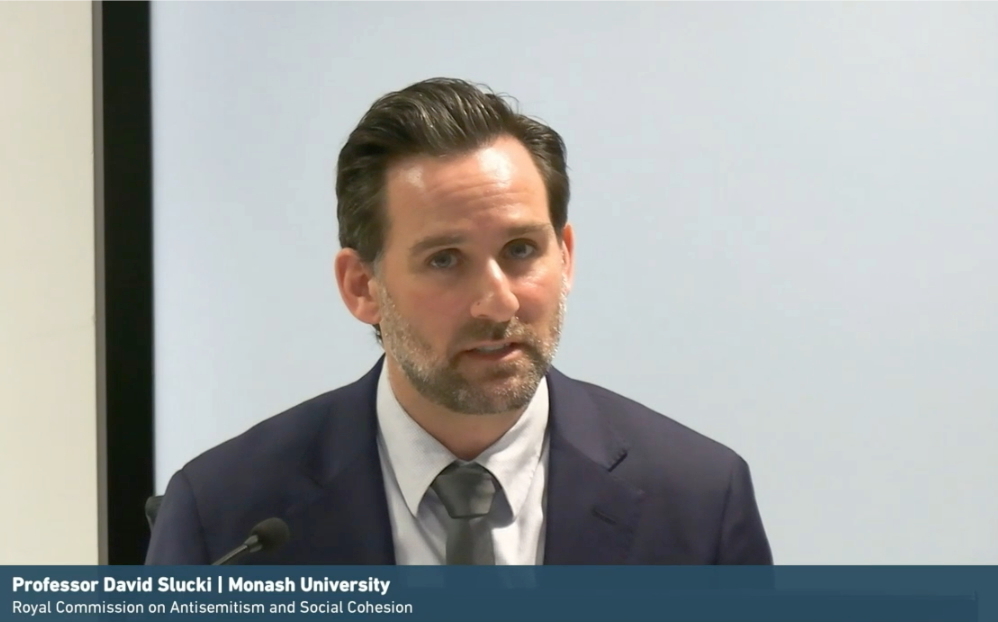
While agreeing with a proposition put to him that intent might carry more weight in a criminal or disciplinary setting, Professor Slucki nevertheless argued that policy, procedures, and education instead needed to focus on impact over intent, including cultural.
“There’s not always a legal or policy instrument that can capture that thing, and sometimes it’s a question of what kind of culture do we want in our organisation,” he said, describing a detrimental climate of “cancellation and counter cancellation” in which disagreement quickly escalates into accusations that someone is “a fascist genocidal baby killer” on one side, or “a Jew-hating antisemite” on the other.
He said many politically progressive Jewish artists had found themselves squeezed by an expectation that they engage in “full-throated condemnation” not just of Israel’s conduct but of its existence.
Support for Palestinians was not the issue, he said, but “increasingly, it’s hard to just hold the criticism without also incorporating the idea that Israel ought not exist,” which became “a bridge too far” for many Jewish people in the creative and arts sectors, isolating them socially as well as professionally.
That isolation, Professor Slucki said, had produced a “sense of cultural homelessness”, with artists who had never considered their Jewishness central to their work suddenly finding institutions such as the Jewish Museum of Australia or Shalom Collective were the only places willing to exhibit or stage them.
“The worst outcome of all of this is if Jewish artists end up only being able to work in Jewish organisations and not as part of the broader artistic world,” he said.
He described the targeting of Jewish philanthropists as “one of the most disturbing parts of this”, built on “classic old anti-Semitic tropes about Jews in power and wielding their financial wealth”, often couched in language about Zionism, and sometimes surfacing subtly, such as a qualified job applicant being asked whether there was “a values alignment” with donors they had previously worked with.
On artistic freedom, Professor Slucki said the concept was often invoked inconsistently. “It can’t just be academic or artistic freedom for people on my side,” he said, arguing that campaigns to harass or cancel artists were themselves “an imposition on their artistic freedom”, not an exercise of it.
He also pointed to structural weaknesses across a sector he likened to “the Wild West”, where small festivals or venues often lack the HR capacity of larger institutions to develop codes of conduct.
Antisemitism in the sector, he said, tended to be “horizontal rather than vertical” — driven by peers rather than leadership — with the harm from leaders instead more often felt as abandonment, as boards and organisational heads found themselves “hamstrung”, squeezed by groups aggrieved from different directions.
Professor Slucki said embedding cultural competency training across the sector was central to his recommendations.
I can’t understate how important I think education is as part of the way forward here,” he said.
Rabbi Meltzer added that a 2025 Sydney Opera House production about Anne Frank drew comments branding it as “Zionist propaganda”.
He told the Commission it had attracted comments, related to the war in Gaza, like Anne Frank “would have been dismayed at the ‘genocide’ occurring”, and comments calling the Holocaust itself, and Anne Frank’s story, a “conspiracy”.
He said, “It was such a shocking moment that people could come out and attack something so innocent and so simple and so needed in that moment . . . it shook us”.
Rabbi Meltzer also described how a Jewish poetry project at that year’s Jewish Writers’ Festival, a Shalom Collective-presented event staged in the Bondi Pavilion courtyard, was “co-opted” after a social media influencer added an unauthorised cube declaring “you are slaves to Zionism. It’s time for another exodus,” and rearranged a magnet wall to attack Zionism.
Rabbi Meltzer said the project – which was not billed as an Israeli event – was recast as “problematic” simply for not including a Palestinian or anti-Israel voice.
He told the Commission Shalom Collective’s approach to security had fundamentally changed since the Bondi Chanukah attack. Previously, event locations were shared publicly in the spirit of inclusion; afterwards, the Jewish Food Festival needed a new, enclosed venue, plus riot police and sniffer dogs — a shift costing “tens and tens of thousands of dollars”, on top of venues often separately charging for security already provided by the Community Security Group and police.
“Everything changed, and now the entire planning had to occur around the security needs, rather than the security needs occurring around the contents and planning of the event,” he said.
Asked what could help bring Jewish creatives back into civic life, Rabbi Meltzer said institutions needed “to be brave” and resist a “very fringe part of our society” suggesting Jewish stories did not belong, while grassroots audiences also had a role.
He pointed to “Holding Light”, a Shalom Collective exhibition with Waverley Council at the Bondi Pavilion and his final project with the organisation.
“If we value and appreciate indigenous stories, and Asian stories, and South American stories… then we should be able to value the Jewish story,” he said, describing it as carrying “universal morals” important to Australia’s social fabric.
A Sydney rabbi has told the Royal Commission on Antisemitism and Social Cohesion that a brand agency advised his Jewish arts organisation to keep out of the public eye weeks after October 7 2023.
Rabbi Alon Meltzer, who was director of programmes at the Shalom Collective until May this year, adopted a statement dated June 29, 2026 before giving evidence.
The Shalom Collective, a member of the Jewish Communal Appeal family of organisations, runs between 150 and 200 events a year for Jewish adults aged 18 to 40 in NSW and the ACT, ranging from playgroups to seasons of theatre at the Sydney Opera House. It employs about 14 staff and relies on some 150 volunteers.
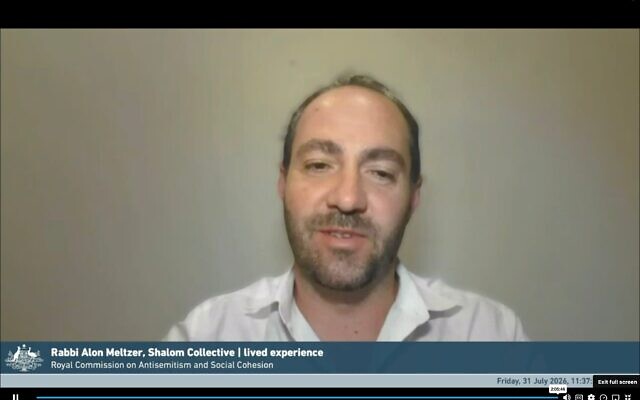
Rabbi Meltzer said his team had come into the office on the Monday after October 7 and, within about three hours, had begun receiving emails from long-standing participants asking what the organisation could do to help them feel safe.
The staff prepared a resource for managers, human resources departments and executives explaining what Jewish and Israeli employees might be feeling. It went to about 16,000 addresses on the organisation’s database, with an invitation to forward it on.
“This was before any retaliation,” Rabbi Meltzer said. “This was a response to grief and to fear.”
Recipients wrote back to say they were afraid to send the material themselves and asked whether the organisation could do so anonymously on their behalf.
“There should be no reason for a Jew or an Israeli employee to be fearful in this moment. There should have only been love and embrace and warmth to anyone on that Monday morning,” he said.
The organisation changed its form so people could submit their managers’ details, then automated the distribution. It reached more than 100 managers in the first week. One replied.
“One response saying thank you,” Rabbi Meltzer told the commission. “And that was it.”
He said the silence told him the community faced a long period of work ahead, and that what followed was a rift that grew exponentially between how the community could operate and its previously secular lived experience within Australian society.
The organisation had spent about six months planning a rebrand and had settled on an agency by September 2023. In the collective’s boardroom in late October or early November, with board members and staff present, the agency said the timing was wrong.
“Now is not the time to do a rebrand for a Jewish organisation and to put yourself out there into the public space,” Rabbi Meltzer quoted the agency as saying.
He said he watched board and staff members nod along and agree that it was not the right moment.
After the agency left, he told the room what he had heard.
“That was antisemitism at play. That a non-Jewish brand agency told us, an arts and culture organisation in the Sydney Jewish community, not an Israeli advocacy organisation, that we should be quiet.”
He described a “pin drop moment” in the room. Everyone present, he said, “realised that they had been silenced, that they had been attacked in their boardroom, and that they had been so conditioned and so normalised to these realities that they had agreed with that brand agency”.
The organisation wrote to the agency, which replied that this had not been its intention.
Rabbi Meltzer also described the collapse of a partnership to bring an Israeli artist of Iraqi heritage to Sydney. The partner organisation withdrew over the prospect of protests or threats, a decision he characterised as fear rather than antisemitism.
A Jewish gallerist in the community took the exhibition on instead, at what Rabbi Meltzer said was considerable personal risk, and showed the work to tens of thousands of people during Vivid.
“When that erasure happens, people don’t get that opportunity to connect and to learn. And there’s this deep craving for it,” he said.
Asked whether some institutions had remained constructive, he said his organisation retained a strong partnership with a major NSW creative institution, but that such examples were “very few and far between, to the point that I can count them on less than one hand”.
Rabbi Meltzer, other staff and a board member were among those doxed in February 2024. Addresses and photographs, including of children, were posted online.
He said he had received several substantial threats over more than a decade working in Australia and had personally brushed the doxing aside, which he described as a difficult thing to say because nobody should be immune to it.
A Melbourne artist who fled the collapse of the Soviet Union as a teenager has told the Royal Commission on Antisemitism and Social Cohesion that the ideology she escaped has reappeared in the Australian art world, this time enforced by artists rather than by the state.
Nina Sanadze, who was born in Tbilisi in the late 1970s, fled Georgia with her mother in 1992 after the Soviet collapse and the country’s civil war.
They spent two years stateless in Russia, where she was barred from school as a non-citizen and missed much of her secondary education. She migrated to Australia in 1996 at 20 and completed a Bachelor of Fine Arts with honours at the Victorian College of the Arts.
Sanadze told the commission she had escaped the two great evils of the twentieth century, Nazi and Soviet antisemitism and Soviet Marxist socialism, only to find that “it has followed me here in some kind of irony”.
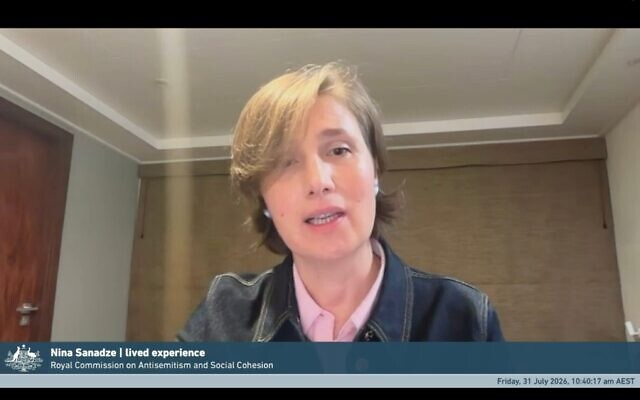
She said her upbringing gave her a particular reading of what she now sees in Australia. “I understand through lived experience the influence of the Soviet Marxist socialism that has really penetrated and captured the art world,” she said, describing antisemitism and anti-Zionism as of the same Soviet origins.
The critical difference, she said, was the source of the pressure. In socialist countries, repression came from the government. In Australia, she told the commission, it was enacted by artists against other artists, through censorship, coercion and fear, until “the art world has become that authoritarian power”.
Sanadze said she posted images of women taken hostage by Hamas on Instagram on 7 October 2023, and privately messaged a fellow artist the following day asking her to show empathy while Jewish people were grieving.
That private message, in which she described Hamas as animals, was leaked and became the basis of her cancellation, she said. She told the commission the word “Hamas” was consistently replaced with “Palestinians” when the message was circulated.
She was among those named in the February 2024 doxing of 600 Jewish creatives, which included the leak of a private WhatsApp group for Jewish artists. She had joined the group in late November 2023 and described it as feeling like a lifeline.
Sanadze told the commission that management at a prestigious publicly funded institution where she held a residency, referred to in her statement as Institution One, asked her to give up her place, saying the organisation had reached breaking point because of her presence.
She said she was interrogated about what other groups she belonged to and told that further material would be released to discredit her unless she left the premises. When she returned in March 2024 to collect belongings for an exhibition, she found the building emptied and graffiti reading “Zio dogs” at the front doors.
Her commercial gallery ended its representation of her around the same time, telling her privately that it could not withstand the harassment as a small business. She said she replied, “Well, now you know what it feels like to be Jewish.”
Within a day, she said, both institutions removed pages about her from their websites. Her university took down an alumni post, and galleries and curators removed material associated with her, including her Holocaust works.
She founded Goldstone Gallery in Melbourne’s northern suburbs in February 2025, she said, because there was no other place for artists in her position to exhibit. The gallery has hosted Chinese, Russian, Iranian and Australian dissident artists as well as Jewish ones, and staged a dialogue between Palestinian and Israeli women on 31 August 2025.
Sanadze said armed security was required even for poetry events, and that artists and visitors requested private viewings so their attendance would not be recorded. Many, she said, “live in deep, deep fear”.
She said she had looked for a peace march since October 2023 and had not found one. In the art world, she said, “we only mention river to the sea”.
Counsel assisting asked whether it was her impression that everyone marching in support of the Palestinian cause wished to see the destruction of Israel. Sanadze said her impression was that there was no place in that movement for the safety of Israeli and Palestinian civilians at the same time.
The gallery closed temporarily after the Bondi Chanukah attack in December 2025 because Sanadze felt staff, volunteers and visitors could not be adequately protected. It has since reopened, hosting the first Australian exhibition about October 7 alongside work by an Iranian artist.
But she told the commission she has now decided to wind it back to a project rather than a permanent space, citing an absence of funding and security.
She also described the Bondi Flower Project, which she leads with the Sydney Jewish Museum. Three tonnes of floral tributes left at the site of the attack have been preserved, with 160 volunteers sorting and drying them in a Sydney warehouse.
The flowers have been transported to Melbourne and will form an exhibition when the museum reopens in 2027. It was the first time, she said, that the Jewish community had felt visible support from the broader Australian public.
Asked what she hoped for, Sanadze called for the reintegration of Jewish artists and stories into mainstream institutions rather than separate provision. “There needs to be consequences, and … reintegration of Jewish stories and artists,” she said.
A Jewish Australian comedian has told the Royal Commission he was dropped from a comedy show because of his Jewish background and that venues are routinely cancelling Jewish performers after receiving backlash.
The witness, who gave evidence under the pseudonym CGM, was examined by counsel assisting Tamara Phillips about his experiences in the arts and creative industry since October 7, 2023.
“There was an ongoing show and it became clear that there was a discomfort with my background,” he said. “A friend kind of suggested, ‘Look, I can bring it up, but it’s going to cause a huge argument,’ and I just said, ‘Don’t worry about it.'”
CGM said the person he believed was uncomfortable had previously been a friend who had supported his career and given him performance spots.
“It just makes you think, what rumours does this person believe about you and your community now?” he said.
He described a broader pattern in which Jewish performers secure venues only to be cancelled after organisers receive pressure.
“They’ll eventually say to the artist, ‘We can’t host you because there’s a security risk or a reputational risk,'” he said. “I don’t think they should have to hide to be seen.”
CGM recounted an incident outside a comedy club in which a man in another comedian’s entourage said to him, unprovoked, “F** the Jews.” When CGM pushed back, the man repeated it twice more with increasing seriousness. None of CGM’s peers intervened.
“I carry a sense of shame in me that I didn’t say anything,” he said. “What also stuck with me is that I don’t think my peers felt any shame. Sometimes you’re more likely to be ostracised by calling out antisemitism than you are by saying something negative about Jewish people.”
But CGM also pointed to moments of solidarity. He told the commission that after October 7, 2023, he withdrew from performing until a comedian with a Muslim background reached out.
“He gave me a spot at his gig, and I made people laugh, and I started to feel like I could function again,” CGM said.
The pair later discussed their shared sense of fear.
“I said, ‘It just feels like our blood is cheap to people. It’s scary.’ And he said to me, ‘How do you think we feel? We feel the same,'” CGM said. “We didn’t hurt each other. We made each other laugh.”
A Jewish Australian comedian has told the Royal Commission on Antisemitism and Social Cohesion that antisemitism does not operate like conventional racism, describing it instead as a self-reinforcing conspiracy that is impossible to disprove.
The witness, who gave evidence under the pseudonym CGM, delivered a prepared statement to the commission before answering questions from counsel assisting Tamara Phillips and Commissioner Virginia Bell.
“Antisemitism is not racism in the way that you know it. I know that racism. I’ve experienced it too,” he said. “Antisemitism is more often a conspiracy. It’s a rumour about you, a theory about your motives, desires, and your control over things.”
CGM, who grew up Jewish in Brisbane and works in the arts and comedy, said his maternal grandparents escaped the Nazis and his father’s parents fled persecution in Yemen, where they faced harassment and violence because of their Jewish ethnicity.
“You cannot prove your innocence to someone who believes you control the system that determines your guilt,” he said. “If you experience discrimination and a court finds in your favour, it isn’t justice but proof the courts favour the Jews. If a media story about you includes your perspective, it’s not standard practice journalism but the captured Jewish press.”
He told the commission the conspiracy had intensified since the Bondi Beach shooting, with false flag narratives spreading online. A senator, whom CGM declined to name, had posted a video questioning what the government was concealing about the attack. The comments, he said, were filled with claims the shooting was staged to further Jewish interests.
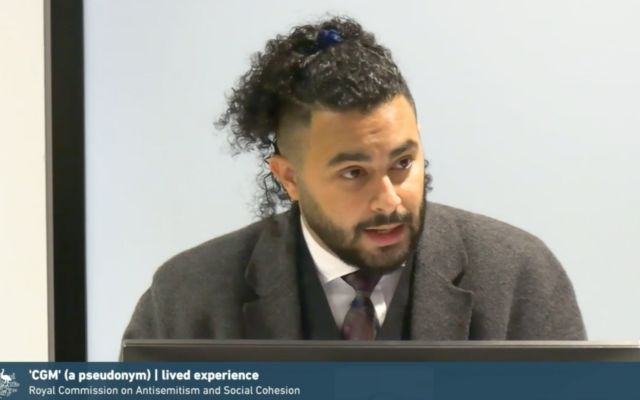
“The cruelty of this conspiracy is not only do you experience the trauma, you are subsequently put on trial for causing it,” he said.
CGM said a close friend had been at the Bondi event and fled when the shooting began. The friend’s father survived Auschwitz as a boy.
“He was separated from his mother. He was forced to work in the crematoriums, and he was reunited with his mother when she was part of the piles of bodies that they had to cremate that day. And his grandson is at Bondi.”
CGM told the commission he had hesitated before giving evidence, noting that people had warned him it could damage his career.
“For some reason, sharing my personal experience started to feel like I was committing career suicide,” he said. “I decided to come and give evidence because of the example my grandfather set, a man whose world was taken from him and found one in Australia, who fought with monsters but did not become one, and who always managed to retain his faith in both humanity and his sense of humour.”
The AJN is providing rolling coverage on the Royal Commission on Antisemitism and Social Cohesion.
For full coverage of the Hearing Blocks, visit the Royal Commission section of The AJN website.
A leading Jewish studies academic has told the Royal Commission today that punitive responses to antisemitism are “not a very large piece of the puzzle”, and that the arts sector instead needs deeper cultural change to address what he called the “all or nothing thinking” now pervading debate around Israel and Gaza.
Professor David Slucki, director of the Australian Centre for Jewish Civilisation at Monash University, returned to give further evidence on the findings of the Monash Initiative for Rapid Research into Antisemitism (MIRRA), whose report “Antisemitism in the Cultural and Creative Industries” drew on 64 interviews and 31 workshop attendees across the arts.
Professor Slucki said the research deliberately prioritised impact over intent, since focusing only on whether conduct was technically antisemitic missed the real harm being done.
“Sometimes we sort of think about this stuff in these kind of binary terms: is this antisemitic or is it not antisemitic?,” he said.
“Our feeling is well, that doesn’t capture the whole story,” he said, noting the impacts documented included lost work, lost livelihoods, and people leaving the sector altogether.”
While agreeing with a proposition put to him that intent might carry more weight in a criminal or disciplinary setting, Professor Slucki nevertheless argued that policy, procedures, and education instead needed to focus on impact over intent, including cultural.
“There’s not always a legal or policy instrument that can capture that thing, and sometimes it’s a question of what kind of culture do we want in our organisation,” he said, describing a detrimental climate of “cancellation and counter cancellation” in which disagreement quickly escalates into accusations that someone is “a fascist genocidal baby killer” on one side, or “a Jew-hating antisemite” on the other.
He said many politically progressive Jewish artists had found themselves squeezed by an expectation that they engage in “full-throated condemnation” not just of Israel’s conduct but of its existence.
Support for Palestinians was not the issue, he said, but “increasingly, it’s hard to just hold the criticism without also incorporating the idea that Israel ought not exist,” which became “a bridge too far” for many Jewish people in the creative and arts sectors, isolating them socially as well as professionally.
That isolation, Professor Slucki said, had produced a “sense of cultural homelessness”, with artists who had never considered their Jewishness central to their work suddenly finding institutions such as the Jewish Museum of Australia or Shalom Collective were the only places willing to exhibit or stage them.
“The worst outcome of all of this is if Jewish artists end up only being able to work in Jewish organisations and not as part of the broader artistic world,” he said.
He described the targeting of Jewish philanthropists as “one of the most disturbing parts of this”, built on “classic old anti-Semitic tropes about Jews in power and wielding their financial wealth”, often couched in language about Zionism, and sometimes surfacing subtly, such as a qualified job applicant being asked whether there was “a values alignment” with donors they had previously worked with.
On artistic freedom, Professor Slucki said the concept was often invoked inconsistently. “It can’t just be academic or artistic freedom for people on my side,” he said, arguing that campaigns to harass or cancel artists were themselves “an imposition on their artistic freedom”, not an exercise of it.
He also pointed to structural weaknesses across a sector he likened to “the Wild West”, where small festivals or venues often lack the HR capacity of larger institutions to develop codes of conduct.
Antisemitism in the sector, he said, tended to be “horizontal rather than vertical” — driven by peers rather than leadership — with the harm from leaders instead more often felt as abandonment, as boards and organisational heads found themselves “hamstrung”, squeezed by groups aggrieved from different directions.
Professor Slucki said embedding cultural competency training across the sector was central to his recommendations.
I can’t understate how important I think education is as part of the way forward here,” he said.
comments