The Royal Commission's sixth hearing block opens in Sydney, examining frameworks to counter antisemitism in government, healthcare, schools and the arts.
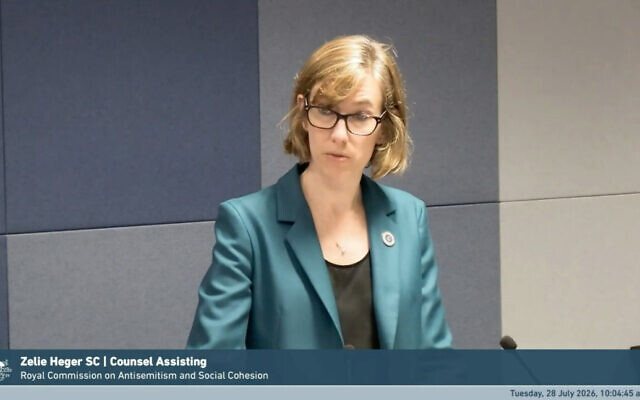
Counsel Assisting Zelie Heger SC opened Hearing Block 6, explaining the block will examine guidance, training and governance frameworks, and pointing out that cultural change and education are what’s required moving forward
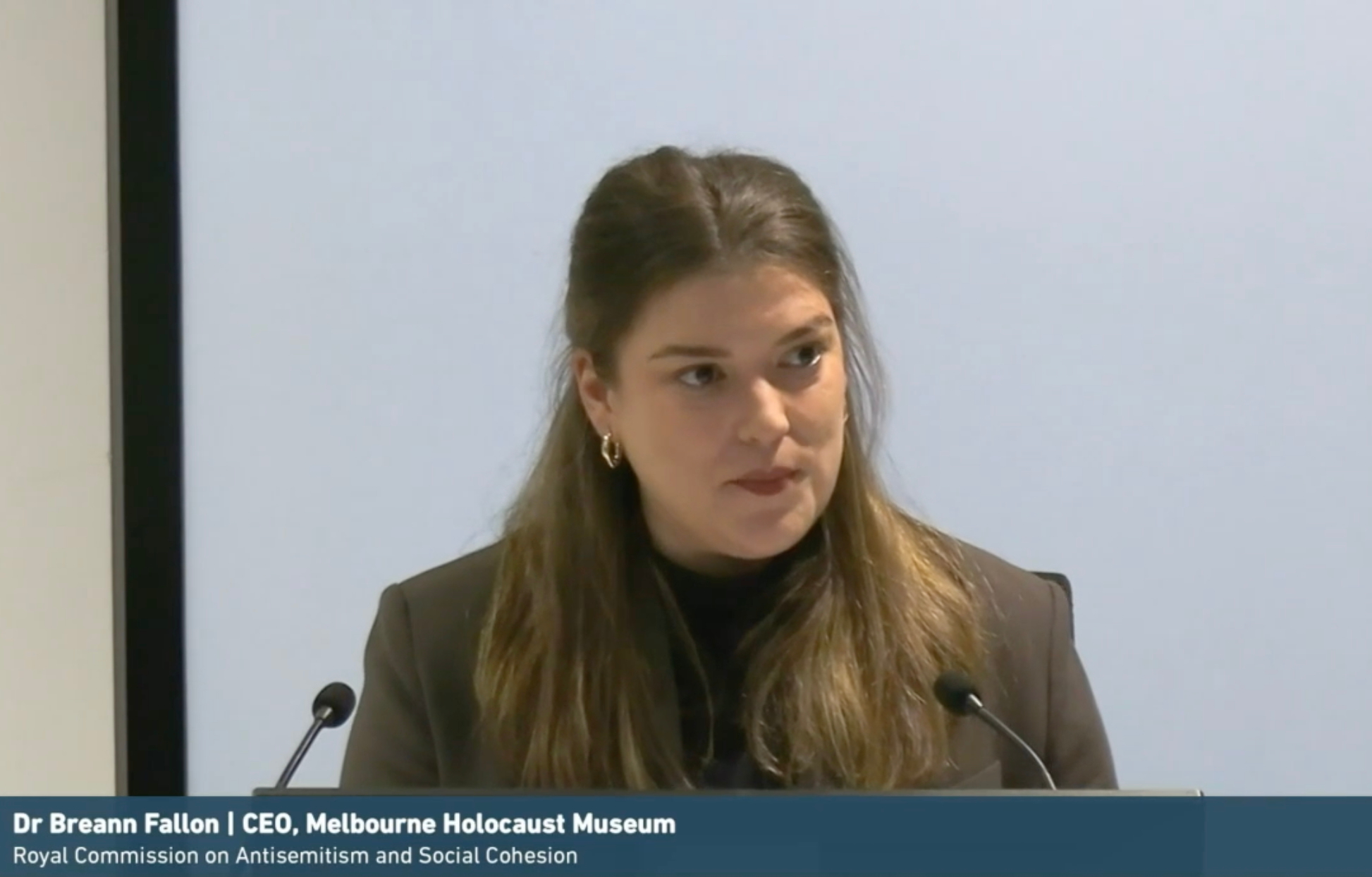
Dr Breann Fallon, CEO of the Melbourne Holocaust Museum (MHM) and a board member of the National Holocaust Memorial and Education Centre on why Holocaust education has become more important than ever
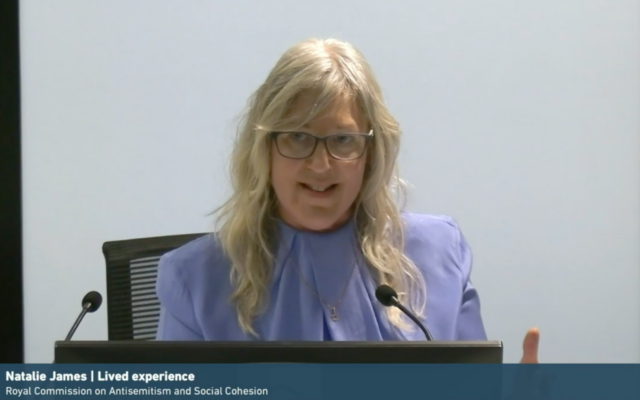
Former Department of Employment and Workplace Relations secretary, Natalie James, on the complexity of Jewish identity that she argued the Australian Public Service had failed to grasp
The Department of Home Affairs has been pressed at the Royal Commission over why it will not make antisemitism training mandatory for all visa decision-makers, and over the years it took to cancel the visa of rapper Kanye West despite his well-documented antisemitism.
Cross-examining the department’s head of immigration Clare Sharp on Tuesday, Michael Borsky KC, Counsel for several Jewish communal organisations, put to her that all officers involved in visa decisions under the character and good-order grounds should be required to complete at least the deeper, face-to-face second module of the department’s new antisemitism training.
Sharp said about 500 officers were expected to complete module two in the initial rollout, and that the department would not cap or prevent anyone who wished to do it, but she resisted making it compulsory for all.
Borsky pressed the point, noting she had confirmed it was not a budgetary constraint. Sharp said the department wanted staff to approach the training “with an open mind, ready to learn”, rather than resenting being made to do it, though she accepted the department might ultimately require it more widely once the initial rollout was worked through.
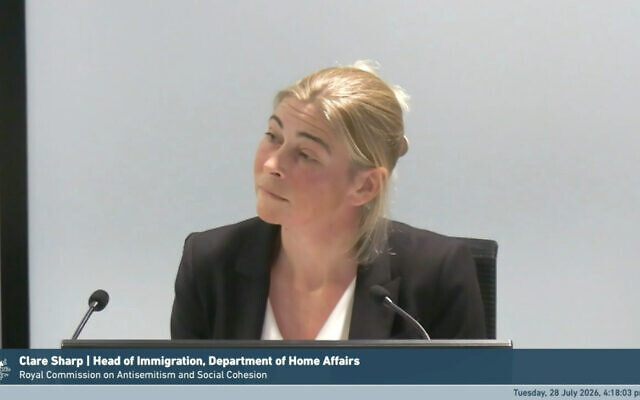
Department of Home Affairs head of immigration Clare Sharp.
Borsky then turned to the case of West, whose visa was cancelled in 2025 under the good-order power. He took Sharp through West’s earlier conduct, including a 2022 social media post that he was going “deathcon 3” on Jewish people, an image of a swastika inside a Star of David, praise for Hitler and Holocaust denial — all widely reported at the time. Borsky asked why, given West was high-profile with a large social media following, there had not been grounds to act years earlier.
Sharp said a delegate in 2022 had considered West’s statements but, weighing other factors such as his ties to Australia and purpose of travel, had concluded a visa could be granted. It was the later release of the song titled “Hitler”, she said, that had “changed a finely balanced decision the other way”.
Borsky also questioned the department’s risk-based approach, under which officers might cancel or refuse a visa on a simpler, more legally robust ground — such as an applicant using the wrong form — rather than on a character ground, even where there was evidence of antisemitic conduct. He put to Sharp that one consequence was that no adverse character finding would sit on the record, so that in a future application the person would not need to demonstrate a material change in circumstances. Sharp said that where the department held information suggesting a person had engaged in antisemitism, it ensured that information was recorded on the client’s file and, where appropriate, added to its central movement alert list, so it could be taken into account in future decisions.
Re-examined by Bora Kaplan SC, for the Commonwealth, Sharp said antisemitic statements amounted to “serious conduct” under the ministerial direction, and that a note to the new provision introduced this year expressly named antisemitic statements as an example of harmful ideas based on hatred of others — included, she said, to remove any doubt that the law was intended to capture antisemitism, given past litigation over whether it was discrimination on the basis of race or religion.
The Department of Home Affairs cannot screen every visa applicant for antisemitic or hateful views, but uses a risk-based approach to identify those who warrant closer scrutiny, its head of immigration has told the Royal Commission.
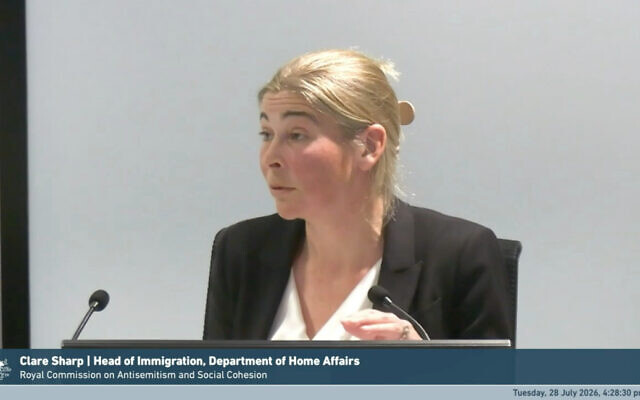
Clare Sharp, head of immigration since July 2025, gave evidence on Tuesday about the powers available to refuse or cancel the visa of a person who holds antisemitic or other hateful views, and how those powers are exercised in practice.
Department of Home Affairs head of immigration Clare Sharp.
Sharp said the Migration Act allowed a visa to be refused or cancelled where a person failed the character test, which could occur in various ways, including by vilifying a segment of the Australian community or inciting discord within it. The “inciting discord” ground had been used to cancel the visa of a man who attended the National Socialist Network rally outside NSW Parliament House in November 2025; he was detained and removed.
The same ground was used to refuse a visa to Candace Owens, who had sought to tour Australia, in circumstances where her comments, including about the Holocaust, had been widely reported. Owens challenged the refusal in the High Court, arguing the provision infringed the implied freedom of political communication, and lost.
Sharp said this year’s Combating Antisemitism, Hate and Extremism Criminal and Migration Laws Act had lowered the threshold for that ground from conduct that “would” incite discord to conduct that “might”, which had allowed the department to make earlier and more risk-based decisions. Previously, meeting the higher standard could require lengthy processes to test whether there was sufficient disclosable evidence.
A separate ground allowed cancellation where a person posed a risk to the safety or good order of the community. Sharp said the mere expression of an antisemitic view was not automatically enough, but that in the current environment the department was looking very sensitively at antisemitic statements, weighing how disruptive a person’s presence would be, including their profile and social media following. That power was used to cancel Kanye West’s visa in 2025 after he released a song titled “Hitler” and expressed other antisemitic views.
Even where a person failed the character test, Sharp said, cancellation was discretionary; a decision-maker had to weigh other matters, such as a person’s ties to Australia or the best interests of any children, consistent with Australia’s international obligations. Protection of the community, however, remained the overarching consideration under the relevant ministerial direction.
Sharp said the scale of the task was vast — almost 9.5 million visa applications in 2024–25, and more than 12 million people holding an Australian visa worldwide — making it impractical to screen everyone.
Instead, the department used a layered, intelligence-led approach, drawing on information from law enforcement and intelligence partners, daily media monitoring, and tip-offs from the public through its Border Watch platform, which had recently been updated with a flag allowing hate-speech concerns to be escalated more quickly.
A central movement alert list allowed the department to flag “controversial visitors” — high-profile individuals known for saying controversial things — so their applications could be examined closely, though being flagged did not automatically mean a visa would be refused.
Sharp said the department had developed antisemitism training for staff involved in visa processing, in collaboration with the Special Envoy to Combat Antisemitism and the Sydney Jewish Museum. A pilot involving about 200 staff, including senior executives and decision-makers, ran from December 2025 to February 2026, and a broader rollout would begin next week.
The training comprises three modules: a 45-minute online unit to be made available to all 6000 immigration staff, face-to-face workshops for a smaller group of decision-makers and managers, and a further tier for those directly applying the relevant provisions of the Act.
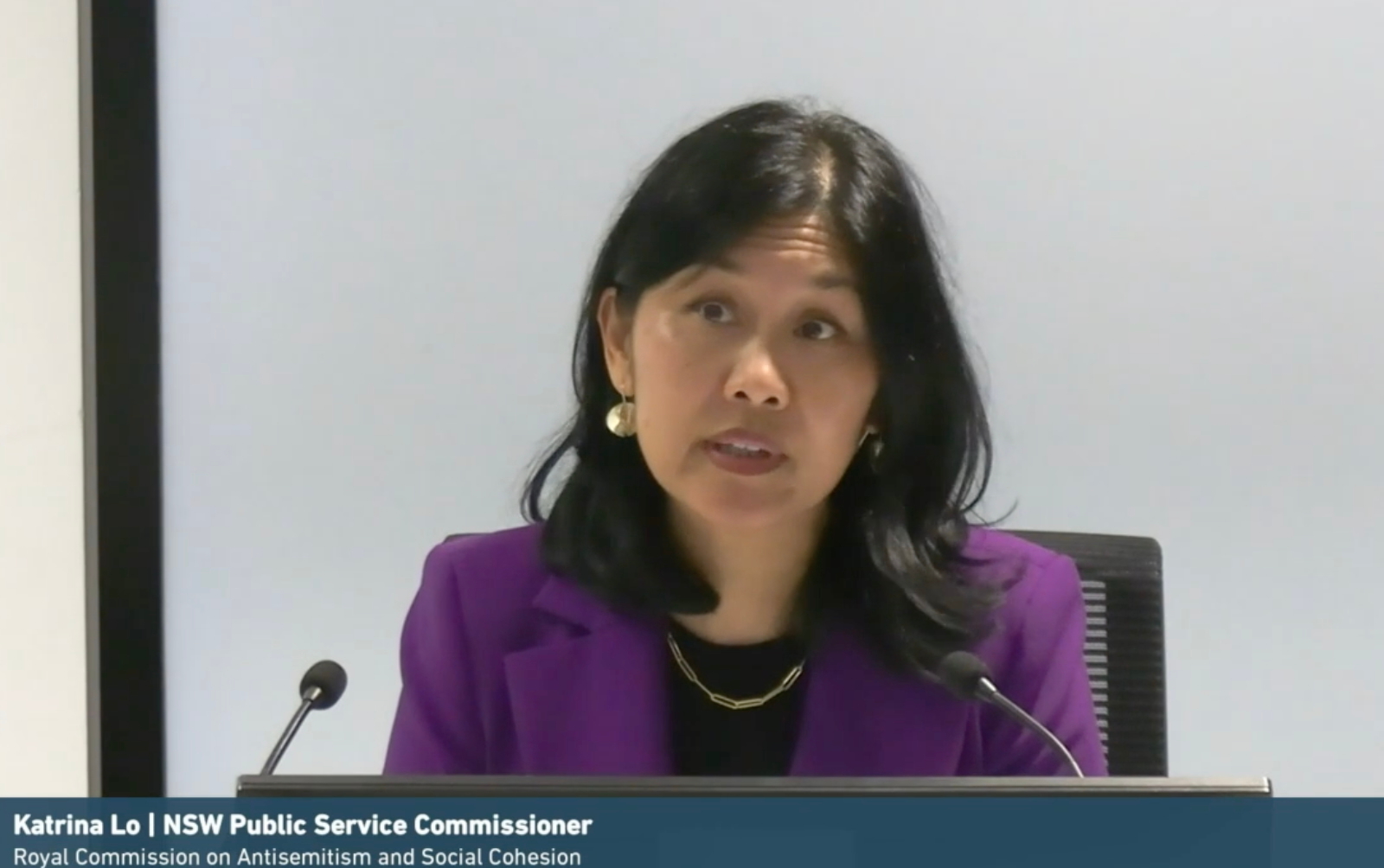
The NSW Royal Commission into Antisemitism heard evidence this afternoon from Katrina Lo, NSW Public Service Commissioner since April 2020, who oversees ethics and conduct standards for a workforce of more than 470,000 public servants.
Lo confirmed the mandatory Code of Ethics and Conduct she adopted in May 2024 requires staff to remain apolitical and act with integrity, and that agencies (such as the Department of Education) can add their own provisions — including on hate speech and racism — without needing to consult her.
Asked whether workplace comments on the Israel-Gaza conflict could breach the apolitical obligation, Lo said “it is not always so simple,” but pointed to one clear-cut case: an open letter to the Prime Minister invoking “genocide,” signed by roughly 2,000 public servants who identified their departments.
Lo said this “clearly” crossed the line, prompting her and the Premier’s Department secretary to send a message to every public servant in the state reinforcing impartiality obligations — a step she called “fairly serious.”
Lo revealed a second sector-wide message was sent after the well-known and reported incident involving two nurses at Bankstown Hospital – again reaching all 470,000-plus staff.
On public-facing conduct — noting 85% of the workforce is “front line” — Lo was repeatedly unable to say whether a nurse commenting on Gaza to a patient would breach the code, saying it would depend on the specific circumstances of that conversation, and on facts and agency-level policy she didn’t have at hand at the hearing.
She said seniority matters for social media conduct, with more senior officials needing to “tread very carefully” before making posts.
Pressed on the Bankstown Hospital circular of 14 February 2025, Lo confirmed it referenced “our NSW health colleagues” but did not mention antisemitism or racism specifically.
Asked why, Lo said the sector’s approach had been to address racism “in a very broad-based way,” and that context made the message’s meaning clear.
She conceded that “with hindsight,” a message issued today “would probably” name the issue explicitly, and accepted the omission “may have” affected how included Jewish staff felt — though she said intentions were good.
On training, Lo said NSW’s 2024 anti-racism guide deliberately avoided naming antisemitism or other specific forms of racism, favouring a “broad-based approach” she said was more inclusive, given the state’s diversity.
She confirmed no single antisemitism definition is being adopted; instead, work is focused on “building understanding, empathy, allyship and capability” through storytelling, rather than “getting hung up on one definition.”
New anti-racism videos, due by year’s end, will include a dedicated module on Jewish community experiences, with input planned from Rabbi Kastel, whom Lo said she’d be meeting after her Commission appearance.
Viewing will be “strongly encouraged” by public service staff, but not mandatory, and no centralised data on antisemitism complaints is currently collected — something Lo said hasn’t impeded her work, though she acknowledged de-identified data “is a possibility.”
The Australian Public Service Commission cannot say how many federal public servants have completed its antisemitism training, and has confirmed that a new standalone module due to be released next month will not be mandatory.
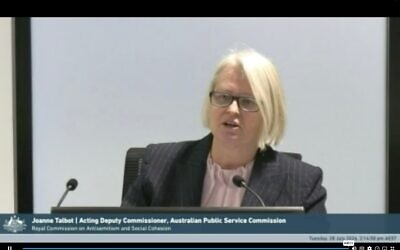
Joanne Talbot, the APSC’s acting deputy commissioner, told the Royal Commission on Antisemitism and Social Cohesion that antisemitism content added to the APS foundational diversity and inclusion e-learning module in May was “not detailed” and was insufficient on its own.
Counsel assisting put to her a statement from the Department of Education which said that, in that department, one person had completed the updated module between its release in May and 8 July. Talbot said she was not aware of the statement. No comparable figures were given for the other 102 APS agencies, and Talbot said the APSC was not in a position to produce them.
“We’re wanting to create the broadest amount of awareness that we can on antisemitism,” she said.
The updated module reproduces the first paragraph of the International Holocaust Remembrance Alliance working definition of antisemitism but includes no examples of what antisemitism looks like in practice. Talbot agreed that a proper understanding of antisemitism could not be obtained without working through examples.
She said the APSC was unable to see, at a whole-of-service level, how many of the more than 195,000 employees across 103 APS agencies had done the training, because agencies host APSC learning on their own platforms.
“It’s something that we probably need to look at a bit more,” she said. Asked whether the APSC should be tracking completion given its statutory function of facilitating continuous improvement, she replied: “I think it’s something we definitely need to be looking at.”
A dedicated 40-minute antisemitism module has been developed with the office of the Special Envoy to Combat Antisemitism. It is being piloted with staff at the Department of Home Affairs and the Department of Education, with further pilots planned at Foreign Affairs and the Attorney-General’s Department. Talbot said it would be rolled out across the APS in the week commencing 24 August.
Joanne Talbot, Acting Deputy Commissioner, Australian Public Service Commission. Photo: Screenshot
It will not be compulsory. “We strongly encourage people to complete,” Talbot said. “There is only one mandatory training that is required of all APS employees, and that relates to integrity.”
The module has been developed with a small group of current and former Jewish APS employees, and the Special Envoy’s office is arranging for Jewish organisations with education expertise to assist with further work on the content. Talbot said it would cover the history and narratives of antisemitism, the experience of Jewish Australians and recent antisemitic incidents in Australia.
Talbot was questioned about the 2024 open letter on Gaza, signed by more than 2000 federal, state and local government public servants, which the letter’s signatories framed in terms of “complicity in genocide” and “the colonial project”.
She said she had not seen the petition itself. Pressed on whether signing it was compatible with the obligation on public servants to be apolitical, she said: “It would appear to be a breach of being apolitical,” but added that it would turn on the seniority of the employee and whether their duties related to foreign policy.
Asked about signatories at middle and junior levels who identified themselves as public servants, Talbot said: “It is highly concerning, and it does border on being not apolitical.”
She said she believed some people had been sanctioned but did not know what had happened to the employees involved. Under the Public Service Act, code of conduct matters are for agency heads, not the APSC, unless referred to it.
Talbot was also asked whether wearing a “free Palestine” badge in the workplace, or a badge expressing support for Israel, was consistent with the requirement to be apolitical. She said the question turned on circumstances, and that managers were expected to act where conduct left other employees feeling disrespected or targeted.
The APSC issued a circular on 9 February titled Working together to combat antisemitism in the APS. Talbot said it followed the Government’s report on eliminating antisemitism and reinforced the service’s zero tolerance of it.
The circular was placed on the APSC website and distributed to the chief operating officers network and to human resources, integrity and communications networks. It was not sent to APS employees directly. “Typically circulars aren’t,” Talbot said.
She said the APSC did not usually ask agencies whether they had acted on a circular, and agreed her confidence that they did so was anecdotal rather than evidence-based.
Talbot also agreed that the touchstone used to identify culturally and linguistically diverse employees (the first language a person speaks) was not a reliable indicator of whether someone is Jewish. She said the APSC was encouraging agencies to take a more expansive view of cultural identity, and that a video series on cultural diversity released by the APSC included a Jewish story among 10 employee accounts.
On data, Talbot said the APSC did not ask a specific question about complaints of antisemitism. The 2025 APS employee census drew two free-text comments referring to antisemitism. Two new questions in the 2026 agency survey ask about informal complaints relating to race and religion and what agencies are doing about them.
Asked whether free-text responses were a reliable indicator of where antisemitism might be a problem, Talbot agreed they were not.
Former Department of Employment and Workplace Relations secretary Natalie James has told the Royal Commission on Antisemitism and Social Cohesion that the Australian Public Service failed to recognise or support its Jewish employees in the wake of October 7.
James, who served as one of the country’s most senior public servants from July 2022 to January 2026 and was previously Fair Work Ombudsman, told the commission that her own background illustrated the complexity of Jewish identity that she argued the APS had failed to grasp.
Her grandfather was a Polish-born Jew who fled Vienna after the Anschluss in 1938, posing as a toy soldier salesman to reach London and eventually Melbourne. James grew up in Townsville, far from Jewish communities, and described Judaism as something she “discovered over time” through Shabbat dinners, trips to shul and wearing a Star of David to “flush my people out” in regional Queensland.
That complexity, she said, made Jewish employees invisible to the APS’s own diversity frameworks. The culturally and linguistically diverse (CALD) strategy relied on the first language spoken at home as its primary data point.
“Unless you were born in Israel, your first language is probably not one that is an indicator of your Jewish identity,” she said.
James said the realisation struck during a meeting with fellow departmental secretaries, when she examined the strategy through a Jewish lens for the first time, realising that Jews were not represented properly.
That institutional blind spot had consequences after October 7, James argued.
She drew a pointed contrast with the APS’s handling of the Voice referendum, where significant effort went into supporting First Nations employees while maintaining political neutrality, and the Public Service Commission issued guidance to secretaries. No equivalent outreach was made to Jewish public servants.
The result was a climate of silence, she said, in which Jewish staff were reluctant to disclose their identity or seek cultural leave for festivals such as Pesach or Yom Kippur.
When public servants signed an open letter in May 2024 condemning the government’s position on the Middle East conflict, James recused herself from her department’s response.
“I doubted. I just had a lot of concern about whether I could be objective and fair,” she said.
James described a personal reckoning with antisemitic graffiti near her home, when it dawned on her that graffiti mentioning Zionism or Zionists referred to Jews, and by extension, to her.
“Suddenly it occurred to me that they meant me,” she said. “Benjamin Netanyahu is not going to see this graffiti, but I am seeing it every day that I walk up to my local high street.”
She called on the APS to build cultural literacy, warning that without it, contemporary antisemitism would go unrecognised.
“If you don’t understand Jewish identity, you don’t understand things that are targeting Jewish identity,” she said, urging the public service “to lean in, not out”.
Dr Breann Fallon, CEO of the Melbourne Holocaust Museum (MHM) and a board member of the National Holocaust Memorial and Education Centre, gave evidence this morning to the Royal Commission, explaining why Holocaust education has become more important and urgent since October 7, 2023, and why she considers the sector under-resourced relative to what it is expected to deliver.
Dr Fallon said MHM’s ‘Space Between’ social cohesion program, run in workplaces, was skilled-based rather than content-based, and had produced strong results: 91 per cent of participants reported a better understanding of antisemitism, 88.5 per cent said they felt more confident engaging in respectful workplace dialogue, and 88 per cent indicated an intention to change their workplace behaviour.
“I think it’s important for us to understand that for many years, Holocaust education [in terms of measuring impact] was based on anecdotal evidence, but we also have independent data that shows us that impact.”
On teacher training, she said equipping educators to handle difficult classroom discussions had become “a key concern of teachers,” who had been approaching the museum “more regularly with this concern, particularly following October 7,” as students raise questions tied to the current geopolitical climate.
She said the museum’s approach is about “really helping teachers build that rapport and confidence, and help them to create critical thinking out in our young learners.
“In paragraph 22 of my witness statement, there is an inclusion there of some feedback from a teacher who said [our program] provides practical strategies that I can implement immediately with my students. And there’s something very important in that, this is an established, well-resourced, well-researched program, but it’s actually attending to an immediate need that we’ve seen rising.”
About 30,000 students visited the MHM last year.
A central theme of her evidence was a structural gap: while Australia has “quite robust” Holocaust education programs, the problem was that “there’s a gap between what they’re expected to do and the facilities and the resourcing provided to them.”
Dr Fallon argued that museums are treated as “an optional excursion” rather than built into national “system architecture,” leaving programs reliant on one-to-three-year funding cycles that make long-term scaling difficult.
She told the Commission she had observed rising Holocaust revisionism and denialism, a trend that predated October 7, but which “lit a fire” that accelerated it.
Despite this, she said her resolve had deepened, arguing that democratic resilience is “a muscle” that cannot be built once and left, and so it needs reinforcement at multiple points across education and workplaces, and not confined to school curricula alone.
“It’s not something that we can just assume that after year 12, they [a student] have that, and it never needs to be worked on again.
“Every Australian is on the front line here in terms of social cohesion and democratic resilience.
“And so, if we expect young people to learn that and to just to hold our society going forward, we’re going to become very weak in terms of that muscle of democratic resilience.”
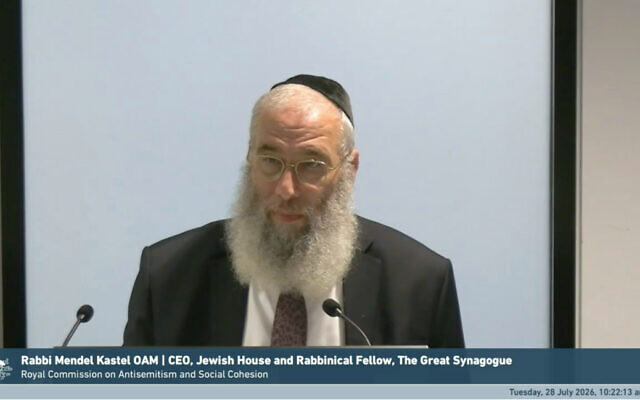
Antisemitism cannot be solved by legislation alone and must be met with cultural change driven through schools and workplaces, Rabbi Mendel Kastel told the Royal Commission.
The Jewish House CEO gave evidence on Tuesday about concerns raised with him by Jewish students, parents and employees, and about the education and workplace reforms he is pursuing. “We’re not going to be able to legislate ourselves out of this,” he said. “It’s about culture. It’s about teaching people to behave in a way that makes people around you feel safe.”
Kastel said parents had told him of distressing experiences their children had had on the school bus and in the playground, and of teachers using material in class that made Jewish children feel uncomfortable. He recounted one school staging The Sound of Music that had worked to ensure Jewish students felt safe, adapting the costumes so that they were army uniforms rather than Nazi ones. Such steps, he said, showed what could be done to make people feel safe.
Through the Waratah Education Foundation, a philanthropic organisation on whose board he sits, Kastel said money had been committed after the Bondi attack to support social cohesion, including building an educational resource about all religions and cultures — not only Judaism — for use by teachers, staff and students. The aim, he said, was to move people from pushing back against discrimination toward genuine curiosity about one another, and to foster a culture in which people considered how their words and behaviour made others feel.
He recommended teacher training on religions and cultures, and argued that the NSW child safe standards and reportable conduct scheme — currently under review in the state — should be expanded to cover safety around religion and culture, not only physical safety. It was, he said, a significant opportunity to ensure children felt safe at school.
On workplaces, Kastel said Jewish House ran a jobs program, and that people were increasingly reporting discomfort in their workplaces — being overlooked for promotions, excluded in team rooms, and in some cases seeking help to find another job because they could no longer stay where they were. He recommended that the Fair Work Commission and the Australian Human Rights Commission issue guidance to employers on religious discrimination, arguing that while laws were needed for the most serious conduct, the goal was a workplace culture in which people respected one another and considered the impact of what they said.
Kastel linked the work to a personal loss. His brother-in-law, Rabbi Eli Schlanger, was killed in the December 14 attack at Bondi Beach, and Kastel said Jewish teaching held that the way to move forward was by embracing good and creating more light. That belief had inspired the “one mitzvah” campaign he founded in Schlanger’s memory, encouraging people of all faiths to perform good deeds, which he said had been embraced by the Premier, the Prime Minister and the Governor-General, with thousands of mitzvahs logged. “That’s really the Australia that I’ve come to,” he said, “where people are about doing mitzvahs, about helping each other, about being kinder to each other.”
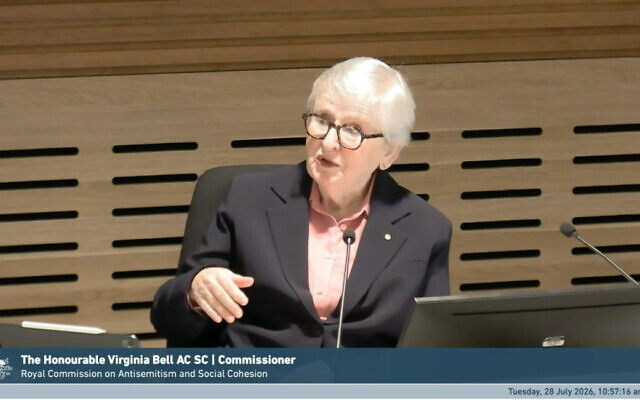
Commissioner Virginia Bell.
Asked by Commissioner Virginia Bell how the Holocaust should be taught to schoolchildren, Kastel said each person had the capacity for both good and bad, and that education mattered because it drew lessons from the past. The Holocaust, he said, was a particular case in which ordinary people had been drawn into a systematic horror.
He said Holocaust survivors had come into his office in tears, telling him “this is happening again” and asking what they should say to their children and grandchildren, because some of the behaviour they were now seeing reminded them of the Holocaust and was of real concern. That, he said, was why education was so important — to learn from past experience and recognise where such things could lead.
Jewish patients are asking hospitals to remove their religion from their records, and some are afraid to disclose a Jewish identity or an Israeli accent to staff, a rabbi and long-serving hospital chaplain has told the Royal Commission.
Rabbi Mendel Kastel, CEO of the crisis organisation Jewish House and a chaplain to NSW Health and several Sydney hospitals for more than 35 years, gave evidence on Tuesday morning about a climate of fear among Jewish patients and staff — and the reforms he is working on with NSW Health to address it.
Rabbi Mendel Kastel fronts the Royal Commission.
Kastel said fear had risen sharply after October 7, 2023, the Bondi Beach attack and the incident involving two nurses at Bankstown Hospital in February 2025, which is the subject of pending criminal proceedings.
After the Bankstown incident, he said, St Vincent’s Hospital had taken calls from patients across the hospital asking that their religion be removed from their records. Some people were afraid to record that they were Jewish on admission forms, and one patient with an Israeli accent had been afraid to speak to a nurse in case it was noticed.
He said members of the community had raised a number of concerns, including doctors being targeted and abused in professional chat groups, and, in one case, a patient refusing treatment from a doctor they called a “Zionist pig”.
But Kastel stressed that his own experience in the hospital system had overwhelmingly been one of warmth. Nervous about visiting Bankstown Hospital after the nurses incident, he had found staff welcoming across the board, and had made a video there with a Muslim chaplain to reassure the community that hospitals were safe. When NSW Health had asked whether a separate healthcare pathway should be created for Jewish patients too afraid to attend hospital, he said his answer had been an emphatic no — the task was to make hospitals safe, not to divert people from them.
Kastel outlined several reforms under way. A formal reporting protocol was being developed to allow Jewish patients and staff to raise complaints through senior staff and a hospital form overseen by the ministry, feeding into data collection with a report roughly every six months, so that problems could be identified and addressed early.
Hospital policies were being reviewed, including on complaints handling, staff conduct, and appropriate dress and the display of political symbols in the workplace and online. Asked by Commissioner Virginia Bell whether it would be desirable that clinical staff not wear a pin bearing either the Palestinian or Israeli flag, Kastel said he would support that.
He said a virtual chaplaincy service was also being trialled at three sites, using technology developed by NSW Health to reach isolated patients in regional and rural areas who might not otherwise have access to a rabbi, priest or sheikh.
Kastel recommended mandatory antisemitism and discrimination training for all public hospital staff, arguing that while existing mandatory training covered matters such as fire safety and infection control, it needed to include hate speech and religious discrimination. Beyond competency, he said, patients and staff needed reassurance that the training was in place — describing simple measures such as a reference guide to different religions and cultures, kosher cabinets, and a mezuzah on a hospital door, which he said could make a Jewish patient feel “they’re thinking of me, I’m safe here”.
He also recommended that the Australian Health Practitioner Regulation Agency (Ahpra) review how it handled complaints of antisemitism and other religious discrimination, saying some who had complained felt they had not been listened to.
The Royal Commission on Antisemitism and Social Cohesion has opened its sixth hearing block, turning from enforcement and security to the question of how education and training might reduce hate against Jews.
Opening the block in Sydney on Tuesday, Counsel Assisting Zelie Heger SC said the previous blocks had examined law enforcement and regulatory responses, institutional responses including at universities, and security measures — which she said were all important, but all reactive. What was ultimately required, she said, was cultural change: equipping people to understand the Jewish community, to recognise antisemitism and how it is experienced, and to know the frameworks in place to address it.
Only cultural change offered any hope of reducing antisemitism over time, Heger said, and with it the need for the security measures the Jewish community currently relies on but wishes it did not need. She cited the Special Envoy to Combat Antisemitism, who has observed that while extreme hatred may need to be met with the levers of law enforcement, education is the best antidote to ignorance, hate and the most prevalent forms of antisemitism.
Counsel Assisting Zelie Heger SC opens the sixth hearing block of the Royal Commission on Antisemitism and Social Cohesion.
Heger said the block would examine guidance, training and governance frameworks across four areas: government decision-making and workplaces, the healthcare sector, schools, and the arts and creative sector.
On government, the commission would hear from the Australian Public Service Commission and the NSW Public Service Commissioner, Katharina Lowe, on the codes of conduct governing public sector employees and the training in place to address antisemitism and racism. The head of immigration at the Department of Home Affairs, Claire Sharp, would speak to the powers available to refuse or cancel a visa where an applicant or holder had engaged in antisemitic or other hateful conduct.
On healthcare, the commission would hear on Wednesday from a health services researcher whose submission identifies systemic issues in the sector, from Australian Health Practitioner Regulation Agency chief executive Justin Untersteiner on the regulator’s response to racism among practitioners, and from South Western Sydney Local Health District chief executive Sonya Marshall on the district’s response to the February 2025 incident involving two nurses at Bankstown Hospital.
On schools, to be examined on Thursday, Heger said the commission had repeatedly heard of antisemitic comments directed at Jewish students by other students or, in some instances, teachers — and of pleas to school leadership for further education on antisemitism that were not taken up, missing the opportunity for cultural change.
It would hear from the NSW Board of Jewish Education, increasingly tasked with restorative education after antisemitic incidents, and from researcher Suzanne Rutland on leadership accountability and safe spaces for affected students. Special Envoy Jillian Segal would give evidence on the training she has commissioned UNESCO to develop for Australian schools, now being trialled in NSW and Victoria and scheduled for rollout in Western Australia this term.
Finally, on Friday, the commission would turn to the arts. Heger said Block 1 had heard from Jewish creatives who felt targeted, cancelled or marginalised for being Jewish, and of the doxxing of 600 Jewish creatives.
Professor David Slucki would speak to a Monash study of antisemitism in the cultural sector, which describes Jewish creatives withdrawing from their networks amid a “cultural homelessness” and an embedded antizionist discourse that collectively demonises Jewish stakeholders regardless of their views on Israel. Creative Australia acting chief executive Tim Blackwell would be asked what powers the government’s principal arts funding body has to respond to antisemitic conduct by those it funds.
Heger said lived-experience evidence was being adduced not for the commission to rule on whether particular conduct was antisemitic, but to understand the experience of Jewish Australians and inform recommendations. She noted some witnesses would give evidence under pseudonyms, protected by non-publication orders, and that witnesses must not be subjected to vilification or abuse for appearing.
The AJN is providing rolling coverage on the Royal Commission on Antisemitism and Social Cohesion.
Antisemitism cannot be solved by legislation alone and must be met with cultural change driven through schools and workplaces, Rabbi Mendel Kastel told the Royal Commission.
The Jewish House CEO gave evidence on Tuesday about concerns raised with him by Jewish students, parents and employees, and about the education and workplace reforms he is pursuing. “We’re not going to be able to legislate ourselves out of this,” he said. “It’s about culture. It’s about teaching people to behave in a way that makes people around you feel safe.”
Kastel said parents had told him of distressing experiences their children had had on the school bus and in the playground, and of teachers using material in class that made Jewish children feel uncomfortable. He recounted one school staging The Sound of Music that had worked to ensure Jewish students felt safe, adapting the costumes so that they were army uniforms rather than Nazi ones. Such steps, he said, showed what could be done to make people feel safe.
Through the Waratah Education Foundation, a philanthropic organisation on whose board he sits, Kastel said money had been committed after the Bondi attack to support social cohesion, including building an educational resource about all religions and cultures — not only Judaism — for use by teachers, staff and students. The aim, he said, was to move people from pushing back against discrimination toward genuine curiosity about one another, and to foster a culture in which people considered how their words and behaviour made others feel.
He recommended teacher training on religions and cultures, and argued that the NSW child safe standards and reportable conduct scheme — currently under review in the state — should be expanded to cover safety around religion and culture, not only physical safety. It was, he said, a significant opportunity to ensure children felt safe at school.
On workplaces, Kastel said Jewish House ran a jobs program, and that people were increasingly reporting discomfort in their workplaces — being overlooked for promotions, excluded in team rooms, and in some cases seeking help to find another job because they could no longer stay where they were. He recommended that the Fair Work Commission and the Australian Human Rights Commission issue guidance to employers on religious discrimination, arguing that while laws were needed for the most serious conduct, the goal was a workplace culture in which people respected one another and considered the impact of what they said.
Kastel linked the work to a personal loss. His brother-in-law, Rabbi Eli Schlanger, was killed in the December 14 attack at Bondi Beach, and Kastel said Jewish teaching held that the way to move forward was by embracing good and creating more light. That belief had inspired the “one mitzvah” campaign he founded in Schlanger’s memory, encouraging people of all faiths to perform good deeds, which he said had been embraced by the Premier, the Prime Minister and the Governor-General, with thousands of mitzvahs logged. “That’s really the Australia that I’ve come to,” he said, “where people are about doing mitzvahs, about helping each other, about being kinder to each other.”
Commissioner Virginia Bell.
Asked by Commissioner Virginia Bell how the Holocaust should be taught to schoolchildren, Kastel said each person had the capacity for both good and bad, and that education mattered because it drew lessons from the past. The Holocaust, he said, was a particular case in which ordinary people had been drawn into a systematic horror.
He said Holocaust survivors had come into his office in tears, telling him “this is happening again” and asking what they should say to their children and grandchildren, because some of the behaviour they were now seeing reminded them of the Holocaust and was of real concern. That, he said, was why education was so important — to learn from past experience and recognise where such things could lead.
Enjoy Unlimited Access To The Australian Jewish News Website And All Our Online Content For AUD$18/month Or Just AUD$120/year.



comments