Victoria University associate professor Mario Peucker has told the Royal Commission into Antisemitism and Social Cohesion that nonviolent protest can play a protective role against radicalisation, while heavy-handed policing of demonstrations can increase extremism risk.
Peucker told the commission that radicalisation involved two distinct components — a cognitive or ideological element, and a separate behavioural element.
“There’s a weak relationship between the attitudes that we have and the behaviour that we show, and the same applies to the radicalisation in that sense,” Peucker said.
Peucker said extremist propaganda was the most commonly identified factor drawing people towards radical groups, but stressed exposure alone rarely explained a person’s path to extremism, “it depends on a lot of other factors that come into play to make that like meaningful in the way that it would drive someone or push someone into extremist groups.”
He pointed to a 2025 UK literature review of 206 academic sources, which found protest activity offered people a democratic outlet for grievances and reduced radicalisation risk.
“If people have access to express their dissent … through protest movements, the chances are reduced that they would radicalize,” he said.
By contrast, Peucker said repressive policing of protests could fragment movements and strengthen their radical elements: “if over policing then reduces the political opportunities through protest, of course, it also leads to a fragmentation … and a strengthening of the radical flanks within a very diverse protest movement.”
He also cited a 2022 United States study that recorded a sharp rise in terrorism-related incidents linked to clashes between opposing protest groups during the 2020-21 pandemic-era demonstrations, a phenomenon he said is often described as “reciprocal radicalization.”
Under cross-examination, Peucker agreed that violence and hate speech fell outside what he termed the “grammar of democracy,” and said the research he relied on did not examine whether the protective effect of protest still applied where a protest involved hate speech or incitement to violence.
Associate Professor Mario Peucker, an expert on radicalisation and violent extremism, has told the Royal Commission into Antisemitism that radicalisation is best understood as a process rather than an inevitable path to violence, stressing that holding extreme views does not necessarily lead to extremist acts.
Peucker of Victoria University, who was commissioned by the Australia Palestine Advocacy Network (APAN) to make a report on extremist activity, specialises in radical political movements, racism, violent extremism and dissenting citizenship.
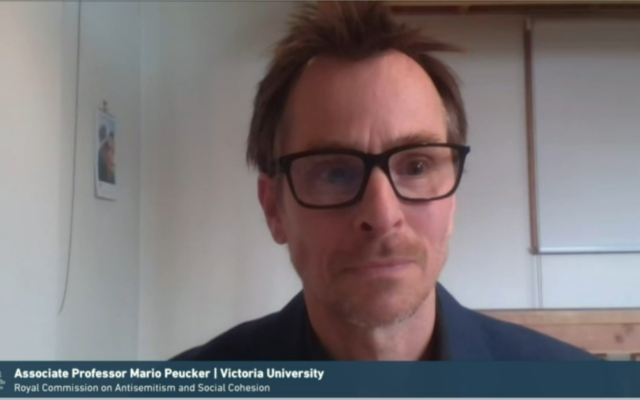
Associate Professor Mario Peucker of Victoria University.
Questioned about the concepts underpinning his report, Peucker said terms such as “radical” and “extreme” were relative to the social and political context.
“When we talk about radicalisation or something being radical … we would see that as something that is outside of the norm,” he said. “It’s relational because it relates to a certain moment in time, in a certain place.”
Peucker distinguished between radicalisation and extremism, describing radicalisation as “a process that leads to extremism” involving both cognitive and behavioural elements. While people’s beliefs may become increasingly extreme, he said their actions do not necessarily follow the same trajectory.
“The research has been very, very clear,” he told the Commission. “People can certainly radicalise in an ideological, cognitive way … but would never act on them.”
He rejected the suggestion that radical beliefs form a “conveyor belt” to violent extremism. “Not at all … It is not something that is causing certain actions.”
The academic also explained the distinction between religiously motivated violent extremism and ideologically motivated violent extremism, noting the categories were developed by the Australian Security Intelligence Organisation rather than by academics. He said the terminology had since become widely adopted by law enforcement, security agencies and, to a lesser extent, academic research.
Turning to the causes of radicalisation, Peucker outlined the commonly used concepts of “push” and “pull” factors. ‘Push’ factors, he said, drive people away from their current circumstances, while ‘pull’ factors make extremist ideologies or groups appear more attractive. He said researchers also increasingly recognised “personal” factors as an additional influence in understanding why some individuals become radicalised.
NSW Police has defended its handling of major protests linked to the Israel-Gaza conflict, while acknowledging mistakes in communication with the Jewish community and outlining significant changes to the way demonstrations are now policed.
Giving evidence before the Royal Commission into Antisemitism and Social Cohesion, Acting Deputy Commissioner McKenna endorsed earlier assessments by Deputy Commissioner Peter Hudson that police acted appropriately during the pro-Palestinian protest at Sydney Town Hall and the Opera House on October 9, 2023.
Questioned about whether police had the power to prevent the protest from proceeding because organisers had not submitted a formal notification under the state’s Form One system, McKenna replied, “That’s correct,” confirming police did not have the authority to stop the demonstration solely on that basis.
The commission heard that while an initial police record estimated the Town Hall crowd at about 700 people, a contemporaneous situation report assessed that the protest later swelled to as many as 1500 participants at the Sydney Opera House.
Reviewing the events nearly three years later, McKenna agreed with Hudson’s conclusion that police managed what was “a potentially volatile situation” appropriately.
“I concur,” he said, while adding that police today would assess any similar protest according to its own circumstances. “Three years on, we would look at every matter on its own merits.”
NSW Police Acting Deputy Commissioner Peter McKenna.
McKenna also acknowledged community concern over the arrest of two people carrying Israeli flags near the Opera House while the larger protest was permitted to continue.
“I can certainly understand that, and I empathise with that position,” he said. He explained the arrests were based on concerns about an imminent breach of the peace, rather than the flags themselves. “Public safety needs to be enacted.”
The Deputy Commissioner also supported the tactical decision to allow protesters to march to the Opera House rather than attempt to block them.
“We have crowd control experts… and tactical policing experts,” he said. “I’ve got no reason to doubt that the fact they were corralled into a certain area and contained into that area worked very well.”
However, he said police thinking had evolved. He pointed to a later attempt by the Palestine Action Group to stage another Opera House protest which police successfully opposed in the Supreme Court because of different circumstances and lessons learned from the October 2023 demonstration.
The commission heard that the scale of protests following the outbreak of the Gaza war prompted NSW Police to establish Operation Shelter, a major operational framework for managing demonstrations across Sydney.
McKenna said the operation was created because police anticipated significantly larger and more frequent protests.
“Those protest numbers swelled from 500 to 20,000 and settled down at about the 2000 mark,” he said. Police responded by establishing a dedicated operations centre and deploying officers from across regional New South Wales when required.
The hearing also examined a November 2025 rally organised by the White Australia group outside NSW Parliament protesting against what organisers described as “Jewish lobby groups” and new hate speech laws.
The commission heard the organisers notified police they intended to display a banner reading “Abolish the Jewish Lobby” and indicated they would cooperate with police instructions.
Before the protest, NSW Police sought internal legal advice, which concluded that no offence appeared to arise simply from holding the rally or displaying the proposed banner.
McKenna explained the legal complexities confronting police.
“Whilst some things are abhorrent and offensive, if they don’t meet the threshold of breaching the law, then we fall back to the fact that people have a right to public assembly,” he said.
The protest itself lasted only about eight minutes, with two brief speeches before participants dispersed.
McKenna admitted police failed to notify Jewish community representatives that the demonstration was taking place.
“Absolutely, it should have happened,” he told the commission. “It was human error.”
He apologised for the failure, saying police understood why members of the Jewish community were upset and had since introduced new systems to prevent a repeat.
Following detailed legal analysis lasting several months, one speaker at the rally was eventually charged with allegedly publicly inciting hatred.
McKenna said police could not assume offences would occur before a protest began, particularly where legal advice indicated the proposed assembly itself was lawful.
“Sometimes the law isn’t black or white,” he said. “It slips into that grey area.”
Cross-examination also focused on the Palestine Action Group’s relationship with police. McKenna agreed the organisation had generally cooperated with authorities across more than 100 protests held since October 2023, most of them organised using the Form One notification system.
He accepted the Town Hall gathering on October 9, 2023 was peaceful, that police eventually worked cooperatively with organisers, and that intelligence indicated a smaller group joined the crowd later at the Opera House and engaged in disruptive behaviour.
The Deputy Commissioner also confirmed police investigations later concluded that the widely reported chant of “Gas the Jews” had not been established, with expert audio analysis instead determining the words were “Where’s the Jews”.
Throughout his evidence, McKenna repeatedly emphasised that NSW Police’s primary objective during protests remained maintaining public safety while balancing the legal right to peaceful assembly with enforcement of criminal law where offences occurred.
New South Wales Police Deputy Commissioner Peter McKenna has told the Royal Commission on Antisemitism and Social Cohesion he has been unable to establish that any officer advised the Community Security Group (CSG) that Jewish community members should stay away from the Sydney CBD on October 9, 2023.
“I haven’t been able to ascertain factually that police gave the advice to the CSG for the Jewish community not to attend,” McKenna said. “However, I don’t disregard the evidence of Mr Ossip. I just can’t factually confirm that.”
McKenna has commanded the Central Metropolitan Region since July 2024. He was not in the role at the time and gave evidence on the basis of the documents and the statement of Deputy Commissioner David Hudson, acting commissioner in October 2023.
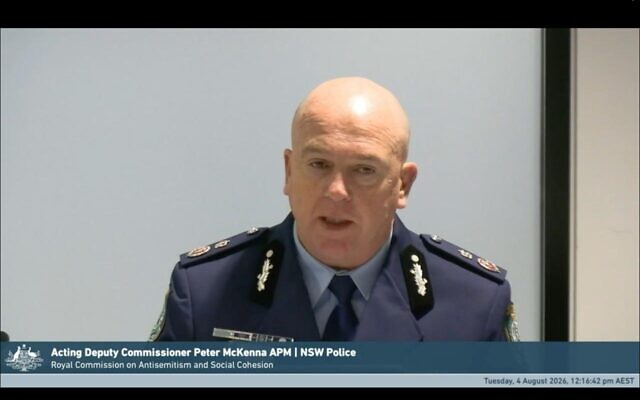
NSW Police Deputy Commissioner Peter McKenna. Photo: Screenshot.
He said he had made his own inquiries, including speaking to a superintendent who did not confirm any recollection of telling the Jewish community it was unsafe to attend.
“That doesn’t mean that a conversation didn’t take place around what is best to consider public safety, and it was taken from that that they should not attend,” he said.
McKenna said he had read Ossip’s statement and the attached WhatsApp records and did not question them. “I’ve got no doubt there were conversations with police about these issues,” he said. His information was that CSG itself regarded attendance as dangerous.
Asked whether police had told CSG to keep community members away from large parts of the city, McKenna said he could not factually say so, but that had the conversation occurred, the advice would have been to keep the two groups apart.
No Form One was lodged for the protest. Police first became aware of it on the evening of October 7, through a public Facebook event created by the Palestine Action Group advertising a Town Hall rally.
Hudson was told at about 3.30pm on October 8 that the Opera House sails would be lit in blue and white, and ordered a threat assessment. No specific threat was identified, McKenna said, but the assessment noted the possibility of spontaneous violence between supporters and opponents, which he said was standard for every protest.
Police learnt early on the afternoon of October 9 that the protest would move to the Opera House. McKenna said officers had raised remaining at Town Hall, but “the organisers were adamant that they were going to march”.
Police did persuade the organisers not to take the route past the Great Synagogue, and cordoned off separate areas of the Opera House forecourt for protesters and for the Jewish community and the public, which McKenna described as a tactical measure “so that you don’t bring people together who may come into conflict”.
McKenna said a flare thrown over officers’ heads was picked up and extinguished, and organisers spoke to the crowd after further flares were let off. Officers on the ground had no concerns about the protest getting out of control, he said, while acknowledging the footage looked terrible.
“We’re talking hours of a protest that has been reduced to seconds or minutes on a news grab that has probably conflated it to make it more significant than what we would say it was,” he said.
Strike Force Mealing, established the following day, at its peak involved 41 officers and reviewed up to 200 hours of footage. Three arrests were made and four common assault charges laid over an altercation between protesters and a man wearing a Star of David. A forensic voice analyst retained by police concluded the phrase chanted was “where’s the Jews”, not “gas the Jews”.
Two people displaying Israeli flags were arrested for breach of the peace, escorted from the area and issued with move-on directions. McKenna said police intervene early when opposing groups come into close proximity and there is a risk of harm.
He told the commission police must approach protests neutrally. “What some people may consider offensive, distasteful, abhorrent even, we are in the unenviable position of sometimes facilitating that because, at law, it is permissible.”
New South Wales Jewish Board of Deputies president David Ossip has told the Royal Commission on Antisemitism and Social Cohesion that the email urging Jewish Sydneysiders to avoid the Opera House and Town Hall on October 9, 2023 was deliberately worded to name the Community Security Group (CSG) alongside NSW Police, to make it more likely the community would comply.
“We didn’t want community members saying this is an outrageous demand being made of police, and we’re going to go regardless,” he said. “We thought if we included CSG, there’d be a greater chance that the community would heed the advice and not expose themselves to danger.”
Ossip took responsibility for the advice, telling the commission the Board had received serious warnings from police, escalated them to government, and had them confirmed or in some cases amplified. Parts of his statement on that point remain confidential.
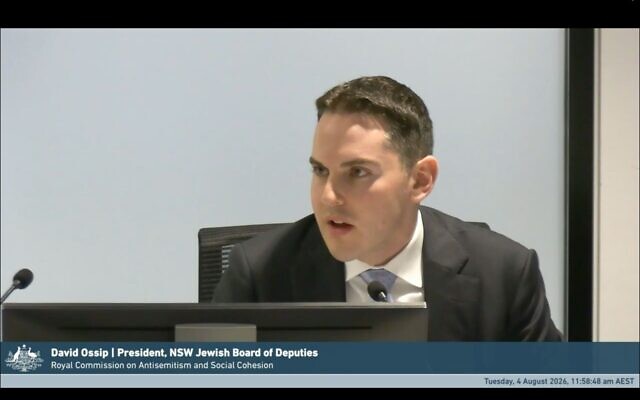
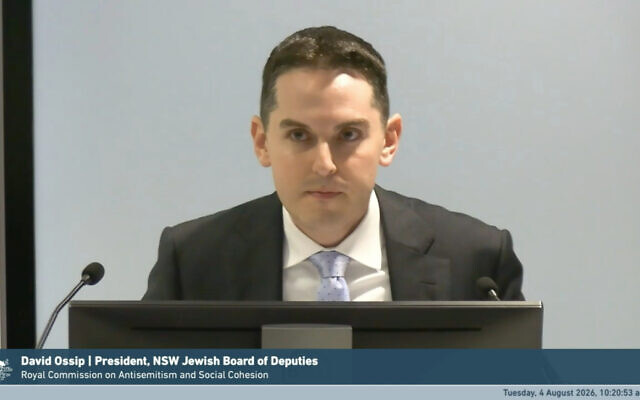
David Ossip, President of the NSW Jewish Board of Deputies. Photo: Screenshot.
“I considered it irresponsible if we didn’t then communicate that to the community, and if we hadn’t, we might have exposed them to danger,” he said.
Ossip said he had held no immediate security concerns when he first learned, on the evening of October 7, that a protest was proposed for Town Hall two days later, describing himself as “bemused and shocked” that anyone would organise one in such circumstances.
He called the protest “incredibly distasteful and insensitive,” but said that “if it was confined to Town Hall, individuals are allowed to protest, even if we find it offensive.”
His position changed the following day, when he was told the protesters intended to march from Town Hall to the Opera House and that police could not guarantee the community’s safety.
Pressed on whether there were sound safety reasons behind the police advice, he did not dispute it. “I’m not a security expert, but obviously I can understand the police wanting to avoid a combustible situation,” he said.
The Commissioner put to him that police had limited legal power to stop a group walking from Town Hall to the Opera House.. Ossip said he understood the difficult legislative environment in which police operate, but drew a distinction between a static protest and a march.
“I think it would have been difficult for them to stop a stationary protest,” he said. “That protest, seeking to move by foot from Town Hall to the Opera House, is a different proposition.”
He told the commission that there “surely could have been another way to handle the situation.”
A communal solidarity gathering was instead held on the evening of October 11, attended by government leaders and leaders of other communities. Ossip said the Opera House had never been considered for a mass gathering because of the constrained site.
He thanked NSW Police for their support over the past three years, saying officers had dealt with extraordinarily difficult situations and that their commitment to the community’s safety and wellbeing had never been doubted.
Ossip also said he welcomed, without question, the Palestine Action Group’s social media post distancing itself from the antisemitic chanting at the Opera House forecourt.
He questioned, however, how police would have responded had thousands of community members attended the Opera House regardless of the advice, saying he presumed “they would have found a way to deal with those two different groups.”
Ossip was cross-examined by counsel for the State of NSW Sophie Callan about events surrounding the October 9, 2023 anti-Israel protest.
She took him through the Community Security Group’s (CSG) operational briefing channel, showing that a CSG officer had relayed advice from a police superintendent that the Jewish community should be kept away from the town hall protest.
Ossip agreed that any reasonable CSG officer receiving that advice would hold consequent concerns, and confirmed there had been no expressions of disagreement within CSG about the police’s public safety assessment.
He said the Board ultimately took responsibility for urging the community, via a joint email with police and CSG, not to attend the Opera House precinct, telling the Commission that serious warnings (related to safety) had been received and escalated to the minister, and that failing to pass them on would have been irresponsible.
Pressed on whether the same security logic should apply regardless of where the protest was held, Ossip agreed police would naturally want to avoid a combustible situation between grieving Jewish community members and pro-Palestinian protesters.
However, he rejected any suggestion that his real frustration lay with legal limits on where protests can occur.
He said his frustration was that a state government gesture of solidarity – lighting the Opera House sails in blue and white – had been overtaken when protesters chose to march from town hall to the same site, effectively forcing police to advise the Jewish community stay away from the CBD.
He argued that police had, in effect, ceded control of parts of the city to the protesters, leaving the Jewish community without a safe and secure place to mourn.
Commissioner Virginia Bell intervened to clarify that the real issue was the limited legal power police had to stop a moving assembly, as opposed to a stationary one.
Ossip maintained that a march was a materially different proposition to a static protest, though he ultimately accepted the difficult legislative and regulatory environment in which police had to make fast decisions.
Earlier, at the beginning of Callan’s cross-examination, Ossip expressed gratitude, overall, to NSW Police, for their support and commitment to the Jewish community’s safety across the past three years.
“They’ve [NSW police] had to deal with some extraordinarily difficult situations,” he said.
“I think they’d be the first to admit that not everything has gone correctly. But the commitment [by police] to the safety and well-being of the Jewish community – I don’t think we’ve ever doubted. And we’re very grateful for the service of the leadership of the NSW Police, and the police force more broadly.”
During cross-examination by counsel for the Australian Palestinian Action Network (APAN), Ragni Mathur, probed NSW Jewish Board of Deputies president David Ossip’s earlier evidence on the Palestine Action Group’s decision to hold a protest in Sydney on 7 October 2023.
Asked to confirm that he and the Board found the timing of that protest “deeply insensitive and troubling,” Ossip said “profoundly”.
He described the scale of the Hamas attack on Israel, including mass casualties, hostage-taking, and violence committed against festival-goers, saying news of the protest going ahead while the attack was still unfolding was “pretty shocking.”
Pressed on whether Palestinians in Gaza and the West Bank, and in Australia, had also suffered deep psychological trauma, Ossip agreed.
Speaking as “a proud Zionist,” he stressed this should not be read as opposition to a Palestinian presence in contested land or to Palestinian rights, adding that he felt empathy for any innocent Palestinian who had suffered too.
When questioned further on that later, he said,“Look, I’m not the best place to opine on what Palestinian Australians were feeling. It’s definitely possible and probably likely that there was concern, after you had the government of Gaza commencing a war in such a vicious and brutal way as it did.
“Notwithstanding all of that, I think it’s important for all of us, as citizens of Australia, to show kindness and respect and understanding and sensitivity to others.
“And, notwithstanding any trauma that those Palestinians Australians were feeling, I feel like if they were involved in organising this rally at a time when such grievous acts of violence were being committed against Israeli civilians, I think that showed a lack of sensitivity.”
The president of the NSW Jewish Board of Deputies has stood by his description of the October 9, 2023 Sydney Opera House protest as “despicable” under cross-examination by counsel for the Palestine Action Group (PAG), telling the Royal Commission the organisers had to answer for what occurred at their rally.
David Ossip was questioned by Dominic Toomey SC, appearing for PAG, who sought to distinguish between the conduct at the protest and the organising of the protest itself.
Ossip said the rally had “achieved international notoriety” because of what took place. “You had protesters proudly screaming, ‘f**k the Jews, where’s the Jews’. One individual screams out, ‘I’m going to kill them all’. There were flares being thrown at the police. There were flags being burnt,” he said. “It was a scene of international disgrace and infamy. It’s amongst the clearest examples of antisemitism we’ve seen over the past few years.”
Pressed on whether his criticism was directed at the conduct or the organisation of a protest per se, Ossip said he had never opposed the holding of a protest. “When it was just scheduled to be held at Town Hall, we were actively working with police to avoid a contest between the groups. So I think it’s a bit of a red herring to suggest that I’ve expressed opposition to a protest,” he said.
He maintained his criticism of the timing, saying the rally had been called on the evening of October 7 “when some of the most gruesome attacks on civilians were still underway. It’s unfathomable.”
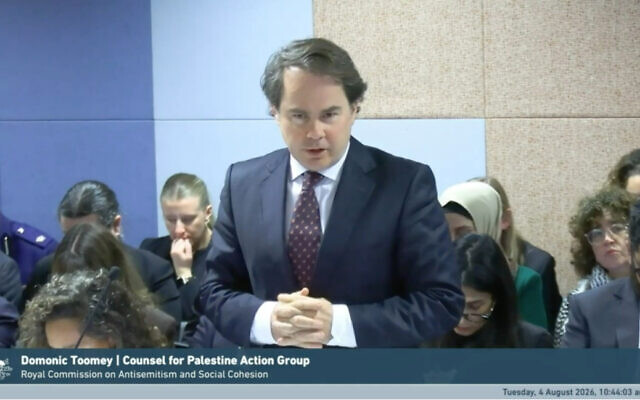
Palestine Action Group (PAG) counsel Dominic Toomey SC.
Toomey put to Ossip that Israel Defence Force jets had begun airstrikes on Gaza at about 5.30pm Sydney time on October 7, and that the Israeli prime minister had declared war that evening. Ossip questioned the relevance of the line of questioning. “This is a Royal Commission on antisemitism. We’re dealing with a protest where protesters shouted out ‘f**k the Jews’ … ‘I’m going to kill them all’. I’m a bit confused as to why we’re getting caught up in the minutia of the timeline of a foreign military operation,” he said.
Commissioner Virginia Bell said she would rule a question inadmissible if it fell outside matters properly before her, but had not done so. Ossip said he respected that and continued to answer.
Toomey suggested Ossip had seen nothing from PAG itself indicating the rally was convened to celebrate the Hamas attack. Ossip declined to concede the point. “When you hold an event, you’re responsible for what takes place at that event, and there were certainly acts of celebration, and there were acts of quite egregious antisemitism,” he said. “In the same way, I take responsibility for events that fall under my auspices. I think the organisers of this protest have to take responsibility for the scenes of notoriety.”
Shown a Facebook post in which the group called for a rally for “a free Palestine” and “no war on Gaza”, Ossip said its timing was “quite extraordinary”. “This post would have gone out while women were still being raped, while children were being kidnapped, whilst families were being burnt alive, and Palestine Action Group thought that that was an appropriate time to hold a rally,” he said. “It’s impossible to avoid the connection between the events of October 7 and the calling of this rally.”
When Toomey suggested the rally could not be divorced from the announcements the Israeli prime minister had made about the impending military response, Ossip rejected the premise. “Israel was in a state of complete disarray at that time. The military wasn’t present, regrettably, to defend against Hamas,” he said. “I don’t understand why you’re seeking to justify the calling of this rally by reference to purported proclamations of Prime Minister Netanyahu.”
The president of the NSW Jewish Board of Deputies has told the Royal Commission that police effectively “transferred control” of Sydney’s CBD to protesters on October 9, 2023, when the Jewish community was advised it was not safe to be in the city centre.
David Ossip, who has held the position since August 2022, gave evidence in Hearing Block 7 about the protest that marched from Town Hall to the Sydney Opera House on the evening of 9 October, two days after the Hamas attack on Israel.
NSW Jewish Board of Deputies president David Ossip.
Ossip said the community had initially been told by police, through the Community Security Group (CSG) NSW, to stay away from a planned protest at Town Hall and not to counter-protest, advice he considered “sensible” in the circumstances. But when it emerged around lunchtime on October 9 that the protest would march to the Opera House — which the NSW government had decided to light in blue and white in solidarity with Israel — the advice shifted.
He said the first indication that police wanted the community to avoid the Opera House was “a source of surprise and disappointment”, coming as Jewish Sydneysiders were planning to gather there for a vigil. “The fact that police were now saying that … the Jewish community had to vacate the national symbol, which was being lit as an act of solidarity, concerned me greatly, and I found it to be quite objectionable,” he said.
Later that afternoon, Ossip said, the advice broadened to a recommendation that the community avoid the CBD altogether. “I thought it was quite an extraordinary and outrageous admonition from police,” he said. “I can’t recall any group, particularly any religious or racial group, ever being provided advice that they should avoid their own city’s CBD for their own safety and well-being. It was effectively the police saying we can’t keep your community safe.”
He said the effect was “the police transferring control of the CBD to the protesters”, a matter he escalated in two phone calls to the NSW police minister.
Ossip said the board had agonised over whether to relay the warning to a community already “highly traumatised and in mourning”. It ultimately emailed a database of at least 10,000 addresses — reaching the overwhelming majority of the community — and posted to Instagram, advising people not to attend the Opera House precinct or Town Hall and to be vigilant if in the CBD. The email did not, in terms, tell people to stay away from the entire CBD, he said, because it was a workday with people at offices and children at school, and such an instruction “would have taken things to a whole nother level”.
He said the events of October 7 had a “profound psychological impact”, surfacing intergenerational trauma. Images of “terrorists going house to house and butchering innocent civilians”, he said, evoked “what had happened to our ancestors in pogroms or the Holocaust”. The community had been “deeply shocked, traumatised, struggled to sleep, struggled to eat”.
Ossip said a combination of factors — the attack itself, a surge of antisemitic social media activity, celebrations on Sydney’s streets on October 8, “the despicable Opera House protest” and the police advice — had given rise to “legitimate” fear about communal safety.
He said the then premier had “handled this matter exceptionally well”, publicly apologising on behalf of the government for the failure to provide a safe space near the Opera House for the Jewish community to grieve.
The Royal Commission on Antisemitism and Social Cohesion has begun today’s single-day hearing block examining the policing of public protests, with a particular focus on the October 9, 2023 demonstration at the Sydney Opera House and a November 2025 neo-Nazi protest outside NSW Parliament House.
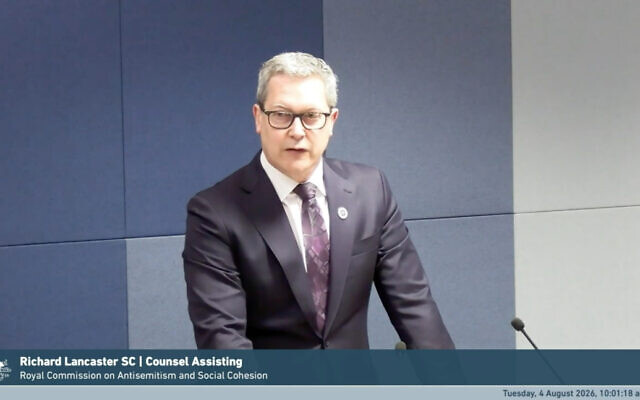
Opening Hearing Block 7, Counsel Assisting Richard Lancaster said the hearing was directed at identifying opportunities to tackle antisemitism and strengthen social cohesion in the policing of protests, one aspect of the commission’s terms of reference.
He said it was “trite to say that lawful public protests are a necessary and valuable part of a properly functioning democratic society”, but that protesters remained subject to the law. “Interpersonal violence does not become lawful or acceptable in the context of a protest. Incitement to violence and racist vilification does not become lawful or acceptable in the context of a protest. Antisemitism does not become acceptable in the context of a protest,” he said, adding that such conduct was not a feature of all, nor most, protests.
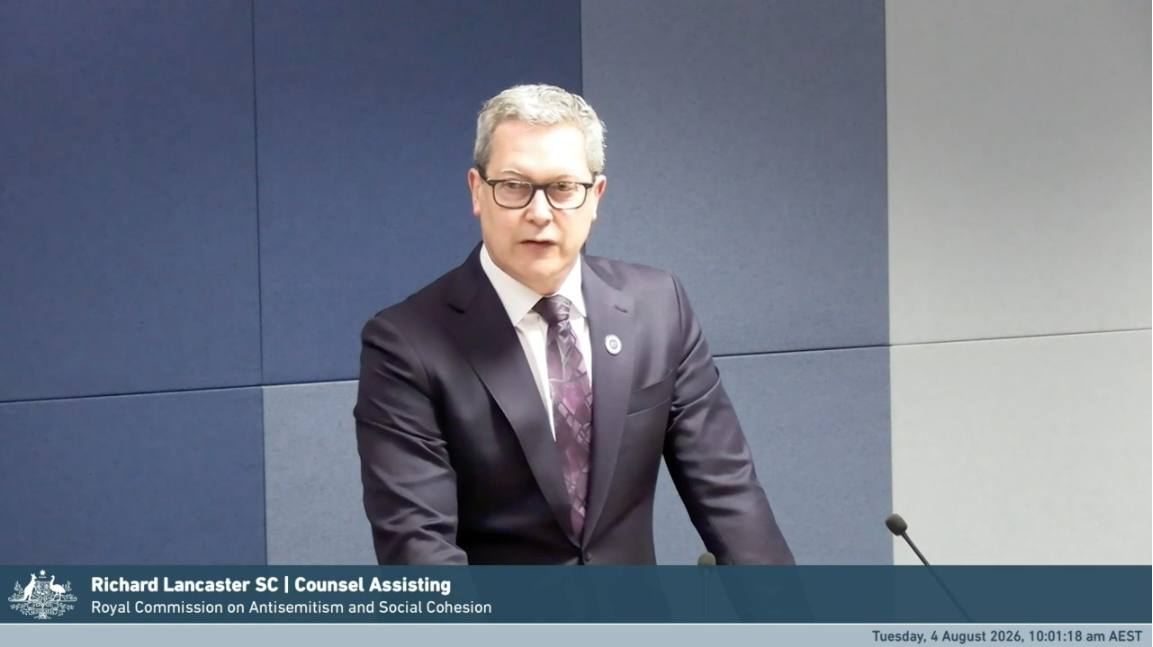
Counsel Assisting Richard Lancaster on Tuesday morning.
Lancaster said there was “a large body of evidence” before the commission acknowledging that criticism of the Israeli government’s military actions in Gaza, or humanitarian compassion for civilian victims in the Middle East, was not antisemitic.
He said several witnesses had described the Palestine Action Group’s Opera House protest as a critical event in the rise of antisemitism in Australia, with the commission hearing in an earlier block that it “marked the shattering of our physical and psychological sense of safety in this country”. A NSW Police investigation had obtained more than 200 hours of footage and a forensic voice analysis expert had identified a chant of “where’s the Jews”, though not the reported “gas the Jews”. The sentiment was “unmistakably antisemitic”, he said, but the findings were “not generalised to all aspects of the protest, and certainly not to all participating protesters”.
The second protest, on November 8, 2025 outside NSW Parliament House, was organised by White Australia, formerly the National Socialist Network, whose members held a banner reading “abolish the Jewish lobby”. Lancaster said the banner invoked “an old antisemitic trope of pervasive Jewish influence on society, delivered by a neat line of white men in black outfits that appeared to misappropriate the initials of a clothing brand to emphasise their neo-Nazi credentials”. Executive Council of Australian Jewry co-CEO Peter Wertheim had described it as a call for the abolition of himself and others representing Jewish organisations.
Two witnesses are giving evidence on the policing of the protests: David Ossip, president of the NSW Jewish Board of Deputies, who held the role in October 2023, and Acting Deputy Commissioner Peter McKenna of NSW Police. Expert witness Professor Mario Peucker, whose research covers radical movements and violent extremism, will also appear, having concluded that protest generally performs a protective function rather than acting as “a conveyor belt towards violence”.
The AJN is providing rolling coverage on the Royal Commission on Antisemitism and Social Cohesion.



comments