



Live updatesPublic hearings
Universities hearing block wraps up
Hearing Block 4, focusing on antisemitism on university campuses, wraps up today with the final four witnesses.
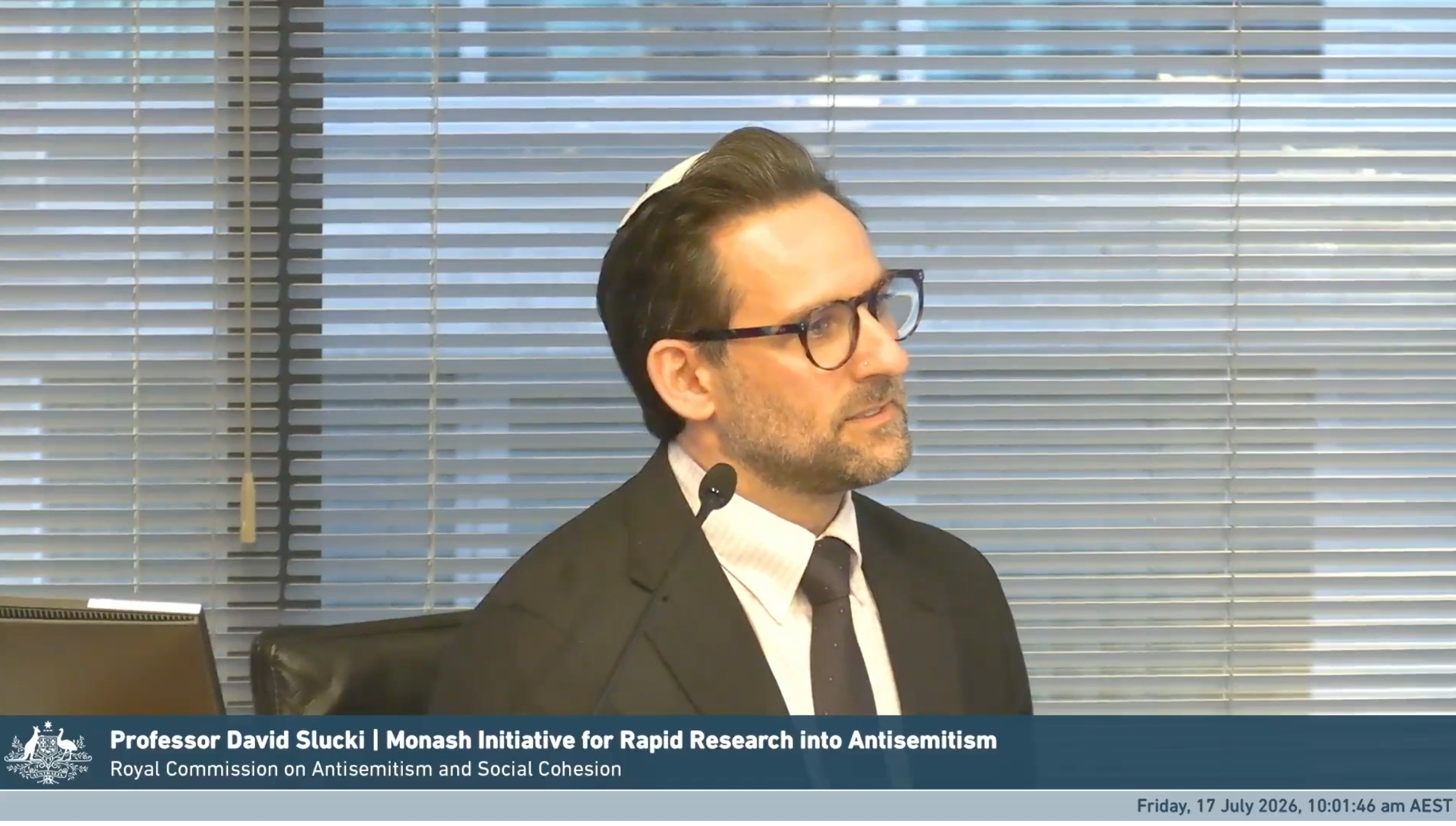
Monash University's Professor David Slucki.
Professor David Slucki, director of the Australian Centre for Jewish Civilisation at Monash University, on the national training program he developed for university leaders
Jasmina Joldic, deputy secretary for higher education, research and international at the Department of Education, new regulatory standards for Australian universities which don’t include a definition of antisemitism
Tertiary Education Quality and Standards Agency (TEQSA) CEO Mary Russell told the Commission the regulator will not tell universities which definition of racism, including antisemitism, they must adopt
Mary Russell on the range of legislative changes she has proposed to strengthen TEQSA’s powers to respond quickly to campus antisemitism
Mary Russell on the need for “quite a broad and holistic approach to systemic change”
Dr Alan Finkel, chair of the Group of Eight’s (Go8) Expert Advisory Committee on Combating Antisemitism, detailed to the Royal Commission the committee’s report and key recommendations
Dr Alan Finkel, chair of the Group of Eight’s (Go8) Expert Advisory Committee on Combating Antisemitism, detailed to the Royal Commission the committee’s report and key recommendations, including that Go8 universities adopt the Universities Australia (UA) definition of antisemitism over the IHRA’s working definition, and that it is important for universities to not only adopt a definition of antisemitism, but use and “operationalise” it through the Codes of Conduct that apply to staff and students.
He said this meant more than symbolic adoption: the definition needed to be usable “for disciplinary purposes, if necessary, as a reference point, and also, if adopted properly, could be used for education purposes.”
He said the IHRA definition had struggled to gain traction at Go8 universities, with academic boards reluctant due to concerns “that the IHRA definition would perhaps reduce freedom of expression and academic freedom,” whereas the UA definition — originally developed by the Go8 itself before being adopted by the vice-chancellors in February 2025 — was “an easier definition to operationalise because it’s a coherent definition.
“It’s not calling out to other descriptors… It’s a very clear statement of what antisemitism is,” he added.
Turning to complaints handling, Dr Finkel agreed with the proposition, put to him by Counsel Assisting, that complaints processes were only one piece of a broader puzzle requiring cultural change.
He said responsiveness was critical, noting complainants had reported that “a claim was made and effectively went to oblivion,” and that the committee recommended an initial response within 10 days and resolution “where practicable” within 45 days.
He also backed annual publication of de-identified, aggregated complaints data, calling it “a no-brainer,” while cautioning that publicising individual case outcomes was far more fraught given competing privacy rights.
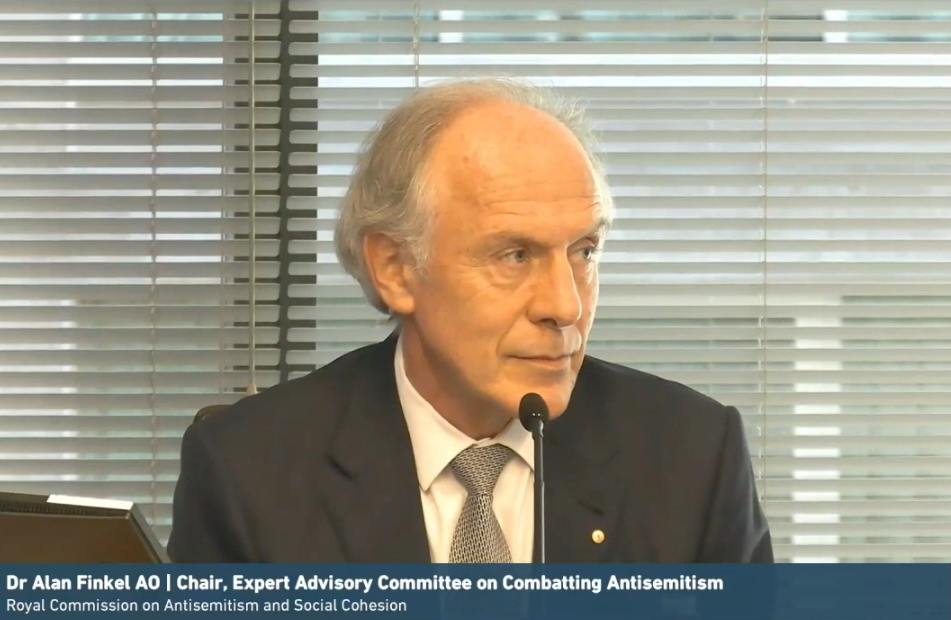
On the report’s section addressing the regulatory and operating environment, Dr Finkel said universities faced an “incredibly complex environment” of overlapping legislation, standards and enterprise agreements, which could create “perceived constraints” for vice-chancellors under pressure.
He said the committee’s goal was to “make it clear that it’s complex, and encourage the vice-chancellors to be well prepared through analysis of that regulatory environment and through scenario planning.”
Asked about recommendations treating on-campus protests like other speaker events — including notification and risk-assessment requirements — Dr Finkel said consultations with universities already using such measures found them effective, with “not a lot of pushback on the implementation of these kinds of approaches.”
On the committee’s recommendation for stronger police relationships, Dr Finkel said the key lesson from international and domestic consultation was that regular engagement mattered more than formal rules: “it was much easier for them to pick up the phone and have a discussion that was effective and understood, rather than calling up for the very first time in a panic and saying help.”
Under questioning from the senior counsel for AUJS and Jewish Communal Organisations, Gabi Crafti – about universities’ reluctance to rule on whether slogans were antisemitic – TEQSA CEO Dr Mary Russell said she had “commonly heard” comments from academic staff and students during the protests, and discussions about the protests and encampments, that “overinterpret” the scope of academic freedom, adding there was “some conflation between academic freedom and freedom of speech.”
Dr David Knoll – Counsel for the Australian Academic Alliance Against Antisemitism (5A) – then pressed Dr Russell on the Tertiary Education Quality and Standards Agency’s (TEQSA) handling of notifications from academics affected by campus unrest.
Referring to the occupation of Professor Prawer’s office at the University of Melbourne, Dr Russell said she had personally phoned the university to “seek information and assurances about how that situation was being managed,” but clarified that “it is not TEQSA’s role to review or remake specific investigations.”
She said, however, that when TEQSA approached the University of Melbourne to arrange contact with Professor Prawer, “we were advised that at that time, his thinking was that he didn’t want to engage or discuss it more broadly, and we respected that.”
On the broader question of inclusion – and to, as Dr Knoll put it, ensure that there are clear and actionable plans that enable Jewish academics to “no longer have to hide their identity and so they can participate in faculty life – Dr Russell acknowledged the need for “quite a broad and holistic approach to systemic change…because all staff and all students need to be able to participate with a sense of safety as themselves in the university environment.
When further pressed on that, Dr Russell said “I’ve noted it is already in our consideration, and it’s the sort of thing that we will explicitly ask providers to do as part of their consultation as well.”
Dr Knoll then put to Dr Russell whether complainants would be updated after TEQSA raised concerns with a provider.
Dr Russell was unable to give a firm commitment, saying “that will depend on the nature. I can’t answer that with a definitive answer without specific context.”
She stressed that, unlike the National Student Ombudsman, “we are not a complaints mechanism,” meaning concerns raised with TEQSA “have to be considered by us in terms of compliance with the standards” rather than investigated or reported back on individually.
Tertiary Education Quality and Standards Agency (TEQSA) CEO Mary Russell has told the Royal Commission on Antisemitism and Social Cohesion that the regulator’s current powers were insufficient to respond quickly to campus antisemitism, and has set out a range of legislative changes she has proposed to strengthen them.
Continuing her evidence on Friday, Russell said several features of the current framework had made it difficult for TEQSA to respond to antisemitism during the protests and encampments. The threshold standards had not, until this week’s amendment, specifically referenced racism, confining any action to issues already covered. There was no positive duty on providers to meet the standards, meaning TEQSA had to work through a lengthy process of gathering information, proposing a decision, allowing the provider to respond and, if necessary, imposing conditions before it could move to enforcement.
A positive duty, she said, would allow TEQSA to move immediately to enforcement measures such as financial penalties or injunctions in appropriate, serious cases. She said TEQSA’s power to compel information in compliance matters was also limited to higher education providers, preventing it from compelling relevant information from other individuals, and that its ability to assess and respond to “thematic” risks was framed around individual providers rather than a sector-wide basis — unhelpful for a problem like antisemitism that spanned much of the sector.
Among the changes Russell said TEQSA had put to the Department of Education were an enforceable code — under which what is currently a statement of regulatory expectations could carry more weight and expose providers to enforcement for significant non-compliance, potentially through publication of non-compliance or financial penalties — along with explicit enforcement provisions for systemic risks, powers to require production of information from parties other than providers, to issue infringement notices and obtain warrants, and to pursue civil penalties for governance failures.
Russell said warrants could allow TEQSA to examine provider records directly, such as complaints information or the evidence of disciplinary investigations and appeals relating to specific antisemitism concerns, rather than relying on cooperative site visits conducted with notice.
On civil penalties for governance failures, she said it was critical that a university’s executive and governing body were directly accountable for meeting the standards, including for assessing antisemitism, putting action plans in place and monitoring them, and that TEQSA needed to be able to respond decisively where there was reluctance to meet those obligations.
Asked about TEQSA’s enforcement history, Russell said the registration of a Group of Eight university had never been cancelled, describing cancellation as a last resort given the impact on large numbers of students and staff, though a condition had been imposed on one such university. She was not aware of any court application for financial penalties against a Group of Eight university during her time as CEO.
Tertiary Education Quality and Standards Agency (TEQSA) CEO Mary Russell has told the Royal Commission that new higher education standards will require universities to adopt definitions of racism, including antisemitism, but that the regulator will not tell them which definition to use.
Russell, who has led TEQSA since May 2024 after acting in the role from June 2023, gave evidence on Friday about a new standalone obligation requiring universities to define racism, including antisemitism, introduced in amendments to the threshold standards this week. She said TEQSA would issue a statement of regulatory expectations as a priority, probably one specific to antisemitism, with separate guidance to follow on Islamophobia and racism towards Aboriginal and Torres Strait Islander peoples.
The standard requires definitions “relevant to a provider’s higher education operations”. Russell said the sector was diverse — 44 registered universities among 219 providers — and a definition needed to be fit for a provider’s particular research, teaching and cohorts, so it could be applied consistently in policies and disciplinary processes.
Asked whether a university should have a single definition of antisemitism, Russell said that before the week’s evidence she had not contemplated universities using multiple definitions, and that TEQSA might prompt providers to consider the risks of doing so. Her initial expectation was that the guidance would call for one definition, but she could not be definitive until the instrument was developed.
The guidance would not specify which definition, she said, because the standard itself did not, and a statement of regulatory expectations could not go beyond the standard. TEQSA would at a minimum direct providers to the International Holocaust Remembrance Alliance (IHRA) definition in full and the Universities Australia definition as options.
Russell confirmed that in March 2025 Universities Australia had sought to have its definition written into the standards, and that TEQSA — in a letter she signed — had responded that it was neither necessary nor appropriate to specify a particular definition, given the standards were deliberately principles-based and providers had separate obligations under Commonwealth, state and territory law. Her expectation was that a definition would be incorporated into the policies regulating staff and student conduct, not merely footnoted.
Russell also gave evidence about TEQSA’s response since October 7, 2023. While the standards then had no obligation specific to racism, the student safety and wellbeing standard could be used as a lens. She said protest activity had initially been peaceful but over time strayed into antisemitism — slogans, placards, posters and stickers, statements in protests and speeches, and, in some instances, conduct in classrooms.
This coincided with the increasing involvement of “external actors” who were not students or staff, which she said ended any prospect of discourse and brought more heated, aggressive and personalised conduct, particularly directed at Jewish students and staff.
In early 2024, TEQSA concluded a more proactive approach was warranted rather than waiting for concerns to surface through its slow compliance processes. With the minister’s support, it formed an internal response group that Russell chaired, and progressively called 15 universities where protests or encampments had been reported.
On May 10, 2024, at the height of public attention on the encampments, it wrote to all universities setting out critical measures, including removing unlawful materials, acting against those who breached policies, maintaining effective law-enforcement relationships and keeping learning spaces safe.
A later sector update on managing external actors, issued in November 2025, had been delayed by contested consultation but remained useful, Russell said. She was critical of a poorly developed understanding of antisemitism across the sector, of universities’ reluctance to determine what constituted antisemitism, and of complaints and academic-adjustment processes that were not trauma-informed — citing a student asked to prove how October 7 had affected a family member. TEQSA issued a statement of regulatory expectations in October 2025 setting out acceptable practice for complaints processes, though Russell was aware of only two providers that had shared self-assessments against it with her.
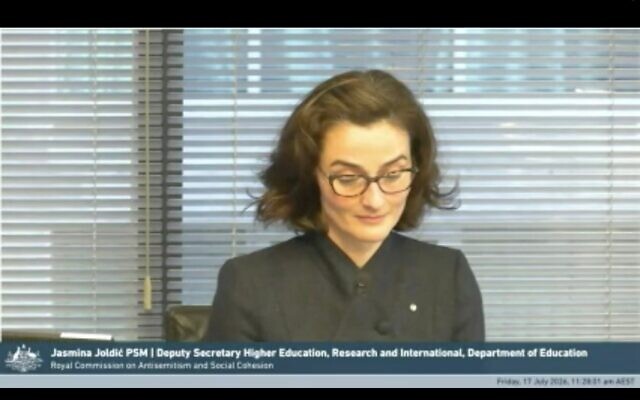
The Federal Government has decided against writing any definition of antisemitism into the new regulatory standards for Australian universities, telling the Royal Commission on Antisemitism that institutions must be left to choose their own.
Jasmina Joldic, deputy secretary for higher education, research and international at the Department of Education, gave evidence this week, days after the Minister for Education amended the Higher Education Standards Framework to require universities to prevent and respond to racism, including antisemitism. Joldic was the most senior official to sign off on the advice to the minister.
“They are autonomous institutions,” she said. “They need to be able to work with their own communities, consult with their own communities.”
Universities Australia had asked regulator the Tertiary Education Quality and Standards Agency (TEQSA) in March 2025 to have its definition of antisemitism written into the standards. TEQSA replied that this was neither necessary nor appropriate, and the department later agreed.
The department did strengthen the standards in one respect, recommending a standalone clause on preventing and responding to racism rather than spreading the obligations across existing provisions, as the Higher Education Standards Panel had advised.
“We wanted to make it explicit and very clear where the accountability sits and what is expected of the sector,” Joldic said.
Gabi Crafti, appearing for seven major Jewish communal organisations and the Australasian Union of Jewish Students, pressed Joldic on why racism is not being tackled with the same machinery the government built for gender-based violence.
The National Higher Education Code on gender-based violence, in force since 1 January, sets seven legally enforceable standards and holds each university’s chief executive personally accountable. It carries financial penalties, is policed by a dedicated regulator and makes compliance a condition of funding.
Crafti put it to Joldic that “now that you’ve done all that good work, it could be applied to the pernicious problem of dealing with racism on Australian university campuses”.
“It could be, absolutely,” Joldic replied, but said the code should be given time to prove itself and that the government had taken “a slightly different approach” to antisemitism.
Asked whether there was any reason for the two to be treated differently, she said the approach was “contextualised” and that “it is the prerogative of the government of today to make those decisions”.
Joldic agreed the evidence heard during the week had been troubling and that action was needed. “I think that goes without saying,” she said.
Dr David Knoll, for the Australian Academic Alliance Against Antisemitism and its 250 members, raised research grants, asking whether academics who had signed public boycott, divestment and sanctions (BDS) letters should be assessing applications from Jewish or Zionist researchers.
Joldic accepted the risk of an appearance of bias. Told that no current process addresses the scenario, she said, “I will have to take your word for it,” and undertook to investigate and report back to the commission.
She also agreed the alliance should be consulted, and accepted that barring grants to those who have engaged in serious racial or religious vilification, or expressed support for listed terrorist organisations, could be included in the terms of reference of the Commonwealth Research Grants Working Group.
That group, chaired by Australian Research Council chair Professor Peter Shergold, reports to the Antisemitism Education Task Force in October.
Professor David Slucki, director of the Australian Centre for Jewish Civilisation at Monash University, has told the Royal Commission that a national training program he developed for university leaders now spans about 30 institutions and more than 1700 executives and frontline staff.
Slucki, a historian who has researched antisemitism since 2007, said he established the Monash Initiative for Rapid Research into Antisemitism (MIRRA) in 2024 in response to rising antisemitism and a lack of evidence-based research to guide policy.
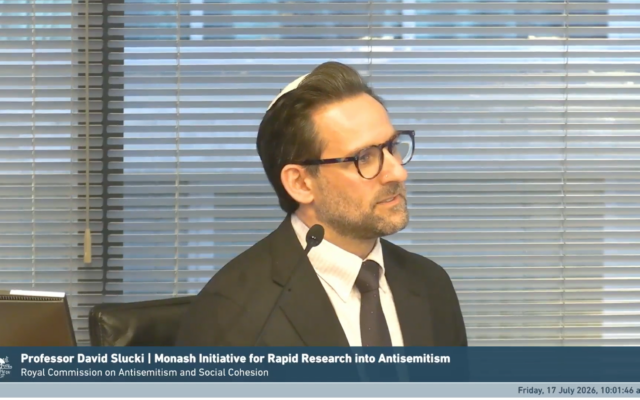
In October 2024, the Group of Eight (Go8) universities asked him to develop training for executive leaders and frontline staff, including complaints handlers and security personnel. After trialling sessions of two and four hours, MIRRA settled on a three-hour format, first piloted with Monash’s Vice-Chancellors Group in December 2024. The training has since been delivered to the Commonwealth Department of Education and Tulane University in New Orleans, which has invited Slucki back later this year.
Funding came initially from Monash, then from the Go8, before the Office of the Special Envoy to Combat Antisemitism and Universities Australia expanded its reach, alongside Commonwealth Department of Education support over two years.
Slucki said the training’s “theory of change” rested on partnership rather than confrontation. “If we’re only solving for antisemitism, we’re not solving antisemitism,” he said, describing a phrase borrowed from a colleague.
The program covers the basics of Judaism and Jewish diversity in Australia, citing Gen17 survey data showing 46 per cent of Australian Jews considered belief in God important to their Jewish identity, against 95 per cent for remembering the Holocaust.
On Zionism, Slucki referenced his Guardian article, written after the Bondi attack, arguing the term carries different meanings across a spectrum. “Zionism as a concept broadly is something we ought to be able to discuss and criticise,” he told the hearing, while distinguishing criticism of Israel’s government from denial of Jewish self-determination.
Under cross-examination by counsel for the Australia Palestine Advocacy Network, Slucki agreed that calling for a bi-national or unitary democratic state was not inherently antisemitic “on its face”, but maintained that ending Jewish self-determination in any resulting state would be.
The AJN is providing rolling coverage on the Royal Commission on Antisemitism and Social Cohesion.
For full coverage of the Hearing Blocks, visit the Royal Commission section of The AJN website.
Tertiary Education Quality and Standards Agency (TEQSA) CEO Mary Russell has told the Royal Commission on Antisemitism and Social Cohesion that the regulator’s current powers were insufficient to respond quickly to campus antisemitism, and has set out a range of legislative changes she has proposed to strengthen them.
Continuing her evidence on Friday, Russell said several features of the current framework had made it difficult for TEQSA to respond to antisemitism during the protests and encampments. The threshold standards had not, until this week’s amendment, specifically referenced racism, confining any action to issues already covered. There was no positive duty on providers to meet the standards, meaning TEQSA had to work through a lengthy process of gathering information, proposing a decision, allowing the provider to respond and, if necessary, imposing conditions before it could move to enforcement.
A positive duty, she said, would allow TEQSA to move immediately to enforcement measures such as financial penalties or injunctions in appropriate, serious cases. She said TEQSA’s power to compel information in compliance matters was also limited to higher education providers, preventing it from compelling relevant information from other individuals, and that its ability to assess and respond to “thematic” risks was framed around individual providers rather than a sector-wide basis — unhelpful for a problem like antisemitism that spanned much of the sector.
Among the changes Russell said TEQSA had put to the Department of Education were an enforceable code — under which what is currently a statement of regulatory expectations could carry more weight and expose providers to enforcement for significant non-compliance, potentially through publication of non-compliance or financial penalties — along with explicit enforcement provisions for systemic risks, powers to require production of information from parties other than providers, to issue infringement notices and obtain warrants, and to pursue civil penalties for governance failures.
Russell said warrants could allow TEQSA to examine provider records directly, such as complaints information or the evidence of disciplinary investigations and appeals relating to specific antisemitism concerns, rather than relying on cooperative site visits conducted with notice.
On civil penalties for governance failures, she said it was critical that a university’s executive and governing body were directly accountable for meeting the standards, including for assessing antisemitism, putting action plans in place and monitoring them, and that TEQSA needed to be able to respond decisively where there was reluctance to meet those obligations.
Asked about TEQSA’s enforcement history, Russell said the registration of a Group of Eight university had never been cancelled, describing cancellation as a last resort given the impact on large numbers of students and staff, though a condition had been imposed on one such university. She was not aware of any court application for financial penalties against a Group of Eight university during her time as CEO.
comments