Hearing Block 8 continues looking at antisemitism and extremism in Australia, including religious, far-right and other ideologically motivated extremism and radicalisation.
The head of the Shia Muslim Council of Australia has told the Royal Commission on Antisemitism and Social Cohesion that mourning ceremonies held in Australian Shia mosques for the late Ayatollah Ali Khamenei were religious, not political.
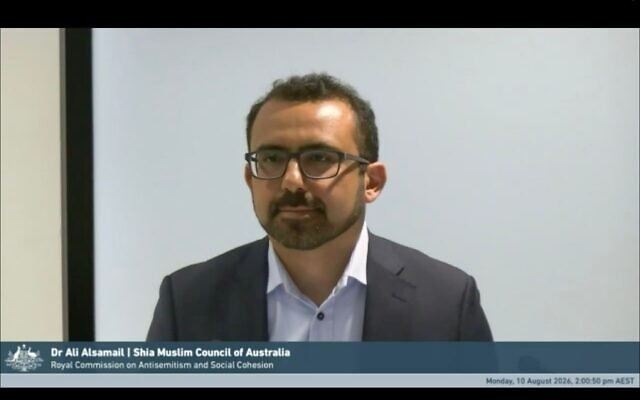
Dr Ali Alsamail, a Sydney GP, university lecturer and Islamic scholar who directs the council, gave evidence on Monday afternoon in the commission’s eighth hearing block, which is examining the drivers of antisemitism and radicalisation in Australia and the effectiveness of disengagement programmes.
Commissioner Virginia Bell AC SC put to Dr Alsamail that Khamenei, who was killed in strikes on Tehran in February, held religious significance for Shia Muslims worldwide.
Dr Ali Alsamail, Director of the Shia Muslim Council of Australia. Photo: Screenshot
He was also, she said, the supreme leader of a country with which Australia had severed diplomatic relations after intelligence agencies found the Islamic Revolutionary Guard Corps had directed the arson of a Jewish synagogue and a Jewish business. She asked how Australian society was to reconcile mourning in those circumstances.
Dr Alsamail said the intelligence findings pointed to “certain criminal elements that were involved in those two horrific attacks, which we completely condemn”.
“There were criminal elements. They’re not community members at all,” he said, describing those responsible as professional criminals rather than mosque attendees.
He said he did not know what chain of authority lay behind the attacks, or whether a rogue element had been involved, but that “we would believe that the Ayatollah would never have any direct involvement in anything like that at all”.
The mourning, he said, was “for a religious leader, a leader in jurisprudence and theology”, set apart from any political or governing role Khamenei had held.
Asked to explain the ayatollah’s standing, Dr Alsamail described the Shia concept of a marja, a scholar whose rulings the faithful follow on questions of religious law.
A marja was “a person of religious, very, very high religious education that we would refer to when it comes to jurisprudential rulings and theological knowledge”, he said. Only two or three such figures were alive at the time, and news reports comparing the position to that of the Pope were a fair approximation.
Commissioner Bell also asked whether the council had expressed condolences to the Jewish community after the Bondi attack, in which 15 people were murdered at a Chanukah celebration on December 14 last year.
Dr Alsamail said that on the same Sunday night, and again early the following week, “the Shia Muslim Council issued statements condemning the terror attack and sending condolences to the Jewish community”.
Earlier, under examination by counsel assisting, Dr Alsamail described the council as an umbrella body registered in March 2024 with 43 member mosques, Islamic centres and religious service providers, most of them in Sydney and Melbourne.
It exercises no religious or disciplinary authority over its members and runs entirely on volunteers, which he called “definitely our biggest challenge”.
He told the commission about an educational programme developed at the Al Bayt Islamic Centre in Auburn, where he leads religious programmes, for people who have engaged in or are at risk of hate crimes.
Titled Wisdom and Good Counsel, after a Quranic instruction to “call to the way of your Lord with wisdom and good counsel, and use only the best of manners”, the four-module course sets out teachings on respect for difference and the use of language.
Dr Alsamail said the material was aligned with “ethical communication, mutual respect, non-coercive dialogue, and the rejection of hostility, intimidation, or imposition of views on others through force or fear”, which he described as basic Australian values.
The programme has rarely been run. “It’s a really good thing that we have very rarely had to do it,” he said, adding that one referred person was yet to attend. He agreed it could be adapted as a general preventive education module.
On hate speech laws, Dr Alsamail said the council had supported the Australian Muslim Advocacy Network’s submission on a dehumanisation framework, and argued that “whatever approach is taken to the issue of hate speech should be universal”. He recommended adopting something along the lines of the National Anti-Racism Framework, covering all forms of hate and vilification.
He linked disengagement to whether young people feel heard, saying the complaint arose often in his community. Young people who felt their views were absent from mainstream media, or who felt unable to express grief over what they saw as human rights violations overseas, could “feel marginalised, frustrated”, he said.
The council’s answer, he said, was civic education sessions, legal information nights and public reporting of its parliamentary submissions, alongside interfaith work.
The Auburn centre exchanges visits with the Auburn Anglican Church, and Dr Alsamail, a member of the NSW Faith Affairs Council, said he wanted to extend interfaith contact to young people at a grassroots level, resources permitting.
Meeting people from other faiths in person was the antidote to the online echo chamber, he said.
“You can meet someone in person and it completely changes what you thought about them.”
Constitutional limitations on Commonwealth legislative power and a longstanding exemption for basic religious charities pose significant obstacles to strengthening charity regulation around racial vilification, the Royal Commission on Antisemitism and Social Cohesion.
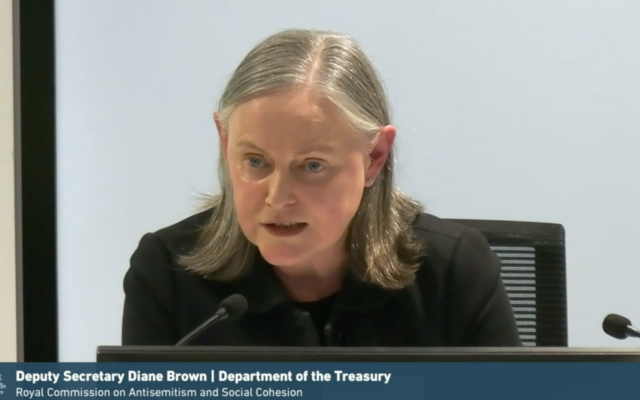
Treasury deputy secretary Diane Brown told the Commission that because there is no explicit head of power in the Constitution relating to charities, the Commonwealth must rely on a patchwork of constitutional powers, including corporations, external territories and taxation, to regulate the sector.
Brown said this meant Treasury’s proposed governance standard amendments, while workable for most charities, could not give the ACNC commissioner a direct power to remove individuals with disqualifying convictions from charity leadership roles. Instead, the obligation falls on charities themselves to take reasonable steps to ensure their responsible persons meet the required conditions.
“It’s not a direct power,” Brown said. “The obligation is on the charity, and it’s one to take reasonable steps.”
She confirmed that giving the ACNC commissioner the power to directly ban or remove individuals would likely require a referral of legislative powers from the states, a process she described as unpredictable.
“I’ve been involved with two referrals,” Brown said. “One was the Corporations Act. It happened quite quickly, so I won’t say it’s without exception that it can occur quickly. It required, it had the support of the whole business community to occur. The second one related to housing. I had that role for 12 months, and over that period, we didn’t get the referral that we wanted. I think it took a matter of years.”
Brown also identified a significant gap in the proposed reforms relating to the approximately 8500 basic religious charities registered with the ACNC, representing about eight per cent of all registered charities. Under section 45-10(5) of the ACNC Act, these entities are exempt from the governance standards, meaning proposed amendments targeting racial vilification would not apply to them.
Brown acknowledged that their continued access to tax concessions such as income tax exemptions could undermine public trust where responsible persons of those charities engage in conduct like racial vilification.
“I think it’s applicable to say that applies to all charities, including basic religious charities,” she said, when asked whether vilification standards should extend to the exempt category.
However, she flagged practical considerations in removing the exemption.
“Many of them are just the local parish church, and so there would need to be an examination of the appropriateness of the ACNC commissioner, for example, being able to remove a priest from their role,” Brown said. “You’d have to think, and I think you could think of ways to manage or mitigate that, but I haven’t to date.”
Brown noted the ACNC legislation review and the Productivity Commission had both recommended removing the basic religious charity distinction to encourage transparency, but said she could find no explanation in the original explanatory memorandum for why the exemption had been created.
Counsel for Jewish organisations Nicholas Bender SC put to Brown that the difficulties around referrals of state powers could be bypassed if state parliaments enacted a national scheme. Brown said she was less familiar with the mechanism but noted it was “another option”, citing the initial Corporations Act national scheme as precedent.
The Department of Treasury has outlined proposed amendments to charity governance standards that would allow the Australian Charities and Not-for-Profits Commission to take action against charities and their leaders involved in racial vilification and hate speech.
Treasury deputy secretary Diane Brown told the Royal Commission on Antisemitism and Social Cohesion that her department had been developing regulatory pathways to respond to concerns raised by both a 2018 review of the ACNC Act and Special Envoy to Combat Antisemitism Jillian Segal’s July 2025 plan.
Segal’s plan included a key action to remove deductible gift recipient status from charitable institutions that promote antisemitism. Brown confirmed the government had broadly adopted the plan in its December 2025 response, but said Treasury had identified limitations with directly revoking DGR status through the Australian Taxation Office.
“We would be conscious to try not to duplicate the regulation of charities,” Brown said. “We could give the power to the ATO to revoke the DGR status, but they would be doing it for matters around behaviour of charities, and the behaviour of charities probably more appropriately sits with the ACNC.”
Instead, Treasury has proposed amending ACNC governance standard three to prohibit registered charities from engaging in summary offences related to racial vilification or hate, as well as conduct that would constitute unlawful offensive behaviour under the Racial Discrimination Act.
A second proposed amendment to governance standard four would make it a condition that responsible persons of charities not have criminal convictions for racial vilification, alongside the terrorism, money laundering, fraud, drug and child sex offences already flagged for inclusion under the long-delayed recommendation 23 of the 2018 ACNC legislation review.
Brown said the advantage of using the ACNC governance standards as the regulatory vehicle was that deregistration would strip charities of all tax concessions, not only DGR status.
“If their charity is revoked, they lose access to all of the tax concessions, not just the DGR,” she said. “So if the issue is about the expenditure of public money by a charity that’s engaging in inappropriate behaviour, we wanted to make sure we dealt with both the DGR as well as income tax and the other tax concessions they may be availing themselves of.”
Asked whether it could damage public trust if responsible persons of charities engaged in hate-based crimes such as inciting racial hatred, Brown said, “I think that would be a reasonable statement to make. People would expect people running charities not to be engaging in that type of behaviour.”
She also agreed it was reasonable to expect that contraventions of civil discrimination provisions, such as section 18C of the Racial Discrimination Act, could similarly damage public confidence.
“I think that is a reasonable expectation,” Brown said. “Though what is reasonable in the case of a law is always a matter for government, and they really are probably the better judge of what is going to affect public confidence.”
Neither of the 2018 review recommendations that underpin the proposed changes has yet been implemented. Brown confirmed there was no active progression of the reforms while the Royal Commission remained on foot.
Continuing giving evidence this morning, ACNC Commissioner Susan Woodward backed a raft of possible reforms to strengthen the regulator’s ability to act against charities and office-holders linked to hate speech, while conceding significant gaps in her agency’s enforcement powers.
Regarding the limits of the ACNC’s jurisdiction, Woodward – when questioned by Counsel for several Jewish organisations, Nicholas Bender – confirmed that only around 6 per cent of charities report overseas activities, meaning the Commonwealth’s external affairs power can rarely be relied upon to regulate the rest.
When she was briefed upon becoming ACNC Commissioner, she said she was told “probably the vast majority” of charities are not “federally regulated entities” because they do not meet the constitutional definition of a corporation.
Asked directly whether that left revocation as effectively her only real sanction against most charities, Woodward agreed: “That’s correct.”
Pressed that this was “a blunt instrument,” including because it ends the ACNC’s oversight altogether, she agreed: “That’s correct.”
Woodward defended the regulator’s record, insisting the ACNC still achieves “an awful lot” through informal compliance measures charities rarely see, and rejected any suggestion of “a free-for-all.”
But she confirmed that closing the gap — whether through a referral of state powers or a nationally consistent scheme modelled on the Australian Consumer Law — “would be very helpful,” while stressing constitutional design was “not my policy remit.”
When Bender asked: Is it the case that, from your perspective as a regulator in this sector, the societal picture has changed since 2018, and that because of heightened concerns about racial and religious vilification and incitement of hatred, there is a greater need in your sector to consider law reform that could address those issues in connection with charities?
Woodward replied, “I think that’s a fair summary”, adding, “Charities are often at the forefront of social issues,” and where they are linked to conduct such as inciting hatred, “they’re not really contributing to social cohesion.”
She backed examining whether criminal convictions for incitement or racial vilification should disqualify a person from being a “responsible person” of a charity.
Pressed further on whether the disqualifying threshold should extend beyond criminal convictions to include civil findings — such as a contravention of section 18C of the Racial Discrimination Act — Woodward said that was properly a matter for the Commission’s recommendations, but that “anything that provides us with a bright line” so the ACNC was not left to reassess such conduct itself “would assist us to play our part.”
She added, where a responsible person’s conduct was inappropriate, the ACNC would need to consider what the charity itself had done about it and whether the relevant governance standards applied.
Bender also explored the ACNC’s 12-month cap on disqualification from acting as a responsible person. Woodward said she had “not considered” extending that period, calling it “a matter for government,” though she agreed it “could be helpful” as a discretionary tool.
She confirmed the ACNC supports scrapping the exemption from most governance standards currently enjoyed by “basic religious charities,” saying it would be “more efficient and basically fair that the same standards apply to all registered charities.”
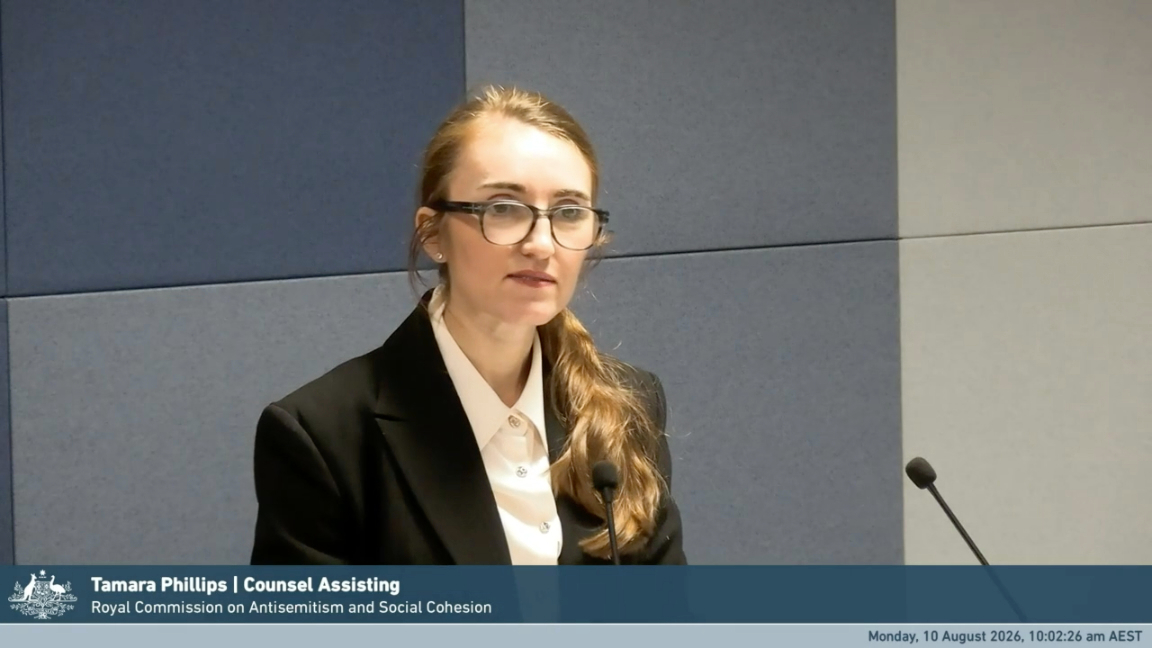
Under brief further questioning from Counsel Assisting Tamara Phillips, Woodward reiterated her support for a statutory mechanism allowing the ACNC to revoke a charity’s registration on national security grounds, based on advice from law enforcement or intelligence agencies.
Such a measure, she said, would give the ACNC “a clear and bright line” to act quickly. She added that relying on a direction from a security agency would also let the ACNC draw on specialist expertise, rather than assessing contested security information itself against the “nuance” of existing governance standards.
Australia’s charities regulator has told the Royal Commission that it has no power to remove a person who runs a religious charity even if they repeatedly deliver hateful or antisemitic speeches.
Susan Woodward, Commissioner of the Australian Charities and Not-for-profits Commission (ACNC), gave evidence on Monday about the limits of her powers over a category known as “basic religious charities”, which are exempt from the governance standards that apply to other registered charities and over which the regulator has a reduced enforcement toolkit.
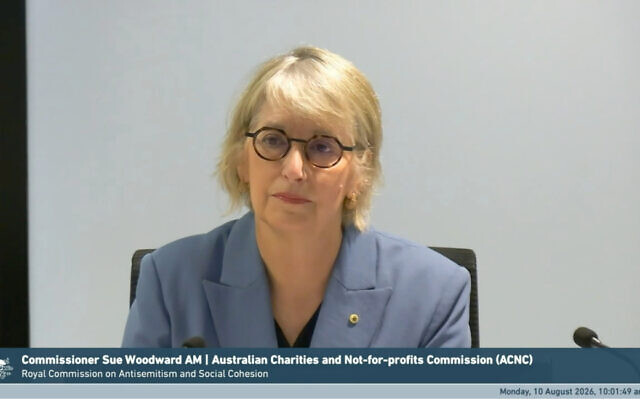
Australian Charities and Not-for-profits Commission commissioner Susan Woodward.
Counsel Assisting Tamara Phillips asked Woodward to consider a hypothetical religious charity that held regular services but also, from time to time, platformed speakers who engaged in racial vilification or hate speech, including where one of those speakers was also a “responsible person” of the charity. Woodward said there was “no simple direct” line to revocation in such a case, and confirmed she had no power to remove a responsible person of a basic religious charity.
Woodward explained that the ACNC’s framework was built around powers over the charity as an entity, not over the individuals governing it — a limitation she traced to the constitutional basis of the ACNC Act. Even where the regulator could act, revocation of a charity’s registration was “a blunt tool”, she said, because once a charity was deregistered the ACNC lost all oversight of it, and the charity could continue operating, albeit without access to Commonwealth tax concessions.
She said whether platforming hateful speakers could cost a religious charity its registration would turn on a technical distinction in the Charities Act between a charity’s “purpose” and its “activities”. Hateful activities might not be enough; only if they rose to the level of a “disqualifying purpose” could the regulator consider revoking a basic religious charity’s status.
A weekly hateful speech delivered by a responsible person, and allowed to continue, would be “a much higher level of concern”, Woodward said, and could bring the regulator “much closer” to being able to act, potentially by rebutting the legal presumption that advancing religion is for the public benefit.
Woodward, who was appointed ACNC commissioner in December 2022, said the regulator would support legislative reform allowing it to use its full toolkit consistently across all charities, including basic religious charities. She acknowledged such reform was “bigger than the Commonwealth government” and would likely require the cooperation of the states and territories.
The AJN is providing rolling coverage on the Royal Commission on Antisemitism and Social Cohesion.
The head of the Shia Muslim Council of Australia has told the Royal Commission on Antisemitism and Social Cohesion that mourning ceremonies held in Australian Shia mosques for the late Ayatollah Ali Khamenei were religious, not political.
Dr Ali Alsamail, a Sydney GP, university lecturer and Islamic scholar who directs the council, gave evidence on Monday afternoon in the commission’s eighth hearing block, which is examining the drivers of antisemitism and radicalisation in Australia and the effectiveness of disengagement programmes.
Commissioner Virginia Bell AC SC put to Dr Alsamail that Khamenei, who was killed in strikes on Tehran in February, held religious significance for Shia Muslims worldwide.
Dr Ali Alsamail, Director of the Shia Muslim Council of Australia. Photo: Screenshot
He was also, she said, the supreme leader of a country with which Australia had severed diplomatic relations after intelligence agencies found the Islamic Revolutionary Guard Corps had directed the arson of a Jewish synagogue and a Jewish business. She asked how Australian society was to reconcile mourning in those circumstances.
Dr Alsamail said the intelligence findings pointed to “certain criminal elements that were involved in those two horrific attacks, which we completely condemn”.
“There were criminal elements. They’re not community members at all,” he said, describing those responsible as professional criminals rather than mosque attendees.
He said he did not know what chain of authority lay behind the attacks, or whether a rogue element had been involved, but that “we would believe that the Ayatollah would never have any direct involvement in anything like that at all”.
The mourning, he said, was “for a religious leader, a leader in jurisprudence and theology”, set apart from any political or governing role Khamenei had held.
Asked to explain the ayatollah’s standing, Dr Alsamail described the Shia concept of a marja, a scholar whose rulings the faithful follow on questions of religious law.
A marja was “a person of religious, very, very high religious education that we would refer to when it comes to jurisprudential rulings and theological knowledge”, he said. Only two or three such figures were alive at the time, and news reports comparing the position to that of the Pope were a fair approximation.
Commissioner Bell also asked whether the council had expressed condolences to the Jewish community after the Bondi attack, in which 15 people were murdered at a Chanukah celebration on December 14 last year.
Dr Alsamail said that on the same Sunday night, and again early the following week, “the Shia Muslim Council issued statements condemning the terror attack and sending condolences to the Jewish community”.
Earlier, under examination by counsel assisting, Dr Alsamail described the council as an umbrella body registered in March 2024 with 43 member mosques, Islamic centres and religious service providers, most of them in Sydney and Melbourne.
It exercises no religious or disciplinary authority over its members and runs entirely on volunteers, which he called “definitely our biggest challenge”.
He told the commission about an educational programme developed at the Al Bayt Islamic Centre in Auburn, where he leads religious programmes, for people who have engaged in or are at risk of hate crimes.
Titled Wisdom and Good Counsel, after a Quranic instruction to “call to the way of your Lord with wisdom and good counsel, and use only the best of manners”, the four-module course sets out teachings on respect for difference and the use of language.
Dr Alsamail said the material was aligned with “ethical communication, mutual respect, non-coercive dialogue, and the rejection of hostility, intimidation, or imposition of views on others through force or fear”, which he described as basic Australian values.
The programme has rarely been run. “It’s a really good thing that we have very rarely had to do it,” he said, adding that one referred person was yet to attend. He agreed it could be adapted as a general preventive education module.
On hate speech laws, Dr Alsamail said the council had supported the Australian Muslim Advocacy Network’s submission on a dehumanisation framework, and argued that “whatever approach is taken to the issue of hate speech should be universal”. He recommended adopting something along the lines of the National Anti-Racism Framework, covering all forms of hate and vilification.
He linked disengagement to whether young people feel heard, saying the complaint arose often in his community. Young people who felt their views were absent from mainstream media, or who felt unable to express grief over what they saw as human rights violations overseas, could “feel marginalised, frustrated”, he said.
The council’s answer, he said, was civic education sessions, legal information nights and public reporting of its parliamentary submissions, alongside interfaith work.
The Auburn centre exchanges visits with the Auburn Anglican Church, and Dr Alsamail, a member of the NSW Faith Affairs Council, said he wanted to extend interfaith contact to young people at a grassroots level, resources permitting.
Meeting people from other faiths in person was the antidote to the online echo chamber, he said.
“You can meet someone in person and it completely changes what you thought about them.”
Enjoy Unlimited Access To The Australian Jewish News Website And All Our Online Content For AUD$18/month Or Just AUD$120/year.



comments