



Live updatesPublic hearings
Royal Commission wraps up security hearings
Hearing Block 5 of the Royal Commission finishes today, examining security arrangements, government funding and police coordination for the Jewish community.
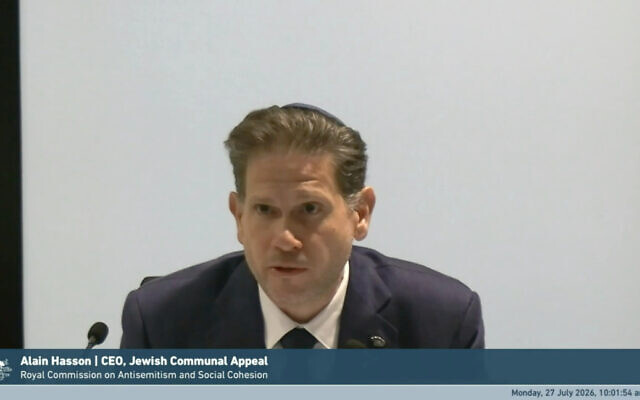
The head of the Jewish Communal Appeal (JCA) NSW has told the Royal Commission on Antisemitism and Social Cohesion that the soaring cost of security is being carried overwhelmingly by the community itself, and is steadily crowding out the funding that sustains Jewish schools, welfare and cultural life.
Alain Hasson, CEO of the JCA since 2019, said the organisation had for close to 60 years served as the central fundraising and planning body for the Jewish community in New South Wales and the ACT, distributing a single annual campaign across the community’s schools, welfare and aged-care services, cultural institutions and youth movements.
Since the October 7, 2023 attacks, he said, the share of that funding consumed by community security had escalated dramatically. When security funding was first separated out as its own line some years ago, it represented a small fraction of the overall pool; today it accounts for a far greater share, and continues to climb. Hasson said the growth in protective spending was substantially outpacing the growth in donations that funded it, meaning security was progressively displacing the money that built and sustained community life.
That trajectory, he warned, posed a fundamental question. If security kept absorbing an ever-greater share of communal resources, there would eventually be little left of the community it was meant to protect. “There will be nothing left to protect,” he said.
Hasson described how the events since October 7 had reshaped the community’s sense of safety. He recounted being in France at the time of the attacks, and drew a contrast between the French Jewish community — long accustomed to gathering under heavy protection — and Australian Jews, who he felt had been left unable to assemble openly in their own civic spaces after the October 9 protest at the Sydney Opera House. Reclaiming that ground, he said, had driven the community’s determination to return to public life, including holding a major community event at the Opera House the following year.
He also described his reaction on the night of the Bondi Beach attack, when he received a message that his child’s Jewish early learning centre, along with all Jewish organisations, would close on the advice of security bodies. His first response, he said, was anger — his instinct, formed over years in community security work, being that a community must keep living openly in the hours after an attack. He quickly realised that this time was different, and that the threat was no longer a possibility but a reality.
Hasson said the strain of the period was also taking a toll on the community’s leaders, some of whom were declining senior roles because of the personal-security burden, the impact on their families, or the professional cost of being publicly associated with the community.
He urged the commission to recommend greater government support, including a standing Commonwealth grant to fund protective security for communities at heightened risk, so that the cost no longer fell principally on the community. He also recommended tax measures to help communal charities retain staff, and to make the security levies now charged by schools and other institutions tax-deductible.
Security risk expert Gavriel Schneider has told the Royal Commission that Australia’s approach to protecting crowded places — in which the public evacuates and waits for police — is no longer adequate, and has urged consideration of a legal duty on venue operators and an expanded role for private security, potentially including armed guards at high-risk sites.
Giving evidence on Sunday, Schneider — a risk and security consultant with more than three decades’ experience who has worked in some 20 countries and served for almost a decade as a volunteer head of security for one of the community security groups — said contemporary threats no longer fit traditional profiles. There was a growing trend of people with a predisposition to violence seeking out a cause to justify it, which, combined with the volume of antisemitic hate online, made it far harder to distinguish those merely expressing hatred from those intending to act.
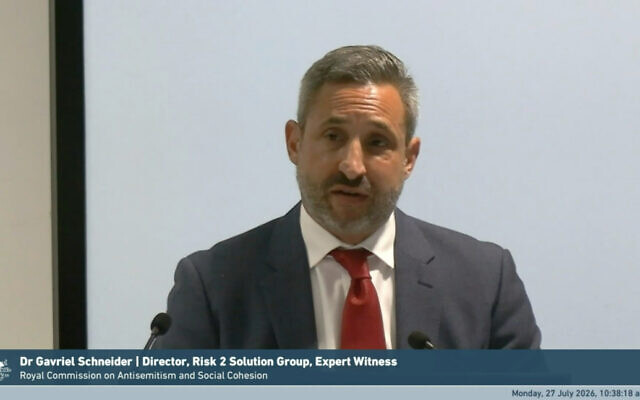
He said the crowded places strategy assumed only designated authorities would respond to an attack while everyone else evacuated and reported — an assumption that no longer held. He pointed to the “reactionary gap”, the window between an attack beginning and a response arriving, when most casualties occurred. “The more time an attacker has, the more freedom of movement they have, the more casualties,” he said.
Schneider criticised a “tick the box” culture in which operators installed bollards and cameras without reducing risk. “If I’m intentful … I’m just going to go where the bollards aren’t,” he said, invoking the term “security theatre”.
He recommended Australia consider legislation comparable to the United Kingdom’s Martin’s Law, which imposes a duty on operators of premises hosting mass gatherings to assess and mitigate security risk. Commissioner Virginia Bell clarified he was advocating a legal duty not presently applying in Australia; Schneider agreed, noting workplace health and safety law arguably already implied one.
Pressed by Bell on whether he was proposing armed private security, Schneider said that if the threat trajectory continued, the country would “probably have no choice but to … look at something like that”. Bell put to him that Australia was “averse to the idea of armed private citizens”. Schneider said he accepted that, but that any such capability would require training comparable to police, independent oversight and coordination with law enforcement, while preserving police primacy.
Social cohesion, he concluded, could not be achieved without safety. “Trust is impossible when you have one portion of the population advocating for the death and destruction of another,” he said.
The Australian Federal Police reversed a decision not to investigate a serious threat against the Australian Jewish Association only after the organisation took the matter to the media, AJA president Robert Gregory has told the Royal Commission on Antisemitism and Social Cohesion.
Gregory said the AJA received a threatening email as recently as last Monday and reported it to the AFP, which initially declined to act.
“The AFP responded and said it didn’t meet the threshold. It wasn’t serious enough, or something along those lines. It didn’t meet the threshold for the Commonwealth offence,” Gregory said.
After the AJA contacted media outlets, the response changed rapidly. “Within a few hours, I received a call from the AFP Commissioner’s Chief of Staff, apologising and saying that they would now be looking into this.”
Gregory told the commission the episode exposed a gap between organisations with public profiles and ordinary community members reporting antisemitic incidents.
“Your average Jewish person who reports an antisemitic incident, they get that response back. I think that’s the end of it. They’re not able to escalate it as we were able to successfully.”
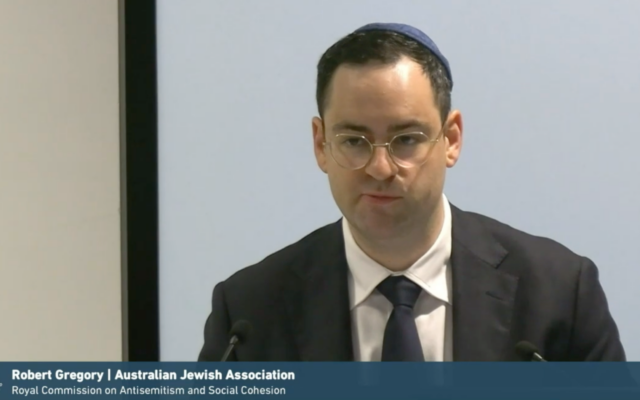
He said the pattern was not new. In 2024, Gregory and then-AJA president David Adler received death threats before they were due to appear at a Senate committee examining proposed misinformation laws.
“One of them was something like kill all Jews, another one was a hangman’s noose, and the words if you appear at the Senate inquiry tomorrow, you will die,” Gregory said.
At the time, the matter did not progress. It was only after the AFP established Operation Avalite that a senior officer proactively reached out to the AJA, leading to an arrest and conviction.
“I consider this quite serious because we receive a lot of antisemitic threats. But this was an attempt to interfere with the democratic process in Australia,” Gregory said.
He described a broader pattern of inconsistent support from authorities, citing a joint communal event the AJA co-hosted this year with members of the Iranian community. Gregory said he approached police, who indicated they might send someone but would not commit to a presence. When the AJA sought to arrange armed guards, the council hosting the event prohibited them on its premises. The Community Security Group also declined to cover the event.
“A joint Jewish Iranian event is what I would consider extremely high risk,” Gregory said. “I’d approached the police, the security organisations who weren’t going to do it, and the council wasn’t going to allow armed security.”
He said organisers faced an impossible choice. “If we put too onerous conditions on organisers and venues, again, Jewish events just won’t be held.”
Gregory also pointed to the departure of his predecessor Adler, who emigrated to Israel approximately two weeks before the hearing. “This is the kind of person who’s picked up, said Australia’s too dangerous, and he has moved to Israel,” Gregory said. “Australia is losing some of its best and brightest.”
Gregory recommended more streamlined engagement between community organisations and law enforcement, and a review of the protective capabilities available to licensed security guards at Jewish communal events.
Members of the pro-Palestinian encampment at Sydney University infiltrated an online Australian Jewish Association event, dressing as a Hamas spokesman and abusing attendees, the Royal Commission on Antisemitism and Social Cohesion has heard.
AJA president Robert Gregory told the hearing that the organisation had hosted a webinar featuring former deputy prime minister John Anderson when the event was disrupted.
“The event was infiltrated by members at the time of the encampment at Sydney University, so they dressed as a famous Hamas spokesman. They covered their faces, and they started abusing attendees,” Gregory said. “Many of them are elderly, and it was quite traumatic. Some of them, I think, had relatives lost in October 7.”
Gregory said the infiltrators entered the public event under false names, with one impersonating former prime minister Tony Abbott in order to infiltrate the event.
He said the AJA reported the incident to Sydney University and provided the names of those involved, but no outcome was communicated.
“We reported this to Sydney University, who began some investigation, which unfortunately I don’t think went anywhere, or they didn’t update us on what happened there.”
Gregory said the incident reflected the tension between keeping Jewish communal life open and protecting participants from abuse.
“The Jewish community shouldn’t have to live behind walls all the time. So these are public events for the community. We advertise them publicly. We want people to attend and listen.”
The Chanukah celebration targeted in the Bondi Beach massacre would have been legally required to have a counterterrorism plan under equivalent United Kingdom legislation, a British counterterrorism expert has told the Royal Commission on Antisemitism and Social Cohesion.
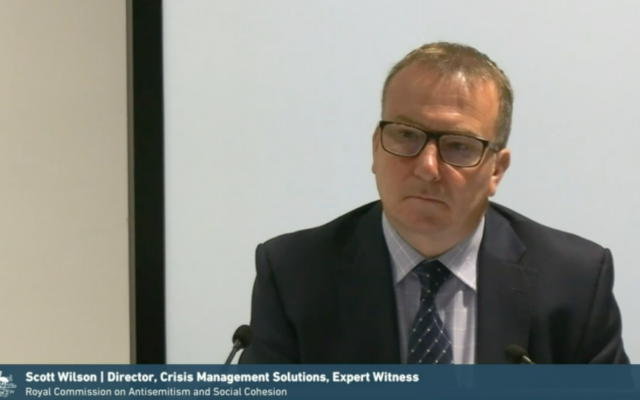
Scott Wilson, a former senior officer with London’s Metropolitan Police who spent 31 years in UK policing, gave expert evidence about the frameworks Britain has introduced to protect public events and premises from terrorist attack.
Wilson told the commission the Bondi Beach event met the criteria that would bring it within scope of the UK’s Terrorism Protection of Premises Act 2025, known as Martin’s Law, which was named in honour of a victim of the 2017 Manchester Arena bombing.
Asked whether the legislation would have applied, Wilson was unequivocal. “It certainly would. It would because it meets those criteria,” he said, noting the event was ticketed, barriered, and publicly advertised.
Under Martin’s Law, events with more than 800 attendees fall into an enhanced tier carrying significant obligations. “You’re definitely looking for a counterterrorism plan to be in place for that event,” Wilson said. “You’re expecting all the staff there to have done the training, without a doubt … It might well be you’ve got hostile vehicle mitigations. This may be barriers to stop crowds, to stop vehicles driving into crowds. It might well be you’ve got enhanced CCTV. It may well be you’ve got security, a security company who have been brought in to provide security at that event.”
The legislation is still in a two-year bedding-in period in the UK, with enforcement due to begin in April 2027, and Wilson acknowledged it has not yet been tested in court. But he said the framework was already shaping how safety advisory groups assess events.
Wilson also outlined the UK’s Act Online training program, a free counterterrorism awareness course that has reached approximately six million people. The program certifies participants in identifying suspicious behaviour, responding to bomb threats, and reacting to firearms attacks.
“Security can’t be down to those five security guards. It has to be down to the 1000 employees,” Wilson said. “It’s sometimes the cleaner or the person serving the coffee who sees the suspicious activity or sees the suspicious item.”
Counsel Assisting Richard Lancaster SC took Wilson through the UK framework in detail, establishing the layered system of local authority safety advisory groups, counterterrorism security advisers, and legislative obligations that underpin event security planning in Britain.
Wilson, who served as national coordinator for the UK’s Protect and Prepare counterterrorism strategy, led emergency planning for the 2012 London Olympic Games, and advised on the Bondi Junction Westfield attack, said even smaller events of 200 to 800 people face requirements under Martin’s Law, including staff awareness training, security briefings, and evacuation and lockdown plans.
Scott Wilson, former UK National Counter Terrorism coordinator, has told the Royal Commission that NSW Police’s response to the Bondi Beach attack was hampered not by a lack of speed, but by the absence of specialist firearms officers on the scene.
Wilson gave expert evidence that while general duties officers reached the scene quickly and neutralised the threat within eight minutes, they lacked the training and equipment to deal with assailants using long arms.
“I felt that the primary limitation was they weren’t the right officers to be there,” he said.
Wilson contrasted UK and NSW training regimes. UK armed response vehicle officers complete a 12-week course, with a further 14 weeks required to become a counterterrorism specialist firearms officer — 26 weeks in total. NSW general duties officers, he said, received around eight hours of firearms training at the police academy, plus a two-to-three-day active armed offender course.
“It’s given them the training to probably deal with a sidearm bank robber or a Bondi Junction knife person, but it’s not giving them the training to be able to go in to deal with a marauding terrorist attack,” Wilson told the commission.
Under cross-examination by counsel for the NSW Government, Sophie Callan, Wilson agreed that the general duties officers’ actions on the day were consistent with their active armed offender training. His concern, he clarified, was not that officers failed to follow their training, but that the training itself did not extend to marauding firearms attacks.
He noted planning for the Bondi Beach event had been comprehensive and praised the speed with which NSW Police notified ambulance services, describing that coordination as “exemplary”.
“Response time was great and the officers were very brave at what they did,” he said.
Wilson also raised doubts about whether the newly announced Armed Response Command (ARC), with 225 officers, would provide adequate coverage across Greater Sydney once shift patterns were factored in, though he said the unit could work if focused on mobile patrols rather than broader operational duties.
No police officers were present at a Chanukah event attended by around 2,000 people at St Ives for about 50 minutes after the Bondi attack began, the Royal Commission into Antisemitism and Social Cohesion has heard.
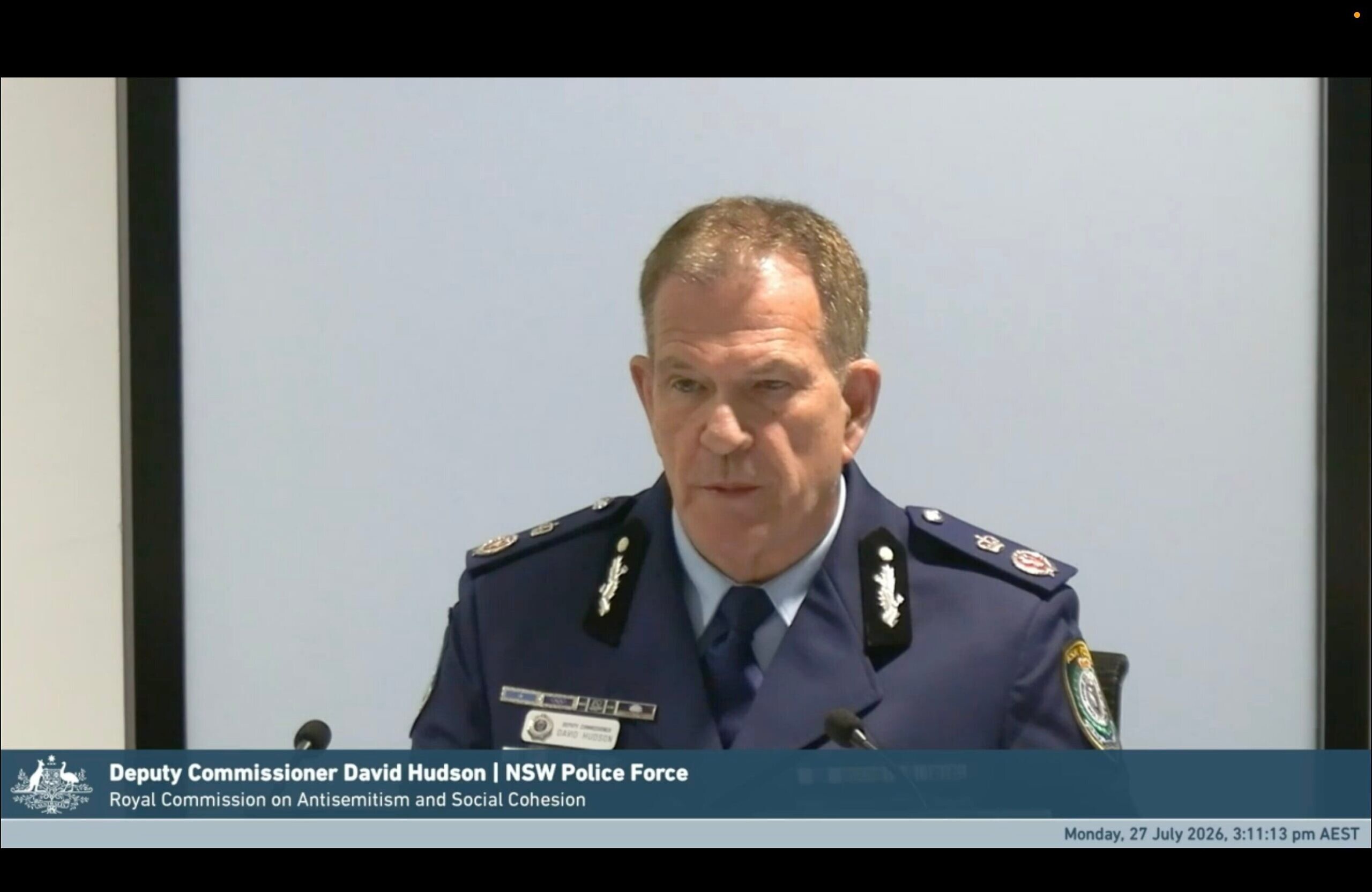
Deputy Commissioner David Hudson, who holds the NSW Police counter terrorism portfolio, was taken through the timeline of Chanukah on the Green on 14 December 2025 during evidence in Sydney.
Four officers were tasked to the event. Two of them were drawn from a local operation whose shift was altered to provide cover, according to the statement of the Ku-ring-gai commander.
The event began at 5pm. Between then and the start of the Bondi attack at 6.41pm, the only police attendance was a single drive-past by two Ku-ring-gai officers.
An all-resources broadcast, calling on any available officers to attend St Ives, was issued at 7.32pm. Two officers from the local operation were on scene from 7.33pm, with others arriving after that.
Counsel put to Hudson that this left a period of about 50 minutes from the start of the attack during which no officers were present at the event. “It would appear so, yes, sir,” he replied.
Asked whether the police numbers at St Ives suggested an inadequate level of protection, given the national terrorism threat level was then set at probable, Hudson said he had not seen the relevant assessment.
“I’m sure the police involved in that took things into consideration before determining what the policing presence should be,” he said. “Whether there was a miscommunication in relation to taskings or full-time attendance for that event, I’m not privy to say.”
He also told the Commission it was unclear to him from the material whether the two officers were rostered to remain at the event for its duration or to attend at points during it while taking other taskings.
Pressed on whether the Jewish community might reasonably read St Ives as evidence it must take greater responsibility for its own protection, Hudson repeated that he would need to see the risk assessment for that event, and where it differed from any assessment by the Communal Security Group.
The exchange came as Hudson set out the force’s opposition to proposals that Jewish communal organisations be permitted to carry firearms or routinely wear body armour.
“Protection of all members of the community is the responsibility of the police,” he said. He cited section 6 of the Police Act, which he said made protection of life and property the force’s primary responsibility.
Allowing particular groups to arm themselves, he said, “would further fracture … relationships that are fairly tenuous between different groups”, and would be seen by others as governments “showing favouritism to that particular group”.
Hudson accepted that police assessments of risk might differ from those of the CSG or of Jewish communal leaders.
“I would be surprised if CSG followed the same threshold and template that we follow,” he said. “However, we are very mindful and attuned to the sensitivities of the Jewish people, and we will always discuss their security needs if they raise them with us.”
Where such a disagreement could not be resolved, he said, the police assessment would prevail, and could extend to shutting an event down.
“If we considered the risk too high, or considered that there was a very high risk of harm being committed to the event, we would probably cancel the event,” he said.
Hudson said the force preferred user pays policing to private armed guards where communal organisations sought additional protection, citing arrangements with the Sydney Opera House and at Westfield Bondi Junction after the stabbing attack there.
User pays officers remain subject to the same investigation and oversight rules that apply to officers on ordinary duty, he said.
He agreed the arrangement imposes a real financial burden on organisations that are not commercial businesses.
The new Armed Response Command, announced in February, will field 225 armed officers across metropolitan Sydney and progressively take over Operation Shelter, the standing deployment of armed police to Jewish sites.
Hudson said a large proportion of the command’s responsibilities would be “the protection of Jewish interests”, and that its 24 hour command centre will include a workstation for a CSG liaison officer during major communal events. He said he was hopeful of deployment by October or November.
The Commission then moved into closed session, with a direction for non-publication of the balance of Hudson’s evidence. The Commissioner told the public gallery there are aspects of policing that need to be heard in conditions of confidence.
Alain Hasson, CEO of the Jewish Communal Appeal (JCA), on the soaring cost of security, which is being carried overwhelmingly by the community itself, steadily crowding out the funding that sustains Jewish schools, welfare and cultural life
Security risk expert Gavriel Schneider on the need to change Australia’s approach to protecting crowded places, saying contemporary threats no longer fit traditional profiles
AJA president Robert Gregory on the experience of the Australian Jewish Association and the various threats that have been directed at the organisation
Robert Gregory on the AJA event that was infiltrated by members of the pro-Palestinian encampment at Sydney University
Scott Wilson, former UK National Counter Terrorism coordinator, on United Kingdom legislation known as Martin’s Law and the frameworks Britain has introduced to protect public events and premises from terrorist attack
Scott Wilson on the absence of specialist firearms officers on the scene at Bondi Beach which hampered the police response
Deputy Commissioner of NSW Police David Hudson, who holds the counter terrorism portfolio, on the Chanukah event that was happening in St Ives on the same night as the terror attack
The AJN is providing rolling coverage on the Royal Commission on Antisemitism and Social Cohesion.
For full coverage of the Hearing Blocks, visit the Royal Commission section of The AJN website.
No police officers were present at a Chanukah event attended by around 2,000 people at St Ives for about 50 minutes after the Bondi attack began, the Royal Commission into Antisemitism and Social Cohesion has heard.
Deputy Commissioner David Hudson, who holds the NSW Police counter terrorism portfolio, was taken through the timeline of Chanukah on the Green on 14 December 2025 during evidence in Sydney.
Four officers were tasked to the event. Two of them were drawn from a local operation whose shift was altered to provide cover, according to the statement of the Ku-ring-gai commander.
The event began at 5pm. Between then and the start of the Bondi attack at 6.41pm, the only police attendance was a single drive-past by two Ku-ring-gai officers.
An all-resources broadcast, calling on any available officers to attend St Ives, was issued at 7.32pm. Two officers from the local operation were on scene from 7.33pm, with others arriving after that.
Counsel put to Hudson that this left a period of about 50 minutes from the start of the attack during which no officers were present at the event. “It would appear so, yes, sir,” he replied.
Asked whether the police numbers at St Ives suggested an inadequate level of protection, given the national terrorism threat level was then set at probable, Hudson said he had not seen the relevant assessment.
“I’m sure the police involved in that took things into consideration before determining what the policing presence should be,” he said. “Whether there was a miscommunication in relation to taskings or full-time attendance for that event, I’m not privy to say.”
He also told the Commission it was unclear to him from the material whether the two officers were rostered to remain at the event for its duration or to attend at points during it while taking other taskings.
Pressed on whether the Jewish community might reasonably read St Ives as evidence it must take greater responsibility for its own protection, Hudson repeated that he would need to see the risk assessment for that event, and where it differed from any assessment by the Communal Security Group.
The exchange came as Hudson set out the force’s opposition to proposals that Jewish communal organisations be permitted to carry firearms or routinely wear body armour.
“Protection of all members of the community is the responsibility of the police,” he said. He cited section 6 of the Police Act, which he said made protection of life and property the force’s primary responsibility.
Allowing particular groups to arm themselves, he said, “would further fracture … relationships that are fairly tenuous between different groups”, and would be seen by others as governments “showing favouritism to that particular group”.
Hudson accepted that police assessments of risk might differ from those of the CSG or of Jewish communal leaders.
“I would be surprised if CSG followed the same threshold and template that we follow,” he said. “However, we are very mindful and attuned to the sensitivities of the Jewish people, and we will always discuss their security needs if they raise them with us.”
Where such a disagreement could not be resolved, he said, the police assessment would prevail, and could extend to shutting an event down.
“If we considered the risk too high, or considered that there was a very high risk of harm being committed to the event, we would probably cancel the event,” he said.
Hudson said the force preferred user pays policing to private armed guards where communal organisations sought additional protection, citing arrangements with the Sydney Opera House and at Westfield Bondi Junction after the stabbing attack there.
User pays officers remain subject to the same investigation and oversight rules that apply to officers on ordinary duty, he said.
He agreed the arrangement imposes a real financial burden on organisations that are not commercial businesses.
The new Armed Response Command, announced in February, will field 225 armed officers across metropolitan Sydney and progressively take over Operation Shelter, the standing deployment of armed police to Jewish sites.
Hudson said a large proportion of the command’s responsibilities would be “the protection of Jewish interests”, and that its 24 hour command centre will include a workstation for a CSG liaison officer during major communal events. He said he was hopeful of deployment by October or November.
The Commission then moved into closed session, with a direction for non-publication of the balance of Hudson’s evidence. The Commissioner told the public gallery there are aspects of policing that need to be heard in conditions of confidence.
comments