Live updatesPublic hearings

Synagogues and schools recount decades of attacks

Hearing Block 5 of the Royal Commission continues today, examining security arrangements, government funding and police coordination for the Jewish community.

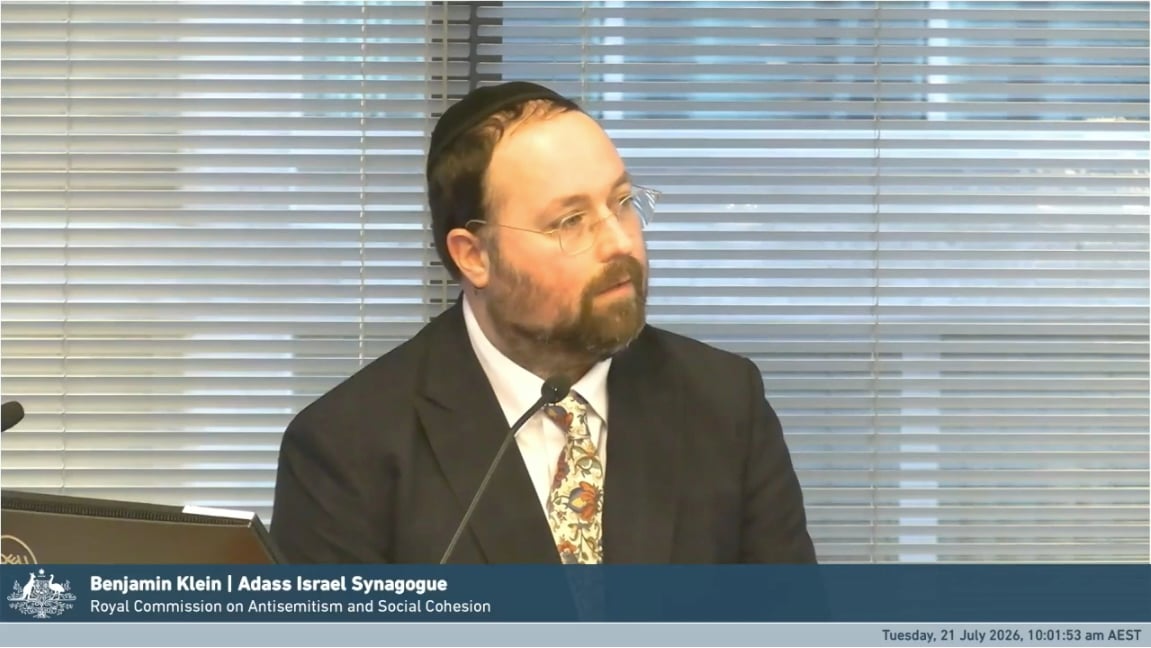
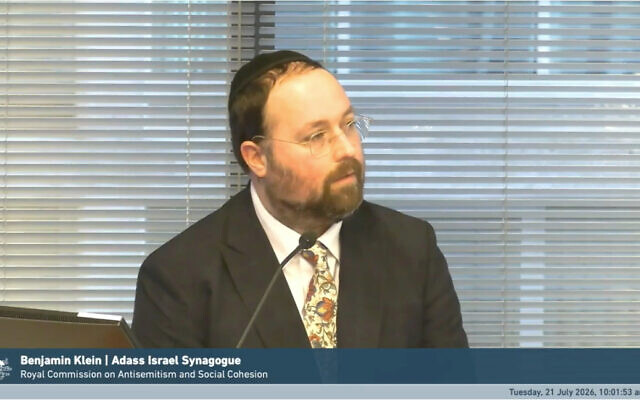
Adass Israel Synagogue board member Benjamin Klein.

Read the reports

Adass Israel Synagogue board member Benjamin Klein on how the synagogue has changed since the December 2024 arson attack

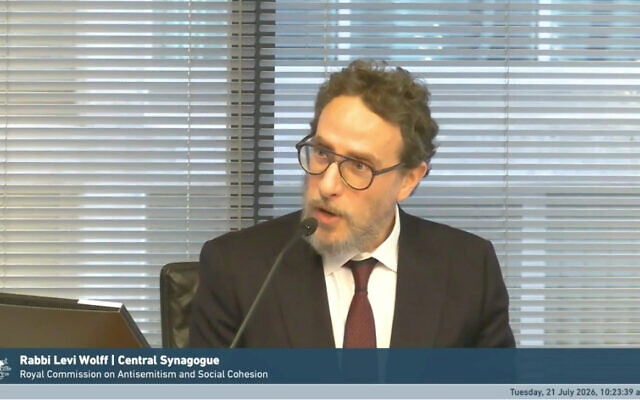
Central Synagogue’s chief rabbi, Rabbi Levi Wolff, on how antisemitism is restricting Australian Jews from living a Jewish life

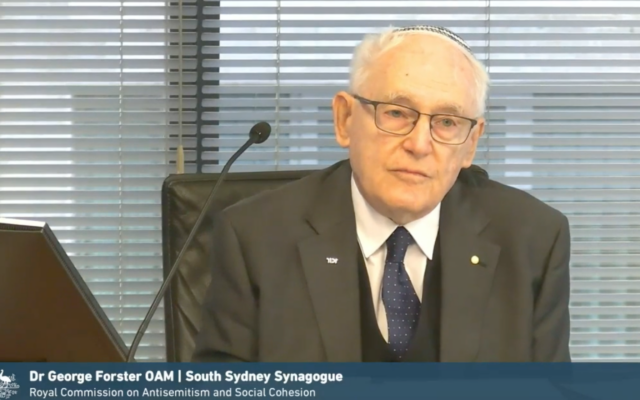
President of Southern Sydney Synagogue and the Australian Association of Jewish Holocaust Survivors and Descendants, Dr George Foster, on the aftermath of October 7 and how it shattered decades of feeling safe in Australia

Dr George Foster on the decades of attacks on Southern Sydney Synagogue and the change in support from the wider community

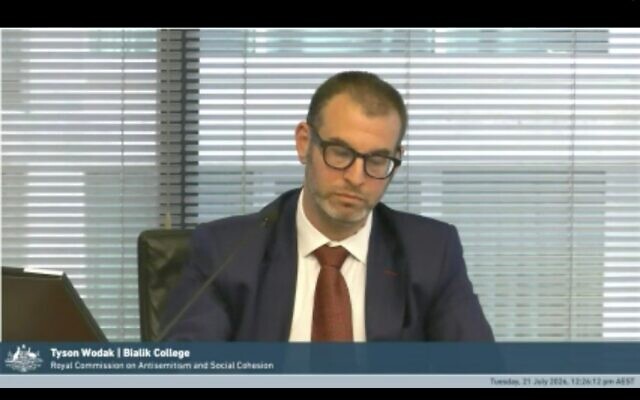
Board president of Bialik College, Tyson Wodak, on his hopes for a community that no longer needs the level of security it now lives under

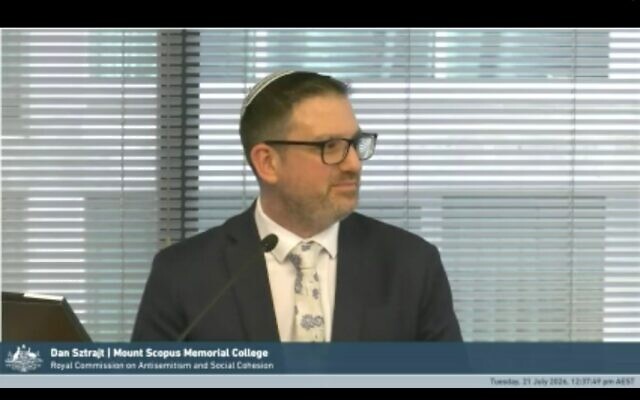
Principal of Mount Scopus Memorial College, Dan Sztrajt, on the overwhelming cost of security that parents are expected to bear

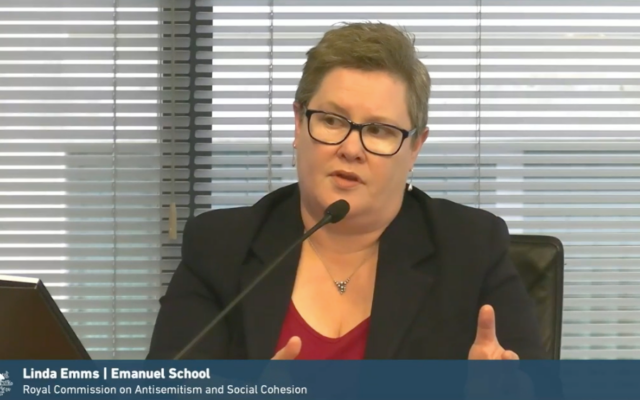
Emanuel School principal, Linda Emms, on the ‘normalisation of the abnormal’ that students, staff and parents are experiencing

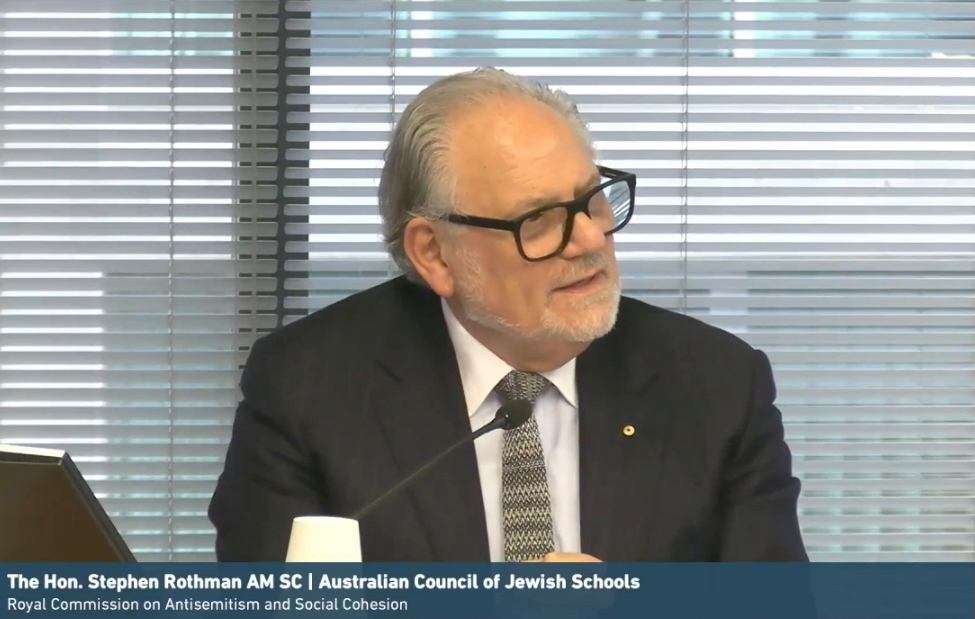
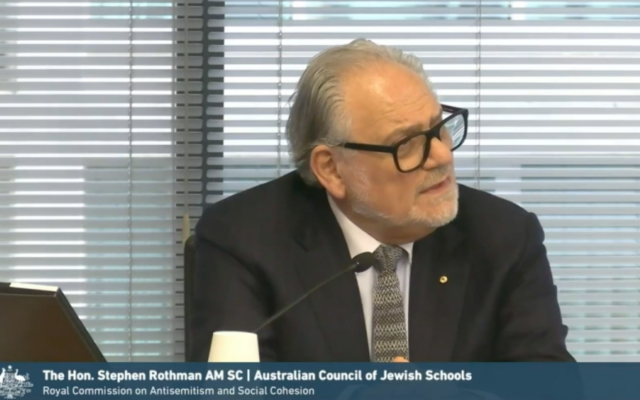
NSW Supreme Court judge, The Honourable Justice Stephen Rothman, who is co-chair of the Australian Council of Jewish Schools, on the funds that schools are spending on security and the duty of care of schools to ensure students and staff are safe

Justice Stephen Rothman on the abuse school students have faced including calling for the murder of Jews and the vulnerability the Australian Jewish community is feeling

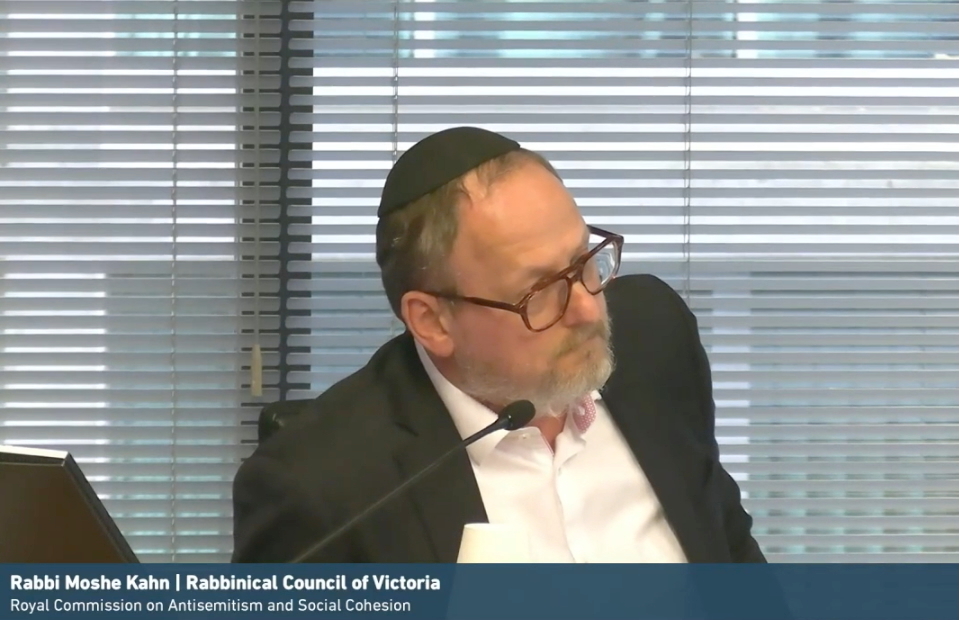
Rabbi Moshe Kahn, president of the Rabbinical Council of Victoria, on the antisemitism that many rabbis in Victoria have experienced

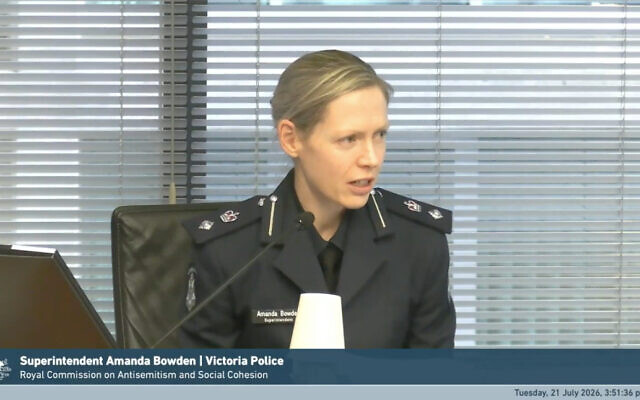
Victoria Police Superintendent Amanda Bowden, on the gaps in Victorian Police’s hate data, including antisemitic offending

‘All crime is under-reported’: the gaps in Vicpol’s hate data

Victoria Police does not collect data specifically on antisemitic conduct, and the recording of a crime as motivated by anti-Jewish prejudice is neither mandatory nor consistent, a senior officer has told the Royal Commission on Antisemitism and Social Cohesion — meaning the force’s figures cannot be a complete record of antisemitic offending.

Victoria Police Superintendent Amanda Bowden, who oversees the Corporate Statistics Unit responsible for collating and releasing the force’s crime data, gave evidence on Tuesday afternoon about how antisemitic incidents are recorded in its main crime database, known as LEAP.

Victoria Police Superintendent Amanda Bowden.

Bowden said there was no specific offence for antisemitic conduct. When someone reported an incident, the receiving officer would identify and record the relevant offence — an assault, say, or property damage — and could then separately tag it as a prejudice-motivated crime, selecting from categories including religion, and, beneath that, a descriptor of Jewish. But that tagging, she said, was optional and subjective, based on the officer’s opinion as to whether prejudice was a contributing factor.

That meant offences carrying the Jewish prejudice-motivated code would not be a complete catalogue of antisemitic crimes reported in any given period. Bowden agreed that some incidents reported by victims as antisemitic would appear in the system without the prejudice code or the Jewish descriptor recorded at all — particularly where the prejudiced element was less clear-cut, or where an officer became aware of it only after the initial report was filed, which was not a simple process to update. All crime, she noted, was under-reported.

Despite those limitations, Bowden said the data did show a trend. From a relatively low base, there had been a significant increase in recorded offences tagged as anti-Jewish prejudice-motivated crimes since October 7, 2023, though she stressed the numbers remained relatively low and should be considered in that context.

Bowden also explained that incidents reported to police that did not amount to a crime were not recorded in LEAP at all, instead going into a separate intelligence database, Interpose, as an information report. That meant the crime database alone could not identify the total number of prejudice-motivated incidents reported to police, as distinct from crimes. Identifying incidents that had not been coded would require an analyst to examine the narrative attached to each report, including by keyword searching — not something her unit typically did.

Asked about a separate dataset of investigations into serious vilification offences, provided to the commission, Bowden confirmed that for a number of those investigations no prejudice-motivated code had been selected, so the affected community could not be identified from the database alone. She also confirmed some of those investigations had not led to charges, with cases recorded as unsolved or summons not authorised.

Bowden agreed it was problematic that the crime data could not provide a reliable snapshot of activity in the community where the affected group was not recorded, and accepted that understanding where incidents were occurring and which segments of the community they affected could be useful for decisions about frontline police resourcing — something she said the force already did through its tasking and coordination.

RCV findings: 85% of rabbis surveyed personally experienced antisemitic conduct

Rabbi Moshe Kahn, president of the Rabbinical Council of Victoria (RCV) and a Chabad rabbi in Melbourne since 2006, gave evidence to the Royal Commission on Antisemitism this afternoon, presenting research findings from an RCV-commissioned survey, alongside his own lived experience of antisemitism across the past few years.

Rabbi Kahn said the RCV surveyed its 60 rabbis and rebbetzins in April 2026 after relying on anecdotal reports, engaging a professional firm to conduct a detailed questionnaire.

The response rate was striking — around 50 of 60 rabbis, and roughly a third of rebbetzins, took part.

Among the findings were that 95 per cent of respondents said their sense of personal safety had significantly deteriorated over the past year; 85 per cent had personally experienced antisemitic conduct; and 90 per cent had observed congregants concealing or minimising outward signs of Jewish identity.

Three-quarters of rabbis reported that their synagogue had been targeted by antisemitic hatred or violence, under a submission section titled “The Synagogue under Siege.”

Rabbi Kahn described rabbis as “very visibly Jewish,” and hence easily identifiable by traditional dress, and said being the target of abuse while walking to synagogue on Saturday mornings had “become normalised.”

He said the strain experienced by that intensified when rabbis’ children were present.

He also spoke of burnout, explaining that the demands of the COVID period were followed almost immediately by the spike in antisemitism in Australia since October 7 (2023), meaning rabbis had carried the community’s “emotional and anxiety” load for years without respite.

Rabbi Kahn said rabbis were now shouldering a “psychological strain” they were never trained for, fielding questions from congregants such as “are we safe here?”, that they could not confidently answer. He noted no dedicated funding currently exists to support rabbis’ pastoral capacity in this environment.

On incidents affecting synagogues, Rabbi Kahn described people screaming abuse outside shules, graffiti, and prank phone calls and harassment, to referencing the more severe incidents at the Adass community, and the firebombing destruction of their shule.

He said smaller synagogues, often lacking resources, faced disproportionate risk in deciding daily whether events could safely proceed.

Public celebrations had also been forced indoors: the Lag BaOmer parade, historically held on Melbourne’s streets, has moved to an enclosed racecourse venue for several years, while other events now require fencing, undisclosed addresses and vetting of attendees.

Returning to his own lived experience, Rabbi Kahn — also a director of Chabad Youth — described running Australia’s largest Jewish youth camp, which had more than 1,200 participants this winter.

Notification of security funding arrived only on the morning the camp began. Rabbi Kahn recounted the Sunday evening of the Bondi terror attack, when Chabad had to decide by the next morning whether camp buses, including one from Sydney, would proceed.

They chose to proceed and funded security guards themselves. The Victorian government later approved and covered those costs.

Under questioning from Commissioner Virginia Bell, Rabbi Kahn confirmed the children’s camps had run for many years, and that security precautions were now built into their planning.

He clarified that because Chabad owns its own campsites, the main camp location is generally known, but the timing of departures and the venues for smaller weekend retreats are kept undisclosed.

Asked about a closing quote in the RCV’s submission from a surveyed rebbetzin — “we love this country and contribute to society and want to live here safely and happily” — Rabbi Kahn said the sentiment reflected the community overwhelmingly.

He spoke of migrating to Australia in 1997, raising four children here, and feeling deeply at home, while expressing hope the community could return to the “beautiful Australia” it once experienced, without fear.

ACJS co-chair also warns of deepening community fear

Rothman also told the Commission that Jewish students have faced abuse on public and school buses, and that many schools have advised children not to wear identifiable Jewish items — including jewellery, uniforms and kippot — due to the level of hostility that could draw. He said there had been reported incidents of passers-by hurling abuse at Jewish children crossing the road.

Rothman noted a pattern of families transferring children into ACJS member schools, describing a smaller-scale movement away from state schools, and some other independent schools, driven by safety concerns.

He cited one troubling case at an independent school with a significant Jewish and Asian student cohort, where a student created a chat calling for the murder of Jews and Asians.

The school’s response — an afternoon detention — had, Rothman said, prompted anger within the community over what was seen as a lenient reaction to serious abuse.

Screenshot

Asked to expand on the recommendations in his statement, Rothman placed current events in a broader historical context, referencing literature on the long history of antisemitism, and a passage from the Book of Numbers describing the Jewish people as set apart among nations.

He said antisemitism was “not a new phenomenon,” but described the recent surge in online abuse as unprecedented, and said many families were now weighing whether their children should study abroad, rather than face intimidation at Australian universities — a fear he said persisted, despite public statements from university chancellors and vice-chancellors.

Rothman contrasted Sydney’s small Jewish community with the scale of New York’s, saying Sydney’s community felt “extremely vulnerable” by comparison.

Counsel Assisting thanked Rothman for his evidence and indicated there were no further questions, but invited him to raise anything else from his statement.

He did so, recounting a recent hospital incident in which a father, after his child was successfully treated by a resident doctor, was reported to have said the outcome would have been better had the doctor not been Jewish — despite the doctor, who was Israeli, having lived in Australia for two decades.

Rothman said such incidents were now a “daily, if not hourly” occurrence, and that reflected the pressure weighing on much of the Jewish community.

Jewish schools spent more than $58 million on security in four years

NSW Supreme Court judge, The Honourable Justice Stephen Rothman has told the Royal Commission on Antisemitism and Social Cohesion that Australia’s Jewish schools have spent more than $58 million on security over four years, diverting funds that would otherwise be spent on education.

Rothman, national co-chair of the Australian Council of Jewish Schools, gave evidence on behalf of the body representing 18 Jewish day schools across Australia.

He told the commission the ACJS’s 18 member schools educate approximately 8864 students, representing 51 per cent of school-age children in the Australian Jewish community. All are not-for-profit entities funded through school fees and recurrent government funding. The government’s schooling resource standard, which determines recurrent funding, does not include any loading for security costs.

Rothman said security at Jewish schools was not discretionary. 

He said, “If you have a duty of care which is non-delegable, then you have to take all reasonable and necessary steps to ensure the safety of the students that are attending. As a consequence, when they’re advised by experts that these steps and certain steps are necessary, those steps are taken, and that’s not discretionary in any real sense of the term.”

NSW Supreme Court judge, The Honourable Justice Stephen Rothman

Security measures at Jewish schools date back to at least the 1990s and escalated sharply around the 2000 Sydney Olympics, when federal law enforcement agencies advised the schools they were an at-risk class. 

Rothman said, “We had SWAT teams and the like on the roofs, so security was significant.”

Since 2023, he said, the situation had worsened dramatically. 

“The level of vitriolic antisemitic abuse has been significant, and in my view, normalised to such an extent that members of the community generally feel unwelcome and unprotected,” Rothman said. 

The $58 million figure, covering 2022 to 2025 across New South Wales, Victoria, Western Australia and Queensland, did not capture the full cost, with Rothman explaining that it excluded the administrative time spent by principals and business managers coordinating security arrangements, and did not account for the volunteer labour of the Community Security Group.

He said every Jewish school charges parents a security levy, but that in every case, the levy fell significantly short of actual costs. Schools were forced to draw on donations and divert funds from other operations to cover the gap.

“That is the case in all of the schools. They will use resources that other schools would use for all sorts of other facilities to fund security, including education, unfortunately,” Rothman said. 

He cited Moriah College as an example, saying it had spent millions on security last year and while it had needed a new building since 1998, it has been unable to proceed. The building is now going ahead, but at an additional cost of approximately $14 million because of the security measures required.

Rothman also addressed the perception that the Jewish community’s wealth should offset these costs. “There’s a general impression that the Jewish community is wealthy,” he said, but told the commission that with a population of approximately 100,000, “it’s not actually a wealthy community in the sense of the whole community.”

He argued the funding disparity was a matter of democratic principle, drawing on High Court authority and ancient sources. 

“Those that have special needs have to be treated in a way that deals with those special needs. It’s a fundamental of democracy. It’s the opposite of capriciousness. And what’s happening in relation to the Jewish schools and Jewish institutions more generally, but the schools in particular, is that an extraordinary amount of money is being spent on the necessity to keep these children safe.”


Emanuel principal: Jewish students face ‘normalisation of the abnormal’

Sydney’s Emanuel School principal Linda Emms has told the Royal Commission on Antisemitism and Social Cohesion that the security environment at Jewish schools would cause uproar if it were imposed on any other independent school in Australia.

Emms, who is not Jewish and took on the role in January 2025 after nearly 30 years as an educator in faith-based independent schools, told the commission that her first communication to the school community as a new principal had been overtaken by safety concerns following a summer of attacks on Jewish property and homes in Sydney.

Emms said, “As a new principal, I had been planning the first letter out to my community. It’s the letter where, as the new principal, you get to introduce yourself. You get to set direction. You get to set vision. That was the letter that I was expecting to send in January of 2025. That’s not the letter that I did send.”

The start of the 2026 school year, following the Bondi Chanukah attack in December 2025, required the school to cancel a day of professional learning to focus entirely on trauma-informed practice. Emms noted that many staff had themselves been at Bondi. 

“I don’t think there was anyone who wasn’t affected by it,” she said. 

She stressed that the toll extended beyond parents and students to staff, including non-Jewish employees who were uncomfortable performing routine duties such as supervising a primary school pickup point on a public street.

The school has daily police presence at its gates, which Emms explained highlighted the two sides of how people, particularly parents, feel.

Emms said, “Our parents have worked incredibly hard, particularly with some of our younger students, to get their children to see the police as their friends and as being there to protect them. And I watch some of them come in, and they will fist bump the police as they come in in the morning and say hello to them. And it’s lovely, because but it’s really sad that we have parents who actually have to do this, because that’s how they’re actually reassuring their child that it’s okay that there’s actually police at the front gate every morning.”

Emanuel School principal, Linda Emms. Photo: screenshot

Emms described what she called the “normalisation of the abnormal”, with antisemitic comments directed at students during sporting events, yelled from car windows and, in one case, from a stranger on an escalator. She said, “People aren’t stepping up anymore and saying you can’t say that. And that’s what I mean by normalisation of the abnormal.”

She recounted how the school took on a pre-service teacher who had fled a placement at another school after a student made an antisemitic comment in class and the supervising teacher failed to step in. The teacher specifically requested placement at a Jewish school.

On funding, Emms said financial assistance to families had almost doubled in 12 months as security levies continued to rise. She said, “I don’t believe that our parents should have to be 100% responsible for paying for security, which is over and above what any other school in New South Wales would need to have.”

She confirmed that many parents send their children to Jewish schools specifically because they don’t feel comfortable with their children being in other school systems at this point in time. 

When asked by the Commissioner whether she had been treated differently by acquaintances since working at a Jewish school, Emms said, she had not been directly by friends, but in a broader group, the fact that she works at a Jewish school has often been left out of the conversation. 

“So if there’s been a friend of a friend, it will be ‘this is my friend who is a principal’. They haven’t said she works at a Jewish school. And that’s not because they’re embarrassed about me working in a Jewish school. That’s because there is concern of how people will respond.”

Emms recently hosted the heads of 45 independent schools at Emanuel. Many were visibly taken aback by the security they encountered simply entering the campus. She told the commission that if non-Jewish schools faced the same requirements, “I have no doubt the Australian community would be in uproar.”

Mount Scopus families bear the cost of guards

Mount Scopus Memorial College Principal, Dan Sztrajt. Photo: Screenshot

The principal of Melbourne’s Mount Scopus Memorial College has told the Royal Commission into Antisemitism that the school’s families are carrying the overwhelming majority of the cost of armed security, and has urged governments to fund security guards rather than just infrastructure.

Dan Sztrajt, who was appointed principal in January 2024 after 13 years as assistant principal at Bialik College, was giving  evidence in Melbourne.

He told the commission that the school spent more than $3,000 per student on operational security in 2025, and that government grants met only 14.9 per cent of its operational security costs that year.

Across total security expenditure, government grants covered a little over 30 per cent, leaving parents to fund roughly 70 per cent.

Sztrajt said the school’s security levy had more than doubled in recent years, rising from just over $500 per student in 2022 to $1,130 in 2025.

He said much government grant funding had historically been restricted to infrastructure and could not be used to hire guards, meaning families were supporting more than 85 per cent of the cost of guarding, running into the millions of dollars.

He said armed guards were an essential part of security, serving both as a visual deterrent and as a means of responding, “if God forbid there was a serious attempt on Jewish children’s lives.”

Sztrajt said excluding guards from grant funding had been problematic, and that the school had urged governments to allow security personnel to be funded through Commonwealth and state grants.

Sztrajt said the school had switched from unarmed to armed guards in 2015, a decision taken alongside the other Jewish day schools in Melbourne following violent antisemitic attacks overseas, including the 2012 murders at a Jewish school in Toulouse.

That change had coincided with the introduction of a separate parent security levy. In 2025 the school appointed a full-time security manager with a background in policing and counter-terrorism.

He said antisemitic incidents affecting the school had risen sharply after 7 October 2023, having already been climbing beforehand.

Over a weekend in May 2024, the words “Jew die” were written in large letters across the front entrance of the school’s Burwood campus.

Sztrajt said the school became aware of it after a student filming a social media video while driving past noticed the graffiti, and the footage spread across the Melbourne Jewish community.

Some families told him they would not send their children to school, fearing it made the school a target or showed its security was insufficient.

The school removed the graffiti that weekend and raised an Australian flag alongside another bearing Hebrew words translating to “the Jewish people live.”

Sztrajt said students arriving that day, many of whom had seen the graffiti circulate online, were instead met with a message of pride, and the school chose to make it a day of standing up in the face of hate.

Sztrajt said the school changed its Instagram account to private in August 2025 after sustained targeted abuse online, accepting the cost to its enrolment promotion because too many parents feared their children being photographed and those images falling into the hands of antisemites.

Sztrajt said the demands of security came at a significant cost to education. He estimated that at least 10 to 15 per cent of almost every one of his days as principal was spent on security matters, “not on education, not on student well-being, not on teacher professional development.”

He said Mount Scopus, established in 1949 by Holocaust survivors and post-war immigrants, had been founded as an expression of Jewish renewal.

Four of his own grandparents survived the Holocaust, and his father, technically a survivor himself, is an alumnus of the school. About one in five students receive fee assistance, a figure Sztrajt said rose closer to one in four once staff discounts were counted.

His hope, he said, was for students who did not have to think about security at all.

“What we should be focusing on, and what I’m trying to make sure that our students actually experience at the end of the day, is a school environment where they don’t need to think about security,” he said. “We’ll do that for them, and they can get on with being proud of who they are.”

Bialik chair wants less need for security

Bialik College Board Chair Tyson Wodak. Photo: Screenshot

The chair of Melbourne’s Bialik College has told the Royal Commission on Antisemitism that his real hope is not for greater security funding, but for a community that no longer needs the level of security it now lives under.

Tyson Wodak, who chairs the board of the pluralist Jewish school in Hawthorn, was giving evidence in Melbourne.

Asked to explain a passage in his witness statement that Bialik “has no interest or purpose in having greater security than is actually required,” Wodak said the point mattered deeply to him.

“I’m engaging with you about security funding, but I don’t want more security funding. I want less need for security,” he said.

“As an Australian, as a parent, as involved in a school, all I want is less need for security.”

He said that while the school would welcome funding if heightened security was genuinely required, that was not his preferred position.

“No one wants their children having armed guards around them every day,” he said. “I’d much rather an environment that was safe rather than an environment where we were spending huge amounts of money on security and asking others to pay for it.”

Wodak, who has two children at the school, told the commission he worried about the effect of a permanently secured environment on young people, including his own.

“My kids have spent their whole life living under security,” he said. He said he feared for a generation of Jewish students growing up “separated from the vast majority of Australians” and internalising the idea that such separation was necessary for them.

Bialik is a high-fee independent school with about 1,150 students, though Wodak said its fee arrangements differed from those of a typical non-Jewish independent school.

About 25 per cent of students receive fee assistance, funded through cross-subsidisation within the school community, and no Jewish student is turned away for an inability to pay the fee their family is assessed as able to afford.

The commission heard that parents also pay a dedicated security levy, currently $840 per student, which covers operational security costs only and is charged on a pass-through basis, with no markup.

Wodak said the levy had risen by about 230 per cent since 2022. Operational security costs had increased by roughly 250 per cent over the same period, driven primarily by guarding costs.

He said he could not understand why families at Bialik were required to pay for the security measures needed to protect them.

“I believe a core function of society is maintaining the peace and security of its people,” he said, telling the commission that three schools sit side by side in Hawthorn, including two state schools that anyone can walk into on a weekend.

“I just can’t understand why we live in a country where one aspect of our community is expected to live under heavy security, which it has to pay for in large part itself.”

Wodak argued that security funding for faith-based organisations should be assessed by an independent body and provided to a level that put them on a level playing field with other institutions.

The commission heard that Bialik’s risk environment changed significantly after 7 October 2023. Students no longer wear uniforms on higher-risk excursions, and one planned outing around St Kilda, taking in synagogues and a cemetery, was cancelled following a risk assessment.

Wodak said the school had also seen enrolments from families who reported experiencing antisemitism at other schools.

He described attending the funeral of a family friend, a retired judge, at a church in Toorak, where mourners stood and talked afterwards in the sun with no apparent concern for their safety.

That, he said, was nothing like his own community’s experience, where people attending a Jewish function are often given the address at the last minute, disperse immediately and walk quickly to their cars.

Asked why he had not spoken out sooner, given his children had been under security for years, Wodak said his communal position, the events of 7 October and what he called the “horrific reaction from sections of the Australian community” had convinced him he had an obligation to speak.

“I feel I have that obligation, and I don’t know why I didn’t speak up earlier.”

Synagogue president’s warning came true

In January 2025, after his synagogue was defaced with Nazi symbols, Southern Sydney Synagogue president Dr George Foster warned the media that if nothing was done about the rising tide of antisemitism, someone would die.

“Sadly, that came true,” Foster told the Royal Commission on Antisemitism and Social Cohesion on Tuesday.

Foster, a psychiatrist and child of Holocaust survivors, gave evidence about more than three decades of attacks on the small neighbourhood synagogue, which sits on an exposed corner of a busy street in Sydney’s south, about 45 minutes from the main Jewish community in the eastern suburbs.

The first attack he recalled was a firebombing in March 1991 following the first Iraq War. South Sydney was among four or five synagogues targeted. One, Bankstown Synagogue, never recovered and its congregation dissolved. South Sydney’s Torah scrolls survived with only smoke damage.

Foster said the atmosphere after that 1991 attack was fundamentally different to today. 

“We received many messages of support and assistance, and there wasn’t the overt vilification of the Jewish people then, and I think because of that, it was easier for us to come to terms with and move forward after that incident.”

The synagogue endured further attacks across the following decade, including another firebombing in 1993, swastikas and bricks through windows in 1995, an attempted firebombing in 2001, graffiti in 2002 and an arson attack in 2003.

Then came the January 2025 graffiti attack, which included Nazi symbols beneath the synagogue’s menorah signage. Foster said his reaction was shaped by his identity as the son of Holocaust survivors. 

“I had never imagined that my own synagogue would be repeatedly targeted like this, and in particular with this sort of graffiti,” he said.

The offensive message scrawled on Southern Sydney Synagogue. Photo: supplied

After the attack, the synagogue resolved to build a fence. 

Foster told the commission that during a meeting with NSW Premier Chris Minns, whose electorate includes the synagogue, he mentioned the board had discussed erecting a fence. “His immediate response was, ‘Don’t worry, we’ll pay for it,'” Foster said. “Without that contribution, we couldn’t have built it at all.”

The fence was completed four days after the Bondi Beach terror attack. 

Foster said it offered some reassurance, but came with sadness. Since October 7, congregants had been calling to ask whether it was safe to attend. 

“Without security, we’re not going to come,” as congregants told him. 

As a small synagogue with limited funds, Foster said the ongoing cost of private security remained a significant challenge.

Drawing on his professional experience as a psychiatrist, Foster said the current atmosphere had reactivated trauma in Holocaust survivors and their descendants. 

“Resilience does not negate impact,” he said, noting that members were anxious about walking to synagogue wearing a kippah, parents questioned whether to bring children, and volunteers were reluctant to serve in visible roles.

Despite three decades of attacks, Foster said the congregation’s determination remained. “It was always my determination that we would not be intimidated, and that we should carry on as we had always done.”


Dr George Foster: October 7 shattered lifetime of safety in Australia

Psychiatrist and Holocaust survivor’s son Dr George Foster told the Royal Commission on Antisemitism and Social Cohesion that the aftermath of October 7 shattered decades of feeling safe in Australia, a country he had spent a lifetime being grateful his parents chose.

Foster, president of Southern Sydney Synagogue and the Australian Association of Jewish Holocaust Survivors and Descendants, was born in Budapest shortly after World War Two and arrived in Australia in 1947 as a toddler. His parents survived forced labour battalions, mass deportations and hiding from the Nazis, and who rebuilt their lives from nothing.

His father was one of only eight men from a battalion of 240 to return alive from forced labour on the Eastern Front. His mother’s brother was killed defusing landmines. After Germany occupied Hungary in 1944, some 437,000 Hungarian Jews were deported, the vast majority to Auschwitz.

In Australia, Foster qualified as a psychiatrist and has been deeply involved in Holocaust remembrance, completing a course at Yad Vashem in Jerusalem and serving as president of the survivors’ association for about 13 years.

Dr George Foster sharing his witness testimony at the Royal Commission on Antisemitism and Social Cohesion

For most of his life, Foster said, he believed antisemitism had been largely confined to the margins of Australian society. He described the periods in which Jewish communities are well accepted in their countries as a “Golden Medina”, a Yiddish term for golden age, and said he had lived through such a period in Australia.

“I would always come back to this country from our holiday and thank my parents for having chosen Australia as the country because it was wonderful to live here until the seventh of October,” he said.

The events that followed, Foster told the commission, were a profound shock. 

“The first thing that happened two days later, when the carnage in Israel was still happening, was on the steps of the opera house. We heard expletives and vilification of Jews to a point which shocked me, and I know much, if not all, of the Jewish community.”

“I never thought that I would see such a thing in this country,” he said.

Foster said he understood why some members of the community had contemplated leaving Australia. 

“It’s certainly a thought that had never occurred to me up until that time. Whilst I wouldn’t actually act upon it, is it a little less a distressing thought to have even had?”

He drew a direct line between his family’s history and the present moment, telling the commission that the experience of Jews suddenly becoming anxious in a country they had felt safe in “has occurred to the Jewish people over many centuries, and in other countries”.

Antisemitism now dictates how Jewish Australians live, rabbi says

Central Synagogue’s chief rabbi, Rabbi Levi Wolff told the Royal Commission that antisemitism has become not merely an attitude but a restriction on how Jewish Australians live their lives.

Giving evidence on Tuesday, Rabbi Wolff, who leads one of the largest Orthodox congregations in Australia, said his synagogue sat just over a kilometre from Bondi Beach, and that the December 14 attack had heightened a fear his community had felt since October 7, 2023.

The grandson of Holocaust survivors, born in the United States and in Australia for nearly 30 years, he said many Australian Jews felt they were being asked to justify their place in a country to which they had contributed for generations.

Central Synagogue’s Rabbi Levi Wolff.

He recounted arriving home some months ago to find a mezuzah placed anonymously in his letterbox, with a note reading: “I am afraid to have this on my door. Please pass it on to somebody who is brave enough and who needs it.” No one in Australia, he said, should need courage to place a symbol of their faith on their own doorpost.

Standing outside St Mary’s Cathedral about a week after the Bondi attack, he said he had been struck by the absence of security and wondered whether he could ever leave his own synagogue’s doors open, without armed guards, bollards and screening. Jewish children growing up with armed guards outside their schools and synagogues was, he said, normal — but should never be allowed to become Australia’s normal.

Wolff said his public profile had risen sharply since December 14, and with it the abuse and threats of violence he received almost daily. What now shocked him, he said, was that he had become accustomed to them.

In a synagogue survey of 300 members, Wolff said between 60 and 70 per cent of respondents had experienced antisemitic abuse, the vast majority considered visible security essential to their willingness to worship, and large numbers had concealed their Jewish identity and limited their children’s participation in Jewish life.

One respondent wrote that during a recent hospital admission — in light of the Bankstown nurses incident and an antizionist post by a senior surgeon — they had for the first time declined to record their religion on the admission form. Another described people shouting abuse on a main Sydney eastern suburbs road as families walked to synagogue on Shabbat, leaving children scared to walk in their own neighbourhood.

Jewish Australians, Wolff said, were not simply afraid; they were having to change how they lived. He said many families in his congregation had bought properties in Israel over the past three years, and that Australia was losing doctors, professionals and community builders — people who wanted only to contribute to the country.

Asked about security costs, Wolff said Central Synagogue had spent about $640,000 on security in 2025, of which $540,000 went to security guards and $100,000 to infrastructure, on top of millions already spent. Costs had risen by 20 to 25 per cent each year for four years, he said, on advice from state and federal authorities and the community’s own security service.

Wolff said interfaith engagement with a certain sector of faiths had not merely chilled but “been iced”, relationships having broken down after Muslim leaders spoke publicly against the Israeli president’s invitation to Australia. He said he hoped it could be recovered.

Pressed by Commissioner Virginia Bell on whether those protesting for Palestinian self-determination were expressing values incompatible with Australia’s, Wolff said people were free to criticise any Israeli government, but that denying only the Jewish people’s right to self-determination was different.

When crowds chanted “death to Israel” in the streets, he said, Jewish Australians heard not nuanced debate but threats to their families — and hatred left unchecked spread into classrooms, universities and workplaces, and ultimately became violent, as it had on the beach at Bondi, where 15 people were killed.

Adass Israel board member on losing his synagogue

Adass Israel Synagogue board member Benjamin Klein has told the Royal Commission how his community was transformed from one whose synagogue doors once had no locks into one preoccupied with security, in the wake of the December 2024 arson attack that destroyed the building.

Giving evidence on Tuesday morning, the Melbourne real estate agent described the ultra-Orthodox community of about 300 families as one where daily life revolved around the synagogue — the “heartbeat” of a community that maintained its own schools, kindergartens, kosher certification and cemetery, catering for members “from cradle to grave”.

Adass Israel Synagogue board member Benjamin Klein.

The grandson of Holocaust survivors on both sides, Klein said his grandfather, a survivor who came to Melbourne with nothing and served for many years as president of the synagogue, had been a proud justice of the peace deeply integrated into Australian life.

Klein said that until the early 2020s there had been no locks on the synagogue doors, no security guards and no need for close ties with CSG Victoria or Victoria Police. It was, he said, a relaxed and open place. Growing up in Melbourne, he had played cricket outside and lived life “as normal and as easy”.

Locks, CCTV cameras and a growing security consciousness had gradually changed that, with the shift becoming most marked after October 2023. He described cars driving past with windows down, occupants screaming “F Jews” and profanities such as “Hitler missed you” and “you belong in the gas chambers”.

Holding back tears, Klein described the December 2024 arson attack which destroyed the synagogue as a very difficult time for the community. The matter is subject to pending criminal charges, and he was not asked about the incident itself. He said that in the aftermath the community had secured temporary accommodation nearby which, while not comfortable, served its purpose, and that rebuilding the synagogue was a “mammoth job” being undertaken with government, architects and other partners.

Klein said the loss had struck at the fabric of the community. He described the synagogue, which he believed was among the busiest in the southern hemisphere and open from about 4.30am until after midnight, as the place where every life milestone was celebrated — from a baby’s birth through to marriage and beyond. To have it taken away “simply for the reason that because you’re Jewish” was devastating, he said, recounting that his wife could not drive past the ruined site for six months.

He described attempts in 2023 and 2024 to secure security funding, with letters sent to local council, state and federal government and to then attorney-general Mark Dreyfus, all unsuccessful amid what he called red tape around incorporated and unincorporated entities.

The community had since followed other Jewish institutions in employing a full-time grant writer dedicated to the process. The federal government had provided a grant to assist the rebuild, which Klein described as a lifesaver, following discussions with the prime minister, the opposition leader and members of parliament who visited after the fire.

Klein said the fire had brought a shift in the community’s thinking. A synagogue that had once considered itself a quiet community in the back streets, removed from any conflict, now faced demands from parents and members for police and security at every activity, including school excursions. The board had built close relationships with CSG Victoria, which he said had been phenomenal, and with Victoria Police, forming a close relationship with Assistant Commissioner Chris Gilbert, who checked in regularly. Since the end of 2024, he said, Victoria Police had been responsive and engaged.

In concluding remarks, Klein reflected that Jewish Australians should not have to prove they deserved safety. He described being screamed at with “free Gaza” on arriving at Melbourne Airport from a work trip, and abuse hurled from passing cars as he walked to synagogue on a Friday night with his son — a common occurrence, he said, recounted nightly among community members.

Two children from his son’s class had moved to Israel, and successful professionals were uprooting their lives to leave, he said, because they simply did not feel safe — whether on a train, a bus or visiting the city on a weekend.

Klein ended on a hopeful note, describing a friendship formed with a journalist of Jordanian and Palestinian descent who had covered the fire. The two, he said, had found much in common and much they shared in Australian values, and their mutual respect was the story that should be told — that people could live together, respect each other and pursue their own lives in their own communities, without hatred directed at a Jewish community that had nothing to do with conflicts overseas.

The AJN is providing rolling coverage on the Royal Commission on Antisemitism and Social Cohesion.

For full coverage of the Hearing Blocks, visit the Royal Commission section of The AJN website.

read more:
comments
Live updates Public hearings

Synagogue president’s warning came true

In January 2025, after his synagogue was defaced with Nazi symbols, Southern Sydney Synagogue president Dr George Foster warned the media that if nothing was done about the rising tide of antisemitism, someone would die.

“Sadly, that came true,” Foster told the Royal Commission on Antisemitism and Social Cohesion on Tuesday.

Foster, a psychiatrist and child of Holocaust survivors, gave evidence about more than three decades of attacks on the small neighbourhood synagogue, which sits on an exposed corner of a busy street in Sydney’s south, about 45 minutes from the main Jewish community in the eastern suburbs.

The first attack he recalled was a firebombing in March 1991 following the first Iraq War. South Sydney was among four or five synagogues targeted. One, Bankstown Synagogue, never recovered and its congregation dissolved. South Sydney’s Torah scrolls survived with only smoke damage.

Foster said the atmosphere after that 1991 attack was fundamentally different to today. 

“We received many messages of support and assistance, and there wasn’t the overt vilification of the Jewish people then, and I think because of that, it was easier for us to come to terms with and move forward after that incident.”

The synagogue endured further attacks across the following decade, including another firebombing in 1993, swastikas and bricks through windows in 1995, an attempted firebombing in 2001, graffiti in 2002 and an arson attack in 2003.

Then came the January 2025 graffiti attack, which included Nazi symbols beneath the synagogue’s menorah signage. Foster said his reaction was shaped by his identity as the son of Holocaust survivors. 

“I had never imagined that my own synagogue would be repeatedly targeted like this, and in particular with this sort of graffiti,” he said.

The offensive message scrawled on Southern Sydney Synagogue. Photo: supplied

After the attack, the synagogue resolved to build a fence. 

Foster told the commission that during a meeting with NSW Premier Chris Minns, whose electorate includes the synagogue, he mentioned the board had discussed erecting a fence. “His immediate response was, ‘Don’t worry, we’ll pay for it,'” Foster said. “Without that contribution, we couldn’t have built it at all.”

The fence was completed four days after the Bondi Beach terror attack. 

Foster said it offered some reassurance, but came with sadness. Since October 7, congregants had been calling to ask whether it was safe to attend. 

“Without security, we’re not going to come,” as congregants told him. 

As a small synagogue with limited funds, Foster said the ongoing cost of private security remained a significant challenge.

Drawing on his professional experience as a psychiatrist, Foster said the current atmosphere had reactivated trauma in Holocaust survivors and their descendants. 

“Resilience does not negate impact,” he said, noting that members were anxious about walking to synagogue wearing a kippah, parents questioned whether to bring children, and volunteers were reluctant to serve in visible roles.

Despite three decades of attacks, Foster said the congregation’s determination remained. “It was always my determination that we would not be intimidated, and that we should carry on as we had always done.”


Enjoy Unlimited Access To The Australian Jewish News Website And All Our Online Content For AUD$18/month Or Just AUD$120/year.

Subscribe Now