A father appeared before the Royal Commission on Antisemitism and Social Cohesion this afternoon under the pseudonym ACF, giving evidence about a sustained campaign of antisemitic abuse directed at his then 11-year-old son through the social media chat app Discord, by classmates at a public secondary school in a major Australian city.
The witness, a 45-year-old Israeli-born Jewish man who migrated to Australia with his family in 2014, told the commission he discovered the messages during the April 2024 school holidays when he noticed his son was unusually withdrawn and “glued to his phone.”
After taking the device and reviewing the Discord app — which was being used by children in his son’s class and cohort — he found messages that he said were “horrifying”.
Among the content directed at his son were messages including “Hamas kills your family,” references to Hitler, and “I hope your family in Israel is going to be killed.”
Further messages, dated to August 2024, included “I hope Israel gets nuked” followed by a racial slur, references to grotesque sexual violence, and posts describing his son in derogatory terms using the word “Israelian.”
Most disturbing, the commission heard, were two polls. The first asked classmates whether they liked his son. The second asked: “Should [his son’s name] kill himself?”
“Horrified — that’s the only thing I can say,” the witness told the commission.
“I was born in the Soviet Union. I left not by choice, because my parents took me to a place where we were not supposed to be afraid or hurt being Jewish, and that threw me back to that same period of time.”
He said the discovery prompted him to explain to his son the history of antisemitism and how the language being used against him had been specifically chosen to target his Jewish and Israeli identity.
“He has done nothing wrong by being an Israeli and Jewish,” the witness said he told his son. “It’s whoever put these messages out there who is on the wrong side.”
The witness reported the matter to the school, presenting screenshots of the messages to the deputy principal on the first day back after the holidays.
He was told families would be contacted, but received no formal confirmation of what action was taken.
When a subsequent incident occurred — a classmate approached his son during the week Iran directly attacked Israel and said he was “happy” about the bombing — the witness threatened to go to police.
He was advised the matter had been referred to the Department of Education, though again he received no confirmation.
The lasting impact, he told the commission, was visible in how his son now navigates friendships.
Where he had once moved easily among children of diverse backgrounds, he now keeps his guard up, and the children who visit the family home are exclusively from Jewish backgrounds.
Responding to a final question from Commissioner Virginia Bell, the witness said he hoped the Royal Commission would lead to concrete measures.
“Jewish kids as well, they deserve to live without fear, and to be able to present their identities,” he said.
“My son should be able to wear his Star of David, walk around the streets comfortably, and say where he was born and what his identity is — and unfortunately, currently this is not the situation. It’s not safe to do so in Australia.”
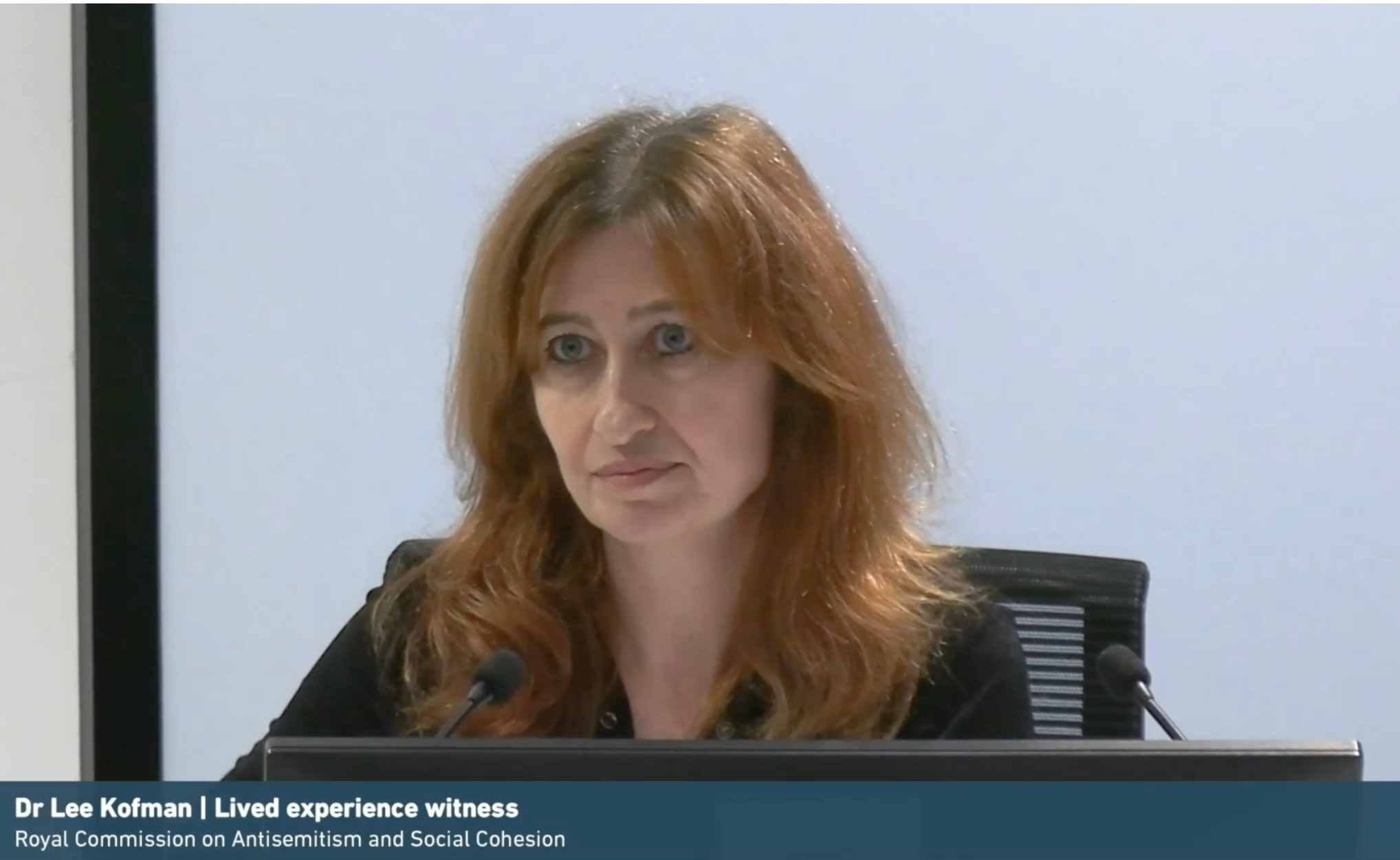
Russian-born, Israeli-Australian author and writing teacher Dr Lee Kofman told the Royal Commission on Antisemitism and Social Cohesion this afternoon further details of the impact on 630 members of a Jewish creative arts WhatsApp group she founded after they were doxxed, defamed and harassed by anti-Israel activists following the group’s private chat transcripts being leaked in January 2024.
Despite many group members lodging reports with state and territory police, the AFP and the eSafety Commissioner — and despite anti-doxxing laws being established largely in response to the incident — Kofman said no one had been brought to justice.
“I really want to say that I feel there is a real wound, not just for the members of this group, but for our entire Jewish community,” she told the commission.
“Not the person who exported the chat, not the person who then disseminated it, not the people who doxxed us, not the people who continue to harass us — nobody was brought to justice.”
She added that the AFP had contacted her in February 2025 as part of an investigation into the leak, more than a year after it occurred, and that she had given numerous subsequent statements — but to her knowledge, nothing had eventuated.
Screenshot
Kofman, the author of six books and co-editor of the anthology Ruptured: Jewish Women in Australia Reflect on Life Post-October 7, described establishing the group in October 2023 to provide a safe space for Jewish creatives and academics reeling from what she characterised as an unprecedented surge in antisemitism in Australia, and particularly in the arts and creative sector, following the Hamas attacks of October 7, 2023.
“There are so few Jewish people in Australia,” Kofman told the commission. “We constitute 0.4% of Australia’s population, and in the arts, we are always a very tiny minority. And so I just felt that being so few, and so much under attack from the very start of the aftermath of October 7, we needed some place to process together things, and to try also to do some advocacy and resistance if needed.”
The group grew to more than 600 members within a fortnight. Kofman said it was composed predominantly of progressive Jews, many of whom supported a two-state solution, and were critical of the Netanyahu government.
The leak occurred after a New York Times journalist, Natasha Frost, who had been a member of the group, shared the chat transcripts with a third party.
Kofman said posts circulating the leaked material began appearing on Australia Day while she was picnicking with her children, and they falsely characterising the group as “a secret group that got together to fire anti-genocide activists from their jobs.”
“It was completely surreal,” Kofman told the commission, and described the doxxing as meticulously organised.
An Excel spreadsheet was circulated listing all 630 group members with their workplace details, social media accounts, and in some cases the details of family members — including a schoolgirl who was not even a member of the group.
Lists of photographs, sometimes containing up to 100 images, were published online with captions labelling members as “genocidal.”
The consequences were severe and lasting. Kofman said she lost approximately 75 per cent of her freelance work from literary organisations across Australia — some of whom had employed her for up to 17 years.
Defamatory letters were sent to members’ workplaces. Businesses were harassed and physically defaced.
One couple from the group was forced to relocate to a safer suburb. Academic members had their names withdrawn from university research projects.
“The impact was not just in the past, it still is,” Kofman said. “It’s a reputational impact.”
Kofman also spoke about misinformation, tropes, and false claims about the Jewish creatives WhatsApp group that circulated immediately following the doxxing incident – and compared that to what she experienced in her childhood in the Soviet Union.
“This online harassment . . . was taken for granted and believed by so many people, so quickly, by arts institutions that are supposed to support us [creatives], by academic circles, and by some large pockets of prominent media.
“The question is, why did is spread so fast, [and] without actually talking to us?
“And I go back to my childhood in the Soviet Union, where every gathering of Jews was always [seen as] suspect.
“It was exactly the same tropes, I think, about us . . . that we had power – you know, all this sort of stuff.
“It really fitted what many people, very unfortunately, maybe subconsciously hold, and feel about, Jews.
“I mean, I don’t have any other explanation. Why otherwise [would it] have happened?”
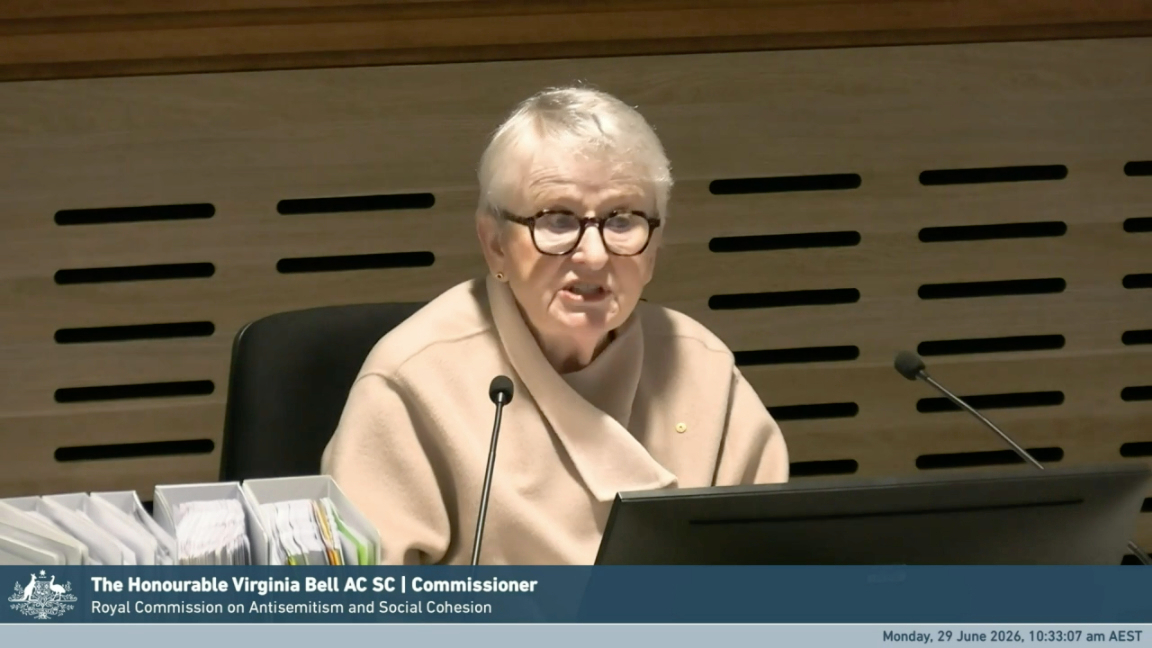
Commissioner Virginia Bell sought to clarify the essence of Kofman’s earlier evidence about her literary peers, asking whether her distress about the October 2023 Overland letter was not that its signatories sympathised with the Palestinian cause, but that they showed no empathy for the brutality suffered by Israelis on 7 October.
“Yes,” Kofman confirmed. “Thank you so much for putting it so clearly and succinctly for me. That’s correct.”
Kofman said appearing before the commission was itself significant.
“I feel that I’ve been silenced for a long time now, since October 7,” she told Counsel Assisting.
“I’m so grateful today to give this really precious to me opportunity to appear in front of the commissioner.”
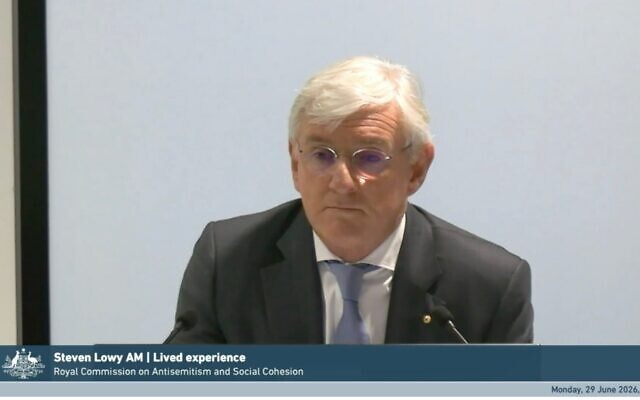
Steven Lowy provided evidence on the antisemitism he and his family have experienced.
He said his father, Sir Frank Lowy AC, was a Holocaust survivor who arrived in Australia in 1952, and his parents taught “that with privilege comes a great responsibility,” adding, “I have tried to teach our children the same. We have a responsibility to give back to the country in ways not just economic, but also in communal and philanthropic ways, and that’s how we’ve lived our lives”.
Lowy said he had experienced antisemitism since December 1982, when while studying in his father’s office at the Westfield headquarters at 100 William Street in Sydney, the Israeli consulate was bombed, which was in the same building.
“I was in the building at the time, of course, a very horrific event. Thank God, nobody actually died, only because of the fault of the terrorists. And then later that day, there was a second bombing at the Hakoah Club in Bondi, of course. One target was the Israeli consulate, the second target was a Jewish community building, nothing to do with Israel, other than being a Jewish centre for culture and sport and social activity, and my father was actually due to be at a meeting that day… and actually I personally took a phone call at our house threatening the lives of our family on that day,” he said.
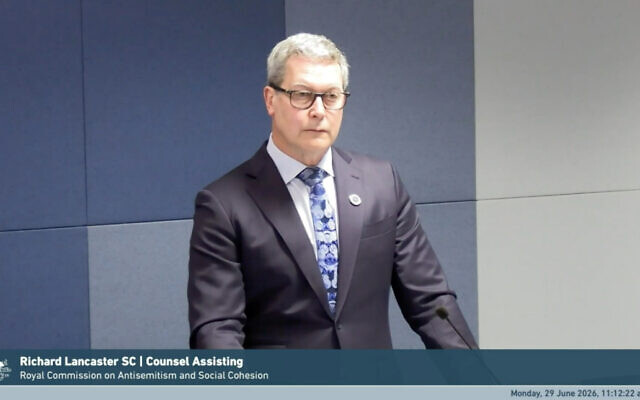
Photo: Screenshot of hearing on 29 June 2026
Asked by Counsel Assisting Richard Lancaster what measures his family had takem to address safety concerns, Lowy said that prior to 7 October 2023, antisemitism was “always hovering” but at lower levels, and after 7 October it “dramatically changed exponentially”.
He said he was in New York when Hamas attacked Israel on 7 October 2023, and as Chair of Keren Hayesod – United Israel Appeal, he went to Israel a week after that.
“It was actually the single biggest killing of Jews since the Holocaust. I had a responsibility to see how I could personally help, how our organisation could assist, and then share bear witness to a horrific event, and how to communicate that to the diaspora Jewry to ultimately assist through funds and moral support to assist the communities that had been deeply affected. I personally visited those communities, was the most horrific thing that I certainly would have experienced in my lifetime, meeting with families of bereaved, families of those who family members were taken hostage, and of course the mental and physical anguish was just horrific.”
On returning to Australia he said, “I felt more unsafe here than I did in Israel.”
“When I came back to Sydney, I felt I’d come back to a different country. I’d observed the television events of October the 9th at the Opera House, but even the night before… what was taking place in Western Sydney, a glorification of the most horrific killing of Jews since the Holocaust. It was a very difficult thing to stomach, seeing your own country, your own compatriots acting in this way. So, I think from that moment on, life has changed for Jews in this country,” he said.
Discussing the online abuse he and his family experienced, he said the Lowy family’s security team maintains a monitoring function for online abuse, and in the last year alone there were more than 15,000 antisemitic attacks online. “Amongst those 15,200 persons of interest have been followed very clearly, and a subset of those have been referred to police and intelligence. Every month is 1500/2000 – it’s in that sort of range.” He said around 200 concern “sufficient volume and severity” and of those around 30 to 40 are referred to police, over concern that they could lead to physical violence.
Lowy said there were spikes around the anniversary of the 11 September 2001 attack, when online users wrongfully blamed his father for the terror attack – as well as when he called for Royal Commission after the Bondi massacre. He added that his wife was harassed on social media for being on the board of Moriah College, and called “Genocide Judy”.
Evidence was tabled regarding specific examples of antisemitism on social media which included comments calling for the deaths of Frank Lowy and his sons as well as other Jews.
Lowy called for social media platforms to act on antisemitism – “I firmly believe that they should be subject to the same regulation and rules that more traditional media has”.
A Sydney mother has told the Royal Commission on Antisemitism and Social Cohesion that her daughter endured a sustained campaign of antisemitic abuse at her public high school, while the school repeatedly failed to take meaningful action.
The witness, identified only as ACE under a non-publication direction, testified that the incidents began within weeks of her daughter starting year seven in 2024, when she was 12 years old.
“Someone had asked her whether her Magen David was the devil symbol, and when she replied no to this particular student, he turned around, did a cross symbol at her, and said, ‘Back away, get away, devil’,” ACE told the commission.
While that incident was being investigated, a second student approached her daughter, saying “‘I wish Hitler had gassed your family, so we wouldn’t have had to meet’.”
The abuse escalated in June 2024 when a TikTok account was created. One video mocked ACE’s younger daughter, who was wheelchair-bound and unwell at the time. A second featured her elder daughter alongside text that, despite using symbols to evade content filters, spelled out “gas inhaler”.
ACE noted the account was created before Australia’s social media age restrictions came into effect.
“This was before social media bans, so in 2024, the whole year knew about it,” she said. A group chat linked to the account contained messages stating “they hate Jews like” her daughter.
“She was devastated,” ACE said.
Police traced the account to two girls in her daughter’s year, one a close friend her daughter had confided in. ACE, a former school principal and education manager at Courage to Care who also had professional experience in eSafety education, reported the matter to the eSafety Commissioner. The response she received was because the account had already been removed, no further action could be taken.
ACE challenged that position, noting that the content had not truly disappeared. “Everyone with social media has taken screenshots of it, have saved videos,” she said. The account had not been taken down by any authority, she added, meaning it could have been reactivated.
Throughout 2024, the school’s responses ranged from dismissive to hostile. When students performed a Nazi salute towards her daughter, the school characterised it as a “soldier salute”. A swastika was drawn in her daughter’s book. On the last day of term, a swastika was engraved into her desk, and when her daughter asked to see the wellbeing teacher, she was refused permission to leave the classroom.
A formal safety plan was only implemented after ACE’s daughter participated in an ABC 7.30 report on antisemitism in schools.
“No safety plan had been put in place before that,” ACE said.
ACE told the commission a survey she developed for Jewish Australians aged 16 to 25 found that of 148 respondents, 49 reported experiencing antisemitic incidents, with many choosing not to report them.
“A lot of people with antisemitism, they chose not to report it because nothing was done, or they felt nothing was done about it. And so, what was the point in reporting it?”
Australia/Israel & Jewish Affairs Council (AIJAC) head of Sydney office Arsen Ostrovsky told the Royal Commission on Antisemitism and Social Cohesion that the online abuse directed at him and his family since the Bondi Beach attack had been “a relentless tsunami of Jew hatred” that his young children were now internalising.
Giving evidence on the opening day of the commission’s third hearing block on Monday, Ostrovsky described the toll of the abuse, much of it built on deepfake images falsely depicting him as having faked the head injury he sustained at the December 14 Chanukah celebration.
“I try my best to block it out, but it’s impossible, and the cumulative nature of it is overwhelming,” he said. “I feel that it threatens not only my life, my physical safety, but my family’s. It tries to completely erase my experience and my trauma.”
He recounted how his nine-year-old daughter, who grew up in Israel through repeated trips to bomb shelters, had told him she felt safer there than in Australia. Both his daughters, aged nine and five, were at Bondi on December 14.
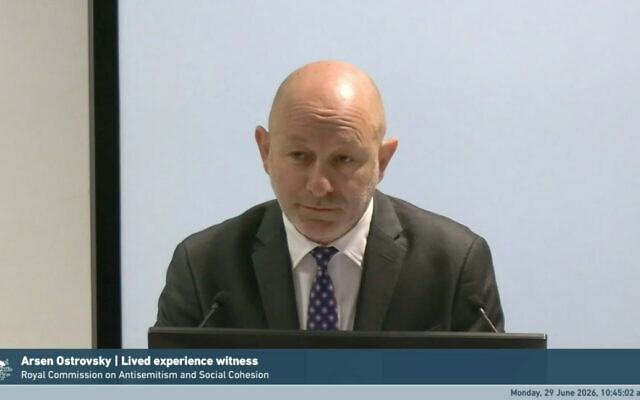
Arsen Ostrovsky at the Royal Commission on Monday, June 29.
He told the commission his daughter had drawn a parallel he found chilling. “She says to me, ‘Daddy, our victory is that you survived.’ Commissioner, do you know when we would say that? After the Holocaust, when our grandparents would say their victory is that we survived. And I now have a nine-year-old girl internalising this.” Children were “incredibly perceptive”, he said, asking why they were subject to layers of security at school when other children were not. “We are not so different to many other Jewish families across Australia who have to grapple with these questions day by day by day.”
Ostrovsky said he could not recall a single instance of antisemitism in Australia until December 14, 2025. He lived in Israel for around 13 years before returning to Australia in November 2025 to take up his AIJAC role, having previously served as CEO of the Israel-based International Legal Forum.
Ostrovsky is an active social media user with a substantial following, including about 395,000 followers on X, and his posts generated more than 121 million impressions on the platform in the 12 months to 2026. He said he engaged willingly in robust debate and did not complain about mere criticism of his posts.
The abuse that followed Bondi was of a different order. A photograph of his head injury, which he had taken himself and shared with a friend, was posted to X on the evening of December 14. Within hours his phone was “going off nonstop”, and amid messages of solidarity came an immediate influx of “hate, abuse, vilification and AI manipulation”. He learned of the deepfake images as he was being prepared for surgery on the Tuesday morning.
The manipulated material suggested the attack was a “false flag”, that the blood was tomato ketchup, and that he was a “crisis actor” or Mossad agent. Some images depicted him holding what appeared to be an Academy Award. Others removed the bandage and scarring from photographs of his head. The material spread across X, YouTube, TikTok, Telegram, Facebook and Instagram, and prompted fact-checking inquiries from Australian and international media including the BBC, which analysed the deepfakes. Much of the material, he said, remained online.
Counsel Assisting Richard Lancaster SC questions Arsen Ostrovsky.
Ostrovsky said his experience of how platforms responded had been mixed. After reporting one image on Instagram to a Meta policy executive he had come to know during his time in Israel, the content was removed from Instagram and Facebook and he had not seen it on those platforms since. By contrast, reports he made to X and YouTube while preparing his statement in June drew only automated confirmation of receipt. As of Monday, he said, he had heard nothing further from either.
A significant proportion of the abuse, he said, was framed as antizionism. “Essentially, everything that is no longer fit to say about Jews is being said against Zionists. It is the same hatred, the same viciousness, but expressed in a more modern language with a veneer of respectability,” he said. The use of “Zionist” as a code word, he added, “puts a target on my back”.
He drew a distinction between reasonable criticism of the Israeli government and content premised on the illegitimacy of the Jewish state. “One can criticise Australian foreign policy, US foreign policy, Italian foreign policy, but we don’t see the same people denying Australia or America the right to exist,” he said. When Israel was “singled out for relentless and vicious vilification”, or supporters were treated as “morally disqualified from public life”, what followed was “exclusion, harassment and violence”.
Ostrovsky also told the commission he had reported to NSW Police a video, posted on X, in which an Islamic preacher publicly questioned the authenticity of his injuries. Police had said they would investigate and provide additional protection in the form of patrols past his home, but he was not aware of any further action.
Asked by Commissioner Virginia Bell whether his non-Jewish friends had offered support after Bondi, Ostrovsky said many had, including people he had not spoken to in years. “That was certainly very, very touching,” he said.
He closed with a warning. “When hatred, whether in person or online, is allowed to go unchecked … it does lead to violence,” he said. “If something said in real life on the street would not be acceptable, we cannot allow it to be acceptable just because it is said online.”
The Royal Commission on Antisemitism and Social Cohesion opened its third hearing block on Monday with a focus on antisemitism online, in social media and in the media, including the conduct of public broadcasters ABC and SBS.
Counsel Assisting Richard Lancaster SC told Commissioner Virginia Bell the block would examine four areas: the lived experience of antisemitism online, the prevalence of online antisemitism and what platforms are doing to combat it, the conduct of the public broadcasters, and the measures available to government to counteract online hate.
Lancaster said the online environment had become “perhaps the most significant vector for the spread of antisemitism and hate in the community”, with the potential to function as “an incubator of antisemitic violence”.
He cited ASIO director-general Mike Burgess, who said in his 2026 terrorism threat assessment on June 24 that when “violent language and violent acts are left unchecked, they become normalised”.
Research cited in the commission’s interim report found up to 60 per cent of violent extremist offenders had radicalised primarily online or had significant online influences.
The first witness, Arsen Ostrovsky, was described as “an extraordinary and confronting example” of the problem. Ostrovsky sustained an injury at Bondi on December 14, and a photo of it was published online within hours. He was subjected to harassment within a day, and deepfake images were created depicting him as faking the injury, feeding conspiracy theories that he was part of a “false flag operation”. Of the platforms he flagged the posts to, only Meta had acted by removing the manipulated content.
The commission will also hear from businessman and philanthropist Steven Lowy, whose statement records what Lancaster called a relentless campaign of online abuse and threats. In the 12 months to February 2026, the Lowy family security team reviewed more than 15,000 items from 200 unique individuals.
Lancaster said the online platforms could not be treated as a uniform group. Facebook, Google, LinkedIn and TikTok had been granted leave to appear, and Meta and TikTok had meaningfully engaged with Jewish organisations. He noted Meta’s July 2024 policy of removing content targeting “Zionists” where the term was used as a proxy for Jews, and a similar TikTok policy from October 2024.
By contrast, he said X Corp and Telegram had not responded to the commission at all, while the platform Gab had been “openly hostile”, with a representative emailing that the company “will publish what it likes when it likes”.
Lancaster flagged concern at Meta’s January 2025 shift to mostly reactive enforcement of hateful content in the United States. He said Meta core policy director Benjamin Good acknowledged in a statement that enforcement in some areas was now mostly reactive, placing the burden on users to report harmful material.
Evidence on the public broadcasters will examine the adequacy of the ABC’s and SBS’s complaint-handling mechanisms, including allegations of bias in Middle East reporting. Special Envoy to Combat Antisemitism Jillian Segal will be called to speak to those concerns.
The AJN is providing rolling coverage on the Royal Commission on Antisemitism and Social Cohesion.
A Sydney mother has told the Royal Commission on Antisemitism and Social Cohesion that her daughter endured a sustained campaign of antisemitic abuse at her public high school, while the school repeatedly failed to take meaningful action.
The witness, identified only as ACE under a non-publication direction, testified that the incidents began within weeks of her daughter starting year seven in 2024, when she was 12 years old.
“Someone had asked her whether her Magen David was the devil symbol, and when she replied no to this particular student, he turned around, did a cross symbol at her, and said, ‘Back away, get away, devil’,” ACE told the commission.
While that incident was being investigated, a second student approached her daughter, saying “‘I wish Hitler had gassed your family, so we wouldn’t have had to meet’.”
The abuse escalated in June 2024 when a TikTok account was created. One video mocked ACE’s younger daughter, who was wheelchair-bound and unwell at the time. A second featured her elder daughter alongside text that, despite using symbols to evade content filters, spelled out “gas inhaler”.
ACE noted the account was created before Australia’s social media age restrictions came into effect.
“This was before social media bans, so in 2024, the whole year knew about it,” she said. A group chat linked to the account contained messages stating “they hate Jews like” her daughter.
“She was devastated,” ACE said.
Police traced the account to two girls in her daughter’s year, one a close friend her daughter had confided in. ACE, a former school principal and education manager at Courage to Care who also had professional experience in eSafety education, reported the matter to the eSafety Commissioner. The response she received was because the account had already been removed, no further action could be taken.
ACE challenged that position, noting that the content had not truly disappeared. “Everyone with social media has taken screenshots of it, have saved videos,” she said. The account had not been taken down by any authority, she added, meaning it could have been reactivated.
Throughout 2024, the school’s responses ranged from dismissive to hostile. When students performed a Nazi salute towards her daughter, the school characterised it as a “soldier salute”. A swastika was drawn in her daughter’s book. On the last day of term, a swastika was engraved into her desk, and when her daughter asked to see the wellbeing teacher, she was refused permission to leave the classroom.
A formal safety plan was only implemented after ACE’s daughter participated in an ABC 7.30 report on antisemitism in schools.
“No safety plan had been put in place before that,” ACE said.
ACE told the commission a survey she developed for Jewish Australians aged 16 to 25 found that of 148 respondents, 49 reported experiencing antisemitic incidents, with many choosing not to report them.
“A lot of people with antisemitism, they chose not to report it because nothing was done, or they felt nothing was done about it. And so, what was the point in reporting it?”
Enjoy Unlimited Access To The Australian Jewish News Website And All Our Online Content For AUD$18/month Or Just AUD$120/year.



comments