TikTok and YouTube appear, as the Royal Commission continues its focus on the dissemination of antisemitic content and other forms of hateful speech in the media.
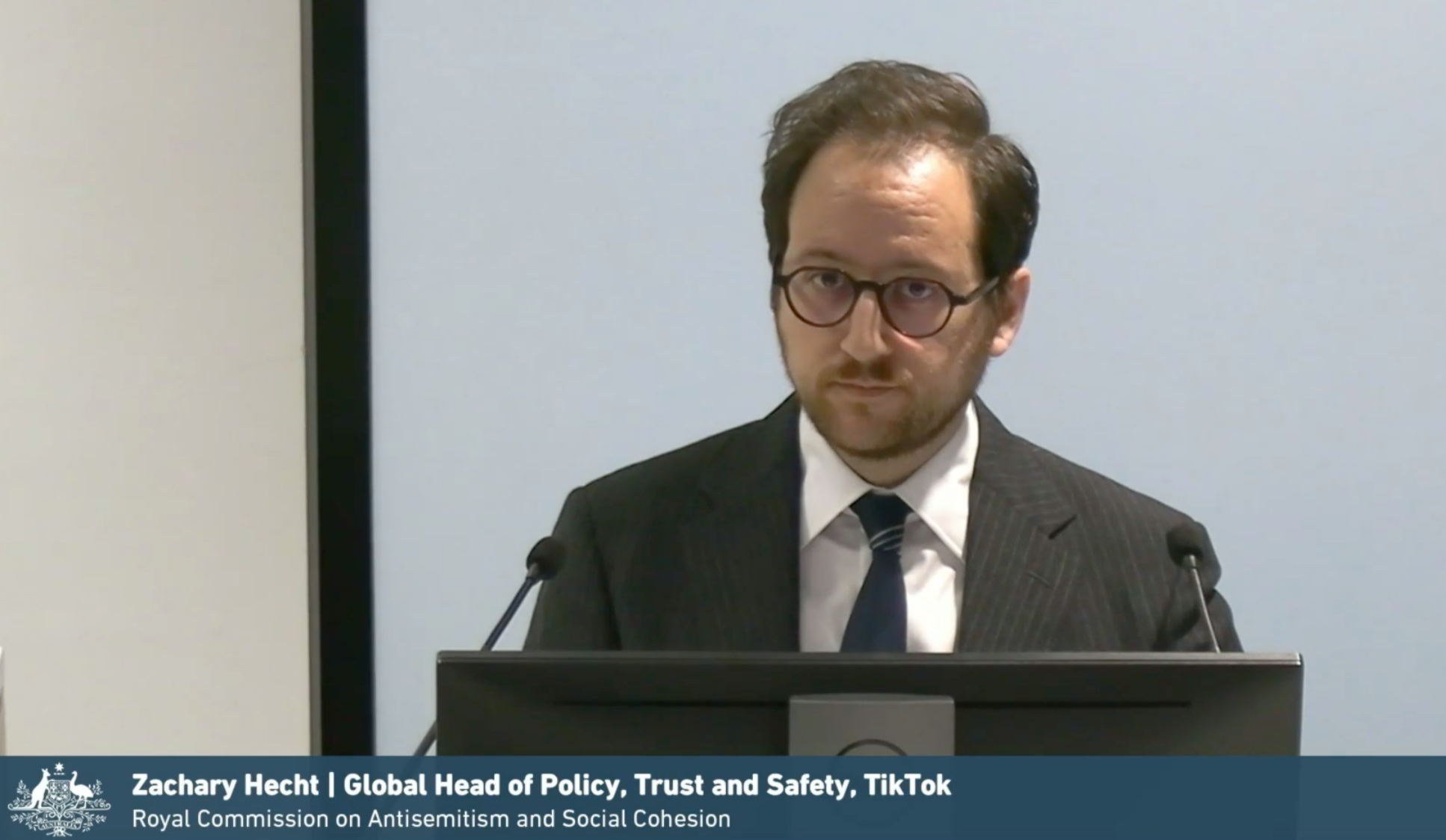
Zachary Hecht, global head of policy, trust and safety, TikTok appears before the Royal Commission on Antisemitism and Social Cohesion. Photo: screenshot
TikTok’s global head of policy, trust and safety, Zachary Hecht, told the Royal Commission on Antisemitism and Social Cohesion that the platform removes antisemitic content under its community guidelines but acknowledged its enforcement is imperfect.
Hecht, who is based in New York and took up his role in December 2025, travelled to Australia voluntarily to give evidence on Tuesday. Under questioning from Counsel Assisting Richard Lancaster SC, he confirmed that TikTok’s community guidelines, updated in September 2025, apply globally and explicitly identify antisemitism as a hateful ideology. Prohibited content includes claims of supremacy over protected groups, Holocaust denial, and hateful conspiracies such as claims that Jewish people control the media.
Hecht said the platform’s policies are shaped by outside expertise.
“The policies that this public document is based on are certainly informed by conversations with members of the Jewish community, as well as experts in the field of hate speech.”
Lancaster also established that the TikTok platform used by Australians is not operated by TikTok Australia but by a Singaporean entity controlled by ByteDance. Hecht confirmed there are some differences between operations but said trust and safety provisions are applied consistently outside the United States.
On content moderation, Hecht said every piece of uploaded content is reviewed proactively, with automated systems handling the bulk of enforcement and human moderators reviewing borderline cases. He told the commission 98 per cent of violating content in Australia is removed before any user reports it.
Data tendered to the commission showed that of more than 336 million videos published in Australia in 2025, 270,749 were removed for breaching safety and civility guidelines. In the first quarter of 2026, 67,012 were removed from more than 110 million uploads.
Hecht conceded though that the system has limits.
“Content moderation is not always perfect, and so there are instances where we would not have gotten it right, but as content is viewed more, we take additional steps to continue reviewing it.”
On how TikTok handles content referencing hateful material for counter-speech or educational purposes, Hecht said clear intent is required.
“We err on the side of caution and safety. So, if somebody simply uploads an image and they make a comment that we can’t tell either way, we’re going to still remove that. We need active condemnation, we need active behavior from the user.”
He said TikTok is also working to detect veiled antisemitic narratives by identifying emerging keywords and trends in partnership with third-party organisations.
TikTok global head of policy, trust and safety Zachary Hecht has told the Royal Commission on Antisemitism and Social Cohesion that an antisemitic comment correctly blocked by the platform’s automated systems was reinstated by a human moderator on appeal, and only removed after a community organisation reported it and the matter was escalated.
Hecht was taken through the history of a comment posted on May 7, 2026, which he acknowledged was “clearly a violation” of TikTok’s prohibition on hate speech and hateful ideologies. The content had been identified as a violation by TikTok’s automated moderation system when first uploaded and was not made visible. But after the user appealed, a human moderator allowed the appeal and the material went up.
On May 29, TikTok received a report about the content from the Dor Foundation, but reviewers assessed it and again decided it was not in breach. It was only after the foundation gave evidence to the commission that the matter was escalated to more senior members of the trust and safety team — before the commission issued a formal notice — and on July 2 the content was determined to be a violation and removed.
Asked what he took from a process in which human moderators had judged the content not to be violating, Hecht said two reviewers had reached that conclusion. He said he would be hesitant to draw an absolute conclusion from a single case, but that it demonstrated automated moderation had in this instance made the correct decision, while “human judgement can sometimes complicate that”. Anyone who had reviewed the content, he said, would receive targeted additional training.
TikTok global head of policy, trust and safety Zachary Hecht.
Hecht was also questioned about the structure of TikTok’s moderation, conceding there was no team dedicated to Australia or to the Asia Pacific region, with content instead routed to a global pool of moderators equipped to review English-language material. Counsel Assisting put to him that this made the training applied to any given moderator “a pretty random process”. Hecht disagreed with the characterisation, saying TikTok’s goal was to equip all reviewers with the knowledge they needed, including targeted guidance on specific harms such as antisemitism and a database of harmful slurs and phrases maintained on a regional basis.
He said TikTok had deployed specific guidance to moderators following the events of October 7, 2023, which had generated “a lot of harmful speech”, as well as anti-bias and antisemitism training that had shown some improvement in enforcement.
Despite the reinstated-comment case, TikTok was independently assessed as the best-performing of the major platforms on removing antisemitic content. Hecht noted evidence from the online safety group CyberWell, whose data ranked TikTok highest among four platforms for its removal rate. He said the platform proactively removed 98 per cent of content that breached its community guidelines in Australia before any report was made, though he acknowledged that in the CyberWell cases, as with the Dor Foundation comment, the content had been removed only after it was reported.
TikTok does not record why content is removed according to the group it targets, meaning the platform cannot say from its own data whether antisemitism is increasing or decreasing, the Royal Commission on Antisemitism and Social Cohesion has heard.
Under cross-examination by Nicholas Bender SC, counsel representing Australia’s mainstream Jewish community organisations, TikTok global head of policy, trust and safety Zachary Hecht agreed that while every moderation decision was recorded as a violation of the relevant part of the community guidelines — such as hate speech and hateful ideologies — it was not logged as being anti-Jewish, anti-Muslim, anti-women or otherwise.
Bender put to Hecht that this meant TikTok “doesn’t maintain data that would permit it to make any assessment at all as to whether antisemitism is increasing or decreasing on its platform over time”. Hecht agreed the platform did not maintain that data, but said TikTok partnered with organisations, including in Australia, that provided feedback on how harm was manifesting and affecting communities including the Jewish community. He accepted he could not offer the commission specific quantitative data on whether antisemitism had risen, fallen or stayed the same.
Hecht resisted the suggestion that recording the targeted group would be straightforward, saying it was a “very complex effort” to identify the protected attribute in every case and not necessarily the best use of moderators’ time. When Bender suggested the resourcing issue was a function of how much TikTok chose to spend on moderation, Hecht said there was “a fixed amount of resource” and the platform’s focus was on removing harmful content as the primary means of combating hate.
Bender also challenged data in Hecht’s statement showing video removals in Australia for breaches of the safety and civility guidelines had fallen each year — from about 338,000 in 2023 to 314,000 in 2024, about 270,000 in 2025 and around 67,000 in the first quarter of 2026. Hecht disputed that this showed the platform was removing less, arguing it might instead reflect less violating content being posted, and noted that hate speech and hateful ideology removals, addressed in a colleague’s statement, were trending differently.
Bender pressed Hecht on whether TikTok conducted a sampling exercise comparable to Meta’s “prevalence” measure to estimate how much violating content slips through detection and remains on the platform. Hecht said sampling was fundamental to how TikTok evaluated its accuracy, but accepted his statement made no assessment of how much violating content was missed. Bender put to him that “TikTok’s focus is on what it removes and not what it misses”, which Hecht rejected.
Finally, Bender showed Hecht an image from a report by the Online Hate Prevention Institute — depicting a spider with a hooked nose and a Star of David above figures representing minority groups — which Hecht agreed was “a fair characterization” and a clear violation of TikTok’s policies. But Hecht said TikTok had been unable to identify the post, or any of the TikTok posts in the report, from the screenshots provided, and could not say whether the content had ever been removed, how many people had seen it, or whether it remained on the platform.
Commissioner Virginia Bell thanked Hecht for travelling to Australia to give evidence and, through him, thanked TikTok for the cooperation it had extended to the commission, noting that the question of online hate was “very much central” to its terms of reference.
TikTok global head of partnerships, elections and market integrity Valiant Richey has told the Royal Commission on Antisemitism and Social Cohesion that the platform has no content moderators located in Australia, despite employing around 760 staff and 16 contractors across Sydney and Melbourne.
Giving evidence, Richey, who travelled to Australia to appear, said content moderation is handled centrally by TikTok Singapore and distributed across global teams. Asked by Counsel Assisting Matt Sherman SC whether he was aware of any reason for the absence, Richey said, “I am not aware of why that is the case.”
The hearing examined the gap between how antisemitic content is handled when flagged by expert organisations versus ordinary users. TikTok’s Community Partner Channel includes more than 400 organisations such as CyberWell, the Anti-Defamation League, the Sydney Jewish Museum, the Executive Council of Australian Jewry and the New Zealand Jewish Council, and achieves removal rates above 90 per cent.
Under cross-examination by Nicholas Bender SC, representing Australia’s mainstream Jewish communal organisations, Richey was confronted with a report by the Online Hate Prevention Institute showing only 22 per cent of antisemitic content it identified was removed through TikTok’s standard reporting channels. Richey acknowledged the gap but said, “There’s a lot of noise in user reporting, and what I mean by noise is that users will often report things that aren’t policy violations, but they just want to just report it, like reporting a football player who they don’t like and calling it hate speech … sometimes our ability to action that is not as robust as it is when it comes in through the community partner channel, which is a very specific set of organisations who have specific expertise. We have a dedicated portal. It’s exactly why we have that, is to make sure that we get that high-quality information directly to our teams.”
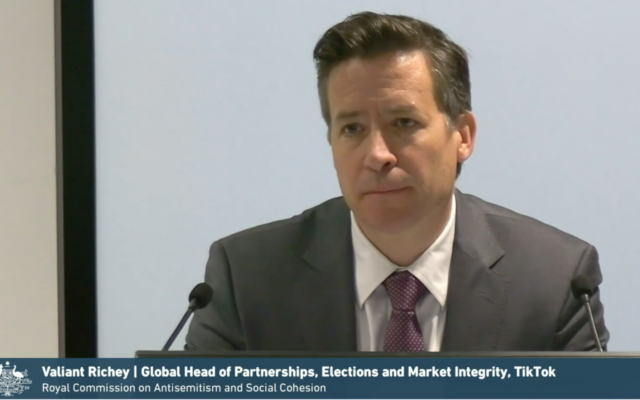
TikTok global head of partnerships, elections and market integrity Valiant Richey appears before the Royal Commission on Antisemitism and Social Cohesion. Photo: screenshot
Bender pressed Richey on TikTok’s lack of an independent oversight board equivalent to Meta’s, putting to him that without an external appeals mechanism, the final call on content always rests with TikTok itself. Richey defended the company’s position, saying, “The challenge with the oversight board approach is the tremendous amount of time it takes to reach a decision. Our view is that we want to move as quickly as possible. Those decisions, as I understand it from the literature that I’ve read about the Oversight Board, can take six to 12 months. We’re looking at trying to make decisions in less than 24 hours … our view is that that system doesn’t serve the needs of our community.”
He confirmed TikTok has no plans to adopt the independent appeals process mandated by European legislation for Australian users, saying the matter would need to be assessed by the company’s public policy team.
Richey also detailed TikTok’s crisis response to the December 2025 Bondi terror attack, saying the platform activated its crisis protocol within an hour, contacting the eSafety Commissioner, NSW Police and the Australian Federal Police. He described the internal risk teams deployed as distinct from standard content moderation, saying, “In very rough terms, and this is not a perfect analogy, it’s like our basic police force versus a SWAT team. So you think about a team that is designed with specific expertise, specific labour levers that they can pull to respond to scenarios, and that’s what we’re talking about here.”
He pointed to positive initiatives including the In Common campaign with the Sydney Jewish Museum and the Dor Foundation, a Holocaust education hub with UNESCO and the World Jewish Congress, and a pilot program with the Violence Prevention Network and Home Affairs to redirect users searching for extremist content toward support services.
Richey said early results from the pilot had been “extremely positive” in terms of user engagement and uptake of conversations.
Rachel Lord, YouTube’s Government Affairs and Public Policy, Australia and New Zealand, provided evidence to the Royal Commission on Tuesday.
Lord is employed by Google Australia Pty Ltd and is based in Sydney. Google LLC is a subsidiary of Alphabet Inc, and YouTube is a property of Alphabet Inc.
Discussing the monetisation of content creation on YouTube, Lord said, “I think we paid out 1.1 billion AUD equivalent in GDP through that creator ecosystem, so that’s creators earning income on YouTube, as well as… buying services”.
“It’s based on Australian content creators, so creators in Australia, Australians who are uploading content to YouTube and who are part of the YouTube partner program, which might be visible both to Australian end users and globally… 90% of watch time on Australian channels comes from overseas. We have a very strong export creative export market here,” she said.
It was noted that YouTube’s Community Guidelines include a harmful or dangerous content policy, a violent criminal organisations policy, and a hate speech policy, as well as an EDSA exception – an educational, documentary, scientific, or artistic context.
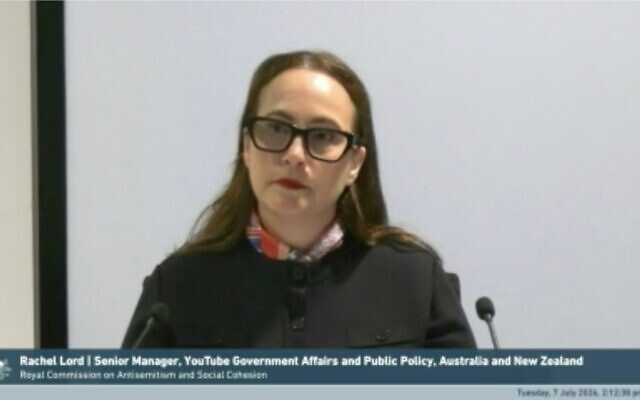
Rachel Lord providing testimony at the Royal Commission. Photo: Screenshot
It was discussed that Google has developed Google DeepMind – AI. Lord said that YouTube uses machine learning classifiers to detect potentially violative content on its platform.
Lord explained, “The way I like to think about it is that the back end of YouTube is very dynamic, as you could imagine, like 2 billion plus videos on the platform. There’s 20 million videos being uploaded every day. There’s removal actions, there’s users pulling down content, and those classifiers run across that content continuously. So, from the moment of upload, the classifiers are continuously sorting through and flagging content for review.”
She added, “It is primarily for flagging, but in certain circumstances where our automated tools are confident that that content is violative of our community guidelines, or have sufficient confidence to make that determination, they will remove the content from the platform, so the sorts of circumstances where that would happen, for instance, would be where it is a reupload of previously hashed terrorist content or child sexual abuse material, for instance, or content that is a reupload of another type of content that had been removed from the service, so when there’s sufficient confidence that it is violated, it’ll be taken down automatically.”
Asked by Counsel Assisting Richard Lancaster, “Is it fair to say that the way YouTube operates is that if content has an antisemitic character, it would never, or almost never, automatically be prevented from being uploaded, it would simply be flagged?”
Lord replied, “If it was a re-upload of content that had been found to violate, say, our hate speech policy. Then, yes, it would be pulled down, like under any of those community guidelines. If it was a reupload, it will come down.”
Asked if it was a fresh upload, whether it would not be caught by the automated blocking mechanism, Lord said, “My understanding is that we continue to basically train those classifiers off human moderation decisions, so once a video has been flagged, it’s then sent for review by a human moderator. If the systems can’t, with sufficient confidence, determine that it’s violative, it will go forward for human moderation.
“Once that outcomes been decided, whether it’s violative, non-violative… it is fed back into the machine learning classifier, so it’s trained on that again to then pick up, you know, or identify that same sort of content in the future,” she said.
Asked about the EDSA exception, Lord said, “My experience of our… content moderation process is that it is quite robust when they are looking at applying these exceptions.”
Asked how many content moderators are engaged at any one time around the world in YouTube’s provision of its service, Lord replied, “I think we’re looking at 22,000 content moderators, both contractors and full time. Then we have approximately 800, I believe, engineers who support that trust and safety function.”
In the final part of today’s hearing session, Lancaster pressed Lord on YouTube’s handling of a video in which four men discussed the Bondi Chanukah attack, and the men described survivor Arsen Ostrovsky as a “front man” and “intelligence asset” and repeatedly labelled the incident a “false flag”.
Lancaster noted that video had been reviewed at senior levels within YouTube and found not to breach the platform’s community guidelines.
“I suggest to you that it shows a really serious deficiency in YouTube’s guidelines that this video, after review at the highest levels, remains accessible to the public,” Lancaster put to Lord, who did not dispute the characterisation, but defended YouTube’s approach.
“We set our guidelines for our platform, and… the difficulties in regulating speech and regulating content… it’s hard,” Lord said, adding YouTube would accept government-mandated regulation “were the government to determine that… Australia required regulation”.
On why the video was not found to breach the hate speech policy, Lord said YouTube’s understanding of “victimhood” under that policy turned narrowly on whether a video denied “loss of life”, rather than on whether it questioned survivors’ honesty or motives.
Later, barrister Nicholas Bender, appearing for several Jewish community organisations, questioned Lord on YouTube’s reliance on data from Cyberwell, an antisemitism-monitoring group, to argue its moderation was improving.
Bender established that before Cyberwell became a “priority flagger”, only 10.9 per cent of its reports resulted in removal — roughly one in nine.
Lord resisted the inference that ordinary users would fare no better, saying review was “dynamic” and multiple flags could affect one outcome.
Bender then turned to Cyberwell’s post-priority-flagger data, noting its removal rate for Holocaust denial and distortion content rose from 30.77 per cent in 2024 to 58.33 per cent in 2025 — a figure YouTube’s statement described as “strong proof” its moderation strategy was working.
Bender put to Lord that Cyberwell’s own report attributed the increase to its new priority status, not any change in YouTube’s standards.
Lord agreed: “Yes, although I guess… where we’re drawing the line is… probably not… capturing more content than had previously been identified.”
Bender also highlighted that YouTube’s “violative view rate” — its self-described “North Star metric” — excludes the roughly 189.4 million comments reviewed for hateful or abusive violations since 2023. In the same period, 2.446 million videos were removed.
Lord maintained comments were “not really an integral part of YouTube’s service”, noting they occupy less than one per cent of users’ time on the platform.
Bender later returned to the Ostrovsky video, asking what options were available if he or another user reported it again.
Lord conceded that, because the video “has been found not to violate our community guidelines,” it “wouldn’t be removed” and, in effect, “absolutely nothing would happen.”
TikTok global head of partnerships, elections and market integrity Valiant Richey on how antisemitic content is handled when flagged by expert organisations versus ordinary users
Rachel Lord on YouTube’s handling of a video in which four men discussed the Bondi Chanukah attack that described Arsen Ostrovsky as a “front man” and “intelligence asset” and repeatedly labelled the incident a “false flag”
The AJN is providing rolling coverage on the Royal Commission on Antisemitism and Social Cohesion.
TikTok does not record why content is removed according to the group it targets, meaning the platform cannot say from its own data whether antisemitism is increasing or decreasing, the Royal Commission on Antisemitism and Social Cohesion has heard.
Under cross-examination by Nicholas Bender SC, counsel representing Australia’s mainstream Jewish community organisations, TikTok global head of policy, trust and safety Zachary Hecht agreed that while every moderation decision was recorded as a violation of the relevant part of the community guidelines — such as hate speech and hateful ideologies — it was not logged as being anti-Jewish, anti-Muslim, anti-women or otherwise.
Bender put to Hecht that this meant TikTok “doesn’t maintain data that would permit it to make any assessment at all as to whether antisemitism is increasing or decreasing on its platform over time”. Hecht agreed the platform did not maintain that data, but said TikTok partnered with organisations, including in Australia, that provided feedback on how harm was manifesting and affecting communities including the Jewish community. He accepted he could not offer the commission specific quantitative data on whether antisemitism had risen, fallen or stayed the same.
Hecht resisted the suggestion that recording the targeted group would be straightforward, saying it was a “very complex effort” to identify the protected attribute in every case and not necessarily the best use of moderators’ time. When Bender suggested the resourcing issue was a function of how much TikTok chose to spend on moderation, Hecht said there was “a fixed amount of resource” and the platform’s focus was on removing harmful content as the primary means of combating hate.
Bender also challenged data in Hecht’s statement showing video removals in Australia for breaches of the safety and civility guidelines had fallen each year — from about 338,000 in 2023 to 314,000 in 2024, about 270,000 in 2025 and around 67,000 in the first quarter of 2026. Hecht disputed that this showed the platform was removing less, arguing it might instead reflect less violating content being posted, and noted that hate speech and hateful ideology removals, addressed in a colleague’s statement, were trending differently.
Bender pressed Hecht on whether TikTok conducted a sampling exercise comparable to Meta’s “prevalence” measure to estimate how much violating content slips through detection and remains on the platform. Hecht said sampling was fundamental to how TikTok evaluated its accuracy, but accepted his statement made no assessment of how much violating content was missed. Bender put to him that “TikTok’s focus is on what it removes and not what it misses”, which Hecht rejected.
Finally, Bender showed Hecht an image from a report by the Online Hate Prevention Institute — depicting a spider with a hooked nose and a Star of David above figures representing minority groups — which Hecht agreed was “a fair characterization” and a clear violation of TikTok’s policies. But Hecht said TikTok had been unable to identify the post, or any of the TikTok posts in the report, from the screenshots provided, and could not say whether the content had ever been removed, how many people had seen it, or whether it remained on the platform.
Commissioner Virginia Bell thanked Hecht for travelling to Australia to give evidence and, through him, thanked TikTok for the cooperation it had extended to the commission, noting that the question of online hate was “very much central” to its terms of reference.
Enjoy Unlimited Access To The Australian Jewish News Website And All Our Online Content For AUD$18/month Or Just AUD$120/year.



comments