Live updatesPublic hearings

Security arrangements for the Jewish community in focus

Hearing Block 5 of the Royal Commission continues today, examining security arrangements, government funding and police coordination for the Jewish community.

Police deployments for Jewish community security “more than ever before”

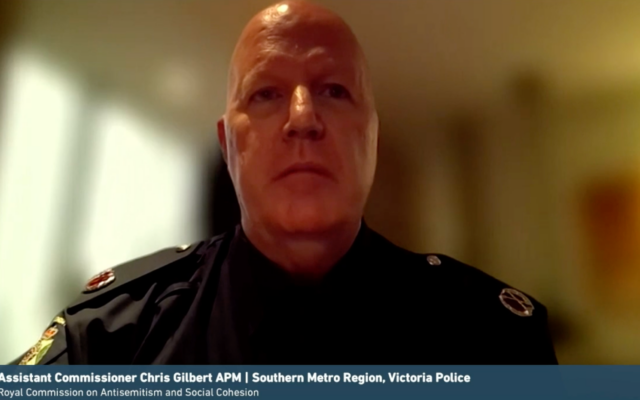
Assistant Commissioner Christopher Gilbert, who leads Victoria Police’s Southern Metro region, has testified to the Royal Commission about resources deployed to the Jewish community.

Asked on Wednesday afternoon about Operation Park — the force’s overarching deployment structure covering both antisemitic and Islamophobic incidents — Gilbert said that the operation had escalated markedly since October 7, 2023, and even more since the December 14 Bondi terror attack.

“I would characterise the changes … as having seen Victoria Police deploy far more resources, far more often relevant to the safety of the Jewish community,” Gilbert said. “We’ve certainly escalated those deployments since December 14, which sees us now deploying more than we ever had before.”

Gilbert revealed that almost 18,000 discrete tasks relevant to community sites of interest had been recorded over the last two and a half years, “of which almost 15,000 of those have been in the inner south of Melbourne”.

Questioned on Victoria Police’s ability to track antisemitic incidents, Gilbert acknowledged limitations in the force’s data systems. “The ability to rapidly capture data on that with the existing system is a little bit limited,” he said, adding that Victoria Police was “looking at ways to improve the connectivity of our systems”.

Asked about direct engagement with Jewish community groups and individuals, Gilbert said such relationships were highly valued. “Relationships on the ground are probably even more important [than data] because that is where we get the feedback loop and the listening post opportunities with communities,” he said.

Gilbert also detailed Victoria Police’s relationship with the Community Security Group (CSG) Victoria, describing it as “a core community stakeholder” met with regularly at senior levels. He said Victoria Police shared information with CSG “where charges have or haven’t been laid”, within legislative limits on victim-related data.

The hearing moved into closed session to address Victoria Police’s engagement with CSG.

Victoria Police “not aware” of accurate specific data on antisemitic incidents

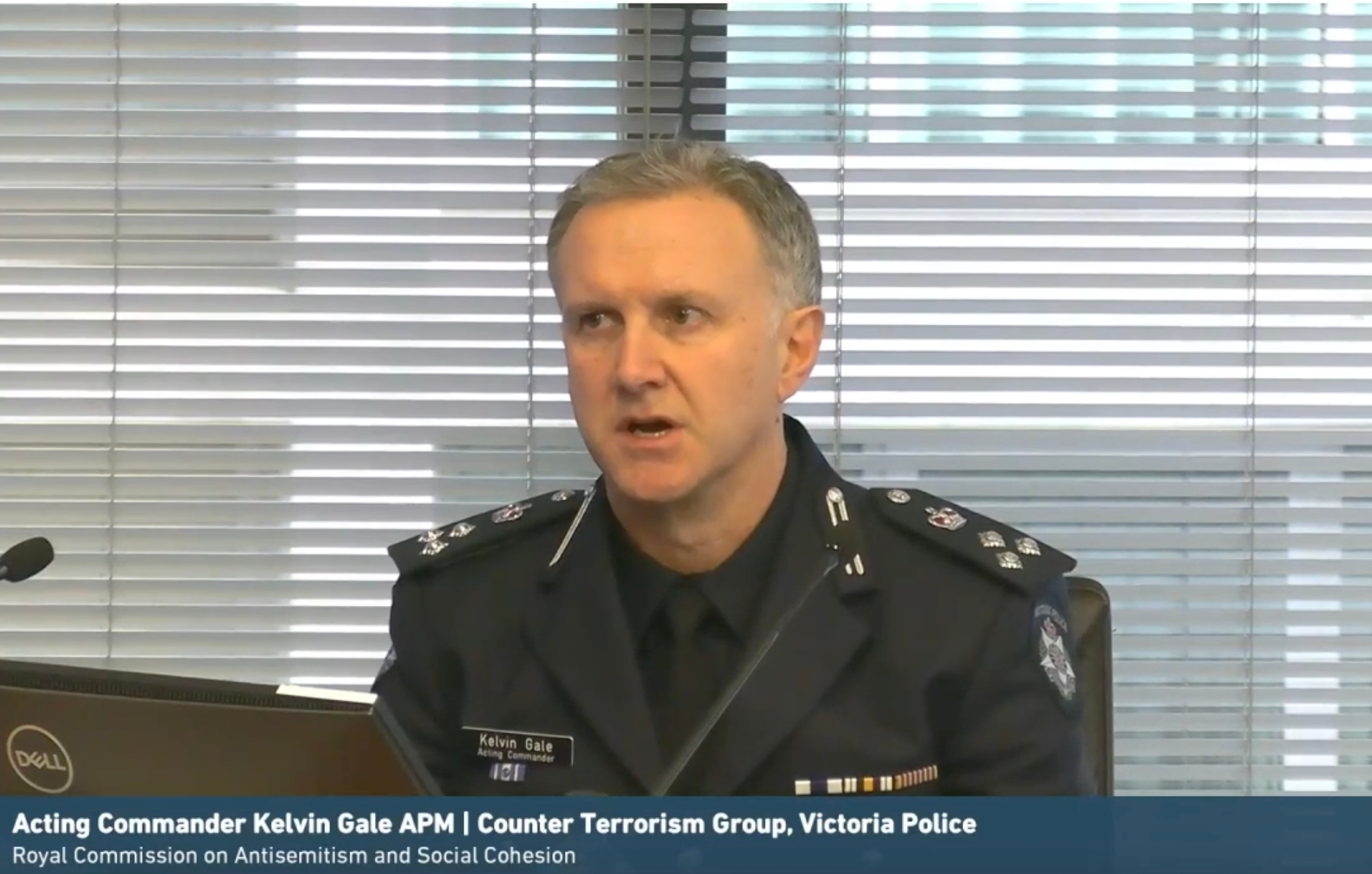
Victoria Police has no reliable way of tracking the true extent of antisemitic incidents across the state, the Royal Commission into Antisemitism heard this afternoon, as Acting Commander Kelvin Gale, head of the force’s Crime and Counter-Terrorism Investigation Services, gave evidence on protective security arrangements for the Jewish community.

Gale told the Commission that the force’s LEAP database records offences but not incidents, while the separate Interpose system relies on free-text narratives that are inconsistently tagged.

“The difficulties come about with their consistency in reporting,” he said, adding that without standardised naming conventions “it can make it difficult to find” antisemitic elements in reports.

Even where an offence is logged, flagging it as ‘prejudice-motivated’ is discretionary for the recording officer, creating what counsel assisting described as a systemic gap.

“It’s not that reliable – that’s our biggest issue. There are mechanisms to work through [in terms of obtaining data about antisemitic incidents], but it’s just not that reliable,” Gale said.

Pressed on whether it was “impossible to get an accurate picture” of antisemitic offending, Gale pushed back, saying “that’s wrong”, though he conceded the situation was “problematic, no doubt” and that better data “would be nice to be able to capture more accurately.”

On protective security, Gale explained that whether an event is managed by the State Event Planning Unit or locally is driven by resourcing rather than risk.

“It’s not about the risk or the importance,” he said. “It’s about the resource and commitment that’s required to manage the event.”

He cited the visit of Israeli President Isaac Herzog as an example of a state-led event, where his Capability Unit conducted vulnerability assessments on venues and travel routes alongside the Planning Unit.

Decisions about whether a Protective Security Vulnerability Assessment (PSVA) is required sit “at the discretion of the police commander or the person who’s in charge of running the event,” Gale said.

He added, there is no published document governing when a PSVA specifically addressing Jewish sites or events must be conducted. Some 148 personnel statewide are trained to carry them out.

Asked whether Victoria Police maintains an arrangement comparable to NSW Police’s ‘Operation Jewish High Holy Days’, Gale said his command has little direct involvement in regard to that, as such events “are not state-led,” although Local Area Commands in Victoria can escalate to his team if a threat assessment warrants it.

On the definition of the policing guidelines category of “Crowded Places,” Gale said a synagogue itself would “not normally” qualify, though its surrounding precinct could, and that the framework was not exhaustive, as a synagogue could be added upon request.

The Commission also probed the process involved in assessing and determining deployment of long-arm weapons by police at Jewish community events.

Gale confirmed that adjustments made after the 14 December 2025 Bondi Beach Chanukah terror attack reflected “community reassurance,” not a specific threat, and that visible long-arm deployment “hasn’t happened this year” in Victoria.

Such deployments, he said, involve specialist units – the Public Order Response Team, Critical Incident Response Team, and Special Operations Group – not his own command.

Asked about possible reforms, Gale said coordination between his Capability Unit and event planners already occurs, but accepted that improved data recording was a legitimate area for improvement.

Terrorism expert details target selection research

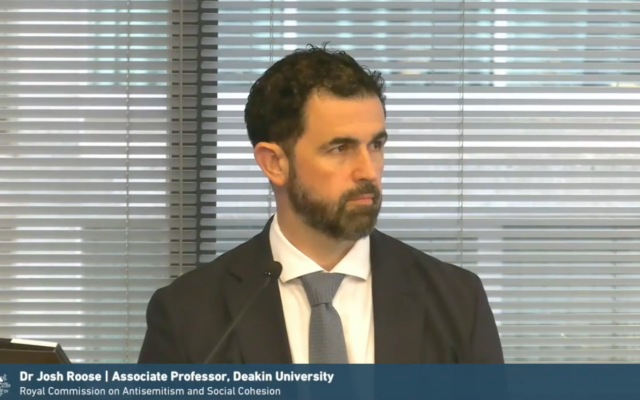
Deakin University associate professor Dr Josh Roose has told the Royal Commission on Antisemitism and Social Cohesion that terrorists select their targets based on a combination of symbolic messaging and pragmatic capability, drawing on research that examined 100 individuals involved in plots and attacks across Australia over two decades.

Roose, who holds a PhD in political science and a law degree, appeared before Commissioner Virginia Bell on July 22. He is a consultant for the United Nations Office of Counterterrorism and in February joined The Dor Foundation on secondment from Deakin to serve as director of research and policy to support work on antisemitism following the Bondi Beach terror attack.

His testimony centred on a target selection report he co-authored with University College London’s Professor Paul Gill, commissioned by the Victorian Government Department of Justice and Community Safety in early 2024 and delivered in November 2025.

The research examined how ideological, operational and environmental factors shape decisions about target attractiveness to violent extremists, spanning right-wing extremism, violent misogyny and Salafi jihadist extremism. Roose noted the team also included the Christchurch terror attack in their dataset because it was carried out by an Australian and “it’s been so influential in shaping the Australian domain, particularly on the extreme right.”

Photo: screenshot

The study involved 29 interviews across the private, community and public sectors, digital ethnography of extremist online forums, and ethnographic observation of previously targeted sites.

Describing the overarching finding, Roose said, “There’s a combination of factors at play in how terrorists choose targets. Critical is the symbolic component. Ultimately, by definition, terrorism is a political act or religious act, and they’re seeking to broadcast a message through that act.”

He added, “Certain sites that, for example, might appear too difficult to reach, would be bypassed in favour of a potentially more vulnerable event where they can maximize lethality and their message.”

The hearing also addressed recommendations for layered protective security measures. Roose described how static security alone was insufficient, telling the commission, “The layered approach requires not only a deeper intelligence picture … but there’s also the broader issue of, for example, communications between different organizations that aren’t seen and yet form a really critical part of the layered approach.”

He specifically noted that Victoria Police, ASIO and the Community Security Group within the Jewish community all contribute to that intelligence picture.

Roose said protecting community events posed particular challenges compared with fixed sites, as “the space itself might not be symbolic, but the group meeting there might be particularly symbolic as a target.”

The hearing moved into closed session to address sensitive security material.


Security now consumes 80 per cent of JCCV’s work.

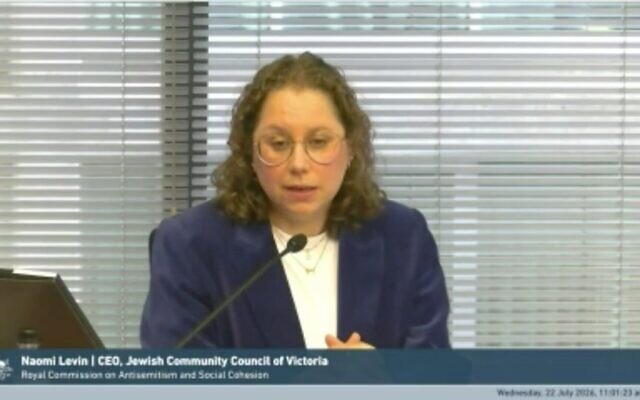
Jewish Community Council of Victoria CEO Naomi Levin. Photo: Screenshot

The Jewish Community Council of Victoria now spends about 80 per cent of its time on antisemitism and community safety, an exact reversal of the position before October 7, 2023, its chief executive has told the Royal Commission into Antisemitism and Social Cohesion.

Naomi Levin, who became CEO in November 2023 after joining the organisation in early 2022, said the JCCV represents 61 member organisations across Victoria.

“Before October 2023, our work was divided into maybe 20 per cent of our time spent on issues related to antisemitism and security, and 80 per cent related to all sorts of other issues,” she said. “Post October 2023, there has been an exact flip.”

Levin told the commission that 564 antisemitic incidents were reported to the Community Security Group in Victoria in 2025, the highest number ever documented in a single year in the state. The JCCV partners with CSG to analyse and publish the data annually. The figures are then fed into the Executive Council of Australian Jewry’s national report.

She said the upward trend predated October 7. “Regrettably, the trend was for increasing reports of antisemitism even before October 2023,” she said, adding that it was then significantly exacerbated.

Levin opened her evidence by pushing back on the framing of the community as defined by its distress.

“I’m here today representing one of the most vibrant and active Jewish communities in the world, and it’s really regrettable for us that all many Australians know about our community is the sadness and pain,” she said.

She cited nine Jewish schools, more than 50 synagogues, two cultural institutions, a 115-year-old Yiddish cultural centre and a welfare organisation whose 850 volunteers provide more than 70,000 meals a year across Victoria.

Funding structure criticised

Levin said the JCCV had never asked government for a specific dollar figure, regarding that as CSG’s role, but had consistently argued that the structure of security funding was inadequate.

“What we’ve seen is very ad hoc funding,” she said. “After an incident, there’s an injection of funds, but it all has to be spent in a pretty short space of time.”

She said funding had been driven more by the electoral cycle than by need, leaving organisations with large sums to spend inside a 12-month window and potentially nothing the following year. Guards trained over a year could be made redundant and new infrastructure left unmaintained, she said.

Levin said she was not aware of any provision for protective security funding for the Jewish community in the Victorian budget handed down in May, though a small amount was allocated to combating antisemitism, Islamophobia and racism more broadly. She stressed that both the government and the opposition had offered bipartisan support for security funding in the past.

She described a federal grant made after the Bondi Chanukah attack, funded over three years, as the first ongoing commitment to protective security for the Jewish community from any level of government.

Levin was also critical of earlier grant rounds requiring matched funding, under which an organisation seeking $40,000 for a fence had to raise $20,000 itself. She cited a small synagogue on a busy main road outside Melbourne’s established Jewish suburbs that had missed multiple grants because it lacked the fundraising capacity to match the money.

“We can’t have a system where organisations are being left alone and being left unsecured just because they don’t have the budgets to match funding,” she said, noting that the most vulnerable locations tended to face the worst attacks.

Policing and the perception gap

Levin said the JCCV had logged more than 100 engagements with Victoria Police since October 2023, having previously dealt mainly with the force’s Priority and Safer Communities Division. Despite that, community members did not feel safer, in part because the substance of those discussions could not be shared publicly.

“When people don’t see the police, they don’t perceive them as being actively engaged in protecting the community,” she said.

She pointed to an anti-racism rally outside Victorian Parliament in August 2024, when a group from a pro-Palestinian protest at the other end of the CBD converged on it.

“It was the worst day we have ever experienced in Victoria for antisemitic incidents,” she said, describing assaults on Jewish people in wheelchairs. She said the perception in the community was that Jewish people at subsequent protests were told by police to vacate areas while other groups moved freely through the city each week.

Asked about ASIO raising the national terrorism threat level to “probable” that same month, Levin said the information appeared to have reached her organisation only via CSG.

“If it was communicated, it wasn’t communicated with sufficient gravitas for us to realise what the significance was,” she said. “I look back and I really feel a lot of regret about that.”

What security costs the community

Levin said protective security had limits. Referring to identifiably Jewish people abused in their own neighbourhoods and students travelling to school on public transport, she said nothing short of a guard beside every Jewish person, which she called completely undesirable, could prevent it.

Security infrastructure also created literal barriers to Jewish life, she said.

“As I came in this morning, I walked past a large cathedral in Melbourne, and the doors are open,” she said. “To go into a synagogue is a completely different experience.”

Visitors to the JCCV’s offices in the Beth Weizmann Jewish Community Centre are met by fences and guards, she said, and the building has been locked down during incidents and evacuated when demonstrations came within 100 metres. She recalled a cafe at the bottom of the same building when she was growing up in Melbourne, with no gates or guards.

Congregants are now directed to disperse immediately after services and events. Levin said the best conversations often happened at the end of an event, and the community was losing those informal chances to build social ties.

She argued funding had focused too narrowly on physical measures.

“That’s not just about putting a guard on the front door, but it’s about creating environments where Jewish people feel welcome, feel that they belong,” she said, singling out arts and cultural events.

“We would not have had a camp without security”

A Sydney youth movement leader has told the Royal Commission into Antisemitism and Social Cohesion that her organisation could not operate in the current climate without security, and that the burden of arranging it has fallen on volunteers aged between 18 and 22.

Giving evidence in Melbourne under the pseudonym ACV, with her image withheld from the live feed, the witness said she is in her early 20s and serves as chairperson of the Sydney branch of a progressive Zionist youth movement, an unpaid role she estimates takes 15 to 25 hours a week alongside part-time work and university study.

The movement runs camps and year-round programming for participants aged eight to 18. Two-thirds of them attend secular schools, she said, and many arrive with limited Jewish education.

ACV said the movement’s summer camp went ahead in the weeks after the Bondi Chanukah attack on December 14, but only after extensive reassurance to anxious families.

“Everything kind of went on hold for about a week after December 14, and then parents started calling, and we started calling families to make sure that they were okay,” she said.

Leaders set up a WhatsApp community group for parents and sent far more frequent updates than in previous years, when one or two emails and a Friday Shabbat shalom message had been the norm.

“There were a lot more calls from parents throughout the camp checking in on their kids because the kids were also extremely worried,” she said. “Some of them not wanting to sleep away from home.”

Asked whether attendance would have been lower without security arrangements in place, ACV answered, “One hundred per cent, yes.”

The cost, she told the commission, is significant. Funding for security at the movement’s three summer camps came through a one-off grant from the Executive Council of Australian Jewry. The commission heard that winter camp funding was confirmed only in the final week of June, days before the camp began.

“We … were confident that whether or not we received funding, security was necessary, and we would find the means,” she said. “We would not have had a camp without security.”

She said the movement was supported by its umbrella body, the Australasian Zionist Youth Council, but the process was draining during exam season.

“The youth movement leaders are not security consultants. We are all 18 to 22 year olds,” she said. “It was not fathomable to me that I would be sitting here today giving evidence.”

ACV described substantial changes to how the movement operates. Where participants once attended public pools, cinemas, picnics in parks and community events such as Clean Up Australia Day, most activities are now held behind the gates of a synagogue with a single entrance, security and a list of attendees.

Camp merchandise, a long-standing part of movement culture, is now removed before buses depart and cannot be worn again until participants arrive home.

“It’s a security risk to have any Hebrew or any identifying symbols while we’re in public,” she said.

Participants are also asked to turn off location services on their phones so the campsite cannot be identified. A tradition of a day out in a nearby town for participants on their final camp has been discontinued.

Her witness statement described the effect on children as jarring.

“The children are brought into a Jewish space that is supposed to be fun and foster connection, but the risks become very real when we have to impose very strict rules for their safety,” the statement reads.

ACV said leaders were themselves traumatised by the Bondi attack and received support from psychologists and trauma responders, including an information session on how to handle conversations with participants.

“Many who usually would just be homesick were suddenly crying because they were scared that someone was going to come and murder them in their sleep,” she said.

Leaders agreed among themselves who would take those conversations, she said, and no leader was required to do so.

The witness also gave evidence about antisemitism reported to her by participants at secular schools. One Year 12 student, who gave permission for the account to be shared, told ACV that after receiving her school captaincy her photograph was altered by peers to add payot and an antisemitic slur, then circulated around the school. The school was unable to identify who had created it.

“She was almost desensitised to it. She couldn’t understand that what had happened was antisemitic,” ACV said.

Asked what was needed beyond physical security, ACV pointed to the school curriculum.

“I think that in order to have true social cohesion in Australia, the education system and the curriculum being taught in schools needs to change,” she said, calling for accurate teaching of Jewish history and culture from kindergarten onwards.

She said that in her experience, non-Jewish Australians typically encounter Judaism only through a brief unit on the Holocaust within a term on World War II.

“They don’t understand anything about contemporary Jewish society. They don’t learn about any Jewish traditions or holidays or practices unless you take studies of religion.”

Asked whether she could foresee a time when security might ease, ACV said it was too risky to contemplate.

“I think parents would be very hesitant, at least for a few years, to send their kids to us if there was no security.”

The AJN is providing rolling coverage on the Royal Commission on Antisemitism and Social Cohesion.

For full coverage of the Hearing Blocks, visit the Royal Commission section of The AJN website.

read more:
comments
Live updates Public hearings

“We would not have had a camp without security”

A Sydney youth movement leader has told the Royal Commission into Antisemitism and Social Cohesion that her organisation could not operate in the current climate without security, and that the burden of arranging it has fallen on volunteers aged between 18 and 22.

Giving evidence in Melbourne under the pseudonym ACV, with her image withheld from the live feed, the witness said she is in her early 20s and serves as chairperson of the Sydney branch of a progressive Zionist youth movement, an unpaid role she estimates takes 15 to 25 hours a week alongside part-time work and university study.

The movement runs camps and year-round programming for participants aged eight to 18. Two-thirds of them attend secular schools, she said, and many arrive with limited Jewish education.

ACV said the movement’s summer camp went ahead in the weeks after the Bondi Chanukah attack on December 14, but only after extensive reassurance to anxious families.

“Everything kind of went on hold for about a week after December 14, and then parents started calling, and we started calling families to make sure that they were okay,” she said.

Leaders set up a WhatsApp community group for parents and sent far more frequent updates than in previous years, when one or two emails and a Friday Shabbat shalom message had been the norm.

“There were a lot more calls from parents throughout the camp checking in on their kids because the kids were also extremely worried,” she said. “Some of them not wanting to sleep away from home.”

Asked whether attendance would have been lower without security arrangements in place, ACV answered, “One hundred per cent, yes.”

The cost, she told the commission, is significant. Funding for security at the movement’s three summer camps came through a one-off grant from the Executive Council of Australian Jewry. The commission heard that winter camp funding was confirmed only in the final week of June, days before the camp began.

“We … were confident that whether or not we received funding, security was necessary, and we would find the means,” she said. “We would not have had a camp without security.”

She said the movement was supported by its umbrella body, the Australasian Zionist Youth Council, but the process was draining during exam season.

“The youth movement leaders are not security consultants. We are all 18 to 22 year olds,” she said. “It was not fathomable to me that I would be sitting here today giving evidence.”

ACV described substantial changes to how the movement operates. Where participants once attended public pools, cinemas, picnics in parks and community events such as Clean Up Australia Day, most activities are now held behind the gates of a synagogue with a single entrance, security and a list of attendees.

Camp merchandise, a long-standing part of movement culture, is now removed before buses depart and cannot be worn again until participants arrive home.

“It’s a security risk to have any Hebrew or any identifying symbols while we’re in public,” she said.

Participants are also asked to turn off location services on their phones so the campsite cannot be identified. A tradition of a day out in a nearby town for participants on their final camp has been discontinued.

Her witness statement described the effect on children as jarring.

“The children are brought into a Jewish space that is supposed to be fun and foster connection, but the risks become very real when we have to impose very strict rules for their safety,” the statement reads.

ACV said leaders were themselves traumatised by the Bondi attack and received support from psychologists and trauma responders, including an information session on how to handle conversations with participants.

“Many who usually would just be homesick were suddenly crying because they were scared that someone was going to come and murder them in their sleep,” she said.

Leaders agreed among themselves who would take those conversations, she said, and no leader was required to do so.

The witness also gave evidence about antisemitism reported to her by participants at secular schools. One Year 12 student, who gave permission for the account to be shared, told ACV that after receiving her school captaincy her photograph was altered by peers to add payot and an antisemitic slur, then circulated around the school. The school was unable to identify who had created it.

“She was almost desensitised to it. She couldn’t understand that what had happened was antisemitic,” ACV said.

Asked what was needed beyond physical security, ACV pointed to the school curriculum.

“I think that in order to have true social cohesion in Australia, the education system and the curriculum being taught in schools needs to change,” she said, calling for accurate teaching of Jewish history and culture from kindergarten onwards.

She said that in her experience, non-Jewish Australians typically encounter Judaism only through a brief unit on the Holocaust within a term on World War II.

“They don’t understand anything about contemporary Jewish society. They don’t learn about any Jewish traditions or holidays or practices unless you take studies of religion.”

Asked whether she could foresee a time when security might ease, ACV said it was too risky to contemplate.

“I think parents would be very hesitant, at least for a few years, to send their kids to us if there was no security.”

Enjoy Unlimited Access To The Australian Jewish News Website And All Our Online Content For AUD$18/month Or Just AUD$120/year.

Subscribe Now