Live Now

Multicultural organisations address the Royal Commission

Hearing Block continues continues today focusing on strengthening social cohesion, including how it is understood and measured.

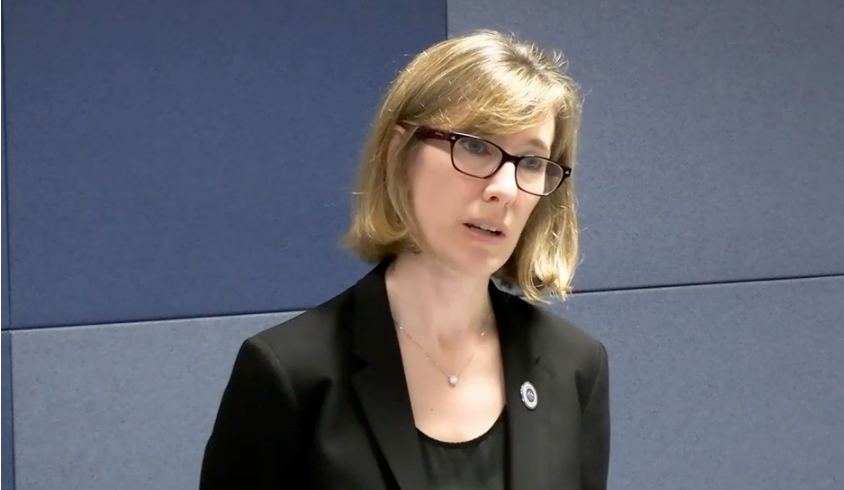
Zelie Heger SC, counsel assisting. Photo: screenshot

Gutwein: Promoting social cohesion should not fall solely on migrant communities

Former Tasmanian premier Peter Gutwein, appearing via video link, used his evidence to the Royal Commission this afternoon to warn that anti-migration voices have been allowed to dominate public debate, and that political and business leaders urgently need to build a more positive national narrative around migration before it is “too late”.

Gutwein, who now chairs the Australian Multicultural Council, when asked why formal affirmations of Australia’s multicultural character matter, pointed to the Multicultural Framework Review, whose first and most prioritised recommendation was that Federal Parliament reaffirm its commitment to multicultural Australia.

It was a reaffirmation, he said, that still has not been properly debated or voted on by Parliament.

Explaining the Australian Multicultural Council’s role, Gutwein said the body now has around 13 members from across the states and territories — eight jointly nominated by federal and state governments, and five ministerial appointees, including himself.

Its function, he said, is to advise the Federal Government on multicultural policy and to feed back to relevant ministers, including recently meeting with Assistant Minister Julian Hill.

A recurring theme of his evidence was that responsibility for promoting social cohesion — which he said he prefers to call “living well together” — should not fall solely on migrant communities themselves.

He argued that business and industry groups have a particular obligation to speak up, given they benefit directly from migrant labour and skills.

“Too often a migrant voice… can be dismissed as… simply arguing for themselves,” he said, arguing that organisations such as the Business Council, chambers of commerce and housing industry associations need to be “heard and be a part of the national narrative”, because a broader range of voices makes the debate harder to dismiss.

Turning to why national narratives matter, Gutwein warned that those seeking to use migration “as a political weapon” have already built a simple message blaming migrants for rising housing costs and job losses, and that a competing, positive narrative is urgently needed.

Gutwein closed by arguing that government has a duty to help shape that narrative, comparing the $40 million spent on public education around the census, with the comparatively limited investment in explaining the value of multiculturalism, given that Australia’s “single most important asset” is its people – migrants included.

Strangers now tell him they hate him, Hindu leader says

Racism directed at Hindu Australians has changed in character in the past year, from clumsy misunderstanding to deliberate abuse from strangers, the Royal Commission on Antisemitism and Social Cohesion has been told.

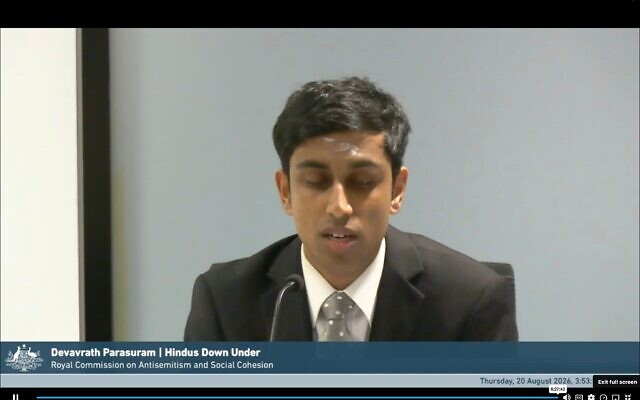
Devavrath Parasuram, a co-founder of Hindus Down Under, said the racism he encountered growing up in Sydney had been of a different kind.

“It was more just a misunderstanding of culture rather than something targeted,” he said. What was unprecedented in the past year, he said, was strangers approaching him unprompted to tell him they hated him for what he is.

“To have people who feel emboldened enough to go up to someone unprompted and tell them how much they hate them, that is something that is quite shocking and saddening to see in our society,” he said.

Australia needed to examine how it conducts respectful conversation, including at a political level, he said.

Hindus Down Under was founded in January this year with a focus on youth identity, social cohesion and public perceptions of Hinduism. Parasuram told the commission the Hindu community is plural and cannot be defined in any single way.

“The beauty of the Hindu faith is that there is no one definitive path,” he said.

Parasuram told the commission that in the wake of the Bondi attack, Hindus Down Under took part in a consultation with the Australian Cohesion Forum and a group of Hindu community leaders. The consultation mapped what rising antisemitism and Hinduphobia have in common, and what the two communities could do about it together.

“We can have one problem, we can have one solution ourselves, but national unity requires all of us to be working actively together for that outcome,” he said.

The consultation produced a hate-reporting tool for the Hindu community, due to launch within weeks. Parasuram said its value was in the numbers.

“Quantitative data is what ultimately drives policy decisions,” he said. The community already holds a good deal of qualitative evidence of racial abuse, he said, but it is scattered and cannot easily be traced.

“I do appreciate that governments receive hundreds and hundreds of reports,” he said. A tracker that compiles the material in one place would give government something it can digest and respond to appropriately, he said.

Asked what practical support grassroots organisations need, Parasuram pointed to introductions. His group had wanted to do something and had not known where to start, he said, and the Australian Cohesion Forum connected it with Indigenous, Jewish and Yazidi communities.

In his witness statement, Parasuram says that while one-off events can be valuable, lasting social cohesion requires relationships that survive beyond a photograph or a social media post.

On policy, he argued for accelerating what already exists rather than designing something new.

“It’s very practical that the government takes a bottom-up approach rather than just a simple top-down approach,” he said. “An organic growth of social cohesion and national unity will do far better long term than a short-term reactive approach.”

Hindu youth leader shocked by Jewish students’ fear on campus

The fear Jewish students carry about walking into class was among the most shocking things a Hindu youth leader encountered in a year of work between communities, the Royal Commission on Antisemitism and Social Cohesion has been told.

One student described being spat on by a stranger on the way to class.

Devavrath Parasuram, a Sydney-born economics graduate now studying law, described a panel run by the Australian Cohesion Forum in April at which he spoke alongside Yazidi and Jewish youth representatives.

He said his own experience of university had been a welcoming one, which made what he heard from Jewish students harder to hear.

Devavrath Parasuram representing Hindus Down Under. Photo: Screenshot

“What really struck me was, especially for Jewish students, the difficulties they have, the lack of confidence to even go to class without having to feel like they were in danger,” he said.

“You would think that in the multicultural society that we’ve built up over centuries, we would be above this. We might all be students, but some are treated different to others due to an unfortunate climate.”

Parasuram told the commission there had long been a close relationship between the Hindu and Jewish communities in Australia. It rested on a shared migrant experience and a shared history of adversity, he said, and needed to continue.

He co-founded Hindus Down Under in January this year and has previously held a leadership role with Hindu Youth Australia.

He described a Chanukah-Diwali dinner held last year with a Jewish youth group, where the two shared the meaning of their respective festivals.

“Two different festivals, but we were able to both share the meaning over dinner and gain an understanding of each other,” he said.

He said the benefit became clear later. Someone from the Jewish community who encounters a Diwali event later this year will have a personal connection to it, and something to weigh against whatever they see online.

Last week the two groups met again, this time at the Art Gallery of New South Wales for a guided tour of Avatar: Forms of Vishnu, the exhibition of South and South-East Asian art that runs until 5 October. Parasuram said they discussed the 10 forms in which the god Vishnu descends and what each has meant across history.

He said the alternative to that kind of contact is a digital space in which stereotypes go unchallenged.

“You wouldn’t insult someone to an extent if you actually had met them and had that empathetic connection,” he said.

Asked about his statement that no Australian community under threat should be regarded as someone else’s problem, Parasuram said the logic was straightforward.

“If we’re not united as one community, and we just let one community cop it, it’s just going to go to the next community, and then the next community,” he said. “Then we’ll have to wait for an atrocity to happen for some meaningful change.”

He closed his evidence by reading the opening paragraph of his witness statement.

“The beauty of democracy lies not in our ability to agree, but in our willingness to share a common future with people whose convictions may be different from our own,” he said.

The measure of success would not be whether disagreement had been eliminated, he said, but whether Australians could look across every culture and religion and still recognise something fundamental.

“Your place here is bound to mine, and neither of us is truly secure unless both of us belong.”

Hindu hate-crime reporting app to launch from cross-community project

A reporting tool designed to change how hate crimes against Hindu Australians are recorded will launch within weeks, the Royal Commission on Antisemitism and Social Cohesion has been told.

Roz Mendelle, managing director of the Australian Cohesion Forum, said too much of the existing multicultural sector stops at the event.

“There’s a lot of very structured dialogue events and multicultural programs out there, but I always ask myself, well, what happens after that?” she said. “After the event ends and we all go home, or we’ve asked someone to stand with us, and they’re an ally now, and what’s next? How can we build each other’s capacity, share skills, knowledge? That’s the true point of multiculturalism.”

Simonne Whine, co-director of the organisation, said the reporting app had emerged from its first Cohesion Lab, a consultation run with Hindu community leadership, and would be delivered with established Hindu organisations.

It would transform how hate crimes and intolerance directed at the Hindu community are recorded, both formally and within the community itself, she said.

Whine told the commission the Cohesion Lab framework begins with a survey. The organisation puts specific questions to a community group, then asks it to rank the issues that matter most. It works on solutions from there, either by making a connection to others who can help or by building something itself.

She said the organisation had deliberately avoided the model used elsewhere in the sector. It does not dictate to partner communities or tell them what should be worked on, she said. Instead it establishes what the challenges are for a community and then works on projects together with it.

Whine said many organisations work on an ally model, while the Australian Cohesion Forum works to a partnership model.

Mendelle said the group had found that existing multicultural programs were often prescriptive and top down, with an organisation arriving with a fixed model and expecting community groups to adopt it.

The Hindu consultation involved 26 community leaders, with a further 50 to 60 community members attending a session in Melbourne, Mendelle said.

A second Cohesion Lab is under way with the organisation’s First Nations partner, the Building Strong Families Foundation, and is taking a different shape. Mendelle said the group is holding a series of meetings on different topics, recording the needs identified, and helping build capacity through practical tools such as community calendars.

Whine said demand had been strong since the organisation was set up in the past year, and that it works with a range of partners including First Nations, Hindu and Iranian groups.

Mendelle said the model can hold together across real differences.

“Even if there are differences and even if there is conflict, as long as none of us endorse violence against another community and we don’t wish the elimination of another community, we can work together,” she said.

Whine said the work gave her hope.

“I’m an Aussie, born and raised here, and I love this country,” she said.

“What’s happened and what we’ve seen unleashed since October 7 is something that I don’t think anyone would have ever imagined. But I think when we work with other communities, we stand by each other. That’s the only way to build social cohesion.”

Jewish-founded group records survivors’ stories from across Australia

A national not-for-profit founded by two Jewish women is recording the testimony of survivors from communities across Australia, and intends to turn the collection into a public educational resource.

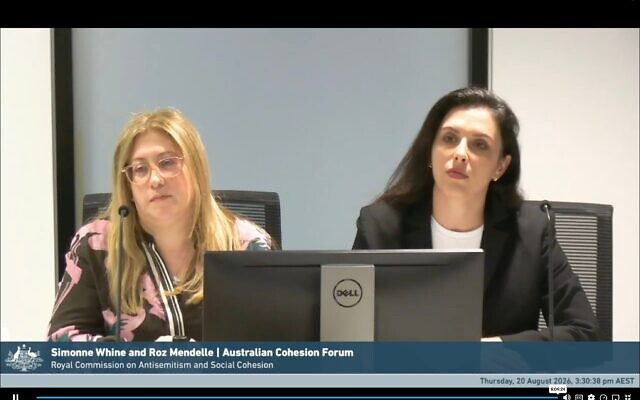
Simonne Whine and Roz Mendelle, co-directors of the Australian Cohesion Forum, told the Royal Commission on Antisemitism and Social Cohesion about the project, which they call the Living Archive.

The Australian Cohesion Forum is a volunteer-run not-for-profit set up in the past year to build intercultural partnerships. Its board is made up of five women, among them a Yazidi woman, a Hindu woman and an Iranian woman.

Whine founded the grassroots group J United to support the Jewish community after October 7. Mendelle grew up in Israel, moved to Australia eight years ago and works in communications.

Mendelle, the organisation’s managing director, said collection of testimony began in November 2025, before the Bondi attack. Within a month, more than 100 written testimonies had been submitted from a range of communities.

Simonne Whine and Roz Mendelle from The Australian Cohesion Forum. Photo: Screenshot

The organisation has since moved to professional filming and recently recorded a Cambodian survivor and a Rwandan survivor, both based in Sydney.

“Once we started working with communities, we realised that many of them carry stories, stories of survival, of resilience,” Mendelle said.

She said those stories included South Sudanese survivors who walked across the desert, Taiwanese Australians, and Iranian dissidents who escaped the Islamic Revolutionary Guard Corps.

Whine, who is the organisation’s program delivery lead and Jewish community liaison, told the commission the value lay in elevating voices seldom heard in Australia.

“When you hear people’s stories, people have empathy,” she said. “You can’t not have empathy when you hear a real-life lived experience story.”

She said she had seen it work before, as a member of the steering committee for Ruptured, the anthology of 36 Australian Jewish women writing about life after October 7, edited by Lee Kofman and Tamar Paluch.

Readers within the Jewish community had thanked the contributors, Whine said. They told her they felt seen and heard. Readers from other communities told her they had not understood what was happening until they read the essays, and some said the book had changed their minds.

“We know that when we hear people’s stories, it cuts through,” she said. “But we also know that if we tell these stories, it can showcase where things will head if we don’t act.”

Whine’s witness statement states that communities that have lived through persecution, displacement and conflict carry knowledge no institution can replicate, and have witnessed the full arc of how social cohesion unravels.

Mendelle said common themes emerge once enough testimony is gathered, and that survivor communities recognise danger early.

“We can see the warning signs well before the crisis happens,” she said. “In Australia, the crisis perhaps has happened, but it can get much worse.”

She said Iranian dissidents had been warning about the extremism of the IRGC, and the organisation had helped them raise awareness, well before a synagogue was firebombed.

A Rwandan genocide survivor describing what led to the genocide pointed to the same lesson. Radicalisation and extremism cannot be ignored, she said.

‘You like music, I like music’: cohesion programs dodging the hard conversation

Australian social cohesion programs are steering around the subject that actually divides communities, the Royal Commission on Antisemitism and Social Cohesion has been told.

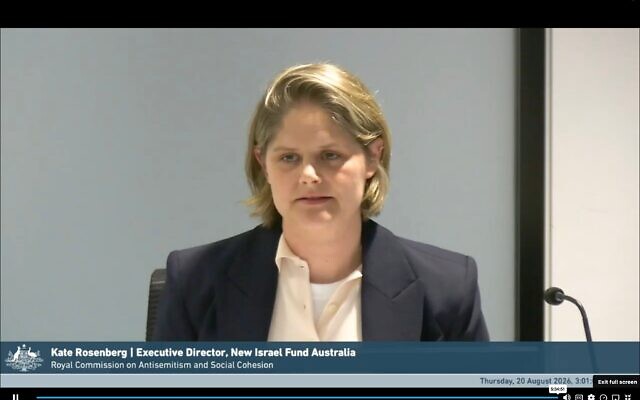
Kate Rosenberg, executive director of the New Israel Fund Australia, gave evidence that work intended to bring communities together too often settles for the safest available common ground.

“In trying to solve the problems that we are facing here in society, it can be easy to avoid the discussion of Israel and Palestine, and to focus on the other things that might bring us together across groups,” she said.

“Oh, you like music. I like music. Oh, you also make this kind of bread in your tradition.”

The alternative, Rosenberg said, was to run at the difficult conversations about what Israel and Palestine are, what Zionism means to people or does not mean to them, and what connection to Israel means to some Jews and not others.

“We must not shy away from the difficult conversations,” she said.

Rosenberg pointed the commission to the British schools program Solutions Not Sides, which brings a Jewish Israeli and a Palestinian speaker into classrooms together and moves from the history of the conflict into civic responsibility, media literacy and critical thinking.

The program “stares the beast right in the face and then extrapolates it out further to achieve the aim of social cohesion”, she said, and works to reduce both antisemitism and anti-Palestinian racism.

She nominated two further models. Givat Haviva, the Center for a Shared Society, runs Arabic instruction for Jewish Israelis and Hebrew instruction for Palestinian citizens of Israel.

It also operates an international school teaching in Hebrew, Arabic and English, and trains teachers to work across social divides. Its expertise was something the Australian community “could very well use”, Rosenberg said.

The third, the campaigning group Have You Seen the Horizon Lately, works through billboards and media to normalise the participation of Palestinian citizens of Israel in Israeli public life.

Rosenberg said she had listened to days of evidence about educational initiatives Australians hope to establish, and recognised them.

“These organisations, these programs actually already exist in the hottest kind of climate in the world over in Israel and Palestine,” she said.

The New Israel Fund Australia has for years run what it calls dual narrative tours, bringing out a Palestinian and a Jewish Israeli who work together.

Recent visitors included Dr Gil Murciano, head of the Israeli foreign policy institute Mitvim, and Hiba Qasas of Principles for Peace. Qasas convenes a group of more than 550 Israelis and Palestinians discussing the prospects for peace in the absence of a political process. The pair met parliamentarians and ministers and took part in media interviews.

Before October 7, Rosenberg said, audiences found the tours informative. Since then, supporters have told the organisation how much they need them.

“Not many Australians may have met a Jewish person or an Israeli, even fewer, and not many Australians would have ever met a Palestinian,” she said. Putting them on a stage together, she said, humanises them.

Rosenberg said the organisation’s audiences had so far been mostly Jewish, and drawn largely from the progressive community. The organisation hoped to reach non-Jewish groups.

Intercultural engagement had to sit alongside interfaith work, she said, because many Jews do not see themselves through the lens of religion.

She told the commission it was the federal government’s “responsibility and duty to encourage this kind of work, and to provide funding and support in order to make that happen”.

Fighting antisemitism alone will not make Jews safer

Australia will not make its Jewish community safer by tackling antisemitism in isolation, the Royal Commission on Antisemitism and Social Cohesion has been told.

Kate Rosenberg, executive director of the New Israel Fund Australia, gave evidence in Sydney that a response directed at the Jewish community alone would fall short, and that antisemitism had to be confronted as part of a systemic response to racism.

Rosenberg said she understood why, in a moment of communal grief, Australian Jews wanted a royal commission report “which has antisemitism written on every line”.

New Israel Fund Australia Executive Director, Kate Rosenberg. Photo: Screenshot

“That is necessary as well,” she said. “But unless we deal with racism in Australia in a holistic manner that tackles it systemically, the Jews won’t be any safer either.”

She was asked about her evidence that responses to antisemitism are most effective when carried out holistically. The commission had heard argument about whether antisemitism is a unique form of racism or one racism among many, she said, and the choice was a false one.

“Both can be true,” Rosenberg said, adding that she understood the Race Discrimination Commissioner to have made a similar point in evidence earlier that day.

Antisemitism had “its own unique identifying factors and therefore its own unique requirements in tackling it, but it cannot be tackled unless all of racism is tackled”, she said.

Asked whether the New Israel Fund supported the national anti-racism framework, Rosenberg said it did, while continuing to press for antisemitism-specific measures within it.

She said the organisation had taken its lead from the Israeli civil society groups it funds.

“These are people who are holding both the grief and pain of Jewish Israelis, while also saying we can also hold the grief and pain of Palestinians,” she said. “In fact, we must hold both of them for both of us to be safe.”

The New Israel Fund was established in the United States in 1979 by American Jews who believed Israel could not become a state of equal citizens without a strong civil society. Its Australian affiliate was established in 2011.

Rosenberg told the commission that the core of the organisation’s work is funding civil society groups in Israel and Palestine, among them the Association for Civil Rights in Israel, Adalah, which represents Palestinian citizens of Israel in legal proceedings, and Hand in Hand, a network of Hebrew and Arabic bilingual schools.

Rosenberg was raised in the Melbourne Jewish community and studied Holocaust and genocide education at the University of Melbourne.

She lived in Israel for 10 years, working at ANU Museum of the Jewish People in Tel Aviv and later alongside Palestinians and African asylum seekers from Eritrea and South Sudan. She worked for the Australian office of Human Rights Watch on her return, served on the New Israel Fund Australia board, and became executive director in June 2025.

The grandchild of Holocaust survivors, she said she had come to human rights work through a Jewish understanding of the Holocaust.

“When we say never again, we not only mean never again to our own people, but we mean never again to any peoples,” she said.

The organisation’s submission states that most of its supporters identify as progressive Australian Jews, that many describe themselves as Zionists while others do not, and that it holds Jewish self-determination in Israel to be compatible with and dependent upon democratic governance, equality before the law and the protection of the rights of all people living there, including Palestinians.

Commissioner Virginia Bell asked whether supporters who identify as Zionists would be people who “believe in the right of Israel to exist in part of its ancestral homelands as a homeland for Jewish people”.

Rosenberg agreed, then said the label mattered less than the principle behind it.

What was most important to supporters, she said, was that “all people living between the Mediterranean Sea and the Jordan River have equal rights”.

Bell asks witness whether Israel is a legitimate state

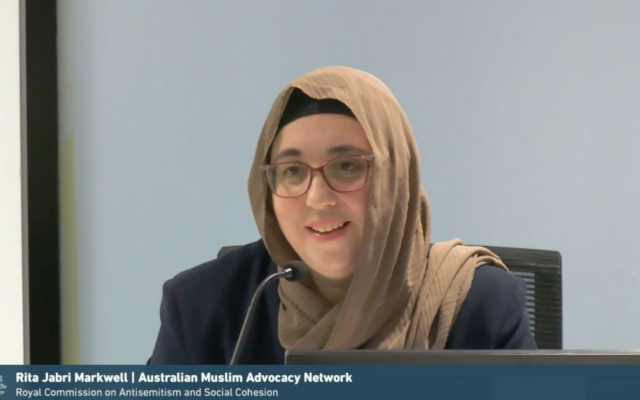
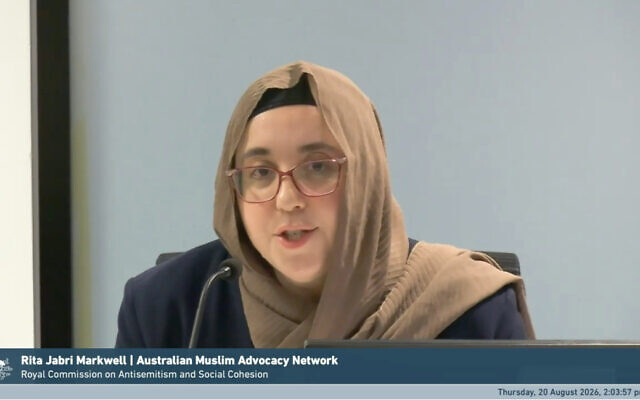
Commissioner Virginia Bell on Thursday afternoon asked Australian Muslim Advocacy Network (MANA) legal adviser Rita Jabri Markwell whether she accepts the legitimacy of the State of Israel. Markwell’s response was that no state relying on unlawful occupation, apartheid and genocide could be legitimate.

Bell put the question to Markwell after noting she had earlier described Zionism as an ideology going back a couple of hundred years and had referenced ideas of Greater Israel. Setting Zionism aside, Bell asked her to accept that following the 1947 United Nations resolution for the partition of Israel and Palestine, the State of Israel was declared by Prime Minister David Ben-Gurion, and that the General Assembly subsequently passed a resolution recognising it.

“Do you accept that there is a legitimacy to the existence of the State of Israel? I’m not speaking of the occupied Palestinian territories, just the State of Israel, at the time of that United Nations declaration,” Bell asked.

“I don’t think I have a view, particularly on the time of that declaration,” Markwell said. “But I know that if you were to ask me now whether I think the state has legitimacy, I, as a human rights lawyer, I don’t think that any state that relies on unlawful occupation and apartheid and genocide could be said to be a legitimate state.”

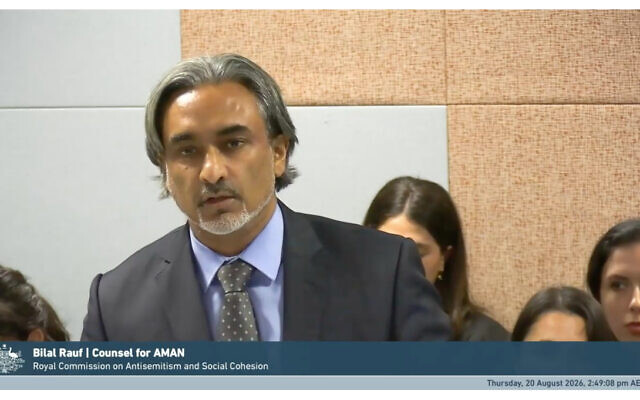
Re-examined by Bilal Rauf for AMAN, Markwell said the framework that AMAN proposes institutions adopt for handling complaints about dehumanising speech, should not be characterised as a permission to dehumanise anyone, because it contained explicit safeguards for human rights advocacy and speech directed at states and political ideologies.

Bilal Rauf, appearing for the Australian Muslim Advocacy Network (AMAN).

“It’s not saying everyone run out there and call your next door neighbour that has a different political view to you a cancer and a cockroach,” she said.

Asked about the research underpinning her view of Zionism, Markwell said she had co-authored a paper for the Global Internet Forum to Counter Terrorism with University of Queensland researchers on distinguishing strong political opinions from violent extremism. Dehumanisation, she said, was a key factor present before violence in cases ranging from ISIS to white supremacist terrorism.

She said AMAN had harvested hate speech over several years and observed a shift from white nationalist and anti-Islam discourse into what she described as Zionist and Hindutva-driven discourse, with repeated dehumanisation of at least three out-groups. That did not mean every person identifying as a Zionist was a violent extremist, she said, but that the ideology itself could be characterised that way.

Counsel assisting Richard Lancaster SC asked in re-examination why the framework needed to accept dehumanising language rather than merely harsh criticism.

Markwell said victims of political violence were likely to express themselves with emotion, and that she imagined victims of the Bondi massacre would wish to express absolute disgust at ISIS ideology and anyone supporting it. “I think it would be entirely within their rights to express that disgust,” she said, adding that Australians who had been victims of what she called Zionist political violence needed to be able to express their fury.

Witness says all Zionism is violent extremism

Australian Muslim Advocacy Network legal adviser Rita Jabri Markwell has told the Royal Commission on Antisemitism and Social Cohesion she regards Zionism as a form of violent extremism, and that a Jewish person who supports a two-state solution and equal rights for Palestinians could be dehumanised under a framework she helped draft.

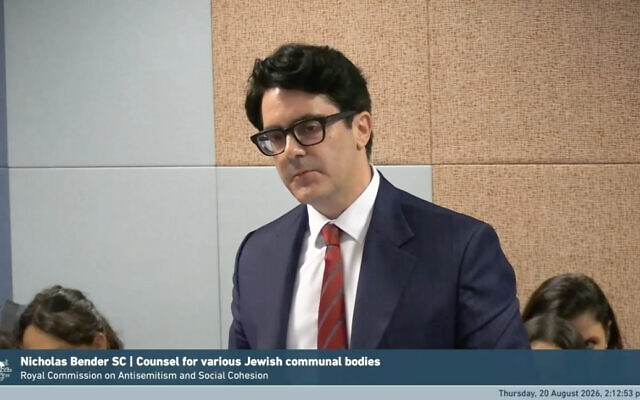
Nicholas Bender SC, appearing for seven peak Jewish communal bodies, took Markwell to a post she published on Substack on May 17, and she agreed it reflected her view that Zionism is a form of violent extremism. He put to her that the post identified no particular aspect of Zionism — not a faction of ultra-nationalist Israelis, nor the settler militias sanctioned by the Israeli government — and that she held the view in respect of all of Zionism. She agreed.

She said the basis was research she had published with three University of Queensland researchers, and that dehumanisation, “a form of psychological violence”, ran through Zionism and was a defining attribute of violent extremist movements.

Nicholas Bender SC, appearing for seven peak Jewish communal bodies.

Bender then turned to an article in The Jewish Independent headlined “I was kicked out of my sharehouse for being a Zionist”, by Mia Klein. Markwell said she recalled reading it, but was unaware Klein had appeared as a lived experience witness in the commission’s first hearing block in May.

The article reproduced a letter Klein sent her former housemates, in which she described herself as a proud supporter of the existence of the Jewish state and the Jewish people’s right to self-determination, while also being a harsh critic of Benjamin Netanyahu, his government and the actions of the IDF. She wrote that she wholeheartedly supported a two-state solution, wanted the war to end and the hostages returned.

Beneath the article, Markwell had posted a comment asking how Zionism is not predicated on ethnic cleansing and the erasure of Palestinians. Markwell told the commission she had been moved by Klein’s piece and shared the values it expressed, but found it difficult to reconcile them with Zionism. “I haven’t yet heard a Zionist explain to me how do they incorporate Palestinian human dignity and human rights into their ideological framework,” she said.

Asked whether she was aware many Jewish people support a two-state solution and equal rights for Palestinians and also identify as Zionists, Markwell said she understood that was how they may identify, “but it’s not necessarily relevant to my analysis of Zionism as someone who studies dehumanisation”.

Asked whether such a person could be dehumanised within Australian institutions under her framework, she said: “Zionism could be spoken about with disgust and fury. Yes, under that framework, it could be.”

Bender put a hypothetical situation to Markwell of Klein “returning to university the day after she’d been kicked out of her share house” to a statement circulating on social media and WhatsApp groups that there are Zionists in classes, that every one of them celebrates genocide, has blood on their hands, and to “make these animals feel subhuman”.

Markwell said she would need to investigate the context, and that if it were clear a Jewish class was meant, that would be a problem. She said the language was very dehumanising towards Zionists, but on its face she did not think it would breach the framework.

“But my point is, where are we going if we start banning dehumanisation directed at political beliefs and adherents of political movements because they are popular political beliefs,” she said.

Bender noted evidence before the commission that 77 per cent of Jewish Australians identify as Zionist, and evidence given on May 13 by Community Security Trust (UK) director of policy Dave Rich that a person can be completely opposed to everything the Israeli government does and be just as much a Zionist. Markwell said she was unaware of Rich’s evidence, but accepted that could be a position people hold.

Bender put it to her that the framework would, by design, continue the tradition of authorising the dehumanisation of Jewish people through a political lens — capitalist, communist, Bolshevik, ruthless cosmopolitan, and now Zionist.

Markwell disagreed, saying Nazi propaganda she had studied as a history teacher and a scholar explicitly identified Jewish people, and that there was no countervailing human rights concern in that context. Here, she said, Palestinians and Lebanese needed to be able to speak about genocide, apartheid and unlawful occupation, and Jewish people who oppose Zionism needed space not to be portrayed as “race traitors”.

Framework would permit Zionists to be dehumanised, commission hears

A framework the Australian Muslim Advocacy Network (AMAN) wants adopted by Australian institutions would permit Zionists to be dehumanised, the Royal Commission on Antisemitism and Social Cohesion has heard.

AMAN legal adviser Rita Jabri Markwell, one of the framework’s principal drafters, was cross-examined by Nicholas Bender SC, appearing for seven peak Jewish communal bodies. Markwell agreed that one of the dangers of dehumanising speech is that it invites an audience to think of and ultimately treat its subject as less than human.

She agreed the AMAN framework does two things: it prohibits dehumanisation on the basis of protected characteristics, and it expressly permits dehumanisation of political ideologies and their adherents at an institutional level. She qualified the word prohibit, noting the framework was a policy rather than a law.

Australian Muslim Advocacy Network (AMAN) legal adviser Rita Jabri Markwell.

“It allows dehumanising speech and conduct towards people based on their political beliefs as well as towards political beliefs and ideologies,” she said.

Bender asked whether she was aware it had been a deliberate strategy of both Nazi and Soviet institutions to dehumanise their enemies, including Jews, and that such propaganda was sometimes framed through a political lens — Jews as capitalists, as communists, as ruthless cosmopolitans, as godless intellectuals.

Markwell said she was, but that “the framing was very much still attached to the Jewish identity, which I think is important in this”.

Asked three times whether it was important to exercise extreme care before permitting institutional dehumanisation of people, Markwell said care was required in relation to protected characteristics, and that in relation to political belief “enough protection should be afforded to people who need to criticise political ideologies as well”.

Bender then tested the framework with hypotheticals. The first involved an academic saying, on the day of a campus vigil mourning Palestinian deaths, that Palestinian statehood activists were terrorist sympathisers raised on hatred and “a cancer in this country”. Markwell said she would need to know the context, including whether the remark was directed at mourners or merely made online the same day, and declined to say whether it would breach the framework.

The second involved a social media post about First Nations treaty advocates reading: “That lot begging for a treaty are parasites on the taxpayer, worthless grifters who should play no part in public life.” On the information given, Markwell said, she did not think it would breach the framework, because it was directed at people making a political argument.

Asked whether permitting such speech was antithetical to social cohesion where political belief overlapped with racial or religious identity, she said context was important, and that social cohesion was also served by institutions having clear principles they could apply across complicated contexts.

The AJN is providing rolling coverage on the Royal Commission on Antisemitism and Social Cohesion.

For full coverage of the Hearing Blocks, visit the Royal Commission section of The AJN website.

read more:
comments
Live Now

‘You like music, I like music’: cohesion programs dodging the hard conversation

Australian social cohesion programs are steering around the subject that actually divides communities, the Royal Commission on Antisemitism and Social Cohesion has been told.

Kate Rosenberg, executive director of the New Israel Fund Australia, gave evidence that work intended to bring communities together too often settles for the safest available common ground.

“In trying to solve the problems that we are facing here in society, it can be easy to avoid the discussion of Israel and Palestine, and to focus on the other things that might bring us together across groups,” she said.

“Oh, you like music. I like music. Oh, you also make this kind of bread in your tradition.”

The alternative, Rosenberg said, was to run at the difficult conversations about what Israel and Palestine are, what Zionism means to people or does not mean to them, and what connection to Israel means to some Jews and not others.

“We must not shy away from the difficult conversations,” she said.

Rosenberg pointed the commission to the British schools program Solutions Not Sides, which brings a Jewish Israeli and a Palestinian speaker into classrooms together and moves from the history of the conflict into civic responsibility, media literacy and critical thinking.

The program “stares the beast right in the face and then extrapolates it out further to achieve the aim of social cohesion”, she said, and works to reduce both antisemitism and anti-Palestinian racism.

She nominated two further models. Givat Haviva, the Center for a Shared Society, runs Arabic instruction for Jewish Israelis and Hebrew instruction for Palestinian citizens of Israel.

It also operates an international school teaching in Hebrew, Arabic and English, and trains teachers to work across social divides. Its expertise was something the Australian community “could very well use”, Rosenberg said.

The third, the campaigning group Have You Seen the Horizon Lately, works through billboards and media to normalise the participation of Palestinian citizens of Israel in Israeli public life.

Rosenberg said she had listened to days of evidence about educational initiatives Australians hope to establish, and recognised them.

“These organisations, these programs actually already exist in the hottest kind of climate in the world over in Israel and Palestine,” she said.

The New Israel Fund Australia has for years run what it calls dual narrative tours, bringing out a Palestinian and a Jewish Israeli who work together.

Recent visitors included Dr Gil Murciano, head of the Israeli foreign policy institute Mitvim, and Hiba Qasas of Principles for Peace. Qasas convenes a group of more than 550 Israelis and Palestinians discussing the prospects for peace in the absence of a political process. The pair met parliamentarians and ministers and took part in media interviews.

Before October 7, Rosenberg said, audiences found the tours informative. Since then, supporters have told the organisation how much they need them.

“Not many Australians may have met a Jewish person or an Israeli, even fewer, and not many Australians would have ever met a Palestinian,” she said. Putting them on a stage together, she said, humanises them.

Rosenberg said the organisation’s audiences had so far been mostly Jewish, and drawn largely from the progressive community. The organisation hoped to reach non-Jewish groups.

Intercultural engagement had to sit alongside interfaith work, she said, because many Jews do not see themselves through the lens of religion.

She told the commission it was the federal government’s “responsibility and duty to encourage this kind of work, and to provide funding and support in order to make that happen”.

Enjoy Unlimited Access To The Australian Jewish News Website And All Our Online Content For AUD$18/month Or Just AUD$120/year.

Subscribe Now