Recording the past for the future
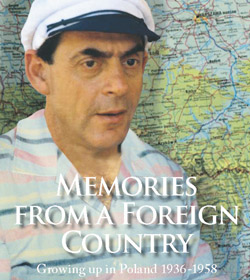
DANNY Kahan's childhood wartime memories are relived in his new book, published as part of Makor Jewish Community Library's Write Your Own Story program.
CHANTAL ABITBOL
THE year is 1942. Danny Kahan is a seven-year-old Jewish child being hidden by two Polish sisters in a cramped two-bedroom flat in Warsaw.
But if anyone ever asks, he goes by a different name: Bogdan Hamielec -— the name in his mother’s Kennkarte, her forged identification card.
As he would later recall, the card served as his mother’s passport, allowing her to travel to visit students for private language lessons and occasionally, at great risk, his hiding place.
Thankfully, she was never found out, and Kahan and his mother managed to survive those fearful years living in war-torn Poland to re-establish a life there years later.
Kahan says that one day he plans to donate the card to a Holocaust museum. But in the meantime, he’s taken to writing down his story as part of Melbourne’s Makor Jewish Community Library’s Write Your Own Story program.
“I’m cursed with a very good memory. A lot of the details are stuck in my memory,” says Kahan, now 72, and residing in Caufield, Melbourne.
“I remember perhaps too much of it, but I didn’t want it to die with me. I imagine future generations are the intended audience in some subconscious way.”
Titled Memories From A Foreign Country, the book chronicles Kahan’s time living out the horrors of the Nazi occupation; the loss of his father, who never returned home from forced labour; and the bloodshed of the Warsaw Uprising.
It also records life in Poland after the war where he and his mother chose to remain, and where Kahan went on to complete a degree in English literature at Warsaw University before later emigrating to Australia.
Kahan dedicated the book to his parents — his mother, whom he fondly calls his “shining beacon”, and his father, a man, he admits, he hardly knew.
As Kahan notes, all that remains of his father’s life is a small headshot photo and a handful of letters. There’s also a note from the Jewish Historical Institute in Warsaw informing Kahan that there was no available information on his father’s fate.
“It’s sad, but it was a long time ago,” Kahan says frankly. “He was taken away to a concentration camp when I was four or five years old. I basically didn’t know this person. One lives with it.”
Leonie Fleiszig, director of Makor’s Write Your Own Stories program, believes it’s important for survivors to record their stories on many levels.
“It [enables] them to tell their stories to their families, and to explain to them why they are the way they are in many situations,” she says.
“It’s also important for the general public to know. As these survivors die, there is no firsthand account of what they went through. It’s the only way to answer the Holocaust deniers.”
Established in 1998, the program offers support for people to write their autobiographies through classes and editorial advice.
Over the years, the program has published 80 individual memoirs and six anthologies. Some of the writers are third-generation Australians, but the majority are migrants or children of migrants -— with about 70 per cent dedicated to recounting Holocaust stories, says Fleiszig.
“[At the beginning] we thought we’d do a few,” she recalls, “but it’s just getting stronger and stronger. More and more people are writing.”
Memories From A Foreign Country was launched by the Makor Jewish Community Library in Caufield South. Enquiries: (03) 9272 5611.