Return visit to Shanghai
ON a visit to Shanghai, Peter Kohn retraces his family's sojourn in a city that helped them to escape and survive the Shoah.
PETER KOHN
SHANGHAI is the megalopolis of Asia, a city of some 17 million, brashly western and quintessentially Chinese at the same time. Its explosion as a hub of 21st-century global industry and commerce marks China’s spectacular comeback after the Cultural Revolution and decades of Marxist orthodoxy. China today is an economic superpower and Shanghai drives the turbines.
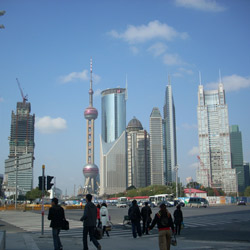
As the liner Giulio Cesare and its Viennese refugees -— my newlywed mother and father among them —- sailed from the Yangtze delta down the Huangpu River past the stately concourse of The Bund in September 1939, they would not have seen the modern glass and concrete towers of Pudong to the south, still decades away from being built.
Whatever odours may have risen from the river, my parents would not have tasted today’s air, thick with carbon monoxide and industrial waste.
All they knew about their exotic destination was that, as a British outpost wrested from China during the opium wars, Shanghai required no visa to enter. After the 1938 Evian Conference, when the world abandoned European Jewry, and visas were rarer than rubies, for those without, the city was just about the only place to flee the Nazis.
On my first visit to Shanghai, a business trip, I am able to retrace the refugees’ journey from the Huangpu docks. Crammed in the tray of a truck, they were driven north-east to the working-class neighbourhood of Hongkou (formerly Hongkew), where some 20,000 Jews, including my mother, father and three grandparents, endured poverty and disease, Japanese internment and an American air raid, while Europe crumbled and burned.
My grandfather died from drinking unboiled Shanghai water, a memory that stings as I inadvertently gulp down a glass of tap water in my hotel bathroom, a force of habit, before catching the toxic taste.
In 1947, my parents and two grandmothers departed China for greener pastures. Their years in Shanghai have fascinated me since childhood, when I first caught an inkling of what it meant to be a “Shanghailander” in Melbourne.
My parents are part of a close-knit group of friends who, in diminishing numbers, still meet every second Tuesday evening, as they have done since their arrival in Australia six decades ago. Shanghai is now a footnote, as these are old friends with tales of grandchildren to relate over sandwiches and tea.
“So many sandwiches, what’s the reason?” I recall asking my mother as a 10-year-old, unlatching a treasure chest of family memories that eventually swelled to become the subject of two novels I wrote about their Shanghai sojourn.
As we stand on the Waibaidu (formerly Garden) Bridge over Suzhou (Soochow) Creek that links The Bund to Hongkou, our tour guide explains that Jewish refugees sheltered in Hongkou. “My family was among them,” I pipe up, and find it hard not to take over the guide’s commentary, as we view the art-deco buildings of The Bund, the Peace Hotel (once the Cathay Mansions), the Customs House, the Hong Kong Shanghai Bank, the Embankment Building and the Astor House.
Many of these landmarks were built by Sephardi Jews from Iraq, like Victor Sassoon and Horace Kadoorie, entrepreneurs who established the welfare infrastructure that enabled German and Austrian refugees of the 1930s to settle in Shanghai without burdening the ­precarious Shanghai municipality.
The Ohel Moshe Synagogue, where my mother remembers bread rolls being handed out at the end of Yom Kippur, became the Shanghai Jewish Refugees Museum in 2007, and the former synagogue itself has been architecturally restored. A guided tour given by “Judy”, a young Chinese woman, includes refugees’ artefacts, a petroleum stove here, a radio there, paintings and Judaica. Judy is excited to be giving the tour to a son of refugees, and is eager to learn more about her field.
On a computer, she opens a database gleaned from a Japanese census. It lists my father and mother -— names, address, and occupation (hairdressing). While there is nothing, even their lane number, I did not already know -— apart from the fact that they lived in dwelling 41 -— it is weirdly fascinating to peer at this information some 60 years later.
On the streets, I am doing what many others have done -— tracing my family’s home in the lane houses. In the British days, Hongkou’s streets had English and Chinese names. The English ones have been changed to Chinese, and all have since been modified the switch to pinyin Chinese pronunciation.
So the little map my parents meticulously drew for me before I left needs interpretation, as I proceed east down Chang Yang (Ward) Road. Triumphantly, I find the old Ward Road jail and police station, exactly where they indicated. My excitement rises further when I arrive at Baoding Road, as they told me they lived between Baoding and Jhingzou roads.
But further east, I cannot locate 343 Ward Road Lane, and the cross alleys lined with double-storey red-brick tenements where they ate and slept and my father ran a barber business behind a curtain. In their latter years, these buildings probably looked like other derelict houses propped up by bamboo scaffolding.
The numbers leap over 343, and from the street sign it appears the lane is in a block that has been bulldozed for the 2010 World Expo in Shanghai, like many slabs of Shanghai real estate. Reluctantly, I cede the search for my family’s dwelling to the ravages of progress.
The hoardings all over town proclaim the landmark expo in goofy Chinglish platitudes, like “Forward, with civility and brilliancy”. The expo will transform Shanghai the way the Olympics transformed Beijing, and the city will take another Great Leap Forward.
Blog
Chanukah in an historic Shanghai synagogue