Shabbat in Antarctica
THE first-known Shabbat service in Antarctica was held on the edge of the Ross Ice Shelf at the US research facility at McMurdo Station.
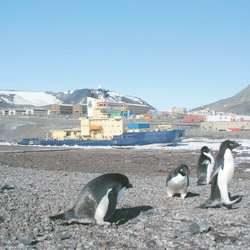
CHAZ FIRESTONE
IN a small chapel overlooking a frozen sea inlet, Dick Heyman leads a tiny congregation in a Shabbat-evening service. “Blessed are you, endless one, who makes the evenings fall,” he says, opening the Ma’ariv service with an English rendition of the prayer Asher Bidvaro.
“Oh, wait,” Heyman says, pausing. “We can’t say that here.”
Heyman is right. This January Shabbat service —- the first ever in Antarctica to the knowledge of anyone present -— is taking place in a dimly lit chapel. But it’s bright as day outside, and it has been that way for nearly six months.
Here, on the McMurdo Sound near the Antarctic coast, the last sunrise was in August, and the sun won’t dip below the horizon again until the end of February. Few things are black or white, but Antarctica is one of them. Save for a brief transition in March, the continent enjoys either 24-hour darkness or 24-hour light.
The stubborn sun presents some secular challenges to the scientists and staff here: sunglasses are a must, even at midnight. But the odd solar schedule may also have implications for Shabbat, the timing of which is determined by the coming and going of the sun and stars.
“Part of lighting Shabbat candles is to have light in the darkness,” Heyman explains to his congregants, “but we don’t have darkness until February”.
In this multipurpose chapel, a small hodgepodge of staff members — Jewish and non-Jewish, the committed and the idly curious, including two Christian chaplains — listen respectfully to Heyman. At McMurdo Station, a research outpost with the largest community in Antarctica — around 1100 summertime residents — he is effectively the chacham, or knowledgeable communal leader.
Heyman, a child of German Holocaust refugees, grew up a Reform Jew in the Forest Hills section of Queens in the US. In Antarctica, he works 50-hour weeks as a network engineer, connecting the remote base to the rest of the world. He has been in information technology for 25 years, but this is his first season on the ice. His four-month stint is the longest he has been away from his family of four in Fort Collins, Colorado. So, though he describes himself as “not especially religious” and recalls that he had his bar mitzvah in a Presbyterian church, Heyman decided to hold a Shabbat service to remind him of home.
With the help of rabbis from Congregation Har Shalom in Fort Collins, Heyman printed out prayer booklets, planned an oneg — an informal Friday night Shabbat service — and baked a challah for the occasion. The 64-year-old estimates that there are upward of 20 Jews on the base, but only eight congregants besides himself have shown up to enjoy the festivities, plus myself, a non-participating reporter. Only six participants are Jewish.
The others, including the two Christian chaplains, are among the curious. “I’m from the Judeo-Christian tradition,” says Reverend Philip Gibbs, a 62-year-old New Zealander. “So when something Jewish is going on, I want to see it.”
Even some of the Jews present admit to little in the way of Jewish background, leading Heyman to punctuate the service with frequent commentary and explanation as he moves along.
As it turns out, Heyman is not the first to ponder the problem of Shabbat in the face of a non-setting sun. In the 18th century, the Vilna Gaon suggested that ambiguous cases should follow the solar calendar of Jerusalem, a proposal accepted today as law.
But according to Rabbi Michael Paley, scholar-in-residence at the Jewish Resource Centre of UJA-Federation of New York, the law extends only to land masses contiguous with Israel, making Antarctica something of a halachic no-man’s-land.
When the situation is uncertain, Rabbi Paley explained, the precise timing of Shabbat could become a community decision. Fortunately, Rabbi Paley’s psak, or ruling, is consistent with Heyman’s intuitions.
“There’s never been a Jewish pope,” Heyman says, “so there can be some interpretation”.
The engineer-cum-chazan decides to follow a custom of referring to the sundown of the nearest community – in this case, the ironically named Christchurch, New Zealand. Christchurch is home to the nearest off-continent base of the United States Antarctic Program, and McMurdo Station — which is located at nearly the same longitude as New Zealand’s Milford Sound but much further south — runs on Christchurch time, allowing Ma’ariv to begin around dinnertime instead of 10 hours later, as it would on Jerusalem time.
But as soon as one problem is solved, another arises. Following the custom of facing towards Jerusalem to pray, Heyman instinctively instructs his congregation to turn east, as do Jews who live in the West.
“Grid east or true east?” Philip Fitzgerald asks.
The 33-year-old carpenter and Jew from Juneau, Alaska, has a point. At McMurdo, a few hundred miles from the geographic South Pole, cardinal directions are skewed. Almost everywhere one turns is geographically north. This has led navigators to develop an artificial “grid” system for designating directions in Antarctica.
For someone standing at or near the South Pole, “grid north” is defined as facing in the direction that aligns with the prime meridian — the longitudinal line that passes through the Royal Observatory in Greenwich, England. “Grid south” aligns with the International Date Line, running through the opposite side of the globe, in the Pacific Ocean.
“Grid east” passes through Bangladesh between India and the Gobi Desert, and bears no relation to Jerusalem. But neither does true east, which simply makes a short lap around the South Pole before looping back to McMurdo.
So where to face? Heyman and his congregation settle on true east, concluding that thinking of Jerusalem is what counts.
Rabbi Paley thinks they could have found Jerusalem on a map and simply faced that way. “But the world is round,” he said. “Eventually you’ll get there.”
For Heyman, the spirit of his Shabbat service trumps the details: during kiddush, accompanying the challah and wine are some tasty (if untimely) latkes, made from roasted potatoes he had been hoarding from the cafeteria.
For Kenneth Iserson, 60, the sight of the Shabbat candles brings him back to his Conservative Jewish upbringing outside Washington. Now professor emeritus at the University of Arizona, Prof Iserson came to Antarctica to serve as the lead physician on the research base.
“Those are the first candles I’ve seen lit at McMurdo,” he says.
Heyman adds that he doesn’t know if another Antarctic Shabbat service is on the horizon. But if he does hold the service again, he says he’ll take extra care to scour the base for more congregants.
“I’m happy with the turnout,” Heyman says. “But there have got to be more than six Jews in Antarctica.”
THE FORWARD