Women in uniform
NAOMI LEVIN
DESPITE its numerous achievements, it is not often that Israel is held up to the world as an example of a great progressive society.
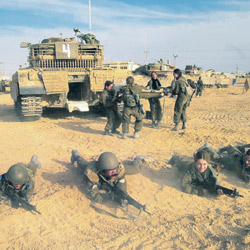
Last week though, Israel was recognised in local media reports as one of only a handful of countries that grants close-to-equal gender rights in its military forces.
In a wide-ranging speech in Parliament last week, the Minister for Defence Personnel, Material and Science Greg Combet introduced the idea of Australian women serving in a wider range of roles in the Australia Defence Force (ADF).
He explained that his department is working with the University of Wollongong to more effectively assess the level of physicality required for various military jobs.
“The development of these new standards will also help inform the government on the appropriateness of a possible expansion of the roles that women can play in the ADF,” Combet said.
“It is perfectly valid to argue that all categories should be open to women,” Combet said.
“The only exceptions should be where the physical demands cannot be met, regardless of gender, according to criteria that are determined on the basis of scientific analysis rather than cultural assumptions.”
These comments created quite a stir. Despite a majority of military positions already being open to women, the Opposition said it would not support full gender equality, largely for psychological reasons.
“When the enemy captures women, they treat them a little bit differently to what they do male prisoners,” Liberal MP Bob Baldwin told reporters last week.
But in Israel, women have always been a part of the modern state’s military history.
They served alongside men in the War of Independence, and since the declaration of the state, woman have been required to complete compulsory national service, albeit for a shorter time than men.
In 1951, Israel’s Defence Ministry chose to restrict women from serving in combat and other military roles. But a landmark court case in the mid-1990s ended many of those restrictions.
Alice Miller, a South African-born Israeli, took her case all the way to Israel’s Supreme Court in a bid to become a pilot in her country’s air force.
Miller, who had a civilian pilot’s licence and a degree in aeronautical engineering, was told she could not sit the test to qualify for the prestigious pilot training course.
“There is a myth of the Israeli woman soldier fighting at the front and doing exactly what men do,” Miller told The New York Times in 1994. “But if you take a deeper look, you see that most women in the army serve coffee to their commanders.”
Miller won her case when the court rejected the Israel Defence Forces’ (IDF) claim that women and men should be treated differently. The military policy was declared as gender discrimination. The court also rejected the argument that it is not prudent to train a woman who, because of pregnancy and childbirth, is not likely to serve as long as a man.
For the record though, Miller did not pass the pilot test and since that case, several other female recruits have been accepted into the pilot course, but none have successfully completed it to become a combat pilot.
According to Avi Waks, who served in the IDF Golani infantry brigade from 2005-2008, women are unlikely to have the physical capability necessary for a gruelling front-line role.
“It is not an easy thing to do for a man, let along a woman,” Waks, now a trainer with IDF Fitness in Melbourne, said. “But for me, if a woman can do it, then why not.”
Waks also said there would be a psychological barrier to men marching alongside women into battle.
He said male IDF soldiers are hesitant to join the Karakal battalion, a female-dominated infantry battalion. He observed that it is really a matter of the male ego.
“If you have a woman in your unit, it means a woman can do what you can do,” he said. “Guys don’t like to be in units with girls.”
Tal Dror, the outgoing Australasian Union of Jewish Students shaliach and a former platoon commander in Lavy — an infantry unit specialising in urban combat — said the IDF has the right balance in terms of where women can serve.
“Women have access to almost 90 per cent of the units in the IDF, with a 10 per cent exception of the ‘hard core’ combat units,” he said. “Usually the training for those units is physically and psychologically harder than the rest, and many issues need to be considered, for example, what happens if a female soldier is kidnapped by a terrorist organisation?”
Nevertheless, female troops and officers in the IDF command a huge amount of respect, he said.
“From what I know, women are treated equally within combined units — there are women officers, platoon sergeants and commanders that have responsibility for male soldiers,” he said. “The army is naturally a very masochistic environment, but I think if you have girls alongside you from the beginning, it is not weird to have a female commander or a female ¬≠soldier.”
On the flip side, many Israeli women do not want to serve in combat roles, but remain pleased that the option is available.
Limor Greenfield, who did her national service in 2001-2002 with children at risk, is one of those people.
“Personally, I don’t think women are less capable, if that is what they want,” she said.
Combet, in addressing the issue in Canberra, failed to give a timeframe to indicate when women may be considered for a wider range of military duties in Australia.
Suffice to say, whenever that is, there will be plenty of lessons to learn from Israel.