Youthful memories of wartime Shanghai
PETER KOHN
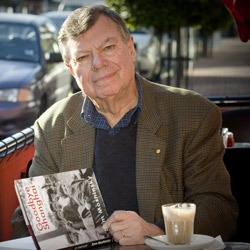
A GRANDFATHER’S gift to his grandchildren “to show them grandparents are not born old” was Sam Moshinsky’s motivation in writing about his childhood years in wartime Shanghai.
Since his book was published some weeks ago, that goal appears to have been achieved, he said, with granddaughter Danita, 13, telling him she found the portrait of her granddad as a boy growing up in China in the 1930s and 1940s, under Japanese occupation and a world war, a “fascinating” read.
Turning 75 some weeks ago seemed to Moshinsky the ideal time to launch his 219-page memoir Goodbye Shanghai, which traces his family’s journey from Russia to the haven that the open port of Shanghai provided.
“My point of difference was that, unlike the European refugees who fled the Nazis, my family had come in earlier times and had established their lives, so I had a far more normal childhood,” he told The AJN.
Moshinsky’s grandparents came from the Ukraine, and his maternal grandmother’s family moved to the United States after the 1903 Kishinev pogrom, while his paternal grandparents moved to Vladivostok under a Siberian settlement drive.
From Vladivostok, it was a relatively short journey to China, an odyssey that took his parents out of harm’s way after revolution and civil war gripped the Soviet Union in the 1920s.
The family grew prosperous by establishing a business manufacturing ice-cream packaging, and young Sam, who was born in 1934, grew up in the French Concession, a middle-class district of Shanghai.
“I had my own amah [domestic servant] who raised me, and we had cooks and servants.” He recalls a holiday to Moganshan, a tourist resort a few hours from Shanghai.
The Russian Jews in Shanghai had relatively little contact with the Sephardis who had arrived from Iraq and India some decades earlier, nor with the European Jews who arrived in the 1930s.
After the attack on Pearl Harbour, which also triggered the Japanese occupation of Shanghai, Moshinsky witnessed incidents of brutality by Japanese soldiers against the Chinese.
But for historical reasons, the Japanese occupiers treated Jews with a mixture of curiosity and respect, he said.
Moshinsky attended a French school but when it was taken over by supporters of the pro-Nazi Vichy regime, he was moved to a prim and proper British school, like the one attended by JG Ballard, characterised in Steven Spielberg’s film Empire of the Sun.
He later went to the Shanghai Jewish School, where he met the children of German and Austrian Jews — families that had been crowded by the Japanese into a ghetto in Hongkew, a slum district of Shanghai — a requirement from which Russian Jews were largely exempt.
An indelible memory for Moshinsky was hiding under his bed during an American air raid on ammunition stores near Shanghai in 1945, when some bombs missed their target and landed on the city.
“I’ll always remember the swarms of American B29 bombers, like black clouds, though the greatest destruction came from Japanese anti-aircraft fire which missed the planes and fell back to the ground.”
After sitting in the Jewish Club in November 1947 and listening to a broadcast of the United Nations partition vote that created Israel, he joined the joyous throngs outside. “We were a community of ardent Zionists and there was dancing in the streets.”
When European Jews left their Shanghai refuge to start new lives, mainly in North America and Australia, the Moshinskys, with their numerous friends and business interests, found departure difficult, and lingered after the 1949 communist takeover.
But when foreign interests began to be targeted, the discovery of a relative in Melbourne made immigration to Australia possible in 1951, when he was 17.
“As a young man growing up in Camberwell, I instantly liked Australia — the egalitarian society, the safety, being able to drink water straight from a tap, taking a train to Sydney without a permit, and Vegemite.”
Moshinsky studied accounting at the University of Melbourne, becoming a partner in a firm, then a management consultant. He knew Richard Pratt at university, and years later joined Pratt’s Visyboard business.
Now retired, he has been a professional director and a financial adviser. He met and married his wife Ada in 1962 and they have three sons and eight grandchildren.
He has chaired the boards of the United Israel Appeal, Temple Beth Israel, the Jewish Museum of Australia and The AJN. In 2000, he received an OAM recognising his contribution to the Jewish and general communities.
Goodbye Shanghai is published by Mind Film & Publishing, Melbourne, www.mindfp.com.au