



Live updatesPublic hearings
Firearms registry operated without dedicated intelligence analyst
Hearing block two continues today examining the circumstances surrounding the attack at Bondi on 14 December 2025.

Photo: screenshot
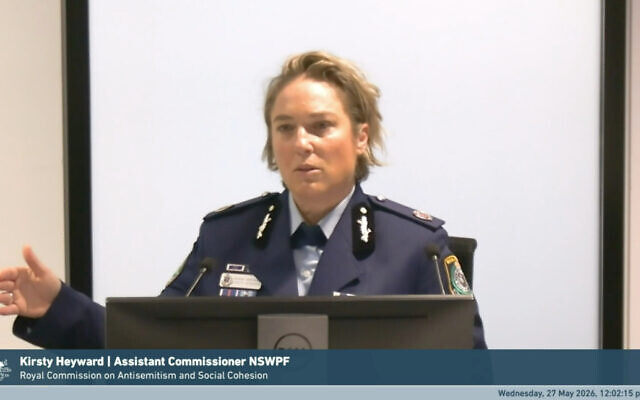
Counsel Assisting Richard Lancaster asked about intelligence analyst positions attached to the NSW firearms registry. Assistant Commissioner NSWPF Kirsty Heywood said going forward there would be an intelligence supervisor, and two analysts.
Lancaster noted a review of the registry in August 2021 led to the removal of an intelligence analyst position and that in 2022 a submission was made for the firearms registry staff to receive training and approval to make decisions based on criminal intelligence. “Before 2022, they weren’t authorised to do so, and intelligence matters needed to be referred to the State Intelligence Command,” Heywood said.
In her statement, Heywood noted an issue raised by the then manager of licensing services at the Firearms Registry, which identified numerous “practice capability gaps”, and in April 2023 there was a further issue raised by the then manager of licensing services at the Firearms Registry, which asserted that there were risks to public safety due to capability gaps at the registry as a result of there being no dedicated intelligence resource to support the functions of the command. This led to a proposal being approved to reinstate an intelligence position at the sergeant level in late 2023 in the registry.
Heywood identified a number of benefits of having an embedded intelligence capacity within the registry. She added, “In terms of decisions to revoke or refuse a license based on criminal intelligence or information, only the Commissioner of Police can make those decisions.”
“The Commissioner of Police cannot issue a PTA, which is a Permit To Acquire, to anyone who has been investigated for terrorism-related offenses or associates with someone who has been investigated or resides with, there will be additional work for the intelligence cell or unit because of that”, Heywood said.
She expressed another advantage was the Gun Safe initiative – which automates processes including licensing applications, and the the acquisition and transfer to interstate.
Discussing its progress she said, “They’re currently doing the last module, which is onboarding clubs, so then we’ll have… all clubs on board and onto Gun Safe… [which] provides the New South Wales Police Force… the registry with lots of data, lots of information about people, locations, permissions to shoot primary clubs… then we can actually start mining that with the intelligence role that we have”.
“I suppose the beauty of that first tranche of that module was that if the right forms were not uploaded… if the essential criteria weren’t provided… The application just didn’t proceed through,” Heywood said.
Asked, “Is there a process for obtaining a higher security clearance for adjudicators? Is that done on a case by case basis, or is there some procedure that’s in place for that?” Heywood replied, “It’s a patrol intelligence profile given to them, which, from my understanding, still gives them access up to and including protected, because it again, it still depends on who puts on the intelligence. If it’s a covert unit or if they classified as such, they still wouldn’t necessarily get access to that.”
Heywood identified problems with information from Commonwealth agencies: “If there is information on our system as being provided by a Commonwealth agency. Information might be there, but it might be caveated, and often it is caveated to say that you can’t use it in administrative decisions unless you have prior approval, so that in its sense creates an issue for us because we can see information but potentially not use them and it did create some issues.”
She agreed it was a matter for the adjudicator to follow up with the Commonwealth agency about the use of the information.
“Just to be clear about this, the difficulty that you identify is that the Commonwealth agency might place the caveat, this information is not to be used in relation to an administrative decision, as you understand it, because the Commonwealth would not want the information to come to light in a challenge before the Civil and Administrative Appeals Tribunal relating to the decision,” Lancaster said.
Asked, “In practice, how you have dealt with that is to contact someone at an appropriate level of seniority in the Commonwealth Agency to explain the importance of accessing the information in order to determine an application for a gun license. Have you been refused?” Heywood replied, it’s a bit of a “mismatch”.
It was noted that firearms information is provided by the police force to the ACIC for inclusion in the Australian Firearms Information Network (AFIN), which includes granting of a new license, a change in the status of an existing license, registration of a firearm and the application being made. New South Wales Police draws on AFIN data itself when assessing an application.
Lancaster noted gun clubs are required by Section 100 of the Firearms Regulation 2017 to provide certain information to New South Wales police in an annual return, which include membership details.
Lancaster said “You’ve identified that 97 clubs out of 581 have been on boarded onto GunSafe”. Heywood said they plan to have all clubs joined by the end of the year.
Asked about the National Firearms Register project, noting the firearms registry is participating in that project, Heywood said: “The National Firearms Register will I think the expected commencement is in mid 2028… there’s an agreement in terms of classification of firearms”.
Asked if there are jurisdictions in Australia “that are entirely paper based when it comes to the firearms registry,” Heywood replied, “That’s my understanding.”
Lancaster asked, “Is there any more frequent or routine engagement with gun clubs by the firearms registry in the course of a consideration of a firearms application or an application under the Firearms Act?”
Heywood said, “I probably say not so much in the application part of the process, but more so in current license holders”.
Lancaster noted “The Commonwealth has introduced the legislation combating antisemitism, hate, and extremism in the Firearms and Customs Law Act of 2026… that establishes a framework for background checks that are proposed to be undertaken by Auscheck”, Heywood indicated in her statement that the preference of NSW for police is for a positive check under Auscheck to be a precondition to a license application progressing.
“So that preference would be that as a precondition, that if a positive is not received, then we don’t take it any further, so I suppose it’s in terms of administrating applications. If that’s a knockout, then we’re not wasting resources when at a point in time, if we get that later. So that’s why that would be our preference,” Heywood said.
Counsel for the Commonwealth noted to Heywood, that since mid 2024 “You could have also requested that ASIO undertake a security assessment under the ASIO Act”
NSW Police’s firearms registry operated without a dedicated senior intelligence analyst for more than three years — a critical gap in vetting applicants and licensees — the Royal Commission has heard.
Assistant Commissioner Kirsty Hayward told the commission on Wednesday that the position, which existed from June 2015 to November 2021, was not reinstated until February 2025, despite approval being granted on December 27, 2023.
The gap meant the registry lacked embedded intelligence capacity to assess applicants and licensees between November 2021 and February 2025 — a period that included the lead-up to the December 14, 2025 Bondi Beach terrorist attack.
“The position didn’t exist,” Hayward confirmed when asked about the gap.
During those three years, Hayward said the intelligence function was “split between different business units” within the registry and the broader NSW Police organisation, with State Intelligence Command providing ad hoc support.
However, Counsel assisting Richard Lancaster SC asked whether that arrangement was formalised.
“I haven’t been able to find any documented form,” Hayward replied.
When the intelligence analyst position was removed in 2021 following the Beatson review, the registry’s business improvement team had deemed it “under-utilised,” “only reactive,” and duplicative of adjudicator work.
The recommendation was to repurpose the role as a business or management analyst focused on performance trends and workforce planning — “a totally separate” function from licensing decisions.
The intention was that State Intelligence Command would provide intelligence support to the registry when needed.
“That was the plan,” Hayward said, “but I haven’t been able to find any documented form” of formalisation.
Since the Bondi attack, intelligence capacity has been significantly expanded. In March 2026, two additional senior intelligence analysts were added to the registry, along with an intelligence supervisor position.
“There’s three together at the moment,” Hayward said. “One’s permanent and two positions are temporary for 12 months.”
Going forward, three dedicated intelligence staff are intended to work full-time within the registry — one supervisor and two analysts.
Hayward explained that the intelligence function is critical to the registry’s role in assessing applicants and licensees.
“Firearms possession and use is a privilege which is conditional on maintaining public safety,” she said.
Adjudicators can access information through the Chimaera decision-making system, which draws on multiple NSW Police databases. But for intelligence reports placed on the system prior to 2015, adjudicators can only see the title, date, subject matter and rating — not the narrative content.
In such cases, adjudicators must contact specialist units directly to access the full information, a process that depends on the responsiveness of those units and the classification of the material.
The commission also heard that the registry is trialling a “cradle to grave” case management model, whereby one adjudicator owns an application from start to finish, rather than the current “next in line” structure where multiple adjudicators assess different stages.
The existing model, which has operated for years, creates “potential” for information to be missed between assessors, Lancaster suggested.
“It has potential. Yes,” Hayward agreed.
The trial is being conducted using Chimaera reports and spreadsheets — “a bit clunky,” Hayward acknowledged — but it aims to ensure single ownership of decision-making and reduce duplication.
New South Wales Police have ruled out granting additional law enforcement powers to the Community Security Group, with the state’s Deputy Police Commissioner warning that doing so could create friction between communities.
Giving evidence to the Royal Commission on Antisemitism and Social Cohesion, Deputy Commissioner David Hudson was unequivocal in his opposition to expanding CSG’s powers.
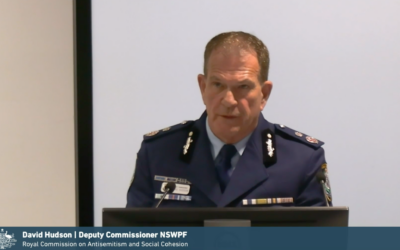
“Isolating a particular group for additional powers within our community is problematic. It creates a disconnect between groups. It can cause friction between groups if one particular element of society is afforded privileges that others aren’t,” he said.
While acknowledging the important service CSG provides to the Jewish community, Hudson said police had sufficient capacity to allocate resources appropriately where enduring threats existed.
Hudson also revealed that a new 250-strong Armed Response Command will incrementally replace Operation Shelter as the permanent police presence protecting Jewish community sites and events in New South Wales.
The new command, announced following the Bondi attack of 14 December 2025, would be operational within 18 months to two years, with the first officers expected to graduate from training next year.
Hudson said the new command would have a dual purpose, conducting high visibility operations both static and mobile, with deployment models drawn from overseas examples. The unit would be commanded by a 24/7 police operations centre tracking where armed response units were deployed across the state.
He said the creation of the new command followed the 14 December 2025 Bondi incident, in which officers had been “placed at significant risk being in a gunfight” with nine millimetre Glocks against long arms.
The Deputy Commissioner confirmed that Strike Force Pearl, established on 13 December 2024 to investigate antisemitic grievance-based offences, is no longer operating as a standalone unit with dedicated staffing.
Hudson said Pearl was created in response to an escalation in violence in the eastern suburbs, including firebombings and graffiti almost exclusively targeting the Jewish community.
He said arrests made in March 2025 had effectively ended the wave of attacks, with investigations revealing the incidents had been orchestrated by a small number of people acting on the direction of others. Once police focused attention on those individuals, the brazen acts ceased.
Pearl’s responsibilities were transferred back to Operation Shelter, the high visibility operation Hudson personally established on 11 October 2023 following the Hamas terrorist attack on Israel.
“I considered that a proactive response was needed to maintain social cohesion, both patrols of Jewish interests and Islamic interests, a high visibility operation to ensure there was no escalation of violence on the streets of Sydney,” Hudson said.
He said Operation Shelter currently deploys 150 officers per day, down from a peak of 200, and would remain active until the Armed Response Command becomes fully operational.
Hudson also told the Commission that NSW Police had not sought any specific funding increase for counter-terrorism between 7 October 2023 and 14 December 2025.
“It wasn’t considered that Counter Terrorism Command needed additional resources. It was supplemented by Operation Shelter,” he said.
The Deputy Commissioner raised concerns about information sharing between Commonwealth and state agencies, suggesting the Protective Security Policy Framework was being interpreted inconsistently.
He said NSW Police took a very open interpretation of the framework and would share information with other agencies where there was risk or threat, but other agencies were not always so forthcoming.
The Royal Commission is expected to hold a future hearing block specifically examining community security for the Jewish community.
The AJN is providing rolling coverage on the Royal Commission on Antisemitism and Social Cohesion.
Hearing block one, week one
Hearing block one, week two – Monday
Hearing block one, week two – Tuesday
Hearing block two, week one – Monday
Hearing block two, week one – Tuesday
NSW Police’s firearms registry operated without a dedicated senior intelligence analyst for more than three years — a critical gap in vetting applicants and licensees — the Royal Commission has heard.
Assistant Commissioner Kirsty Hayward told the commission on Wednesday that the position, which existed from June 2015 to November 2021, was not reinstated until February 2025, despite approval being granted on December 27, 2023.
The gap meant the registry lacked embedded intelligence capacity to assess applicants and licensees between November 2021 and February 2025 — a period that included the lead-up to the December 14, 2025 Bondi Beach terrorist attack.
“The position didn’t exist,” Hayward confirmed when asked about the gap.
During those three years, Hayward said the intelligence function was “split between different business units” within the registry and the broader NSW Police organisation, with State Intelligence Command providing ad hoc support.
However, Counsel assisting Richard Lancaster SC asked whether that arrangement was formalised.
“I haven’t been able to find any documented form,” Hayward replied.
When the intelligence analyst position was removed in 2021 following the Beatson review, the registry’s business improvement team had deemed it “under-utilised,” “only reactive,” and duplicative of adjudicator work.
The recommendation was to repurpose the role as a business or management analyst focused on performance trends and workforce planning — “a totally separate” function from licensing decisions.
The intention was that State Intelligence Command would provide intelligence support to the registry when needed.
“That was the plan,” Hayward said, “but I haven’t been able to find any documented form” of formalisation.
Since the Bondi attack, intelligence capacity has been significantly expanded. In March 2026, two additional senior intelligence analysts were added to the registry, along with an intelligence supervisor position.
“There’s three together at the moment,” Hayward said. “One’s permanent and two positions are temporary for 12 months.”
Going forward, three dedicated intelligence staff are intended to work full-time within the registry — one supervisor and two analysts.
Hayward explained that the intelligence function is critical to the registry’s role in assessing applicants and licensees.
“Firearms possession and use is a privilege which is conditional on maintaining public safety,” she said.
Adjudicators can access information through the Chimaera decision-making system, which draws on multiple NSW Police databases. But for intelligence reports placed on the system prior to 2015, adjudicators can only see the title, date, subject matter and rating — not the narrative content.
In such cases, adjudicators must contact specialist units directly to access the full information, a process that depends on the responsiveness of those units and the classification of the material.
The commission also heard that the registry is trialling a “cradle to grave” case management model, whereby one adjudicator owns an application from start to finish, rather than the current “next in line” structure where multiple adjudicators assess different stages.
The existing model, which has operated for years, creates “potential” for information to be missed between assessors, Lancaster suggested.
“It has potential. Yes,” Hayward agreed.
The trial is being conducted using Chimaera reports and spreadsheets — “a bit clunky,” Hayward acknowledged — but it aims to ensure single ownership of decision-making and reduce duplication.
comments