



Live updatesPublic hearings
ASIO identified antisemitism “one of its most pressing priorities”
Hearing block two begins today examining the circumstances surrounding the attack at Bondi on 14 December 2025.
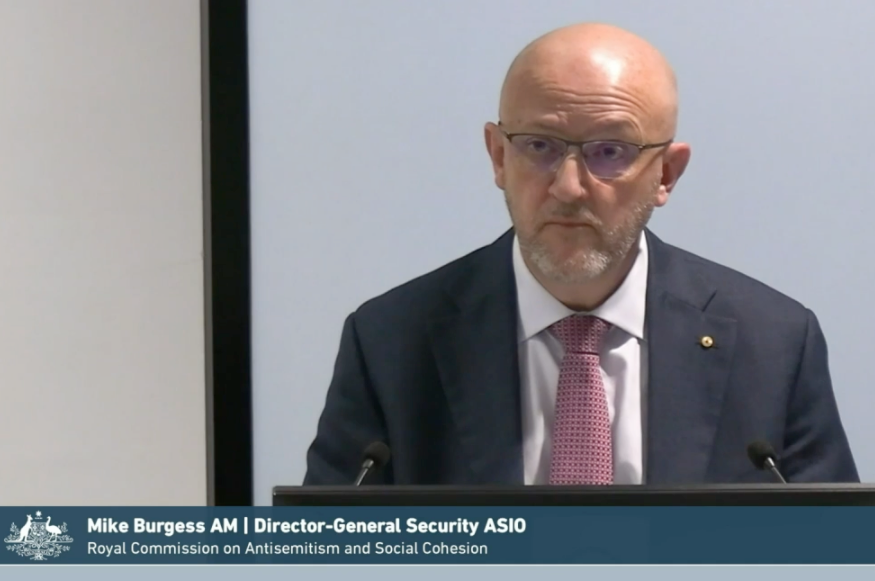
Photo: screenshot
Counsel assisting Richard Lancaster SC: “no information on threat prior to Bondi”
ASIO Director-General Mike Burgess on resources of ASIO
ASIO Director-General Mike Burgess on the consequences for the security environment
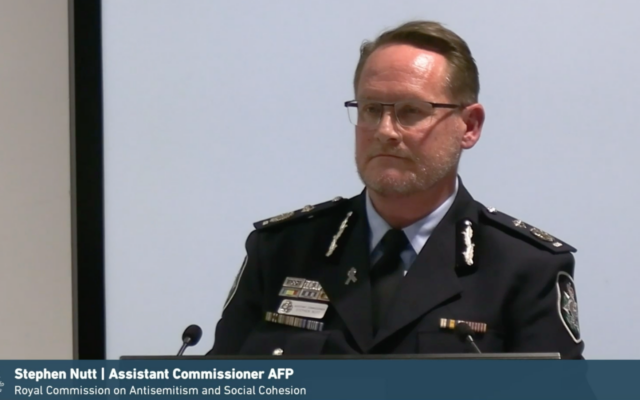
Stephen Nutt, Assistant Commissioner of Global Operations Command at the AFP on the escalation of antisemitism
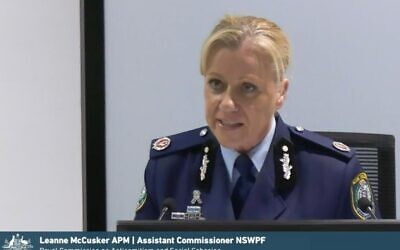
Assistant Commissioner Leanne McCusker, of the Counter Terrorism and Special Tactics Command on the threat assessment for Chanukah by the Sea
Witness ABO, CSG NSW on the communications with police before the Bondi Beach terror attack
Witness ABP, CSG NSW on direct communications with NSW Police officers
The Royal Commission this afternoon heard from a senior CSG NSW staffer, appearing under the pseudonym Witness ABP, who gave evidence about direct communications with NSW Police officers in the days before the 14 December 2025 Chanukah by the Sea event at Bondi Beach, in which 15 people were killed and dozens injured in a terrorist attack.
The witness confirmed involvement in two key exchanges with Eastern Suburbs Police Local Area Command — a phone call with the Commander on 8 December 2025, and a subsequent phone call with the Operations Inspector on either 10 or 11 December.
The witness told the Commission that on the morning of 8 December, after reviewing a draft of the event notification email CSG was preparing to send to police that afternoon — which categorised Chanukah by the Sea and Chanukah in the Park at Dover Heights as “priority events” requiring police resources “for their entirety” — a decision was made to call the Eastern Suburbs Police Area Commander directly.
“Given the current threat environment that our community was facing, the fact that it was an open-air event, the fact that CSG couldn’t be armed in that environment… and given the number of people expected to attend, we were requesting that there be a static presence,” the witness said.
The witness acknowledged having no specific recollection of what was discussed in that phone call, but believed the Commander had directed the request to the Operations Inspector.
It was in the subsequent call from the Operations Inspector — received on the 10th or 11th of December, with no note taken and no record appearing in the witness’s incoming call log — that the police response was conveyed.
The inspector’s reply, as the witness recalled it, was unambiguous. “His response to my recollection was that they do not believe a static presence is required, based on the risk assessment they would have undertaken internally.”
The witness said the matter was pressed further.
“I said that it would be a lot of unease from the community not having a static police presence on the ground, and I would have tried to convince him, other than having mobile taskings.”
The witness told the Commission that mobile taskings — where police units attend and leave periodically — were considered an inadequate substitute, from CSG’s perspective.
“Mobile taskings is attending and leaving, attending and leaving. There is no specific time frame in between, or how long they’ll actually be on the ground while they’re there,” he told the Royal Commission.
A Community Security Group (CSG) NSW figure who was given the pseudonym ‘Witness ABO’, gave evidence to the Royal Commission this afternoon spanning the broad uplift in interagency cooperation since October 7, 2023, communications with NSW Police ahead of Chanukah events in Sydney, and rising costs involved in the Jewish community’s private security arrangements.
“The level of engagement with both organisations [NSW Police and ASIO] increased materially after October 7,” Witness ABO told the Commission.
“My observation, and the observation of our organisation, is that both of those organisations have been extremely reactive, have been available, and have worked extremely hard to protect the community.
“I’d say from my personal perspective, they’ve gone above and beyond to do that.”
The witness described a significant increase in the cadence of meetings with both NSW Police and ASIO, including semi-formal briefings on specific threats to the Jewish community.
Discussion then turned to examining communications between CSG NSW and NSW Police in the weeks preceding the Chanukah by the Sea event.
The Commission was taken through a CSG threat assessment dated 28 November 2025, distributed to what Witness ABO recalled as the commander of the Eastern Suburbs Police Area Command, and its intelligence email address, which warned in explicit terms that a terrorist attack against the NSW Jewish community was assessed as “likely,” with the community threat level rated five out of six, referred to as “high.”
The document specifically flagged Chanukah by the Sea, anticipated to draw around 1,000 attendees, as “a major open-air event of concern”.
A further notification email sent by CSG NSW on 8 December 2025 — six days before the attack — listed Chanukah by the Sea as a Category One event, meaning CSG was “requesting deployment of resources for the entirety of the event.”
The email was distributed to multiple NSW Police recipients, including the Operation Shelter Intelligence Distribution List.
The witness said they received no reply from NSW police, but that a reply was “not expected”.
The warning flagged by CSG NSW was not sent to federal agencies such as ASIO or the Australian Federal Police.
A subsequent phone call between a CSG NSW officer and a NSW Police inspector sought specifically to confirm a static police presence at the event, for its full duration.
“What I understand by static police presence,” the witness explained, “is not taskings, so not patrol — someone there permanently for the duration.”
The Commission also heard that CSG NSW deployed 12 unarmed volunteers — a mix of licenced security personnel and ushers — to the 2025 Chanukah by the Sea event at Bondi Beach.
On funding, the witness revealed that the estimated commercial security guarding costs for the NSW Jewish community for 2026 now stand at approximately $12.5 million (for the current financial year) — a figure that has risen sharply in accordance with the threat or risk environment.
“The costs are moving around because as the threat increases, obviously the costs increase,” the witness said, noting that CSG NSW does not charge for its own personnel but must work alongside commercial guarding companies for sites and events it cannot cover.
Finally, questions from Sophie Callan on behalf of her client, the State of NSW, clarified that the police officer with whom CSG NSW exchanged key pre-event emails in December 2024 was a staff officer to Assistant Commissioner Scott White, who was at that time the commander of Operation Shelter — not, as had initially been unclear, an officer from the local Eastern Suburbs Police Area Command.
Witness ABO is expected to return in a future hearing block, to address additional topics canvassed in their statement.
The NSW Police Force did not prepare a specific threat assessment for the Chanukah by the Sea event at Bondi on 14 December 2025, the Royal Commission of Antisemitism and Social Cohesion has heard.
Assistant Commissioner Leanne McCusker, of the Counter Terrorism and Special Tactics Command, told the inquiry that threat assessments had historically only been prepared for five major calendar events – New Year’s Eve, Australia Day, Anzac Day, Mardi Gras, and Jewish High Holy Days such as Yom Kippur.
Counsel assisting asked whether, with the benefit of hindsight, threat assessments should be prepared for Chanukah events.
“Yes, I see no reason why a threat assessment could not be completed for that event,” McCusker said.
Asked specifically whether she now saw it as a good idea, she replied: “As a good idea? Yes, I do.”
McCusker said a recommendation to that effect had been made in the inquiry’s interim report, and the matter was presently under consideration by the NSW Police Force executive.
The evidence followed McCusker’s confirmation that hate crime incidents against Jewish victims in NSW had risen sharply since 2020.
According to data from the Engagement and Hate Crimes Unit, there were 40 incidents in 2020, 59 in 2021, 118 in 2022, 353 in 2023, 445 in 2024, 841 in 2025, and 287 in the first quarter of 2026.
The proportion of total hate crime incidents in NSW with Jewish victims climbed from 8 per cent in 2020 to 30 per cent in 2025.
McCusker said hate crime incidents against Jewish people had risen from 43 in the third quarter of 2023 to 231 in the fourth quarter, coinciding with the October 7 Hamas attacks on Israel. She said she saw a clear link between the two.
“It was by virtue of what was being reported to New South Wales Police, what was being displayed in the protest activity that was being seen post the seventh of October, the online commentary that was also being seen and that community sentiment that was being displayed and the reports coming from the Jewish community,” she said.
A further increase, from 155 incidents in the fourth quarter of 2024 to 309 in the first quarter of 2025, reflected a continuing threat. McCusker agreed the threat to the Jewish community had remained at “a concerning level” in the lead-up to December 2025.
McCusker outlined a number of operational responses by NSW Police. Operation Shelter was established in October 2023 in response to community safety concerns following large-scale protests after the October 7 attacks.
Strike Force Pearl was established in December 2024 to investigate hate crimes of significant public interest.
Operation Reassurance was established in February 2025, focused on hate crime education for younger people through schools.
Strike Force Pearl personnel grew from 10 in December 2024 to 20 in January 2025 and 46 in February 2025, in response to escalating antisemitic offences including arson attacks, firebombings and graffiti targeting Jewish premises.
McCusker said 22 offenders had been charged with 178 offences as a result of the strike force’s work.
Incidents investigated by Strike Force Pearl included the fire at Lewis’ Continental Kitchen in October 2024, the arson attack at the former home of Executive Council of Australian Jewry co-CEO Alex Ryvchin, graffiti at Mount Sinai School in January 2025, and the conduct of two Bankstown-Lidcombe Hospital nurses.
The August 2024 raising of Australia’s national terrorism threat level to “probable” by ASIO prompted the updating of key NSW Police Force threat assessment documents, including a crowded places assessment, McCusker said.
That assessment noted crowded places, including places of worship and civic spaces, were the most likely targets of a terrorist attack in NSW, irrespective of ideology.
McCusker agreed that a threat assessment of that kind would be relevant to assessing how many police resources should be allocated to a Chanukah event in a public park.
NSW Police stopped issuing regular intelligence briefings on threats to the Jewish community stemming from October 7 after December 2023, more than two years before the Bondi Beach terrorist attack.
Assistant Commissioner Leanne McCusker told the Royal Commission on Monday that the Counter Terrorism and Special Tactics Command had disseminated weekly and fortnightly intelligence briefings between October and December 2023 following the Hamas attack on Israel.
“That view was held as a result of the global impact following the Israel and Hamas conflict, that the impact to the security environment in New South Wales,” McCusker said.
The briefings assessed the threat of terrorism against Israel and Jewish interests in New South Wales, which was identified at that time as “possible” rather than “probable”, consistent with the national terrorism threat level.
Asked why the volume of briefings dropped off after December 2023, McCusker said Operation Shelter had been established and “the threat environment and the intelligence continued to be communicated”.
Operation Shelter was stood up within days of October 7, 2023 “in response to the protest activity, the community reassurance to have a collective and coordinated and consistent approach regarding intelligence, and also the response for the various incidents that were being seen across the community”.
McCusker said the purpose of intelligence briefings and threat assessments was to provide “situational awareness” to NSW Police officers.
“That’s to ensure that information can then cascade down to the frontline police officers, but also for the leadership across the organisation to be provided with current up-to-date information for that situational awareness and to then be able to take that into account,” she said.
“In particular for police area commands, for those commands’ daily activities for them to understand the threat environment that may be relevant to their demographic and their local area command, but also for that information to be taken into account when there’s major events on.”
The briefings and assessments were expected to inform “local operational policing decisions” and “day to day tasking and deployment decisions”, she said.
Senior Australian Federal Police officer Stephen Nutt has told the Royal Commission into Antisemitism and Social Cohesion there were fears antisemitism in Australia could escalate into terrorism following the October 7 Hamas attacks, as authorities confronted what he described as a fundamentally altered national security environment.
Nutt, Assistant Commissioner of Global Operations Command at the AFP, agreed that the attacks and their aftermath significantly affected Australia’s national security environment, forcing a recalibration of policing priorities.
He acknowledged that antisemitism had since become a strategic priority for the AFP, marking a shift in focus that followed what he described as an escalation in both the scale and severity of incidents across the country.
In the months that followed, he told the Commission, authorities observed a deterioration in public order and an increase in extremist expression at demonstrations.
“We saw protest activity, which is a legitimate part of a functioning democracy, turn into violent protests,” he said. “We saw increasing antisemitic chants, where praise around the attack was occurring, and we also saw an increasingly open display of prohibited hate symbols, specifically, whereas we were concerned, was around the symbols of prescribed terrorist organisations, including Hamas and Hezbollah.”
Nutt said the trajectory of events raised concerns within national security agencies about potential escalation.
“There was absolutely a concern that the antisemitism could escalate to actual terrorist acts,” he said.
The AFP response included the establishment of Operation Avalite in December 2024 following the arson attack on Melbourne’s Adass Israel Synagogue.
Nutt said the operation was designed to investigate and mitigate antisemitic threats and violence, and to identify and disrupt individuals engaging in criminal conduct targeting the Jewish community.
He also confirmed the creation of a national antisemitism coordination group involving deputy commissioners from each jurisdiction, designed to share intelligence and align operational responses across Australia’s policing agencies.
Asked whether a comparable national coordination structure was required for other forms of hate crime, Nutt replied, “I’m not aware of that. No.”
The Commission was told AFP received 166 reports of alleged offences following the launch of Operation Avalite, with a portion assessed as duplicates or matters under state investigation, and 15 serious allegations being actively pursued.
Nutt also gave evidence about the January 2025 ‘Dural caravan’ incident, in which a vehicle containing explosives and antisemitic material was discovered in Sydney’s north west.
Investigators ultimately assessed the incident as part of a fabricated terror plot.
Nutt affirmed his written statement that said, “the primary motive of the individuals involved was to manipulate the judicial system by taking advantage of antisemitic incidents and fear in the community”.
But he acknowledged that, despite the fabrication, the incident had a significant psychological impact.
“A caravan with explosives with a threatening note is enough to have a very concerning impact on the Jewish community’s feeling of safety,” he said.
Nutt agreed there was an enduring threat to the Jewish community in Australia, extending beyond vandalism and abuse to potential risks to physical safety, reiterating then police Commissioner Kershaw’s January 2025 public statement, which read, “it all points to the same motivation — demonising and intimidating the Jewish community”.
He said authorities remained alert to the possibility of escalation, with antisemitism now firmly embedded in Australia’s broader national security and counter-terrorism framework.
ASIO Director-General Mike Burgess gave evidence to the Royal Commission about ASIO’s annual threat assessment in February 2024 which addressed the consequences for the security environment post October 7 2023, in which ASIO stated it remains concerned about lone actors who use readily available weapons to carry out an act of terrorism.
Asked how ASIO seeks to combat lone actors, Burgess said: “Well, that’s where it gets extremely hard for us, because, as you’d appreciate, for us to actually investigate or do a line of inquiry, we need to have some lead information, and if individuals are not making themselves discoverable by meeting at a prayer group or talking on the internet openly about what their plans are, or doing things that are observable for members of the community. It’s hard for someone to call the police or the national security hotline, or for us to pick up indications. That is just the nature of the threat environment we have today, and of course, under our law, which is appropriate, all my officers’ actions have to be proportionate to the threat we’re facing and lawful, and under law we can’t be everywhere all at once, we’re not all seeing or knowing, and we don’t aspire to be.”
Discussing the national terrorism threat level returning to “probable” in 2024, it was noted that ASIO observed “politically motivated violence” now joining espionage and foreign interference as its principal security concerns.
“We had a range of ideologies and a broadening of ideologies that would go to violence, so not only did we have Islamic violent extremists in the mix, we had nationalists and racist violent extremists in the mix, neo-Nazis… We had an increase in the number of youth and minors in our caseload that happened through 2020 onwards, accelerated during Covid,” Burgess said.
Asked what effect the war in the Middle East had on his decision to increase the terrorism threat level, Burgess replied, “So it was a factor, it wasn’t the direct reason… but yes there is no doubt that the war in the Middle East invoked a range of emotions in Australia, and actually those strong reactions and some of those violent aspects of that, and those behaviours, including antisemitism, that in our view that were left unchecked were therefore normalised and gave more permission for violence through late 2023 and through 2024 to August when we raised it and that was of concern to us in that environment where violence is more permissible of course it can go through to politically motivated violence or promotion of communal violence, and Jewish Australians are on the receiving end of that.”
ASIO said it devoted resources to the terrorism threat as it emerged and developed. “Because the counterterrorism workload increased at the coalface of what ASIO does, there was a response from ASIO to devote staff and resources to that,” Burgess said.
It was noted that when the terror threat level was changed in August 2024, Burgess did not specifically refer to the risk to Jewish Australians.
“I did not mention the Jewish Australians at that time. No, we had not assessed that Jewish Australians were most likely [to be targeted], but of course we had picked up on and actually communicated our concerns as to what was happening in antisemitism and targeting the Jewish Australians and the conflation of the State of Israel’s actions and people in Australia, so that was a concern for us from August 2024 going forward… Well, actually from 7th of October, literally two days later, as I said, when we saw those strong emotions,” Burgess said.
Asked what ASIO was doing at that time to review its caseload of assessed violent extremists, Burgess said: “Out of an abundance of caution, we look back over the last 12 months of those individuals that we had assessed that had a violent extremism or a violent ideology that actually we believed whilst they had the awful ideology they would not go to violence, and we revisited all of those cases, going back the last 12 months from that point.”
As to why the review went back 12 months and not longer, Burgess said: “We made a judgment to go back 12 months just to satisfy ourselves that those individuals and their circumstances haven’t changed to make sure our assessment is still valid.”
Asked if ASIO continued to perceive a continued uptick in antisemitic incidents in late 2024 and into 2025, Burgess said, “Yes, we definitely were observing that… we saw it transition in our view from threatening, intimidating behaviour to direct targeting of people, businesses, and places of worship with the first arson and graffiti attacks”.
Burgess said that as the terrorism threat level came to the fore, “espionage and foreign interference had not let up”. Asked if focusing on both stretched ASIO’s resources in early 2025, Burgess replied, “Certainly stretches us and stretched us at the time, but we have a very effective identification and prioritisation process by which we’re looking at what we have, and I’m confident as Director General that even during that time, when my officers were working really hard, we were not actually leaving serious matters untreated or uninvestigated, and that’s the matters before us, of course. Again, I’d stress we are not all seeing and all knowing.”
As to whether additional resources would have provided a better opportunity to address those threats, Burgess said: “It’s my job as Director General, and as an organisation, we look at the threats we have before us and the resources we’ve got and where those resources applied, and of course, even if we’d identified that we needed more resources, the very nature of our recruitment and clearance process would have seen a 12 month lag before those resources came on board, but of course, it’s my day job to look at that, and if I think I need more resources, I put my argument to the government of the day through the standard budget process, we can do that in this case.
“I’m very clear that we knew we were busy and we had a lot on our plate, but again, I fall back on at no time did we have serious matters that we knew about that we were leaving untreated, because that is the important measure for me in terms of the effectiveness of the security service,” Burgess said.
Asked why ASIO did not take on more staff in 2024 and 2025, Burgess said, “We chose not to put forward any extra resource requirements, given the environment we had at that time. Of course, we’re operating in a budget environment where the government rules are very clear: if you ask for something, it’s a zero offset, so you have to offer an offset, so I might have got a plus up, but I would have had to take it from somewhere else.”
It was noted that while there was an overall increase in funding to the National Intelligence Community, the proportion of funding allocated to counter terrorism significantly declined from 2020 to 2025.
Asked if in retrospect, he would consider whether additional funding and resources would have put ASIO in a better position to pursue its counter-terrorism activities over the last five years or so, Burgess replied, “No, I don’t. In retrospect, I still think that our resourcing was sufficient for the problems we face, of course. We are stretched, and I do have means by which I can ask for additional resources if we need.”
Regarding the Iranian Revolutionary Guard Corp’s (IRGC) involvement in antisemitism in Australia including in at least the arsons on the Adass Israel Synagogue and Lewis Continental Kitchen, Burgess replied, “The IRGC was behind those, and behind those we mean they used their network of proxies and agents to do their bidding, and that is to bring harm to Jewish people wherever they are in the world.”
Burgess noted that there may be other Iran backed attacks but there were also other antisemitic incidents that did not involve Iran.
It was noted that after the Manchester Synagogue terrorist attack ASIO in October 2025 recognised an enduring threat to Jewish interests, both in the UK, but also in Australia, which was notified to Commonwealth and state government bodies. It stated that Jewish holy days and significant dates represent an attractive target for extremists.
It was also noted that “ASIO had no specific intelligence suggesting an attack was being planned against Jewish interests in Australia” in relation to Bondi.
ASIO also put out a holiday threat assessment in December 2025, which it put out at the end of each year, which noted that “the most likely attack will occur at a crowded place or gathering”. Burgess said this was for people of all faiths including Chanukah celebrations.
Burgess confirmed that there was no credible information to indicate current attack planning or targeting of crowded places in Australia, including religious events over this period. However, the warning also noted that “attacks could emerge quickly with little to no warning and that crowded places”.
“With violent extremists using simple tactics and readily acquired weapons, our greatest concern is the threat from lone actors or small cells on the edge of established groups, irrespective of motivation, and that reflects also what you said earlier about both the difficulty of identifying in advance from ASIO’s perspective loan actor attacks, but also the risk posed by such persons,” Burgess stated.
Discussing that the terrorism risk currently remaining at “probable”, Burgess said, “Probable means greater than 50 per cent chance someone will advocate or plan or undertake an act of terror, but in our security environment, we believe we have a concerning trajectory, as in it’s getting hotter in terms of there is more permission for violence, and an environment where people can go to violence with little or no warning means it’s kind of run the upper end of probable the next level up is expected, but in the current system that requires us to have specific intelligence that there is a plan and a location for an act of terror, and in the absence of not having that, it won’t go to expected, but we’re flagging the environment is a lot hotter than it has been in the past when we first raised the threat level, and that concerns me and my agency.”
Asked if ASIO had made any change to its operations to address that even more heightened risk of antisemitic conduct that might affect security, Burgess replied, “We have, and basically what that means is we continue to put the resources where we know the threat is and where we need to, or see something that must have an inquiry, and at the same time, there’s a number of activities we have underway to investigate matters out of abundance of caution to satisfy ourselves, they do not represent or will not represent the threat to security.”
Burgess included assessing whether there are “potential actions underway from the State of Iran”.
As to whether the public can be assured that ASIO has sufficient resources and powers to respond to antisemitic conduct in the nature of a terrorist attack, Burgess stated: “I believe they can be assured that my agency puts its resources where it needs to, and if we have a resource issue, I will ask government, and government will consider that through the budget process, and as we’ve seen recently, we had an ask of government to deal with the online radicalisation problem, and the government have given us and the federal police an investment to provide additional resources to address that growing threat.”
Burgess was referring to the Counter Terrorism Online Centre announced on 6 May 2026, designed to counter people who radicalise online.
ASIO Director-General Mike Burgess has told the Royal Commission the spy agency “pivoted” resources away from counter-terrorism to focus on foreign interference in 2022, but insists the shift did not leave counter-terrorism work under-resourced when antisemitic violence escalated after October 7, 2023.
Giving evidence on Monday, Burgess said ASIO identified antisemitism as “one of its most pressing priorities” in 2025 after the national terrorism threat level was raised back to “probable” in August 2024.
The threat level had been lowered from “probable” to “possible” in November 2022 after the defeat of the Islamic State caliphate significantly reduced the number of terrorism investigations ASIO was conducting.
“There were fewer extremists with the intention to conduct an attack on shore than there were when we raised the threat level in 2014,” Burgess said.
At the same time, ASIO increased its focus on espionage and foreign interference, which Burgess described in February 2023 as having “supplanted terrorism as our principal security concern”.
“In terms of scale and sophistication, espionage and foreign interference threats are outpacing terrorism threats and therefore demanding more attention and more resources,” he said at the time.
Burgess told the commission ASIO “did at this time pivot to increase our focus on foreign interference” but insisted “this was not to the detriment of our CT [counter-terrorism] mission”.
“It coincided with a reduction in our CT workload that was naturally emerging. It did not leave CT under-resourced,” he said.
“There was less activity that we were investigating, because the nature of the environment had changed and the number of tasks we were looking at had reduced.”
However, the security environment changed dramatically after Hamas’s October 7, 2023 terrorist attack on Israel.
“Literally two days later, not even before the Israeli Government responded to that horrific attack, we saw the strong emotions appear in this country where we had people celebrating the Hamas terrorist attack,” Burgess said.
“We saw threatening, intimidating behaviour through the end of ’23 against Jewish Australians all the way through ’24 until when it pivoted to direct targeting of people, businesses, and places of worship in October ’24.”
Five days after October 7, Burgess issued an unprecedented public statement warning that “inflamed language can lead to tensions and can lead to violence”.
“It was unprecedented for a director general, but it was something I thought was important to remind people it’s okay to have a view, it’s how you express it can have consequences,” he said.
Burgess said ASIO’s relationship with the Community Security Group (CSG) intensified after October 2023.
He described it as “a productive working relationship” with the purpose of explaining to CSG “the threats as we see it at the official or unclassified level”.
Burgess noted that while antisemitism itself is broader than ASIO’s role, the agency’s interest is “identifying and understanding threats of security, insofar as individuals who have an ideology where they think violence is the answer”.
“An act of antisemitism can be something that is not of interest to the security service in itself,” he said.
The Director-General explained that ASIO’s role in combating terrorism covers “politically motivated violence” as an umbrella term that includes various ideologies.
“Islamic violent extremism, Christian violent extremists in the broad, people who have a neo-Nazi or an anarchist and revolutionist ideology that says violence is the answer, and today we have people with a whole range of societal, economic, or conspiracy theory grievances,” he said.
The threat level was raised to “probable” in August 2024, where it remained through December 2025 when the Bondi Beach terrorist attack occurred.
Burgess said ASIO consults extensively with federal and state police both before and after changing the threat level, with regular meetings and additional consultations “as needed”.
Counsel assisting Richard Lancaster SC told the Royal Commission into Antisemitism and Social Cohesion on Monday there is “no evidence that any intelligence agency or law enforcement agency had any actual knowledge or specific information to suggest that there might be an armed attack on the Chanukah celebration at Bondi”.
“In that sense, it was a surprise attack,” Lancaster said in his opening address to the second hearing block, which will focus on security arrangements.
The hearing block will examine whether intelligence agencies and police had adequate information to prevent the December 14, 2025 Bondi Beach terrorist attack that killed 15 people and injured dozens more.
It will hear evidence from ASIO Director-General Mike Burgess, senior Australian Federal Police and NSW Police officers, and representatives of the Community Security Group (CSG) NSW.
Lancaster outlined eight key facts the commission expects to establish, including that CSG requested NSW Police provide a presence “for the entirety of the Chanukah events at Bondi Beach and at Dover Heights”. However, NSW Police decided not to provide a static presence for the duration of the event, instead allocating a “mobile tasking” with officers instructed to attend from time to time during the evening.
Despite this decision, Lancaster said, four police officers were at Archer Park when the shooting began. Three police officers were shot and injured during the attack. Within five minutes there were 11 officers on scene. The first shooter was killed and the second shooter apprehended around seven minutes and 41 seconds after the shooting started, he said.
Lancaster said the Commission will examine “the assessment by the Eastern Suburbs Police Area Command of the threats to and risks concerning the Chanukah event at Bondi, and whether, in hindsight, the decision about the allocation of police resources was appropriate for a large Jewish celebration in a public park in December 2025”.
The Chanukah events at Bondi and Dover Heights were treated as “tier one community events” with resource management the responsibility of the local Eastern Suburbs Police Area Command, rather than tier three events like the Jewish High Holy Days in September-October 2025, which were managed by the Major Events Group with liaison from the Counter Terrorism and Special Tactics Command.
“It presently appears to the Commission that there was no such liaison between Eastern Suburbs PAC and either the Major Events Group or the Counter Terrorism and Special Tactics Command, or the Public Order and Riots Squad, in the lead up to the Chanukah event at Bondi,” Lancaster said.
The Commission will examine ASIO’s assessment of antisemitic threats leading up to the attack. In August 2024, the national terrorism threat level was raised to “probable” from “possible”. ASIO identified antisemitism as one of its most pressing priorities in 2025.
Lancaster said four topics will be explored with ASIO: the assessment of violent antisemitic attack threats, the adequacy of information sharing between agencies, the effectiveness of investigations and analysis before December 14, and changes in counter-terrorism resourcing over time.
He said the Commission will also examine Operation Avalite, established by the AFP in late 2024 to investigate high-impact antisemitism incidents, and Strike Force Pearl, established by NSW Police to investigate antisemitic incidents during the “summer of terror” at the end of 2024 and start of 2025.
Evidence will be heard about CSG’s threat assessment document sent to NSW Police on November 28, 2025, and an email sent December 8 giving notice of upcoming Jewish community events including the “Chanukah party at the beach” with about 1000 people expected to attend.
Lancaster said a future hearing block will be devoted to Jewish community security issues now and into the future.
The Commission has made non-publication orders protecting the identities of several witnesses.
Much of the evidence in this hearing block will be heard in closed sessions due to national security sensitivities.
The AJN is providing rolling coverage on the Royal Commission on Antisemitism and Social Cohesion.
comments