Live Now

Local government, multicultural and community leaders appear

Hearing Block 9 continues continues today focusing on strengthening social cohesion, including how it is understood and measured.

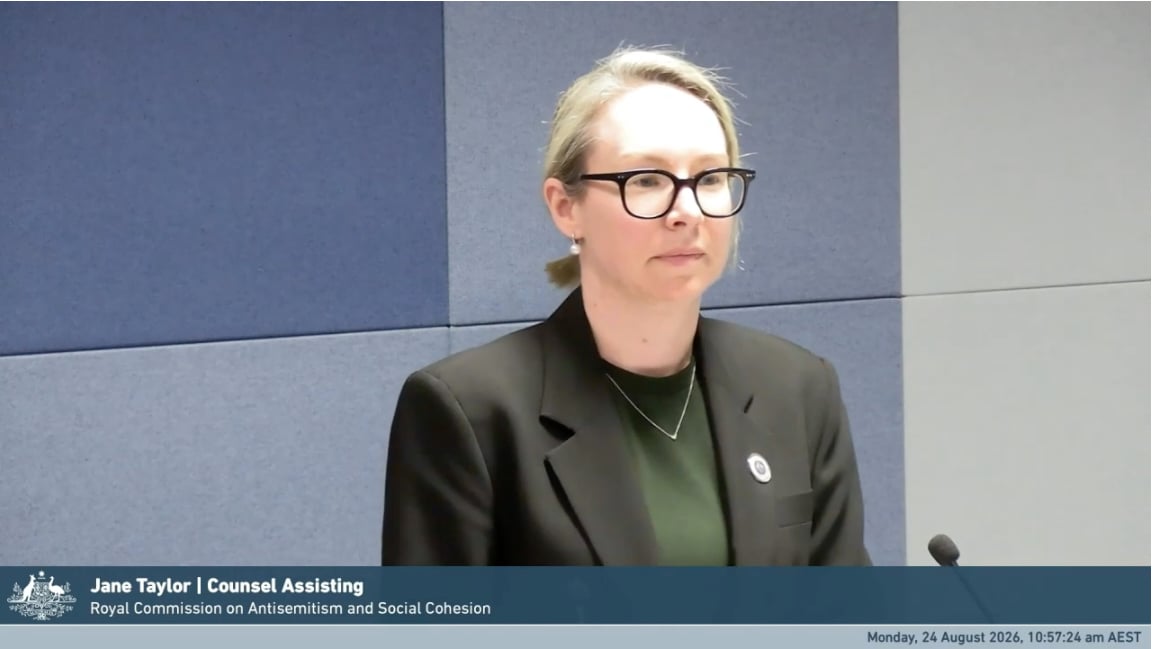
Counsel Assisting Jane Taylor.

Waverley mayor urges for councils to have a social cohesion role

Waverley mayor Will Nemesh has suggested the Royal Commission on Antisemitism and Social Cohesion consider recommending that councils be given an explicit role in fostering social cohesion under the Local Government Act.

Nemesh told counsel assisting Zelie Heger that while the mayor’s role includes promoting social cohesion, there is no equivalent reference to councils more generally.

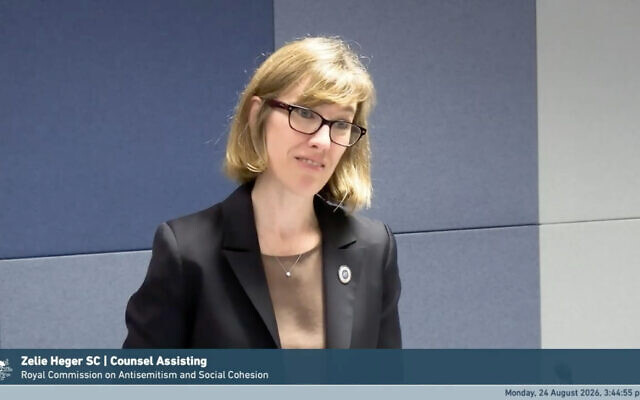
Counsel Assisting Zelie Heger.

“There’s an expression that local government just deals with roads, rates, and rubbish, and I firmly believe that at its core, local government is really about community,” he said. “What we do at local government is we enact the hopes and aspirations of our communities.”

The Waverley local government area has the largest Jewish population in NSW, with more than 11,000 people making up 16 per cent of the local population and about a quarter of the state’s Jewish community. Its residents come from 118 ancestries and 33 religions.

Nemesh, who is Jewish and a grandson of Holocaust survivors, said Waverley itself took its name from a house built in the 1820s by a Jewish free settler.

He said the rise in antisemitism after October 7 had been disturbing and alarming, involving graffiti, an arson attack and other forms of hate and abuse, and had left both the Jewish community and the broader community feeling vulnerable and unsafe.

Waverley became the first council in Australia to produce an antisemitism strategy, adopted in March 2025, before releasing a model template for other councils in September that year. Nemesh said a number of councils had since taken it up or incorporated elements of it.

He said antisemitism did not stop with its target. “It’s insidious, it permeates across the community more generally to sow division,” he said, describing it as a joint responsibility of all levels of government and civil society.

Waverley mayor Will Nemesh.

In February 2025, Waverley co-hosted a social cohesion roundtable at Bondi with Liverpool and Inner West councils, convened by Nemesh alongside Darcy Byrne, a Catholic mayor in the inner west, and Ned Mannoun, a Muslim mayor in western Sydney. More than 20 of Sydney’s 33 metropolitan mayors attended and co-signed a joint statement condemning racism and antisemitism.

That work fed into a state government template anti-racism strategy for local government, released in March 2026 after extensive consultation.

Nemesh also described two council programs: Cultural Waves, a five-month intercultural leadership program for 14 to 18-year-olds that teaches them to be upstanders rather than bystanders; and Perfect Strangers, which brings people who do not know each other together over a shared meal.

On graffiti, Nemesh said council policy required removal within 48 hours, or 24 hours for offensive graffiti, but that in practice offensive graffiti was generally removed within a couple of hours by an in-house team.

He said that following a motion he moved in late 2024, Waverley records whether graffiti is antisemitic or otherwise hateful — detail not required under the national register, which logs only location, cost and time.

Nemesh said Local Government NSW and its president Byrne had helped bring more than 40 mayors from across the state to Bondi to lay wreaths days after the attack, and that a Rotary fund had been established for councils wishing to support victims’ families and survivors.

Council facilitated the Light Over Darkness commemoration at Bondi Park on the final day of Chanukah, and hosted the Holding Light exhibition at Bondi Pavilion. A solar-powered chanukiah originally installed at Dover Heights now stands in Archer Park and will remain until a permanent memorial is established.

In late May the council held a Shabbat dinner at Bondi Beach for about 250 people, including Jewish and non-Jewish guests, interfaith and multicultural community members, MPs, mayors and councillors. Nemesh said the event was expensive and had not been budgeted for, but that between 80 and 90 per cent was privately funded.

Home Affairs secretary says antisemitism-linked visa cases raise ‘valid concern’

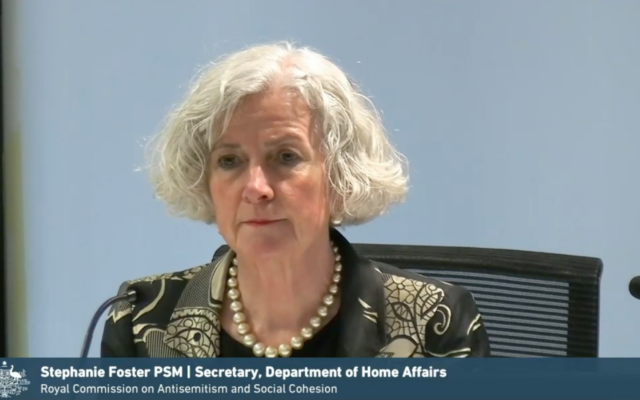
Department of Home Affairs secretary Stephanie Foster told the Royal Commission into Antisemitism and Social Cohesion that she understood there would be a “valid concern amongst the Jewish community” that people who had engaged in public antisemitic conduct had made it through the visa screening process, in some cases only being removed from Australia after being publicly exposed.

Foster was questioned about three cases in which visa holders had their visas cancelled after arrival in Australia: Bangladeshi preacher Mizanur Rahman Azari, who had reportedly been refused entry to the United Kingdom in 2021 and was said to have described Jews as “the biggest terrorists of the world,” with his visa cancelled in March after Jewish community bodies wrote to the minister; fellow preacher Sheik Ahmadulla, whose visa was cancelled in April; and social media personality Sneako, whose visa was cancelled after Sky News reported on him.

Asked whether such cases suggested people should never have been granted visas in the first place, Foster repeatedly said decision-makers acted on the facts available to them at the time, but added the department would “always act swiftly when we have information that allows us to refuse or cancel a visa.”

Foster was also shown documents suggesting Sneako had appeared in a One Path Network YouTube video after being deported, and that OPN Media Limited, which operates the channel, had received a $308,000 Commonwealth grant. She said the matter had “only been brought to my attention very recently” and that the department would “always, when information is provided to us, investigate its validity and its appropriateness.”

On the National Anti-Racism Framework, published in November 2024, Foster confirmed none of its recommendations directly addressed antisemitism as a distinct form of racism, and that the federal government had not yet responded to it. She said she remained “on the record as saying that I believe specific targeted action against antisemitism is critical.”

Foster also addressed a proposal, raised by the commission, for a national hate incident database that would draw on reporting from bodies such as the Executive Council of Australian Jewry alongside a public reporting portal. She said she would “take that proposition and see if there’s something that we can do constructively to bring that together.”

On social cohesion, Foster pointed to the department’s work with local councils in Melbourne’s Dandenong area and said leadership was critical to shifting community attitudes, noting the department did not currently have a mechanism to convene faith, business and community leaders on the issue.

Home Affairs builds social cohesion framework, awaits commission findings

The Department of Home Affairs has established a dedicated Office of Social Cohesion and is developing a national agenda, but will not finalise it until the Royal Commission on Antisemitism and Social Cohesion hands down its findings.

Department of Home Affairs secretary Stephanie Foster told the commission the office was established in September 2024 with about 25 staff and a budget of $7 million.

She said it performs three core functions: coordinating social cohesion work across governments and community organisations, community outreach through a network of about 50 community liaison officers, and pilot programs designed to seed ideas that can be scaled.

“I am very sure that no one office or entity can do social cohesion,” Foster said. “Even if I made an organisation of 1000 people, it could not tackle that task, and so I’m trying to ensure that its role is to connect, to seed ideas, to try things that can then be institutionalised.”

In January 2025, Foster established a secretary’s steering group comprising 11 Commonwealth department and agency heads to coordinate social cohesion efforts across government.

Around the same time, in response to a spate of antisemitic attacks, the department stood up a rapid response team. Foster said the temporary initiative, which operated primarily in the first half of 2025, was designed to respond to affected communities’ immediate needs and examine what was underlying the attacks. The team produced an Understanding Hate podcast series with SBS and established a Home Affairs web page providing tools and guidance for people experiencing hate crimes.

Foster said safety had become a critical element of social cohesion since October 7, 2023.

“I would not, prior to the events of the last couple of years, have included safety as a specific element that I think is really important for social cohesion,” she said. “But the spate of horrific attacks and the impact that that’s had on people in our community has really brought home to me how critical it is that people both feel safe and are safe for them to feel that sense of belonging and connection.”

She agreed with the evidence of Race Discrimination Commissioner Sivaraman that social cohesion cannot be achieved without addressing racism.

The department is developing a national social cohesion agenda in collaboration with the NSW Premier’s Department and has endorsed a measurement framework with three strategic goals: that individuals experience cohesive communities, that people and groups remain connected across multiple networks, and that conditions enable social cohesion.

Foster said the agenda would not be finalised until the commission reports. “I’ve asked the team to continue to develop it, to continue to work with states and territories, but not to actually finalise it until the Royal Commission reports,” she said.

She described local government as the most important level for social cohesion, noting the department has been working with councils in Melbourne’s Dandenong area and has a partnership with the Municipal Association of Victoria.

“I think all of the research we’re seeing is that the more local the initiative, the more impactful it is,” she said.

Home Affairs embeds social cohesion clauses in more than 1100 grants

The Department of Home Affairs has embedded a “positive social cohesion clause” in more than 1100 multicultural grant agreements since September 2025, and is exploring extending the requirement across other Commonwealth departments.

Department of Home Affairs secretary Stephanie Foster told the Royal Commission on Antisemitism and Social Cohesion that the clause defines “inciting behaviour” to include making comments on social media or engaging in public activities that incite prejudice, discrimination, violence or hate crime, and applies to grantees and their officers, employees, contractors and agents.

Asked whether antisemitic speech by a grantee would breach the clause, Foster said the department “would certainly consider it to be potentially inciting behaviour, and we would investigate that with the grantee to establish whether or not they had breached the contract”.

“It’s difficult to imagine a circumstance in which that would not be the case, but we would have to look at every case on its merit,” she said.

The clause is not limited to conduct connected to the funded activity. Foster said it was initiated after concerns arose about grants where individuals in recipient organisations were engaging in “hateful or abhorrent behaviour” and the department “had limited redress”.

“It was clear that there was a reasonable community expectation that we address that issue,” she said.

A secretary’s steering group on social cohesion, comprising 11 Commonwealth department and agency heads, is now exploring whether the clause should be extended to other departments’ grants. Foster said there was “very strong support from secretaries to do something of this nature more broadly” but work was underway to adapt the clause for different contexts.

Asked whether she could identify a grant where such a requirement would be inappropriate, Foster said: “One could say building a bridge is a kind of very technical grant process. But if, in fact, the company to whom the money had been awarded was engaging in behaviour that was inciting discord or hatred, then we would have to question that.”

Counsel assisting Zelie Heger SC put to Foster that there may be good reason for the Commonwealth to adopt an approach that anyone given public money should not engage in hate speech. Foster agreed but said she was “very conscious” of the need to consult with colleagues responsible for their own grant programs.

Foster also expressed interest in a proposal put to the commission to require private-sector contractors to demonstrate social cohesion milestones before winning government contracts.

“I’m really interested in any way that we can use our leverage to advance social cohesion,” she said.

Bondi woman’s mosque visit bridges two communities

A Jewish woman from Sydney’s eastern suburbs has told the Royal Commission into Antisemitism and Social Cohesion how a trip to a Lakemba mosque to seek help for an incoming refugee family became an exchange between two communities under pressure.

The woman, identified to the Commission only as Jessica, was preparing with her volunteer group to welcome a Somali Muslim mother and daughter to Sydney through the Community Refugee Integration and Settlement Program.

She travelled to Lakemba with a member of her group of Lebanese background, who was able to connect them with a Somali religious leader there. He in turn telephoned another religious leader in Auburn on their behalf.

Jessica said the visit took place after 14 December, and that before the conversation turned to practical matters the two took a moment to ask after one another.

“He was asking me about how we were all feeling in Bondi,” she said.

She said she was able to ask him how his own community was faring amid Islamophobia.

Jessica described the encounter as the most powerful part of the preparation for her personally.

“Some of the really amazing parts of it is getting to go to parts of the community you don’t normally go and meet people you don’t normally meet,” she said.

On the same outing, another Muslim contact took the group to buy prayer mats and water from Mecca, which they presented to the family as a welcoming gift when they arrived later that month.

The visit formed part of the groundwork the group carried out before the family landed. Jessica said she had also contacted the Migrant Resource Centre and the Muslim Women’s Association for advice on housing and schooling, while other members inspected neighbourhoods the family might be able to afford.

The family had asked to be connected to a Muslim community and, if possible, to Somali community members in Sydney. Group members later took the mother to meet Somali residents in the city’s west.

Jessica told the Commission the encounter was an example of what the chief executive of Community Refugee Sponsorship Australia, Lisa Button, had described earlier in the day as the program’s ripple effect, in which contact extends well beyond the household being supported and the volunteers directly involved.

Bondi Jewish group welcomes Somali refugee family

A Jewish woman has told the Royal Commission into Antisemitism and Social Cohesion how she and a group of mostly Jewish volunteers welcomed a Somali Muslim mother and daughter to Sydney in June, weeks after the Bondi attack.

The woman, identified only as Jessica, said she volunteered for the Community Refugee Integration and Settlement Program, known as CRISP, in October last year, after attending an information evening where a friend screened a film about her own group’s experience supporting four Afghan Muslim women.

“I was inspired to put my hand up,” she said.

Several people at that evening signed up together and formed a group, with two further Jewish members connected to them by the organisation that runs the program. Members are drawn from the Bondi area and elsewhere in Sydney, and include a woman of Lebanese background.

The group was matched with Layla and her daughter, who had spent 11 years in India before arriving in Australia on 25 June. Layla is Muslim. Jessica said the two families were matched in part because both women have daughters of a similar age.

Sixteen people met them at the airport with flowers on a cold, wet night.

“They were welcoming us. They were nice. They [gave us] everything we need,” Layla told the Commission.

Layla’s priorities, conveyed to the group over WhatsApp before she arrived, were a school place for her daughter and somewhere to live. Her daughter was enrolled within five days, sat an entrance exam after two years out of schooling, and received the highest grade. The family found a home in the weeks that followed.

Jessica said the pace was possible only because the work was shared across a group.

“If you go through the traditional programme, it can take quite a bit longer,” she said, adding that Layla knew others whose housing search had run to months.

Group members have taken the family to food relief services and to collect furniture, and connected Layla with Somali community members in Sydney’s west.

Layla said she had not met a Jewish person before arriving in Australia.

Asked what she had learned, Jessica said the differences in background mattered less than she expected.

“We really just care about the same things,” she said. “Everyone really has similar priorities.”

The group has shared meals where members bring dishes from their own cultures, and marked Layla’s daughter’s birthday at the family’s home with gifts and a cake.

Jessica said the connection formed between the two girls was the part she valued most.

“We all kind of live in little bubbles,” she said. “Without this programme, I never would have had the opportunity to meet Layla.”

Layla said she had already recommended the program to refugees she knew in India.

Refugee program keeps politics out of volunteer base

An organisation matching Australian volunteers with newly arrived refugee families has told the Royal Commission into Antisemitism and Social Cohesion that it deliberately keeps political division out of its work, and that its supporters span the full range of Australian opinion.

Community Refugee Sponsorship Australia chief executive Lisa Button said the model had attracted socially conservative faith groups, progressive political groups and LGBTI activists, alongside people who did not see themselves as political at all.

“We’re trying to depoliticise this space, not import political divisions into the work,” she said.

Button said anyone willing to welcome refugees and treat others with respect was welcome, and that the organisation had made a point of embracing that breadth.

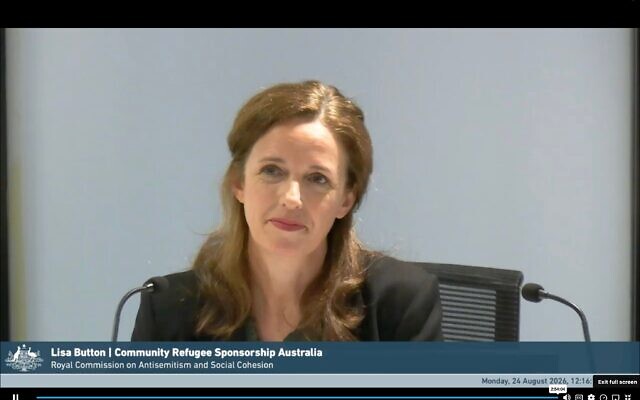
Lisa Button, CEO Community Refugee Sponsorship Australia. Photo: Screenshot

“This model appeals to a lot of different people for a lot of different reasons.”

She acknowledged the approach carried difficulties as well as benefits, describing it as an essential part of the work but also at times among the harder aspects of it.

Volunteers come to the program through about 30 supporting community organisations, which Button said often produce ready-made groups drawn from faith organisations, service clubs, advocacy groups or simply friends and neighbours. Individuals who approach the organisation on their own are helped to find a group to join.

Button told the Commission that a national television program screened in July, which followed a group of Melbourne Jewish friends supporting a newly arrived Somali Muslim mother and son, had a marked effect on interest in the model.

“We saw a sevenfold increase in the number of people registering to attend our public information sessions, which was very welcome indeed,” she said.

She said the country needed more storytelling of that kind.

“We need to see the humans behind the statistics and the politics. Most people, in my experience, are good people. When you put them in a room together, they’ll find ways to get along.”

Asked whether the program counters polarisation by disrupting simplistic narratives, Button said she believed so but could not point to hard evidence.

“We’re a small organisation, so I can’t offer you specific data on that,” she said.

She told the Commission that refugees had been argued over in Australian politics for so long that people tended to reach for extremes when describing them, and that the stereotyping ran in both directions, with migrants also arriving holding assumptions about Australians that need to be tested against experience.

The volunteers take part in the Community Refugee Integration and Settlement Program, known as CRISP, which matches humanitarian entrants referred by the United Nations with groups of five or more local residents who commit to supporting them through their first 12 months in Australia.

Button said the pilot, which ran from May 2022 to 13 June this year, became a permanent part of Australia’s resettlement program on 1 July. It has supported around 915 refugees to arrive, with about 180 community supporter groups involving more than 1600 individuals.

An independent evaluation by the University of Queensland, commissioned by the Department of Home Affairs, benchmarked the program against the long-running Humanitarian Settlement Program and found it met or exceeded those benchmarks on most measures. Newcomers reported a high sense of belonging and a high ability to make friends outside their own cultural community.

The Commission has heard from a number of witnesses in recent weeks that social cohesion depends on sustained and meaningful relationships rather than symbolic gestures. Button said most groups spend more than 10 hours a week with the household they support, particularly in the early months, and that only a very small number had not seen the year out.

“It’s not a performative thing. It’s not a symbolic thing. It’s a very deep and practical thing.”

She said five babies born to newcomer families had been named after members of their supporter groups.

Lord Mayor urges DFAT to hear community on foreign policy

Melbourne Lord Mayor Nicholas Reece has told the Royal Commission into Antisemitism and Social Cohesion that the Department of Foreign Affairs and Trade should take on a role hearing community views on international conflicts, so that town halls are no longer the default venue.

Reece was speaking about the council meeting of 20 February 2024, when he was acting Lord Mayor and a motion titled “Reflecting Community Sentiment on the Humanitarian Crisis in Gaza” came before the chamber.

“It’s a council meeting I will never forget,” he said.

More than 1000 people gathered at the front of the town hall, a large screen was set up outside and protesters banged on the doors. Reece said it was loud and confronting for the city, and confusing for members of the public who had come to speak for and against the motion. The debate ran for five hours.

He questioned whether that was the best use of local government.

“Is that the best use of local government spending five hours debating a complex geopolitical conflict on the other side of the world, where the decision that’s made in that council chamber will be of no consequence to that conflict,” he said.

Reece said councils lacked the machinery to form a judgement on such matters.

“We don’t have a Department of Foreign Affairs in local government either, and so our ability to actually form a judgement and get advice on something like that is limited as well.”

He said local government still had a role in international engagement, citing sister city relationships, cultural visits, international students, university connections, events and trade missions, but that complex geopolitical conflicts sat outside that remit.

Reece told the Commission that DFAT had run community forums around Australia through the Ausaid programme about 10 or 12 years ago, and that Melbourne Town Hall had hosted one of them before the programme ceased.

He said he had been reflecting on whether Australian town halls were being targeted by people moving motions on Middle East conflicts because no other forum was available to them.

“I’m certainly not here today saying councils should never be able to hear community debate on these things,” he said.

“Every government, every department, every agency, it seems these days, is required to engage in community consultation, hear what the community thinks about their policies and programmes. Maybe it’s time for DFAT to take on a function in that area, like they once did.”

Melbourne removes 4000 square metres of antisemitic material

The City of Melbourne has removed close to 4000 square metres of antisemitic graffiti, posters and stickers over about two years, Lord Mayor Nicholas Reece has told the Royal Commission into Antisemitism and Social Cohesion.

Reece said the council had removed more than 3000 offensive graffiti materials in that period, of which he estimated between 800 and 1000 were antisemitic.

The removals are carried out under a zero-tolerance rapid response policy introduced as part of the council’s cleaning contracts, with a target of one hour from the time material is reported. The service operates 24 hours a day, seven days a week, and reports can be made through the council website, its call centre or the Snap Send Solve app, which allows a photograph to be attached and the content flagged as offensive.

Reece said the policy was one of the things he was most proud of as Lord Mayor.

“We won’t stand for racist, hateful, antisemitic materials on our streets,” he said.

Asked by counsel assisting the Royal Commission what proportion of material was actually removed within the hour, Reece said it was “a substantial percentage” and that the council was always striving to do better.

He pointed to an incident in January 2026, when more than 40 large posters of the Bondi terrorist captioned “Aussie” appeared across the city overnight on a Friday, on major roads into the city, in laneways and on buildings.

“We had some of them down within an hour. Spent the whole weekend scouring the city. We got them all down. By Monday, they were all gone in the city of Melbourne.”

Reece said the same posters remained up more than a week later across greater Melbourne.

“They just didn’t have the policy framework in place and didn’t have the resources to deliver on what we were able to do in the city of Melbourne,” he said, adding that he did not say so to denigrate other councils.

He said synagogues had been targeted almost weekly for almost two years, and that people had told him they were afraid to come into the city.

“If they’re in an urban environment where they’re seeing hateful things written on walls, then that is a very threatening thing. Indeed, it’s a menacing thing for people in the community.”

Where material appears on private property, the council has no automatic right of removal, but Reece said standing cleaning agreements with VicRoads, Yarra Trams and Metro allowed immediate action on their assets, and the council holds contact details for private property owners across the city.

The council is now working with the M9 group of inner-city mayors to extend the one-hour standard beyond its boundaries. Reece said there was complete buy-in from the other mayors and that the only obstacle was cost.

He recommended the Commission consider a Commonwealth or state funding programme to help councils that want to adopt the policy, targeted at areas most likely to be attacked.

Lord mayor asks why Israeli restaurant was targeted and Russian ones are not

Melbourne lord mayor Nicholas Reece has questioned why an Israeli restaurant in the city was overrun by a mob when restaurants of other nationalities caught up in geopolitical conflicts are not.

Reece told the Royal Commission on Antisemitism and Social Cohesion on Monday morning that Miznon had been targeted because it was an Israeli restaurant serving Middle Eastern food. “I know people have strong feelings about the conflict in the Middle East. That’s perfectly human, but equally, I’m unaware of a restaurant serving Russian cuisine being targeted by people who are upset about what’s happening in Ukraine,” he said.

“So I think one of the questions that this Royal Commission should reflect upon is why does an Israeli restaurant get targeted, overrun by an angry mob because of concerns about a conflict, whereas a Russian restaurant … is not.”

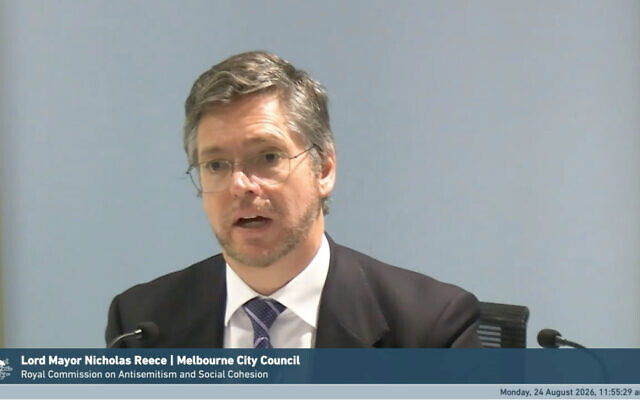
Melbourne lord mayor Nicholas Reece.

Reece told counsel assisting Zelie Heger he was in the city with his wife on the evening of the arson attack on the East Melbourne Synagogue when a friend from the congregation called, and the pair rushed to the shule. “It was one of the most upsetting scenes I’ve ever seen, and I do see a bit in my job,” he said. “It was Shabbat dinner, there were children, families out on the street … the area was being taped off because it was a crime scene.

“This is not the Melbourne that I have lived in for most of my life. To have people in their place of worship, sharing a community meal, to be subject to an arson attack and turn into a crime scene, is terrifying, and should be absolutely unacceptable in a city like Melbourne and in a country like Australia.”

Reece said Melbourne had the largest Jewish community of any Australian city and that it had been part of the city’s DNA since its earliest days. He said he had seen significant change since 2023, describing a fraying of cohesion largely affecting the Jewish community but extending more broadly, and called it one of the most challenging issues he had faced as lord mayor. Antisemitism, he said, was “the most venal form of racism”.

Reece said local government had an enormous role as the level of government closest to the people. The city holds a major Chanukah celebration in Federation Square and an Eid celebration at the end of Ramadan in Flagstaff Gardens. Security had been required at some events in recent times, he said, though he was pleased it had not been called upon.

The city has introduced community safety officers who can attend such events, and has at times engaged private security. But Reece said most councils were extremely resource constrained.

“If we do want to see more celebration of faith events, social multicultural events, and we feel that we need to have a strategic safety presence as part of them, well then that might be something that requires some funding support,” he said, pointing to a recommendation in his statement for further Commonwealth support.

The AJN is providing rolling coverage on the Royal Commission on Antisemitism and Social Cohesion.

For full coverage of the Hearing Blocks, visit the Royal Commission section of The AJN website.

read more:
comments
Live Now

Refugee program keeps politics out of volunteer base

An organisation matching Australian volunteers with newly arrived refugee families has told the Royal Commission into Antisemitism and Social Cohesion that it deliberately keeps political division out of its work, and that its supporters span the full range of Australian opinion.

Community Refugee Sponsorship Australia chief executive Lisa Button said the model had attracted socially conservative faith groups, progressive political groups and LGBTI activists, alongside people who did not see themselves as political at all.

“We’re trying to depoliticise this space, not import political divisions into the work,” she said.

Button said anyone willing to welcome refugees and treat others with respect was welcome, and that the organisation had made a point of embracing that breadth.

Lisa Button, CEO Community Refugee Sponsorship Australia. Photo: Screenshot

“This model appeals to a lot of different people for a lot of different reasons.”

She acknowledged the approach carried difficulties as well as benefits, describing it as an essential part of the work but also at times among the harder aspects of it.

Volunteers come to the program through about 30 supporting community organisations, which Button said often produce ready-made groups drawn from faith organisations, service clubs, advocacy groups or simply friends and neighbours. Individuals who approach the organisation on their own are helped to find a group to join.

Button told the Commission that a national television program screened in July, which followed a group of Melbourne Jewish friends supporting a newly arrived Somali Muslim mother and son, had a marked effect on interest in the model.

“We saw a sevenfold increase in the number of people registering to attend our public information sessions, which was very welcome indeed,” she said.

She said the country needed more storytelling of that kind.

“We need to see the humans behind the statistics and the politics. Most people, in my experience, are good people. When you put them in a room together, they’ll find ways to get along.”

Asked whether the program counters polarisation by disrupting simplistic narratives, Button said she believed so but could not point to hard evidence.

“We’re a small organisation, so I can’t offer you specific data on that,” she said.

She told the Commission that refugees had been argued over in Australian politics for so long that people tended to reach for extremes when describing them, and that the stereotyping ran in both directions, with migrants also arriving holding assumptions about Australians that need to be tested against experience.

The volunteers take part in the Community Refugee Integration and Settlement Program, known as CRISP, which matches humanitarian entrants referred by the United Nations with groups of five or more local residents who commit to supporting them through their first 12 months in Australia.

Button said the pilot, which ran from May 2022 to 13 June this year, became a permanent part of Australia’s resettlement program on 1 July. It has supported around 915 refugees to arrive, with about 180 community supporter groups involving more than 1600 individuals.

An independent evaluation by the University of Queensland, commissioned by the Department of Home Affairs, benchmarked the program against the long-running Humanitarian Settlement Program and found it met or exceeded those benchmarks on most measures. Newcomers reported a high sense of belonging and a high ability to make friends outside their own cultural community.

The Commission has heard from a number of witnesses in recent weeks that social cohesion depends on sustained and meaningful relationships rather than symbolic gestures. Button said most groups spend more than 10 hours a week with the household they support, particularly in the early months, and that only a very small number had not seen the year out.

“It’s not a performative thing. It’s not a symbolic thing. It’s a very deep and practical thing.”

She said five babies born to newcomer families had been named after members of their supporter groups.

Enjoy Unlimited Access To The Australian Jewish News Website And All Our Online Content For AUD$18/month Or Just AUD$120/year.

Subscribe Now