Live Now

Local government, multicultural and community leaders appear

Hearing Block 9 continues continues today focusing on strengthening social cohesion, including how it is understood and measured.

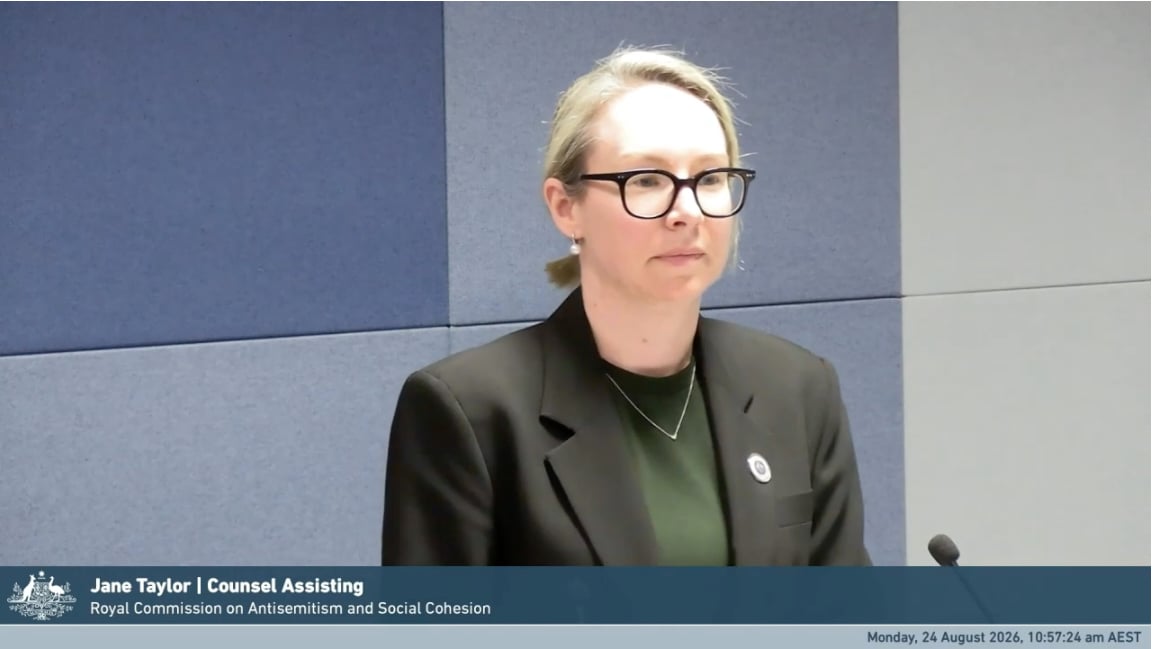
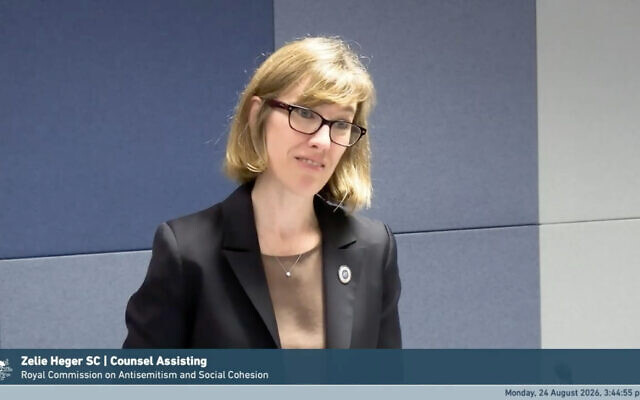
Counsel Assisting Jane Taylor.

Lord mayor asks why Israeli restaurant was targeted and Russian ones are not

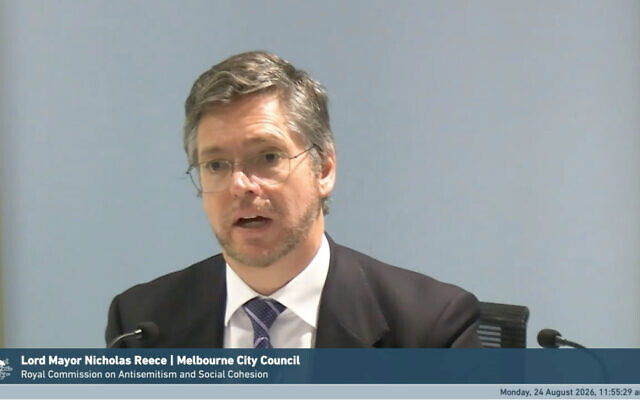
Melbourne lord mayor Nicholas Reece has questioned why an Israeli restaurant in the city was overrun by a mob when restaurants of other nationalities caught up in geopolitical conflicts are not.

Reece told the Royal Commission on Antisemitism and Social Cohesion on Monday morning that Miznon had been targeted because it was an Israeli restaurant serving Middle Eastern food. “I know people have strong feelings about the conflict in the Middle East. That’s perfectly human, but equally, I’m unaware of a restaurant serving Russian cuisine being targeted by people who are upset about what’s happening in Ukraine,” he said.

“So I think one of the questions that this Royal Commission should reflect upon is why does an Israeli restaurant get targeted, overrun by an angry mob because of concerns about a conflict, whereas a Russian restaurant … is not.”

Melbourne lord mayor Nicholas Reece.

Reece told counsel assisting Zelie Heger he was in the city with his wife on the evening of the arson attack on the East Melbourne Synagogue when a friend from the congregation called, and the pair rushed to the shule. “It was one of the most upsetting scenes I’ve ever seen, and I do see a bit in my job,” he said. “It was Shabbat dinner, there were children, families out on the street … the area was being taped off because it was a crime scene.

“This is not the Melbourne that I have lived in for most of my life. To have people in their place of worship, sharing a community meal, to be subject to an arson attack and turn into a crime scene, is terrifying, and should be absolutely unacceptable in a city like Melbourne and in a country like Australia.”

Reece said Melbourne had the largest Jewish community of any Australian city and that it had been part of the city’s DNA since its earliest days. He said he had seen significant change since 2023, describing a fraying of cohesion largely affecting the Jewish community but extending more broadly, and called it one of the most challenging issues he had faced as lord mayor. Antisemitism, he said, was “the most venal form of racism”.

Reece said local government had an enormous role as the level of government closest to the people. The city holds a major Chanukah celebration in Federation Square and an Eid celebration at the end of Ramadan in Flagstaff Gardens. Security had been required at some events in recent times, he said, though he was pleased it had not been called upon.

The city has introduced community safety officers who can attend such events, and has at times engaged private security. But Reece said most councils were extremely resource constrained.

“If we do want to see more celebration of faith events, social multicultural events, and we feel that we need to have a strategic safety presence as part of them, well then that might be something that requires some funding support,” he said, pointing to a recommendation in his statement for further Commonwealth support.

‘Middle Australia hadn’t listened’: Rotary club’s post-Bondi program

A Melbourne Rotary club president has told the Royal Commission on Antisemitism and Social Cohesion he felt he had let his members down after the Bondi attack, prompting him to build a social cohesion program now being taken up across Victoria.

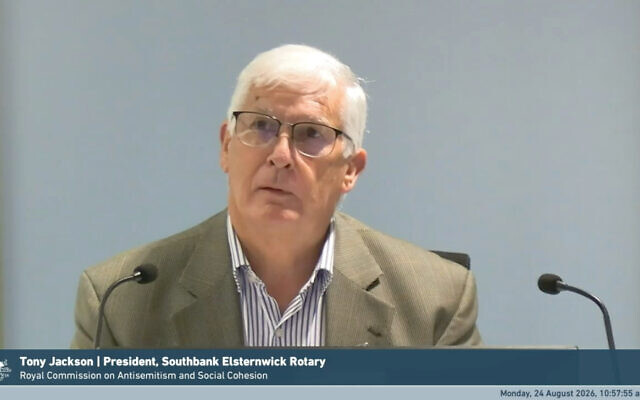
Southbank Elsternwick Rotary Club president Tony Jackson said about half the club’s 23 members were Jewish, most living in the Glen Eira council area, and that he had heard in ordinary conversation how frightened they were about what was happening in the community.

“When Bondi happened, I felt like we’d let down the club, the members of the club,” he said. “I felt like I hadn’t listened. I felt like that middle Australia hadn’t listened.”

Southbank Elsternwick Rotary Club president Tony Jackson.

He wrote to members expressing his support, then approached Glen Eira mayor Simone Zmood, who responded within 10 minutes and connected him with facilitators Collaborative Thinking Experiences. Jackson said building the program around social cohesion rather than antisemitism was deliberate, because the council was already running antisemitism programs and because one community being attacked meant others were too.

The pilot involved three workshops with about 45 participants, among them school principals, heads of not-for-profit organisations, neighbourhood house chief executives and, in large numbers, sporting club presidents. Jackson said he cold-called around 30 leaders and found Rotary’s standing opened doors.

“People said, well, if Rotary’s doing it, one, we trust Rotary to do this well, and secondly, this is really important,” he said.

The workshops use a process in which only one person speaks at a time for 30 seconds before a bell sounds, so participants spend most of the session listening. Leaders define social cohesion for themselves, discuss what they can do in their own organisations, then sign off on a plan. Jackson said security came up repeatedly in those definitions, as did fun, unexpectedly often.

“Everybody feels angry out there, they’re bumping into anger … so what’s missing is laughter and fun,” he said, adding that social cohesion was ultimately about what people share. “We need to be really, really careful when we are celebrating diversity that we don’t lose the commonality.”

He said the first workshop deliberately steered away from ethnic or religious groups to avoid it devolving into argument, but that Jewish community groups were invited to the third, which he described as powerful. One secondary school principal whose students speak about 70 languages has since begun training teachers in the same listening skills.

Jackson has presented the program to Rotary district presidents, about 10 of whom are interested in rolling it out across western Melbourne and Bendigo, and has secured district foundation funding. With more than 1000 clubs nationally, he said reaching even 200 could generate thousands of local plans.

He described it as a quiet revolution. “Nobody will notice this. There will be no big government announcement … This will be local community working on local community problems.”

Commissioner Virginia Bell told Jackson it was very heartening to hear his evidence.

Port Phillip mayor: Jewish residents are “hiding visual artefacts” out of fear

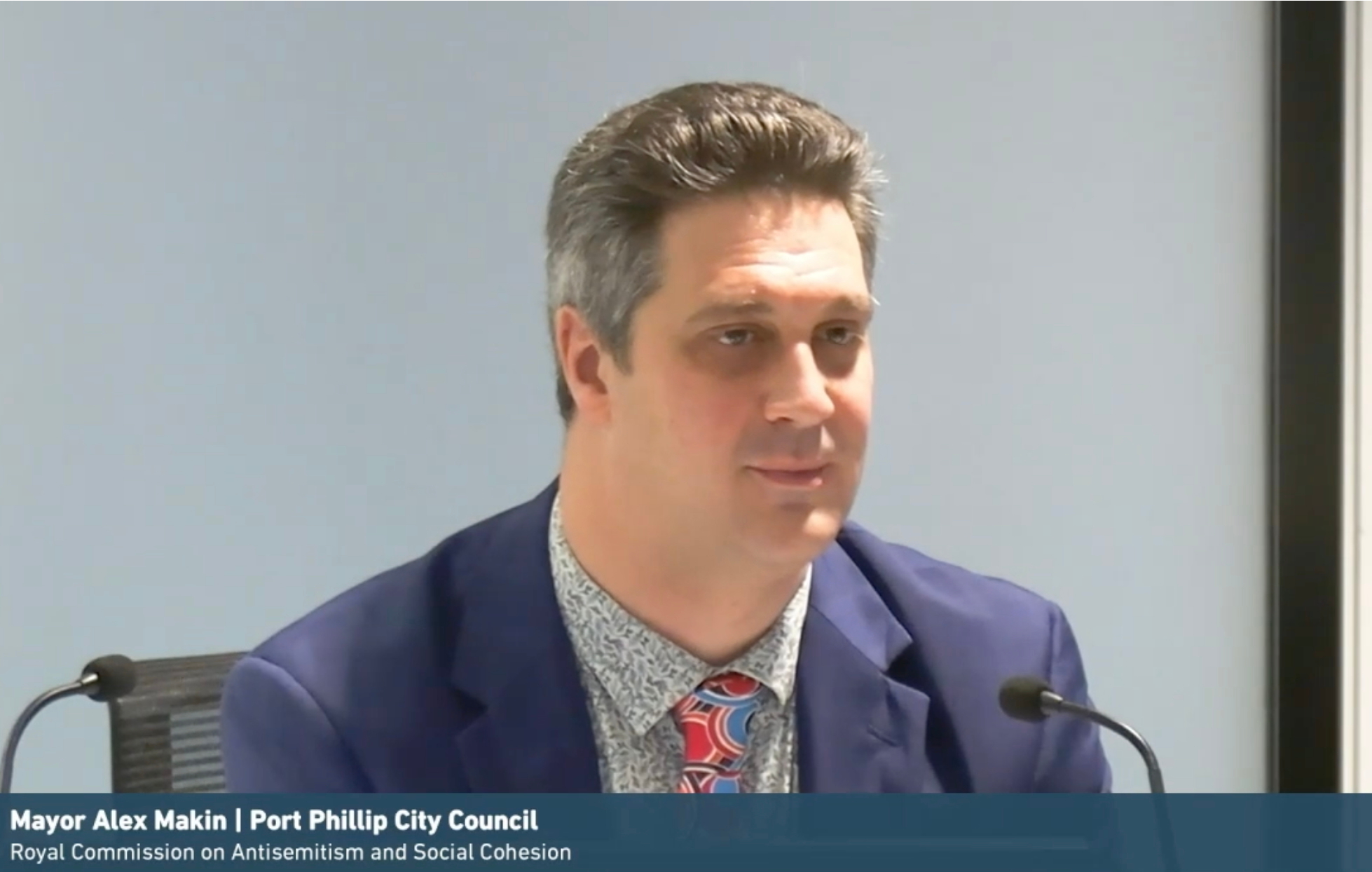
Alex Makin, Mayor of the City of Port Phillip in Melbourne’s inner south, told the Royal Commission this morning that members of the local Jewish community have described concealing items that identify their faith, due to rising anxiety about safety.

Asked what he had been hearing from Port Phillip’s Jewish community as a councillor and then as the mayor since November 2025, Makin said consultations for the council’s multicultural strategy and its Ripponlea place plan had revealed “an increased level of anxiety and concern around safety, and a feeling of being excluded, to the point where a number of members of the Jewish community will talk about hiding visual artefacts that identify their following of Judaism.”

He confirmed the Adass Israel Synagogue, firebombed in late 2024, sits within the municipality, noting the council had also since had to respond to the Bondi Chanukah terror attack in December 2025.

Makin argued that local government occupies a unique position in the system, describing councils as “the closest form of government to communities” and “the nexus between government policy and the outreach into community.”

He said local government should be treated as an integral partner by the commission, and by federal policymakers seeking to strengthen social cohesion.

On the council’s response to the Adass Israel firebombing, Makin described symbolic leadership from the then-mayor and ward councillor attending the scene, a dedicated liaison officer appointed to support the community, and a vigil held the day after the attack.

He said this demonstrated “how rapidly local government can respond,” pointing to councils’ emergency management function and their ability to draw on pre-existing trusted relationships within communities.
Turning to the aftermath of the Bondi attack, Makin gave evidence about coordinating a joint statement of solidarity, first between Port Phillip and neighbouring Glen Eira City Council — the two municipalities with the highest proportion of Jewish residents in Australia — before expanding it to a Victoria-wide statement.

He said 85 per cent of the state’s 79 councils signed on within three days. Counsel Assisting read into the record the statement’s closing lines: “To our Jewish community, we say we see you, we stand with you. This is your home, and you should not feel afraid.”

Makin said feedback from the Jewish community was “exemplary,” and noted some of the earliest signatories were regional councils with negligible Jewish populations, which he said reflected “the need for humanity.”

The commission also heard about Port Phillip’s multicultural strategy for 2026–2031, developed through co-design workshops including with the Jewish community.

Makin said consultation had uncovered a “startling” finding: primary school-aged Jewish children raising safety concerns, something he contrasted with his own carefree childhood at that age.

On funding accountability, Mr Makin said the council has embedded the Victorian government’s value statement on social cohesion into its grants and funding frameworks, covering roughly $250,000 in dedicated social cohesion funding.

Organisations that fail to commit to inclusion could face cultural training requirements or, in repeated cases, loss of funding.

Pressed by Commissioner Virginia Bell on whether refusing to include a Jewish musician in a funded program would justify withdrawing funds, Makin agreed that would “certainly give us recourse to act appropriately.”

The council has also introduced a dedicated Jewish cultural immersion program for staff, alongside similar training on LGBTQI+ communities.

Makin cited the “Ask the Rabbi” stall at the St Kilda Festival — an event attracting 350,000 visitors — as a practical initiative fostering human connection, noting its exact location could not be publicised due to security concerns.

On graffiti, Makin confirmed council received 3,273 removal requests in the year to 31 March 2026, of which 565 were racist, antisemitic, sexually offensive or otherwise hate-motivated – a figure he said was rising.

Public property is typically cleared within four hours, though private property removal depends on landowner consent.

Makin called for a nationally consistent data framework linking local government, police and community reporting, and for direct Commonwealth funding empowering councils on social cohesion, warning Australia too often “recreates the model” each time a new crisis emerges, rather than building durable systems.

Sydwest Multicultural Services CEO: “if one community hurts, really the whole of the Australian society hurts.”

The Royal Commission on Antisemitism and Social Cohesion heard evidence this morning from Elfa Moraitakis, chief executive officer of Sydwest Multicultural Services, who told the commission that Western Sydney communities felt “used as scapegoats” in political debate following the Bondi attack.

Responding to a question from Commissioner Virginia Bell about the source of division and distrust that emerged after the attack, Ms Moraitakis said the resulting unease was new.

“I think that, post-Bondi, unfortunately, specific communities were used as scapegoats, and they were used as part of the political debate, and this made people very uncomfortable,” Moraitakis said.

She described people going about daily life while deliberately avoiding conversations about the attack, not wanting to be drawn into public discussion.

And she emphasised that the harm could not be viewed as belonging to one community alone: “we could not see the attack to the Jewish community separate from any other community,” adding that “if one community hurts, really the whole of the Australian society hurts.”

Pressed by Commissioner Bell on the widely publicised street celebrations in Lakemba on the night of 7 October 2023, following the Hamas attack on Israel, Moraitakis said communities themselves reject division.

She told the commission that people “want to feel that they integrate in Australian society” and want a sense of equality without discrimination between communities.

On opportunities to strengthen social cohesion identified through Sydwest’s monthly community leaders’ forum, Moraitakis said the priority should be reaching people outside of existing conversations.

“We should stop talking to the already converted,” she said, arguing that genuine progress on belonging happens in workplaces, schools and playgrounds, and depends on tighter partnerships between organisations, such as Sydwest and local councils.

She also gave evidence on the Think Social Cohesion Summit held in Parramatta last month, which Sydwest co-convened. Its aim, she said, was to bring together researchers, community leaders, academics, government and politicians not simply to name problems, but to clarify institutional responsibility, and produce a roadmap to inform future policy. That work remains ongoing.

Turning to Sydwest’s formal recommendations to the commission, Moraitakis called for full implementation of the multicultural framework review and the National Anti-Racism Framework, saying this would deliver critical data, clearer reporting standards and greater transparency.

She flagged digital platforms as a particular concern, noting young people increasingly source information — including misinformation — online.

She also nominated “low-hanging fruit” such as embedding anti-racism education in schools alongside teaching on multiculturalism and First Nations history, as things that could be done sooner.

Moraitakis closed by calling for a new national narrative that frames diversity as a strength rather than a deficit, arguing this shift in language needs to be embedded across institutions and all levels of government, rather than treated as a mere feel-good sentiment.

The AJN is providing rolling coverage on the Royal Commission on Antisemitism and Social Cohesion.

For full coverage of the Hearing Blocks, visit the Royal Commission section of The AJN website.

read more:
comments
Live Now

Sydwest Multicultural Services CEO: “if one community hurts, really the whole of the Australian society hurts.”

The Royal Commission on Antisemitism and Social Cohesion heard evidence this morning from Elfa Moraitakis, chief executive officer of Sydwest Multicultural Services, who told the commission that Western Sydney communities felt “used as scapegoats” in political debate following the Bondi attack.

Responding to a question from Commissioner Virginia Bell about the source of division and distrust that emerged after the attack, Ms Moraitakis said the resulting unease was new.

“I think that, post-Bondi, unfortunately, specific communities were used as scapegoats, and they were used as part of the political debate, and this made people very uncomfortable,” Moraitakis said.

She described people going about daily life while deliberately avoiding conversations about the attack, not wanting to be drawn into public discussion.

And she emphasised that the harm could not be viewed as belonging to one community alone: “we could not see the attack to the Jewish community separate from any other community,” adding that “if one community hurts, really the whole of the Australian society hurts.”

Pressed by Commissioner Bell on the widely publicised street celebrations in Lakemba on the night of 7 October 2023, following the Hamas attack on Israel, Moraitakis said communities themselves reject division.

She told the commission that people “want to feel that they integrate in Australian society” and want a sense of equality without discrimination between communities.

On opportunities to strengthen social cohesion identified through Sydwest’s monthly community leaders’ forum, Moraitakis said the priority should be reaching people outside of existing conversations.

“We should stop talking to the already converted,” she said, arguing that genuine progress on belonging happens in workplaces, schools and playgrounds, and depends on tighter partnerships between organisations, such as Sydwest and local councils.

She also gave evidence on the Think Social Cohesion Summit held in Parramatta last month, which Sydwest co-convened. Its aim, she said, was to bring together researchers, community leaders, academics, government and politicians not simply to name problems, but to clarify institutional responsibility, and produce a roadmap to inform future policy. That work remains ongoing.

Turning to Sydwest’s formal recommendations to the commission, Moraitakis called for full implementation of the multicultural framework review and the National Anti-Racism Framework, saying this would deliver critical data, clearer reporting standards and greater transparency.

She flagged digital platforms as a particular concern, noting young people increasingly source information — including misinformation — online.

She also nominated “low-hanging fruit” such as embedding anti-racism education in schools alongside teaching on multiculturalism and First Nations history, as things that could be done sooner.

Moraitakis closed by calling for a new national narrative that frames diversity as a strength rather than a deficit, arguing this shift in language needs to be embedded across institutions and all levels of government, rather than treated as a mere feel-good sentiment.

Enjoy Unlimited Access To The Australian Jewish News Website And All Our Online Content For AUD$18/month Or Just AUD$120/year.

Subscribe Now