



Live updatesPublic hearings
Royal Commission: police queried over security concerns
Hearing block two continues today examining the circumstances surrounding the attack at Bondi on 14 December 2025.
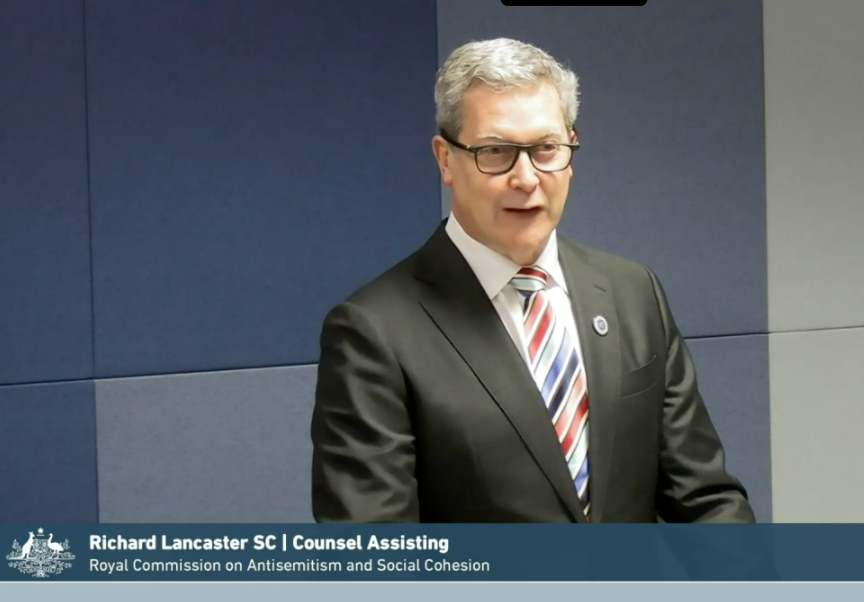
Photo: screenshot
Royal Commissioner Virginia Bell on the antisemitism being directed towards witnesses
Witness ABQ, Superintendent Commander of the East and South Police Area Command (PAC) NSWPF on communication with NSW Police prior to December 14, 2025
Witness ABQ, Superintendent Commander of the East and South Police Area Command (PAC) NSWPF on police resourcing on December 14, 2025
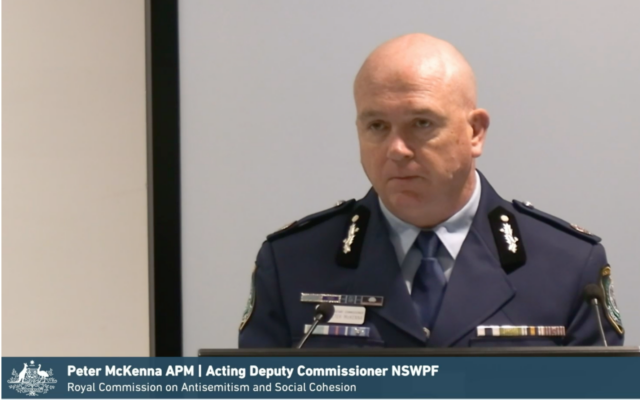
Peter McKenna, NSW Police Force acting deputy commissioner and commander of the Central Metropolitan Region on the “real and tangible threat”
Peter McKenna, NSW Police Force acting deputy commissioner and commander of the Central Metropolitan Region on risk assessment guidelines for community events
Assistant Commissioner Scott Cook on NSW Police consultations with ASIO
NSW Police had only one consultation with ASIO before the national terrorism threat level was raised from “possible” to “probable” in August 2024, the Royal Commission has heard.
Assistant Commissioner Scott Cook told the commission on Tuesday the only consultation before the level was raised was a video conference on August 1, 2024, with no subsequent consultation or briefing after the threat level was raised on August 5.
Asked whether NSW Police requested further meetings with ASIO to understand the reasons for the change, Cook said: “Not that I’m aware of.”
He said he was “certain that we would agree with the level that was articulated in the threat assessment we were provided with” and did not regard further consultation as required.
Asked whether there should have been greater consultation, Cook said: “The raising of the level is entirely a matter for ASIO. If ASIO was of a mind to engage in further consultation, we would absolutely be part of that, but it’s a matter for ASIO.”
He agreed it would be “absolutely beneficial” for NSW Police to get a briefing as far in advance as possible.
Cook also gave evidence about the firearms registry, revealing NSW Police removed the intelligence analyst position in 2021 following a business review that found the role “under-utilised”, but reinstated it in 2023.
A person was only appointed to fill the reinstated position last year.
Cook, who commanded the Police Prosecutions and Licensing Enforcement Command from 2019 to 2022, said the position primarily handled about four or five commissioner’s delegations on licence refusals and revocations per year, with other work being “ad hoc advice” to firearms registry staff.
When a lawyer asked whether this ad hoc work was useful, Cook replied: “Absolutely, it’s useful. It’s just not structured and organised.”
Cook said removing the position was offset by establishing the Chimaera Intelligence System for adjudicators, providing basic intelligence training for all registry staff, and having the state intelligence command support intelligence-based decisions.
Asked whether he received feedback in 2021 raising concerns about removing the position, Cook said: “That’s true.”
He agreed it was important for the firearms registry to have “an embedded intelligence capacity” but said: “It was never the intent that it was a final complete around the structure of the registry.”
Cook also provided evidence about the emergency response to the December 14, 2025 Bondi Beach terrorist attack.
Four general duties officers from the Eastern Suburbs Police Area Command were at Archer Park when the shooting began. Within 29 seconds, 11 people were shot, 10 fatally. The attack was reported almost immediately at 18:42:44.
Within four minutes and 55 seconds, one shooter was fatally shot by police. The second shooter was shot and apprehended at seven minutes and 41 seconds. At that time, 11 NSW Police officers were at the scene. Three police officers were injured during the attack.
Cook said the ongoing critical incident investigation has identified two issues that impacted officers’ ability to respond: the need for police to have access to long-arm weapons, which offer higher accuracy, range and power than standard firearms, and the need to review active armed defender training.
“The gunfire differential ratio between police firearms and long arms was clearly identified as one of the items that we need to address, and is being addressed,” he said.
The commission heard NSW Police is establishing a 250-person Armed Response Command (ARC) that will eventually replace Operation Shelter, with all officers carrying long arms.
NSW Police had no published guidelines or policy documents to assist local commanders in carrying out risk assessments for community events before the December 14, 2025 Bondi Beach terrorist attack, the Royal Commission has heard.
Assistant Commissioner Peter McKenna, commander of the Central Metropolitan Region, acknowledged on Tuesday that the absence of standardised procedures left “quite a large area of discretion to the particular operations inspector”.
McKenna told the commission he had not seen any documented risk assessment for the 2025 Chanukah events, including the Bondi celebration where 15 people were killed.
“Obviously, that is a significant difference, saying no risk assessment to saying no documented risk assessment,” McKenna said. “I would agree that I’ve not seen any documented risk assessment.”
Asked whether the Eastern Suburbs Police Area Command operations inspector had access to guidelines or policy documents for carrying out risk assessments, McKenna said it would be done “by experience for sure”.
Counsel assisting Richard Lancaster SC suggested “the surest way to make sure that nothing is overlooked, or at least one way to reduce the possibility that things are overlooked, is to have some sort of guideline or process in place for the way those risk assessments are carried out, even for local community events”.
“I wouldn’t argue with that, and I wouldn’t sit here and say that best practice is not to do formal risk assessments,” McKenna replied. “But we can’t do them for every event — we would be tied up doing paperwork for things that we can’t possibly achieve.”
McKenna said NSW Police uses “a varying range of risk assessments for different things, all probably fit for purpose, but yet we would like to move to a more sustained model”.
He is now running a project in the Central Metropolitan Region using one model risk assessment for every event. “That project is running through April and May. At the end of that, we will look to work out if there are any impediments that need to be fixed, and my hope is that we can roll out a consistent risk assessment process across the organisation.”
McKenna said the decision on whether to conduct a formal risk assessment would depend on several factors, including whether the event had happened previously, what the outcomes were, the current threat environment, and whether there was any specific threat.
He explained that static police deployment had been used extensively after the attack despite not being standard practice.
“We’ve just come off the back of the most significant terrorist attack probably Australia has ever seen. Are we going to put static police there? Absolutely, we are. If that’s going to make the community feel safe and reassured, we will work with them and do that.”
McKenna described how Operation Shelter was rationalised on February 10, 2026, reducing staff from 234 to 150 while improving effectiveness through a model developed in conjunction with CSG and community leaders.
“Since that model has come into place, we’ve doubled our taskings, we’ve actually identified a lot more people who are coming into that area who may be intent on criminal offending,” he said.
The commission heard that before December 14, 2025, deploying officers with long arms required approval at deputy commissioner level to carry them in vehicles, and commissioner level to have them outside vehicles.
Asked whether it was open to a local commander to request such deployment before the attack, McKenna replied: “Certainly, it could. It is my understanding and experience that it is very unlikely that would have been approved.”
NSW Police Force acting deputy commissioner and commander of the Central Metropolitan Region, Peter McKenna, told the Royal Commission that Australia had entered a new security environment for the Jewish community following the Chanukah by the Sea terror attack on December 14, 2025.
“Australia has, unfortunately, now moved to other Jewish communities around the world who have been living at threat of real and tangible terrorist attacks. We’ve now joined them,” McKenna said, explaining that as a result, Operation Shelter moved to a 24/7 tempo.
“It has got a significant proactive arm,” McKenna said. “We’ve now moved into a position where we’re having, for the first time ever, long arms out in public. It’s a different environment we’re in now.”
McKenna said NSW Police was moving towards a “fully armed policing squad” — the armed response command — that would eventually take over from Operation Shelter, with all officers carrying long arms. He said this represented a shift from what he described as a “specific threat response basis” to a response based on the general threat environment.
He told the Commission that prior to December 14, 2025, police had relied heavily on specific intelligence before deploying additional resources, citing limited capacity across competing demands. “We rely so heavily because of our limited resources across competing demands for specific intelligence to work with,” McKenna said.
McKenna gave evidence about policing arrangements for the 2025 Chanukah celebrations in the Eastern Suburbs, confirming he had requested a briefing note from the Eastern Suburbs Police Area Command (PAC) about the events. He said the purpose was to keep the police executive informed of high-profile matters relating to the Jewish community following October 7, 2023.
The commission heard that the Community Security Group (CSG) had made two requests for dedicated police resources for the Hanukkah events, including the Bondi celebration, including an email requesting deployment of resources for the entirety of the event, and a subsequent verbal request by the CSG’s chief operating officer directly to the Eastern Suburbs PAC operations inspector. McKenna described the verbal request as a reaffirmation of the email rather than a second distinct request.
McKenna confirmed that in December 2025, Operation Shelter had scaled back to a protest-focused model and did not have a proactive arm oriented towards Jewish community events. He said that had the Eastern Suburbs PAC commander sought additional resources, the appropriate pathway would have been through his operations manager or directly to him.
He confirmed there was no documentary threat assessment produced by the Eastern Suburbs Command in respect of the 2025 Chanukah events, and that he had no discussions with the PAC commander after receiving the briefing note, as the commanders informed him that they had sufficient resources to manage the events in their areas.
McKenna told the commission that Jewish High Holy Days had been managed as tier three major events by the NSW Police major events group since approximately 2015. This means a coordinated approach between NSW Police and CSG, particularly regarding logistics, at the original request of the CSG. McKenna confirmed that he anticipates Chanukah will in future be managed under the same model.
“We will move to the same model that we use for the High Holy Days. But once again, I’m not saying that’s necessarily about the threat to the community, I’m saying that it is as much about reassurance to that community as anything else.”
When asked further about the finalised briefing note that was sent to the Region Commander’s staff officer on 11 December 2025 by email, Witness ABQ said she received no reply, which she described as consistent with common practice, and took that – when questioned by the Counsel Assisting – as indicating a level of comfort or endorsement with it.
ABQ was also taken to an email the Operations Inspector sent on the evening of 11 December to the two command inspectors rostered for 14 December, advising them to “take a car crew or two” and provide a high-visibility presence, adding there was “no need to stay the entire duration.”
Lancaster pressed ABQ on whether this language would have been understood by the recipients to mean the car crews, not just the inspectors, were free to leave. ABQ maintained the email was “poorly worded” and that, knowing her leadership team, she believed the expectation of a police presence for the full duration would have been understood.
She acknowledged she had only appreciated this ambiguity after 14 December.
The most substantive exchanges of the afternoon centred on whether the Chanukah by the Sea event at Bondi Beach had been appropriately categorised in the police escalation framework.
Lancaster asked ABQ whether, at the time in December 2025, she had given any conscious thought to whether a higher tier was appropriate, and whether she had raised this with the Operations Inspector.
ABQ replied she had not, adding: “we don’t really talk in tiers.”
Lancaster put to ABQ directly whether she accepted that treating the Bondi Chanukah event as a tier one community event “gave it a categorisation that was obviously too low.”
ABQ rejected this, saying the event had been planned on the basis of information available at the time: it was a local community event, and she had no specific intelligence of a direct threat.
Lancaster reminded her that ASIO had assessed the terrorism threat to crowded places and religious events over the 2025–26 holiday period as “probable,” and that the Bondi event had attracted approximately 1,000 people in a public place. He suggested the tier one categorisation “significantly understated the risk.”
ABQ maintained that resources were allocated as she believed “appropriate at the time”.
Asked in hindsight, whether it was a mistake to treat the event as tier one, ABQ said: “No, I don’t accept that it was a mistake, but in hindsight, knowing what I now know, absolutely events of this nature should be dealt with, similar to Jewish High Holy Days.”
She elaborated that she saw scope for a range of tiering options — tier one “plus”, two or three — depending on location and attendance numbers, as a collective of options for the future.
Lancaster then asked whether ABQ, as PAC commander, could have allocated police officers with long arms to the event. ABQ said “It’s not open to me.”
She explained that deployment of long arms in the community required approval at Deputy Commissioner level, and that the capability rested with the Public Order and Riot Squad or Tactical Operations. She confirmed that, since 14 December, police with long arms have been approved for some major events.
ABQ confirmed Strike Force Pearl — which she described as an investigative response to antisemitic incidents — had no involvement in planning for Chanukah 2025.
She also confirmed Operation Shelter had been de-escalated and was not available in December 2025.
Asked whether those kinds of resources would have been appropriate in hindsight, ABQ agreed: “Absolutely, Operation Shelter would be of assistance to those type of events.”
Superintendent Commander of the East and South Police Area Command (PAC) NSWPF, known as “ABQ”, provided evidence to the Royal Commission on Tuesday morning regarding police resourcing for the Chanukah by the Sea event on December 14, 2025. The Eastern Suburbs PAC includes the police stations of Waverley, Bondi, Rose Bay, and Paddington.
ABQ said decisions for police resourcing for the Chanukah events were made by the Operations Inspector. ABQ said in her statement she had agreed with the steps made by the Operations Inspector and “took no steps to intervene with it.”
Counsel Assisting Richard Lancaster asked, “Is it right that there is no requirement or practice in the eastern suburbs to prepare a document recording a risk assessment or a threat assessment for a community event?”, to which ABQ replied, “There’s no requirement… There are some mandated areas of policing that do require a risk assessment.”
Lancaster asked of the Operations Inspector was “provided with any document in the nature of a guideline that sets out the considerations to be taken into account when deciding on the allocation of police resources to a community event?” ABQ replied, “I don’t believe a guideline exists.”
Asked if the Operations Inspector is required to consult with anyone regarding risk assessment process for a community event, ABQ said it was “largely left to his discretion”.
ABQ said Operation Shelter had provided an overlay in police protection for the Jewish community in previous years since October 7 2023 amid increased antisemitism, but Operation Shelter was not active in December 2025.
Asked whether Operation Shelter had been disbanded, ABQ stated: “Not disbanded, it had escalated and reduced or de-escalated as the need. They’re probably not questions I can answer appropriately.”
ABQ attended the December 2025 Chanukah celebration at Bondi Beach earlier in the evening and then went to the Dover Heights.
Lancaster asked ABQ about an email sent to her from CSG on November 28, as well as the Operations Inspector, regarding “heightened risk”, with a specific request from CSG to seek assistance to ensure community safety.
CSG witness ABP gave evidence to the Commission that he called ABQ on December 8 prior to the Chanukah by the Sea event, and said although he doesn’t have a specific recollection of the call, he believes it’s likely he discussed a request for a static police presence to be provided at the Chanukah events. ABQ denied that security arrangements were discussed on the call.
Lancaster asked ABQ about an email from CSG on 8 December 2025 which ABQ said in her statement she read “part” of it. The email made a specific request for deployment of police resources for the entirety of the Chanukah by the Sea event. In relation to the full email ABQ stated, “I’ve certainly read it since December 14. I couldn’t confidently say I’d read it prior.”
Discussing the ASIO threat assessment dated December 2025 titled “Violent Protest and Terrorism Threat Assessment”, asked if she was aware of this document in early December 2025, ABQ replied, “Yes, I would have received it.” Lancaster noted it stated that the national terrorism threat level in Australia as “probable”, and the terrorism threat to crowded places and religious events over the 2025 to 2026 holiday period.
Lancaster asked about a second ASIO document issued in October 2025, titled “Manchester Synagogue Terrorist Attack Highlights Enduring Threat to Jewish interests”. ABQ said, “I have seen an email trail that I was sent the document… It was a worldwide event and created quite as expected a lot of fear and in community. Whilst I don’t particularly recall at the time reading the document, I was certainly very aware of the incident and its implications”.
Asked if she forwarded it to her senior leadership team ABQ said, “I don’t know that I forwarded it to anyone, as it was sent specifically to me… I think, because I was the Police Operations Commander at the time for Jewish High Holy Days… but I would have discussed it with the team at the time”.
Before commencing the days hearings on Tuesday morning, Royal Commissioner Virginia Bell condemned the antisemitism being directed towards witnesses in the Royal Commission hearings.
Commissioner Bell stated: “There is something I would like to say, and it concerns the harassment and intimidation to which members of the Jewish community who have given evidence before this commission have been subject… I should indicate that in one instance the matter has been referred to the Australian Federal Police for investigation.
“The Commission is keeping a close eye on these instances and recording these offensive social media posts. Quite what this undiluted level of hatred and bigotry directed towards members of the Jewish community is thought to benefit by those who post these remarks is lost on me, but the commission has, as one of its principal objects, understanding and assessing the lived experience of antisemitism by members of the Jewish community, and it is being informed by conduct of this character.”
The AJN is providing rolling coverage on the Royal Commission on Antisemitism and Social Cohesion.
Hearing block one, week one
Hearing block one, week two – Monday
Hearing block one, week two – Tuesday
Hearing block two, week one – Monday
comments